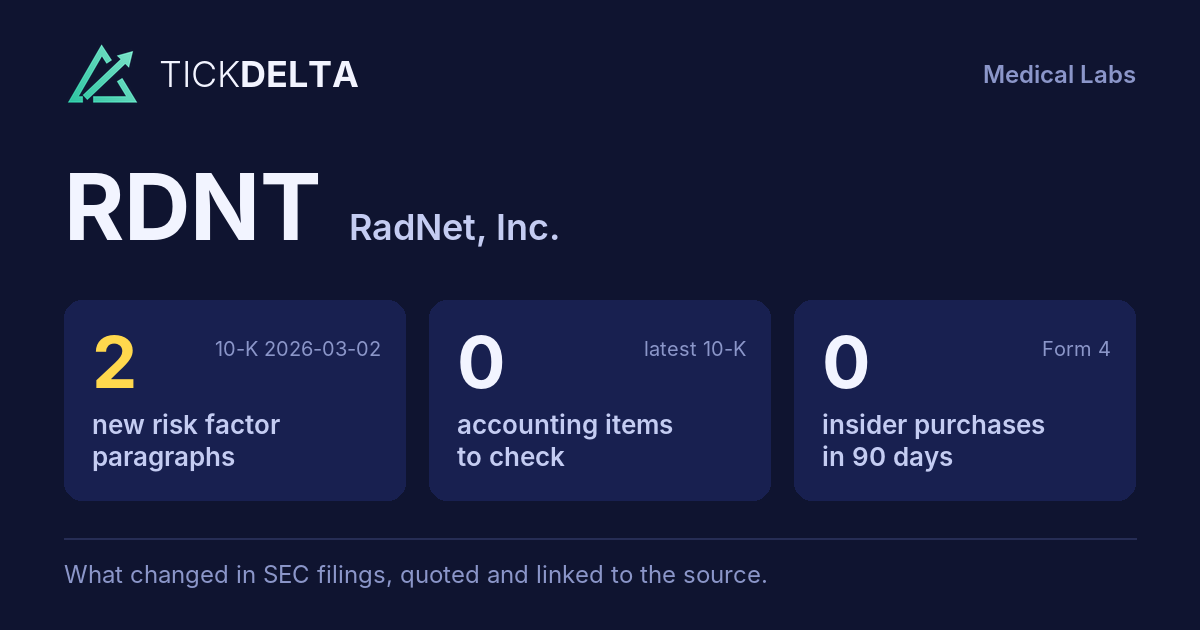
Screener / SEC EDGAR /CIK 0000790526 /10-K filed Mar 2, 2026, compared with Mar 3, 2025 /Numbers from the XBRL of the 10-Ks
Nasdaq Health care · Medical Labs

RadNet, Inc. RDNT

Compare with peers Embed
SEC comment letters, last 20 years

2 reviews of RDNT's filings by SEC staff

UPLOAD and CORRESP
Reviews 2 latest letter Dec 20, 2023
Questions asked 20 each answered in the company's own letter
No closing letter 0 reviews without a letter saying the staff completed it

When the SEC's staff reviews a filing, it writes to the company with numbered questions, and the company answers each one in a letter. SEC publishes the exchange once the review is over, at least 20 business days later. A question is not an accusation; most reviews end with the company adding detail to its next filing.

How the reviews went

Every review on EDGAR, from the first staff letter to the letter that closes it

  1. 1. Staff letters 3 UPLOAD
  2. 2. Questions in them 20 numbered comments
  3. 3. Company replies 4 CORRESP
  4. 4. Reviews closed 2 of 2 closing letter

Half the closed reviews took 59 days or less from the first letter to the closing letter.

Form 10-K

2023-12-20 to 2024-01-10 · 3 questions · 1 letter from the SEC, 1 from the company
Review closed 2024-01-10
Results discussion (MD&A)Liquidity and cashIncome taxesDerivatives and hedgingDebtNon-GAAP measures
Results of Operations, page 38
SEC asked (1)
Please expand your disclosure to identify the specific factors that caused the 2022 "Net income attributable to noncontrolling interests" to increase by 17% whereas both your operating income and pre-tax income decreased significantly. Similarly, it is not clear why the corresponding 2023 variances are similarly disproportionate.
Rest of the question

The expanded disclosure should identify the specific causal factors relevant to the period presented and not merely reference speculative factors that could impact the account balance. See Item 303(b) of Regulation S-K.

RDNT answered
The Company respectfully acknowledges the Staff’s comment and, in future filings, will provide additional disclosure if percentage changes in Net Income Attributable to Noncontrolling

Interests are significant. Our net income attributable to noncontrolling interests relates to the operations of non-wholly owned subsidiaries which represents only a portion of our business.
Rest of the answer

Further, it excludes our AI segment which generated losses of $25.8 million in 2022.

Given these factors, we do not expect net income attributable to noncontrolling interests to correlate with consolidated operating income or pretax income and are proposing to disclose the nature of the relationship as presented below. The following represents an example of the presentation and discussion that we propose to include in future filings, using 2022 versus 2021 for illustrative purposes:

Net income attributable to noncontrolling interests

At December 31, 2022, our consolidated subsidiaries included 318 centers of which 81 were not wholly-owned and thus a portion of their operating results were attributable to noncontrolling interests. At December 31, 2021, our consolidated subsidiaries included 323 centers of which 66 were not wholly-owned. As noncontrolling interests only represent a portion of our imaging center business and excludes our AI segment, which generated losses of $25.8 million in 2022, we do not expect changes in net income attributable to noncontrolling interests to correlate with changes in consolidated operating income or pretax income.

1510 Cotner Avenue, Los Angeles, CA

90025 | Tel: (310) 445-2800 | (800) 2- RADNET | Fax: (310) 445-2980 | www.RadNet.com

SEC Division of Corporate Finance

For the twelve months ended December 31, 2022, we recognized net income attributable to noncontrolling interests of $23.0 million versus $19.6 million for the twelve months ended December

31, 2021, an increase of $3.4 million. The increase in net income attributable to noncontrolling interests was primarily due to the formation of a new majority owned subsidiary, Frederick County Radiology, LLC in April 2022 as described in Note 4 to the consolidated financial statements. We contributed the operations of four centers to Frederick County Radiology, LLC, and Frederick Health Hospital, Inc. contributed two additional centers. Additionally, in September 2021 we sold a noncontrolling interest in West Valley Imaging Group, LLC (“West

Valley”) to Tarzana Medical Center, LLC for cash, which increased net income attributable to noncontrolling interests subsequent to the sale as a result of the profitability of West Valley.

Read in the reply
In its next report

First report after the company's reply of Jan 3, 2024: 10-K filed Feb 29, 2024 ↗, against the 10-K filed Mar 1, 2023 ↗.

Tickdelta does not hold the text of both reports, so they are not compared here.
Interest Expense, page 42
SEC asked (2)
The $39.6 million 2022 gain from interest rate swaps comprised 92% of your pre-tax income. However, it is not clear from the existing MD&A disclosure what specific events and circumstances ocurred in 2022 to precipitate this gain. Further, it is not clear how this gain impacted your provision for income taxes.
Rest of the question

Additionally, it is not clear what the liquidity impact of these derivatives has been in the periods presented and what your maximum loss exposure is on these investments. For example, if you received cash payments from these investments due to increased market interest rates in 2022 and the impact was to offset the higher interest payments required on your variable rate debt then please provide a quantified disclosure that illustrates this outcome. Please expand your disclosures to clarify these issues in light of the significant financial statement impact. See Item 303(b)(1) of Regulation S-K.

RDNT answered
comment and, in future filings, will provide additional disclosure of the reasons for any significant changes in the fair value of our interest rate swaps, the impact of such changes on our provision for income taxes, and our exposure to loss and the cash activity associated with such swaps for the relevant periods presented. The following represents an example of the presentation and discussion that we propose to include in the future filings, using 2022 versus 2021 for illustrative purposes.
Rest of the answer

In addition to the disclosure previously included under the “Interest Expense” section of the MD&A, we intend to add the below disclosure and separately we intend to add a new section to the MD&A under “Non-cash change in fair value of interest rate hedge”.

Interest expense

To mitigate our future floating rate interest expense exposure we entered into the 2019 swaps with locked in interest rates for one-month LIBOR of 1.96% for $100 million of notional value and 2.05% for $400 million of notional value. We are liable for premium payments to the 2019 swap counterparties if interests rates are below the arranged rates, and receive payments from the 2019 swap counterparties if interest rates exceed the arranged rates. If interest rates were to theoretically reduce to 0%, our maximum premium payment would be the difference between the two swapped rates and 0% then multiplied by the notional value of the swaps, or $1.96 million per year for the $100 million swap and $8.2 million per year for the $400 million swap. Payments under the 2019 swaps are settled in cash on a monthly basis. During the year ended December 31, 2022, interest rates were below the arranged rates for most of the year and we paid a net of $2.8 million in cash payments to our 2019 swap counterparties, which was reported a component of interest expense. See Derivative Instruments section of Note 2, Significant Accounting Policies, to the financial statements included in this report and Item 7A, Quantitative and Qualitative Disclosure About Market Risk below for more details on our derivative instruments.

Non-cash change in fair value of interest rate hedge

In 2020, we determined that the cash flows from the 2019 swaps did not match the cashflows of our First Lien Term Loans and were therefore ineffective as cash flow hedges. Since that time, in accordance with accounting guidelines, all changes in fair value are being recognized in other income and expenses.

The fair value of the 2019 swaps at December 31,

2021 was a net liability of $16.3 million and at December 31, 2022 was a net asset of $23.3 million, resulting in a gain of $39.6 million during the year ended December 31, 2022, which increased the Company’s tax provision by $10.3 million. The significant change in fair value of interest rate hedge was caused by the increase in market interest rates and the steepening of the yield curve, which reflects expectations of future interest rates. The one-month LIBOR rate at December 31, 2021 was approximately 0.10%, significantly below the

1.96% and 2.05% arranged rates under the 2019 swaps. However, one-month LIBOR rates had climbed to 4.33% at December 31, 2022, significantly above the arranged rates in the 2019 swaps.

Read in the reply
In its next report

First report after the company's reply of Jan 3, 2024: 10-K filed Feb 29, 2024 ↗, against the 10-K filed Mar 1, 2023 ↗.

Tickdelta does not hold the text of both reports, so they are not compared here.

Non-GAAP Financial Measures, page 43
SEC asked (3)
Your disclosures here and in your Form 10-Q's indicate that Adjusted EBITDA is used as both a performance measure and as a liquidity measure. In this regard, we note that you use it to measure your cash generated from operations. Please expand your disclosures to include a reconciliation between Adjusted EBITDA and GAAP operating cash flows. Also, please do not adjust out any cash settled expenses or liabilities.
Rest of the question

See Item 10(e) of We remind you that the company and its management are responsible for the accuracy and adequacy of their disclosures, notwithstanding any review, comments, action or absence of action by the staff. Please contact Al Pavot at 202-551-3738 or Terence O'Brien at 202-551-3355 if you have questions regarding comments on the financial statements and related matters. Sincerely,

RDNT answered
comment and notes that the Company inadvertently implied in its disclosure that Adjusted EBITDA is used as a liquidity measure. In prior periods, the Company had presented a liquidity measure, Free Cash Flow, and accidentally retained certain language in its disclosure from periods when Free Cash Flow was presented.
Rest of the answer

The following is a revised version of our disclosure (marked for changes) which we will include in future filings and which we believe eliminates the confusion created with our previous disclosure:

Non-GAAP Financial Measures

We use both GAAP and non-GAAP metrics to measure our financial results. We believe that, in addition to GAAP metrics, non-GAAP metrics such as Adjusted EBITDA and

Free Cash Flow assist us in measuring our core operations from period to period as well as our cash generated from operations and ability to service our debt obligations.

Adjusted EBITDA

Our adjusted EBITDA metric removes non-cash and non-recurring charges that occur in the affected period and provides a basis for measuring the Company’s core financial performance against other periods.

We define Adjusted EBITDA as earnings before interest, taxes, depreciation and amortization, as adjusted to exclude losses or gains on the disposal of equipment, other income or loss, loss on debt extinguishment, bargain purchase gains, loss on de-consolidation of joint ventures and non-cash equity compensation. Adjusted EBITDA includes equity in earnings in unconsolidated operations and subtracts allocations of earnings to non-controlling interests in subsidiaries and is adjusted for non-cash or one-time events that take place during the period.

Adjusted EBITDA is a non-GAAP financial measure used as an analytical indicator by us and the healthcare industry to assess business performance, and is a measure of leverage capacity and ability to service debt. Adjusted EBITDA should not be considered a measure of financial performance under GAAP, and Adjusted EBITDA should not be considered in isolation or as alternatives to net income, cash flows generated by operating, investing or financing activities or other financial statement data presented in the consolidated financial statements as an indicator of financial performance or liquidity.

Adjusted EBITDA is not a measurement determined in accordance with GAAP and is therefore susceptible to varying methods of calculation and this metric, as presented, may not be comparable to other similarly titled measure of other companies.

*************************

If you should have any additional questions, please contact me directly at (310) 445-2800.

Read in the reply
In its next report

First report after the company's reply of Jan 3, 2024: 10-K filed Feb 29, 2024 ↗, against the 10-K filed Mar 1, 2023 ↗.

Tickdelta does not hold the text of both reports, so they are not compared here.

Also in this review: closing letter, 2024-01-10
Form 10-K for the Year Ended December 31, 2012

2013-09-20 to 2013-11-18 · 17 questions · 2 letters from the SEC, 3 from the company
Review closed 2013-11-18
RevenueResults discussion (MD&A)AcquisitionsLeasesChinaGoodwill and impairmentLiquidity and cashDebtIncome taxes
General
SEC asked (1)
Please be advised that your correct file number for Exchange Act reporting purposes is 001-33307.
RDNT answered
We confirm that in future filings we will use the correct file number.
Read in the reply
Item 1. Business, page 3
SEC asked (2)
Based on review of historical trends of the last three years, it appears your business experiences the lowest revenues during the first quarter of each year as indicated by net losses recognized during the first quarters of 2013, 2012 and 2011.
Rest of the question

In addition, based on the earnings release, you state your first quarter is generally the most challenging quarter with respect to procedural volumes because of typical seasonality in your business. Please provide a draft to be included in future filings to address the seasonality of your business, as required by Item 303(a)(3) of Regulation S-K.

RDNT answered
U.S. Securities and Exchange Commission

Division of Corporation Finance

We propose to include a disclosure in future filings, to the extent appropriate, substantially as follows:

“We typically experience some seasonality to our business. During the first quarter of each year we generally experience the lowest volumes of procedures and the lowest level of revenue for any quarter during the year. This is primarily the result of two factors.

First, our volumes and revenue are typically impacted by winter weather conditions in our northeastern operations.
Rest of the answer

It is common for snowstorms and other inclement weather to result in patient appointment cancellations and, in some cases, imaging center closures. Second, in recent years, we have observed greater participation in high deductible health plans by patients.

As these high deductibles reset in January for most of these patients, we have observed that patients utilize medical services less during the first quarter, when securing medical care will result in significant out-of-pocket expenditures.”

Read in the reply
In its next report

First report after the company's reply of Oct 11, 2013: 10-Q filed Nov 13, 2013 ↗, against the 10-Q filed Aug 9, 2013 ↗.

Tickdelta does not hold the text of both reports, so they are not compared here.

Item 7. Management’s Discussion and Analysis of Financial Condition and Results of · Operations, page 35
SEC asked (3)
Please disclose in the Overview section the total diagnostic imaging services performed for each year the consolidated statements of operations are presented.
RDNT answered
disclosure in future filings, substantially as follows (with appropriate changes for the applicable periods presented):

“The total number of diagnostic imaging services performed for each of the years ended December 31, 2012, 2011 and 2010, were 4,142,267,
Read in the reply
In its next report

First report after the company's reply of Oct 11, 2013: 10-Q filed Nov 13, 2013 ↗, against the 10-Q filed Aug 9, 2013 ↗.

Tickdelta does not hold the text of both reports, so they are not compared here.

Item 7. Management’s Discussion and Analysis of Financial Condition and Results of · Operations, page 35
SEC asked (4)
Please tell us whether you have off-balance sheet arrangements pursuant to Item 303(a)(4) of Regulation S-K. If so, present off-balance sheet arrangements in a separately-captioned section in future filings.
RDNT answered
We advise the Staff that we do not have any off-balance sheet arrangements pursuant to Item 303(a)(4) of Regulation S-K.
Read in the reply
In its next report

First report after the company's reply of Oct 11, 2013: 10-Q filed Nov 13, 2013 ↗, against the 10-Q filed Aug 9, 2013 ↗.

Tickdelta does not hold the text of both reports, so they are not compared here.

Item 7. Management’s Discussion and Analysis of Financial Condition and Results of · Operations, page 35
SEC asked (5)
We note other operating expenses increased significantly (over 15%) during the year ended December 31, 2012 and the quarter ended March 31, 2013. Please provide a draft disclosure to be included in future filing that describes the cause(s) of this change. Please refer to Regulation S-K 303(a)(3). Alternatively, explain why you believe such disclosure is not necessary.
RDNT answered
the increase referred to in the comment above is related to the additional expenses associated with centers added from our acquisition of Lenox Hill.

disclosure in future filings with respect to Other Operating Expenses, substantially as follows (with appropriate changes for the applicable periods presented):

“Other operating expenses, including billing fees, office supplies, repairs and maintenance, insurance, business tax and license, outside services, utilities, marketing, travel and other expenses increased $6.3 million, or 17.9%, to $41.4 million for the three months ended March 31,
Rest of the answer

2013 compared to $35.1 million for the three months ended March 31, 2012.

Other operating expenses, including only those centers which were in operation throughout the first quarters of both 2013 and 2012, decreased $736,000, or 2.1%. This

2.1% decrease is in line with our decrease in procedure volumes at these centers. This comparison excludes expenses from centers that were acquired or divested subsequent to January 1, 2012. For the three months ended March 31, 2013, other operating expenses from centers that were acquired subsequent to January 1, 2012 and excluded from the above comparison were approximately $7.0 million.”

Item 8. Financial Statements and Supplementary

Data, page 50

Consolidated Statements of Operations,

Read in the reply
In its next report

First report after the company's reply of Oct 11, 2013: 10-Q filed Nov 13, 2013 ↗, against the 10-Q filed Aug 9, 2013 ↗.

Tickdelta does not hold the text of both reports, so they are not compared here.

Item 8. Financial Statements and Supplementary Data, page 50 · Consolidated Statements of Operations, page 52
SEC asked (6)
It appears that the caption “Cost of operations” excludes depreciation and amortization for property and equipment directly attributed to the generation of revenue. If so, revise your presentation to comply with SAB 11:B, as applicable, by disclosing parenthetically that depreciation and amortization are excluded from the caption “Cost of operations.”
RDNT answered
11:B, as applicable, by disclosing parenthetically that depreciation and amortization are excluded from the caption “Cost of operations.” filings, as appropriate, we will revise our presentation to reflect “Cost of operations” as “Cost of operations, excluding depreciation and amortization”.
Read in the reply
In its next report

First report after the company's reply of Oct 11, 2013: 10-Q filed Nov 13, 2013 ↗, against the 10-Q filed Aug 9, 2013 ↗.

Tickdelta does not hold the text of both reports, so they are not compared here.

Note 1 – Nature of Business, page 57
SEC asked (7)
Please tell us how your VIE disclosures comply with the requirement to present assets and liabilities of the VIE on the face of your consolidated balance sheets pursuant to ASC 810-10-45-25.
RDNT answered
We determined under ASC

810-10-45-25 that it is not necessary to present assets and liabilities of our VIE on the face of the consolidated balance sheets for the following reasons:

1. None of our VIE’s assets are pledged, or restricted solely for use in settlement of obligations of the VIE; and

2. Our VIE has no outstanding obligations of its own.
Read in the reply
In its next report

First report after the company's reply of Oct 11, 2013: 10-Q filed Nov 13, 2013 ↗, against the 10-Q filed Aug 9, 2013 ↗.

Tickdelta does not hold the text of both reports, so they are not compared here.

Note 2 – Summary of Significant Accounting Policies, page 58 · Reclassification, page 58
SEC asked (8)
Please tell us why the reclassification was appropriate pursuant to ASC 954-605-45-5(b). We note that it is your policy “to attempt to collect amounts due from patients…at the time of service.”
RDNT answered
The reclassification referenced in the comment above was appropriate given the guidance in ASC 954-605-45-4, which states:

“Some health care entities may perform services for patients for which the ultimate collection of all or a portion of the amounts billed or billable cannot be determined at the time services are rendered.
Rest of the answer

For example, some health care entities have a policy of providing services to patients and recording patient service revenue regardless of their ability to pay and, in some cases (for example, hospital emergency departments), are required by law to treat emergency conditions regardless of a patient’s ability to pay. As a result, those health care entities might record revenue along with a relatively high bad-debt provision in the period of service. A health care entity that recognizes significant amounts of patient service revenue at the time the services are rendered even though it does not assess the patient’s ability to pay shall present all of the following as separate line items on the face of the statement of operations:

1. Patient service revenue (net of contractual allowances and discounts)

2. The provision for bad debts (the amount related to patient service revenue and included as a deduction from patient service revenue)

3. The resulting net patient service revenue less the provision for bad debts.”

As mentioned in the guidance above, a health care entity should present net patient revenue net of the provision for bad debts if it recognizes significant amounts of patient service revenue at the time the services are rendered even though it does not assess the patient’s ability to pay. Although we attempt to collect deductibles and co-payments due from patients with insurance at the time of service, this attempt to collect at the time of service is not an assessment of the patient’s ability to pay nor are revenues recognized based on an assessment of the patient’s ability to pay. As indicated in Note 2 of our financial statements included in our

Form 10-K for the year ended December 31, 2012, “A significant portion of our provision for bad debt relates to co-payments and deductibles owed to us by patients with insurance.” The reason that a significant portion of our provision for bad debt relates to co-payments and deductibles is that the revenue for such co-payments and deductibles is recognized absent an assessment of the patient’s ability to pay. As such, the guidance in ASC 954-605-45-4 is applicable to RadNet. We are not subject to the guidance provided for in ASC 954-605-45-5(b) as it is applicable if “the entity only recognizes revenue to the extent it expects to collect that amount”, which is not the manner in which we recognize revenue.

Read in the reply
In its next report

First report after the company's reply of Oct 11, 2013: 10-Q filed Nov 13, 2013 ↗, against the 10-Q filed Aug 9, 2013 ↗.

Tickdelta does not hold the text of both reports, so they are not compared here.

Revenues, page 59
SEC asked (9)
Please separately present managed care capitation revenues pursuant to ASC-954-60545-3. We note that you received 13% of your payments from capitation arrangements in 2012. Please comply with this comment in future filings and confirm your compliance with us.
RDNT answered
filings we will separately present managed care capitation revenues pursuant to ASC 954-605-45-3.
Read in the reply
Deferred Financing Costs, page 60
SEC asked (10)
Please tell us why you are not amortizing the deferred financing costs under the effective interest method.
RDNT answered
we are not amortizing deferred financing costs under the effective interest method because we have determined that the difference in amortization between an amount calculated under the effective interest rate method and under the straight line method is immaterial

(less than 0.1% of total consolidated quarterly interest expense for all periods presented).
Rest of the answer

Accordingly, we have determined that the straight line method, which we currently apply, approximates the effective interest rate method.

We propose to include in future filings the following revised critical accounting policy:

“DEFERRED FINANCING COSTS - Costs of financing are deferred and amortized on a straight-line basis over the life of the associated loan, which approximates the effective interest rate method.”

Note 4 – Facility Acquisitions,

Read in the reply
In its next report

First report after the company's reply of Oct 11, 2013: 10-Q filed Nov 13, 2013 ↗, against the 10-Q filed Aug 9, 2013 ↗.

Tickdelta does not hold the text of both reports, so they are not compared here.

Note 4 – Facility Acquisitions, page 66
SEC asked (11)
Please tell us how you considered ASC 805-20-25-12 and 13 in concluding that favorable lease and customer-related intangible assets were not required to be recognized for Pueblo Radiology acquisition.
RDNT answered
At the closing of the Pueblo

Radiology acquisition, we determined that all rents associated with the operating lease assumed as part of our purchase of Pueblo

Radiology were at current market value. Accordingly, no amount for favorable lease contracts was recorded.

Further, no intangible assets such as those described in ASC 805-20-25-13 were identified in the Pueblo Radiology acquisition as the lease did not provide entry into a market or other future economic benefits that qualify as identifiable intangible assets.
Rest of the answer

In addition, we evaluated whether there were other identifiable intangible assets acquired and concluded there were none (see response to comment #12 below for more information).

Read in the reply
In its next report

First report after the company's reply of Oct 11, 2013: 10-Q filed Nov 13, 2013 ↗, against the 10-Q filed Aug 9, 2013 ↗.

Tickdelta does not hold the text of both reports, so they are not compared here.

Note 5 – Goodwill and Other Intangible Assets, page 70
SEC asked (12)
Based on Note 4, it appears that since January 1, 2010 you recognized customer-related intangible assets for only the Imaging On Call, LLC acquisition. Please tell us how you considered ASC 805-20-25-10 and 805-20-55-23 through 28 in concluding that customer-related intangible assets were not required to be recognized apart from goodwill for acquisitions other than Imaging On Call, LLC.
RDNT answered
Imaging On Call, LLC is a teleradiology business. Its revenues are driven by contracts with customers including hospitals, clinics, and imaging centers which we acquired. As a result, Imaging On Call’s customers were recognized as a separable and identifiable intangible asset.

Our acquisitions since

January 1, 2010, other than Imaging On Call, LLC, have been limited to diagnostic imaging companies. Typically, diagnostic imaging companies have customer-related intangible assets in the form of contracts with physician groups.
Rest of the answer

However, when RadNet acquires diagnostic imaging companies in California, any existing contracts with physician groups are cancelled and physicians become employees of RadNet’s Beverly Radiology Medical Group (BRMG). For acquisitions of diagnostic imaging companies outside California, any existing contracts with physician groups are cancelled and RadNet enters into new contracts with new local physicians. In both cases, there are no acquired customer-related intangible assets to be recognized apart from goodwill. RadNet believes that its cancelling of existing contracts with physician groups is consistent with a market participant’s treatment of such contracts.

Read in the reply
In its next report

First report after the company's reply of Oct 11, 2013: 10-Q filed Nov 13, 2013 ↗, against the 10-Q filed Aug 9, 2013 ↗.

Tickdelta does not hold the text of both reports, so they are not compared here.

Note 8 – Notes Payable, Line of Credit and Capital Leases, page 71
SEC asked (13)
We note you refinanced your credit facility in October 2012 and April 2013. Please tell us how you considered ASC 470-50, Modifications and Extinguishment, for these transactions and provide us with your analysis to determine if the transactions were a modification or extinguishment.
RDNT answered
We determined that the refinancing of our credit facility in October 2012 and then again in April 2013 were each modifications of our existing credit facility under ASC 470-50 and were accounted for as such. We made this determination as follows:

Background:

In April 2010, RadNet entered into a Credit and Guaranty Agreement (“2010 Credit Facility”) whereby Radnet Management Inc. obtained a $285.0 million, six year term loan and a $100.0 million, five year revolving credit facility.
Rest of the answer

The revolving credit facility was increased by $21.25 million in November 2011 for a total revolving credit facility of $121.25 million. For the purposes of our analysis, this 2010 Credit Facility is considered the “Original Debt Instrument”.

In October 2012, RadNet completed a refinancing of the 2010 Credit Facility by entering into a new Credit and Guaranty Agreement providing for a $350 million, six year term loan and a $101.25 million revolving five year credit facility. For the purposes of our analysis, this transaction is the “October 2012 Refinance”.

In April 2013, RadNet refinanced the October 2012 term loan component of its credit facility by entering into a $388.3 million term loan payable over the same time frame as the October 2012 term loan. No adjustment was made to the revolving credit facility in April 2013. For the purpose of our analysis, this transaction is the “April 2013 Refinance”.

The Original Debt Instrument as well as the new term loans executed in October 2012 and April 2013 were loan participations with Barclays as the lead lender.

Accordingly, we applied the guidance in ASC 470-50 on a single lender basis (Barclays to Barclays).

October 2012 Refinance:

As the October 2012 Refinance included both a term loan and revolving credit facility, each was examined under ASC 470-50 to determine if the transactions were modifications or extinguishments of the Original Debt Instrument.

Term Loan:

Cash Flow Test:

Generally, an exchange of debt instruments with “substantially different” terms constitutes a debt extinguishment. Consequently, the old debt would be derecognized and the resulting gain or loss would be recognized in current earnings. ASC 470-50 considers debt instruments to be “substantially different” if the present value of the cash flows under the terms of the new debt instrument is at least 10 percent different from the present value of the remaining cash flows under the terms of the original instrument. If the terms of a debt instrument are changed or modified and the cash flow effect on a present value basis is less than 10 percent, the debt instruments are not considered to be substantially different.

The refinance analysis for the October 2012 term loan was performed comparing the cash flows remaining under the terms of the Original Debt Instrument to the stated principal balances and terms of the October 2012 Refinance. The cash flow streams were discounted at the effective interest rate of the Original Debt Instrument, which was 5.9% (ASC 470-50-40-12).

The results of the Present Value Test for the term loan portion of the October 2012 Refinance were as follows (in thousands):

Present Value of Original Debt Instrument:

$279,087

Present Value of October 2012 Refinance: $281,831

Change in Present Value: 1%

Because the change in present value was less than 10%, the term loan was deemed to be a modification in accordance with ASC 470-50.

Revolving Credit Facility:

The lenders participating in the revolving credit facility under the Original Debt Instrument and in the revolving credit facility under the October 2012 Refinance were the same. Our analysis below was performed for each lender in the group applying the guidance in ASC 470-50.

ASC 470-50-40-21 Modifications to or exchanges of line of credit or revolving debt arrangements resulting in either a new line of credit or revolving debt arrangement or resulting in a traditional term debt arrangement shall be evaluated in the following manner:

1. The debtor shall compare the product of the remaining term and the maximum available credit of the old arrangement (this product is referred to as the borrowing capacity) with the borrowing capacity of the new arrangement.

2. If the borrowing capacity of the new arrangement is greater than or equal to the borrowing capacity of the old arrangement, then any unamortized deferred costs, any fees paid to the creditor, and any third-party costs incurred shall be associated with the new arrangement (that is, deferred and amortized over the term of the new arrangement), essentially accounting for the transaction as a modification.

Because both the remaining term and the maximum available credit increased for each lender, the borrowing capacity of the October 2012 Refinance was greater than the Original Debt Instrument for each lender. Accordingly, we determined that the revolving credit facility under the October

2012 Refinance was a modification of the revolving credit facility under the Original Debt Instrument in accordance with ASC 470-50-40-21.

April 2013 Refinance:

The refinance analysis for the April 2013 term loan was performed comparing the cash flows remaining under the terms of the Original Debt Instrument to the stated principal balances and term of the April 2013 Refinance. In accordance with ASC 470-50, the Original Debt Instrument was used, as the transaction took place within one year of the October 2012 Refinance. The cash flow streams were discounted at the effective interest rate of the Original Debt Instrument, which was 5.9% (ASC 470-50-40-12).

April 2013 Refinance were as follows (in thousands):

$278,203

Present Value of October 2012 Refinance: $257,311

Change in Present Value: 8%

Because the change in present value was less than 10%, the term loan was deemed to be a modification per ASC 470-50.

Read in the reply
In its next report

First report after the company's reply of Oct 11, 2013: 10-Q filed Nov 13, 2013 ↗, against the 10-Q filed Aug 9, 2013 ↗.

Tickdelta does not hold the text of both reports, so they are not compared here.

Note 11 – Income Taxes, page 78
SEC asked (14)
In determining that deferred tax assets are more likely than not to be realized, we note the objective evidence you evaluated was the “three years of cumulative operating income.” Please tell us how you considered the three years of cumulative net loss (excluding the 2012 tax benefit of $60.4 million) in evaluating your objective evidence.
RDNT answered
as noted in Note 11 of our consolidated financial statements, we evaluate all sources of future taxable income when determining if deferred tax assets are more likely than not to be realized, including projected future taxable income, scheduled reversals of deferred tax liabilities, and prudent tax planning strategies. In assessing projected future taxable income, we consider the evidence provided by historical results. When evaluating historical results, we considered both historical operating (or pre-tax) income as well as historical net losses.
Rest of the answer

Note that the variance between our cumulative three years of historical pre-tax income of $0.4 million at December 31, 2012 and our cumulative three years of net loss of $(1.4) million at December 31, 2012 (excluding the benefit recognized associated with the release of our valuation allowance) represents state tax provisions in certain jurisdictions where we operate. Additionally, we considered the fact that the cumulative net loss over the three year period was caused by losses incurred in 2010. For the two years ended December 31, 2012, cumulative pre-tax income was $12.5 million and cumulative net income, when excluding the benefit recognized associated with the release of our valuation allowance, was $11.2 million. These historical results were considered when assessing the reasonableness of future forecasted taxable income exclusive of reversing temporary differences. After consideration of historical results and an evaluation of all sources of future taxable income, we concluded, based on the weight of available evidence, that our deferred tax assets are more likely than not to be realized, with the exception of certain deferred tax assets relating to state net operating losses for which a valuation allowance remains as of December 31,

2012.

Read in the reply
In its next report

First report after the company's reply of Oct 11, 2013: 10-Q filed Nov 13, 2013 ↗, against the 10-Q filed Aug 9, 2013 ↗.

Tickdelta does not hold the text of both reports, so they are not compared here.

Report of the Independent Registered Public Accounting Firm, page 3
SEC asked (15)
We note that your independent auditor’s report refers to “the auditing standards” of the PCAOB rather than to “the standards” of the PCAOB as is required by the PCAOB’s Auditing Standard No. 1. Please explain why the report includes the qualifier “auditing”; and if the reason is that there is a typographical error, please amend the filing to include a corrected independent auditor’s report.
RDNT answered
The inclusion of the word “auditing” was a typographical error. We will amend the filing to include a corrected independent auditor’s report.

* * * * *

In connection with responding to the Staff’s comments, the Company acknowledges the following:

· The Company is responsible for the adequacy and accuracy of the disclosure in the filing.

· The Staff’s comments or changes to disclosure in response to Staff comments do not foreclose the Commission from taking any action with respect to the filing.

· The Company may not assert Staff comments as a defense in any proceeding initiated by the
Rest of the answer

Commission or any person under the federal securities laws of the United States.

By: /s/ Howard G. Berger, M.D.

Name: Howard G. Berger, M.D.

Read in the reply
In its next report

First report after the company's reply of Oct 11, 2013: 10-Q filed Nov 13, 2013 ↗, against the 10-Q filed Aug 9, 2013 ↗.

Tickdelta does not hold the text of both reports, so they are not compared here.

Note 2 – Summary of Significant Accounting Policies, page 58 · Revenues, page 58
SEC asked (1)
We note your response to comment eight of our letter dated September 20, 2013 that although you attempt to collect deductibles and co-payments from patients with insurance at the time of service, this attempt to collect is not an assessment of the patient’s ability to pay.
Rest of the question

In accordance with ASC 954-605-50-4(a), please provide draft disclose to be included in future filings to clearly address your policy to assess collectability in determining the timing and amount of patient service fee revenue to be recognized at the time of service.

RDNT answered
We propose to include in future filings the following revised critical accounting policy:

Provision for Bad Debts

We provide for an allowance against accounts receivable that could become uncollectible to reduce the carrying value of such receivables to their estimated net realizable value. We estimate this allowance based on the aging of our accounts receivable by each type of payer over an 18-month look-back period, and other relevant factors. A significant portion of our provision for bad debt relates to co-payments and deductibles owed to us from patients with insurance.
Rest of the answer

Although we attempt to collect deductibles and co-payments due from patients with insurance at the time of service, this attempt to collect at the time of service is not an assessment of the patient’s ability to pay nor are revenues recognized based on an assessment of the patient’s ability to pay. There are various factors that can impact collection trends, such as changes in the economy, which in turn have an impact on the increased burden of co-payments and deductibles to be made by patients with insurance. These factors continuously change and can have an impact on collection trends and our estimation process.

Comment 2:

Amendment No. 1 to Form 10-K for the Year Ended December 31,

Read in the reply
In its next report

First report after the company's reply of Nov 13, 2013: 10-K filed Mar 17, 2014 ↗, against the 10-K filed Mar 18, 2013 ↗.

Tickdelta does not hold the text of both reports, so they are not compared here.

Report of the Independent Registered Public Accounting Firm, page 3
SEC asked (2)
We note your response to comment 15 of our letter dated September 20, 2013. In your amended filing, please provide the financial statement disclosures you agreed to provide in future filings.
RDNT answered
The Company takes note of the Staff’s comment and on November 13, 2013, the Company filed Amendment No. 2 to its Form 10-K for the year ended December

31, 2012 and Form 10-Q for the quarter ended September 30, 2013, both of which include the financial statement disclosures the

Company agreed to provide in future filings. Included within its Amendment No.
Rest of the answer

2 to Form 10-K is the corrected report of the Independent

Registered Public Accounting Firm.

* * * * *

In connection with responding to the Staff’s comments, the Company acknowledges the following:

· The Company is responsible for the adequacy and accuracy of the disclosure in the filing.

· The Staff’s comments or changes to disclosure in response to Staff comments do not foreclose the Commission from taking any action with respect to the filing.

· The Company may not assert Staff comments as a defense in any proceeding initiated by the Commission or any person under the federal securities laws of the United States.

By: /s/ Howard G. Berger, M.D.

Name: Howard G. Berger, M.D.

Title: Chief Executive

Officer cc: Myra Moosariparambil, Staff Accountant

Dean Suehiro,

Senior Staff Accountant

Linda Michaelson,

Read in the reply
In its next report

First report after the company's reply of Nov 13, 2013: 10-K filed Mar 17, 2014 ↗, against the 10-K filed Mar 18, 2013 ↗.

Tickdelta does not hold the text of both reports, so they are not compared here.

Also in this review: company letter, Oct 1, 2013, closing letter, 2013-11-18

Letters without questions

Other letters

UPLOAD and CORRESP
4 other letters: notices that a filing will not be reviewed, requests to declare a registration effective, and the like

From the SEC's correspondence on EDGAR: staff letters (form UPLOAD) and company letters (form CORRESP), 13 letters filed since 2011-01-11. Questions and answers are matched by their numbers; topics come from words in each question. The reports are compared word for word (same form, before the first SEC letter against the first report after the company's reply). No AI.

Sources

The SEC's correspondence on EDGAR: staff letters (form UPLOAD) and company letters (form CORRESP), matched question by question. No AI.

Also

Filings: the letters in the filing list.

Work with it

Excel workbook · CSV. Google Sheet that stays up to date: paste =IMPORTDATA("https://tickdelta.com/company/RDNT/export.csv") into a cell.

Next in Owners and insiders:Insider trades
Esc

Type a ticker such as AAPL, a name, an investor such as Buffett, or a topic such as tariffs. ↑ ↓ to move, Enter to open.