Screener / SEC EDGAR /CIK 0001782170 /10-K filed Feb 18, 2026, compared with Feb 19, 2025 /Numbers from the XBRL of the 10-Ks
Nasdaq Industrials · Business Services

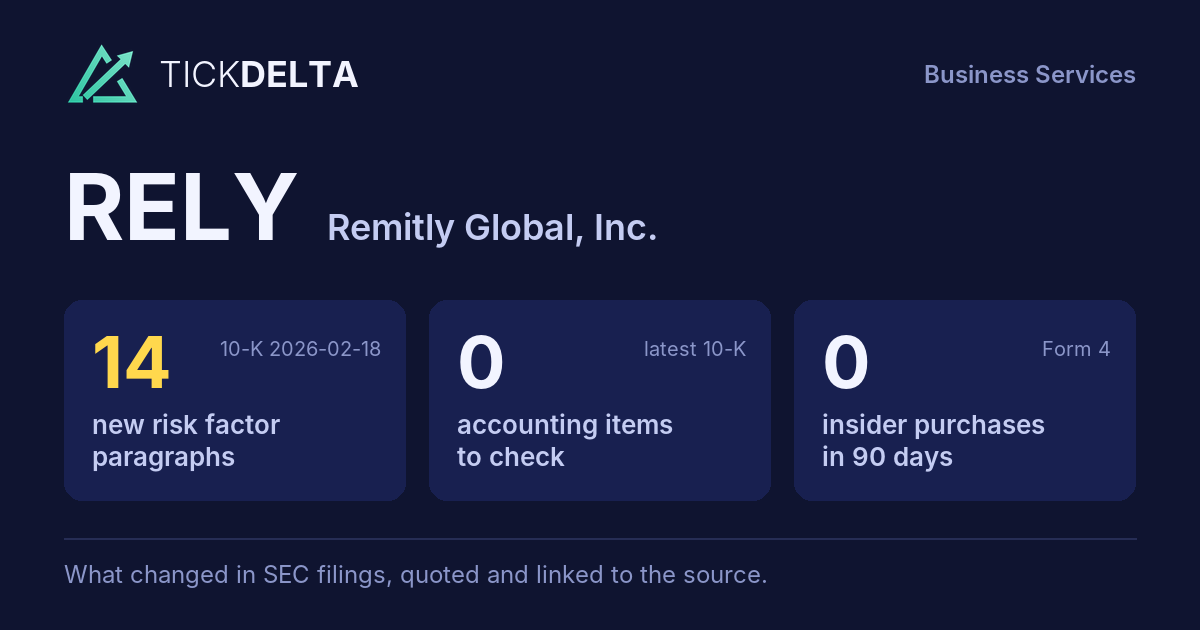
Remitly Global, Inc. RELY

Compare with peers Embed
The 10-K against last year's

175 changes: 19 added, 8 removed, 145 reworded, 3 quiet changes

10-K Feb 18, 2026 vs Feb 19, 2025

10-K 0001628280-26-009038 (Feb 18, 2026) vs 10-K 0001782170-25-000018 (Feb 19, 2025)

Every paragraph, and how much of it changed

One bar per paragraph, in the order of the 10-K. Height and colour show the share of its words not in the closest paragraph a year earlier; the tallest bars are new paragraphs.

Risk Factors

320 paragraphs · 14 new · 102 reworded · 4 gone · 10-K Feb 18, 2026 against Feb 19, 2025
New paragraph Reworded (5% of its words or more) Same or nearly
Paragraph 226 · 49% changed Every version of it
Other periods of favorable seasonality include Ramadan/Eid, Lunar New Year/Tết, and Mother’s Day, although the impact is generally lower than the seasonality we see in the fourth quarter and the timing of some of these holidays varies from year to year. Conversely, we typically observe lower customer acquisition and existing customer activity through most of the first quarter, especially in regions that experience favorable seasonality in the fourth quarter. Following the fourth quarter, typically the second quarter is seasonally the next strongest quarter from an existing customer activity perspective, however customer activity and the impact on financial results can vary across quarters based on the timing of holidays and other geographic drivers. Furthermore, our cash flows may be affected by the day of the week on which each quarter ends which may affect our quarterly operating results. There can be a delay between when we release funds for disbursement and when we receive customer funds from our payment processors. For example, if a quarter closes on a Saturday, our cash flow statements will show a decreased cash balance because we will have wired out funds on Friday which will be available for disbursement on Saturday, Sunday, and Monday, but we may not receive customer funds from our payment processors until Monday. In addition, due to time zone differences, an additional day’s worth of funding is required for disbursements to certain regions. As a result, period-to-period comparisons of our statements of cash flows may not be meaningful, and you should not rely on them as an indication of our liquidity or capital resources.
Paragraph 236 · 44% changed Every version of it
The Organization for Economic Cooperation and Development (the “OECD”) introduced significant changes to the international tax law framework through the Pillar Two guidelines. The guidelines, a framework outlines outlining a coordinated set of rules to prevent multinational enterprises from shifting profits to low-tax jurisdictions by implementing that implements a 15% global minimum tax. Many countries in which we operate have enacted Pillar Two. Pillar Two rules will rules, which apply to us beginning in our fiscal year 2025. In June 2025, the Group of Seven countries agreed that U.S. Multi-National Entities (“MNEs”) should be excluded from certain aspects of the Pillar Two tax rules in exchange for the U.S. not imposing retaliatory taxes. In January 2026, the OECD released comprehensive guidance for a “U.S. side-by-side arrangement” with respect to Pillar Two, under which, if adopted in relevant jurisdictions, U.S. MNEs would be exempt from two of the three Pillar Two top up taxes. The potential effects of Pillar Two may vary depending on the specific provisions and rules implemented enacted by each country that adopts Pillar Two and may include tax rate changes, higher effective tax rates, potential tax disputes disputes, and adverse impacts to our cash flows, tax liabilities, results of operations, and financial position. Many of the jurisdictions in which we conduct business have detailed transfer pricing rules or may comply with the OECD guidelines, which require contemporaneous documentation establishing that all transactions with non-resident related parties be priced using arm’s-length pricing principles. Tax authorities in these jurisdictions could challenge our related party transfer pricing policies and, consequently, the tax treatment of corresponding expenses and income. If any tax authority were to be successful in challenging our transfer pricing policies, we may be liable for additional corporate income tax, withholding tax, indirect tax and penalties, and interest related thereto, which may have a significant impact on our business, financial condition, operating results, and future prospects.
Paragraph 62 · 44% changed Every version of it
Any diversion of these developments internal resources, all of which could adversely affect have a material adverse effect on our business, financial condition, operating results, reputation, and future prospects.
Paragraph 91 · 37% changed Every version of it
In addition, particular, the CFPB administers other U.S. Consumer Financial Protection Bureau (“CFPB”) is largely responsible for administering regulations and may adopt adopting new regulations governing consumer financial services, including regulations defining unfair, deceptive, or abusive acts or practices, and new model disclosures. The Given the uncertainty with respect to the CFPB’s authority operations, it may be that select states will seek to change fill this consumer protection void, potentially issuing a patchwork of regulations adopted in the past by other regulators, or to rescind or alter past regulatory guidance, could that may increase our compliance costs and litigation exposure. These regulations, changes to these regulations, and other potential changes under CFPB Such regulations could harm our business, financial condition, operating results, and future prospects, and force us to change the way we operate our business.
Paragraph 36 · 37% changed Every version of it
Our business is subject to the risk of financial losses as a result of operational errors, fraudulent activity, employee misconduct, or other similar actions or errors on our or our partners’ solutions. Such behavior, either by our employees, vendors, counterparties, or other third parties, may include fraudulent actions, breaches of applicable laws, rules, regulations, as well as contractual obligations, including confidentiality or non-disclosure agreements, or failure to adhere to our policies and procedures or those of our partners and other counterparties. We have been, in the past, and will continue to be, subject to losses due to software errors in our systems and operational errors by our employees and third-party service providers. In addition, we also are regularly targeted by parties who seek to commit acts of financial fraud, using a variety of techniques, including stolen bank accounts, compromised business email accounts, employee fraud, account takeover, and false account creation. We are also routinely targeted for illegitimate transactions, including transactions to facilitate money laundering, and transactions in which customers authorize transfers requested by third parties under false or misleading pretenses (“scams”). These risks are inherently greater for us because many of our corridors for remittances are from developed to developing economies, which have traditionally been highly targeted by bad actors perpetrating fraud or other unwanted activity. We also in certain instances have a business practice of transferring money to recipients before funds are actually received from our customers, which also increases these risks. The methods used to perpetrate these illegal activities are continually evolving, and we expend considerable resources to detect, monitor, and prevent them. Our risk management efforts may not effectively prevent, and we may suffer losses from, these errors and activities and, in some cases, our usual risk allocation agreements and insurance coverages may not be sufficient to cover these losses. We have experienced transaction losses of $84.2 million, or 0.11%, $57.9 million, or 0.11%, and $39.0 million, or 0.10%, and $41.9 million, or 0.15%, of total send volume in connection with such errors, fraud, and misconduct in the years ended December 31, 2025, 2024, and 2023, and 2022, respectively. We expect that losses of similar or greater magnitude may occur again in the future. If any of these errors or illegitimate or fraudulent activities are significant, we may be subject to regulatory enforcement actions and termination of services provided by third parties and parties. We may also suffer significant losses or reputational harm, and our business, financial condition, operating results, and future prospects could be adversely affected.
Paragraph 5 · 32% changed Every version of it
Cyberattacks, •Cyberattacks, cybersecurity breaches, service outages, or other similar incidents could result in serious harm to our business, financial condition, operating results, reputation, and future prospects, including by triggering regulatory action or a breach of our agreements with significant partners that we rely on to deliver our services. prospects;
Paragraph 188 · 32% changed Every version of it
To date, we have not engaged in currency hedging activities to limit the risk Our use of exchange fluctuations; however, to limit our risk exposure associated with exchange rate fluctuations we may choose to engage in currency hedging activities in the future. Even if we use financial derivative instruments to hedge exposure to fluctuations in foreign currency exchange rates, rates may not be effective to mitigate related risks, and the use of such hedging activities may not offset the adverse financial effects of unfavorable movements in foreign exchange rates over the time the hedges are in place, and place. Furthermore, the use of derivative instruments may introduce additional risks and costs if we are unable to structure effective hedges with such instruments. Such additional risks, associated with both operating outside the United States with foreign currencies and the use of derivative instruments, include counterparty credit risk, including settlement risk, liquidity risk, operational risk, litigation risk relating to the enforcement of our contractual rights, and risk of changes in regulatory requirements.
Paragraph 25 · 32% changed Every version of it
Further, as we continue to grow, our business becomes increasingly complex and requires more resources. We have expended and anticipate continuing to expend, significant resources on expanding our infrastructure, streamlining our business and management processes, and expanding and streamlining strengthening other operational areas. Continued growth could strain our existing resources, and we could experience operating difficulties in managing our business across numerous jurisdictions. Failure to effectively scale could harm our future success, including our ability to retain and recruit personnel and to effectively focus on our growth strategy. Our limited operating history and experience may also lead to deficiencies in our governance and operational structures, including with respect to our internal controls, resulting in inefficient decision-making, internal oversight, or other operational inefficiencies, regulatory risks, failures to identify and capitalize on growth opportunities, and reputational damage. If our controls, policies, and procedures are not fully effective or we are not successful in identifying and mitigating significant risks to which we are or may be exposed, we may suffer uninsured liability, harm to our reputation, or be subject to litigation or regulatory actions that could affect our business, financial condition, operating results, and future prospects.

MD&A

102 paragraphs · 5 new · 61 reworded · 4 gone · 10-K Feb 18, 2026 against Feb 19, 2025
New paragraph Reworded (5% of its words or more) Same or nearly
Paragraph 82 · 48% changed
Refer (1) Beginning in the fourth quarter of 2025, the Company changed the presentation of certain cash activity related to disbursement prefunding, customer funds receivable, customer liabilities, and trade settlement liability, from cash flows from operating activities to cash flows from financing activities within the line item ‘Net change in customer funds assets and liabilities.’ Prior period statements of cash flows and any commentary below have been conformed to the current period presentation to enhance transparency and provide comparability. For additional information, refer to Note 2. Basis of Presentation and Summary of Significant Accounting Policies in of the notes to the our consolidated financial statements included in Part II, Item 8 of this Annual Report on Form 10-K for a discussion of recent accounting pronouncements. 10-K.
Paragraph 12 · 47% changed
Active customers increased to approximately 7.8 9.3 million, or 32% 19% growth, for the three months ended December 31, 2024, 2025, compared to the three months ended December 31, 2023. 2024. This increase was primarily due to an increase in the number of new customers, driven by investments continued marketing efficiency and strong retention, as well as product and geographic expansion. The increase was also a result of growth in our mobile app new customer categories, including high-amount senders and efficient marketing spend, our focus on small- to mid-sized businesses. Ongoing improvements in customer experience and how we serve our customers, expansion of our global disbursement network, localized innovation in key corridors supported customer acquisition and the continued diversification across both send and receive countries. While we continue to see strong results in our largest existing receive countries (India, Mexico, and the Philippines), our successful diversification of our corridor portfolio across both send and receive countries has contributed to new customer growth. engagement.
Paragraph 24 · 46% changed
Global macroeconomic and geopolitical factors, including inflation, currency fluctuations, immigration and immigration policy, regulatory changes, trade and regulatory policies, including imposition of trade restrictions, taxes and tariffs, and any related market or economic uncertainty or slowdown, regional and global conflicts, global crises and natural disasters, unemployment, potential recession, and the rate of digital remittance cross-border payment adoption impact demand for our services and the options that we can offer. These factors evolve over time, and periods of significant currency appreciation or depreciation, whether in send or receive currencies, changes to global migration patterns or patterns, immigration policy, or international trade, and changes to digital adoption trends may shift the timing and volume of transactions, or the number of customers using our service. In addition, We continue to assess the impact of developments in foreign currency movements impact our business in numerous ways. For example, as trade policy, including taxes and tariffs, and global market conditions. While the U.S. dollar strengthens, we see customers in certain geographies taking advantage imposition of the ability to get more local currency to their families and friends. We also believe the strength of the U.S. dollar and the strength of other developed country currencies versus emerging country currencies make it easier to acquire new customers in certain geographies. Conversely, expansion of our international business can negatively impact our consolidated results when these currencies weaken against the U.S. dollar. As we grow, we are becoming more diversified across geographies and currencies, which can help mitigate some localized geopolitical risks and macroeconomic trends. As foreign currency can have tariffs has not had a significant impact on our business, business historically, we strive recognize there is a potential for indirect effects, particularly from foreign exchange volatility to maintain a diversified cash balance portfolio and frequently assess for foreign currency cash concentrations. Refer to Note 2. Basis of Presentation and Summary of Significant Accounting Policies in the notes which we are exposed due to the consolidated financial statements included in Part II, Item 8 global nature of this Annual Report on Form 10-K for a more comprehensive description of current business concentrations. our cross-border payment operations.
Paragraph 18 · 44% changed
Efficiently acquiring customers is critical to our growth and maintaining attractive customer economics, which are impacted by online marketing competition, our ability to effectively target the right demographic, and a competitive environment. We have a history of successfully monitoring customer acquisition costs through disciplined, data-driven investment decisions, and will continue to be strategic and disciplined toward customer acquisition. For example, for performance marketing, we set rigorous customer acquisition targets that we continuously monitor Our marketing engine increasingly leverages automation and AI to ensure a high return on investment over the long term, optimize channel mix, targeting, and we can increase or decrease this investment as desired. Customer acquisition costs, which are deployed to acquire new customers or retain existing customers in certain circumstances, are a component of advertising expenses as defined in Note 2. Basis of Presentation and Summary of Significant Accounting Policies in the notes to the consolidated financial statements included in Part II, Item 8 of this Annual Report on Form 10-K. lifetime value.
Paragraph 83 · 44% changed
Our main sources of operating cash are transaction fees charged to customers and foreign exchange spreads on transactions. Our primary uses of cash from operating activities have been for advertising expenses used to attract new customers, transaction expenses that include fees paid to payment processors and disbursement partners, advertising expenses used to attract new customers, personnel-related costs, technology expenses, technology, and other general corporate expenditures. Our changes in operating cash flows are heavily impacted by the timing of customer transactions and, in particular, the day of the week that the year end falls on, including holidays and long weekends. For example, we generally have higher prefunding amounts if the year closes on a weekend or in advance of a long weekend, such as a holiday, which creates variability in customer transaction related balances period over period and can reduce our cash position at a particular point in time. These balances within our Consolidated Statements of Cash Flows include disbursement prefunding, customer funds receivable, customer liabilities, and trade settlement liabilities, which are included within the line item ‘Accrued expenses and other liabilities.’
Paragraph 81 · 44% changed
Years Ended December 31, (in thousands) 2025 2024(1) 2023(1) Net cash provided by (used in): Operating activities $ 325,082 $ 111,596 $ 66,806 Investing activities (69,934) (19,886) (50,037) Financing activities (89,780) (42,367) 6,254 Effect of foreign exchange rate changes on cash, cash equivalents equivalents, and restricted cash 9,114 (4,555) 1,272 (1,201) Net increase in cash, cash equivalents, and restricted cash $ 174,482 $ 44,788 $ 24,295
Paragraph 54 · 42% changed
Interest income increased $0.6 million decreased by an immaterial amount for the year ended December 31, 2024, 2025, as compared to the year ended December 31, 2023. The increase is primarily due to an increase in average invested balances throughout the year. 2024.
Paragraph 90 · 41% changed
For Net cash used in financing activities for the year ended December 31, 2023, 2025 was $89.8 million, as compared to net cash used in operating financing activities was $53.6 million, which for the year ended December 31, 2024 of $42.4 million. This change was primarily driven by an increase a net cash outflow in overall growth customer funds assets and liabilities of $208.7 million for the year ended December 31, 2025, as compared to a net cash inflow of $85.1 million in our global network of funding and disbursement partnerships, and an increase in volume of customer transactions. the prior period. Specifically, as a result of timing, cash outflows were impacted by increases in both growth and timing, we saw an increase in disbursement prefunding of $31.8 million and customer funds receivable of $183.4 million, receivable, partially offset by an increase increases in customer liabilities of $61.7 million and accrued expenses and other liabilities, which is inclusive of our trade settlement liability, liabilities. Net cash used in financing activities was also impacted by a $21.7 million increase in cash paid for taxes related to net share settlement of $47.4 million, which were the key drivers equity awards and $23.9 million in cash paid for the unfavorable changes repurchase of common stock in our operating assets and liabilities of $91.2 million. This change in our operating assets and liabilities was also the year ended December 31, 2025. Financing activities for the year ended December 31, 2025 were partially offset by cash generated from net borrowings on our operations, when excluding the $155.4 revolving credit facilities of $155.0 million, as compared to net repayments of $130.0 million of noncash charges included within the $117.8 million net loss for the period. year ended December 31, 2024.

A paragraph is matched with the one last year that shares the most of its words; under half in common makes it new. The paragraphs shown are the 8 reworded the most in each section.

The paragraph that changed most in each section

The redline

Marked against last year's 10-K: cut words struck through, new words highlighted.

MD&A246 words changed in this paragraph; it is 47% similar to last year's version.
Global macroeconomic and geopolitical factors, including inflation, currency fluctuations, immigration and immigration policy, regulatory changes, trade and regulatory policies, including imposition of trade restrictions, taxes and tariffs, and any related market or economic uncertainty or slowdown, regional and global conflicts, global crises and natural disasters, unemployment, potential recession, and the rate of digital remittance cross-border payment adoption impact demand for our services and the options that we can offer. These factors evolve over time, and periods of significant currency appreciation or depreciation, whether in send or receive currencies, changes to global migration patterns or patterns, immigration policy, or international trade, and changes to digital adoption trends may shift the timing and volume of transactions, or the number of customers using our service. In addition, We continue to assess the impact of developments in foreign currency movements impact our business in numerous ways. For example, as trade policy, including taxes and tariffs, and global market conditions. While the U.S. dollar strengthens, we see customers in certain geographies taking advantage imposition of the ability to get more local currency to their families and friends. We also believe the strength of the U.S. dollar and the strength of other developed country currencies versus emerging country currencies make it easier to acquire new customers in certain geographies. Conversely, expansion of our international business can negatively impact our consolidated results when these currencies weaken against the U.S. dollar. As we grow, we are becoming more diversified across geographies and currencies, which can help mitigate some localized geopolitical risks and macroeconomic trends. As foreign currency can have tariffs has not had a significant impact on our business, business historically, we strive recognize there is a potential for indirect effects, particularly from foreign exchange volatility to maintain a diversified cash balance portfolio and frequently assess for foreign currency cash concentrations. Refer to Note 2. Basis of Presentation and Summary of Significant Accounting Policies in the notes which we are exposed due to the consolidated financial statements included in Part II, Item 8 global nature of this Annual Report on Form 10-K for a more comprehensive description of current business concentrations. our cross-border payment operations.

Source: Item 7, 10-K 0001628280-26-009038 vs Item 7, 10-K 0001782170-25-000018

Risk Factors225 words changed in this paragraph; it is 45% similar to last year's version.
The Organization for Economic Cooperation and Development (the “OECD”) introduced significant changes to the international tax law framework through the Pillar Two guidelines. The guidelines, a framework outlines outlining a coordinated set of rules to prevent multinational enterprises from shifting profits to low-tax jurisdictions by implementing that implements a 15% global minimum tax. Many countries in which we operate have enacted Pillar Two. Pillar Two rules will rules, which apply to us beginning in our fiscal year 2025. In June 2025, the Group of Seven countries agreed that U.S. Multi-National Entities (“MNEs”) should be excluded from certain aspects of the Pillar Two tax rules in exchange for the U.S. not imposing retaliatory taxes. In January 2026, the OECD released comprehensive guidance for a “U.S. side-by-side arrangement” with respect to Pillar Two, under which, if adopted in relevant jurisdictions, U.S. MNEs would be exempt from two of the three Pillar Two top up taxes. The potential effects of Pillar Two may vary depending on the specific provisions and rules implemented enacted by each country that adopts Pillar Two and may include tax rate changes, higher effective tax rates, potential tax disputes disputes, and adverse impacts to our cash flows, tax liabilities, results of operations, and financial position. Many of the jurisdictions in which we conduct business have detailed transfer pricing rules or may comply with the OECD guidelines, which require contemporaneous documentation establishing that all transactions with non-resident related parties be priced using arm’s-length pricing principles. Tax authorities in these jurisdictions could challenge our related party transfer pricing policies and, consequently, the tax treatment of corresponding expenses and income. If any tax authority were to be successful in challenging our transfer pricing policies, we may be liable for additional corporate income tax, withholding tax, indirect tax and penalties, and interest related thereto, which may have a significant impact on our business, financial condition, operating results, and future prospects.

Source: Item 1A, 10-K 0001628280-26-009038 vs Item 1A, 10-K 0001782170-25-000018

Accounting Policies132 words changed in this paragraph; it is 36% similar to last year's version.
In November 2023, September 2025, the Financial Accounting Standards Board (“FASB”) FASB issued Accounting Standards Update (“ASU”) ASU No. 2023-07, “Segment Reporting (Topic 280): 2025-06, Intangibles—Goodwill and Other—Internal-Use Software (Subtopic 350-40): Targeted Improvements to Reportable Segment Disclosures” the Accounting for Internal-Use Software (“ASU 2023-07”), 2025-06”), which is intended to improve reportable segment disclosure requirements, primarily through enhanced disclosures about significant segment expenses. modernize the recognition and capitalization framework to reflect current software development practices. The guidance is amendments in ASU 2025-06 are effective for fiscal years annual periods beginning after December 15, 2023, 2027, and interim periods within fiscal years beginning after December 15, 2024. those annual periods. Early adoption is permitted. The guidance Company is to be applied retrospectively to all prior periods presented in currently evaluating the financial statements. The Company adopted potential impact of adopting this new guidance beginning with to its annual report for fiscal year ending December 31, 2024. Refer to the Segments policy within Note 20. Segment Reporting for additional information. consolidated financial statements and related disclosures.

Source: Item 8, Note 2 – Basis of Presentation and Summary of Significant Accounting Policies, 10-K 0001628280-26-009038 vs Item 8, Note 2 – Basis of Presentation and Summary of Significant Accounting Policies, 10-K 0001782170-25-000018

Legal Proceedings114 words changed in this paragraph; it is 52% similar to last year's version.
From time to time, the Company may be a party to litigation and subject to claims incident to the ordinary course of business, including intellectual property claims, labor and employment claims, threatened claims, breach of contract claims, and other matters. The Company operates in a complex legal and regulatory environment and its operations are subject to various U.S. and foreign laws, rules, and regulations. From time to time, the Company is also subject to inquiry, examinations, or enforcement actions from various of its regulators. The Company accrues estimates for resolution of legal and other contingencies when losses are probable and estimable. Although the results of litigation and claims are inherently unpredictable, the Company does not believe that there was a reasonable possibility that it had incurred a material loss with respect to such loss contingencies as As of December 31, 2024 2025, the Company was involved in certain intellectual property and December 31, 2023. trademark disputes in certain jurisdictions; any potential loss related to those disputes cannot currently be reasonably estimated and any impact is expected to be immaterial.

Source: Item 3, via Note 16 – Commitments and Contingencies, 10-K 0001628280-26-009038 vs Item 3, via Note 16 – Commitments and Contingencies, 10-K 0001782170-25-000018

Sentences and paragraphs added, removed or reworded

Every change, by type

Sentences and paragraphs of RELY's Risk Factors and MD&A, 10-K Feb 18, 2026 against 10-K Feb 19, 2025. Each links to the text at sec.gov.

Quiet changes are sentences kept from last year with one to four words changed, at least one of them a hedge, a modal or a qualifier (may, could, will, not, significant, material…). A year or date rolling forward is not counted.

The full word list

adverse, adversely, all, although, anticipate, anticipates, any, approximately, believe, believes, can, cannot, certain, could, expect, expects, generally, however, if, intend, intends, largely, likely, many, material, materially, may, might, most, must, never, no, not, possible, primarily, probable, should, significant, significantly, some, substantial, substantially, unlikely, will, would

AddedRisk Factors
For example, the Central Bank of Nigeria previously imposed currency controls that limit repatriation of funds with immediate effect, which required money transmission businesses, including us, to make substantial adjustments to payments processes that serve Nigerian consumers. While we believe that we are compliant with our regulatory responsibilities, the legal, political, and business environments in these areas are routinely
Read it in 10-K Feb 18, 2026 at sec.gov
AddedRisk Factors
changing, and subsequent legislation, regulation, litigation, court rulings, or other events could expose us to increased liability, increased operating and compliance costs to implement new measures to reduce our exposure to this liability, and reputational damage.
Read it in 10-K Feb 18, 2026 at sec.gov
AddedRisk Factors
change our disbursement options, modify payment methods, or take other measures that would impact our costs and profitability or cause us to lose customers or otherwise limit our operations.
Read it in 10-K Feb 18, 2026 at sec.gov
AddedRisk Factors
We have certain tax attributes, including net operating loss carryforwards (“NOLs”) and research and development credit carryforwards (“R&D tax credits”), that can be used to offset future income tax liabilities. Certain of our NOLs and R&D tax credits will expire if they are not used within applicable time periods. Furthermore, our ability to use our tax attributes may be subject to certain limitations, including as a result of any future changes in tax laws. If we are not able to utilize a material portion of the tax attributes reflected on our balance sheets, our future tax liability may increase and our business, financial condition, operating results, and future prospects could be adversely affected.
Read it in 10-K Feb 18, 2026 at sec.gov
AddedRisk Factors
The liquidity product we offer exposes us to financial losses and if a substantial number of our customers do not repay the cross-border payment advances provided, or if our performance forecasts for the product are not accurate, our business, financial condition, operating results, and future prospects may be impacted.
Read it in 10-K Feb 18, 2026 at sec.gov
AddedRisk Factors
The performance of the product is dependent on our ability to develop and deploy effective models to evaluate the collectability of consumer receivables recorded in customer funds receivables based on a variety of factors. There can be no assurance that our performance forecasts will be accurate. In particular, during periods with changing economic conditions, elevated interest rates, and continued or renewed inflationary pressures, accurately forecasting repayment of consumer receivables is more difficult. For more information, see “ —The development and use of quantitative models in our business may present risks and challenges that could adversely impact us.”
Read it in 10-K Feb 18, 2026 at sec.gov
AddedRisk Factors
Our allowance for credit losses is an estimate, and if actual losses are materially greater than the allowance for credit losses, or more generally, if our forecasts are not accurate, our business, financial condition, operating results, and future prospects could be adversely affected. Furthermore, as we scale and expand the liquidity products offered through our platform, our losses relating to consumer receivables may increase.
Read it in 10-K Feb 18, 2026 at sec.gov
Show the other 44
AddedRisk Factors
effect on our operations. In addition, the Chinese government could take action that would create significant competitive advantage for Chinese companies and create obstacles for us.
Read it in 10-K Feb 18, 2026 at sec.gov
AddedRisk Factors
We cannot guarantee that our share repurchase program will be fully consummated or that it will enhance long-term stockholder value. Share repurchases could also affect the trading price of our stock and may reduce working capital.
Read it in 10-K Feb 18, 2026 at sec.gov
AddedRisk Factors
In August 2025, we announced that our board of directors had approved a share repurchase program that provides for the repurchase of up to an aggregate of $200 million of our outstanding common stock. The timing, method, and total amount of share repurchases will be determined by us at our discretion and will depend on a variety of factors, including business, economic, and market conditions, corporate and regulatory requirements, prevailing stock prices, alternative investment opportunities, and other considerations. The share repurchase program does not expire and may be suspended, discontinued, or modified at any time without notice at our discretion, and the program does not obligate us to acquire any amount of common stock.
Read it in 10-K Feb 18, 2026 at sec.gov
RemovedRisk Factors
In particular, the U.S. Consumer Financial Protection Bureau (“CFPB”) has authority over Regulation E, which implements the Electronic Fund Transfer Act (“EFTA”) and among other things, consumer protection requirements under the Remittance Transfer Rule. The CFPB could modify the Remittance Transfer Rule or issue administrative guidance that may impose limitations on remittance providers, such as the type of fees charged by remittance companies, how remittances are advertised to consumers, how the exchange rate is applied to transactions by these companies, and the level of transparency surrounding such fees and exchange rates. Such changes may require us to assume fees and charges by third-party providers that are outside of our control.
Read it in 10-K Feb 19, 2025 at sec.gov
RemovedRisk Factors
Our net operating losses (“NOLs”) could expire unused and be unavailable to offset future income tax liabilities because of their limited duration or because of restrictions under U.S. or international tax law. NOLs generated in taxable years beginning before January 1, 2018 are permitted to be carried forward for only 20 taxable years and NOLs generated in taxable years beginning after December 31, 2017 may be carried forward indefinitely, but the deductibility of such NOLs generally will be limited to 80% of current year taxable income under applicable U.S. federal income tax law. For these reasons, we may not be able to utilize a material portion of the NOLs reflected on our balance sheets, even if we attain consistent profitability, which could potentially result in increased future tax liability to us and could adversely affect our operating and financial results.
Read it in 10-K Feb 19, 2025 at sec.gov
RewordedRisk Factors
The process of designing and implementing effective internal controls and disclosure controls is a continuous effort that requires us to anticipate and react to changes in our business and the economic and regulatory environment and to We expend significant resources to maintain and improve a system of internal controls that is adequate to satisfy our reporting obligations as a public company.
Read it in 10-K Feb 18, 2026 at sec.gov
RewordedRisk Factors
Debt in the notes to the Company’s consolidated financial statements included in Part II, Item 8 of this Annual Report on Form 10-K) under that certain Revolving Credit and Guaranty Agreement dated as of September 13, 2021 (as amended by Amendment No. 1 dated as of June 26, 2023 and as further amended by Amendment No. 2 and Joinder Agreement dated as of December 20, 2023 (“Amendment No. 2”)). 24, 2025.
Read it in 10-K Feb 18, 2026 at sec.gov
RewordedRisk Factors
Even if we Our use of financial derivative instruments to hedge exposure to fluctuations in foreign currency exchange rates, rates may not be effective to mitigate related risks, and the use of such hedging activities may not offset the adverse financial effects of unfavorable movements in foreign exchange rates over the time the hedges are in place, and may introduce additional risks and costs if we are unable to structure effective hedges with such instruments. place.
Read it in 10-K Feb 18, 2026 at sec.gov
RewordedRisk Factors
We are also exposed to risks relating to fluctuations in currency exchange rates between the date on which we purchase foreign currencies, the date a customer initiates a cross-border remittance payment payment, and the date that the remittance payment recipient receives the funds through our disbursement partners because the foreign exchange rate quoted to the customer is not adjusted for changes between the initiation date and the settlement date. partners.
Read it in 10-K Feb 18, 2026 at sec.gov
RewordedRisk Factors
Our systems and operations and those of third-party partners have experienced and experienced, or may experience in the future future, interruptions or degradation of service availability due to a variety of events including cyberattacks, cybersecurity breaches, service outages, and other similar incidents, incidents; insider threats, threats; hardware and software defects or malfunctions, malfunctions; development delays, delays; installation difficulties, difficulties; human error, error; earthquakes, hurricanes, floods, fires, and other natural disasters, disasters; public health crises (including epidemics or pandemics such as the COVID-19 pandemic), pandemic); power losses, losses; disruptions in telecommunications services, fraud, services; fraud; military or political conflicts, conflicts; terrorist attacks, attacks; or other events.
Read it in 10-K Feb 18, 2026 at sec.gov
RewordedRisk Factors
While we do not currently We additionally enter into derivative financial instrument transactions as part of to reduce foreign currency hedging activities, exchange risk, and we may in increase the future enter into level and frequency of such transactions with various financial institutions. institutions in the future.
Read it in 10-K Feb 18, 2026 at sec.gov
RewordedRisk Factors
If any of these errors or illegitimate or fraudulent activities are significant, we We may be subject to regulatory enforcement actions and termination of services provided by third parties and also suffer significant losses or reputational harm, and our business, financial condition, operating results, and future prospects could be adversely affected.
Read it in 10-K Feb 18, 2026 at sec.gov
RewordedRisk Factors
While we have experienced significant revenue increases, increases and achieved profitability on an Adjusted EBITDA basis, and on a generally accepted accounting principles (“GAAP”) basis in recent periods, and achieved profitability on a GAAP basis in the third quarter of 2024, fiscal year 2025, if the assumptions we use to plan our business are incorrect or change, or if we are unable to maintain consistent revenue, it may be difficult to maintain profitability.
Read it in 10-K Feb 18, 2026 at sec.gov
RewordedRisk Factors
We Although we generated net income of $67.9 million in the year ended December 31, 2025, we incurred losses of $37.0 million, million and $117.8 million, and $114.0 million for in the years ended December 31, 2024, and 2023, and 2022, respectively.
Read it in 10-K Feb 18, 2026 at sec.gov
RewordedRisk Factors
However, even if our revenue continues to increase, we expect that Although a large market segment for cross-border financial services remains untapped by us, our growth rate will likely may decline in the future as a result of a variety of factors, including the increasing scale of our business.
Read it in 10-K Feb 18, 2026 at sec.gov
RewordedRisk Factors
The process of designing and implementing effective internal controls and disclosure controls is a continuous effort that requires us to anticipate and react to changes in our business and the economic and regulatory environment and to expend significant resources to maintain a system of internal controls that is adequate to satisfy our reporting obligations as a public company. environment.
Read it in 10-K Feb 18, 2026 at sec.gov
RewordedRisk Factors
The Organization for Economic Cooperation and Development (the “OECD”) introduced significant changes to the international tax law framework through the Pillar Two guidelines. guidelines, a framework outlining a coordinated set of rules that implements a 15% global minimum tax.
Read it in 10-K Feb 18, 2026 at sec.gov
Quiet changesRisk Factors
We have been examined, and may continue to be subject to examination by the CFPB, which has defined participants of the international money transfer market that make at least one million aggregate annual international money transfers, such as Remitly, to be “larger participants” subject to such supervisory examination.
Read it in 10-K Feb 18, 2026 at sec.gov
Quiet changesRisk Factors
Additionally, the restrictive covenants impose significant certain operating and financial restrictions that may impact our ability to engage in certain transactions or make investments that could be in our long-term best interests.
Read it in 10-K Feb 18, 2026 at sec.gov
AddedMD&A
Remitly is a trusted provider of financial services that transcend borders. With a footprint spanning more than 175 countries, we have built one of the world’s leading global money movement platforms, trusted by millions of customers who rely on us everyday. Leveraging our strengths in global money movement, we continue to evolve beyond a remittance company into a diversified, cross-border financial services provider, serving both consumers and businesses across a growing set of use cases.
Read it in 10-K Feb 18, 2026 at sec.gov
AddedMD&A
Evolving regulatory developments may influence customer behavior and transaction volumes. For example, recent U.S. policy changes have increased the costs associated with the H-1B visa program and increased deportation activity more broadly, and the One Big Beautiful Bill Act (the “OBBBA”), which passed on July 4, 2025, imposes a tax on outbound, non-digital remittances from the United States to recipients abroad. While these regulatory developments may impact certain areas of our business, our business has remained resilient through various macroeconomic, political, and regulatory cycles over the past decade. We will continue to evaluate the impact the new legislation will have on our consolidated financial statements, but at this time, we do not expect that the remittance tax included in the OBBBA will have a material impact on our business.
Read it in 10-K Feb 18, 2026 at sec.gov
AddedMD&A
The OBBBA also enacts U.S. corporate income tax reform, certain aspects of which apply to our business beginning in 2025. We continue to evaluate the impact the new legislation will have on our consolidated financial statements, but we do not expect a significant impact, inclusive of the effect of the valuation allowance on our U.S. deferred tax assets.
Read it in 10-K Feb 18, 2026 at sec.gov
AddedMD&A
(2) As previously announced on February 19, 2025, our presentation of Adjusted EBITDA now excludes the impact of payroll taxes related to stock-based compensation expense, net. Prior period Adjusted EBITDA has been recast to reflect this change.
Read it in 10-K Feb 18, 2026 at sec.gov
AddedMD&A
In July 2025, our board of directors approved a share repurchase program that provides for the repurchase of up to an aggregate of $200 million of our outstanding common stock. The program allows for share repurchases through open market transactions, in privately negotiated transactions, or by other means, in accordance with applicable securities laws and other restrictions, but does not obligate us to acquire any amount of common stock. The timing and total amount of share repurchases will be determined by us in our discretion and will depend on a variety of factors, including business, economic and market conditions, corporate and regulatory requirements, prevailing stock prices, alternative investment opportunities, and other considerations. During the year ended December 31, 2025, we repurchased $23.9 million of our common stock in open market transactions.
Read it in 10-K Feb 18, 2026 at sec.gov
RemovedMD&A
Remitly is a trusted provider of digital financial services that transcend borders. With a global footprint spanning more than 170 countries, Remitly’s digitally native, cross-border payments app delights customers with a fast, reliable, and transparent money movement experience. Building on its strong foundation, Remitly is expanding its suite of products to further its vision and transform lives around the world.
Read it in 10-K Feb 19, 2025 at sec.gov
RemovedMD&A
Cash used in financing activities consists primarily of borrowings on our 2021 Revolving Credit Facility, proceeds from the exercise of stock options, and proceeds from the issuance of common stock in connection with the ESPP, offset by repayments of our 2021 Revolving Credit Facility borrowings and other indebtedness.
Read it in 10-K Feb 19, 2025 at sec.gov
RemovedMD&A
Revenue is derived from each transaction and varies based on the funding method chosen by the customer, the size of the transaction, the currency to be ultimately disbursed, the rate at which the currency was purchased, the disbursement method chosen by the customer, and the country to which the funds are transferred. Our contract with customers can be terminated by the customer without a termination penalty up until the time the funds have been delivered to the intended recipient. Therefore, our contracts are defined at the transaction level and do not extend beyond the service already provided.
Read it in 10-K Feb 19, 2025 at sec.gov
RemovedMD&A
We recognize transaction revenue on a gross basis as we are the principal for fulfilling payment transactions. As the principal to the transaction, we control the service of completing payments for our customers. We bear primary responsibility for the fulfillment of the payment service, are the merchant of record, contract directly with our customers, control the product specifications, and define the value proposition of our services. We are also responsible for providing customer support. Further, we have full discretion over determining the fee charged to our customers, which is independent of the cost we incur in instances where we may utilize payment processors or other financial institutions to perform services on our behalf. These fees paid to payment processors and other financial institutions are recognized as ‘Transaction expenses’ within the Consolidated Statements of Operations. We do not have any capitalized contract acquisition costs.
Read it in 10-K Feb 19, 2025 at sec.gov
RewordedMD&A
These The investments will allow us to introduce new and innovative products, add features to current products, enhance the customer and recipient experience, also grow our payment and disbursement network, invest in strengthen our risk and security infrastructure, and continue to secure maintain data protection in accordance with evolving best practices and legal requirements.
Read it in 10-K Feb 18, 2026 at sec.gov
RewordedMD&A
The 2021 Revolving Credit Facility was amended in December 2023 to increase the revolving commitments from $250.0 million (including a $60.0 million letter of credit sub-facility) to $325.0 million. million, and was replaced in June 2025 with the 2025 Revolving Credit Facility, which increased the revolving commitments to $550.0 million (including a $200.0 million letter of credit sub-facility).
Read it in 10-K Feb 18, 2026 at sec.gov
RewordedMD&A
The decrease This change was primarily driven by the increase in net repayments on our 2021 Revolving Credit Facility of $260.0 $130.0 million and the settlement of amounts previously held back for the Rewire acquisition of $10.3 million in the year ended December 31, 2024, offset by the repayment of assumed indebtedness of $17.1 million that occurred in the year ended December 31, 2023. 2024.
Read it in 10-K Feb 18, 2026 at sec.gov
RewordedMD&A
The amortization of internal-use software costs which were capitalized in accordance with ASC Accounting Standards Codification (“ASC”) 350-40, Intangibles - Goodwill and Other-Internal-Use Software, are separately presented under the caption is included in ‘Depreciation and amortization’ within the Consolidated Statements of Operations included in Part II, Item 8 of this Annual Report on Form 10-K. Operations.
Read it in 10-K Feb 18, 2026 at sec.gov
RewordedMD&A
Transaction expenses increased $102.5 $117.9 million, or 31%, 27%, to $549.5 million for the year ended December 31, 2025, compared to $431.6 million for the year ended December 31, 2024, compared to $329.1 million for the year ended December 31, 2023. 2024.
Read it in 10-K Feb 18, 2026 at sec.gov
RewordedMD&A
For example, for performance marketing, we set rigorous customer acquisition targets that we continuously monitor to ensure drive a high long-term return on investment over the long term, investment, adjusting spend dynamically based on performance and we can increase or decrease this investment as desired. opportunity.
Read it in 10-K Feb 18, 2026 at sec.gov
RewordedMD&A
As a percentage of revenue, marketing expenses decreased to 21% for the year ended December 31, 2025, from 24% for the year ended December 31, 2024, from 25% for the year ended December 31, 2023. primarily due to efficiencies in digital and brand marketing.
Read it in 10-K Feb 18, 2026 at sec.gov
RewordedMD&A
Send volume increased 38%, 37%, to $74.9 billion for the year ended December 31, 2025, compared to $54.6 billion for the year ended December 31, 2024, compared to $39.5 billion for the year ended December 31, 2023, driven primarily by the increase in active customers.
Read it in 10-K Feb 18, 2026 at sec.gov
RewordedMD&A
As a percentage of revenue, technology and development expenses decreased to 19% for the year ended December 31, 2025, from 21% for the year ended December 31, 2024, from 23% for the year ended December 31, 2023, as we benefited from increasing efficiencies. efficiencies, including the usage of AI.
Read it in 10-K Feb 18, 2026 at sec.gov
RewordedMD&A
Cash used in investing activities consists primarily of purchases of property and equipment, net originations from consumer receivables, and the capitalization of internal-use software, and cash paid for acquisitions of businesses, net of acquired cash, cash equivalents, and restricted cash. software.
Read it in 10-K Feb 18, 2026 at sec.gov
RewordedMD&A
While we expect our expenses related to We believe these investments in technology and development to increase, which may impact short-term profitability, we believe these investments capabilities will ultimately contribute to our long-term growth.
Read it in 10-K Feb 18, 2026 at sec.gov
RewordedMD&A
Our For our global money movement product, which currently represents the substantial majority of our revenue, we earn revenue is generated on from transaction fees charged to customers and the foreign exchange spreads earned between the foreign exchange rate offered to customers and the foreign exchange rate on our currency purchases.
Read it in 10-K Feb 18, 2026 at sec.gov

Sources

The two latest 10-Ks on EDGAR, section by section. Each change links to the text at sec.gov.

Also

New risk factors: paragraphs with nothing like them last year, quoted in full.

Work with it

Excel workbook · CSV. Google Sheet that stays up to date: paste =IMPORTDATA("https://tickdelta.com/company/RELY/export.csv") into a cell.

Next:Related parties
Esc

Type a ticker such as AAPL, a name, an investor such as Buffett, or a topic such as tariffs. ↑ ↓ to move, Enter to open.