Form S-1
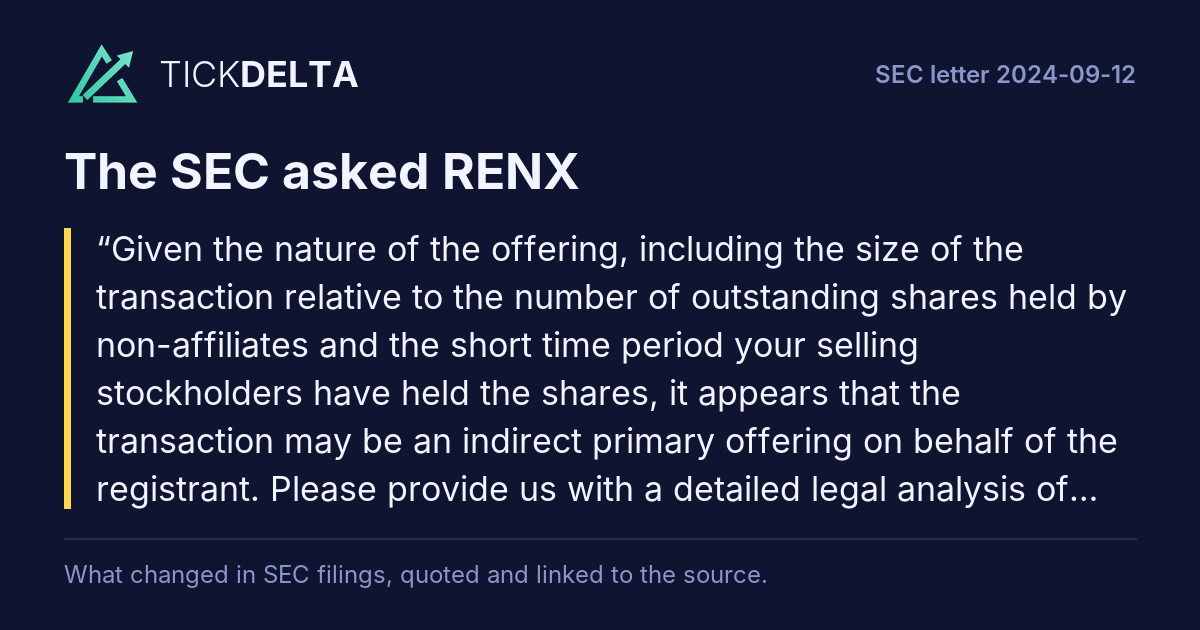
Given the nature of the offering, including the size of the transaction relative to the number of outstanding shares held by non-affiliates and the short time period your selling stockholders have held the shares, it appears that the transaction may be an indirect primary offering on behalf of the registrant.Rest of the question
Please provide us with a detailed legal analysis of your basis for determining that it is appropriate to characterize the transaction as a secondary offering under Securities Act Rule 415(a)(1)(i). For guidance, please see Securities Act Rules Compliance and Disclosure Interpretations Question 612.09.
For the reasons set forth below, the Company respectfully submits that the offering contemplated by the Registration Statement is a valid secondary offering by or on behalf of the Selling Stockholders, of shares of the Company’s Common Stock that may be registered for resale on a continuous basis pursuant to Rule 415(a)(1)(i) of the Securities Act of 1933, as amended (the “Securities Act”).Read in the reply
As requested in the Staff’s comment, the Company analyzed, among other factors, the guidance set forth in Securities Act Rules Compliance and Disclosure Interpretations, Question 612.09Rest of the answer
(“Interpretation
612.09”), which identifies six factors to be considered in determining whether a purported secondary offering is really a primary offering. We do not believe any single factor to be dispositive. Interpretation 612.09 states:
It is important to identify whether a purported secondary offering is really a [“disguised” or “indirect”] primary offering, i.e., the selling shareholders are actually
[a conduit acting]. . . on behalf of an issuer. . . .In an offering involving Rule 415 or Form S-3, if the offering is deemed to be on behalf of the issuer, the Rule and Form in some cases will be unavailable (e.g., because of the Form S-3 “public float” test for a primary offering, or because Rule 415(a)(1)(i) is available for secondary offerings, but primary offerings must meet the requirements of one of the other subsections of Rule 415). The question of whether an offering styled a secondary one is really on behalf of the issuer is a difficult factual one, not merely a question of who receives the proceeds. Consideration should be given to how long the selling shareholders have held the shares, the circumstances under which they received them, their relationship to the issuer, the amount of shares involved, whether the sellers are in the business of underwriting securities, and finally, whether under all the circumstances it appears that the seller is acting as a conduit for the issuer.
Based on the Company’s consideration of the totality of the facts and circumstances of the transaction and each of the factors enumerated in Interpretation 612.09, the Company believes that the shares of Common Stock that the Company is proposing to register for resale by Selling Stockholders (the “Shares”) are eligible for registration on a delayed or continuous basis pursuant to Rule 415(a)(1)(i) of the Securities Act.
Factor 1: How long the Selling Stockholders have held the securities.
The Registration Statement covers the resale of 11,000,000 shares of the Company’s Common Stock consisting of:
● up to 7,700,758 shares of Common Stock issuable upon the conversion of issued debentures (the “First Closing Debentures”);
● up to 1,299,242 shares of Common Stock issuable upon exercise of issued warrants (the “First Closing Warrants”);
● 925,000 shares of Common Stock (the “Arena Global Shares”) issued to Arena Business Solutions Global SPC II, LTD (“Arena Global”) as a commitment fee pursuant to the equity line purchase sgreement dated August 12, 2024 (the “ELOC Agreement”); and
● up to 1,075,000 shares of Common Stock issuable pursuant to a warrant (the “Arena Global Warrant”) issued to Arena Global as a commitment fee pursuant to the ELOC Agreement (the “Arena
Warrant Shares” and together with the Arena Global Shares, the “Initial Commitment Fee Shares”).
(the First Closing Debentures, the First Closing Warrants, the Arena
Global Shares and the Arena Global Warrant being referred to collectively as the “Securities”).
As noted above a significant portion of the Shares will be issuable upon conversion of the First Closing Debentures and to a lesser extent a portion of the Shares will be issuable upon exercise of the First
Closing Warrants and the Arena Global Warrant. Only a small portion of the Shares are Initial Commitment Fee Shares that are actually outstanding shares at this time. Before the Shares issuable upon conversion of the First Closing Debentures or exercise of the First Closing
Warrants or Arena Global Warrant can be sold, the convertible Securities must be converted or exercised, therefore requiring the holder to hold such securities for an additional period of time beyond the date of this letter.
In addition, no Selling Stockholder can currently sell the Shares as they are required to be held for 6 months unless they are registered. The Arena Global Shares and the Arena Global Warrant were issued to one of the Selling Stockholders pursuant to the terms of the ELOC Purchase Agreement entered into over five weeks ago at the same time when the First Closing Debentures and First Closing Warrants were issued. All of the First Closing Debentures and First Closing Warrants were issued to certain of the Selling Stockholders pursuant to the terms of a securities purchase agreement (the “SPA”) in a private placement that closed on August 12, 2024 (the “August 2024 Private Placement”). The Selling Stockholders were irrevocably bound to their obligations to acquire the securities on August 12, 2024. The issuances were made in a bona fide private placement exempt from registration under Section 4(a)(2) of the Securities Act and Regulation D promulgated thereunder. The Selling Stockholders have been subject to the full economic and market risks of their entire investment since the date of the execution of the ELOC Purchase Agreement and the SPA. The Selling Stockholders acquired the securities with no assurance as to when a registration statement registering the Shares would be declared effective and with no assurance that a liquid market would be available in which the Shares could be sold when the Shares became eligible for resale.
Each of the Selling Stockholders that were parties to the SPA and ELOC
Purchase Agreement made representations that they were acquiring the securities for their own account and not with a view to or for distributing or reselling such securities or any part thereof in violation of the Securities Act or any applicable state securities law and that they had no direct or indirect arrangement or understandings with any other persons to distribute or regarding the distribution of such Securities.
The discussion above supports the conclusion that the offering pursuant to the Registration Statement is a valid secondary offering.
Factor 2: The circumstances under which Selling Stockholders received the securities.
The First Closing Debentures and First Closing Warrants were issued to certain of the Selling Stockholders in the August 2024 Private Placement, an arm’s-length private placement transaction, pursuant to an exemption from registration under Section 4(a)(2) of the Securities Act and Regulation D promulgated thereunder. The August 2024 Private Placement was conducted pursuant to the SPA. The Selling Stockholder that received the Arena
Global Shares and the Arena Global Warrants was issued those securities pursuant to the terms of the ELOC Purchase Agreement. The
Selling Stockholders were introduced to the Company by, solicited to make an investment with the Company by, and worked with Maxim
Group, LLC (“Maxim”), a registered broker-dealer and member firm of the Financial Industry Regulatory Authority, Inc.
(“FINRA”), acting on behalf of the Company.
In the SPA and ELOC Purchase
Agreement, the Selling Stockholders made certain representations to the Company, including that (i) each was an “accredited investor” as defined in Rule 501(a) of Regulation D promulgated thereunder; (ii) each was acquiring the securities and the Shares issuable upon conversion thereof, in each case, for its own account and not with a view towards, or for resale in connection with, the public sale or distribution thereof in violation of applicable securities laws, except pursuant to sales registered or exempted under the Securities Act; and (iii) the Selling Stockholders had sought such accounting, legal and tax advice as it had considered necessary to make an informed investment decision with respect to its acquisition of the securities. The Company is neither aware of any evidence that would indicate that these representations were false nor aware of any evidence that any Selling Stockholder has any plan to act in concert with a third party to effect a distribution of the Shares. Moreover, pursuant to the SPA and ELOC Purchase Agreement, the Selling Stockholders agreed that the securities may only be disposed of in compliance with state and federal securities laws.
Pursuant to the SPA, the Company was required to enter into the Registration
Rights Agreement, dated as of August 12, 2024, between the Company and certain Selling Stockholders
(the “Registration Rights Agreement”). In addition, the ELOC Purchase Agreement had provisions requiring the registration for resale of the shares to be issued pursuant thereto, including the Initial Commitment Fee Shares. The registration obligations under the Registration Rights Agreement require that the Company file a registration statement registering the resale of the Shares issuable under the First Closing Debentures and the First Closing Warrants within 30 days of the August 12, 2024 closing date. Similarly, the ELOC
Purchase Agreement, requires the Company to as soon as practicable, file a registration statement registering the resale of the Initial
Commitment Fee Shares. The Registration Statement is being filed by the Company to comply with its obligations under the Registration
Rights Agreement and the ELOC Purchase Agreement. The Company did not enter into the Registration Rights Agreement or the ELOC Purchase
Agreement for the purposes of conducting an indirect primary offering. The Company did not and will not pay commissions or fees to any
Selling Stockholder and will not receive proceeds from the resale of the Shares by the Selling Stockholders.
In addition, the Company is not aware of any evidence that would indicate that a distribution would occur if the Registration Statement is declared effective. Under the SEC’s rules, a “distribution” requires special selling efforts. Rule 100(b) of Regulation M defines a “distribution” as “an offering of securities, whether or not subject to registration under the Securities Act, that is distinguished from ordinary trading transactions by the magnitude of the offering and the presence of special selling efforts and selling methods.” The Company is not aware of any evidence that would indicate that any special selling efforts or selling methods (such as road shows or other actions to condition the market for the
Company’s Common Stock) by or on behalf of the Selling Stockholders has occurred or will occur if the Registration Statement is declared effective.
Further, no Selling Stockholder is acting on the Company’s behalf with respect to the registration of the Shares for resale under the Registration Statement and, other than the Selling Stockholder’s registration rights, the Company has no contractual or other relationship with any Selling Stockholder that would govern either (a) the timing, nature, and amount of resales of the Shares; or (b) whether the Shares are ever resold under the Registration Statement. The existence of registration rights is not, in and of themselves, evidence of an intent on the part of the Selling Stockholders to sell its Shares, much less to sell or distribute the securities on behalf of the Company. The Company also notes that there are many reasons, other than to effect an immediate resale, why investors may prefer securities to be registered, which may include that an issuer’s decision to not register its Shares may limit the market value of investors’ Shares due to their restricted status and prevent investors from taking advantage of market opportunities or from liquidating their investments if, for example, the investors’ convictions in their original investment decision had waned.
Therefore, the circumstances under which the Selling Stockholders received or will receive the Shares support the conclusion that the offering pursuant to the Registration Statement is a valid secondary offering.
Factor 3: Selling Stockholder’s relationship with the Company.
Prior to entering into the SPA and the ELOC Purchase Agreement, the
Company did not have any relationship with the Selling Stockholders. The Selling Stockholders were not provided with any control over the Company’s business pursuant to the SPA or the ELOC Purchase Agreement. No Selling Stockholder has a seat on the Board or even an observer right. Neither agreement provides that the Selling Stockholders are acting as a financial advisor or fiduciary of the Company.
In addition, pursuant to the terms of the First Closing Debentures, the First Closing Warrants and the Arena Global Warrant, the Selling
Stockholders do not have the right to convert any portion of the First Closing Debentures, the First Closing Warrants and the Arena Global
Warrant, to the extent that, after giving effect to such conversion or exercise, the Selling Stockholders (together with certain related parties) would beneficially own in excess of 4.99% of the shares of Common Stock outstanding immediately after giving effect to such conversion
(the “Beneficial Ownership Limitation”). This Beneficial Ownership Limitation limits the influence that the Selling Stockholders can have over the management and policies of the Company.
As noted above, the Selling Stockholders are not acting on the Company’s behalf with respect to the registration of the Shares for resale under the Registration Statement and, other than the registration rights, the Company has no contractual or other relationship with the Selling Stockholders that would govern either (a) the timing, nature, and amount of resales of the Shares being registered for resale; or (b) whether the Shares being registered for resale are ever resold under the Registration Statement. The existence of registration rights is not, in and of themselves, evidence of an intent on the part of the
Selling Stockholders to sell their Shares, much less to sell or distribute the Shares on behalf of the Company.
None of the Selling Stockholders has had any other material relationship with the Company in the past three years. No Selling Stockholder nor any person that controls a Selling Stockholder is an officer, director, affiliate, or beneficial owner of more than 4.99% of any class of the Company’s capital stock. The
Selling Stockholders were introduced to the Company by, solicited to make an investment with the Company by, and worked through
Maxim, acting on behalf of the Company, and Maxim, not the Selling Stockholders, acted as the Company’s placement agent with respect to financings.
As a result, this factor weighs favorably in the Company’s determination that the offering for resale of the Shares by the Selling Stockholders is a secondary offering and not a primary offering.
4: The amount of Shares being registered.
As of September 16, 2024, the Company had 18,733,713 shares of Common Stock outstanding, of which approximately 11,357,107 were held by persons other than affiliates of the Company. After consultation with the Selling Stockholders, the Company has amended the Registration Statement to reduce the number of Shares being registered for resale to 11,000,000 shares of Common Stock, which would represent approximately 50% of the Company’s outstanding shares of
Common Stock held by non-affiliates, on a pro forma basis assuming that the 11,000,000 shares registered are included in the non-affiliate float.
In light of these circumstances, we submit that the number of Shares being registered for resale should not restrict the Company’s ability to use Rule 415(a)(1)(i) of the Securities Act for this offering.
Factor 5: Whether the Selling Stockholders are in the business of underwriting securities.
The Selling Stockholders are each private investment funds. None of the Selling Stockholders are (i) a registered broker-dealer or an affiliate of a broker-dealer as defined in Section 3(a)(4)(A) and Section
3(a)(5)(A) of the Securities Exchange Act of 1934, as amended, and (ii) in the business of underwriting securities. As noted above, the
Selling Stockholders were introduced to the Company by, solicited to make an investment with the Company by, and worked through Maxin, acting on behalf of the Company as the Company’s placement agent with respect to financings.
Therefore, this factor also weighs favorably in the Company’s determination that the offering for resale of the Shares is a secondary offering and not a primary offering.
Factor 6: Whether under all the circumstance it appears that the
Selling Stockholders are acting as a conduit for the Company.
Based on the foregoing analysis and the totality of the facts and circumstances, the Company believes that the facts support the conclusion that the Selling Stockholders are acting on their own behalf, and are motivated by their own self-interests, and are not acting as a conduit for the Company in connection with the offering of the Shares being registered under the Registration Statement.
The Registration Statement is filed by the Company to comply with its obligations under the Registration Rights Agreement and the ELOC Purchase Agreement. The Company does not have an underwriting relationship with any of the Selling Stockholders, and none of the Selling Stockholders are acting on behalf of the Company with respect to the Shares being registered for resale under the Registration Statement. Each Selling Stockholder has represented that they have acquired the securities, and will acquire the Shares being registered, for its own account and not with a view towards, or for resale in connection with, the public sale or distribution thereof.
Other than the investment terms and conditions and limited covenants provided for under the SPA or the ELOC Purchase Agreement, the Company does not have any material relationship with any Selling Stockholder.
No Selling Stockholder is acting as a financial advisor or fiduciary of the Company and, subject to limited restrictions under the SPA, may engage in trading in the Company’s securities independently and without the Company’s knowledge or control. The Company has been advised that no Selling Stockholder is in the business of underwriting securities. As noted above, the Selling Stockholders were introduced to the Company by, solicited to make an investment with the Company by, and worked through Maxim, a FINRA member firm acting on behalf of the Company, acting as placement agent.
Each Selling Stockholder personally bears the economic risks and rewards of being a stockholder and will continue to do so until a time when it sells its Shares. The Company will not benefit when or if the Selling
Stockholders sell the Shares. Since the time of purchase, the Selling Stockholder has borne the full economic risk of ownership of the
Company’s securities, and likely will continue to do so for a significant period of time given the historically low trading volume and price volatility of our Common Stock.
For all of the reasons set forth above, the Company respectfully submits to the Staff that the proposed resale of the Shares by the Selling Stockholders, as contemplated by the Registration Statement, should appropriately be classified as a valid secondary offering and not a primary offering, and, accordingly, we can rely on Rule 415(A)(1)(i) of the Securities Act for the offering of the Shares.
Should the Staff disagree with the foregoing conclusion, the Company would welcome and appreciate guidance regarding suggested modifications to the nature or size of the offering in order to proceed as a secondary offering under Rule 415 of the Securities Act.
Please file Exhibit 10.67, Amendment to Purchase Agreement, dated August 30, 2024.
The Company has incorporated by reference ExhibitRead in the reply
10.67 from its Form 8-K filed on September 6, 2024.
If you would like to discuss our response to the Comment Letter or any other matters related to the Registration Statement, please contact Leslie Marlow at (212) 885-5358 or Melissa Palat Murawsky at (215)
569-5732.