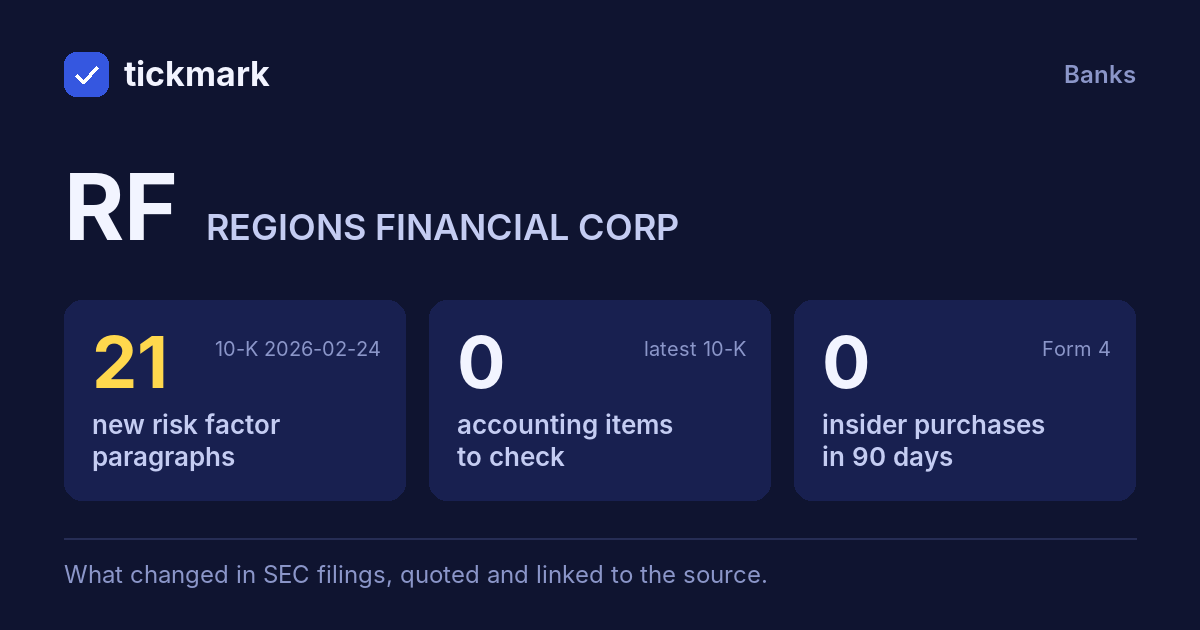
10-K 0001281761-26-000019 (2026-02-24) vs 10-K 0001281761-25-000010 (2025-02-21)
| Section | Compared text | Words now | Changed |
|---|
| Risk Factors | Item 1A | 18,084 |
16.8% |
| MD&A | Item 7 | 20,936 |
22.4% |
| Legal Proceedings | Item 3, via Note 23 – COMMITMENTS, CONTINGENCIES AND GUARANTEES | 1,521 |
11.0% |
| Accounting Policies | Item 8, Note 1 – SUMMARY OF SIGNIFICANT ACCOUNTING POLICIES | 14,137 |
10.9% |
The redline: what was cut and what was added
In each section, the paragraph that changed most, marked against last year's 10-K:
cut words struck through, new words highlighted and underlined.
Risk Factors 228 words changed in this paragraph; it is 37% similar to last year's version.
In addition, technology has lowered barriers to entry and made it possible for non-banks to offer products and services, such as loans and payment services, that traditionally were banking products, and made it possible for technology companies to compete with financial institutions in providing electronic, internet-based, and mobile phone–based financial solutions. Competition with non-banks, including technology companies, to provide financial products and services is intensifying. In particular, the activity of fintechs has grown significantly over recent years and is expected to continue to grow. Fintechs have and may continue to offer bank or bank-like products. For example, a number of fintechs have applied for, and in some cases been granted, bank or industrial loan charters. In addition, other fintechs have partnered with existing banks to allow them to offer deposit products to their customers. Regulatory changes, such as the revisions to the FDIC’s rules on brokered deposits intended to reflect recent technological changes and innovations, may also make it easier for fintechs to partner with banks and offer deposit products. In addition to fintechs, traditional technology companies have begun to make efforts toward providing financial services directly to their customers and are expected to continue to explore new ways to do so. Many of these companies, including our competitors, have fewer regulatory constraints, and some have lower cost structures, in part due to lack of physical locations. Regions provides an array of digital products and services to our customers and we expect a bank’s digital offerings to be a key competitive differentiator. The move toward digital banking and financial services, and customer expectations regarding digital offerings, will require us to invest greater resources in technological improvements and may put us at a disadvantage to banks and non-banks with greater resources to spend on technology.
Source: Item 1A, 10-K 0001281761-26-000019 vs Item 1A, 10-K 0001281761-25-000010
MD&A 203 words changed in this paragraph; it is 30% similar to last year's version.
In the fourth quarter of 2024, 2025, the Company added $3.0 $3.5 billion in forward-starting interest rate receive-fixed swaps (floating rate loan hedges) with a receive rate of 3.6 3.4 percent, which will become active throughout 2026 with 5-year maturities, to partially hedge 2026 expected fixed-rate loan turnover. A portion of these hedges were terminated subsequent to December 31, 2025, consistent with the timing of the fixed-rate loan production the swaps were intended to hedge. Additionally, subsequent to December 31, 2025, the Company continued the execution of this strategy and added $1.25 billion in forward-starting receive-fixed swaps with a receive rate of 3.5 percent, which will become active in both July the third and fourth quarters of 2026 and July 2028 and mature in July 2031. The Company also added $2.0 billion in pay-fixed interest rate swaps (AFS securities hedges) with an average pay rate of 3.9 percent and an average maturity in 2030 to reduce AOCI volatility in the AFS securities portfolio. As an offset to the interest rate risk associated with these pay-fixed fair value hedges, 5-year maturities. Separately, the Company added $2.0 billion in spot-starting a $250 million forward-starting receive-fixed interest rate swaps (floating rate loan hedges) swap with an average a receive rate of 3.8 percent and an average maturity percent, which becomes active in 2030. Cash flow swaps (floating rate loan hedges) typically have the first quarter of 2029 with a different day count convention than fair value swaps (AFS securities hedges), resulting in a lower fixed rate. 3-year maturity.
Source: Item 7, 10-K 0001281761-26-000019 vs Item 7, 10-K 0001281761-25-000010
Accounting Policies 153 words changed in this paragraph; it is 50% similar to last year's version.
Foreclosed property and other real estate is carried in other assets at the lower of the recorded investment in the loan or fair value less estimated costs to sell the property. The fair value for foreclosed property that is based on either observable transactions of similar instruments or formally committed sale prices is classified as a Level 2 measurement. If no formally committed sale price is available, Regions also obtains valuations from professional valuation experts and/or third party appraisers. Updated valuations are obtained on at least an annual basis. Foreclosed property exceeding established dollar thresholds is valued based on appraisals. Appraisals are performed by third-parties with appropriate professional certifications and conform to generally accepted appraisal standards as evidenced by the Uniform Standards of Professional Appraisal Practice. Regions’ policies related to appraisals conform to regulations established by the Financial Institutions Reform, Recovery and Enforcement Act of 1989 and other regulatory guidance. Professional valuations are considered Level 2 measurements because they are based largely on observable inputs. Regions has a centralized appraisal review function that is responsible for reviewing appraisals for compliance with banking regulations and guidelines as well as appraisal standards. Based on these reviews, Regions may make adjustments to the market value conclusions determined in the appraisals of real estate (either as other real estate or loans held for sale) when the appraisal review function determines that the valuation is based
Source: Item 8, Note 1 – SUMMARY OF SIGNIFICANT ACCOUNTING POLICIES, 10-K 0001281761-26-000019 vs Item 8, Note 1 – SUMMARY OF SIGNIFICANT ACCOUNTING POLICIES, 10-K 0001281761-25-000010
Legal Proceedings 75 words changed in this paragraph; it is 82% similar to last year's version.
Regions sells commercial loans to Fannie Mae through the DUS lending program and through other platforms. The DUS program provides liquidity to the multi-family housing market. Regions services loans sold to Fannie Mae and is required to provide a loss share guarantee equal to one-third of the principal balance for the majority of the commercial servicing portfolio. At December 31, 2025 and 2024, the Company's DUS servicing portfolio totaled approximately $7.8 billion and $7.0 billion, respectively. Regions has additional loans sold to Fannie Mae outside of the DUS program that are also subject to a loss share guarantee and at December 31, 2024 2025 and 2023, 2024, these serviced loans totaled approximately $665 $823 million and $653 $665 million, respectively. Regions' maximum quantifiable contingent liability related to all loans subject to a loss share guarantee was approximately $2.4 $2.7 billion and $2.3 $2.4 billion at December 31, 2024 2025 and 2023, 2024, respectively. The Company would be liable for this amount only if all of the loans it services for Fannie Mae, for which the Company retains some risk of loss, were to default and all of the collateral underlying these loans was determined to be without value at the time of settlement. Therefore, the maximum quantifiable contingent liability is not representative of the actual loss the Company would be expected to incur. The estimated fair value of the associated loss share guarantee recorded as a liability on the Company's consolidated balance sheets was immaterial at both December 31, 2024 2025 and 2023. 2024. Refer to Note 1 for additional information.
Source: Item 3, via Note 23 – COMMITMENTS, CONTINGENCIES AND GUARANTEES, 10-K 0001281761-26-000019 vs Item 3, via Note 23 – COMMITMENTS, CONTINGENCIES AND GUARANTEES, 10-K 0001281761-25-000010
Every change, by type
Sentences and paragraphs of RF's Risk Factors and MD&A, 10-K 2026-02-24 against 10-K 2025-02-21.
Each links to the text at sec.gov.
Quiet changes are sentences kept from last year with one to four words changed, at least one of them a hedge, a modal or a qualifier
(may, could, will, not, significant, material…). A year or date rolling forward is not counted.
The full word list
adverse, adversely, all, although, anticipate, anticipates, any, approximately, believe, believes, can, cannot, certain, could, expect, expects, generally, however, if, intend, intends, largely, likely, many, material, materially, may, might, most, must, never, no, not, possible, primarily, probable, should, significant, significantly, some, substantial, substantially, unlikely, will, would
AddedRisk Factors
other assets, such as loans. See the “Liquidity” section within “Management’s Discussion and Analysis of Financial Condition and Results of Operations” of this Annual Report on Form 10-K for our liquidity policy.
Read it in 10-K 2026-02-24 at sec.gov ↗
AddedRisk Factors
The development and use of AI presents risks and challenges that may adversely impact our business.
Read it in 10-K 2026-02-24 at sec.gov ↗
AddedRisk Factors
We and our third-party vendors, clients or counterparties develop, deploy and incorporate AI technology in certain business processes, services and products. Our current and increasing development, deployment and use of AI presents a number of risks and challenges to our business. The legal and regulatory environment relating to AI is uncertain and rapidly
Read it in 10-K 2026-02-24 at sec.gov ↗
AddedRisk Factors
evolving, both in the U.S. and internationally, and includes regulatory schemes targeted specifically at AI as well as new and existing provisions in intellectual property, privacy, cybersecurity, consumer protection, employment and other laws applicable to the use of AI and changes in interpretation of the foregoing. These evolving laws and regulations could require changes in our implementation of AI technology and increase our compliance costs and the risk of non-compliance. AI models, particularly generative AI models, may, and often do, produce output or take action that is incorrect, that result in the release of personal, confidential or proprietary information, that reflect or introduce discrimination, errors or biases included in the data on which they are trained or prompts or algorithms on which they rely, that infringe on the intellectual property rights of others or that is otherwise harmful. In addition, the complexity of many AI models makes it challenging to understand why they are generating particular outputs. This limited transparency increases the challenges associated with assessing the proper operation of AI models, understanding and monitoring the capabilities of the AI models, reducing erroneous output, eliminating bias and complying with applicable laws and regulations, including those that require documentation or explanation of the basis on which decisions are made. Additionally, if we do not have sufficient rights to use AI models, the data on which they are trained or prompts or algorithms on which they rely or the output thereof, we could also incur liability through the violation of applicable laws and regulations, third-party intellectual property, privacy or other rights or contracts to which we are a party.
Read it in 10-K 2026-02-24 at sec.gov ↗
AddedRisk Factors
Further, we currently rely, and expect to continue to rely, on AI models developed by third parties, and are and would be dependent in part on the manner in which those third parties develop, train and deploy their models, which involves risks arising from any discrimination, errors or bias in the models and the data on which they are trained or prompts or algorithms on which they rely, as well as the risk of inadvertent disclosure or incorporation of our personal, confidential or proprietary information into publicly available training sets. Any of these risks may impact our ability to realize the benefit of such information or adequately maintain, protect and enforce our intellectual property rights, and could result in regulatory compliance failures and otherwise harm our competitive position and business. The use of AI by companies has resulted in, and may in the future result in, systems failures or errors and cyber-attacks or other similar incidents. We may not be able to sufficiently mitigate, remediate or detect any of the foregoing limitations or risks given our and other market participants’ evolving experience with using AI, the pace of technological change, and rapid adoption of AI by our third-party vendors, clients, counterparties or competitors. Any of these risks could expose us to liability or adverse legal or regulatory consequences and harm our reputation and the public perception of our business or the effectiveness of our security measures.
Read it in 10-K 2026-02-24 at sec.gov ↗
AddedRisk Factors
We are also exposed to risks arising from the use of AI technologies by bad actors to commit fraud and misappropriate funds and to facilitate cyber-attacks and other similar incidents. Generative AI, if used to perpetrate fraud or launch cyberattacks or other similar incidents, could create panic at a particular financial institution or securities exchange, which could pose a threat to financial stability.
Read it in 10-K 2026-02-24 at sec.gov ↗
AddedRisk Factors
Moreover, inappropriate or controversial data practices by AI developers and users, or other factors adversely affecting public opinion of AI, could also impair the acceptance of AI. If the AI technology that we incorporate into our business processes, services or products are, or are perceived to be, deficient, inaccurate or controversial, we could suffer operational inefficiencies, competitive harm, legal liability, brand or reputational harm or other adverse impacts on our business, results of operations and financial condition. Additionally, our competitors and other third parties may incorporate AI into their business processes, services and products more quickly or more successfully than us, which could impair our ability to compete effectively and adversely affect our business, results of operations and financial condition.
Read it in 10-K 2026-02-24 at sec.gov ↗
AddedRisk Factors
Industry competition, including competition from decentralized finance platforms, cryptocurrencies and blockchain technologies, could disrupt our business model and adversely affect our revenues, market share or liquidity.
Read it in 10-K 2026-02-24 at sec.gov ↗
AddedRisk Factors
In addition, technology has lowered barriers to entry and made it possible for non-banks to offer products and services, such as loans and payment services, that traditionally were banking products, and made it possible for technology companies to compete with financial institutions in providing electronic, internet-based, and mobile phone–based financial solutions. Competition with non-banks, including technology companies, to provide financial products and services is intensifying. In
Read it in 10-K 2026-02-24 at sec.gov ↗
AddedRisk Factors
The rapid emergence and increasing adoption of DeFi platforms, cryptocurrencies and related blockchain-enabled financial products and services could disrupt traditional banking services and accelerate competitive pressures on our business. As customers and counterparties gain access to alternative platforms that facilitate payments, lending, trading, custody, settlement and other financial services outside of, or with reduced reliance on, traditional financial institutions, we may experience reduced demand for certain of our products and services, lower volumes and compression of pricing and fee incomes. If we do not effectively develop, acquire, partner with or otherwise adapt our products to respond to evolving customer preferences and competitive dynamics, then we may lose customers to existing or new competitors, including non-bank competitors, resulting in reduced market share and lower revenues.
Read it in 10-K 2026-02-24 at sec.gov ↗
AddedRisk Factors
Continued growth in the acceptance of DeFi platforms, cryptocurrencies and blockchain technologies could also reduce traditional banking deposits and income streams and increase volatility in our deposit base, which could adversely affect our liquidity position, funding costs and overall financial condition. The evolving regulatory and supervisory environment applicable to DeFi platforms, cryptocurrencies and blockchain technologies may increase our compliance costs, constrain our ability to pursue strategic initiatives or engage in certain activities and heighten our exposure to reputational and operational risks. Developments in the regulatory landscape, such as the enactment and implementation of the Guiding and Establishing National Innovation for U.S. Stablecoins Act of 2025 (GENIUS Act) and potential enactment of the Digital Asset Market Clarity Act of 2025 (CLARITY Act) or similar market structure legislation, may also affect our clients’ needs and expectations for products and services. In addition, adverse events involving DeFi platforms and cryptocurrencies, including security breaches, fraud, market manipulation, insolvencies or other failures, could negatively impact customer confidence in financial institutions generally or in us, even if we are not directly involved, and thereby adversely affect our business and results of operations.
Read it in 10-K 2026-02-24 at sec.gov ↗
AddedRisk Factors
Our geographic footprint includes markets that are experiencing significant population growth and economic development, which makes these areas attractive to both existing and new financial institutions. As a result, we could face increased competition from other financial institutions seeking to expand in these markets. If we are unable to compete effectively, our ability to grow loans and deposits, maintain customer relationships, and achieve desired profitability could be adversely affected.
Read it in 10-K 2026-02-24 at sec.gov ↗
RemovedRisk Factors
•Our business and financial performance could be adversely affected by a U.S. government debt default or the threat of such a default.
Read it in 10-K 2025-02-21 at sec.gov ↗
RemovedRisk Factors
could affect the ability of borrowers to repay loans. These factors could result in higher delinquencies and greater charge-offs in future periods, which could materially adversely affect our business, financial condition or results of operations.
Read it in 10-K 2025-02-21 at sec.gov ↗
RemovedRisk Factors
Instability in geopolitical matters could have a material adverse effect on our results of operations and financial condition. The macroeconomic environment in the United States is susceptible to global events and volatility in financial markets. For example, trade negotiations between the United States and other nations remain uncertain and could adversely impact economic and market conditions for our and our clients and counterparties. Global political and military conflicts, including the ongoing conflicts in the Ukraine and the Middle East, present destabilizing forces, including higher and more volatile commodity and food prices, which may cause international and domestic economic deterioration. Financial markets may be adversely affected by the current or anticipated impact of military conflicts, including the conflicts in the Ukraine and the Middle East, terrorism or other geopolitical events (including China-Taiwan and U.S.-China relations), which could cause higher inflation. Any of the above consequences could have significant negative effects on the U.S. economy, and, as a result, our operations and earnings. We could also experience more numerous and aggressive cyber-attacks launched by or under the sponsorship of one or more of the adversaries in such a conflict.
Read it in 10-K 2025-02-21 at sec.gov ↗
RemovedRisk Factors
The former U.S. presidential administration called on all regulatory agencies to reduce or eliminate certain fees relating to a number of services, including banking services and during this same time, the CFPB launched an initiative to reduce the amounts and types of fees financial institutions may charge, including the issuance of final rules that would significantly reduce the permissible amount of credit card late fees and that would impose certain requirements on overdraft fees unless the IDI limits the overdraft fee. While the new administration may impact the government's position on fees, the changes proposed by the former administration could affect the Company’s ability or willingness to provide certain products or services, necessitate changes to the Company’s business practices or have an adverse effect on our results of operations.
Read it in 10-K 2025-02-21 at sec.gov ↗
RemovedRisk Factors
development or marketing of certain products or services, or increase the costs of offering them to customers. For more information concerning our legal and regulatory obligations with respect to privacy and cybersecurity, please see the “Privacy and Cybersecurity” discussion within Item 1. “Business” and the “Technology Risks” discussion within in Item 1. “Risk Factors.”
Read it in 10-K 2025-02-21 at sec.gov ↗
RemovedRisk Factors
significantly decrease the value of our MSRs. Any of these actions could adversely affect our reported financial condition and results of operations.
Read it in 10-K 2025-02-21 at sec.gov ↗
RemovedRisk Factors
Our business and financial performance could be adversely affected by a U.S. government debt default or the threat of such a default.
Read it in 10-K 2025-02-21 at sec.gov ↗
RemovedRisk Factors
On January 21, 2025, the U.S. Treasury began taking extraordinary measures to prevent a default on U.S. government debt, which measures are expected to continue until such time as the U.S. Congress increases the debt ceiling. However, it is unclear how long such extraordinary measures will forestall a default in the event of extended Congressional negotiations or inaction. A U.S. government debt default would have material adverse impact on our business and financial performance, including a decrease in the value of Treasury bonds and other government securities held by us, which could negatively impact our capital position and our ability to meet regulatory requirements. Other negative impacts could be volatile capital markets, an adverse impact on the U.S. economy and the U.S. dollar, as well as increased default rates among borrowers in light of increased economic uncertainty. Some of these impacts might occur even in the absence of an actual default but as a consequence of extended political negotiations around the threat of such a default and a government shutdown.
Read it in 10-K 2025-02-21 at sec.gov ↗
RemovedRisk Factors
of any collateral held by us. Man-made disasters and other events connected with the Gulf region or Atlantic Ocean, such as oil spills, could have similar effects.
Read it in 10-K 2025-02-21 at sec.gov ↗
RewordedRisk Factors
After the benchmark federal Federal funds interest rates reached a peak range between 5.25 percent and 5.50 percent in 2023 and into 2024, the FOMC reduced the federal Federal funds rate by 50 basis points in September 2024 and by 25 basis points in both November and December 2024, to 2025 ending with a range of 4.25 3.50 percent to 4.50 and 3.75 percent.
Read it in 10-K 2026-02-24 at sec.gov ↗
RewordedRisk Factors
Responding to Our and our stakeholders' concerns around climate change provides us with potential new avenues through which we can support our stakeholders but also exposes may expose us to risks, including risks associated with the any transition to a lower-carbon economy.
Read it in 10-K 2026-02-24 at sec.gov ↗
RewordedRisk Factors
Ongoing Many of our stakeholders, including regulators in different jurisdictions in which we operate, have differing views, perspectives, and expectations that could continue to evolve and diverge; ongoing legislative or regulatory uncertainties and changes regarding climate risk management and practices, including inconsistent (and sometimes conflicting) perspectives or requirements, may result in higher regulatory, compliance, credit and reputational risks and costs.
Read it in 10-K 2026-02-24 at sec.gov ↗
RewordedRisk Factors
Weather-related events, health crises, the occurrence or worsening of disease outbreaks or pandemics such as COVID-19, pandemics, or other catastrophic events, other natural or man-made disasters, climate change and the transition to a lower-carbon economy, change, as well as economic, market and industry changes, or government actions or other restrictions responses in connection with such events, pose shorter- and longer-term risks to our business and/or that of our customers, vendors and suppliers and are expected to increase over time.
Read it in 10-K 2026-02-24 at sec.gov ↗
RewordedRisk Factors
The total amount of the special assessment is to be being paid over an initial eight-quarter collection period that began with the invoice for the first quarter of 2024 (received in June 2024) and includes an additional two quarters beyond the initial eight-quarter collection period, at a lower rate. 2024).
Read it in 10-K 2026-02-24 at sec.gov ↗
RewordedRisk Factors
Proposed changes to applicable capital, liquidity and similar requirements, such as the Basel III endgame proposal and the long-term debt proposal, could result in increased expenses or cost of funding, which could negatively affect our financial results or our ability to pay dividends and engage in share repurchases.
Read it in 10-K 2026-02-24 at sec.gov ↗
RewordedRisk Factors
We are subject to a variety of risks, including reputational risk, associated with environmental, social and governance, or ESG, issues - including differing perspectives on the meaning of the term “ESG. sociopolitical issues.
Read it in 10-K 2026-02-24 at sec.gov ↗
RewordedRisk Factors
All of our businesses are materially affected by conditions in the financial markets and economic conditions generally or specifically in the South, Midwest and Texas, the principal markets in which we conduct business.
Read it in 10-K 2026-02-24 at sec.gov ↗
RewordedRisk Factors
If, as a result of general economic conditions, there is a decrease in asset quality or growth in the loan portfolio and management determines that additional increases in the allowance for credit losses are necessary, we may incur additional expenses which will reduce our net income, income and could materially affect our business, results of operations or financial condition may be materially adversely affected. condition.
Read it in 10-K 2026-02-24 at sec.gov ↗
RewordedRisk Factors
In such a circumstance, there may be no alternative technology for us to use or an appropriate alternative technology could be expensive to obtain.
Read it in 10-K 2026-02-24 at sec.gov ↗
RewordedRisk Factors
Our regulatory capital position is discussed in greater detail in Note 12 "Regulatory Capital Requirements and Restrictions" to the consolidated financial statements of this Annual Report on Form 10-K. in Item 8.
Read it in 10-K 2026-02-24 at sec.gov ↗
RewordedRisk Factors
“Business,” and for more information concerning our compliance with capital requirements, see Note 12 "Regulatory Capital Requirements and Restrictions" to the consolidated financial statements of this Annual Report on Form 10-K. in Item 8.
Read it in 10-K 2026-02-24 at sec.gov ↗
Quiet changesRisk Factors
Risks associated with home equity products where we are in a second lien position could materially adversely affect our performance.
Read it in 10-K 2026-02-24 at sec.gov ↗
Quiet changesRisk Factors
In addition, the any transition to a lower-carbon economy could indirectly subject us to specific risks through our borrowers' exposure to changes in commodity prices.
Read it in 10-K 2026-02-24 at sec.gov ↗
AddedMD&A
After what is expected to be full-year 2025 growth of 2.2 percent, Regions' baseline forecast anticipates real GDP growth of 2.7 percent for 2026. The economic environment faces challenges such as lingering trade policy uncertainty, a weaker pace of hiring, and persistent inflation pressures; however, the economy is supported by ample liquidity in the household and corporate sectors, elevated profit margins, expansionary fiscal policy, accommodative financial conditions, and accelerating trend productivity growth.
Read it in 10-K 2026-02-24 at sec.gov ↗
AddedMD&A
The pace of nonfarm job growth slowing has been a function of diminished hiring as opposed to a rising pace of layoffs. Lingering policy uncertainty, uncertainty around the economic outlook, and a drive for greater efficiency are likely weighing on hiring while a significant outflow of foreign born labor has left a gap in the supply of labor which is weighing on hiring. A slower pace of labor force growth will largely offset the slowing pace of job growth, leaving the unemployment rate little changed; the unemployment rate averaged 4.3 percent in 2025, which we expect will be the average for 2026 as well.
Read it in 10-K 2026-02-24 at sec.gov ↗
AddedMD&A
Though growth in aggregate labor earnings is slowing, it continues to outpace inflation. Growth in consumer spending has slowed partially reflecting payback for purchases of consumer durable goods that were pulled forward in 2025 as consumers looked to avoid tariff-related price increases. After slowing mid-year, growth in spending on discretionary services firmed up in the fall, but a significant decline in equity prices would likely lead to a pronounced pullback in such spending. Additionally, flagging consumer sentiment and uncertainty about the path of the labor market may weigh on spending growth. That said, overall household financial conditions remain healthy, with elevated household net worth and still-low monthly debt service burdens. Moreover, changes in the tax code will lead to a significant boost to after-tax household income in the first quarter of 2026 that is expected to support spending amongst lower-to-middle income households.
Read it in 10-K 2026-02-24 at sec.gov ↗
AddedMD&A
More favorable tax treatment seems to have bolstered business investment spending over recent months and the momentum is expected to carry forward in 2026. Corporate profit margins remain notably elevated, particularly relative to the years immediately prior to 2020, which has enabled firms to absorb some portion of the higher tariffs already put in place. However, there is some remaining uncertainty around how the costs of higher tariffs will impact longer-term decisions on capital spending, hiring, and pricing.
Read it in 10-K 2026-02-24 at sec.gov ↗
AddedMD&A
While increased emphasis on the downside risks to the labor market led the FOMC to cut the Federal funds rate three times in 2025, most recently by twenty-five basis points at their December 2025 meeting, the extent of further cuts in 2026 remains unclear. Several Committee members remain focused on the upside risks to inflation. While this does not rule out additional Federal funds rate cuts, it likely limits the scope for further cuts barring a more pronounced deterioration in labor market conditions.
Read it in 10-K 2026-02-24 at sec.gov ↗
AddedMD&A
activities, executed through multiple, distinct debt securities repositioning transactions. See Table 2 "Volume and Yield/Rate Variances" for further details.
Read it in 10-K 2026-02-24 at sec.gov ↗
AddedMD&A
Non-interest income increased year-over-year, totaling $2.5 billion in 2025 compared to $2.3 billion 2024. The improvement was primarily driven by a decline in securities losses associated with less repositioning activity in 2025 compared to 2024. Additionally, most categories of non-interest income increased including investment management and trust fee income, investment services income, other miscellaneous income, and service charges on deposit accounts. See Table 3 "Non-Interest Income" for further details.
Read it in 10-K 2026-02-24 at sec.gov ↗
AddedMD&A
Partially offsetting the decrease in funding costs were lower loan balances and lower loan yields. The Company's loan yields are primarily influenced by short-term interest rates such as 30-day term SOFR, which averaged 4.28 percent in 2025 compared to 5.19 percent in 2024. While floating-rate loan yields declined, the decline was mitigated by the Company's use of financial derivative instruments as hedges in order to provide interest income benefits in periods of lower interest rates. In addition, loan yields were also supported in 2025 from legacy fixed rate asset maturities and their replacement in the current elevated interest rate environment.
Read it in 10-K 2026-02-24 at sec.gov ↗
AddedMD&A
The Company continues to monitor and evaluate the potential impact of proposals to lower the maximum interchange fee that a large debit card issuer can receive for a debit card transaction, which remain subject to ongoing litigation.
Read it in 10-K 2026-02-24 at sec.gov ↗
AddedMD&A
was due primarily to favorable mortgage servicing rights valuation adjustments, partially offset by negative pipeline valuation adjustments.
Read it in 10-K 2026-02-24 at sec.gov ↗
AddedMD&A
Other miscellaneous income includes net revenue from affordable housing, income from SBIC investments, valuation adjustments to equity investments, commercial loan and leasing related income, fees from safe deposit boxes, check fees, and other miscellaneous income including unusual gains. Net revenue from affordable housing includes actual gains and losses resulting from the sale of affordable housing investments, cash distributions from the investments and any related impairment charges. Other miscellaneous income increased in 2025 compared to 2024 primarily due to increases in commercial leasing income and improvements in valuation adjustments on certain equity investments.
Read it in 10-K 2026-02-24 at sec.gov ↗
AddedMD&A
FDIC insurance assessments decreased in 2025 compared to 2024 primarily resulting from updates to the special assessment which was initially recorded in 2023 due to bank failures. In 2025, the Company reduced the special assessment accrual by $17 million based upon revised loss estimates related to the failures compared to an increase in the special assessment of $16 million in 2024. Also contributing to the decrease was a reduction of the base assessment primarily due to higher unsecured debt, lower concentration risk, and improved credit metrics.
Read it in 10-K 2026-02-24 at sec.gov ↗
RemovedMD&A
After what is expected to be full-year 2024 growth of around 2.8 percent, Regions' baseline forecast anticipates real GDP growth of 2.2 percent in 2025. Though the economy grew at a robust pace in 2024, performance across individual sectors varied considerably. Interest rates rose over the latter part of 2024, reflecting persistent inflation pressures and uncertainty over looming policy changes. The Company's baseline forecast anticipates real GDP growth settling back toward the pre-pandemic trend rate of growth over coming quarters. There is considerable uncertainty around any forecast for 2025 made before the specific details of changes to fiscal, trade, immigration, and regulatory policy are made known.
Read it in 10-K 2025-02-21 at sec.gov ↗
RemovedMD&A
The pace of job growth slowed over the course of 2024 reflecting a slower pace of hiring amongst firms as opposed to a rising pace of layoffs. The combination of slowing job growth and rapid growth in the supply of labor pushed the unemployment rate higher in 2024. While Regions' forecast anticipates further moderation in the pace of job growth, it also anticipates much slower growth in the supply of labor, in part reflecting likely changes to immigration policy. These two factors should leave the unemployment rate relatively unchanged from where it ended 2024, with an expected annual average rate of 4.2 percent for 2025.
Read it in 10-K 2025-02-21 at sec.gov ↗
RemovedMD&A
Despite slowing job growth, aggregate labor earnings, the largest component of personal income, have continued to grow at a rate faster than inflation, which is expected to remain the case through 2025. This will continue to act as a support for consumer spending, and Regions' forecast anticipates growth in consumer spending will align more closely with growth in after-tax income than has been the case over the past few years. Nonetheless, the divide in spending patterns across the various income cohorts that has developed over recent quarters will likely persist in 2025.
Read it in 10-K 2025-02-21 at sec.gov ↗
RemovedMD&A
Still-soft global economic growth and uncertainty around looming policy changes have acted as headwinds for the manufacturing sector. Business capital spending has been somewhat limited in range, but the Company's forecast anticipates faster growth over the back half of 2025, in part reflecting expectations there will be a push to enhance labor productivity. Additionally, what is anticipated to be a more conducive regulatory environment could trigger a meaningful pick-up in merger and acquisition activity in 2025.
Read it in 10-K 2025-02-21 at sec.gov ↗
RemovedMD&A
Mortgage rates moved higher along with yields on longer-dated U.S. Treasury securities during the fourth quarter of 2024, dealing a setback to construction and sales of new single family homes. Builders have been able to facilitate sales via aggressive use of incentives, including mortgage rate buydowns, but have been more focused on paring down spec inventories. As such, construction starts of new single family homes tailed off over the second half of 2024 and Regions' forecast anticipates further declines in 2025.
Read it in 10-K 2025-02-21 at sec.gov ↗
RemovedMD&A
Though the FOMC cut the Fed funds rate at their final meeting of 2024, it signaled a slower pace of rate cuts in 2025. Inflation pressures have proven to be more persistent than had been anticipated, and while having some concerns about cooling labor market conditions, FOMC members perceive growing upside risks to their inflation forecasts. Regions' baseline forecast anticipates two twenty-five basis point funds rate cuts in 2025, though the timing of any cuts remains somewhat uncertain, particularly given the perceived inflation impacts of looming changes to fiscal, trade, and immigration policy. To the extent there is less relief on the rates front than anticipated, potential downside risks from certain pockets of commercial real estate and the volume of debt in the non-financial corporate sector coming up for refinancing over coming quarters will continue to loom over the outlook.
Read it in 10-K 2025-02-21 at sec.gov ↗
RemovedMD&A
Non-interest income improved slightly, totaling $2.3 billion in both 2024 and 2023. The improvement was driven by increases in most categories, led by capital markets income. These increases were largely offset by net securities losses and decreased card and ATM fees. See Table 3 "Non-Interest Income" for further details.
Read it in 10-K 2025-02-21 at sec.gov ↗
RemovedMD&A
Other identifiable intangible assets such as relationship assets and agency commercial real estate licenses are reviewed at least annually (usually in the fourth quarter) for events or circumstances which could impact the recoverability of the intangible asset. These events could include loss of customer relationships, increased competition, or adverse changes in the economy. To the extent an other identifiable intangible asset is deemed unrecoverable, an impairment loss would be recorded to reduce the carrying amount. These events or circumstances, if they occur, could be material to Regions’ operating results for any particular reporting period but the potential impact cannot be reasonably estimated. As of December 31, 2024, the Company’s review indicated there was no impairment in the value of the other identifiable intangible assets.
Read it in 10-K 2025-02-21 at sec.gov ↗
RemovedMD&A
2024 Compared to 2023 2023 Compared to 2022 Change Due to Change Due to Volume Yield/ Net Volume Yield/ Net Rate Rate (Taxable-equivalent basis—in millions) Interest income on: Debt securities $ 13 $ 163 $ 176 $ 4 $ 57 $ 61 Loans held for sale 2 (3) (1) (4) 8 4 Loans, including fees (71) 69 (2) 281 1,368 1,649 Interest-bearing deposits in other banks 11 12 23 (245) 327 82 Other earning assets 2 12 14 — 3 3 Total earning assets (43) 253 210 36 1,763 1,799 Interest expense on: Savings (1) — (1) (3) — (3) Interest-bearing checking 10 103 113 (11) 221 210 Money market 45 270 315 1 534 535 Time deposits 186 103 289 41 275 316 Total interest-bearing deposits 240 476 716 28 1,030 1,058 Federal funds purchased and securities sold under agreements to repurchase — (1) (1) — 1 1 Short-term borrowings (55) — (55) 95 — 95 Long-term borrowings 59 (6) 53 67 40 107 Total interest-bearing liabilities 244 469 713 190 1,071 1,261 Increase (decrease) in net interest income $ (287) $ (216) $ (503) $ (154) $ 692 $ 538
Read it in 10-K 2025-02-21 at sec.gov ↗
RemovedMD&A
The mix of interest-bearing liabilities can also affect the interest spread. Funding for Regions’ earning assets comes from interest-bearing and non-interest-bearing sources. As previously discussed, in 2024 the Company continued to experience a remixing of deposits into higher-interest-bearing categories, albeit at a slower pace. Higher balances within these categories contributed to the overall increase in funding costs.
Read it in 10-K 2025-02-21 at sec.gov ↗
RemovedMD&A
(1) In the third quarter of 2022, the Company settled a previously disclosed matter with the CFPB. The Company received an insurance reimbursement in the fourth quarter of 2022 related to the settlement.
Read it in 10-K 2025-02-21 at sec.gov ↗
RemovedMD&A
On October 25, 2023, the Federal Reserve issued a proposal for public comment that, if finalized, would lower the maximum interchange fee that a large debit card issuer can receive for a debit card transaction. Under the proposed rule the maximum interchange fee would be subject to adjustments every other year based upon issuer cost data. The Company is studying the proposal and evaluating its impact.
Read it in 10-K 2025-02-21 at sec.gov ↗
RewordedMD&A
Commercial and industrial 234 200 145 55 Commercial real estate mortgage—owner-occupied 3 2 — 2 Commercial real estate construction—owner-occupied (1) — (1) — Commercial investor real estate mortgage 59 39 — 3 Residential first mortgage — (1) — (4) Home equity lines (3) (3) (4) (7) Home equity loans — — (1) Consumer credit card 58 55 44 32 Other consumer—exit portfolios — 47 13 Other consumer 163 167 165 170 212 513 458 397 263 Provision for loan losses 456 495 547 248 Allowance Ending allowance for loan losses at December 31 1,556 1,613 1,576 1,464 Reserve Beginning reserve for unfunded credit commitments at January 1 116 124 118 95 Provision for (benefit from) unfunded credit losses 14 (8) 6 23 Reserve Ending reserve for unfunded credit commitments at December 31 130 116 124 118 Allowance Ending allowance for credit losses at December 31 $ 1,686 $ 1,729 $ 1,700 $ 1,582 Loans, net of unearned income, outstanding at end of period $ 95,637 $ 96,727 $ 98,379 $ 97,009 Average loans, net of unearned income, outstanding for the period $ 96,124 $ 97,036 $ 98,239 $ 92,282
Read it in 10-K 2026-02-24 at sec.gov ↗
RewordedMD&A
Predetermined Variable Rate (1) Rate (In millions) Commercial and industrial $ 13,397 13,264 $ 26,076 27,403 Commercial real estate mortgage—owner-occupied 2,660 1,849 2,542 1,964 Commercial real estate construction—owner-occupied 155 161 153 103 Total commercial 16,212 28,086 15,959 29,470 Commercial investor real estate mortgage 206 2,874 195 3,365 Commercial investor real estate construction 1 1,842 5 1,471 Total investor real estate 207 4,716 200 4,836 Residential first mortgage 17,722 2,361 15,813 3,939 Home equity lines — 3,008 3,065 Home equity loans 2,384 — Other consumer—exit portfolios 2 2,320 — Other consumer 5,675 254 5,370 233 Total consumer 25,783 5,623 23,503 7,237 $ 42,202 39,662 $ 38,425 41,543
Read it in 10-K 2026-02-24 at sec.gov ↗
RewordedMD&A
Commercial and industrial $ 6 $ 7 $ 11 Commercial real estate mortgage—owner-occupied — 1 — Total commercial 6 8 11 Commercial investor real estate mortgage — 23 Total investor real estate — 23 Residential first mortgage(2) 105 88 61 Home equity lines 15 16 20 Home equity loans 7 8 7 Consumer credit card 20 22 20 Other consumer 24 27 29 Total consumer 174 158 137 Total accruing loans 90+ days past due $ 180 $ 166 $ 171 Non-performing loans(1) to loans and non-performing loans held for sale 0.73 % 0.96 % 0.82 % Non-performing loans, excluding loans held for sale(1) to loans 0.73 % 0.96 % 0.82 % Non-performing assets(1) to loans, foreclosed properties and non-performing loans held for sale 0.75 % 0.97 % 0.84 %
Read it in 10-K 2026-02-24 at sec.gov ↗
RewordedMD&A
Non-performing loans (excluding loans held for sale) at December 31, 2024 increased $120 2025 decreased $230 million as compared to year-end 2023 2024 levels primarily due to increases reductions in the industries or property types of office, business offices, healthcare, apartments and transportation and warehousing, apartments and retail, warehousing portfolios, which were partially offset by reductions an increase in information and restaurant, accommodation and lodging. the manufacturing portfolio.
Read it in 10-K 2026-02-24 at sec.gov ↗
RewordedMD&A
Average earning assets in 2024 2025 totaled $137.5 $139.4 billion, a decrease an increase of $383 million $2.0 billion as compared to the prior year, primarily due to an increase in interest-bearing deposits in other banks and debt securities, partially offset by a modest decline in loans, net of unearned income, partially offset by growth in debt securities and interest-bearing deposits in other banks. income.
Read it in 10-K 2026-02-24 at sec.gov ↗
RewordedMD&A
Commercial and industrial 0.48% 0.40% 0.28% 0.11% Commercial real estate mortgage—owner-occupied 0.05% 0.04% —% 0.04% Commercial real estate construction—owner-occupied (0.25)% (0.18)% (0.09)% (0.03)% Total commercial 0.43% 0.37% 0.26% 0.11% Commercial investor real estate mortgage 0.86% 0.60% —% 0.06% Commercial investor real estate construction —% —% (0.01)% —% Total investor real estate 0.65% 0.45% (0.01)% 0.04% Residential first mortgage —% (0.01)% —% (0.02)% Home equity lines (0.08)% (0.08)% (0.10)% (0.19)% Home equity loans (0.01)% (0.02)% (0.02)% (0.05)% Consumer credit card 4.11% 4.04% 3.58% 2.72% Other consumer—exit portfolios (3.88)% 12.79% 1.75% Other consumer 2.71% 2.74% 2.99% 2.75% 2.69% 3.32% Total consumer 0.67% 0.65% 0.77% Total 0.53% 0.47% 0.40% 0.29% Ratios (2):
Read it in 10-K 2026-02-24 at sec.gov ↗
RewordedMD&A
Commercial and industrial $ 474 $ 408 $ 471 Commercial real estate mortgage—owner-occupied 45 37 36 Commercial real estate construction—owner-occupied 2 5 8 Total commercial 521 450 515 Commercial investor real estate mortgage 121 423 233 Total investor real estate 121 423 233 Residential first mortgage 25 23 22 Home equity lines 24 26 29 Home equity loans 6 7 6 Total consumer 56 55 57 Total non-performing loans, excluding loans held for sale 698 928 805 Non-performing loans held for sale — 3 Total non-performing loans(1) 698 928 808 Foreclosed properties 17 14 15 Total non-performing assets(1) $ 715 $ 942 $ 823 Accruing loans 90+ days past due:
Read it in 10-K 2026-02-24 at sec.gov ↗
RewordedMD&A
Net charge-offs totaled $513 million, or 0.53 percent of average loans, in 2025, compared to $458 million, or 0.47 percent of average loans, in 2024, compared to $397 million, or 0.40 percent in 2023, driven by an increase in commercial and industrial and commercial investor real estate mortgage net charge-offs. charge-offs from resolutions within previously identified portfolios of interest with established reserves.
Read it in 10-K 2026-02-24 at sec.gov ↗
RewordedMD&A
Commercial and industrial 276 257 195 102 Commercial real estate mortgage—owner-occupied 4 4 2 5 Commercial real estate construction—owner-occupied — — — Commercial investor real estate mortgage 62 42 — 5 Residential first mortgage 2 1 2 1 Home equity lines 1 3 3 5 Home equity loans 1 — 1 1 Consumer credit card 67 63 52 40 Other consumer—exit portfolios 1 50 18 Other consumer 189 186 198 192 190 236 605 561 490 375 Recoveries of loans previously charged-off:
Read it in 10-K 2026-02-24 at sec.gov ↗
RewordedMD&A
Specific factors as of the date of filing the consolidated financial statements that could negatively impact the assumptions used in assessing goodwill for impairment include: a protracted decline in the Company’s market capitalization; adverse business trends resulting from litigation and/or regulatory actions; higher loan losses; forecasts of high unemployment levels; future increased minimum regulatory capital requirements above current thresholds (refer to Note 12 "Regulatory Capital Requirements and Restrictions" to the consolidated financial statements for a discussion of current minimum regulatory requirements); future federal rules and regulations (e.g., such as those resulting from the Dodd-Frank Act); and/or significant volatility in interest rates. Item 8.
Read it in 10-K 2026-02-24 at sec.gov ↗
RewordedMD&A
Receive variable/pay fixed swaps - debt securities available for sale(1)(2)(3) $ 2,334 5.2 4.4% 4.0% 5,667 6.4 3.8% 3.7% Receive fixed/pay variable swaps - borrowings and time deposits(3) 3,150 4.9 2.3% 4.3% Derivatives in cash flow borrowings(3) 2,400 5.4 2.9% 3.7% Total derivatives designated as hedging relationships: instruments $ 49,985
Read it in 10-K 2026-02-24 at sec.gov ↗
RewordedMD&A
On April 20, 2022, December 10, 2025, the Board authorized the repurchase of up to $2.5 $3.0 billion of the Company's common stock, permitting purchases from stock for the second quarter of 2022 period beginning January 1, 2026 and extending through the fourth quarter of 2024. December 31, 2027.
Read it in 10-K 2026-02-24 at sec.gov ↗
Quiet changesMD&A
The amount is phased-in over a three-year period beginning in 2022 and will conclude concluded in the first quarter of 2025.
Read it in 10-K 2026-02-24 at sec.gov ↗