Level 3 - Valuations based on inputs that are unobservable or significant to the overall fair value measurement.
Read in the 10-Qopen_in_new
The availability of observable inputs can vary among the various types of financial assets and liabilities. To the extent that the valuation is based on models or inputs that are less observable or unobservable in the market, the determination of fair value requires more judgment. In certain cases, the inputs used to measure fair value may fall into different levels of the fair value hierarchy. In such cases, for financial statement disclosure purposes, the level in the fair value hierarchy within which the fair value measurement is categorized is based on the lowest level input that is significant to the overall fair value measurement.
Read in the 10-Qopen_in_new
Financial assets and financial liabilities measured at fair value on a recurring basis consist of the following as of September 30, 2026, and December 31, 2025:
Read in the 10-Qopen_in_new
(1) Cash and cash equivalents are recorded at carrying value, which approximate fair value.
Read in the 10-Qopen_in_new
A reconciliation of the change in fair value of contingent consideration - earnout is included in the following table (amounts in thousands):
Read in the 10-Qopen_in_new
Balance at December 31, 2025 $ 6,353 Increase in fair value of contingent consideration earnouts 1,459 Earnout payment - cash (5,225) Cumulative translation adjustment (333) Balance at September 30, 2026 $ 2,254
Read in the 10-Qopen_in_new
Changes in the projected performance of the acquired business could result in a higher or lower contingent consideration obligation in the future.
Read in the 10-Qopen_in_new
At September 30, 2026, and December 31, 2025, the fair value of the Company’s 1.00 % Convertible Senior Notes due 2028 (the “2023 Notes”) was $ 652.2 million and $ 603.1 million, respectively. The fair value of the 2023 Notes is a Level 1 valuation and was determined based on the most recent trade activity of the 2023 Notes as of September 30, 2026, and December 31, 2025. See Note 8, “Convertible Senior Notes”, for additional information.
Read in the 10-Qopen_in_new
During the three months ended September 30, 2026, the Company determined the developed-technology intangible assets related to an intellectual property license agreement were impaired, as the asset would not generate future undiscounted cash flows and therefore was not recoverable. Accordingly, the Company recorded a $ 41.2 million impairment charge, representing the excess of carrying value over fair value. See Note 6, “Goodwill and Intangible Assets”, for more information.
Read in the 10-Qopen_in_new
The Company accounted for the 908 Devices PAT Portfolio acquisition as a purchase of a business in accordance with ASC 805, “Business Combinations.” Under the securities and asset purchase agreement, the PAT Portfolio and associated net assets were acquired for cash consideration of $ 69.9 million. The assets acquired and liabilities assumed were recorded as of the acquisition date, at their respective fair values and consolidated with those of the Company.
Read in the 10-Qopen_in_new
Acquisition-related costs are not included as a component of consideration transferred but are expensed in the periods in which such costs are incurred. The Company has incurred $ 14.2 million of transaction and integration costs associated with the 908 Devices PAT Portfolio acquisition from the date of acquisition to September 30, 2026, of which $ 0.4 million and $ 1.7 million were incurred during the three and nine months ended September 30, 2026, respectively. The transaction and integration costs are included in operating expenses in the condensed consolidated statements of comprehensive income or loss.
Read in the 10-Qopen_in_new
The components and allocation of the purchase price consist of the following (amounts in thousands):
Read in the 10-Qopen_in_new
Cash and cash equivalents $ 191 Accounts receivable 1,110 Inventory 6,946 Prepaid expenses and other current assets 651 Property and equipment 1,698 Operating lease right of use assets 2,552 Other assets, long-term 41 Customer relationships 5,040 Developed technology 6,910 Trademark and tradename 1,660 Goodwill 50,177 Accounts payable (208) Accrued liabilities (542) Operating lease liabilities (2,552) Deferred revenue (2,366) Deferred tax liability (1,011) Fair value of net assets acquired $ 70,297
Read in the 10-Qopen_in_new
The goodwill of $ 50.2 million represents future economic benefits expected to arise from anticipated synergies from the integration of the 908 Devices PAT Portfolio into the Company. These synergies include operating efficiencies and strategic benefits projected to be achieved as a result of the 908 Devices PAT Portfolio acquisition. Goodwill is calculated based on the acquired assets in the United States and Germany. Goodwill related to the United States of $ 39.6 million is deductible for income tax purposes. The goodwill of $ 10.6 million related to Germany is nondeductible for income tax purposes.
Read in the 10-Qopen_in_new
The following table sets forth the components of the identified intangible assets associated with the 908 Devices PAT Portfolio acquisition and their estimated useful lives:
Read in the 10-Qopen_in_new
Useful life Fair Value (Amounts in thousands) Customer relationships 8 - 9 years $ 5,040 Developed technology 10 - 12 years 6,910 Trademark and tradename 13 - 14 years 1,660 $ 13,610
Read in the 10-Qopen_in_new
The Company expects to identify additional actions as it further refines its initiatives in future periods. These charges will be recorded when criteria are met in accordance with ASC 420, “Exit or Disposal Cost Obligations.” The activities included in these initiatives are expected to be substantially complete by the end of 2027.
Read in the 10-Qopen_in_new
The following table summarizes the charges related to restructuring activities and other charges by type of cost for the periods presented within the Company’s condensed consolidated statements of comprehensive income or loss:
Read in the 10-Qopen_in_new
The following table summarizes the changes in the Company’s accrued restructuring balance, which is recorded within accrued liabilities on the condensed consolidated balance sheets.
Read in the 10-Qopen_in_new
Restructuring liability Restructuring charges Cash payments Non-cash items Restructuring liability
Read in the 10-Qopen_in_new
The following table provides information about receivables and deferred revenue from contracts with customers as of September 30, 2026, and December 31, 2025:
Read in the 10-Qopen_in_new
2026 2025 (Amounts in thousands) Balances from contracts with customers only: Accounts receivable $151,235 $158,587 Deferred revenue (included in accrued liabilities and other noncurrent liabilities in the condensed consolidated balance sheets) $18,920 $16,152
Read in the 10-Qopen_in_new
The Company’s annual impairment analysis of goodwill was performed as of October 1, 2026. The qualitative assessment of the Company’s one reporting unit indicated there were no indications of impairment and it was not more likely than not that its fair value was less than its carrying amount.
Read in the 10-Qopen_in_new
Indefinite-lived intangible assets are reviewed for impairment at least annually. Definite-lived intangible assets are reviewed for impairment whenever events or changes in circumstances indicate that the carrying value of the asset group that includes the definite-lived assets may not be recoverable. The Company reassesses its asset groupings whenever changes in facts and circumstances occur.
Read in the 10-Qopen_in_new
During the three months ended September 30, 2026, the Company identified an impairment indicator related to certain definite-lived intangible assets, specific to an intellectual property license agreement, and performed an impairment analysis. Based on the facts and circumstances, these definite-lived intangible assets were determined to be a separate asset group. As a result, the Company determined the developed-technology intangible assets related to the intellectual property license agreement were impaired and recorded a $ 41.2 million impairment charge, which is included within intangible asset impairment charges on the condensed consolidated statements of comprehensive income or loss.
Read in the 10-Qopen_in_new
Intangible assets, net, consisted of the following at September 30, 2026, and December 31, 2025:
Read in the 10-Qopen_in_new
Amortization expense for finite-lived intangible assets was $ 9.6 million and $ 28.9 million for the three and nine months ended September 30, 2026, respectively, and $ 9.9 million and $ 29.3 million for the three and nine months ended September 30, 2025, respectively. As of September 30, 2026, the Company expects to record the following amortization expense in future periods:
Read in the 10-Qopen_in_new
2026 2025 (Amounts in thousands) Employee compensation $ 33,073 $ 40,141 Deferred revenue 15,788 14,609 Income taxes payable 763 3,592 Other 25,714 20,866 Total accrued liabilities $ 75,338 $ 79,208
Read in the 10-Qopen_in_new
The initial conversion rate for the 2023 Notes is 4.9247 shares of the Company’s common stock per $1,000 principal amount of the 2023 Notes, which is equivalent to an initial conversion price of $ 203.06 per share and represents a 30 % premium over the last reported sale price of $ 156.20 per share on December 6, 2023, the date on which the 2023 Notes were priced.
Read in the 10-Qopen_in_new
The holders of the 2023 Notes may convert all or a portion of such notes prior to the close of business on the business day immediately preceding September 15, 2028 under the following circumstances, as stated in the indenture governing the 2023 Notes (the “2023 Notes Indenture”):
Read in the 10-Qopen_in_new
• During any calendar quarter (and only during such calendar quarter), if the last reported sale price of the Company’s common stock for at least 20 trading days (whether or not consecutive) during a period of 30 consecutive trading days ending on, and including, the last trading day of the immediately preceding calendar quarter is greater than or equal to 130 % of the conversion price on each applicable trading day;
Read in the 10-Qopen_in_new
• During the five -business day period immediately after any five consecutive trading day period (the “measurement period") in which the trading price (as defined in the 2023 Notes Indenture) per $1,000 principal amount of the 2023 Notes for each trading day of the measurement period was less than 98 % of the product of the last reported sale price of the Company’s common stock and the conversion rate on each such trading day; and
Read in the 10-Qopen_in_new
• If the Company calls the 2023 Notes for redemption, at any time prior to the close of business on the second scheduled trading day immediately preceding the redemption date; or
Read in the 10-Qopen_in_new
• Upon occurrence of a specific corporate events as set forth in the 2023 Notes Indenture.
Read in the 10-Qopen_in_new
The following table sets forth total interest expense recognized related to the 2023 Notes for the three and nine months ended September 30, 2026, and 2025:
Read in the 10-Qopen_in_new
In April 2025, the Company issued 52,935 shares of its common stock to former security holders of Avitide to satisfy the final contingent consideration obligation established under the Agreement and Plan of Merger and Reorganization (the “Avitide Agreement”) which the Company entered into as part of the acquisition of Avitide in September 2021.
Read in the 10-Qopen_in_new
In April 2025, the Company issued 5,517 shares of its common stock to former security holders of FlexBiosys, Inc. (“FlexBiosys”) to satisfy the final contingent consideration obligation established under the Equity Purchase Agreement (the “FlexBiosys Agreement”), which the Company entered into as part of the acquisition of FlexBiosys in April 2023.
Read in the 10-Qopen_in_new
The following table presents stock-based compensation expense in the Company’s condensed consolidated statements of comprehensive income or loss:
Read in the 10-Qopen_in_new
Potentially dilutive shares from the Company’s 2023 Notes were excluded from the calculation of diluted earnings per share during the three and nine months ended September 30, 2026, and 2025, as the inclusion would be anti-dilutive.
Read in the 10-Qopen_in_new
The following table represents the Company’s total revenue by customers’ geographic locations:
Read in the 10-Qopen_in_new
(1) Rest of the world consists of countries in Central and South America and Africa.
Read in the 10-Qopen_in_new
The following table presents the Company’s significant segment expenses which are regularly provided to the CODM for the single reportable segment:
Read in the 10-Qopen_in_new
Financial instruments that subject the Company to significant concentrations of credit risk primarily consist of cash and cash equivalents, marketable securities and accounts receivable. The Company's investment policy requires that it only invest in highly-rated securities and limits its exposure to any single-issuer to mitigate the risk of credit loss.
Read in the 10-Qopen_in_new
On October 29, 2026, the Company entered into privately negotiated exchange and subscription agreements with certain holders of its outstanding 1.00 % Convertible Senior Notes due 2028 and certain new investors. Pursuant to the agreements, the Company expects to issue $ 1.0 billion aggregate principal amount of 0.25 % Convertible Senior Notes due 2031 (the “New Notes”). Approximately $ 541.4 million principal amount of the New Notes will be issued in exchange for approximately $ 456.8 million principal amount of 2028 Notes (the “Exchange Transactions”) and approximately $ 458.6 million principal amount of the New Notes will be issued for cash (the “Subscription Transactions”, and together with the Exchange Transactions, the “Transactions”). In connection with the issuance of the New Notes, the Company intends to use approximately $ 120.0 million of the net proceeds from the Subscription Transactions to repurchase shares of its common stock from certain purchasers of the New Notes. The transactions are expected to close in November 2026, subject to customary closing conditions.
Read in the 10-Qopen_in_new
On October 6, 2026, we completed our previously announced acquisition of BioLife Solutions, Inc. (“BioLife”), a company focused on developing cell processing tools and services for the cell and gene therapy market, for approximately $1.9 billion, comprised of approximately 7.2 million shares in our common stock and approximately $564 million in cash on hand. Following the acquisition, BioLife operates as our wholly owned subsidiary under the name “BioLife Solutions, LLC.” BioLife brings a differentiated portfolio of products including a market-leading bio- preservation media platform and other cell processing tools, expanding our presence in the cell therapy market. We will account for the acquisition in the fourth quarter of 2026. See Note 14, “Subsequent Events,” included in Part I, Item 1, “Financial Statements,” in this Quarterly Report on Form 10-Q.
Read in the 10-Qopen_in_new
During the three months ended September 30, 2026, we identified an impairment indicator related to certain definite-lived intangible assets, specific to an intellectual property license agreement, and performed an impairment analysis. Following this analysis, these definite-lived intangible assets were determined to be a separate asset group. As a result, we determined the developed-technology intangible assets related to the intellectual property license agreement were impaired and recorded a $41.2 million impairment charge, included within intangible asset impairment charges on the condensed consolidated statements of comprehensive income or loss.
Read in the 10-Qopen_in_new
million to settle the cash portions of the contingent consideration earnout obligations related to acquisitions from previous years. These cash outflows are partially offset by proceeds received from stock option exercises of $2.1 million.
Read in the 10-Qopen_in_new
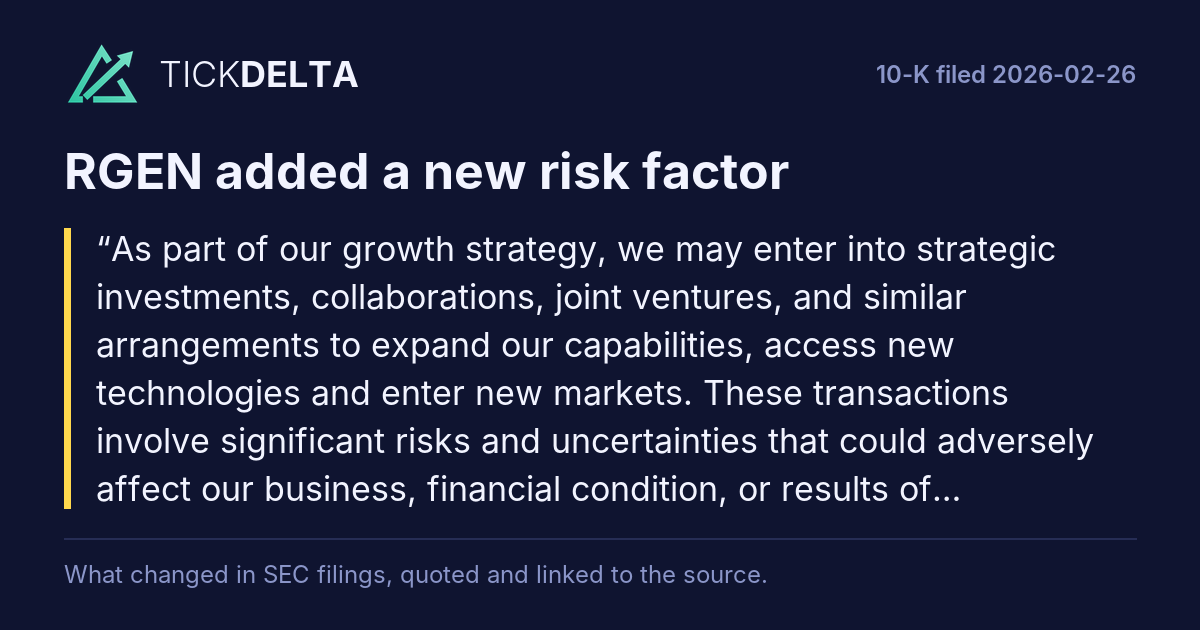
On October 29, 2026, we entered into privately negotiated exchange and subscription agreements with certain holders of our outstanding 1.00% Convertible Senior Notes due 2028 and certain new investors. Pursuant to the agreements, we expect to issue $1.0 billion aggregate principal amount of 0.25% Convertible Senior Notes due 2031 (the “New Notes”). Approximately $541.4 million principal amount of the New Notes will be issued in exchange for approximately $456.8 million principal amount of 2028 Notes (the “Exchange Transactions”) and approximately $458.6 million principal amount of the New Notes will be issued for cash (the “Subscription Transactions”, and together with the Exchange Transactions, the “Transactions”). In connection with the issuance of the New Notes, we intend to use approximately $120.0 million of the net proceeds from the Subscription Transactions to repurchase shares of its common stock from certain purchasers of the New Notes. The transactions are expected to close in November 2026, subject to customary closing conditions.
Read in the 10-Qopen_in_new