Paragraph 111 · 50% changed
Every version of it
Screener
/
SEC EDGAR
/CIK 0000730272
/10-K filed Feb 26, 2026, compared with Mar 14, 2025
/Numbers from the XBRL of the 10-Ks
Nasdaq
Health care · Biotechnology
Repligen Corp RGEN
The 10-K against last year's
181 changes: 45 added, 51 removed, 81 reworded, 4 quiet changes
10-K Feb 26, 2026 vs Mar 14, 2025
Risk Factors
22.6%
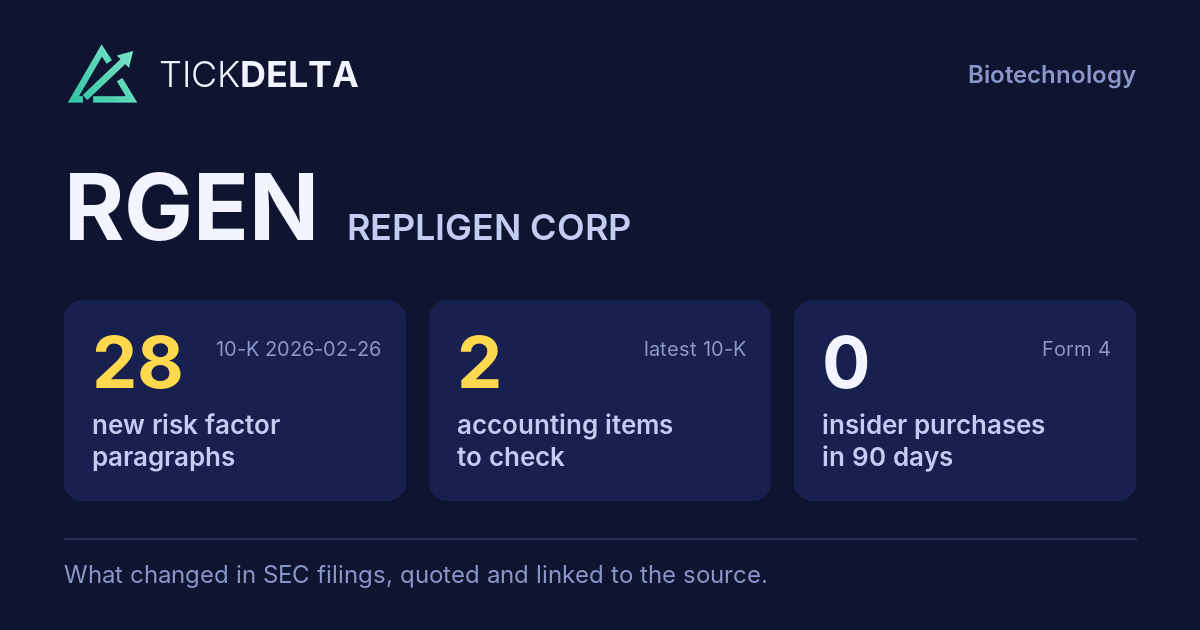
of the text changed · 12,605 words now · 28 new paragraphs, 21 gone
MD&A
48.5%
of the text changed · 5,322 words now · 17 new paragraphs, 30 gone
10-K 0001193125-26-076528 (Feb 26, 2026) vs 10-K 0000950170-25-038999 (Mar 14, 2025) Not compared: Legal Proceedings, Accounting Policies.
Every paragraph, and how much of it changed
One bar per paragraph, in the order of the 10-K. Height and colour show the share of its words not in the closest paragraph a year earlier; the tallest bars are new paragraphs.
Risk Factors
177 paragraphs · 28 new · 80 reworded · 21 gone · 10-K Feb 26, 2026 against Mar 14, 2025
New paragraph
Reworded (5% of its words or more)
Same or nearly
Paragraph 166 · 50% changed
Every version of it
Paragraph 138 · 47% changed
Every version of it
Paragraph 136 · 45% changed
Every version of it
Paragraph 171 · 44% changed
Every version of it
Paragraph 69 · 40% changed
Every version of it
In July 2023, our Board of Directors (“Board”) authorized the Company's management team to undertake we undertook restructuring activities to simplify and streamline our organization and strengthen the overall effectiveness of our operations (the “Restructuring Plan”). As part of operations. We may need to undertake another organizational restructuring in the Restructuring Plan, we consolidated a portion of our manufacturing business between certain U.S. locations and reduced our headcount. future. We may not realize, in full or in part, the anticipated benefits, savings and improvements in our cost structure from our any future restructuring efforts due to unforeseen difficulties, delays or unexpected costs. If we are unable to realize the expected operational efficiencies and cost savings from the Restructuring Plan, a restructuring, our operating results and financial condition could would be adversely affected. Furthermore, the Restructuring Plan our restructuring plan may be disruptive to our operations. Further restructuring and cost-cutting activities may be required and For example, any future headcount reductions could yield unintended consequences and costs, unanticipated consequences, such as a reduction increased difficulties in morale among our remaining employees, adverse effects to our reputation as both an employer and with respect to customers, the loss of institutional knowledge and expertise, and increased likelihood of turnover of key members of management and employees, all of which can impede our ability to successfully implement implementing our business strategy, and consequently, including retention of our business, financial condition, and results of operations remaining employees. A future restructuring may lead to employee litigation related to the headcount reduction, which could be materially costly and adversely affected. prevent management from fully concentrating on the business.
Paragraph 112 · 39% changed
Every version of it
As discussed below in Part II, Item 9A, “Controls and Procedures,” of in this report, we have identified Annual Report on Form 10-K, the material weaknesses in our internal control over financial reporting related to (i) controls weakness related to revenue recognition specific to has been remediated and no longer exists as of December 31, 2025. However, the evaluation of accounting for contract terms, (ii) information technology (“IT”) material weaknesses associated with IT general controls for information systems that are relevant to the preparation of our financial statements, and (iii) business process-level process controls related to inventory valuation and the financial statement close process either in a timely manner or with an appropriate precision threshold. As a result were not remediated as of December 31, 2025. Based on these unremediated material weaknesses, our the Company’s management concluded that our at December 31, 2025, the Company’s internal control over financial reporting was not effective as of December 31, 2024. effective.
Paragraph 163 · 39% changed
Every version of it
We consider trade secrets, know-how and other forms of market confidentiality protection to be among the most important elements of our proprietary position, in particular, position as it relates to many of the products that currently account for a majority of our revenue. We also own or have exclusive rights to U.S. a global portfolio of patents and U.S. pending patent applications as well as corresponding foreign patents and patent applications. We continue to actively and selectively pursue patent protection and seek to expand Our success depends, in part, on our patent estate, particularly for our products currently in development, and we cannot be sure that any patent applications that we will file in the future or that any currently pending applications will issue on a timely basis, if ever. We cannot be certain that we were the first to conceive the invention(s) described by each of our pending patent applications or that we were the first to file patent applications for such invention(s). Even if patents are issued, the degree of protection afforded by such patents will depend upon the: ability to:
Paragraph 111 · 50% changed
Every version of it
10-K Mar 14, 2025As discussed below in Part II, Item 9A, “Controls and Procedures,” of this report, we have identified material weaknesses in our internal control over financial reporting related to (i) controls related to revenue recognition specific to the evaluation of accounting for contract terms, (ii) information technology (“IT”) general controls for information systems that are relevant to the preparation of our financial statements, and (iii) business process-level controls related to inventory valuation and the financial statement close process either in a timely manner or with an appropriate precision threshold. As a result of these material weaknesses, our management concluded that our internal control over financial reporting was not effective as of December 31, 2024.
10-K Feb 26, 2026
3.Irrespective of the effects of the IT general controls deficiencies, management did not perform certain business process-level controls related to inventory valuation and the financial statement close process either in a timely manner or with an appropriate precision threshold.
Paragraph 166 · 50% changed
Every version of it
10-K Mar 14, 2025We consider trade secrets, know-how and other forms of market protection to be among the most important elements of our proprietary position, in particular, as it relates to many of the products that currently account for a majority of our revenue. We also own or have exclusive rights to U.S. patents and U.S. pending patent applications as well as corresponding foreign patents and patent applications. We continue to actively and selectively pursue patent protection and seek to expand our patent estate, particularly for our products currently in development, and we cannot be sure that any patent applications that we will file in the future or that any currently pending applications will issue on a timely basis, if ever. We cannot be certain that we were the first to conceive the invention(s) described by each of our pending patent applications or that we were the first to file patent applications for such invention(s). Even if patents are issued, the degree of protection afforded by such patents will depend upon the:
10-K Feb 26, 2026
Though we continue to pursue patent protection, we cannot guarantee that any patent applications will issue on a timely basis, if ever. Even if patents are issued, the degree of protection afforded by such patents will depend upon the:
Paragraph 138 · 47% changed
Every version of it
10-K Mar 14, 2025The efforts of governmental and third-party payors to contain or reduce the costs of health care may adversely affect the business and financial condition of pharmaceutical and biotechnology companies, including ours. Specifically, in both the United States and some foreign jurisdictions, there have been a number of legislative and regulatory proposals to change the health care system in ways that could affect our ability to sell our products profitably. For the Patient Protection and Affordable Care Act, as amended by the Health Care and Education Reconciliation Act of 2010 (together, the “ACA”), substantially changed the way health care is financed by both governmental and private insurers. The ACA and other federal and state proposals and health care reforms could limit the prices that can be charged for the products we develop and may limit our commercial opportunity.
10-K Feb 26, 2026
Health care reform measures could adversely affect our business. Efforts by governmental and third-party payors to contain or reduce health care costs may negatively impact pharmaceutical and biotechnology companies, including ours. Legislative and regulatory proposals in the United States and abroad continue to seek changes to health care systems that could affect our ability to sell products profitably.
Paragraph 136 · 45% changed
Every version of it
10-K Mar 14, 2025Investor advocacy groups, certain institutional investors, investment funds, other market participants and other stakeholders have focused increasingly on the Environmental, Social and Governance (“ESG”) practices of companies, including those associated with climate change. These parties have placed increased importance on the importance on the implications of the social cost of their investments. If our ESG practices do not meet investor or other industry stakeholder expectations and standards, which continue to evolve, our reputation and associate retention may be negatively impacted based on an assessment of our ESG practices. Any sustainability disclosures we make may include our policies and practices on a variety of social and ethical matters, including corporate governance, environmental compliance, employee health and safety practices, human capital management, product quality, supply chain management, and workforce inclusion. It is possible that stakeholders may not be satisfied with our ESG practices or the speed of their adoption, or that we may not sufficiently communicate our ESG practices sufficiently to stakeholders. We could also incur additional costs and require additional resources to monitor, report, and comply with various ESG practices. In addition, investors may decide to refrain from investing in us as a result of their assessment of our approach to and consideration of the ESG factors.
10-K Feb 26, 2026
employee retention may be negatively impacted. Any sustainability disclosures we make may include policies and practices on corporate governance, environmental compliance, employee health and safety, human capital management, product quality, supply chain management, and workforce inclusion. Stakeholders may not be satisfied with our ESG practices or the pace of adoption, or we may fail to communicate them effectively. Compliance with emerging ESG regulations, including the EU requirements, could result in additional costs and resource commitments for monitoring, reporting, and assurance. Investors may also refrain from investing in us based on their assessment of our ESG approach.
Paragraph 171 · 44% changed
Every version of it
10-K Mar 14, 2025Patents that may be granted to us in certain foreign countries may be subject to opposition proceedings brought by third parties or result in suits by us, which may be costly and result in adverse consequences for us.
10-K Feb 26, 2026
Relatedly, certain foreign patent applications may be subject to opposition proceedings brought by third parties, which may be costly
Paragraph 69 · 40% changed
Every version of it
10-K Mar 14, 2025
In July 2023, our Board of Directors (“Board”) authorized the Company's management team to undertake restructuring activities to simplify and streamline our organization and strengthen the overall effectiveness of our operations (the “Restructuring Plan”). As part of the Restructuring Plan, we consolidated a portion of our manufacturing business between certain U.S. locations and reduced our headcount. We may not realize, in full or in part, the anticipated benefits, savings and improvements in our cost structure from our restructuring efforts due to unforeseen difficulties, delays or unexpected costs. If we are unable to realize the expected operational efficiencies and cost savings from the Restructuring Plan, our operating results and financial condition could be adversely affected. Furthermore, the Restructuring Plan may be disruptive to our operations. Further restructuring and cost-cutting activities may be required and could yield unintended consequences and costs, such as a reduction in morale among our remaining employees, adverse effects to our reputation as both an employer and with respect to customers, the loss of institutional knowledge and expertise, and increased likelihood of turnover of key members of management and employees, all of which can impede our ability to successfully implement our business strategy, and consequently, our business, financial condition, and results of operations could be materially and adversely affected.
10-K Feb 26, 2026
In July 2023, we undertook restructuring activities to simplify and streamline our organization and strengthen the overall effectiveness of operations. We may need to undertake another organizational restructuring in the future. We may not realize, in full or in part, the anticipated benefits, savings and improvements in our cost structure from any future restructuring efforts due to unforeseen difficulties, delays or unexpected costs. If we are unable to realize the expected operational efficiencies and cost savings from a restructuring, our operating results and financial condition would be adversely affected. Furthermore, our restructuring plan may be disruptive to our operations. For example, any future headcount reductions could yield unanticipated consequences, such as increased difficulties in implementing our business strategy, including retention of our remaining employees. A future restructuring may lead to employee litigation related to the headcount reduction, which could be costly and prevent management from fully concentrating on the business.
Paragraph 112 · 39% changed
Every version of it
10-K Mar 14, 2025
As discussed below in Part II, Item 9A, “Controls and Procedures,” of this report, we have identified material weaknesses in our internal control over financial reporting related to (i) controls related to revenue recognition specific to the evaluation of accounting for contract terms, (ii) information technology (“IT”) general controls for information systems that are relevant to the preparation of our financial statements, and (iii) business process-level controls related to inventory valuation and the financial statement close process either in a timely manner or with an appropriate precision threshold. As a result of these material weaknesses, our management concluded that our internal control over financial reporting was not effective as of December 31, 2024.
10-K Feb 26, 2026
As discussed below in Part II, Item 9A, “Controls and Procedures,” in this Annual Report on Form 10-K, the material weakness related to revenue recognition has been remediated and no longer exists as of December 31, 2025. However, the material weaknesses associated with IT general controls and business process controls related to inventory valuation and the financial statement close process were not remediated as of December 31, 2025. Based on these unremediated material weaknesses, the Company’s management concluded that at December 31, 2025, the Company’s internal control over financial reporting was not effective.
Paragraph 163 · 39% changed
Every version of it
10-K Mar 14, 2025
We consider trade secrets, know-how and other forms of market protection to be among the most important elements of our proprietary position, in particular, as it relates to many of the products that currently account for a majority of our revenue. We also own or have exclusive rights to U.S. patents and U.S. pending patent applications as well as corresponding foreign patents and patent applications. We continue to actively and selectively pursue patent protection and seek to expand our patent estate, particularly for our products currently in development, and we cannot be sure that any patent applications that we will file in the future or that any currently pending applications will issue on a timely basis, if ever. We cannot be certain that we were the first to conceive the invention(s) described by each of our pending patent applications or that we were the first to file patent applications for such invention(s). Even if patents are issued, the degree of protection afforded by such patents will depend upon the:
10-K Feb 26, 2026
We consider trade secrets, know-how and other forms of confidentiality protection to be among the most important elements of our proprietary position as it relates to many of the products that currently account for a majority of our revenue. We also own or have exclusive rights to a global portfolio of patents and pending patent applications. Our success depends, in part, on our ability to:
MD&A
71 paragraphs · 17 new · 42 reworded · 30 gone · 10-K Feb 26, 2026 against Mar 14, 2025
New paragraph
Reworded (5% of its words or more)
Same or nearly
Paragraph 33 · 49% changed
In 2025, R&D expenses increased $0.5 $11.0 million, or 1.1%, during 2024, 25.4%, compared to 2023. 2024. The increase during the periods in R&D costs is primarily due to a $1.8 million increase driven by the 908 Devices PAT Portfolio and Tantti acquisitions, which have been included in employee-related costs, partially offset by a decrease in product development costs our consolidated results of $1.4 million. operations since the acquisition dates of March 2025 and December 2024, respectively.
Paragraph 38 · 48% changed
Interest expense increased $0.8 million in 2024 is primarily from 2025, compared to the same period of 2024. Interest expense includes contractual coupon interest on our outstanding convertible notes and the convertible debt outstanding as of December 31, 2024. On December 14, 2023, we entered into a privately negotiated exchange and subscription agreement with certain holders associated accretion of the 2019 Notes and certain new investors pursuant to which we issued $600.0 million aggregate principal amount discount. The discount is being accreted into interest expense using the effective interest method over the term of the 2023 Notes. Interest expense in 2024 includes $0.1 million of interest on the 2019 Notes, compared to $1.0 million of interest expense on the 2019 Notes in 2023. Interest expense in 2024 also includes $6.0 million of contractual coupon interest on the 2023 Notes for which there were no comparable amounts in 2023 as well as $13.7 million in accretion of the $82.1 million debt discount on the modified notes, which includes the accretion of an increase in principal and the accretion of increased fair value of the conversion option in 2024, for which there were no comparable costs in 2023. defined below. See Note 15, 13, “Convertible Senior Notes,” Notes” in the notes to our the consolidated financial statements statements, included within Part IV, Item 15, “Exhibits and Financial Statement Schedules”, in this report Annual Report on Form 10-K for more information on this transaction. detail.
Paragraph 43 · 48% changed
Paragraph 35 · 47% changed
In 2025, SG&A costs increased by $44.8 $27.1 million, or 20.5%, in 2024, as 10.3%, compared to 2023 2024. The increase in SG&A is primarily due driven by an investment in personnel costs to $22.4 million in costs support growth, increased headcount, and incremental professional services, primarily driven by our acquisition and integration activities. These increases were partially offset by the incremental stock-based compensation expense incurred during 2024 associated with the modification of our former Chief Executive Officer’s (“CEO”) unvested equity awards resulting from the announcement of his in connection with their transition from CEO to Executive Chair of our Board, which was announced on June 12, 2024 Board of Directors. See Note 11, “Stockholders' Equity” included within Item 15, “Exhibits and effective September 1, 2024. For more information on the former CEO’s transition to Executive Chair of our Board, see Note 13, “Stockholders’ Equity - Chief Executive Officer Accounting Modifications” included Financial Statement Schedules”, in this report. In addition, employee-related costs increased $15.9 million, and rent increased $5.9 million primarily related to the expansion of our Waltham headquarters. Annual Report on Form 10-K for more information.
Paragraph 53 · 47% changed
Our investing activities consumed $123.3 $298.5 million of cash in 2023, 2025, primarily due to $186.6 $200.3 million in cash (net of cash received) used for the 2023 acquisitions purchase of Metenova marketable securities and FlexBiosys, in $70.3 million, net of cash acquired, primarily used for the aggregate. acquisition of the 908 Devices PAT Portfolio. Capital expenditures during 2025 consumed $39.0 $25.7 million, inclusive of $2.2 million in 2023, as we continue to increase our manufacturing capacity worldwide. Of these expenditures, $2.8 million represented of capitalized costs related to our internal-use software for 2023. These uses of cash were partially offset by the maturity of our short-term investment in U.S. treasury securities in June 2023, which provided cash of $102.3 million. software.
Paragraph 21 · 46% changed
The following discussion of the financial condition and results of operations should be read in conjunction with the accompanying consolidated financial statements and the related footnotes thereto. footnotes, included within Part IV, Item 15, “Exhibits and Financial Statement Schedules”, in this Annual Report on Form 10-K. All dollar and percentage changes made herein refer to the year ended December 31, 2025, compared with the year ended December 31, 2024, unless otherwise noted.
Paragraph 20 · 46% changed
Paragraph 9 · 45% changed
Paragraph 33 · 49% changed
10-K Mar 14, 2025
R&D expenses increased $0.5 million, or 1.1%, during 2024, compared to 2023. The increase during the periods is primarily due to a $1.8 million increase in employee-related costs, partially offset by a decrease in product development costs of $1.4 million.
10-K Feb 26, 2026
In 2025, R&D expenses increased $11.0 million, or 25.4%, compared to 2024. The increase in R&D costs is primarily driven by the 908 Devices PAT Portfolio and Tantti acquisitions, which have been included in our consolidated results of operations since the acquisition dates of March 2025 and December 2024, respectively.
Paragraph 38 · 48% changed
10-K Mar 14, 2025
Interest expense in 2024 is primarily from contractual coupon interest on the convertible debt outstanding as of December 31, 2024. On December 14, 2023, we entered into a privately negotiated exchange and subscription agreement with certain holders of the 2019 Notes and certain new investors pursuant to which we issued $600.0 million aggregate principal amount of the 2023 Notes. Interest expense in 2024 includes $0.1 million of interest on the 2019 Notes, compared to $1.0 million of interest expense on the 2019 Notes in 2023. Interest expense in 2024 also includes $6.0 million of contractual coupon interest on the 2023 Notes for which there were no comparable amounts in 2023 as well as $13.7 million in accretion of the $82.1 million debt discount on the modified notes, which includes the accretion of an increase in principal and the accretion of increased fair value of the conversion option in 2024, for which there were no comparable costs in 2023. See Note 15, “Convertible Senior Notes,” to our consolidated financial statements included in this report for more information on this transaction.
10-K Feb 26, 2026
Interest expense increased $0.8 million in 2025, compared to the same period of 2024. Interest expense includes contractual coupon interest on our outstanding convertible notes and the associated accretion of the discount. The discount is being accreted into interest expense using the effective interest method over the term of the 2023 Notes, as defined below. See Note 13, “Convertible Senior Notes” in the notes to the consolidated financial statements, included within Part IV, Item 15, “Exhibits and Financial Statement Schedules”, in this Annual Report on Form 10-K for more detail.
Paragraph 43 · 48% changed
10-K Mar 14, 2025For year ended December 31, 2024, we recorded an income tax benefit of $1.5 million. The effective tax rate was 5.6% for 2024 and is based upon the net loss for the year ended December 31, 2024 and the composition of income in different jurisdictions. The difference in effective tax rates between 2024 and 2023 was primarily due to a loss before income taxes and nonrecurring nondeductible loss on extinguishment of debt and debt discount that occurred in 2023.
10-K Feb 26, 2026
The difference in effective tax rates between the periods was primarily due to the increase in income before income taxes, nontaxable contingent consideration, lower nondeductible stock-based compensation and an increase in valuation allowance offset by stock windfall tax benefits. Our effective tax rate for the year ended December 31, 2025 was more than the U.S. statutory rate of 21% primarily due to an increase in valuation allowance offset by nontaxable contingent consideration and stock windfall tax benefits.
Paragraph 35 · 47% changed
10-K Mar 14, 2025
SG&A costs increased by $44.8 million, or 20.5%, in 2024, as compared to 2023 primarily due to $22.4 million in costs associated with the modification of our former Chief Executive Officer’s (“CEO”) unvested equity awards resulting from the announcement of his transition from CEO to Executive Chair of our Board, which was announced on June 12, 2024 and effective September 1, 2024. For more information on the former CEO’s transition to Executive Chair of our Board, see Note 13, “Stockholders’ Equity - Chief Executive Officer Accounting Modifications” included in this report. In addition, employee-related costs increased $15.9 million, and rent increased $5.9 million primarily related to the expansion of our Waltham headquarters.
10-K Feb 26, 2026
In 2025, SG&A costs increased $27.1 million, or 10.3%, compared to 2024. The increase in SG&A is primarily driven by an investment in personnel costs to support growth, increased headcount, and incremental professional services, primarily driven by our acquisition and integration activities. These increases were partially offset by the incremental stock-based compensation expense incurred during 2024 associated with the modification of our former Chief Executive Officer’s (“CEO”) unvested equity awards in connection with their transition from CEO to Executive Chair of our Board of Directors. See Note 11, “Stockholders' Equity” included within Item 15, “Exhibits and Financial Statement Schedules”, in this Annual Report on Form 10-K for more information.
Paragraph 53 · 47% changed
10-K Mar 14, 2025
Our investing activities consumed $123.3 million of cash in 2023, primarily due to $186.6 million in cash (net of cash received) used for the 2023 acquisitions of Metenova and FlexBiosys, in the aggregate. Capital expenditures consumed $39.0 million in 2023, as we continue to increase our manufacturing capacity worldwide. Of these expenditures, $2.8 million represented capitalized costs related to our internal-use software for 2023. These uses of cash were partially offset by the maturity of our short-term investment in U.S. treasury securities in June 2023, which provided cash of $102.3 million.
10-K Feb 26, 2026
Our investing activities consumed $298.5 million of cash in 2025, primarily due to $200.3 million in cash used for the purchase of marketable securities and $70.3 million, net of cash acquired, primarily used for the acquisition of the 908 Devices PAT Portfolio. Capital expenditures during 2025 consumed $25.7 million, inclusive of $2.2 million of capitalized costs related to our internal-use software.
Paragraph 21 · 46% changed
10-K Mar 14, 2025
The following discussion of the financial condition and results of operations should be read in conjunction with the accompanying consolidated financial statements and the related footnotes thereto.
10-K Feb 26, 2026
The following discussion of the financial condition and results of operations should be read in conjunction with the accompanying consolidated financial statements and the related footnotes, included within Part IV, Item 15, “Exhibits and Financial Statement Schedules”, in this Annual Report on Form 10-K. All dollar and percentage changes made herein refer to the year ended December 31, 2025, compared with the year ended December 31, 2024, unless otherwise noted.
Paragraph 20 · 46% changed
10-K Mar 14, 2025See Note 2, “Summary of Significant Accounting Policies – Recent Accounting Standards Updates,” to our consolidated financial statements included in this report for more information.
10-K Feb 26, 2026
For more information about recent accounting pronouncements, refer to Note 2, “Summary of Significant Accounting Policies”, included within Part IV, Item 15, “Exhibits and Financial Statement Schedules”, in this Annual Report on Form 10-K.
Paragraph 9 · 45% changed
10-K Mar 14, 2025While our significant accounting policies are more fully described in the notes to our consolidated financial statements, we have identified the policies and estimates below as being critical to our business operations and the understanding of our results of operations. These policies require management’s most difficult, subjective or complex judgments, often as a result of the need to make estimates about the effect of matters that are inherently uncertain. The impact of and any associated risks related to these policies on our business operations are discussed throughout “Management’s Discussion and Analysis of Financial Condition and Results of Operations,” specifically in the “Results of Operations” section, where such policies affect our reported and expected financial results. Although we believe that our estimates, assumptions, and judgments are reasonable, they are based upon information presently available. Actual results may differ significantly from these estimates under different assumptions, judgments, or conditions.
10-K Feb 26, 2026
The preparation of our financial statements and related disclosures require us to make estimates, assumptions and judgments. We believe the accounting policies described below, some of which require estimates, assumptions and judgments, have the greatest potential impact on our financial statements and related disclosures. Therefore we consider these to be our critical accounting policies. Although we believe that our estimates, assumptions, and judgments are reasonable, they are based upon information presently available. Actual results may differ significantly from these estimates under different assumptions, judgments, or conditions. See Note 2, “Summary of Significant Accounting Policies” in the notes to the consolidated financial statements, included within Part IV, Item 15, “Exhibits and Financial Statement Schedules”, in this Annual Report on Form 10-K.
A paragraph is matched with the one last year that shares the most of its words; under half in common makes it new. The paragraphs shown are the 8 reworded the most in each section.
The paragraph that changed most in each section
The redline
Marked against last year's 10-K: cut words struck through, new words highlighted.
Risk Factors366 words changed in this paragraph; it is 37% similar to last year's version.
We may plan to build and integrate AI into our business practices, and the evolving nature of AI technologies and the surrounding legal and regulatory environment presents risks and uncertainties that could affect our business. The use of AI technology can give rise to intellectual property risks, including compromises to the disclosure or compromise of our confidential information or other proprietary intellectual property through the use of generative artificial intelligence tools. AI could also pose cybersecurity, data privacy, IT, regulatory, legal, operational, competitive, reputational, and intellectual property infringement. other risks and challenges that could affect our business. Specifically, risks related to bias, AI hallucinations, discrimination, harmful content, misinformation, fraud, scams, targeted attacks such as model poisoning or data poisoning, surveillance, data leakage, loss of consensus reality, inequality, environmental harms, and other harms may flow from our development, use, or deployment of AI technologies. Additionally, we expect to see increasing government regulation related to artificial intelligence use and ethics, which may also significantly increase the burden and cost of research, development and compliance in this area. For example, in the U.S., a number of states have proposed and or passed dozens of laws over the past year regulating various uses and applications of AI, AI and federal regulators have issued guidance affecting the use AI governance, including addressing deployment of AI in regulated sectors. In Europe, healthcare settings. At the EU’s Artificial Intelligence Act (“AI Act”) - which entered into force federal level, the Trump Administration has endorsed a federal moratorium on August 1, 2024 and, with some exceptions, will begin to apply as enforcement of August 2, 2026 - imposes significant obligations on providers and deployers of high-risk artificial intelligence systems, and encourages providers and deployers of artificial intelligence systems to account for EU ethical principles in their development and use of these systems. If we develop or deploy certain state-level AI systems that are governed by these laws and regulations, we may be required to adopt higher standards of data quality, transparency, and human oversight, and adhere to specific and potentially burdensome and costly ethical, accountability, and administrative requirements. Even in the absence of dedicate AI laws and regulations, we may be subject to novel legal and business risks relating to our adoption of these new technologies. Our vendors may in turn incorporate AI tools into their own offerings, and the providers of these AI tools may not meet existing or rapidly evolving regulatory or industry standards, including with respect to privacy and data security. Further, bad actors around the world use increasingly sophisticated methods, including the use of AI, to engage in illegal activities involving the theft and misuse of personal information, confidential information, and intellectual property. Any of these outcomes could damage our reputation, result in the loss of valuable property and information, and adversely impact our business. regulation,
Source: Item 1A, 10-K 0001193125-26-076528 vs Item 1A, 10-K 0000950170-25-038999
MD&A219 words changed in this paragraph; it is 52% similar to last year's version.
Total consideration transferred for acquisitions is allocated to the tangible and intangible assets acquired and liabilities assumed, if any, based on their fair values at the dates of acquisition. This purchase price allocation process requires management to make significant estimates and assumptions with respect to intangible assets. The fair value of identifiable intangible assets is based on detailed valuations that use information and assumptions determined by management. Any excess of purchase price over the fair value of the net tangible and intangible assets acquired is allocated to goodwill. While we use our best estimates and assumptions to accurately value assets acquired and liabilities assumed at the acquisition date as well as any contingent consideration, where applicable, our estimates are inherently uncertain and subject to refinement. As a result, during the measurement period, which may be up to one year from the acquisition date, we record adjustments to the assets acquired and liabilities assumed with the corresponding offset to goodwill. Upon conclusion of the measurement period or final determination of the values of assets acquired or liabilities assumed, whichever comes first, any subsequent adjustments are recorded to our consolidated statements of comprehensive income. The Company estimates the fair value of the contingent consideration earnouts using a Monte Carlo Simulation and updates the fair value of the contingent consideration at each reporting period based on the estimated probability of achieving the earnout targets and applying a discount rate that captures the risk associated with the expected contingent payments. To the extent that our estimates change in the future regarding the likelihood of achieving these targets, we may need to record material adjustments to our accrued contingent consideration. Such changes in the fair value of contingent consideration are recorded as contingent consideration in our consolidated statements of comprehensive income. The fair value of contingent consideration obligations for the year ended December 31, 2024 had a net change of $3.2 million primarily related to the change in the contingent consideration obligations from the acquisition of Avitide, Inc. (“Avitide”) in September 2021. income or loss.
Source: Item 7, 10-K 0001193125-26-076528 vs Item 7, 10-K 0000950170-25-038999
Sentences and paragraphs added, removed or reworded
Every change, by type
Sentences and paragraphs of RGEN's Risk Factors and MD&A, 10-K Feb 26, 2026 against 10-K Mar 14, 2025. Each links to the text at sec.gov.
Quiet changes are sentences kept from last year with one to four words changed, at least one of them a hedge, a modal or a qualifier (may, could, will, not, significant, material…). A year or date rolling forward is not counted.
The full word list
adverse, adversely, all, although, anticipate, anticipates, any, approximately, believe, believes, can, cannot, certain, could, expect, expects, generally, however, if, intend, intends, largely, likely, many, material, materially, may, might, most, must, never, no, not, possible, primarily, probable, should, significant, significantly, some, substantial, substantially, unlikely, will, would
AddedRisk Factors
Risks Related to Product Development, Strategic Investments, Collaborations and Acquisitions
Read it in 10-K Feb 26, 2026 at sec.gov
AddedRisk Factors
As part of our growth strategy, we may enter into strategic investments, collaborations, joint ventures, and similar arrangements to expand our capabilities, access new technologies and enter new markets. These transactions involve significant risks and uncertainties that could adversely affect our business, financial condition, or results of operations, including:
Read it in 10-K Feb 26, 2026 at sec.gov
AddedRisk Factors
•Limited Control and Alignment Challenges: In joint ventures or minority investments, we may have limited ability to influence strategic decisions or operational practices. Differences in objectives, governance structures, or priorities with partners can lead to conflicts and inefficiencies.
Read it in 10-K Feb 26, 2026 at sec.gov
AddedRisk Factors
•Financial Exposure: Investments and collaborations may underperform or fail, resulting in impairment charges or loss of invested capital. Returns may be delayed, uncertain, or significantly below expectations.
Read it in 10-K Feb 26, 2026 at sec.gov
AddedRisk Factors
•Dependence on Third Parties: Our success often depends on the performance and cooperation of partners for development, commercialization, or distribution activities. Delays, quality issues, or regulatory non-compliance by partners could negatively impact our operations.
Read it in 10-K Feb 26, 2026 at sec.gov
AddedRisk Factors
•Intellectual Property Risks: Disputes over ownership or use of intellectual property, limitations on our ability to protect or enforce rights, and potential loss of proprietary technology through licensing arrangements.
Read it in 10-K Feb 26, 2026 at sec.gov
AddedRisk Factors
•Operational and Compliance Risks: Challenges in monitoring and managing joint venture activities, exposure to unfamiliar legal, tax, and regulatory frameworks—particularly in foreign jurisdictions—and potential liability for actions taken by partners or affiliates.
Read it in 10-K Feb 26, 2026 at sec.gov
AddedRisk Factors
•Liquidity and Exit Risks: Minority investments may be illiquid, and we may be unable to sell or exit these investments on favorable terms or within desired timeframes.
Read it in 10-K Feb 26, 2026 at sec.gov
Show the other 68
AddedRisk Factors
•Reputational Risks: Actions or failures by partners or investee companies could negatively impact our reputation or business relationships.
Read it in 10-K Feb 26, 2026 at sec.gov
AddedRisk Factors
•Termination or Non-Performance: Collaborations or joint ventures may be terminated early or fail to deliver anticipated benefits, leaving us without expected products, technologies, or revenue streams.
Read it in 10-K Feb 26, 2026 at sec.gov
AddedRisk Factors
There can be no assurance that any strategic investment, collaboration, or joint venture will achieve its intended objectives or generate anticipated benefits within a reasonable timeframe, or at all. Failure to successfully manage these risks could materially and adversely affect our business and growth prospects.
Read it in 10-K Feb 26, 2026 at sec.gov
AddedRisk Factors
To mitigate these risks, we have implemented strategies to reduce tariff exposure and closely monitor trade policy developments. However, recent litigation challenging the legality of certain tariffs before the U.S. Supreme Court introduces additional uncertainty. If such tariffs are deemed unlawful, resulting policy reversals or retaliatory measures could create new risks and volatility in global trade, which may adversely affect our operations and financial results.
Read it in 10-K Feb 26, 2026 at sec.gov
RemovedRisk Factors
RemovedRisk Factors
RemovedRisk Factors
RemovedRisk Factors
RemovedRisk Factors
RemovedRisk Factors
RemovedRisk Factors
RemovedRisk Factors
RemovedRisk Factors
RemovedRisk Factors
RemovedRisk Factors
RemovedRisk Factors
RewordedRisk Factors
RewordedRisk Factors
RewordedRisk Factors
RewordedRisk Factors
We are subject to data privacy and protection security laws and regulations in various jurisdictions that apply to the collection, transmission, storage storage, security and use of proprietary information and personally-identifying information, personal data, which among other things, imposes certain requirements relating to the privacy, security and transmission of certain individually identifiable information. impose significant compliance obligations.
Read it in 10-K Feb 26, 2026 at sec.gov
RewordedRisk Factors
RewordedRisk Factors
The GDPR is wide-ranging in scope and imposes numerous requirements on companies that process personal data, including imposing special requirements in respect of the processing of health and other sensitive data, requiring that consent of individuals to whom the personal data relates is obtained in certain circumstances, requiring additional disclosures to individuals regarding data processing activities, requiring that safeguards are implemented to protect the security and confidentiality of personal data, limiting retention periods for personal data, creating mandatory data breach notification requirements in certain circumstances, and requiring that certain measures (including contractual requirements) are put in place when engaging third-party service providers.
Read it in 10-K Feb 26, 2026 at sec.gov
RewordedRisk Factors
RewordedRisk Factors
Our acquisitions strategic investments, collaborations and joint ventures with and into business expose us to risks that could adversely affect our business, and we may not achieve the anticipated benefits of acquisitions of such investments, collaborations and/or joint ventures with or into such businesses or technologies. technologies
Read it in 10-K Feb 26, 2026 at sec.gov
RewordedRisk Factors
RewordedRisk Factors
RewordedRisk Factors
Furthermore, if any of our current or future products compete with those of any of our largest customers, these customers may place fewer orders with us or cease placing orders with us, which would negatively affect our revenues and operating results.
Read it in 10-K Feb 26, 2026 at sec.gov
RewordedRisk Factors
Quiet changesRisk Factors
Quiet changesRisk Factors
We may not realize, in full or in part, the anticipated benefits, savings and improvements in our cost structure from our any future restructuring efforts due to unforeseen difficulties, delays or unexpected costs.
Read it in 10-K Feb 26, 2026 at sec.gov
Quiet changesRisk Factors
A material cyber-attack or other security incident or compromise could cause interruptions in our operations and could result in a material disruption of our business operations, damage to our reputation or a loss of revenues.
Read it in 10-K Feb 26, 2026 at sec.gov
Quiet changesRisk Factors
Such litigation could result in adverse judgments, substantial costs to us us, and diversion of our resources.
Read it in 10-K Feb 26, 2026 at sec.gov
AddedMD&A
On March 4, 2025, the Company completed its acquisition of 908 Devices Inc.’s (“908 Devices”) desktop portfolio of four devices for bioprocessing process analytical technology applications (“PAT Portfolio”). In connection with the transaction, Repligen also acquired facilities, employees, equipment and lease obligations for facilities in North Carolina and Braunschweig, Germany as well as certain working capital balances related to the PAT Portfolio. This transaction is referred to as the 908 Devices PAT Portfolio acquisition.
Read it in 10-K Feb 26, 2026 at sec.gov
AddedMD&A
The addition of these desktop assets complements and strengthens Repligen’s differentiated PAT Portfolio that provides its biopharmaceutical and CDMO customers with actionable insights to optimize development processes and improve manufacturing efficiencies.
Read it in 10-K Feb 26, 2026 at sec.gov
AddedMD&A
A change in the estimated timing or amount of demand for our products could result in additional provisions for excess inventory quantities on hand. In addition, significant unanticipated changes in demand or unexpected quality failures could have a significant impact on the value of inventory and reported operating results.
Read it in 10-K Feb 26, 2026 at sec.gov
AddedMD&A
Fair value of contingent consideration includes estimates and judgments made by management regarding the probability that future contingent payments will be made and the extent of payments to be earned in excess of defined minimum sales thresholds and achievement of defined milestones. To the extent that our estimates change in the future regarding the likelihood of achieving these targets, we may need to record material adjustments to our accrued contingent consideration. Such changes in the fair value of contingent consideration are recorded as contingent consideration in our consolidated statements of comprehensive income or loss.
Read it in 10-K Feb 26, 2026 at sec.gov
AddedMD&A
In 2025, product revenue increased by $103.8 million, or 16.4% , compared to 2024. This growth is widespread across our portfolio of products and includes significant contributions from all our franchises. Geographically, product revenue increased 15.7% in North America, 16.0% in Europe and 19.3% in Asia Pacific and the rest of the world. Related to our acquisitions, products acquired from
Read it in 10-K Feb 26, 2026 at sec.gov
AddedMD&A
908 Devices contributed $9.3 million in revenue during the year ended December 31, 2025. In addition, the year ended December 31, 2024 included $11.5 million of COVID-19 related sales.
Read it in 10-K Feb 26, 2026 at sec.gov
AddedMD&A
In 2025, cost of goods sold decreased $7.8 million, or 2.2%, compared to 2024. The decrease in cost of goods sold is primarily due to lower costs related to scrap, excess and obsolete inventory and restructuring activities in 2025, compared to those incurred in 2024. Restructuring relates to activities to simplify and streamline our organization and strengthen the overall effectiveness of our operations. These decreases were partially offset by higher export duties, direct material and labor costs.
Read it in 10-K Feb 26, 2026 at sec.gov
AddedMD&A
In 2025, gross margin was 52.3%, compared to 43.3% in 2024. The increase in gross margin resulted from the decrease in cost of goods sold as described above.
Read it in 10-K Feb 26, 2026 at sec.gov
AddedMD&A
See Note 5, “Restructuring Activities and Other Inventory-Related Charges” in the notes to the consolidated financial statements, included within Part IV, Item 15, “Exhibits and Financial Statement Schedules”, in this Annual Report on Form 10-K, for more detail.
Read it in 10-K Feb 26, 2026 at sec.gov
AddedMD&A
On July 4, 2025, the United States enacted into law new tax legislation, the One Big Beautiful Bill Act (“OBBBA”), which contains several provisions modifying the corporate income tax code such as the permanent extension of certain expiring provisions of the Tax Cuts and Jobs Act, updates to the international tax framework and the reinstatement of certain business-related provisions. The legislation has multiple effective dates, with provisions taking effect from 2025 through 2027. The changes effective in 2025 are included in our provision for income taxes for the year ended December 31, 2025 and were not material. We do not expect the OBBBA to have a material impact on our consolidated financial statements or results of operations in future periods.
Read it in 10-K Feb 26, 2026 at sec.gov
AddedMD&A
See Note 10, “Income Taxes” in the notes to the consolidated financial statements, included within Part IV, Item 15, “Exhibits and Financial Statement Schedules”, in this Annual Report on Form 10-K for more detail.
Read it in 10-K Feb 26, 2026 at sec.gov
AddedMD&A
Net (decrease) increase in cash and cash equivalents $ (191,334) $ 6,032 $ (197,366)
Read it in 10-K Feb 26, 2026 at sec.gov
RemovedMD&A
RemovedMD&A
RemovedMD&A
RemovedMD&A
RemovedMD&A
RemovedMD&A
RemovedMD&A
RemovedMD&A
RemovedMD&A
RemovedMD&A
RemovedMD&A
RemovedMD&A
RewordedMD&A
Information pertaining to fiscal years 2024 and 2023 and 2022 was included in the Company’s Annual Report on Form 10-K/A (“Form 10-K/A”) 10-K for the year ended December 31, 2023, 2024, on pages 36 39 through 50 52 under Part II, Item 7, “Management’s Discussion and Analysis of Financial Condition and Results of Operations,” which was filed with the Securities and Exchange Commission SEC on November 18, 2024 and Form 10-K for the year ended December 31, 2022, on pages 37 through 53 under Part II, Item 7, “Management’s Discussion and Analysis of Financial Condition and Results of Operations,” which was filed with the Securities and Exchange Commission on February 22, 2023, respectively. March 14, 2025.
Read it in 10-K Feb 26, 2026 at sec.gov
RewordedMD&A
For 2024, 2025, our operating activities provided cash of $175.4 $117.4 million reflecting net loss income of $25.5 $48.9 million and non-cash charges totaling $140.0 $119.4 million primarily related to depreciation, intangible depreciation and amortization, stock-based compensation, right of use asset amortization, amortization of debt discount and issuance costs, contingent consideration fair value adjustments, net unrealized foreign exchange gains and deferred income taxes, stock-based compensation charges, loss on disposal of fixed assets, and right of use asset amortization. taxes.
Read it in 10-K Feb 26, 2026 at sec.gov
RewordedMD&A
Our investing activities consumed $123.3 $298.5 million of cash in 2023, 2025, primarily due to $186.6 $200.3 million in cash (net of cash received) used for the 2023 acquisitions purchase of Metenova marketable securities and FlexBiosys, in $70.3 million, net of cash acquired, primarily used for the aggregate. acquisition of the 908 Devices PAT Portfolio.
Read it in 10-K Feb 26, 2026 at sec.gov
RewordedMD&A
See Note 15, 13, “Convertible Senior Notes,” Notes” in the notes to our the consolidated financial statements statements, included within Part IV, Item 15, “Exhibits and Financial Statement Schedules”, in this report Annual Report on Form 10-K for more information on this transaction. detail.
Read it in 10-K Feb 26, 2026 at sec.gov
RewordedMD&A
RewordedMD&A
RewordedMD&A
RewordedMD&A
These direct sales have represented 90.8% of our total product revenue during 2025 compared to 89.7% of our total product revenue during 2024 compared to 85.8% of our total product revenue in 2023. 2024.
Read it in 10-K Feb 26, 2026 at sec.gov
RewordedMD&A
RewordedMD&A
We are subject to a territorial tax system under the Tax Cuts and Jobs Act enacted in December 2017, in which we are required to provide for tax on Global Intangible Low-Taxed Income (“GILTI”) earned by certain foreign subsidiaries.
Read it in 10-K Feb 26, 2026 at sec.gov
RewordedMD&A
The following discussion of the financial condition and results of operations should be read in conjunction with the accompanying consolidated financial statements and the related footnotes thereto. footnotes, included within Part IV, Item 15, “Exhibits and Financial Statement Schedules”, in this Annual Report on Form 10-K.
Read it in 10-K Feb 26, 2026 at sec.gov
RewordedMD&A
Sources
The two latest 10-Ks on EDGAR, section by section. Each change links to the text at sec.gov.
Also
New risk factors: paragraphs with nothing like them last year, quoted in full.
Work with it
Excel workbook · CSV. Google Sheet that stays up to date: paste =IMPORTDATA("https://tickdelta.com/company/RGEN/export.csv") into a cell.