Paragraph 47 · 44% changed
Every version of it
Screener
/
SEC EDGAR
/CIK 0000315213
/10-K filed Feb 13, 2026, compared with Feb 13, 2025
/Numbers from the XBRL of the 10-Ks
NYSE
Industrials · Help Supply Services
Robert Half Inc. RHI
The 10-K against last year's
84 changes: 8 added, 3 removed, 73 reworded
10-K Feb 13, 2026 vs Feb 13, 2025
Risk Factors
21.2%
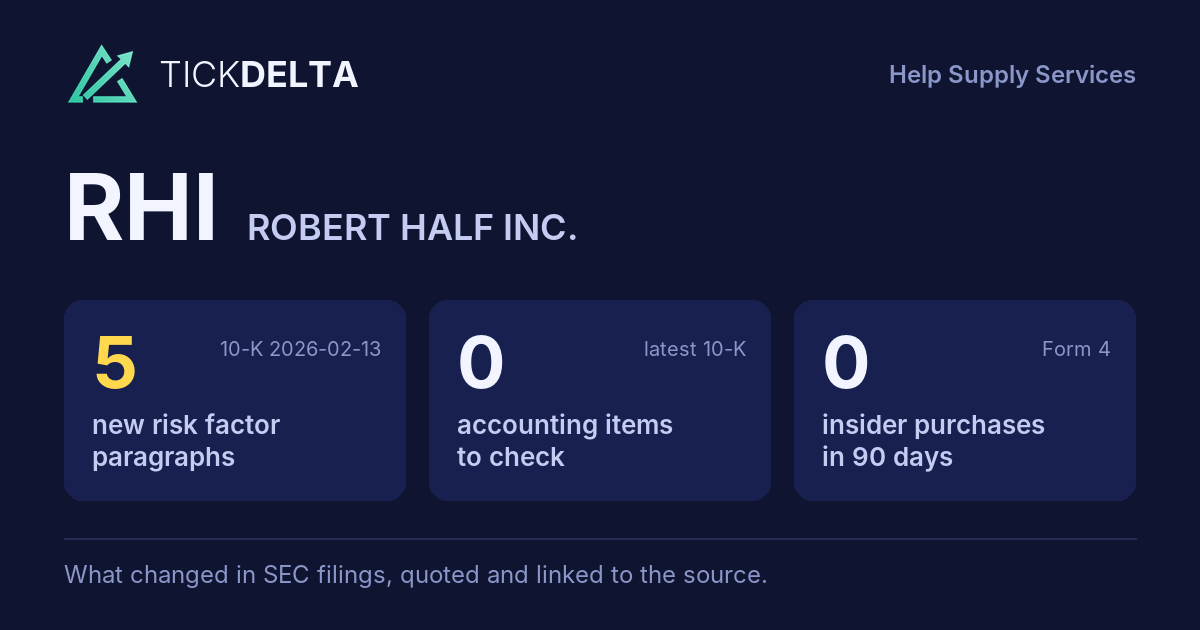
of the text changed · 7,411 words now · 5 new paragraphs, 1 gone
MD&A
12.1%
of the text changed · 6,048 words now · 3 new paragraphs, 2 gone
Legal Proceedings
18.5%
of the text changed · 773 words now
10-K 0000315213-26-000006 (Feb 13, 2026) vs 10-K 0000315213-25-000007 (Feb 13, 2025) Not compared: Accounting Policies.
Every paragraph, and how much of it changed
One bar per paragraph, in the order of the 10-K. Height and colour show the share of its words not in the closest paragraph a year earlier; the tallest bars are new paragraphs.
Risk Factors
55 paragraphs · 5 new · 34 reworded · 1 gone · 10-K Feb 13, 2026 against Feb 13, 2025
New paragraph
Reworded (5% of its words or more)
Same or nearly
Paragraph 46 · 34% changed
Every version of it
Changes in data privacy and protection laws and regulations in respect of relating to the use and control of personal information (and the failure to comply with such laws and regulations) could increase the Company’s costs or otherwise adversely impact its operations, financial results, and reputation. In the ordinary course of business, the Company collects, uses and retains personal information from its clients, employees, candidates, candidates and contractors, including, without limitation, full names, government-issued identification numbers, addresses, phone numbers, birthdates, birthdates and payroll-related information. The possession and use of personal information in conducting the Company’s business subjects it to a variety of complex and evolving domestic and foreign laws and regulations regarding data privacy. For example, the European Union’s General Data Protection Regulation (“GDPR”), which became effective in May 2018, imposes specific operational requirements for entities processing personal information, including requirements for data transfers to certain countries outside the European Union, and strong enforcement authorities and mechanisms. Complying with the enhanced obligations imposed by the GDPR and other current and future laws and regulations relating to data storage, use, transfer, residency, privacy and protection has increased and may continue to increase the Company’s operating costs and require significant management time and attention, while any failure by the Company or its subsidiaries to comply with applicable laws could result in governmental enforcement actions, fines and other penalties that could potentially have an adverse effect on the Company’s operations, financial results and reputation.
Paragraph 24 · 31% changed
Every version of it
The Company and certain subsidiaries are defendants in several lawsuits that could cause the Company to incur substantial liabilities. The Company and certain subsidiaries are defendants in several certified or putative class and representative action lawsuits brought by or on behalf of the Company’s current and former employees alleging violations of federal and state law with respect to certain wage and hour related matters, as well as claims by job applicants challenging the Company’s compliance with the Fair Credit Reporting Act. matters. The various claims made in one or more of such lawsuits include, among other things, the misclassification of certain employees as exempt employees under applicable law, failure to comply with wage statement requirements, failure to compensate certain employees for time spent performing activities related to the interviewing process (including attending the interviews themselves), and other related wage and hour violations. Such suits seek, as applicable, unspecified amounts for unpaid overtime compensation, penalties and other damages, as well as attorneys’ fees. The Company is defending several claims brought under the California Labor Code Private Attorney General Act (“PAGA”) and which authorizes individuals to file lawsuits to seek civil penalties on behalf of themselves and other employees for alleged labor code violations. It is not possible to predict the outcome of these lawsuits. However, these lawsuits may consume substantial amounts of the Company’s financial and managerial resources and might result in adverse publicity regardless of the ultimate outcome of the lawsuits. In addition, the Company and its subsidiaries may become subject to similar lawsuits in the same or other jurisdictions, or to various other claims, disputes, and legal or regulatory proceedings that arise in the ordinary course of business. An unfavorable outcome with respect to these lawsuits and any future lawsuits or regulatory proceedings could, individually or in the aggregate, cause the Company to incur substantial liabilities or impact its operations in such a way that may have a material adverse effect upon the Company’s business, financial condition or results of operations. Furthermore, any future lawsuits, claims, disputes, or legal or regulatory proceedings may also consume substantial amounts of the Company’s financial and managerial resources and might result in adverse publicity regardless of the ultimate outcome. In addition, an unfavorable outcome in one or more of these cases could cause the Company to change its compensation plans for its employees, which could have a material adverse effect upon the Company’s business.
Paragraph 17 · 30% changed
Every version of it
Paragraph 40 · 29% changed
Every version of it
Cyberattacks, including attacks motivated by the desire for monetary gain or embarrassment, geopolitics, and grievances against the business services industry in general or against the Company in particular, could potentially disable or damage the Company’s IT Assets or those of its vendors or clients, or allow unauthorized access to, or exposure of, intellectual property and personal or confidential information, including information about employees, vendors, candidates, contractors and clients. The Company’s security tools, controls and practices, including those relating to identity and access management, credential strength, and the security tools, controls and practices of its vendors and clients, may not prevent or detect access, damage or disruption to Company or third-party computer, technology, and communications hardware and software systems IT Assets or the unauthorized access to, or exposure of, intellectual property or personal or confidential information. A failure to prevent or detect unauthorized access to Company or third-party systems IT Assets could expose the Company to material operational, financial and reputational damage. There are many approaches through which such systems IT Assets or the information stored thereon could be damaged or damaged, disrupted, or information exposed or accessed, including through system vulnerabilities, configuration errors, vendor vulnerabilities, social engineering, cyberattacks, improperly obtaining cyberattacks (including cyberattacks through the use of AI), improper acquisition and using use of user credentials, malfeasance, or the misuse of authorized user access.
Paragraph 52 · 28% changed
Every version of it
Paragraph 25 · 25% changed
Every version of it
Paragraph 42 · 24% changed
Every version of it
No security program can offer a guarantee against all potential cyberattacks or other cybersecurity-related incidents. On an increasing frequency, the The Company and its third-party vendors experience security cybersecurity attacks with increasing frequency, including incidents that have resulted in unauthorized access to the Company’s or its third-party vendors’ computer, technology and communications hardware and software systems. IT Assets. To date, no such incidents have been determined to have had a material impact on the Company. Company, but there is no guarantee that such incidents will not have a material impact on the Company in the future.
Paragraph 47 · 44% changed
Every version of it
10-K Feb 13, 2025Changes in data privacy and protection laws and regulations in respect of control of personal information (and the failure to comply with such laws and regulations) could increase the Company’s costs or otherwise adversely impact its operations, financial results, and reputation. In the ordinary course of business, the Company collects, uses and retains personal information from its clients, employees, candidates, and contractors, including, without limitation, full names, government-issued identification numbers, addresses, phone numbers, birthdates, and payroll-related information. The possession and use of personal information in conducting the Company’s business subjects it to a variety of complex and evolving domestic and foreign laws and regulations regarding data privacy. For example, the European Union’s General Data Protection Regulation (“GDPR”), which became effective in May 2018, imposes specific operational requirements for entities processing personal information, including requirements for data transfers to certain countries outside the European Union, and strong enforcement authorities and mechanisms. Complying with the enhanced obligations imposed by the GDPR and other current and future laws and regulations relating to data storage, use, transfer, residency, privacy and protection has increased and may continue to increase the Company’s operating costs and require significant management time and attention, while any failure by the Company or its subsidiaries to comply with applicable laws could result in governmental enforcement actions, fines and other penalties that could potentially have an adverse effect on the Company’s operations, financial results and reputation.
10-K Feb 13, 2026
For example, the European Union’s General Data Protection Regulation (“GDPR”), which became effective in May 2018, imposes specific operational requirements on entities that process personal information (including requirements relating to data transfers to certain countries outside the European Union) and strong enforcement mechanisms. In the United States, the California Consumer Privacy Act (the “CCPA”), which became effective in January 2020, limits the collection and use of personal data and mandates that covered companies provide new disclosures to California consumers and afford such consumers new data privacy rights. Under the CCPA, a data breach affecting California residents’ personal information because of a failure to maintain reasonable security procedures and practices can trigger a private right of action lawsuit, and as a result data breach litigation is likely to increase. Many other U.S. states have enacted their own privacy laws that are in some ways similar to, and in other ways different from, the CCPA’s requirements. Compliance with the GDPR, the CCPA and other current and future laws and regulations relating to data storage, use, transfer, residency, privacy and protection has increased and may continue to increase the Company’s operating costs and may require significant management time and attention. Further, any actual or perceived failure by the Company or its subsidiaries to comply with applicable laws could result in litigation, reputational harm, governmental enforcement actions or fines, and other penalties that could potentially have an adverse effect on the Company’s operations, financial results and reputation.
Paragraph 46 · 34% changed
Every version of it
10-K Feb 13, 2025
Changes in data privacy and protection laws and regulations in respect of control of personal information (and the failure to comply with such laws and regulations) could increase the Company’s costs or otherwise adversely impact its operations, financial results, and reputation. In the ordinary course of business, the Company collects, uses and retains personal information from its clients, employees, candidates, and contractors, including, without limitation, full names, government-issued identification numbers, addresses, phone numbers, birthdates, and payroll-related information. The possession and use of personal information in conducting the Company’s business subjects it to a variety of complex and evolving domestic and foreign laws and regulations regarding data privacy. For example, the European Union’s General Data Protection Regulation (“GDPR”), which became effective in May 2018, imposes specific operational requirements for entities processing personal information, including requirements for data transfers to certain countries outside the European Union, and strong enforcement authorities and mechanisms. Complying with the enhanced obligations imposed by the GDPR and other current and future laws and regulations relating to data storage, use, transfer, residency, privacy and protection has increased and may continue to increase the Company’s operating costs and require significant management time and attention, while any failure by the Company or its subsidiaries to comply with applicable laws could result in governmental enforcement actions, fines and other penalties that could potentially have an adverse effect on the Company’s operations, financial results and reputation.
10-K Feb 13, 2026
Changes in data privacy and protection laws and regulations relating to the use and control of personal information (and the failure to comply with such laws and regulations) could increase the Company’s costs or otherwise adversely impact its operations, financial results, and reputation. In the ordinary course of business, the Company collects, uses and retains personal information from its clients, employees, candidates and contractors, including, without limitation, full names, government-issued identification numbers, addresses, phone numbers, birthdates and payroll-related information. The possession and use of personal information in conducting the Company’s business subjects it to a variety of complex and evolving domestic and foreign laws and regulations regarding data privacy.
Paragraph 24 · 31% changed
Every version of it
10-K Feb 13, 2025
The Company and certain subsidiaries are defendants in several lawsuits that could cause the Company to incur substantial liabilities. The Company and certain subsidiaries are defendants in several certified or putative class and representative action lawsuits brought by or on behalf of the Company’s current and former employees alleging violations of federal and state law with respect to certain wage and hour related matters, as well as claims by job applicants challenging the Company’s compliance with the Fair Credit Reporting Act. The various claims made in one or more of such lawsuits include, among other things, the misclassification of certain employees as exempt employees under applicable law, failure to comply with wage statement requirements, failure to compensate certain employees for time spent performing activities related to the interviewing process (including attending the interviews themselves), and other related wage and hour violations. Such suits seek, as applicable, unspecified amounts for unpaid overtime compensation, penalties and other damages, as well as attorneys’ fees. The Company is defending several claims brought under the California Labor Code Private Attorney General Act (“PAGA”) and which authorizes individuals to file lawsuits to seek civil penalties on behalf of themselves and other employees for alleged labor code violations. It is not possible to predict the outcome of these lawsuits. However, these lawsuits may consume substantial amounts of the Company’s financial and managerial resources and might result in adverse publicity regardless of the ultimate outcome of the lawsuits. In addition, the Company and its subsidiaries may become subject to similar lawsuits in the same or other jurisdictions, or to various other claims, disputes, and legal or regulatory proceedings that arise in the ordinary course of business. An unfavorable outcome with respect to these lawsuits and any future lawsuits or regulatory proceedings could, individually or in the aggregate, cause the Company to incur substantial liabilities or impact its operations in such a way that may have a material adverse effect upon the Company’s business, financial condition or results of operations. Furthermore, any future lawsuits, claims, disputes, or legal or regulatory proceedings may also consume substantial amounts of the Company’s financial and managerial resources and might result in adverse publicity regardless of the ultimate outcome. In addition, an unfavorable outcome in one or more of these cases could cause the Company to change its compensation plans for its employees, which could have a material adverse effect upon the Company’s business.
10-K Feb 13, 2026
The Company and certain subsidiaries are defendants in several lawsuits that could cause the Company to incur substantial liabilities. The Company and certain subsidiaries are defendants in several certified or putative class and representative action lawsuits brought by or on behalf of the Company’s current and former employees alleging violations of federal and state law with respect to certain wage and hour related matters. The various claims made in one or more of such lawsuits include, among other things, the misclassification of certain employees as exempt employees under applicable law, failure to comply with wage statement requirements, failure to compensate certain employees for time spent performing activities related to the interviewing process (including attending the interviews themselves), and other related wage and hour violations. Such suits seek, as applicable, unspecified amounts for unpaid overtime compensation, penalties and other damages, as well as attorneys’ fees. The Company is defending several claims brought under the California Labor Code Private Attorney
Paragraph 17 · 30% changed
Every version of it
10-K Feb 13, 2025Further, unauthorized use or misuse of AI by the Company’s employees, vendors or others may result in disclosure of confidential company and customer data, reputational harm, privacy law violations, and legal liability. The Company’s use of AI may also lead to novel and urgent cybersecurity risks, including access to or the misuse of personal data, all of which may adversely affect its operations and reputation.
10-K Feb 13, 2026
AI may also lead to novel and urgent cybersecurity risks, including access to or the misuse of personal data, all of which may adversely affect its operations and reputation.
Paragraph 40 · 29% changed
Every version of it
10-K Feb 13, 2025
strength, and the security tools, controls and practices of its vendors and clients, may not prevent or detect access, damage or disruption to Company or third-party computer, technology, and communications hardware and software systems or the unauthorized access to, or exposure of, intellectual property or personal or confidential information. A failure to prevent or detect unauthorized access to Company or third-party systems could expose the Company to material operational, financial and reputational damage. There are many approaches through which such systems could be damaged or disrupted, or information exposed or accessed, including through system vulnerabilities, configuration errors, vendor vulnerabilities, social engineering, cyberattacks, improperly obtaining and using user credentials, malfeasance, or the misuse of authorized user access.
10-K Feb 13, 2026
Cyberattacks, including attacks motivated by the desire for monetary gain or embarrassment, geopolitics, and grievances against the business services industry in general or against the Company in particular, could potentially disable or damage the Company’s IT Assets or those of its vendors or clients, or allow unauthorized access to, or exposure of, intellectual property and personal or confidential information, including information about employees, vendors, candidates, contractors and clients. The Company’s security tools, controls and practices, including those relating to identity and access management, credential strength, and the security tools, controls and practices of its vendors and clients, may not prevent or detect access, damage or disruption to Company or third-party IT Assets or the unauthorized access to, or exposure of, intellectual property or personal or confidential information. A failure to prevent or detect unauthorized access to Company or third-party IT Assets could expose the Company to material operational, financial and reputational damage. There are many approaches through which such IT Assets or the information stored thereon could be damaged, disrupted, exposed or accessed, including through system vulnerabilities, configuration errors, vendor vulnerabilities, social engineering, cyberattacks (including cyberattacks through the use of AI), improper acquisition and use of user credentials, malfeasance, or the misuse of authorized user access.
Paragraph 52 · 28% changed
Every version of it
10-K Feb 13, 2025Based Target initiative (“SBTi”). Failure to achieve such goals, or a perception (whether valid or invalid) of our failure to achieve such goals, could result in market, reputational, regulatory or liability risks, client dissatisfaction, reduced revenue and profitability, or shareholder lawsuits. If the Company is unable to achieve our environmental goals, our business and reputation may be adversely affected. There can be no assurance that climate change will not have a material adverse effect on our properties, operations or business.
10-K Feb 13, 2026
lawsuits. If the Company is unable to achieve its environmental goals, the Company’s business and reputation may be adversely affected. There can be no assurance that climate change will not have a material adverse effect on the Company’s properties, operations or business.
Paragraph 25 · 25% changed
Every version of it
10-K Feb 13, 2025The Company and certain subsidiaries are defendants in several lawsuits that could cause the Company to incur substantial liabilities. The Company and certain subsidiaries are defendants in several certified or putative class and representative action lawsuits brought by or on behalf of the Company’s current and former employees alleging violations of federal and state law with respect to certain wage and hour related matters, as well as claims by job applicants challenging the Company’s compliance with the Fair Credit Reporting Act. The various claims made in one or more of such lawsuits include, among other things, the misclassification of certain employees as exempt employees under applicable law, failure to comply with wage statement requirements, failure to compensate certain employees for time spent performing activities related to the interviewing process (including attending the interviews themselves), and other related wage and hour violations. Such suits seek, as applicable, unspecified amounts for unpaid overtime compensation, penalties and other damages, as well as attorneys’ fees. The Company is defending several claims brought under the California Labor Code Private Attorney General Act (“PAGA”) and which authorizes individuals to file lawsuits to seek civil penalties on behalf of themselves and other employees for alleged labor code violations. It is not possible to predict the outcome of these lawsuits. However, these lawsuits may consume substantial amounts of the Company’s financial and managerial resources and might result in adverse publicity regardless of the ultimate outcome of the lawsuits. In addition, the Company and its subsidiaries may become subject to similar lawsuits in the same or other jurisdictions, or to various other claims, disputes, and legal or regulatory proceedings that arise in the ordinary course of business. An unfavorable outcome with respect to these lawsuits and any future lawsuits or regulatory proceedings could, individually or in the aggregate, cause the Company to incur substantial liabilities or impact its operations in such a way that may have a material adverse effect upon the Company’s business, financial condition or results of operations. Furthermore, any future lawsuits, claims, disputes, or legal or regulatory proceedings may also consume substantial amounts of the Company’s financial and managerial resources and might result in adverse publicity regardless of the ultimate outcome. In addition, an unfavorable outcome in one or more of these cases could cause the Company to change its compensation plans for its employees, which could have a material adverse effect upon the Company’s business.
10-K Feb 13, 2026
General Act (“PAGA”) and which authorizes individuals to file lawsuits to seek civil penalties on behalf of themselves and other employees for alleged labor code violations. It is not possible to predict the outcome of these lawsuits. However, these lawsuits may consume substantial amounts of the Company’s financial and managerial resources and might result in adverse publicity regardless of the ultimate outcome of the lawsuits. In addition, the Company and its subsidiaries may become subject to similar lawsuits in the same or other jurisdictions, or to various other claims, disputes, and legal or regulatory proceedings that arise in the ordinary course of business. An unfavorable outcome with respect to these lawsuits and any future lawsuits or regulatory proceedings could, individually or in the aggregate, cause the Company to incur substantial liabilities or impact its operations in such a way that may have a material adverse effect upon the Company’s business, financial condition or results of operations. Furthermore, any future lawsuits, claims, disputes, or legal or regulatory proceedings may also consume substantial amounts of the Company’s financial and managerial resources and might result in adverse publicity regardless of the ultimate outcome. In addition, an unfavorable outcome in one or more of these cases could cause the Company to change its compensation plans for its employees, which could have a material adverse effect upon the Company’s business.
Paragraph 42 · 24% changed
Every version of it
10-K Feb 13, 2025
No security program can offer a guarantee against all potential incidents. On an increasing frequency, the Company and its third-party vendors experience security incidents that have resulted in unauthorized access to the Company’s or its third-party vendors’ computer, technology and communications hardware and software systems. To date, no such incidents have been determined to have had a material impact on the Company.
10-K Feb 13, 2026
No security program can offer a guarantee against all potential cyberattacks or other cybersecurity-related incidents. The Company and its third-party vendors experience cybersecurity attacks with increasing frequency, including incidents that have resulted in unauthorized access to the Company’s or its third-party vendors’ IT Assets. To date, no such incidents have been determined to have had a material impact on the Company, but there is no guarantee that such incidents will not have a material impact on the Company in the future.
MD&A
70 paragraphs · 3 new · 26 reworded · 2 gone · 10-K Feb 13, 2026 against Feb 13, 2025
New paragraph
Reworded (5% of its words or more)
Same or nearly
Paragraph 5 · 50% changed
Paragraph 12 · 43% changed
Paragraph 47 · 43% changed
Paragraph 4 · 37% changed
Demand for the Company’s contract talent solutions, permanent placement talent solutions and Protiviti is largely dependent upon general economic and labor trends both domestically and abroad. The U.S. real gross domestic product increased 2.3% at an annual rate of 4.4% in 2024, the third quarter of 2025 (the latest information available as of the date of this filing), compared to an increase of 2.5% 2.3% in 2023, while 2024. Concerns around a near-term economic downturn have moderated, supported by a more conducive macro environment. Continued progress in the unemployment rate rose from 3.8% in December rate-cutting cycle, easing inflation, less regulation and relatively more clarity on trade policy all contribute.
Paragraph 3 · 28% changed
The Company’s service revenues were $5.80 $5.38 billion in 2024, 2025, a decrease of 9.3% 7.2% from the prior year. Full-year 2024 2025 net income decreased 38.8% 47.1% to $252 $133 million and diluted net income per share decreased 37.1% 45.5% to $2.44. $1.33. The Company’s results were impacted by the ongoing macroeconomic uncertainty that affects client and candidate confidence, lengthening decision cycles and delaying hiring activities and projects in the short term.
Paragraph 34 · 25% changed
Gross margin dollars for contract talent solutions were $1.17 billion for the year ended December 31, 2025, down 11.4% from $1.32 billion for the year ended December 31, 2024, down 15.0% from $1.55 billion for the year ended December 31, 2023. 2024. As a percentage of revenues, gross margin dollars for contract talent solutions were 39.0% in 2025, down from 39.2% in 2024, down from 39.8% in 2023. The decrease in gross margin percentage was primarily due to lower conversions and a smaller mix of higher margin services which impacted pay-bill spreads. 2024.
Paragraph 64 · 21% changed
Paragraph 49 · 20% changed
The following tables provide reconciliations of the non-GAAP adjusted gross margin operating income to reported gross margin operating income (loss) for the years ended December 31, 2024, 2025, and 2023 (in thousands): 2024:
Paragraph 5 · 50% changed
10-K Feb 13, 20252023 to 4.1% in December 2024. Global labor markets remain resilient with U.S. job openings significantly above historical averages indicating pent-up demand for talent. In the U.S., unemployment stands at 4.1% and remains even lower for those with a college degree, where the rate is 2.4%.
10-K Feb 13, 2026
The U.S. job market remains resilient with overall unemployment at 4.4% in December 2025, up from 4.1% in December 2024. Particularly noteworthy is that the unemployment rate for college-educated professionals is holding steady at just 2.8%, with even lower rates prevailing among specialized accounting, finance and technology roles. Although current hiring and quit rates remain subdued and well below post-Covid highs, job openings continue to be well above historical levels, indicating strong pent-up hiring demand.
Paragraph 12 · 43% changed
10-K Feb 13, 2025The Organization of Economic Cooperation and Development (“OECD”), an international association of many countries, has introduced a framework to impose a 15% global minimum corporate tax, referred to as Pillar Two, effective for tax years beginning in 2024. Currently, there are no laws enacted incorporating Pillar Two in the U.S., however, certain countries in which the Company operates have adopted, or are in the process of adopting legislation to implement Pillar Two. The OECD continues to release additional guidance and countries are implementing legislation with widespread adoption of the Global Anti-Base Erosion (“GloBE”) Model Rules for Pillar Two. The Company is continuing to evaluate the GloBE Model Rules for Pillar Two and related legislation; no material tax impacts are expected.
10-K Feb 13, 2026
Previously, the Organization of Economic Cooperation and Development (“OECD”), an international association of many countries including the U.S., introduced a framework to impose a 15% global minimum corporate tax, referred to as Pillar Two, effective for tax years beginning in 2024. On January 5, 2026, the OECD released new guidance establishing the Side-by-Side (“SbS”) program under the Pillar Two global minimum tax framework. The SbS program includes a Simplified Effective Tax
Paragraph 47 · 43% changed
10-K Feb 13, 2025Selling, general and administrative expenses for Protiviti were $303 million for the year ended December 31, 2024, increasing by 5.3% from $288 million for the year ended December 31, 2023. As a percentage of revenues, selling, general and administrative expenses for Protiviti were 15.5% in 2024, up from 14.9% in 2023.
10-K Feb 13, 2026
Operating Income The Company’s operating income consists of gross margin less selling, general and administrative expenses. The Company’s reported operating income was $76 million for the year ended December 31, 2025, down 68.3% compared to $241 million for the year ended December 31, 2024. As a percentage of revenues, reported operating income was 1.4% for the year ended December 31, 2025, down from 4.2% for the year ended December 31, 2024. The Company’s adjusted operating income was $183 million for the year ended December 31, 2025, down 45.6% from $336 million for the year ended December 31, 2024. As a percentage of revenues, adjusted operating income was 3.4% for the year ended December 31, 2025, down from 5.8% for the year ended December 31, 2024. Since operating income is defined as gross margin less selling, general and administrative expenses, the year over year change is explained by factors previously discussed.
Paragraph 4 · 37% changed
10-K Feb 13, 2025
Demand for the Company’s contract talent solutions, permanent placement talent solutions and Protiviti is largely dependent upon general economic and labor trends both domestically and abroad. The U.S. real gross domestic product increased 2.3% in 2024, compared to an increase of 2.5% in 2023, while the unemployment rate rose from 3.8% in December
10-K Feb 13, 2026
Demand for the Company’s contract talent solutions, permanent placement talent solutions and Protiviti is largely dependent upon general economic and labor trends both domestically and abroad. The U.S. real gross domestic product increased at an annual rate of 4.4% in the third quarter of 2025 (the latest information available as of the date of this filing), compared to an increase of 2.3% in 2024. Concerns around a near-term economic downturn have moderated, supported by a more conducive macro environment. Continued progress in the rate-cutting cycle, easing inflation, less regulation and relatively more clarity on trade policy all contribute.
Paragraph 3 · 28% changed
10-K Feb 13, 2025
The Company’s service revenues were $5.80 billion in 2024, a decrease of 9.3% from the prior year. Full-year 2024 net income decreased 38.8% to $252 million and diluted net income per share decreased 37.1% to $2.44.
10-K Feb 13, 2026
The Company’s service revenues were $5.38 billion in 2025, a decrease of 7.2% from the prior year. Full-year 2025 net income decreased 47.1% to $133 million and diluted net income per share decreased 45.5% to $1.33. The Company’s results were impacted by the ongoing macroeconomic uncertainty that affects client and candidate confidence, lengthening decision cycles and delaying hiring activities and projects in the short term.
Paragraph 34 · 25% changed
10-K Feb 13, 2025
Gross margin dollars for contract talent solutions were $1.32 billion for the year ended December 31, 2024, down 15.0% from $1.55 billion for the year ended December 31, 2023. As a percentage of revenues, gross margin dollars for contract talent solutions were 39.2% in 2024, down from 39.8% in 2023. The decrease in gross margin percentage was primarily due to lower conversions and a smaller mix of higher margin services which impacted pay-bill spreads.
10-K Feb 13, 2026
Gross margin dollars for contract talent solutions were $1.17 billion for the year ended December 31, 2025, down 11.4% from $1.32 billion for the year ended December 31, 2024. As a percentage of revenues, gross margin dollars for contract talent solutions were 39.0% in 2025, down from 39.2% in 2024.
Paragraph 64 · 21% changed
10-K Feb 13, 2025In May 2023, the Company entered into an amendment to extend the maturity of its $100 million unsecured revolving credit facility (the “Credit Agreement”) to May 2026. Borrowings under the Credit Agreement will bear interest in accordance with the terms of the borrowing which will be calculated according to the Adjusted Term Secured Overnight Financing Rate (“SOFR”), or an alternative base rate, plus an applicable margin. The Credit Agreement is subject to certain financial covenants and the Company was in compliance with these covenants as of December 31, 2024. There were no borrowings under the Credit Agreement as of December 31, 2024, or December 31, 2023.
10-K Feb 13, 2026
On May 28, 2025, the Company entered into a $100.0 million credit agreement (the “2025 Credit Agreement”) which matures in May 2030. Borrowings under the 2025 Credit Agreement will bear interest in accordance with the terms of the borrowing, which typically will be calculated according to the adjusted term Secured Overnight Financing Rate (“SOFR”), or an alternative base rate, plus an applicable margin. The 2025 Credit Agreement is subject to certain financial covenants, and the Company was in compliance with these covenants as of December 31, 2025. The Company had no borrowings under the Credit Agreement as of December 31, 2025, and maintained $10.1 million in standby letters of credit to satisfy workers’ compensation insurer’s collateral requirements.
Paragraph 49 · 20% changed
10-K Feb 13, 2025
The following tables provide reconciliations of the non-GAAP adjusted gross margin to reported gross margin for the years ended December 31, 2024, and 2023 (in thousands):
10-K Feb 13, 2026
The following tables provide reconciliations of the non-GAAP adjusted operating income to reported operating income (loss) for the years ended December 31, 2025, and 2024:
A paragraph is matched with the one last year that shares the most of its words; under half in common makes it new. The paragraphs shown are the 8 reworded the most in each section.
The paragraph that changed most in each section
The redline
Marked against last year's 10-K: cut words struck through, new words highlighted.
Risk Factors244 words changed in this paragraph; it is 56% similar to last year's version.
The Company and certain subsidiaries are defendants in several lawsuits that could cause the Company to incur substantial liabilities. The Company and certain subsidiaries are defendants in several certified or putative class and representative action lawsuits brought by or on behalf of the Company’s current and former employees alleging violations of federal and state law with respect to certain wage and hour related matters, as well as claims by job applicants challenging the Company’s compliance with the Fair Credit Reporting Act. matters. The various claims made in one or more of such lawsuits include, among other things, the misclassification of certain employees as exempt employees under applicable law, failure to comply with wage statement requirements, failure to compensate certain employees for time spent performing activities related to the interviewing process (including attending the interviews themselves), and other related wage and hour violations. Such suits seek, as applicable, unspecified amounts for unpaid overtime compensation, penalties and other damages, as well as attorneys’ fees. The Company is defending several claims brought under the California Labor Code Private Attorney General Act (“PAGA”) and which authorizes individuals to file lawsuits to seek civil penalties on behalf of themselves and other employees for alleged labor code violations. It is not possible to predict the outcome of these lawsuits. However, these lawsuits may consume substantial amounts of the Company’s financial and managerial resources and might result in adverse publicity regardless of the ultimate outcome of the lawsuits. In addition, the Company and its subsidiaries may become subject to similar lawsuits in the same or other jurisdictions, or to various other claims, disputes, and legal or regulatory proceedings that arise in the ordinary course of business. An unfavorable outcome with respect to these lawsuits and any future lawsuits or regulatory proceedings could, individually or in the aggregate, cause the Company to incur substantial liabilities or impact its operations in such a way that may have a material adverse effect upon the Company’s business, financial condition or results of operations. Furthermore, any future lawsuits, claims, disputes, or legal or regulatory proceedings may also consume substantial amounts of the Company’s financial and managerial resources and might result in adverse publicity regardless of the ultimate outcome. In addition, an unfavorable outcome in one or more of these cases could cause the Company to change its compensation plans for its employees, which could have a material adverse effect upon the Company’s business.
Source: Item 1A, 10-K 0000315213-26-000006 vs Item 1A, 10-K 0000315213-25-000007
Legal Proceedings151 words changed in this paragraph; it is 82% similar to last year's version.
On March 23, 2015, Plaintiff Jessica Gentry, on her own behalf and on behalf of a putative class of allegedly similarly situated individuals, filed a complaint against the Company in the Superior Court of California, San Francisco County, which was subsequently amended on October 23, 2015. The complaint alleges that a putative class of current and former employees of the Company working who resided in California since March 13, 2010, were denied compensation for the time they spent interviewing “for temporary and permanent employment opportunities” in California, as well as performing activities related to the interview process. The class period runs from March 13, 2010, to present. Gentry seeks recovery on her own behalf and on behalf of the putative class in an unspecified amount for this allegedly unpaid compensation. Gentry also seeks recovery of an unspecified amount for the alleged failure of the Company to provide her and the putative class with accurate wage statements. Gentry also seeks an unspecified amount of other damages, attorneys’ fees, and statutory penalties, including penalties for allegedly not paying all wages due upon separation to former employees and statutory civil penalties on behalf of herself and other allegedly “aggrieved employees” as defined by California’s Labor Code Private Attorneys General Act (“PAGA”). On January 4, 2016, the Court denied a motion by the Company to compel all of Gentry’s claims, except the PAGA claim, to individual arbitration. On March 8, 2024, the Court issued an order certifying: (1) a class of California-based temporary employees who attended at least one uncompensated interview with a third-party client at any time since March 13, 2010; (2) a subclass of class members who held a prior temporary job assignment before interviewing for a subsequent assignment; and (3) a subclass of class members who are no longer employed by the Company (i.e., a “waiting time penalties” subclass). The first phase of the trial in the case on the issue of liability as to the Plaintiff and the class commenced on November 3, 2025. Closing arguments were delivered on January 23, 2026, at which hearing the court requested further legal briefs to be delivered February 13, 2026. The Court is permitting Robert Half to file a motion for decertification. The timing of a liability ruling is not expected until after a case management conference on March 19, 2026. If the Court’s order on the liability phase finds in favor of Plaintiff on any of her claims, the case will move on to a second phase of the trial regarding damages later this year. This phase will have its own discovery and its own separate trial. At this stage of the litigation, it is not feasible to predict the outcome of or a range of loss, should a loss occur, from this proceeding and, accordingly, no amounts have been provided in the Company’s Financial Statements. The Company believes it has meritorious defenses to the allegations and the Company intends to continue to vigorously defend against the litigation.
Source: Item 3, 10-K 0000315213-26-000006 vs Item 3, 10-K 0000315213-25-000007
MD&A125 words changed in this paragraph; it is 44% similar to last year's version.
Operating Income Before Income Taxes and Segment Income. The Company’s total operating income before consists of gross margin less selling, general and administrative expenses. The Company’s reported operating income taxes was $358 million, or 6.2% of revenues, $76 million for the year ended December 31, 2024, 2025, down from $577 million, or 9.0% of revenues, 68.3% compared to $241 million for the year ended December 31, 2023. Combined segment 2024. As a percentage of revenues, reported operating income was $337 million, or 5.8% of revenues, 1.4% for the year ended December 31, 2024, 2025, down from $555 million, or 8.7% of revenues, 4.2% for the year ended December 31, 2023. 2024. The Company’s adjusted operating income was $183 million for the year ended December 31, 2025, down 45.6% from $336 million for the year ended December 31, 2024. As a percentage of revenues, adjusted operating income was 3.4% for the year ended December 31, 2025, down from 5.8% for the year ended December 31, 2024. Since operating income is defined as gross margin less selling, general and administrative expenses, the year over year change is explained by factors previously discussed.
Source: Item 7, 10-K 0000315213-26-000006 vs Item 7, 10-K 0000315213-25-000007
Sentences and paragraphs added, removed or reworded
Every change, by type
Sentences and paragraphs of RHI's Risk Factors and MD&A, 10-K Feb 13, 2026 against 10-K Feb 13, 2025. Each links to the text at sec.gov.
Quiet changes are sentences kept from last year with one to four words changed, at least one of them a hedge, a modal or a qualifier (may, could, will, not, significant, material…). A year or date rolling forward is not counted.
The full word list
adverse, adversely, all, although, anticipate, anticipates, any, approximately, believe, believes, can, cannot, certain, could, expect, expects, generally, however, if, intend, intends, largely, likely, many, material, materially, may, might, most, must, never, no, not, possible, primarily, probable, should, significant, significantly, some, substantial, substantially, unlikely, will, would
AddedRisk Factors
In addition, the Company increasingly relies on third-party technology vendors that regularly deploy new and enhanced AI-enabled features, tools and platforms, often at a rapid pace and with limited advance notice. These technologies in some cases may be made broadly available to employees, including through embedded features in existing enterprise software or low-code or no-code development environments that enable employees to build or customize AI-enabled tools. As a result, the Company may have limited ability to fully evaluate, test, restrict, monitor or govern the security, data handling practices, model behavior, or downstream uses of such AI technologies before or after deployment.
Read it in 10-K Feb 13, 2026 at sec.gov
AddedRisk Factors
Governance, monitoring and security controls designed to manage the use of AI technologies, including controls related to data access, data retention, model training, prompt inputs and outputs, explainability, auditability and third-party risk management, are evolving and may not mature at the same pace as the deployment of new AI capabilities by vendors. This disparity may increase the risk of unauthorized or unintended use of AI, data leakage, regulatory non-compliance, intellectual property infringement, security vulnerabilities, or inconsistent application of Company policies. The Company may also incur additional costs and operational complexity through attempts to retrofit controls, implement safeguards, restrict access, or discontinue use of certain AI tools after deployment. Any failure to effectively manage these risks could adversely affect the Company’s business, results of operations, financial condition or reputation.
Read it in 10-K Feb 13, 2026 at sec.gov
AddedRisk Factors
The Company may not be able to adequately protect its intellectual property (“IP”) or may be found to infringe upon the IP rights of others, which could harm the value of the Company’s brand and adversely affect its business. The Company utilizes IP, including patents, trademarks, copyrights and trade secrets, in its business, including in the software and AI the Company uses, and in its customer lists. A combination of patent, copyright, trademark and trade secret laws in the jurisdictions in which the Company operates are critical to protecting these IP rights. However, these laws may not be adequate to protect the Company’s IP from being challenged, invalidated, infringed, diluted or misappropriated. While the Company enters into confidentiality agreements with employees, consultants and partners, such agreements may not be effective in preventing unauthorized disclosure or use of its proprietary information. If such disclosures occur, the Company may not have adequate remedies.
Read it in 10-K Feb 13, 2026 at sec.gov
AddedRisk Factors
Moreover, while it is the Company’s policy to protect and vigorously defend its IP rights, it cannot predict whether steps taken by it will be adequate to prevent misappropriation of these rights or the use by others of the Company’s IP. IP disputes and proceedings and infringement claims may result in a significant distraction for management and significant expense, which may not be recoverable regardless of whether the Company is successful. Such proceedings may be protracted with no certainty of success, and an adverse outcome could subject the Company to liabilities, force it to cease use of certain trademarks or other IP, or force it to enter into license agreements on terms which may not be favorable to the Company. Any one of these occurrences may have an adverse effect on the Company’s business, profitability, results of operation and financial condition.
Read it in 10-K Feb 13, 2026 at sec.gov
AddedRisk Factors
The Company uses open-source software in connection with its software development, which could negatively affect its ability to operate its business and subject the Company to litigation or other actions. The Company uses and may continue to use open-source software in connection with the development and operation of its platforms. Open-source software is generally licensed under open-source licenses, which could subject the Company to unfavorable conditions, including requiring it to make publicly available the source code for any modifications or derivative works the Company develops using the open-source software. The Company may face claims demanding the release of software it developed that incorporates open-source software, which could include its source code, or otherwise seeking to enforce the terms of underlying license. Litigation could be costly for the Company to defend and could require it to devote additional research and development resources to change the Company’s platforms. Further, open-source licensors typically do not provide warranties or controls regarding the origin or security of the software and related support from the licensor is often unavailable. Therefore, the Company cannot be sure that the authors of the open-source software it uses will implement or offer updates to address security risks or will not abandon further development and maintenance. Many risks associated with usage of open-source software cannot be eliminated, and may, if not effectively addressed, negatively affect the Company’s operations, reputation and financial results.
Read it in 10-K Feb 13, 2026 at sec.gov
RemovedRisk Factors
RewordedRisk Factors
RewordedRisk Factors
Show the other 27
RewordedRisk Factors
Periodic and continuous assessments are conducted by the Company on its IT Assets to identify security risks, vulnerabilities, weaknesses or gaps, and a risk-based approach is then employed to address them, recognizing that not all system and software updates can be made and not all risks or vulnerabilities, weaknesses or gaps can be eliminated in an economical or timely manner. them.
Read it in 10-K Feb 13, 2026 at sec.gov
RewordedRisk Factors
The operations of both the talent solutions business and Protiviti include services related to Sarbanes-Oxley, Anti-Money Laundering Act of 2020 reviews reviews, the Bank Secrecy Act of 1970, as amended, and related anti-money laundering regulations, the Dodd-Frank Wall Street Reform and Consumer Protection Act (the “Dodd-Frank Act”), the Foreign Corrupt Practices Act of 1977 and other regulatory compliance services.
Read it in 10-K Feb 13, 2026 at sec.gov
RewordedRisk Factors
Protiviti risks liability from allegations of damages caused by errors, omissions or misconduct by its employees or allegations of compromised client confidential or personal information while working on consulting engagements engagements, or from damages caused by its employees acting on phishing emails and cyber attacks, facilitating, allowing or allegations of compromise of client confidential information. failing to stop cyberattacks while working in a client’s environment.
Read it in 10-K Feb 13, 2026 at sec.gov
RewordedRisk Factors
The Company currently uses and intends to leverage continue using its own and third parties’ artificial intelligence (“AI”) processes and proprietary AI processes, algorithms and its own evolving and applications, as well as those of third parties’ cognitive, analytical and artificial intelligence applications parties in its daily operations for Protiviti and talent solutions, including by deploying generative AI into the Company’s talent solutions search operations.
Read it in 10-K Feb 13, 2026 at sec.gov
RewordedRisk Factors
These enacted changed and proposed changes in tax laws, treaties or regulations, or their interpretation or enforcement could impact our current or future tax positions while the proposed changes in tax laws, treaties or regulations, or their interpretation or enforcement, could have a material adverse impact on our the Company’s current or future tax positions.
Read it in 10-K Feb 13, 2026 at sec.gov
RewordedRisk Factors
There are many approaches through which such systems IT Assets or the information stored thereon could be damaged or damaged, disrupted, or information exposed or accessed, including through system vulnerabilities, configuration errors, vendor vulnerabilities, social engineering, cyberattacks, improperly obtaining cyberattacks (including cyberattacks through the use of AI), improper acquisition and using use of user credentials, malfeasance, or the misuse of authorized user access.
Read it in 10-K Feb 13, 2026 at sec.gov
RewordedRisk Factors
The Company is defending several claims brought under the California Labor Code Private Attorney General Act (“PAGA”) and which authorizes individuals to file lawsuits to seek civil penalties on behalf of themselves and other employees for alleged labor code violations.
Read it in 10-K Feb 13, 2026 at sec.gov
RewordedRisk Factors
RewordedRisk Factors
Conflicting regulations regulations, legal and regulatory uncertainty, and a lack of ESG harmonization of ESG legal and regulatory environments across the jurisdictions in which we operate the Company operates has created and, in the future may create continue to create, enhanced compliance risks and costs.
Read it in 10-K Feb 13, 2026 at sec.gov
RewordedRisk Factors
AddedMD&A
Rate Safe Harbor, an extended Transitional Country-by-Country Reporting Safe Harbor, and a Substance-based Tax Incentive Safe Harbor. The Company does not expect the SbS guidance to materially affect its tax obligations and will continue to monitor global implementation.
Read it in 10-K Feb 13, 2026 at sec.gov
AddedMD&A
On July 4, 2025, the United States enacted tax reform legislation through the One Big Beautiful Bill Act (the “Tax Act”). Included in this legislation are provisions that allow for the immediate expensing of domestic United States research and development expenses, immediate expensing of certain capital expenditures, and other changes to the U.S. taxation of profits derived from foreign operations. The Tax Act did not have a material impact on income tax expense for the year ended December 31, 2025.
Read it in 10-K Feb 13, 2026 at sec.gov
AddedMD&A
In connection with entering into the 2025 Credit Agreement, the Company terminated its prior Credit Agreement dated May 11, 2020 (as amended from time to time, the “2020 Credit Agreement”). At the time of termination, the 2020 Credit Agreement provided for up to $100 million of borrowings and the Company had no outstanding borrowings. There were no early termination fees associated with the Company’s termination of the 2020 Credit Agreement. There were no borrowings outstanding under the 2020 Credit Agreement as of December 31, 2025.
Read it in 10-K Feb 13, 2026 at sec.gov
RemovedMD&A
RemovedMD&A
RewordedMD&A
Global United States International Contract talent solutions As Reported -13.8% -14.6% -11.0% -10.6% -12.1% Billing Days Impact -0.4% -0.5% -0.4% 0.5% 0.3% 0.5% Currency Impact 0.2% -0.3% — 0.8% -1.1% As Adjusted -14.0% -15.1% -10.6% -10.8% -10.3% -12.7% Permanent placement talent solutions As Reported -14.1% -12.6% -17.8% -9.8% -9.9% -9.6% Billing Days Impact -0.4% -0.5% -0.4% 0.5% 0.4% 0.5% Currency Impact 0.2% -0.3% — 0.8% -0.9% As Adjusted -14.3% -13.1% -17.4% -9.6% -9.5% -10.0% Protiviti As Reported 1.1% 3.5% -8.5% -0.1% -2.5% 10.9% Billing Days Impact -0.5% -0.5% -0.4% 0.5% 0.3% 0.6% Currency Impact -0.5% — — — -2.7% As Adjusted 0.6% 3.0% -8.9% -0.1% -2.2% 8.8%
Read it in 10-K Feb 13, 2026 at sec.gov
RewordedMD&A
Gross margin dollars for contract talent solutions were $1.17 billion for the year ended December 31, 2025, down 11.4% from $1.32 billion for the year ended December 31, 2024, down 15.0% from $1.55 billion for the year ended December 31, 2023. 2024.
Read it in 10-K Feb 13, 2026 at sec.gov
RewordedMD&A
During the years ended December 31, 2024 2025, and 2023, 2024, the Company repurchased 1.7 million shares, at a cost of $80 million, and 3.5 million shares, at a cost of $249 million, and 3.0 million shares, at a cost of $232 million, on the open market, respectively.
Read it in 10-K Feb 13, 2026 at sec.gov
RewordedMD&A
During the years ended December 31, 2024 2025, and 2023, 2024, such repurchases totaled 0.2 million shares, at a cost of $11 million, and 0.3 million shares, at a cost of $23 million, and 0.3 million shares, at a cost of $26 million, respectively.
Read it in 10-K Feb 13, 2026 at sec.gov
RewordedMD&A
During 2024 2025 the Company decreased Company’s headcount remained relatively flat for its contract talent solutions and solutions, permanent placement talent solutions segments, and Protiviti segments when compared to prior year-end levels. levels, while administrative headcount decreased.
Read it in 10-K Feb 13, 2026 at sec.gov
RewordedMD&A
The following tables provide reconciliations of the non-GAAP adjusted gross margin operating income to reported gross margin operating income (loss) for the years ended December 31, 2024, 2025, and 2023 (in thousands): 2024:
Read it in 10-K Feb 13, 2026 at sec.gov
RewordedMD&A
(1)Changes in the Company’s employee deferred compensation plan obligations related to talent solutions operations are included in selling, general and administrative expenses, while the related investment operating income is presented separately. (loss).
Read it in 10-K Feb 13, 2026 at sec.gov
RewordedMD&A
Fluctuations in foreign currency exchange rates had the effect of decreasing increasing reported cash and cash equivalents by $21 $22 million during the year ended December 31, 2024, 2025, compared to an increase a decrease of $9 $21 million in 2023. 2024.
Read it in 10-K Feb 13, 2026 at sec.gov
RewordedMD&A
In addition, historical, current and forward-looking information about the Company’s environmental, social and governance (“ESG”) corporate responsibility and compliance programs, including targets or goals, may not be considered material for the Securities and Exchange Commission (“SEC”) or other mandatory reporting purposes and may be based on standards for measuring progress that are still developing, developing; on internal controls, diligence or processes that are evolving, evolving; on representations reviewed or provided by third parties, parties; and on assumptions that are subject to change in the future.
Read it in 10-K Feb 13, 2026 at sec.gov
RewordedMD&A
The increase decrease in Protiviti revenues for 2024 2025 was primarily due to a 2.4% increase 7.3% decrease in average hourly bill rate, partially offset by a 1.3% decrease 7.2% increase in billable hours.
Read it in 10-K Feb 13, 2026 at sec.gov
RewordedMD&A
In the U.S., 2024 2025 revenues increased 3.5% decreased 2.5% on a reported basis, and increased 3.0% decreased 2.2% on an as adjusted basis, compared to 2023. 2024.
Read it in 10-K Feb 13, 2026 at sec.gov
RewordedMD&A
International revenues for 2024 2025 revenues decreased 8.5% increased 10.9% on a reported basis, and decreased 8.9% increased 8.8% on an as adjusted basis, compared to 2023. 2024.
Read it in 10-K Feb 13, 2026 at sec.gov
Sources
The two latest 10-Ks on EDGAR, section by section. Each change links to the text at sec.gov.
Also
New risk factors: paragraphs with nothing like them last year, quoted in full.
Work with it
Excel workbook · CSV. Google Sheet that stays up to date: paste =IMPORTDATA("https://tickdelta.com/company/RHI/export.csv") into a cell.