63 paragraphs in Risk Factors of the 10-K filed Mar 2, 2026
with nothing like them in the 10-K filed Feb 28, 2025. Quoted exactly.
Paragraphs that were only edited are under 10-K change.
Compared with the Risk Factors in the latest 10-K of the other 31 Crypto companies:
a paragraph with at least half its words the same at another company is called similar, and the companies are listed under it.
A paragraph most of them have is marked boilerplate. No line means no other company has one like it.
This counts text; it does not say how serious a risk is.
Below is a summary of the principal factors that make an investment in our securities speculative or risky.
Our industry is evolving and our business model is shifting toward data center development alongside bitcoin mining.
We may be unable to compete effectively and our business and results of operations may be adversely affected.
Read in the 10-K ↗
Our expansion into data centers may divert resources from our existing operations and introduce operational complexity.
Similar paragraph at 2 of 31 other Crypto companies:
CLSK,
MARAOur success in the data center sector depends on our ability to attract qualified third-party partners and customers.
Similar paragraph at 2 of 31 other Crypto companies:
CORZ,
EXODIncorrectly estimating our data center lease capacity requirements and capital expenditures could adversely affect our results of operations.
We face potential reputational, operational, and financial risks from development of a scalable data center platform.
Read in the 10-K ↗
Global macroeconomic, geopolitical, and public health events and resulting supply chain issues could adversely affect our business, financial condition, and operations.
Changes in U.S. trade policy may have a material adverse impact on our business, financial condition and operations.
Read in the 10-K ↗
Changes to laws, regulations, or enforcement priorities may adversely impact our Bitcoin Mining and related activities.
Read in the 10-K ↗
High bitcoin transaction fees may reduce demand for bitcoin and adversely affect our operations and growth.
Bitcoin faces scaling obstacles which may adversely affect demand for bitcoin and our Bitcoin Mining operations.
We must grow our hash rate relative to the global network hash rate and increasing network difficulty to effectively compete.
Read in the 10-K ↗
Our reliance primarily on immersion-cooling exposes us to additional operational and performance risks.
Similar paragraph at 1 of 31 other Crypto companies:
MARA
Certain natural disasters, mechanical failures, cyber incidents, evolving climate and ESG requirements, and other events outside of our control could adversely affect us.
Read in the 10-K ↗
Our expanding data center operations may be subject to new or evolving regulatory frameworks.
Read in the 10-K ↗
25 more
We have issued, and may continue to issue, new shares of our common stock, which has a dilutive effect on existing stockholders.
Similar paragraph at 1 of 31 other Crypto companies:
WULF
We operate in a rapidly evolving industry and have an evolving business model and strategy, including our increasing focus on constructing and operating data centers, in addition to bitcoin mining.
Similar paragraph at 3 of 31 other Crypto companies:
CIFR,
CLSK,
CORZThe digital assets industry is rapidly evolving, and we expect the services, technologies and market dynamics associated with it to continue to change. As a result, aspects of our business model and strategy may need to evolve in order for us to remain competitive and responsive to industry developments. From time to time, we may modify elements of our business model or pursue strategic initiatives that complement our power portfolio and current operations. We are exploring opportunities to expand our revenue sources, including a business transition to constructing and operating data centers which may be used for AI/HPC applications. We cannot assure you that these or any other modifications to our strategy will be successful, that they will achieve their intended objectives, or that they will not adversely affect our business. Strategic changes may also increase the complexity of our operations and place significant demands on our management team, personnel, systems, infrastructure, financial resources, and internal controls.
Additionally, our ability to manage growth effectively is uncertain. Failure to do so could harm our reputation, limit our ability to grow, and negatively affect our operating results. We also may not successfully identify or capitalize on emerging trends or new market opportunities within the digital assets industry, the data center market, or other markets we may pursue, which could result in missed opportunities and competitive disadvantages. Changes to our business model or entry into new markets may further subject us to additional regulatory scrutiny and new or expanded compliance obligations, including licensing, permitting, and other regulatory requirements. Any of the foregoing risks could have a material adverse effect on our business, prospects, financial condition, and results of operations.
Similar paragraph at 2 of 31 other Crypto companies:
CIFR,
CLSKWe believe that transitioning to a data center business has the potential to complement our existing business model by providing more stable, long-term, and higher-margin revenue than our Bitcoin Mining operations. We also believe that leveraging our existing infrastructure to serve data center customers may offer more consistent revenue and lower risk than our traditional Bitcoin Mining business. However, this initiative is in its early stages, and the success of our data center strategy is uncertain and may not develop as anticipated. The performance of our data center business may be affected by various factors, including the availability, reliability, and timing of power supply; increased community scrutiny of data center resource use, including land, water, and power, resulting in stricter requirements from permitting authorities; supply chain disruptions, including constraints in local labor availability; changes in tariff policies or the adoption of more restrictive trade regulations; and our ability to retain or develop the specialized expertise required to operate and scale a data center business. If any of these challenges arise, or if we are otherwise unable to successfully implement or execute our data center strategy, our business, prospects, financial condition, and results of operations could be materially and adversely affected.
We may not be able to compete effectively against our current and future competitors, and if we are unable to effectively innovate or compete, our business and results of operations may be adversely affected.
The industries in which we operate are highly competitive and continuously evolving. We expect competition to further intensify as existing and new competitors introduce new offerings or enhance existing offerings and as the industries that we operate in continue to grow. As we continue to expand in our existing markets and enter new markets, we compete against an increasing number of companies operating both within North America and abroad, that may be more established or have greater financial and other resources and/or expertise. Driven by the proliferation of energy-intensive applications such as bitcoin mining and HPC, demand for energy capacity continues to outpace supply. Our competitors may have greater financial, technical, and operational resources, longer operating histories, and stronger brand recognition than we do. To compete effectively, we must accurately anticipate technological developments, supply chain disruptions and regulatory constraints, our need for additional power and continue to innovate in the design, management, and operation of data centers, including those used to support AI/HPC applications. We may face difficulties expanding and improving our data centers at the pace necessary to remain competitive. Competitors with greater resources, experience, or industry relationships may be better positioned to secure strategic acquisitions, partnerships, or customer relationships that are critical to scaling data center operations. If we are unable to innovate effectively, maintain or grow our data center operations, or compete successfully against current and future competitors, our business, financial condition, and results of operations could be materially and adversely affected. Any such developments could also negatively impact the trading price of our securities.
Similar paragraph at 1 of 31 other Crypto companies:
HUT
We generate revenue from Bitcoin Mining operations primarily through the receipt of block rewards for successfully validating transactions and adding new blocks to the Bitcoin blockchain. The total supply of bitcoin is finite, permanently capped at 21.0 million coins, and the number of new bitcoin issued per block decreases approximately every four years pursuant to the bitcoin protocol, in an event commonly referred to as a “halving.” The final bitcoin is expected to be mined around the year 2140. As of December 31, 2025, approximately 20.0 million bitcoin had been mined and were in circulation. As the bitcoin supply approaches its maximum limit, the block reward will continue to decline. Once the final new bitcoin has been issued, miners will no longer receive block rewards and will instead rely solely on transaction fees associated with the blocks they validate. Historically, transaction fees have represented a relatively small portion of total mining revenue. Although transaction fees have increased at various times due to network usage and reduced new-bitcoin issuance, we cannot predict whether such fees will increase, or remain at levels, sufficient to offset the decline in block rewards over time. If transaction fees do not rise to levels that support profitable mining operations, or if the economic incentives to mine otherwise diminish, our ability to generate revenue from Bitcoin Mining could be materially and adversely affected. In such circumstances, our business, financial condition, and results of operations could suffer, and the market price of our securities could be adversely affected.
Read in the 10-K ↗
A bitcoin miner’s likelihood of successfully validating a block and earning the associated block reward is directly correlated to the miner’s hash rate relative to the global network hash rate. As adoption of bitcoin has increased, demand for bitcoin has drawn additional mining participants into the industry, resulting in sustained growth of the global network hash rate. As more miners enter the market and more efficient mining equipment is deployed, the global network hash rate is expected to continue increasing. Consequently, unless we are able to grow our hash rate at a pace consistent with industry growth, our probability of earning block rewards will decline. To remain competitive, we believe we must continue to obtain and deploy more efficient and energy-effective miners, both to replace units that are lost to ordinary wear-and-tear and to expand our hash rate to keep pace with increases in the global network hash rate. These miners are highly specialized servers that are difficult to manufacture at scale. As a result, only a limited number of suppliers are capable of providing miners in the quantities and performance specifications required by large-scale operators. Demand for new miners typically increases in periods of elevated bitcoin prices, and we have observed corresponding increases in miner pricing during such periods. If we are unable to procure an adequate number of new miners on acceptable terms, or if we are unable to access sufficient capital to fund the acquisition and deployment of such miners, we may be unable to grow our hash rate or maintain our competitive position. Any inability to expand or maintain our hash rate could adversely affect our business, financial condition, and results of operations, and could negatively impact the market price of our securities.
Read in the 10-K ↗
We expect to require substantial additional capital to support the expansion of our operations, pursue our growth strategies, and respond to competitive pressures or unanticipated working-capital needs. The construction and development of our facilities, and continuation of our miner fleet, are capital-intensive undertakings and we anticipate that our current and future strategic growth initiatives will likewise require significant investment. Although we expect to raise additional capital to fund these initiatives, we may be unable to do so in a timely manner, in the amounts required, or on favorable terms, if at all. If we raise capital through equity financing, our stockholders may experience dilution of their ownership interests, and the market price of our common stock may decline. If we incur additional indebtedness, lenders may have priority over holders of our common stock with respect to repayment and liquidation preferences, and debt financing may be accompanied by restrictive covenants that limit our operational flexibility, including restrictions on incurring additional indebtedness or engaging in certain other corporate activities. We may also be required to comply with financial maintenance covenants, such as minimum liquidity or leverage ratios, which may not align with the interests of our stockholders. If we are unable to raise the additional capital needed to fund our strategic growth initiatives, we may be less competitive in our industry, and our business, financial condition, and results of operations could be materially and adversely affected.
Similar paragraph at 2 of 31 other Crypto companies:
ABTC,
HUTOur expansion into data centers may divert resources from our core Bitcoin Mining operations, limit our power capacity for mining, and introduce operational complexity.
Similar paragraph at 2 of 31 other Crypto companies:
CLSK,
MARAAlthough we intend to continue certain of our Bitcoin Mining operations, our strategic expansion into data center development may divert capital, personnel, infrastructure and other resources away from our mining business. In particular, allocating power capacity to data center workloads may reduce the power available for bitcoin mining, which is a highly competitive and capital-intensive industry. Reduced power availability for mining could limit our ability to deploy additional hash rate at the pace of our competitors, potentially diminishing our market position and profitability. Operating multiple distinct business lines may also increase operational complexity and place additional demands on our management, technical teams, and support personnel. Managing these competing priorities may strain our resources, increase the risk of operational inefficiencies, and negatively affect our overall performance, strategic execution, and financial results. Any such developments could materially and adversely affect our business, prospects, financial condition, and results of operations.
Similar paragraph at 2 of 31 other Crypto companies:
CLSK,
MARAOur success in the data center sector depends on our ability to attract and retain qualified third-party partners and customers.
Similar paragraph at 2 of 31 other Crypto companies:
CORZ,
EXODWe are relying on third-party consultants, vendors, and potential customers to support the development and commercialization of the data center infrastructure. Our ability to generate revenue from this initiative depends on securing long-term, creditworthy customers and partners. If we are unable to do so, or if these parties fail to perform as expected, our investment may not yield the anticipated returns.
If we incorrectly estimate our data center lease capacity requirements and related capital expenditures, our results of operations could be adversely affected.
We are continuously evaluating our data center lease capacity requirements in order to effectively manage our capital expenditures and operating results. However, we may be unable to accurately project our future capacity needs or sufficiently allocate resources to address such needs. If we underestimate these requirements, we may not be able to provide sufficient service to tenants or may be required to limit new tenants, both of which may materially and adversely impair our results of operations.
We face potential reputational, operational, and financial risks arising from our development of a scalable data center platform for data center operations.
The demand for power to support data centers, including AI/HPC workloads, has increased significantly, and we believe that by allocating a portion of our available power capacity to AI/HPC customers, while continuing to operate our bitcoin mining business, may create long-term value for our stockholders. We are in the process of developing scalable data center platforms at our Corsicana Facility and Rockdale Facility. As we pursue this expansion, we may face reputational harm, liability exposure, and adverse financial impacts arising from perceptions that we are shifting away from our core bitcoin-mining business, challenges associated with execution or integration, or increased scrutiny from investors and participants in the broader digital asset industry. Any perception that we are deprioritizing bitcoin mining could adversely affect our relationships with certain stakeholders, including investors, employees, and members of the crypto community. Data center customers also generally have heightened expectations regarding uptime, data integrity, cybersecurity, sustainability, and operational reliability. Any failure to meet these expectations, or any adverse incident involving our data center operations, could damage our reputation and credibility and negatively affect customer relationships. If we are unable to maintain or enhance our reputation, successfully execute our data-center strategy, or adapt to
Read in the 10-K ↗
Our strategic growth initiatives may require the construction, expansion or conversion of associated power facilities. These activities expose us to risks that include, among others: construction delays; shortages of parts or labor; increased equipment and materials costs, including those driven by inflation; delays in receiving data center components; labor disputes or work stoppages, including those arising from pandemics or other public health emergencies; unanticipated environmental conditions or geological issues; delays in obtaining necessary permits, licenses, and approvals from governmental agencies or utility providers; delays in site readiness that could prevent us from meeting contractual commitments; and delays or suspensions related to evaluations of prospective growth projects. Construction projects also depend heavily on the skill, reliability, and financial stability of designers, general contractors, subcontractors, and key suppliers. If any such party encounters financial difficulties, operational issues, or performance problems during the design or construction process, we could experience significant delays, cost overruns, and other adverse impacts on expected project returns. If we are unable to mitigate these risks and complete our growth initiatives on schedule and within our anticipated budget, if at all, such delays or failures could prevent us from realizing expected benefits from these initiatives and could materially and adversely affect our business, financial condition, and results of operations.
Similar paragraph at 1 of 31 other Crypto companies:
WULF
We have recorded historical operating losses and negative cash flows from operations, particularly during periods in which the value of the bitcoin we mined did not exceed the associated operating, energy, personnel, and capital costs of our Bitcoin Mining activities. As part of our strategic growth plans, we have made, and expect to continue making, significant capital investments into data center operations, increase our workforce, and support the ownership and operation of our Facilities. These investments increase our cost base and may contribute to future losses if we are unable to generate sufficient revenue to offset these expenses. We cannot assure you that our revenue will exceed our associated costs or that we will achieve or maintain profitability. Continued operating losses could materially and adversely affect our business, financial condition, and results of operations.
Read in the 10-K ↗
broader digital asset ecosystem and contributed to increased price volatility across many digital asset markets, including the market for bitcoin. A continued loss of public confidence in digital asset exchanges may negatively impact the bitcoin ecosystem as a whole and may result in sustained or increased volatility.
Read in the 10-K ↗
Our success depends on our ability to attract, retain and motivate qualified officers, managers, and skilled professionals. Competition for experienced personnel, particularly those with technical, operational, or industry-specific expertise, is intense, and we may be unable to retain existing employees or hire additional personnel on acceptable terms. The loss of key employees or our inability to effectively recruit and develop talent could impair our management capabilities, strategic execution, and other critical functions. Human capital constraints may also limit our ability to support ongoing operations or achieve our growth objectives. As our business grows and evolves, we must continue expanding and developing our leadership team and skilled workforce. If we fail to attract or retain the personnel necessary to meet these demands, our business, growth prospects, financial condition, and results of operations could be materially and adversely affected.
Read in the 10-K ↗
Our business may be adversely affected by global economic conditions, geopolitical developments and conflicts, shifts in governmental policy, trade restrictions, and public health events, including pandemics, epidemics, or other disease outbreaks. These events can contribute to port congestion, supplier shutdowns, logistics delays, and increased freight and transportation costs, all of which may result in higher expenses to procure and deploy new miners and acquire other critical materials needed for our expansion initiatives. We may also experience volatility and uncertainty in our supply chain resulting from recessions, inflation, tariffs, sanctions, and other restrictive actions by the United States or foreign governments, as well as broader social, political, and economic risks, including acts of war or regional instability. Changes in domestic or foreign policy priorities may further heighten such volatility.
Miner manufacturers have been affected by constrained semiconductor supply—particularly shortages involving the highly specialized ASIC chips used in bitcoin miners—as well as increased labor costs and broader disruptions to global supply chains. These factors have contributed to higher prices for new miners and may continue to do so. Inflationary pressures, combined with supply chain challenges, have increased the cost of goods, services, and personnel, raising both our capital expenditures and operating costs. Until these global pressures ease, we expect to continue incurring elevated costs to obtain and deploy miners, and we may face difficulties securing the materials or pricing necessary to support our growth plans. Adverse macroeconomic, public health, or geopolitical developments may also reduce market confidence in Bitcoin, shift investor preferences toward less volatile assets, and impair our access to capital or other financial markets, potentially increasing our cost of capital. Any of these events could have a material adverse effect on our business, operations, financial results, and the value of the bitcoin we mine.
Changes in U.S. trade policy, including the imposition of tariffs and the resulting consequences, may have a material adverse impact on our business, financial condition and results of operations.
To maintain and further develop our Bitcoin Mining operations, we must procure mining hardware and other specialized technology. Additionally, the development and potential expansion of our Facilities requires large quantities of construction materials, specialized electricity distribution equipment and other critical components, all of which are in high demand and may be difficult to source. While we proactively procure products and materials from our suppliers in sufficient quantities to facilitate deployment at scale, we cannot predict the effect of the existing or future U.S. tariffs on imports, or the extent to which other countries will impose quotas, duties, tariffs, taxes or other similar restrictions upon the import or export of products and materials we require for our operations, nor can we predict future trade policy or the terms of any renegotiated trade agreements and their impact on our business, financial condition, and results of operations.
Similar paragraph at 2 of 31 other Crypto companies:
CIFR,
WULF
Our ability to achieve and maintain profitability depends significantly on the market price of bitcoin. The price of bitcoin has experienced substantial historical volatility, including its recent decline beginning in October 2025, and may continue to fluctuate widely due to a variety of factors, including the actions of malicious or manipulative actors, perceived or actual scarcity, political or economic developments, regulatory changes, and market speculation that may contribute to “bubble”-type price dynamics. Unlike traditional securities exchanges, which impose rigorous listing standards and maintain extensive oversight of trading activity, many cryptocurrency trading platforms are lightly regulated or unregulated. Markets with less stringent oversight may pose increased risks of fraud, manipulation, and other abusive practices. Any such real or perceived lack of transparency, stability, or oversight could undermine confidence in the integrity of bitcoin markets and adversely affect the price of bitcoin.
As disclosed in Part I, Item 1. “Business” - “Regulatory” of this Annual Report, bitcoin and other crypto asset markets may be subject to increased scrutiny and regulation by the U.S. Congress and governmental agencies. Changes to laws, regulations, or enforcement priorities—whether directed at digital assets, mining operations, trading platforms, or participants—may adversely impact our Bitcoin Mining and related activities.
Read in the 10-K ↗
Bitcoin and the broader digital asset ecosystem have also been negatively impacted by bankruptcies, restructurings, and forced liquidations of certain cryptocurrency exchanges, lenders, funds, and other market participants, and additional failures or distress events could further depress bitcoin prices or reduce liquidity. Any sustained reduction in the price of bitcoin or market liquidity, or any associated deterioration in sentiment toward the digital asset sector, could adversely affect our reputation, increase our cost of capital, and negatively impact the profitability of our Bitcoin Mining operations.
Read in the 10-K ↗
High bitcoin transaction fees may reduce demand for bitcoin and adversely affect our Bitcoin Mining operations and growth prospects.
As block rewards on the Bitcoin blockchain decline over time, transaction fees have become an increasingly important incentive for miners to continue supporting the network. However, elevated transaction fees may limit the adoption of bitcoin as a means of
Read in the 10-K ↗
Bitcoin, like many other cryptocurrencies, faces significant scaling challenges that may lead to high transaction fees or slow transaction settlement times. The bitcoin network is limited in the number of transactions it can process per second, and efforts to increase throughput—such as increasing block size, implementing alternative scaling mechanisms, or researching techniques like sharding—may not prove effective or may introduce new risks or technical trade-offs. There is no assurance that any proposed or existing scaling solutions will successfully increase transaction capacity or be adopted by network participants. Widespread adoption of bitcoin as a means of payment depends, in part, on the ability of the network to efficiently handle growth in transaction volume. If scaling limitations persist or if technological improvements do not occur on the schedule or scale we anticipate, Bitcoin’s adoption as a payment method may stagnate or decline. Reduced adoption could decrease demand for bitcoin and negatively impact its market price. A decline in bitcoin prices could adversely affect the revenue we generate from our Bitcoin Mining operations and could materially and adversely impact our business, financial condition, results of operations, and the market price of our securities.
Read in the 10-K ↗
To remain competitive and preserve our ability to earn bitcoin rewards, we must continue to grow our deployed hash rate by acquiring and deploying new miners at a pace consistent with growth in the global network hash rate. If bitcoin prices are not sufficiently high to support ongoing capital investment in miners, or if we are unable to obtain miners in the quantities, quality, or pricing necessary to increase our hash rate, our hash rate may stagnate. Falling behind competitors in hash rate would reduce our chances of earning future bitcoin rewards, which could materially and adversely affect our business, financial condition, and results of operations.
Read in the 10-K ↗
Our reliance primarily on immersion-cooling exposes us to additional operational and performance risks.
Similar paragraph at 1 of 31 other Crypto companies:
MARA
We receive bitcoin rewards from our mining activities through participation in third-party mining pools. Mining pools allow participants to combine their processing power, and provide payouts to participants based on their contributed hash rate under the mining pool’s payout methodology. After deducting any applicable pool fees, the pool operator distributes bitcoin proportionally based on our contribution to the pool’s overall mining power, which may occur regardless of whether the mining pool successfully
Read in the 10-K ↗
Our Bitcoin Mining and data center operations require significant and continuous access to reliable electrical power and high-speed internet connectivity. Any prolonged interruption, shortage, curtailment, or capacity constraint affecting our power supply or internet access, whether due to equipment failure, weather events, grid instability, utility curtailments, regulatory actions, or other causes, could require us to reduce or suspend our operations. Any such disruption could materially and adversely affect our ability to mine bitcoin, provide data center services, generate revenue, and achieve expected returns on our infrastructure investments. If this occurs, our business and results of operations and financial condition may be materially and adversely affected.
Read in the 10-K ↗
Certain natural disasters, external events, mechanical failures, cyber incidents, and evolving climate, energy and Environmental, Social and Governance (“ESG”) requirements could adversely affect our business, financial condition, results of operations, cash flows, and prospects.
Similar paragraph at 1 of 31 other Crypto companies:
EXOD
There is ongoing regulatory uncertainty in the United States regarding climate and energy policy. Because Bitcoin Mining and data centers require substantial energy, the industries may become the target of future climate-related or energy-use regulations. New or
revised legislation or regulation could impose significant costs on us or our suppliers, including increased energy-efficiency requirements, capital investment in alternative technologies, enhanced environmental monitoring and reporting obligations, or changes in the availability or cost of electrical power. Any such regulations could also impair our ability to compete with companies operating in jurisdictions with less restrictive environmental or energy policies.
Similar paragraph at 1 of 31 other Crypto companies:
CIFR
state to formally establish such a reserve. In January 2026, new legislation was filed in Texas to expand the reserve’s scope to include other major digital assets.
Although these developments may appear favorable and may suggest a trend toward regulatory clarity, the ultimate direction, scope, and impact of digital-asset-related legislation and regulation remain uncertain. Future regulatory actions could materially affect the use, transfer, custody, mining, or classification of bitcoin and other digital assets. Such changes could, among other things, impose new licensing, reporting, or compliance obligations; restrict or prohibit certain activities; or otherwise adversely affect our business model.
Our expanding data center operations, including those supporting AI and HPC applications, may also be subject to new or evolving regulatory frameworks.
Data centers are increasingly scrutinized by federal, state, and local authorities due to concerns regarding energy consumption, land use, carbon emissions, water usage, environmental impacts, data-sovereignty considerations, and national-security-related issues. Regulators may impose new permitting requirements, energy-efficiency standards, carbon-reduction mandates, sustainability reporting rules, or operational restrictions specific to data centers, AI infrastructure, or high-density compute environments. Such regulations, particularly at the federal level or in the States of Texas and Kentucky, where our facilities operate, could increase our capital expenditures, delay development timelines, limit expansion opportunities, or require costly modifications to existing infrastructure. Any restrictions or new policy initiatives targeting large-scale compute operations, including those supporting AI/HPC workloads, could adversely affect our data center business or limit the economic viability of our strategic diversification initiatives. Given the evolving nature of digital asset and data-center regulation, and the difficulty of predicting the outcomes of ongoing or future governmental actions, we cannot assure you that future regulatory or legislative developments will not have a material adverse effect on our business, prospects, financial condition, or operations.
Read in the 10-K ↗
Bitcoin, bitcoin mining, and cryptocurrencies generally are permitted or tolerated in some jurisdictions, restricted in others, and outright banned in several countries. It is possible that federal, state, or local regulators in the United States could adopt laws, regulations, or policy actions that impose significant restrictions on, or fully prohibit, bitcoin mining or related activities. Any such action could make it impossible or impractical for us to continue operating our mining facilities without relocating our operations, which would be costly, time-consuming, and uncertain. Although bitcoin activities in the United States are currently subject to a patchwork of evolving and sometimes overlapping regulatory requirements, regulators could take new or intensified actions that severely limit or prohibit the ability to mine, acquire, own, hold, sell, transfer, or use bitcoin or other cryptocurrencies, or to exchange them for fiat currencies such as the U.S. dollar. Restrictions of this nature could materially reduce the utility, acceptance, and market value of bitcoin. Because the widespread use of bitcoin as a means of exchange remains limited globally, restrictive regulatory actions in key jurisdictions could have an outsized impact on its price and adoption. Any prohibition or material restriction on bitcoin mining, ownership, or use could result in a significant decline in the value of the bitcoin we mine or hold and could materially and adversely affect our business, prospects, financial condition, and results of operations. Such developments could also negatively impact the market price of our securities and harm investors.
Read in the 10-K ↗
We have issued, and may continue to issue, new shares of our common stock, which has a dilutive effect on existing stockholders.
Similar paragraph at 1 of 31 other Crypto companies:
WULF
At our 2025 annual meeting of stockholders, our stockholders approved a proposal to declassify our Board. In response to this vote, the Board expects to implement a declassification of the Board prior to the 2026 annual meeting of the stockholders.
Read in the 10-K ↗
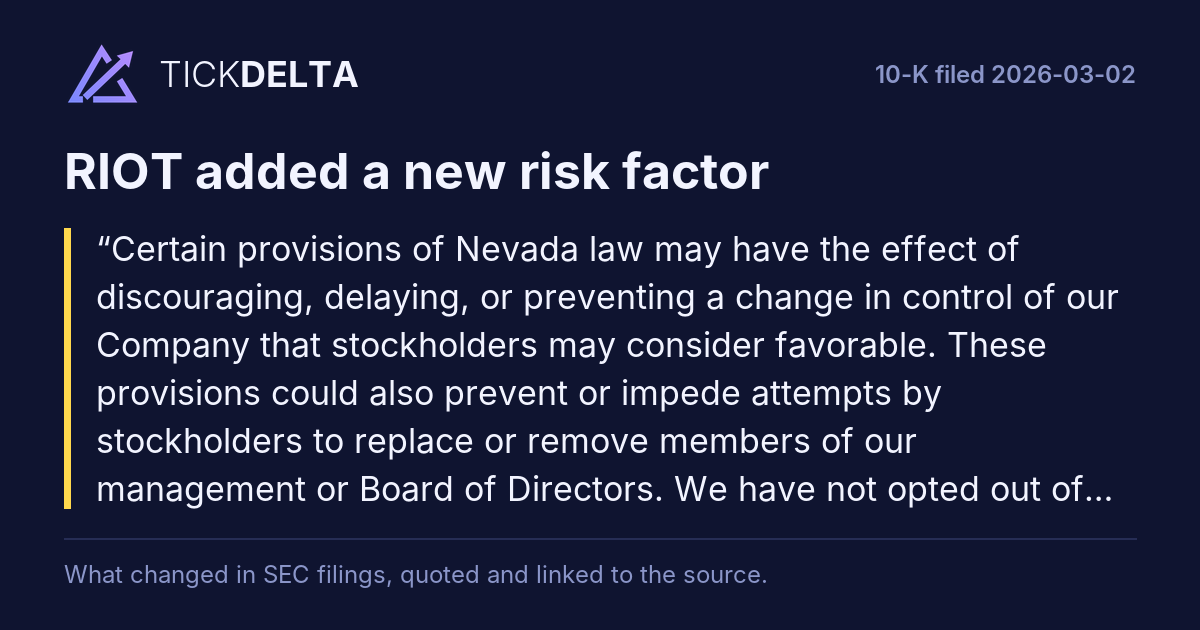
Certain provisions of Nevada law may have the effect of discouraging, delaying, or preventing a change in control of our Company that stockholders may consider favorable. These provisions could also prevent or impede attempts by stockholders to replace or remove members of our management or Board of Directors. We have not opted out of these statutory provisions in our Bylaws, as permitted under the Nevada Revised Statutes, and therefore remain fully subject to them.
Read in the 10-K ↗
New in the latest 10-Q
58 paragraphs in the 10-Q filed Nov 4, 2026 with nothing like
them in the 10-Q filed Aug 10, 2026 (at least half the words must differ; new numbers alone do not count).
Quoted exactly, grouped by the item heading above them. This is text that changed, not a judgement of how serious it is.
10-Q
(Title of each class) (Trading Symbol(s)) (Name of each exchange on which registered)
Read in the 10-Q ↗
Financial statements and notes
On October 28, 2026, Riot Corsicana, LLC (“Riot Corsicana”), a wholly owned subsidiary of the Company, entered into a long-term powered land lease agreement (the “Corsicana Lease”) with Anthropic PBC (the “Frontier AI Lab”) to provide critical IT load capacity at the Company’s Corsicana Facility. The Corsicana Lease became effective on November 4, 2026. See Note 3. Data Center Operations.
Read in the 10-Q ↗
Use of estimates The preparation of financial statements in conformity with GAAP requires management to make estimates and assumptions that affect the reported amounts of assets and liabilities, the disclosure of contingent assets and liabilities at the date of the balance sheets, and the reported amounts of revenue and expenses during the reporting periods. Actual results may differ materially from those estimates. The most significant accounting estimates inherent in the preparation of the Company’s financial statements include revenue recognition; valuation of the derivatives classified under Level 3 on the fair value hierarchy; determination of the useful lives and recoverability of long-lived assets; impairment analysis of fixed assets and finite-lived intangibles; impairment analysis of goodwill; allocating the fair value of purchase consideration to assets acquired and liabilities assumed in business acquisitions; stock-based compensation; and the valuation allowance associated with the Company’s deferred tax assets. Reclassifications Certain prior period amounts have been reclassified to conform to the current period presentation. These reclassifications did not have a material impact on the Company’s Condensed Consolidated Financial Statements and related disclosures. Significant Accounting Policies Except for the updates noted below, see the Company’s 2025 Annual Report for a detailed discussion of the Company’s significant accounting policies. Revenue Recognition Data Center Revenue The Company generates revenue from its Data Center operations by leasing certain of its property and power access to tenants. Those leases include lease and non-lease components. The Company elected the practical expedient under ASC Topic 842, Leases (“ASC 842”) to combine lease components and non-lease components, including provisioning of power and service agreements, with the same transfer pattern as lease components. If the lease components are predominant and the underlying leases qualify as operating leases, the combined component is accounted for under ASC 842 as lease revenue. Recognition begins when the asset is available for customer use. The Company classifies its leases as operating, sales-type, or direct financing at lease commencement, which determines the pattern of revenue recognition and the presentation of lease-related activity in the Condensed Consolidated Statements of Operations over the lease term. The Company provides tenant fit-out services, including the procurement and installation of equipment, in accordance with the terms of the respective lease agreements. Tenants are required to reimburse the Company for all costs incurred in the provision of these services. Tenant fit-out services do not have the same transfer pattern as the lease components and are therefore subject to recognition under ASC Topic 606, Revenue from Contracts with Customers (“ASC 606”). Tenant fit-out reimbursement revenue is recognized using the percentage-of-completion method, calculated by dividing the total costs incurred by total costs expected to be incurred, which the Company believes to be the most accurate measure of progress toward the satisfaction of the performance obligation. Contract Balances The timing of revenue recognition, billings, and cash collections results in accounts receivable, contract assets, and contract liabilities. A receivable is recorded at the invoice amount, net of an allowance for credit losses, in the period in which products or services are provided and when the right to consideration is unconditional. In instances where the timing of revenue recognition differs from the timing of invoicing, the Company has determined that its contracts do not include a significant financing component. The Company assesses collectability based on several factors, including its past transaction history with the customer and the creditworthiness of the customer. Any amounts that were previously recognized as revenue and subsequently determined to be uncollectible are charged to bad debt expense.
Read in the 10-Q ↗
delivered in January 2026 and the remaining 20 MW that was delivered in May 2026. The AMD Lease carries a term of 10 years, with three five-year extension options. The AMD Lease included an expansion option for an additional 75 MW of critical IT load capacity and a right of first refusal for another 100 MW, totaling 200 MW. In April 2026, the Company entered into an amendment to the AMD Lease (the “AMD Lease Amendment”), in which AMD exercised a portion of the existing expansion option in the AMD Lease to provide an additional deployment of 25 MW of critical IT load capacity to be delivered in phases beginning with 10 MW of critical IT load capacity expected to be delivered in November 2026 and the remaining 15 MW expected to be delivered in May 2027. Under the AMD Lease Amendment, AMD holds a remaining balance of 50 MW of reserved critical IT load capacity under the existing expansion option. The AMD Lease Amendment also grants AMD a conditional, first-priority right to lease up to an additional 100 MW of critical IT load capacity, exercisable in increments of not less than 50 MW. If both the remaining 50 MW of reserved capacity under the existing expansion option and the additional 100 MW option are fully exercised, AMD’s total leased capacity at the Rockdale Facility would increase to 200 MW. This conditional, first-priority right replaces the right of first refusal for an additional 100 MW previously granted to AMD in the AMD Lease. Under the AMD Lease (as amended by the AMD Lease Amendment, the “Amended AMD Lease”), power is provided to AMD at pass-through rates and recognized as variable lease revenue in the same period the related expenses are incurred. The Company is also required to provide tenant fit-out services to AMD. Tenant fit-out services include the procurement and installation of customer-specific equipment provided in accordance with the terms of the Amended AMD Lease. All associated costs incurred by the Company plus a margin will be reimbursable and paid by AMD. Rockdale Lease In August 2026, the Company entered into the Rockdale Lease to provide 191 MW of critical IT load capacity and operations and maintenance services at the Rockdale Facility. The Rockdale Lease includes an initial deployment of 96 MW of critical IT load capacity anticipated to be delivered in December 2027, with the remaining capacity anticipated to be delivered in June 2028. The Rockdale Lease carries an initial term of 20 years, commencing upon full deployment anticipated in June 2028, and includes provisions for two successive five-year renewal terms at the option of the Frontier AI Lab. Under the Rockdale Lease, power will be provided to the Frontier AI Lab at pass-through rates and recognized as variable lease revenue in the same period the related expenses are incurred. In connection with the Rockdale Lease, the Company entered into a senior secured delayed-draw term loan facility in an aggregate principal amount of up to $573.0 million to fund the purchase of long-lead equipment and related project equipment, and certain other expenses, associated with the data center project to be delivered under the Rockdale Lease. See Note 11. Debt for more information. Summary Data Center Operations Information The following table presents the components of the Company’s Data Center revenue: Three Months Ended Nine Months Ended September 30, September 30, 2026 2026 ──────────────────────────────────────────────────────────────────────────────────────────────────────────────────────────────── Operating lease revenue $ 7,734 $ 13,176 Variable lease revenue, including power reimbursement 522 902 Tenant fit-out reimbursement revenue 10,173 60,714 Total Data Center revenue $ 18,429 $ 74,792
Read in the 10-Q ↗
Other information
On October 28, 2026, Riot Corsicana entered into the Corsicana Lease with the Frontier AI Lab. The Corsicana Lease became effective and binding on November 4, 2026, upon satisfaction of its conditions to effectiveness, which consisted of approval by the Company’s Board of Directors and approval of the technical specifications for the premises by Riot Corsicana’s third-party consultants.
Read in the 10-Q ↗
Under the Corsicana Lease, Riot Corsicana will lease land, powered pads and related infrastructure at the Company’s Corsicana Facility to the Frontier AI Lab for the development and operation of a data center. The premises are expected to provide 910 MW of critical IT load capacity. Riot Corsicana expects to construct and deliver this capacity in three phases comprising a total of 40 blocks, with each phase delivered on a block-by-block basis, as follows:
Read in the 10-Q ↗
Phase 1, consisting of Blocks 1 through 16 and a total of 400 MW of critical IT load capacity, with the first block targeted to commence on June 28, 2027 and the full phase targeted to commence on September 11, 2027;
Read in the 10-Q ↗
Phase 3, consisting of Blocks 25 through 40 and a total of 310 MW of critical IT load capacity, with the first block and the full phase each targeted to commence on July 30, 2028.
Read in the 10-Q ↗
Financial statements and notes
The initial term commences on the commencement date of the first block and expires on the last day of the calendar month in which the 15th anniversary of the commencement date of Phase 3 occurs, and the Frontier AI Lab has two options to extend the term for five years each. The Frontier AI Lab will pay base rent of $130.0 per kilowatt of critical IT load capacity per month for each delivered block of capacity, escalating 3% annually.
Read in the 10-Q ↗
The Corsicana Lease is a triple net lease, and the Frontier AI Lab will also bear taxes, insurance, site expenses and the cost of electricity consumed at the premises. Riot Corsicana is responsible, at its own cost, for constructing and delivering the power and site infrastructure and for operating and maintaining the power infrastructure during the term. Riot Corsicana will also reimburse the Frontier AI Lab for certain costs of the data center modules of up to $4.0 million per MW of critical IT power actually achieved, subject to Riot Corsicana obtaining financing on market terms reasonably acceptable to it. If that financing is not available after Riot Corsicana uses commercially reasonable efforts to obtain it, Riot Corsicana will instead provide rent credits that amortize that amount, plus interest at 12% per year, over the remainder of the initial term.
Read in the 10-Q ↗
Revenue disaggregated by reportable segment is presented in Note 18. Segment Information.
Read in the 10-Q ↗
The following table presents the estimated future recognition of the Company’s remaining performance obligations, which represent the transaction price of current contracts for work to be performed.
Read in the 10-Q ↗
Borrowings under the $573 Million Credit Facility bear interest, at the Borrower’s election, at a rate per annum equal to (i) the Adjusted Term SOFR rate plus an applicable margin of 2.75% or (ii) the base rate plus an applicable margin of 1.75%, and mature on December 31, 2026. The Borrower is also obligated to pay an undrawn fee of 0.50% per annum on the average daily undrawn commitments, customary agency fees, and other customary fees. The Borrower’s obligations under the $573 Million Credit Facility are guaranteed by each subsidiary of the Borrower and its affiliate, RPI AUS01-0H DC LLC (together with the Borrower, the “Credit Parties”), and are secured by substantially all of the assets of the Borrower, and by the Frontier AI Lab, related to the project. The $573 Million Credit Facility matures on December 31, 2026.
Read in the 10-Q ↗
The $573 Million Credit Facility is non-recourse to the Company and its affiliates other than the Credit Parties, subject to certain customary exceptions, including for fraud, willful misrepresentation, or misappropriation of collateral proceeds. The $573 Million Credit Facility contains customary representations, warranties, covenants, and events of default, including covenant limitations on indebtedness, liens, restricted payments, investments, transactions with affiliates, and changes in the nature of the Borrower’s business.
Read in the 10-Q ↗
The carrying value of the $573 Million Credit Facility approximates its fair value as the facility incurs interest at a variable rate, which is tied to a market rate, and has a short maturity.
Read in the 10-Q ↗
The Company has a note payable with a fixed rate of 8.81 %. The note matures in December 2035, with annual principal and accrued interest payments due beginning on December 31, 2024.
Read in the 10-Q ↗
The following table presents supplemental lease information: Three Months Ended Nine Months Ended September 30, September 30, 2026 2025 2026 2025 ─────────────────────────────────────────────────────────────────────────────────────────────────────────────────────────────────────────────────────────────────── Operating leases net operating cash outflows $ 2,559 $1,201 $ 8,469 $5,240 Right-of-use assets exchanged for new operating lease liabilities $ - $1,768 $ 13,564 $7,730 New right-of-use assets associated with finance leases $ - $3,595 $ - $3,595 Weighted-average remaining lease term - operating leases 3.7 5.4 3.7 5.4 Weighted-average discount rate - operating leases 6.6% 7.3% 6.6% 7.3% The following table presents the Company’s future minimum operating lease payments as of September 30, 2026: Remainder of 2026 $3,757 2027 10,816 2028 9,093 2029 6,751 2030 2,835 Thereafter 3,742 Total undiscounted lease payments 36,994 Less present value discount (3,980) Present value of lease liabilities $33,014 Note 13. Stockholders’ Equity Common Stock The Company is authorized to issue up to 680,000,000 shares of common stock, without any par value per share. Each holder of common stock is entitled to one vote for each share held of record on all matters to be voted on by such holders. Holders of common stock are entitled to receive dividends, if declared. Upon liquidation, dissolution, or winding-up, holders of common stock are entitled to share ratably in the net assets legally available for distribution after payment of all debts and other liabilities, subject to any preferential rights of the holders of preferred stock, if any. During the nine months ended September 30, 2026, the increase of approximately 3.5 million shares of common stock outstanding was attributable to the awarding of approximately 8.2 million restricted stock awards (“RSAs”) and the issuance of approximately 1.4 million shares of common stock in settlement of an equal number of fully vested restricted stock units (“RSUs”), net of approximately 4.3 million shares, with a fair value of approximately $86.2 million, withheld to cover taxes related to the vesting and settlement of such RSAs, as permitted by the 2019 Equity Incentive Plan, as amended (the “2019 Equity Incentive Plan”). These increases were partially offset by the forfeiture of approximately 1.8 million RSAs. At-the-Market Equity (“ATM”) Program During 2025 and 2024, the Company offered and sold shares of its common stock through ATM offering programs pursuant to sales agreements with sales agents (each, an “ATM Program”). In December 2025, the Company established the 2025 ATM program, under which it could offer and sell up to $500.0 million in shares of the Company’s common stock (the “2025 ATM Program”). During the nine months ended September 30, 2026, no shares were sold under the 2025 ATM Program, and as of September 30, 2026, all $500.0 million in shares of the Company’s common stock were available for sale under the 2025 ATM Program. In August 2024, the Company established the August 2024 ATM program, under which it could offer and sell up to $750.0 million in shares of the Company’s common stock (the “August 2024 ATM Program”).
Read in the 10-Q ↗
The Company and its subsidiaries are subject at times to various claims, lawsuits and governmental proceedings relating to our business and transactions arising in the ordinary course of business. The Company cannot predict the final outcome of such proceedings. Where appropriate, the Company vigorously defends such claims, lawsuits, and proceedings. Some of these claims,
Read in the 10-Q ↗
On September 30, 2026, the court issued an Opinion and Order on the parties' pending motions. The court dismissed all claims against the Company, with prejudice. On the parties' cross-motions for summary judgment, the court granted Whinstone’s motion for summary judgment dismissing two of GMO’s breach-of-contract claims for invoice overcharges and for the installation environment, and dismissed all of Whinstone's counterclaims. The court granted GMO’s motion for partial summary judgment as to liability (but not damages), subject to certain limitations that may narrow the scope of liability, on four other breach-of-contract claims for the Louisiana power shortage; specified power draw; service uptime; and miner removal, which are subject to certain limitations that may limit liability. The court reserved GMO’s two largest claims, for wrongful termination and for a share of the power-sale proceeds, to be resolved at trial as to both liability and damages. Damages on all surviving claims remain to be determined, and as such, the Company cannot reasonably predict the outcome of such ongoing litigation, or the magnitude of such an outcome, at this time. A bench trial is scheduled to begin on January 5, 2027.
Read in the 10-Q ↗
On October 7, 2026, we entered into a Custodial Services Agreement with BitGo, which became effective on October 10, 2026, and which we amended on October 14, 2026 (as amended, the “BitGo Custodial Agreement”). Under the BitGo Custodial Agreement, BitGo serves as a custodian of our bitcoin. BitGo is a national banking association chartered and supervised by the Office of the Comptroller of the Currency and authorized to exercise trust powers. Our bitcoin is held in segregated on-chain wallets maintained solely for us. BitGo keeps the private keys in segregated cold storage wallets that it controls, and its books and records identify our bitcoin as held solely for our benefit. BitGo holds our bitcoin in a custodial capacity, separate from its own assets. Our bitcoin is not commingled with the assets of BitGo’s other customers, except temporarily as necessary to settle trades that we elect to make, or as required by law. We retain all right, title, and interest in our bitcoin.
Read in the 10-Q ↗
BitGo is required to maintain insurance coverage in such types and amounts as are commercially reasonable for its custodial services. That coverage may not be sufficient to cover our losses. Upon reasonable request, BitGo will provide us and our independent auditors with confirmation of the bitcoin held in our custodial accounts, and other information it customarily makes available to its custody clients. We reconcile the bitcoin held in custody against our records on a monthly basis. We pay BitGo a monthly tiered fee based on the value of the bitcoin held in custody, with no minimum fee.
Read in the 10-Q ↗
The BitGo Custodial Agreement has an initial term of one year from October 10, 2026, and renews automatically for successive one-year terms unless either party gives notice of non-renewal at least 60 days before the end of the then-current term. We may terminate it at any time on 14 days’ prior written notice, without an early termination fee. Either party may terminate it if the other party fails to cure a material breach within 30 days after notice. BitGo may also suspend or terminate our account in certain circumstances, including as required by law. We have agreed to indemnify BitGo for losses arising from, among other things, our use of its services and our breach of the agreement. BitGo’s liability is generally limited to the fees we paid during the preceding six months. That limit does not apply to fraud or willful misconduct. For gross negligence, BitGo’s liability is limited to the market value of the affected assets.
Read in the 10-Q ↗
Our strategy with respect to the bitcoin we mine and hold (our “Bitcoin Treasury Strategy”) is designed to balance the potential for long-term value appreciation with our need for operational flexibility and liquidity. Historically, we retained a substantial portion of the bitcoin we mined and selectively sold, or pledged as collateral, portions of our bitcoin holdings to fund operating needs, capital expenditures, and strategic initiatives. As our business has shifted toward the development of data center infrastructure, we have increasingly relied on sales of our bitcoin as a source of liquidity. During the nine months ended September 30, 2026, we sold 20,264 bitcoin for proceeds of approximately $1.5 billion, primarily to fund our data center development and to repay in full the $200 Million Credit Facility, reducing our bitcoin holdings to 2,418 bitcoin as of September 30, 2026. We currently expect to continue to sell substantially all of the bitcoin we mine to fund our data center development and other projects, operating expenses, and working capital needs, and, as a result, we do not expect to accumulate significant bitcoin holdings in the near term.
Read in the 10-Q ↗
This approach allows us to use our bitcoin production as a source of funding for our operations and growth initiatives and reduces our need to rely on external debt or equity financing. We regularly evaluate our Bitcoin Treasury Strategy in light of our cash requirements, market conditions, and capital allocation objectives, and we may change it at any time.
Read in the 10-Q ↗
the underlying facility requirements for bitcoin mining and data center workloads, including large electrical loads, advanced cooling systems, and high-density rack deployments.
Read in the 10-Q ↗
Texas legislators, regulators and state officials have recently taken several actions affecting large electrical loads in the ERCOT region, including bitcoin mining and data center facilities. The developments that we currently believe are most relevant to our operations and development plans are summarized below. See also Part II, Item 1A. “Risk Factors” of this Quarterly Report.
Read in the 10-Q ↗
Interconnection standards. In 2025, the Texas legislature enacted Senate Bill 6 (“SB 6”), which, among other things, requires the PUCT and ERCOT to establish new interconnection requirements for large loads. In September 2026, the PUCT adopted final large load interconnection standards implementing SB 6 (PUCT Project No. 58481). The standards apply to new or expanded loads of 75 MW or more at a single site in the ERCOT region and require, among other things, a $100,000 study fee; financial security of $50,000 per MW of requested peak demand (or, upon execution of an interconnection agreement, the greater of that amount and allocated transmission upgrade costs); officer-attested technical disclosures; advance payment of direct interconnection costs; and minimum billing demand commitments. Posted security may be forfeited or applied if a project is withdrawn after transmission capacity is allocated or is not energized within 24 months of its scheduled energization date. ERCOT has also implemented a batch study process, announced in December 2025, under which large load interconnection requests are evaluated together on a portfolio basis. Following the initial study cycle (“Batch Zero”), ERCOT is conducting subsequent study cycles, the rules for which remain under development. The existing capacity at our Rockdale Facility and Corsicana Facility is already interconnected and energized. The additional MWs of capacity planned for the expansion of the Corsicana Facility was studied and approved by ERCOT under its prior large load interconnection process, are not subject to the Batch Zero study process, and are classified as base load. Any new site in Texas, or any other expansion that requires a new or modified interconnection, would be subject to these standards and would be studied in a later batch, which would require us to post financial security before interconnection and could extend our development timelines.
Read in the 10-Q ↗
Audit and permitting directives. In August 2026, the Governor directed the PUCT and ERCOT to audit data center projects in ERCOT’s Batch Zero interconnection study and to deny interconnection to projects that fail to meet applicable requirements. On August 20, 2026, the PUCT granted ERCOT’s request for good cause exceptions to Batch Zero deadlines to allow time to complete the audit, which has delayed the Batch Zero study and the resulting capacity allocations. ERCOT expects to complete the audit in or around December 2026. Because the existing capacity at our Rockdale Facility and Corsicana Facility was already energized, it is not subject to the audit. On September 21, 2026, the Governor further directed the Texas Commission on Environmental Quality (“TCEQ”) to suspend the issuance of permits sought by data center projects pending completion of the audit and the Texas Water Development Board’s evaluation of the impact of data centers on municipal water supplies.
Read in the 10-Q ↗
Water-use reporting. Texas officials have intensified enforcement of the Texas Water Development Board’s mandatory water-use survey requirements, and the Texas Office of the Attorney General (“OAG”) has opened an investigation into data center compliance with those requirements. We have completed the survey in each of the past two years and, to our knowledge, the investigation does not currently include the counties in which we operate.
Read in the 10-Q ↗
Transmission cost allocation and curtailment. SB 6 requires the PUCT to amend its wholesale transmission cost-allocation rules by December 31, 2026. The PUCT is considering measures that could require large loads to bear a greater share of transmission upgrade costs, pay minimum demand charges based on contracted peak demand for a period of 20 years, and replace the current four coincident peak (“4CP”) cost-allocation methodology with a twelve coincident peak (“12CP”) methodology. Our participation in ERCOT’s 4CP Program reduces the transmission charges on our power bills in the following year. See “Strategic Goals and Initiatives - Power Strategy” above for further information. If the PUCT adopts a 12CP methodology, we expect our transmission-related charges to increase and the benefit of our 4CP-avoidance strategy to decline, which could increase our all-in power cost at
Read in the 10-Q ↗
our Texas facilities. SB 6 also requires ERCOT to ensure that utilities serving customers interconnected after December 31, 2025 develop protocols, including the installation of any necessary equipment before interconnection, to enable the curtailment of those loads during firm load-shed events. Because our existing Texas facilities were interconnected before that date, we believe these requirements should not apply to them; however, we may be subject to curtailment in the future pursuant to Interconnection Reliability Operating Limits (“IROLs”) if we are unable to utilize equipment that is sufficiently effective at enhancing grid reliability.
Read in the 10-Q ↗
Grid stability requirements. ERCOT’s voltage and frequency ride-through requirements for large computational loads (Nodal Operating Guide Revision Request 282 and Nodal Protocol Revision Request 1308) became effective on August 1, 2026. These requirements establish frequency and voltage ride-through standards for certain large loads, subject to an exemption for loads that were operational, or had received ERCOT’s written approval to energize (or had signed an interconnection agreement, completed the required interconnection studies, posted required financial security, and provided the notice to proceed), on or before November 14, 2025. Our existing operations at the Rockdale Facility and Corsicana Facility qualify for this exemption. Expansion capacity that does not qualify for the exemption may require modifications to cooling equipment and associated electrical systems, and ERCOT is considering a separate NOGRR addressing cooling loads.
Read in the 10-Q ↗
In addition, ERCOT, working with transmission service providers, manages the grid to stay within IROLs, which are system limits that, if exceeded, could lead to instability or cascading outages. Because large loads that are exempt from the ride-through requirements may trip offline during grid disturbances, ERCOT has grouped these loads by region, including in North and Central Texas, and established IROLs and mitigation plans for each group. Once a group’s aggregate consumption approaches its limit, ERCOT will activate a mitigation plan, after which each transmission service provider must keep its affected loads at or below an assigned “not to exceed” limit. Our Corsicana Facility is included in an IROL group, and its consumption could be capped or curtailed as other loads in the group increase their consumption, even if our own usage does not change. As of the date of this Quarterly Report, ERCOT has not activated a mitigation plan for this group.
Read in the 10-Q ↗
As of September 30, 2026, $20.8 million of principal was outstanding under the $573 Million Credit Facility. The $573 Million Credit Facility matures on December 31, 2026 and is non-recourse to the Company, subject to certain customary exceptions. We expect to repay the $573 Million Credit Facility with the proceeds of long-term project financing, although there can be no assurance that such financing will be received on a timely basis, on acceptable terms, or at all.
Read in the 10-Q ↗
Market risk
We expect to continue to sell substantially all of the bitcoin we mine to fund our operations and data center development, and the price of bitcoin therefore directly affects our revenue and liquidity. As of September 30, 2026, we held 2,418 bitcoin recognized at a total fair value of $202.0 million.
Read in the 10-Q ↗
Risk Factors
We depend on grid operators, electrical distribution providers, and regulators for access to power, and changes in the laws, rules, and market requirements applicable to large electrical loads could increase our costs, delay or prevent the interconnection of new capacity, or require us to curtail our operations.
Read in the 10-Q ↗
In Texas, SB 6, enacted in 2025, and the rules adopted and proposed to implement it have changed, and continue to change, the terms on which large loads connect to and use the ERCOT grid. New or expanded large loads must now post significant financial security, pay study and direct interconnection costs in advance, make extensive technical disclosures, and commit to minimum billing demand, and may forfeit posted security if a project is withdrawn or is not energized on schedule. New large loads must also proceed through ERCOT’s batch study process, which has been delayed by a state-directed audit of data center projects, and further delays could postpone the energization of expansion capacity at our Texas facilities or of any new sites. In addition, SB 6 requires ERCOT to ensure that utilities serving customers interconnected after December 31, 2025 develop protocols, including the installation of any necessary equipment before interconnection, to enable the curtailment of those loads during firm load-shed events. SB 6 also requires the PUCT to revise its transmission cost-allocation rules by December 31, 2026. The PUCT is considering measures that could shift a greater share of transmission upgrade costs to large loads, impose long-term minimum demand charges, and replace the current 4CP methodology with a 12CP methodology. If adopted substantially as proposed, these measures could materially increase our transmission-related charges and reduce the benefit of the demand-response and 4CP-avoidance strategies on which we have historically relied. SB 6 further directs ERCOT and the PUCT to establish curtailment obligations for certain large loads during firm load-shed events and a reliability service under which ERCOT may direct large loads to reduce demand on short notice.
Read in the 10-Q ↗
ERCOT has also adopted, and continues to develop, grid-stability requirements for large loads. Voltage and frequency ride-through requirements for large computational loads became effective on August 1, 2026. Although our existing operations qualify for an exemption from these requirements, expansion capacity may not qualify. In addition, ERCOT has established IROLs for regional groups of large loads and may limit the aggregate consumption of the loads within a group, which could require us to install additional equipment, modify cooling and electrical systems, or limit our equipment and facility design choices. Our Corsicana Facility is included in one of these groups, and its consumption could be capped or curtailed as other loads in the group increase their consumption, even if our own usage does not change. ERCOT and Oncor also periodically test and monitor our Texas facilities, and
Read in the 10-Q ↗
we have experienced curtailments in connection with those grid conditions. Any curtailment or interruption of power at our data center facilities could also adversely affect our ability to meet our obligations to our data center tenants.
Read in the 10-Q ↗
At the federal level, new or revised NERC reliability standards, whether applied to our facilities directly or through our grid operators and electrical distribution providers, could impose additional technical, reporting, and compliance obligations. In addition, in August 2026, the President issued Executive Order 14421 addressing national security risks associated with certain foreign-produced electric equipment used in the bulk-power system, and the U.S. Department of Energy is considering how to implement it, including through potential procurement restrictions and requirements affecting existing equipment. Depending on how these measures are implemented and whether they apply to infrastructure serving our facilities, they could limit available suppliers, require us to mitigate or replace equipment, increase our costs, or delay the interconnection or expansion of our facilities.
Read in the 10-Q ↗
Increasing political and regulatory scrutiny of data centers in Texas could delay or prevent our data center development, increase our costs, and reduce the incentives available to our projects.
Read in the 10-Q ↗
Texas state officials have taken a series of actions directed at data center development. In August 2026, the Governor directed the PUCT and ERCOT to audit data center projects in ERCOT’s interconnection process and to deny interconnection to projects that fail to meet applicable requirements. In September 2026, the Governor directed the TCEQ to suspend the issuance of permits sought by data center projects pending completion of that audit and a state evaluation of the impact of data centers on municipal water supplies. The Governor has also indicated that future permitting may be conditioned on, among other things, project sponsors bearing the full cost of dedicated grid infrastructure, reporting electricity and water usage, and complying with local setback ordinances, and has stated an intention to work with the Texas Legislature to eliminate tax exemptions and economic development incentives for data centers. In addition, Texas officials have intensified enforcement of mandatory water-use survey requirements, and the OAG has opened an investigation into data center compliance with those requirements.
Read in the 10-Q ↗
Our future data center projects in Texas, including expansions of our existing facilities and any new sites, may require new or modified TCEQ permits or other approvals. These actions, and any similar measures adopted by state or local authorities in Texas or elsewhere, could delay or prevent those projects, increase our compliance and development costs, or reduce or eliminate tax abatements or other incentives on which the economics of our projects depend. Any failure to satisfy applicable reporting obligations could also expose us to enforcement proceedings and penalties and adversely affect our ability to obtain or maintain required permits.
Read in the 10-Q ↗
In addition, the PUCT is litigating rulings of the OAG requiring disclosure, under the Texas Public Information Act, of certain facility-location information collected through the PUCT’s energy and water use survey of data centers and virtual currency mining facilities. Depending on the outcome of that litigation and of other public information requests, sensitive information about our facilities that we have submitted to regulators could become public, which could create competitive or security risks and increase our costs to protect that information.
Read in the 10-Q ↗
We rely on third-party custodians to safeguard our bitcoin, and the loss, theft, or inaccessibility of bitcoin held in custody, or the failure or insolvency of a custodian, could have a material adverse effect on our liquidity, financial condition, and results of operations.
Read in the 10-Q ↗
We currently hold our bitcoin with BitGo Bank & Trust, National Association (“BitGo”) and Coinbase Custody Trust Company, LLC (each, a “Custodian”). In October 2026, we transitioned custody of our bitcoin from NYDIG Trust Company LLC to BitGo. Transitions between custodians require the transfer of bitcoin between wallets and expose us to operational risks, including errors in transfer instructions, delays, and cybersecurity threats targeting assets in transit. Although our bitcoin is held in segregated custodial accounts for our benefit, our Custodians maintain only limited insurance coverage that is shared among their customers, may be modified or terminated without notice to us, and may be insufficient to cover our losses, and our bitcoin is not insured by us or protected by the Federal Deposit Insurance Corporation or the Securities Investor Protection Corporation.
Read in the 10-Q ↗
The treatment of digital assets held by a custodian in an insolvency, receivership, or similar proceeding is not fully settled. If a Custodian were to become insolvent, suffer a security breach, or otherwise fail to perform its obligations, our access to our bitcoin
Read in the 10-Q ↗
could be delayed or our bitcoin could be lost, and we may be required to self-custody our bitcoin until we are able to engage a replacement custodian, which would increase our exposure to theft, loss, and operational error. Any such event could adversely affect our ability to implement our Bitcoin Treasury Strategy and fund our operations and could have a material adverse effect on our liquidity, financial condition, and results of operations and the market price of our securities.
Read in the 10-Q ↗
Other information
On August 17, 2026, Stephen Howell, the Company’s Chief Operating Officer, adopted a Rule 10b5-1 trading arrangement intended to satisfy the affirmative defense conditions of Rule 10b5-1(c) under the Exchange Act. The trading arrangement provides for the sale of up to 887,942 shares of our common stock, which includes shares issuable upon the future vesting of equity awards (with the actual number of such shares to be sold reduced by shares withheld to satisfy tax withholding obligations), and will remain in effect until the earlier of February 1, 2028 and the date on which all transactions under the arrangement are completed.
Read in the 10-Q ↗
On October 28, 2026, Riot Corsicana entered into the Corsicana Lease with the Frontier AI Lab. The Corsicana Lease became effective and binding on November 4, 2026, upon satisfaction of its conditions to effectiveness, which consisted of approval by the Company’s Board of Directors and approval of the technical specifications for the premises by Riot Corsicana’s third-party consultants.
Read in the 10-Q ↗
Under the Corsicana Lease, Riot Corsicana will lease land, powered pads and related infrastructure at the Company’s Corsicana Facility to the Frontier AI Lab for the development and operation of a data center. The premises are expected to provide 910 MW of critical IT load capacity. Riot Corsicana expects to construct and deliver this capacity in three phases comprising a total of 40 blocks, with each phase delivered on a block-by-block basis, as follows:
Read in the 10-Q ↗
Phase 1, consisting of Blocks 1 through 16 and a total of 400 MW of critical IT load capacity, with the first block targeted to commence on June 28, 2027 and the full phase targeted to commence on September 11, 2027;
Read in the 10-Q ↗
Phase 3, consisting of Blocks 25 through 40 and a total of 310 MW of critical IT load capacity, with the first block and the full phase each targeted to commence on July 30, 2028.
Read in the 10-Q ↗
The initial term commences on the commencement date of the first block and expires on the last day of the calendar month in which the 15th anniversary of the commencement date of Phase 3 occurs, and the Frontier AI Lab has two options to extend the term for five years each. The Frontier AI Lab will pay base rent of $130.0 per kilowatt of critical IT load capacity per month for each delivered block of capacity, escalating 3% annually. The Corsicana Lease is a triple net lease, and the Frontier AI Lab will also bear taxes, insurance, site expenses and the cost of electricity consumed at the premises. Riot Corsicana is responsible, at its own cost, for constructing and delivering the power and site infrastructure and for operating and maintaining the power infrastructure during the term. Riot Corsicana will also reimburse the Frontier AI Lab for certain costs of the data center modules of up to $4.0 million per MW of critical IT power actually achieved, subject to Riot Corsicana obtaining financing on market terms reasonably acceptable to it. If that financing is not available after Riot Corsicana uses commercially reasonable efforts to obtain it, Riot Corsicana will instead provide rent credits that amortize that amount, plus interest at 12% per year, over the remainder of the initial term.
Read in the 10-Q ↗
If Riot Corsicana delivers capacity more than 60 days late, the Frontier AI Lab is entitled to escalating rent credits, capped at 270 days of base rent for the undelivered blocks in the applicable phase. If a phase is not delivered within 270 days after its target date, the Frontier AI Lab may terminate the Corsicana Lease as to that phase on 30 days’ notice, subject to Riot Corsicana’s right to cure during that notice period; this deadline is extended for force majeure (for up to 365 days) and for delays caused by the Frontier AI Lab. Without the Frontier AI Lab’s consent, Riot Corsicana may not curtail the Frontier AI Lab’s power load (other than as mandatorily ordered by the utility or grid operator) or enroll the premises in voluntary demand response programs. Without the Frontier AI Lab’s consent, Riot Corsicana may not transfer the land to or undergo a change of control (including at the Company level) that would result in control by, certain restricted parties; if it does, the Frontier AI Lab’s remedies include terminating the Lease or purchasing Riot Corsicana’s interest in the premises at 95% of fair market value. The Corsicana Lease contains customary events of default. Riot Corsicana’s right to terminate the Lease is limited to uncured payment defaults and bankruptcy events.
Read in the 10-Q ↗
There is no material relationship between the Company or any of its affiliates and the Frontier AI Lab, other than in respect of a leasing relationship.
Read in the 10-Q ↗
The foregoing description of the Corsicana Lease does not purport to be complete and is qualified in its entirety by reference to the full text of the Corsicana Lease. The Company intends to file the Corsicana Lease as an exhibit to its Annual Report on Form 10-K for the fiscal year ending December 31, 2026, with certain portions omitted in accordance with Item 601(b)(10)(iv) of Regulation S-K.
Read in the 10-Q ↗
Item 6
10.1 †* Credit Agreement, dated as of August 10, 2026, by and among Riot DC Logistics, LLC, as borrower, the several lenders from time to time party thereto, and Morgan Stanley Senior Funding, Inc., as administrative agent. Filed herewith.
Read in the 10-Q ↗
The 10-Q's risk factors against the 10-K
Item 1A of the 10-Q filed Nov 4, 2026 against Item 1A of the 10-K filed Mar 2, 2026.
A 10-Q repeats only the risks that changed, so a 10-K paragraph that is missing from it is not counted as removed.
Added is a paragraph with nothing like it in the 10-K, Reworded a sentence that is in both with several words changed,
Quiet changes a sentence in both where one to four words changed and one is a hedge or a modal
(cut words struck through, new words highlighted and underlined).
Text on the page, not a score; each links to the filing at sec.gov.
What the 10-Q itself says about its risk factors:
The following risk factors supplement, and to the extent inconsistent, supersede, the risk factors previously disclosed in our 2025 Annual Report.
Read in the 10-Q ↗
Added10-Q 2026-11-04 vs 10-K 2026-03-02
Investors should carefully review and consider the information regarding certain factors that could materially affect our business, results of operations, financial condition, cash flows, and equity as set forth herein and in Part I, Item 1A. “Risk Factors” of our 2025 Annual Report. Except as set forth below, there have been no material changes to the risk factors set forth in our 2025 Annual Report. We may disclose changes to our risk factors or disclose additional risk factors from time to time in our future filings with the SEC. Additional risks and uncertainties not presently known to us or that we currently believe not to be material may also adversely impact our business, financial condition, results of operations, cash flows, and equity.
Read it in the 10-Q at sec.gov ↗
Added10-Q 2026-11-04 vs 10-K 2026-03-02
We depend on grid operators, electrical distribution providers, and regulators for access to power, and changes in the laws, rules, and market requirements applicable to large electrical loads could increase our costs, delay or prevent the interconnection of new capacity, or require us to curtail our operations.
Read it in the 10-Q at sec.gov ↗
Added10-Q 2026-11-04 vs 10-K 2026-03-02
Our access to power depends on our electrical distribution providers, grid operators, and regulators. In Texas, the PUCT, ERCOT, and Oncor oversee the regulatory, administrative, and delivery aspects of our power supply. In Kentucky, MISO and Big Rivers Electric Corporation oversee the power supply at our Commerce site, and the Tennessee Valley Authority oversees the power supply at our Blue Steel site. Scrutiny of the electricity consumption of bitcoin mining and data center facilities has intensified at the state and federal levels, including from the Federal Energy Regulatory Commission and the North American Electric Reliability Corporation (“NERC”). This scrutiny has led, and may continue to lead, to new measures that regulate, restrict, or increase the cost of electricity use by large loads such as our facilities.
Read it in the 10-Q at sec.gov ↗
Added10-Q 2026-11-04 vs 10-K 2026-03-02
In Texas, SB 6, enacted in 2025, and the rules adopted and proposed to implement it have changed, and continue to change, the terms on which large loads connect to and use the ERCOT grid. New or expanded large loads must now post significant financial security, pay study and direct interconnection costs in advance, make extensive technical disclosures, and commit to minimum billing demand, and may forfeit posted security if a project is withdrawn or is not energized on schedule. New large loads must also proceed through ERCOT’s batch study process, which has been delayed by a state-directed audit of data center projects, and further delays could postpone the energization of expansion capacity at our Texas facilities or of any new sites. In addition, SB 6 requires ERCOT to ensure that utilities serving customers interconnected after December 31, 2025 develop protocols, including the installation of any necessary equipment before interconnection, to enable the curtailment of those loads during firm load-shed events. SB 6 also requires the PUCT to revise its transmission cost-allocation rules by December 31, 2026. The PUCT is considering measures that could shift a greater share of transmission upgrade costs to large loads, impose long-term minimum demand charges, and replace the current 4CP methodology with a 12CP methodology. If adopted substantially as proposed, these measures could materially increase our transmission-related charges and reduce the benefit of the demand-response and 4CP-avoidance strategies on which we have historically relied. SB 6 further directs ERCOT and the PUCT to establish curtailment obligations for certain large loads during firm load-shed events and a reliability service under which ERCOT may direct large loads to reduce demand on short notice.
Read it in the 10-Q at sec.gov ↗
Added10-Q 2026-11-04 vs 10-K 2026-03-02
ERCOT has also adopted, and continues to develop, grid-stability requirements for large loads. Voltage and frequency ride-through requirements for large computational loads became effective on August 1, 2026. Although our existing operations qualify for an exemption from these requirements, expansion capacity may not qualify. In addition, ERCOT has established IROLs for regional groups of large loads and may limit the aggregate consumption of the loads within a group, which could require us to install additional equipment, modify cooling and electrical systems, or limit our equipment and facility design choices. Our Corsicana Facility is included in one of these groups, and its consumption could be capped or curtailed as other loads in the group increase their consumption, even if our own usage does not change. ERCOT and Oncor also periodically test and monitor our Texas facilities, and
Read it in the 10-Q at sec.gov ↗
Added10-Q 2026-11-04 vs 10-K 2026-03-02
we have experienced curtailments in connection with those grid conditions. Any curtailment or interruption of power at our data center facilities could also adversely affect our ability to meet our obligations to our data center tenants.
Read it in the 10-Q at sec.gov ↗
Added10-Q 2026-11-04 vs 10-K 2026-03-02
At the federal level, new or revised NERC reliability standards, whether applied to our facilities directly or through our grid operators and electrical distribution providers, could impose additional technical, reporting, and compliance obligations. In addition, in August 2026, the President issued Executive Order 14421 addressing national security risks associated with certain foreign-produced electric equipment used in the bulk-power system, and the U.S. Department of Energy is considering how to implement it, including through potential procurement restrictions and requirements affecting existing equipment. Depending on how these measures are implemented and whether they apply to infrastructure serving our facilities, they could limit available suppliers, require us to mitigate or replace equipment, increase our costs, or delay the interconnection or expansion of our facilities.
Read it in the 10-Q at sec.gov ↗
Added10-Q 2026-11-04 vs 10-K 2026-03-02
If we cannot secure adequate electrical power on acceptable terms, whether due to reliability curtailments, new interconnection requirements, increased costs, or other regulatory constraints, we may be forced to reduce or shut down our operations or to delay or abandon the development of new capacity, which could have a material adverse effect on our business, prospects, financial condition, and results of operations. For a discussion of recent regulatory developments in Texas, see Part I, Item 2. “Management’s Discussion and Analysis of Financial Condition and Results of Operations - Business Overview and Trends - Texas Large Load Regulation” of this Quarterly Report.
Read it in the 10-Q at sec.gov ↗
Added10-Q 2026-11-04 vs 10-K 2026-03-02
Increasing political and regulatory scrutiny of data centers in Texas could delay or prevent our data center development, increase our costs, and reduce the incentives available to our projects.
Read it in the 10-Q at sec.gov ↗
Added10-Q 2026-11-04 vs 10-K 2026-03-02
Texas state officials have taken a series of actions directed at data center development. In August 2026, the Governor directed the PUCT and ERCOT to audit data center projects in ERCOT’s interconnection process and to deny interconnection to projects that fail to meet applicable requirements. In September 2026, the Governor directed the TCEQ to suspend the issuance of permits sought by data center projects pending completion of that audit and a state evaluation of the impact of data centers on municipal water supplies. The Governor has also indicated that future permitting may be conditioned on, among other things, project sponsors bearing the full cost of dedicated grid infrastructure, reporting electricity and water usage, and complying with local setback ordinances, and has stated an intention to work with the Texas Legislature to eliminate tax exemptions and economic development incentives for data centers. In addition, Texas officials have intensified enforcement of mandatory water-use survey requirements, and the OAG has opened an investigation into data center compliance with those requirements.
Read it in the 10-Q at sec.gov ↗
Added10-Q 2026-11-04 vs 10-K 2026-03-02
Our future data center projects in Texas, including expansions of our existing facilities and any new sites, may require new or modified TCEQ permits or other approvals. These actions, and any similar measures adopted by state or local authorities in Texas or elsewhere, could delay or prevent those projects, increase our compliance and development costs, or reduce or eliminate tax abatements or other incentives on which the economics of our projects depend. Any failure to satisfy applicable reporting obligations could also expose us to enforcement proceedings and penalties and adversely affect our ability to obtain or maintain required permits.
Read it in the 10-Q at sec.gov ↗
Added10-Q 2026-11-04 vs 10-K 2026-03-02
In addition, the PUCT is litigating rulings of the OAG requiring disclosure, under the Texas Public Information Act, of certain facility-location information collected through the PUCT’s energy and water use survey of data centers and virtual currency mining facilities. Depending on the outcome of that litigation and of other public information requests, sensitive information about our facilities that we have submitted to regulators could become public, which could create competitive or security risks and increase our costs to protect that information.
Read it in the 10-Q at sec.gov ↗
The first 12 of 16 are shown (at most 12 of each type).