CIFRCipher Digital
We are dedicated to developing and operating industrial-scale data centers engineered for next-generation computing at the highest standards of innovation, precision, and excellence. 10-K, Item 1
- Headquarters
- New York, NY
- CEO
- Tyler Page
- Next results
- around Feb 23, 2027
102 paragraphs in Risk Factors of the 10-K filed Feb 24, 2026 with nothing like them in the 10-K filed Feb 25, 2025. Quoted exactly. Paragraphs that were only edited are under 10-K change.
Compared with the Risk Factors in the latest 10-K of the other 31 Crypto companies: a paragraph with at least half its words the same at another company is called similar, and the companies are listed under it. A paragraph most of them have is marked boilerplate. No line means no other company has one like it. This counts text; it does not say how serious a risk is.
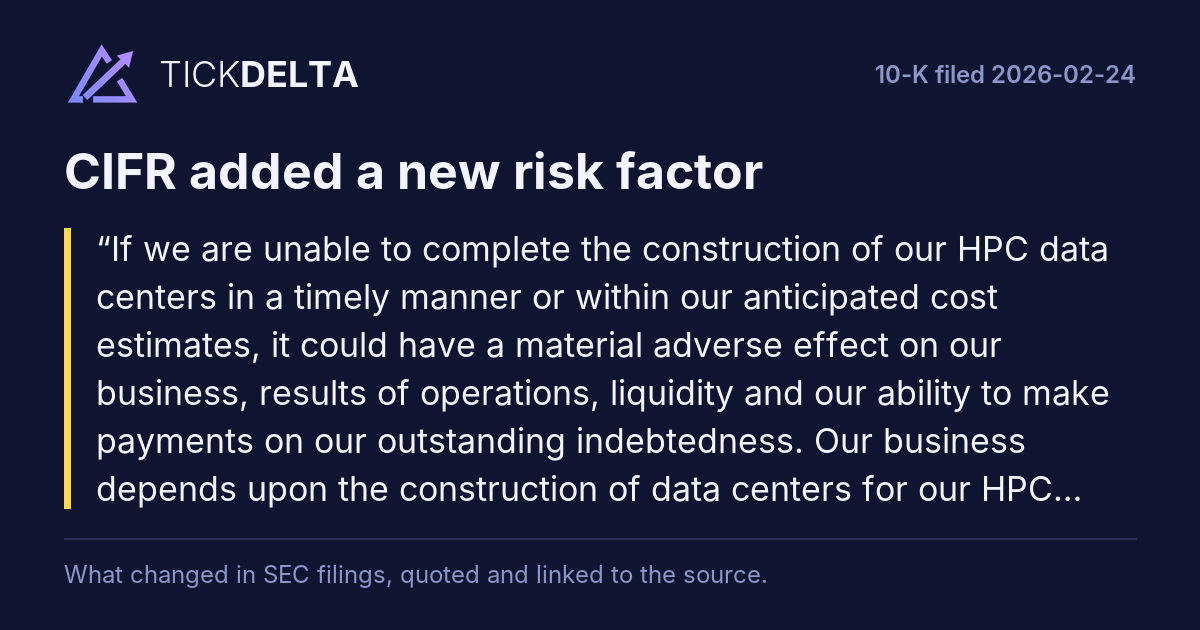
If we are unable to complete the construction of our HPC data centers in a timely manner or within our anticipated cost estimates, it could have a material adverse effect on our business, results of operations, liquidity and our ability to make payments on our outstanding indebtedness.
Our business depends upon the construction of data centers for our HPC tenants. Until we complete construction of those data centers, we will not realize the full amount of projected revenue from such leases. We cannot guarantee we will complete construction of all or any portion of the Barber Lake Facility, the Black Pearl Facility, or any future strategic growth initiatives on time or within our cost estimates, if at all, due in part to the ongoing challenges to the global supply chain, the implementation of new tariffs and more restrictive trade policies, increased inflation and changing conditions within the United States labor market.
Similar paragraph at 1 of 31 other Crypto companies: WULFUnder certain circumstances, our lessees will have the right to terminate the lease if there are significant delays in the completion of construction, subject to extension for force majeure events and certain tenant delays. If we experience delays in the construction process or are unable to complete construction within our anticipated costs estimates, we may not generate sufficient revenues to fund our liquidity needs, including payment of principal and interest on the notes.
Similar paragraph at 1 of 31 other Crypto companies: WULFRead in the 10-K ↗
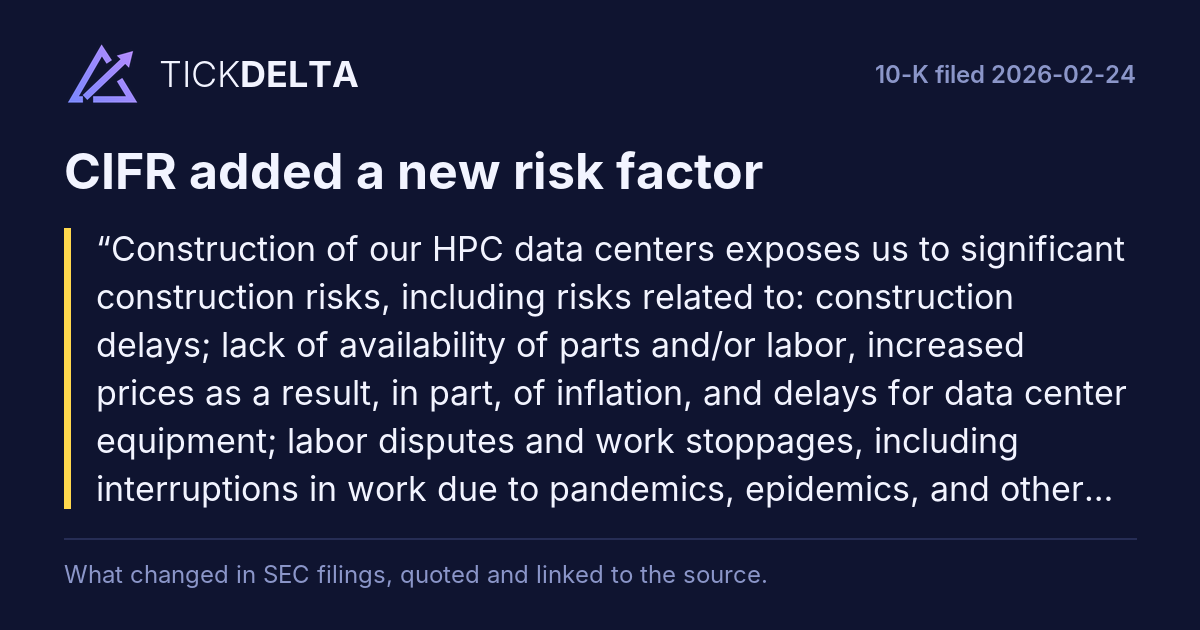
Construction of our HPC data centers exposes us to significant construction risks, including risks related to: construction delays; lack of availability of parts and/or labor, increased prices as a result, in part, of inflation, and delays for data center equipment; labor disputes and work stoppages, including interruptions in work due to pandemics, epidemics, and other health risks; unanticipated environmental issues and geological problems; delays related to permitting and approvals to commence operations from public agencies and utility companies; and delays in site readiness leading to our failure to meet commitments made in connection with such expansion. Should any of the foregoing risks materialize or should any of our assumptions concerning the timing of construction or the availability of supplies and labor, our estimates of the total construction cost for our HPC data centers may be inaccurate and total construction costs may exceed our budget. Further, although we will provide completion guarantees of the construction, there can be no assurance that we will have sufficient funds to meet our obligations under such guarantees if we are unable to complete construction of the HPC data centers within our current anticipated cost estimates. All construction-related projects depend on the skills, experience, and attentiveness of our personnel throughout the design and construction process. Should a designer, general contractor, significant subcontractor or key supplier experience financial difficulties or other problems during the design or
Similar paragraph at 1 of 31 other Crypto companies: WULFconstruction process, we could experience significant delays, increased costs to complete the project and/or other negative impacts to our expected returns.
If we are unable to overcome these risks and additional pressures to complete our HPC construction projects in a timely manner, if at all, we may not realize their anticipated benefits, and our business and financial condition may be materially impacted.
Our tenants’ guarantees and other backstop arrangements under our HPC leases will only be effective after rent commencement under such leases and are subject to certain limitations, like event of default triggers or caps.
Our tenants’ guarantees of their obligations under the HPC leases are only effective following the rent commencement date of such lease and are subject to certain limitations, like event of default triggers or caps on liability. If the leases do not commence as of their targeted rent commencement date, then the guarantee under such lease will not become effective until the completion of the HPC data center. If completion of the data centers are delayed, our tenants may have the right to terminate their lease. Such termination events would not trigger the tenants’ guarantee either. While we believe they are unlikely to occur, there are other events of default or termination events that may result in the termination of the HPC leases without triggering a tenant guarantee. In addition, if we have a disagreement with our tenants about whether their guarantee has been triggered, there can be no assurance that they will honor their guarantee in a timely manner or at all. If a guarantee has been triggered, they are subject to certain caps on such guarantor’s liability, which may limit the amount of tenant’s obligations that are guaranteed.
Similar paragraph at 1 of 31 other Crypto companies: WULFWe believe the potential for HPC hosting complements our current business model with expected stable, long-term and high margin revenue. However, the success of our HPC hosting services may not develop as anticipated, and may be affected by factors such as the reliability and timing of power supply, supply chain disruption (including local labor availability), the implementation of new tariffs and more restrictive trade regulations and changes in in-house specialized expertise to manage the business. A failure to successfully implement our HPC business strategy may adversely affect our business, prospects, or operations.
We are in the business of owning, acquiring, developing and operating data centers. A reduction in the demand for data center space, power or connectivity could have an adverse effect on our business and financial condition. Our substantial development activities make us susceptible to adverse developments in the data center, Internet and data communications and broader technology industries. Any such slowdown or adverse development could lead to reduced demand for data center space. Reduced demand could also result from business relocations, including to metropolitan areas that we do not currently serve. Changes in industry practice or in technology could also reduce demand for the physical data center space we provide. In addition, our customers may choose to develop new data centers or expand their own existing data centers or consolidate into data centers that we do not own or operate, which could reduce demand for our newly developed data centers or result in the loss of one or more key tenants. Our financial condition, results of operations, cash flow, cash available to satisfy our debt service obligations could be materially adversely affected as a result of any or all of these factors.
Similar paragraph at 1 of 31 other Crypto companies: BTBTRead in the 10-K ↗
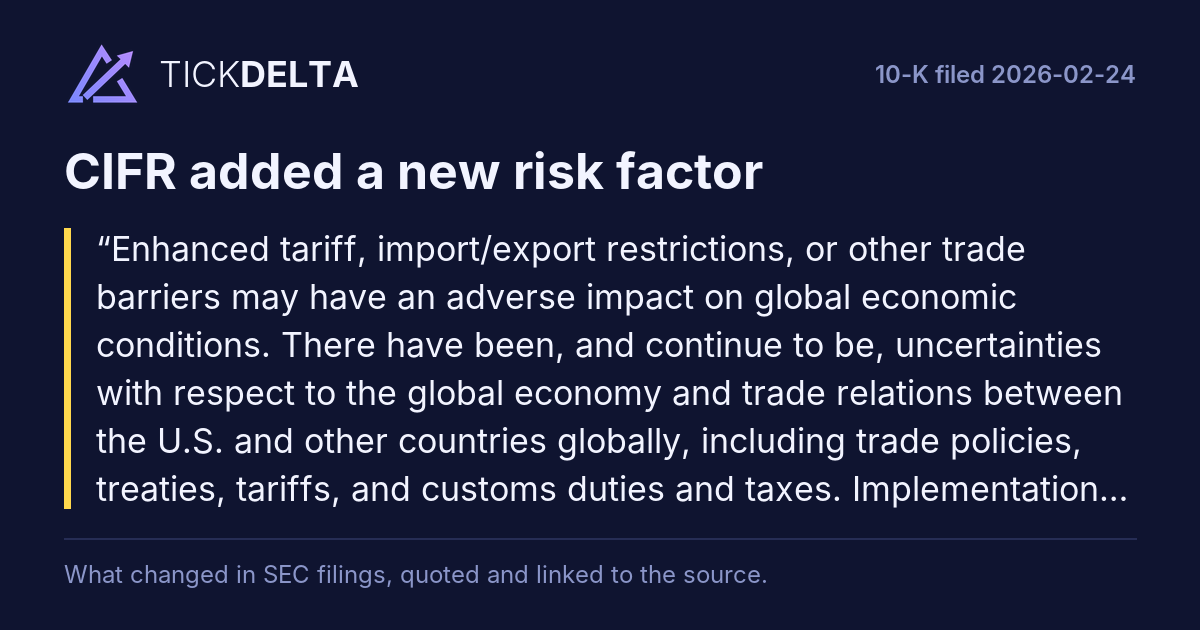
Enhanced tariff, import/export restrictions, or other trade barriers may have an adverse impact on global economic conditions.
Similar paragraph at 1 of 31 other Crypto companies: WULFThere have been, and continue to be, uncertainties with respect to the global economy and trade relations between the U.S. and other countries globally, including trade policies, treaties, tariffs, and customs duties and taxes. Implementation of more restrictive trade policies or the renegotiation of existing U.S. trade agreements or trade agreements of other countries where we procure supplies and materials for our digital infrastructure could negatively impact our business results of operations, cash flows, and financial condition. Tariffs, sanctions and other barriers to trade could adversely affect the business of our business partners, such as suppliers, which could in turn negatively impact our net revenue and results of operations. If tariffs, trade restrictions or trade barriers are expanded or increased, then our exposure to future taxes and duties on imported products and components could be significant and could have a material effect on our financial results.
Similar paragraph at 1 of 31 other Crypto companies: WULFWe cannot predict the extent to which the U.S. or other countries will impose new or additional quotas, duties, tariffs, taxes, or other similar restrictions upon the import of goods and services in the future, nor can we predict future trade policy or the terms of any renegotiated trade agreements and their impact on our business. The continuing adoption or expansion of trade restrictions, the occurrence of a trade war, or other governmental action related to tariffs or trade agreements or policies has the potential to adversely impact demand for our HPC data centers, our costs, our business partners, our suppliers, and the U.S. economy, which in turn could have a material adverse effect on our business, operating results, and financial condition.
We may be harmed by increased costs to procure power, prolonged power outages, shortages or capacity constraints as well as insufficient access to power.
Similar paragraph at 1 of 31 other Crypto companies: WULFAny power outages, shortages, capacity constraints, limits on access or significant increases in the cost of power may have an adverse effect on our business and our results of operations. Any such limitations may have a negative impact on a given data center and may limit our ability to grow our business which could negatively affect our financial performance and results of operations. Furthermore, the inability to supply tenants with power for any reason could harm our relationships as well as cause reputational harm.
Similar paragraph at 1 of 31 other Crypto companies: WULFOur HPC data centers require access to significant quantities of electricity. Limitations on generation, transmission and distribution may limit our ability to obtain sufficient power capacity for potential expansion sites in new or existing markets. Utility companies and other third-party power providers may impose onerous operating conditions to any approval or provision of power or we may experience significant delays, unfavorable contractual terms, and substantial increased costs to provide the level of electrical service required by our current or future data center designs. Our ability to find reliable partners and appropriate sites for expansion may also be limited by access to power, especially as we design our data centers to the specifications of hyperscaler tenants operating data centers for HPC technology, which is power-intensive, and further prepare to serve the power demands in the future.
Similar paragraph at 1 of 31 other Crypto companies: WULFWe rely on third parties, third party infrastructure, governments, and global supplies to provide a sufficient amount of power to maintain our HPC data center operations to meet the needs of our current and future HPC hosting and colocation tenants. Any limitation on the delivered energy supply could limit our ability to operate our HPC data centers. These limitations could have a negative impact on our financial performance and results of operations. Each new HPC data center requires access to significant quantities of electricity. Limitations on generation, transmission and distribution may limit our ability to obtain sufficient power capacity for potential expansion sites or existing markets. Utility companies may impose onerous operating conditions to any approval or provision of power or we may experience significant delays and substantial increased costs to provide the level of electrical service required by our current or future data center designs.
Similar paragraph at 1 of 31 other Crypto companies: WULFAny failure of our physical or information technology or operational technology infrastructure or services could lead to significant costs and disruptions.
Our business depends on providing tenants with highly reliable services, including with respect to physical security, cybersecurity, and maintenance of environmental conditions. We may fail to provide such services because our operations are vulnerable to, among other things, mechanical or telecommunications failure, power outage, human error, physical or electronic security breaches, cyberattacks, war, terrorism, fire, earthquake, pandemics, hurricane, flood and other natural disasters, sabotage and vandalism.
Similar paragraph at 1 of 31 other Crypto companies: BTBTWe also have service level commitment obligations to certain tenants. As a result, service interruptions or significant equipment damage in our HPC data centers could result in difficulty maintaining service level commitments to these customers and potential claims related to such failures. A failure to meet these or other commitments or equipment damage in our data centers could subject us to contractual liability. Service interruptions, equipment failures or security breaches could also materially impact our brand and reputation globally and lead to customer contract terminations or non-renewals and an inability to attract customers in the future
Similar paragraph at 1 of 31 other Crypto companies: BTBTMany factors, including global and domestic economic conditions, may cause current HPC data center tenants like Amazon, Fluidstack or future tenants to experience a downturn in their businesses or otherwise experience a lack of liquidity, which may weaken their financial condition and impact our estimates as to the probability of collectability of payments, and ultimately result in their failure to make timely rental and other payments or their default under their agreements with us. Further, the development of new technologies, the adoption of new industry standards or other factors could render our HPC data center tenants’ current products and services obsolete or unmarketable and contribute to a downturn in their businesses, thereby increasing the likelihood that they default under their leases, become insolvent or file for bankruptcy. If a tenant defaults or fails to make timely rent or other payments (notwithstanding the Google Backstop with respect to the Fluidstack Lease), we may experience delays in enforcing our rights as landlord and may incur substantial costs in protecting our investment, which could adversely affect our financial condition and results of operations.
Similar paragraph at 1 of 31 other Crypto companies: WULFIf a tenant becomes a debtor in a case under Title 11 of the United States Code, as amended, we cannot evict the tenant solely because of the bankruptcy. In addition, the bankruptcy court might authorize the tenant to reject and terminate its contracts with us. Our claim against the tenant for unpaid, future rent and other payments would be subject to a statutory cap that might be substantially less than the remaining amounts actually owed under their agreements with us. In either case, our claim for unpaid rent and other amounts would likely not be paid in full. Our revenue could be materially adversely affected if a significant tenant were to become bankrupt or insolvent, suffer a downturn in its businesses, fail to renew its contract or renew on terms less favorable to us than its current terms.
Similar paragraph at 1 of 31 other Crypto companies: WULFTo date, our data centers are single-tenant properties, and we expect future tenants at other sites in our pipeline to also want to be the only tenant at those sites. If we were to lose one or more of our customers, including by defaulting on one of our leases with Amazon or Fluidstack/Google), such loss could have a material adverse effect on our business, financial conditions and results of operations.
We expect demand for our services generated by these customers may fluctuate significantly from quarter to quarter. The anticipated concentration of our customer base increases risks related to the financial condition of our customers, and the deterioration in financial condition of a single customer or the failure of a single customer to perform its obligations could have a material adverse effect on our results of operations and cash flow. In the event that any of our future customers experience a decline in their equipment usage for any reason, or decide to discontinue the use of our facilities, we may be compelled to lower our prices or risk losing a significant customer. Such developments could adversely affect our profit margins and financial position, leading to a negative impact on our revenue and operational results.
Similar paragraph at 1 of 31 other Crypto companies: BTBTOur contracts with HPC data center tenants could subject us to significant liability.
Similar paragraph at 1 of 31 other Crypto companies: WULFIn the ordinary course of business, we aim to continuously enter into agreements with tenants pursuant to which we provide data center space, power, environmental controls, physical security and connectivity products to our HPC hosting and colocation tenants. These contracts typically contain indemnification and liability provisions, in addition to service level commitments, which could potentially impose a significant cost on us in the event of losses arising out of certain breaches of such agreements, services to be provided by us or our subcontractors or from third-party claims. HPC data center tenants increasingly are looking to pass through their regulatory obligations and other liabilities to their outsourced data center providers and we may not be able to limit our liability or damages in an event of loss suffered by such tenants whether as a result of our breach of an agreement or otherwise. If such an event of loss occurred, we could be liable for material monetary damages and could incur significant legal fees in defending against such an action, which could adversely affect our financial condition and results of operations.
Similar paragraph at 1 of 31 other Crypto companies: WULFWe may also develop space specifically for HPC data center tenants pursuant to agreements signed prior to beginning or early in the development process. In those cases, if we fail to meet our development obligations under those agreements, such tenants may be able to terminate their agreements and we would be required to find a new tenant for the applicable space. In addition, in certain circumstances we may lease HPC data center facilities prior to their completion. If we fail to complete the facilities in a timely manner, the tenant may be entitled to terminate its agreement, seek damages or penalties against us or pursue other remedies and we may be required to find a new tenant for the space. If development costs are higher than our current estimates and we are not able to complete an HPC data center in a timely manner, it could have a material adverse effect on our business, financial condition, results of operations and cash flow.
Similar paragraph at 1 of 31 other Crypto companies: WULFAdditionally, a tenant’s decision to lease space and power in our HPC data center typically involves a significant commitment of resources and due diligence on the part of our tenants regarding the adequacy of our facilities. As a result, we may expend significant time and resources in pursuing a particular transaction that may not result in revenue. Economic conditions, including market downturns and the implementation of new tariffs and more restrictive trade regulations may impact tenants’ ability to plan future business activities, which could cause tenants to slow spending or delay decision-making. Our inability to adequately manage the risks associated with these developments may adversely affect our business, financial condition and results of operations.
Similar paragraph at 1 of 31 other Crypto companies: WULFThe introduction of, development and advancement in the efficiency of AI models could potentially adversely affect data center usage by significantly reducing the computational power needed to train AI models, potentially leading to less demand for high-power density, liquid-cooled data center infrastructure and colocation facilities such as those we are building at the Barber Lake Facility. New advancements in AI models could also alter the way data centers are currently designed and utilized and such risks and challenges may have a material adverse effect on our business, financial condition and results of operations.
Similar paragraph at 1 of 31 other Crypto companies: WULFRead in the 10-K ↗
From time to time, we may modify aspects of our business model or engage in various strategic initiatives, which may be complementary to our existing operations. For further information on our strategy, see “Business—Our Strategy.”
Our growth strategy includes expanding and diversifying our revenue sources into new markets. We are actively working to develop our pipeline for HPC data centers. Expansion plans may take longer or be more expensive than we currently anticipate as a result of evolving market conditions, technological developments, customer requirements, our evolving business model or otherwise, and any such expansion may also have an impact on our existing bitcoin mining operations. Factors including inflation, tariffs, and interest rates may all impact the amount of capital required and the terms upon which we can obtain such capital. We will continue to review our expansion plans in light of such factors, and our expansion plans may be delayed or may change as a result.
Read in the 10-K ↗
The market for HPC data centers is driven in large part by demand for data center space capable of supporting graphics processing units ("GPUs"), server clusters, specialized or high-performance applications, and hosted software solutions which require fast and efficient data processing, and is characterized by rapid advances in technologies. It is difficult to predict the development of demand for HPC data centers, the size and growth rate for this market, the entry of competitive products, or the success of any existing or future products that may compete with any services we may develop. There has been an increasing number of businesses constructing HPC data centers, which has resulted in increasing competition and pricing pressure that may cause us to reduce our pricing in order to remain competitive.
If there is a reduction in demand for any of these services, whether caused by a lack of customer acceptance, a slowdown in demand for computational power, advancements in technology, technological challenges, competing technologies and solutions, decreases in corporate and customer spending, weakening economic conditions or otherwise, it could result in reduced customer orders, early order cancellations, the loss of customers, or decreased sales, any of which would adversely affect our business, results of operations and financial condition.
Read in the 10-K ↗
Operating HPC data centers is energy-intensive, which may have a negative environmental impact. Changing environmental regulation and public energy policy may expose our business to new risks.
Operating HPC data centers requires large amounts of electrical power. There has been a substantial increase in the demand and cost of electricity for computing purposes, and this has had varying levels of impact on local electricity supply. As a result, the success of any data center facility we establish is subject to obtaining sufficient electrical power for that facility on a cost-effective basis, and our establishment of new facilities requires us to find locations where that is the case. If new regulations are imposed, or if existing regulations are modified, the assumptions we made underlying our plans and strategic initiatives may be inaccurate, and potential HPC tenants may seek to sign leases in other locations with more favorable power supply and regulations.
Read in the 10-K ↗
were to become less favorable to data center operators like us or HPC operations, including by way of increased taxes or policies that limit the ability of data center operators to expand their footprint, our heavy concentration of sites in Texas means our business, financial condition and results of operations could be adversely affected.
Read in the 10-K ↗
We and our third-party service providers face numerous and evolving cybersecurity risks and regularly identify, defend against and recover from a variety of cyber-attacks, including phishing and other efforts to gain unauthorized access to systems. These risks may increase as we grow, as our operations become more complex and as threat actors become more sophisticated, including through the use of artificial intelligence and other advanced techniques designed to circumvent security controls, evade detection or remain dormant for extended periods. Remote and hybrid working arrangements at our company and at many of our third-party providers may further increase cybersecurity risks due to challenges associated with managing distributed computing assets and non-corporate networks. In addition, any integration of artificial intelligence in our or our service providers’ or partners’ operations, products or services may pose new or unknown cybersecurity risks.
Despite our efforts to maintain and enhance cybersecurity controls and incident response and disaster recovery preparedness, including employee training, monitoring and preventative measures, we may be unable to detect, prevent, investigate, remediate or adequately recover from all cybersecurity incidents or IT Systems failures in a timely manner or at all. Security breaches or other cybersecurity incidents may arise from a variety of sources, including state-sponsored actors, opportunistic hackers, hacktivists, insiders, human or technological error, malware (including ransomware), social engineering or vulnerabilities in our or third-party systems. Certain attacks could harm us even if our systems are not directly compromised, including through disruptions at or vulnerabilities within third-party service providers on which we rely. We also may not be able to ensure the adequacy of the security measures implemented by our third-party service providers, custodians or counterparties, many of which store or process our sensitive data and digital assets.
A successful cybersecurity incident or IT Systems failure could result in, among other things, (i) interruptions to our operations or services; (ii) loss of control or impaired operation of our equipment; (iii) misappropriation or loss of personal data, Confidential Information or other critical data; and (iv) loss, theft or irretrievable loss of bitcoin or other digital assets. Such incidents could materially harm our business and reputation, require significant incident response, remediation or system restoration efforts and expenses, and expose us to governmental or regulatory investigations,
enforcement actions, litigation (including class actions), fines, penalties or other liabilities. In addition, a data breach or cybersecurity incident may trigger mandatory notification obligations under applicable privacy and data protection laws, which could result in negative publicity and a loss of confidence in our security measures.
Mitigating cybersecurity risks and responding to incidents has resulted, and may in the future result, in increased operating and capital costs for systems, technology, personnel, monitoring and compliance. Insurance coverage for cybersecurity incidents involving digital or cryptocurrency assets is limited, and we do not currently maintain cybersecurity insurance for such assets. As a result, losses, costs or damages arising from cybersecurity incidents or IT Systems failures may not be fully recoverable, if at all.
Read in the 10-K ↗
8 more
lower labor, compliance, risk mitigation and research and development costs, operations in certain jurisdictions with lower compliance costs and substantially greater financial, technical and other resources.
Read in the 10-K ↗
Historically, we have derived substantially all of our revenue from bitcoin mining, and our operating results have depended primarily on the number of bitcoin block rewards earned and the market price of bitcoin. Bitcoin prices have historically been highly volatile and are influenced by numerous factors outside of our control, and actual prices may differ materially from those assumed by us. As a result, our operating results have fluctuated significantly from period to period and may continue to do so while bitcoin mining remains a component of our business.
The price of bitcoin and our results of operations may be adversely affected by conditions in the broader cryptocurrency and blockchain ecosystem; trading and investment activity by retail and institutional participants; competition among mining operators; developments in mining hardware and technology; changes in consumer preferences or perceptions regarding digital assets; macroeconomic conditions, including interest rates and inflation; negative publicity or events affecting public perception of bitcoin; and the correlation of bitcoin prices with other digital assets, including disruptions or failures affecting exchanges or trading venues.
Our business has also been subject to risks related to the Bitcoin network, including reductions in mining rewards resulting from block reward halving events; transaction congestion, fees, and processing speed; network disruptions, forks, hacks, or other attacks; changes to the Bitcoin protocol or governance practices; technological developments that could undermine cryptographic security; and adverse legal or regulatory developments affecting bitcoin, mining operations, or access to the Bitcoin network. In particular, bitcoin halving events reduce block rewards by 50% approximately every four years, which, absent a corresponding increase in bitcoin prices or reductions in operating costs, materially reduces mining revenue and profitability.
In addition, the total supply of bitcoin is capped at 21 million, and as the remaining supply decreases, the processing power and costs required to mine new blocks may increase, potentially rendering mining less economically attractive over time. While we are transitioning our business toward high-performance computing and other strategic initiatives, a sustained decline in the value of bitcoin, adverse developments in the Bitcoin ecosystem, or reduced mining economics could continue to materially adversely affect our business, financial condition, and results of operations during this transition period.
Read in the 10-K ↗
Expansion of our business strategy into the HPC data center market could increase competitive, operational, legal and regulatory risks to our business in ways we cannot predict.
As we continue to enter into the HPC data center market, competitive, operational, legal and regulatory risks may be exacerbated as there is substantial uncertainty about the extent to which AI will result in changes that come with risks that we may not be able to anticipate, prevent, mitigate or remediate.
We will face new sources of competition, new business models and new customer relationships, and our competitors may be larger, have longer operating histories and significantly greater resources than we do. In order to be successful, we will need to cultivate new industry relationships and strengthen existing relationships to bring any new solutions and offerings to market, and the success of any services we develop will depend on many factors, including demand for those solutions, our ability to win and maintain customers, and the cost, performance and perceived value of any such services. As a result, there can be no assurance that any HPC data centers we develop will be adopted by the market, or be profitable or viable.
Our limited experience with respect to the provision of data center services could limit our ability to successfully execute on this growth strategy or adapt to market changes. If we are unsuccessful in continuing to develop HPC data centers, our business, results of operations and financial condition could be adversely affected. Further, an increased focus on HPC data centers could displace or reduce our existing operations, which may adversely affect our business, results of operations and financial condition.
Our investments in developing HPC data centers may result in new or enhanced governmental or regulatory scrutiny, litigation, confidentiality or security risks, ethical concerns or other complications that could adversely affect our business, reputation, results of operations or financial condition.
Similar paragraph at 1 of 31 other Crypto companies: GLXYThe increasing focus on the risks and strategic importance of certain AI services, such as AI cloud services, and AI or machine learning technologies, has already resulted in regulatory restrictions that target products and services capable of enabling or facilitating AI and machine learning, and may in the future result in additional restrictions or complex regulatory requirements impacting any offerings we may develop, including AI cloud services and other solutions. Complying with multiple evolving laws, rules and regulations from different jurisdictions related to new solutions are developed could increase the cost of doing business or may change the way HPC data centers operate in certain jurisdictions. We may not be able to adequately anticipate or respond to these evolving laws and regulations, and we may need to expend additional resources to adjust our offerings in certain jurisdictions if applicable legal frameworks are inconsistent across jurisdictions.
For example, the European Union (“EU”) Artificial Intelligence Act (“EU AI Act”), which entered into force on August 1, 2024 and will become enforceable in a gradual manner between 2025 and 2027, establishes, among other things, a risk-based governance framework for regulating AI systems operating in the EU. There is a risk that the EU AI Act could have a negative impact on our current or future use of AI. For example, the EU AI Act prohibits certain uses of AI systems and places numerous obligations on providers and developers of permitted AI systems, with heightened requirements based on AI systems that are considered high risk. This regulatory framework is expected to have a material impact on the way AI is regulated in the EU and beyond. Similarly, other jurisdictions, such as Canada with its Artificial Intelligence and Data Act and several U.S. states have also implemented or are considering similar regulatory frameworks or laws governing the development and deployment of AI generally or in specific contexts, as well as critical infrastructure cybersecurity legislation or regulations relating to data flows. Specific to AI law, in April 2023, the U.S. Federal Trade Commission, Department of Justice, Consumer Financial Protection Bureau and Equal Employment Opportunity Commission issued a joint statement on AI enforcement, demonstrating their interest in monitoring the development and use of automated systems and enforcement of their respective laws and regulations. The Federal Trade Commission and certain state Attorneys General have pursued enforcement actions against companies offering AI products and services under consumer protection laws. Such regulatory frameworks, as well as developing or potentially conflicting regulatory guidance and judicial decisions in this area, as well as conflict between potentially competing legal regimes (including with respect to state laws that may conflict with federal AI policy), may introduce uncertainty, affect our use of AI and our ability to provide and to improve our products and solutions, require additional compliance measures and changes to our operations and processes, result in increased compliance costs and potential increases in civil claims against us and could have a material adverse effect on our business, financial condition and results of operations.
Furthermore, concerns regarding third-party use of AI for purposes contrary to governmental, national security and societal interests, including concerns relating to the misuse of AI applications, models, and solutions, could result in restrictions on AI products. Any such restrictions could reduce the demand for our intended AI data center services, and negatively impact our business, financial condition and operating results, and damage our reputation.
It is also unclear how our status as an infrastructure provider for customers developing and deploying AI applications, as opposed to developing such applications ourselves, could affect the applicability of these existing or proposed regulatory frameworks and other restrictions with respect to any services we may offer from time to time. However, it is possible that such regimes will impose obligations on infrastructure providers, such as us, to oversee, monitor or restrict the use of AI systems that are trained or deployed on their systems, and/or to ensure compliance with such regulatory frameworks and other restrictions. If our customers violate existing or proposed regulatory regimes or other restrictions, or if they use our services for unlawful, harmful or non-compliant purposes, we could be subject to regulatory investigations, regulatory fines, reputational damage or contractual liability for any such actions, even if we do not control the customer applications. Further, potential HPC tenants may look to pass through their regulatory obligations and other liabilities to their outsourced data center providers, and we may not be able to limit our liability or damages in an event of loss suffered by such customers whether as a result of our breach of an agreement or otherwise.
Read in the 10-K ↗
We are subject to a highly-evolving regulatory landscape and any adverse changes to, or our failure to comply with, any laws and regulations could adversely affect our business, reputation, prospects or operations.
As we transition from bitcoin mining operations to HPC infrastructure services, we face evolving regulatory frameworks in multiple areas. Our HPC business is subject to data center regulations, energy and environmental regulations, and potentially AI-specific regulatory requirements depending on how our role as infrastructure provider is
classified. During our transition period, we also remain subject to regulations affecting bitcoin mining operations. As cryptocurrencies have grown in both popularity and market size, governments around the world have reacted differently to cryptocurrencies; certain governments have deemed them illegal, and others have allowed their use and trade without restriction, while some jurisdictions, such as the United States, subject the mining, ownership and exchange of cryptocurrencies to certain, and in some cases overlapping, unclear and evolving regulatory requirements.
We currently only operate in the United States, and do not currently have any plans to expand our operations beyond the United States. The complexity and evolving nature of our business and the significant uncertainty surrounding regulation of the HPC industry requires us to exercise our judgment as to whether certain laws, rules, and regulations apply to us, and it is possible that governmental bodies and regulators may disagree with our conclusions. To the extent we have not complied with such laws, rules, and regulations, we could be subject to significant fines, revocation of licenses, limitations on our products and services, reputational harm, and other regulatory consequences, each of which may be significant and could adversely affect our business, operating results, and financial condition.
We may face electricity market risks relating to changes in laws, regulations and requirements of market operators, network operators and/or regulatory bodies, including with respect to interconnection of facilities of large electrical loads to the ERCOT grid (for example, via a process that may batch multiple large load interconnection requests), grid stability, voltage ride-through, frequency ride-through and curtailment obligations.
Certain governments and regulators are increasingly focused on the energy and environmental impact of HPC services and bitcoin mining. This has led, and could lead, to new governmental measures regulating, restricting or prohibiting the use of electricity for data center operators in the HPC industry, or could result in increased power costs for these types of power consumers. See “— Operating HPC data centers is energy-intensive, which may have a negative environmental impact. Changing environmental regulation and public energy policy may expose our business to new risks.” For example, in 2025, the Texas legislature enacted legislation SB 6 to support ERCOT’s grid reliability by proposing minimum transmission rates on certain large loads and removing phantom loads from its interconnection queue to enhance accuracy of actual future load growth. SB 6 requires the PUCT and ERCOT to create new processes and impose new requirements for the interconnection of facilities with large electrical loads of at least 75 MWs to the ERCOT system. SB 6 also requires security type payments as part of the initial interconnection request, and creates a new approval that is required for co-location of generation with large loads. In addition, ERCOT has amended and continues to evaluate its processes for interconnection of large electrical loads to the ERCOT grid. In December 2025, ERCOT announced amendments to the approval process for large load interconnection requests and is designing and implementing a process that may batch multiple large load interconnection requests together to evaluate system impacts on a portfolio basis for purposes of transmission planning. These developments, along with potential requirements relating to grid stability, voltage ride-through, frequency ride-through and curtailment obligations, could increase costs, delay project timelines, or impose additional operational constraints. In 2024, the PUCT also required operators of large virtual currency mining operations connected to register their facilities with the PUCT. See “Business— Government Regulation.”
Read in the 10-K ↗
We and our operations and properties are subject to laws and regulations governing health and safety, the discharge of pollutants into the environment or otherwise relating to health, safety and environmental protection requirements in the jurisdictions in which we operate. These laws and regulations may impose numerous obligations that are applicable to us, including acquisition of a permit or other approval before conducting construction or regulated activities; restrictions on the types, quantities and concentration of materials that can be released into the environment; limitation or prohibition of construction and operating activities in environmentally sensitive areas, such as wetlands or areas with endangered plants or species; imposition of specific health and safety standards addressing worker protection from work related health and safety risks; imposition of certain zoning, building code and energy-efficiency standards for the sites at which we operate; and imposition of significant liabilities for pollution, including investigation, remedial and clean-up costs, which can be joint and several. Failure to comply with these requirements may expose us to fines, penalties and/or interruptions in our operations, among other sanctions, that could have a material adverse effect on our financial position, results of operations and cash flows. Failure to obtain, secure renewal of, or maintain, permits or tightening of
Similar paragraph at 1 of 31 other Crypto companies: BTBTrestrictions within our permits, or the failure to meet the zoning, building code, health and safety and energy-efficiency standards imposed by regulations applicable to our sites, could have a material adverse effect on our business, including our ability to recruit and retain personnel, or cause us to incur material expenses. Moreover, it is not uncommon for neighboring landowners, community groups, activists and other third parties to file claims for personal injury, property damage and nuisance allegedly caused by noise or the release of hazardous substances into the environment.
Read in the 10-K ↗
Our indebtedness and liabilities could limit the cash flow available for our operations, expose us to risks that could adversely affect our business, financial condition and results of operations and impair our ability to satisfy our obligations under the notes.
As of December 31, 2025, our total consolidated indebtedness amounted to $3,206 million. In May 2025 and September 2025, we completed offerings of our 2030 Convertible Notes and 2031 Convertible Notes, from which we incurred $172.5 million and $1,300.0 million of additional indebtedness, respectively. Additionally, in November 2025, Cipher Compute LLC, our wholly owned indirect subsidiary, incurred $1,733.0 million of indebtedness from offerings of $1,400.0 million and $333.0 million of our senior secured notes due 2030. Subsequent to December 31, 2025, Black Pearl Compute LLC, our wholly owned indirect subsidiary, incurred $2.0 billion of 6.125% senior secured notes due 2031. We may also incur additional indebtedness to meet future financing needs. Our indebtedness could have significant negative consequences for our security holders and our business, results of operations and financial condition by, among other things:
•limiting our ability to obtain additional financing, such as in the event of adverse changes to our credit ratings;
•requiring the dedication of a substantial portion of our cash flow from operations to service our indebtedness, which will reduce the amount of cash available for other purposes;
•diluting the interests of our existing stockholders as a result of issuing shares of our common stock upon conversion of the Convertible Notes; and
•placing us at a possible competitive disadvantage with competitors that are less leveraged than us or have better access to capital.
Our ability to make scheduled payments of the principal of, to pay interest on or to refinance our indebtedness depends on our future performance, which is subject to economic, financial, competitive and other factors beyond our control. Our business may not generate sufficient funds, and we may otherwise be unable to maintain sufficient cash reserves, to pay amounts due under our indebtedness, including the Convertible Notes, and our cash needs may increase in the future. In addition, future indebtedness that we may incur may contain financial and other restrictive covenants that limit our ability to operate our business, raise capital or make payments under our other indebtedness. If we fail to comply with these covenants or to make payments under our indebtedness when due, then we would be in default under that indebtedness, which could, in turn, result in that and our other indebtedness becoming immediately payable in full.
We may not be able to generate sufficient cash to service all of our indebtedness and to fund our working capital and capital expenditures, and may be forced to take other actions to satisfy our obligations under our indebtedness that may not be successful.
Our ability to pay principal and interest on the senior secured notes incurred to finance the construction of the leased facilities will depend primarily upon revenue from our HPC leases. Until we complete construction of the data centers for our HPC tenants, we will not realize the full amount of projected revenue under our HPC leases. As a result, we
cannot assure you that our business will generate cash flow from operation of those HPC facilities on a timeline basis, or at all.
In the event we are unable to complete construction of the data center for our HPC leases in a timely manner and, consequently, do not receive some or all of the contracted rent under our HPC leases, we may not have sufficient funds to service our obligations under the senior secured notes incurred to finance the construction of the leased facilities or our other debt obligations. If we cannot make scheduled payments on our indebtedness, we will be in default and holders of the notes and other debt obligations could declare all outstanding principal and interest to be due and payable, our secured creditors (including the holders of the notes) could foreclose against the assets securing their loans and the notes and we could be forced into bankruptcy or liquidation.
We cannot assure you we will be able to access other sources of financing, in an amount sufficient to fund our liquidity needs, including the payment of principal and interest on the notes or our other indebtedness. If our cash flows and capital resources are insufficient to service our indebtedness, we may be forced to reduce or delay capital expenditures, sell assets, seek additional capital or restructure or refinance our indebtedness, including the notes. These alternative measures may not be successful and may not permit us to meet our scheduled debt service obligations. Our ability to restructure or refinance our debt will depend on the condition of the capital markets and our financial condition at such time, and there can be no guarantee that we will be able to access the capital markets on terms that are attractive or at all. Any refinancing of our debt could be at higher interest rates and may require us to comply with more onerous covenants, which could further restrict our business operations. We cannot assure you that we will be able to restructure or refinance any of our debt on commercially reasonable terms or at all. In addition, the terms of existing or future debt agreements may restrict us from adopting some of these alternatives. In the absence of such operating results and resources, we could face substantial liquidity problems and might be required to dispose of material assets or operations to meet our debt service and other obligations. We may not be able to consummate those dispositions for fair market value or at all. Furthermore, any proceeds that we could realize from any such dispositions may not be adequate to meet our debt service obligations then due. Our inability to generate sufficient cash flow to satisfy our debt obligations, or to refinance our indebtedness on commercially reasonable terms or at all, could result in a material adverse effect on our business, results of operations and financial condition and could negatively impact our ability to satisfy our obligations under the notes.
If any of our indebtedness is accelerated, we may need to repay or refinance all or a portion of our other indebtedness before maturity. There can be no assurance that we will be able to obtain sufficient funds to enable us to repay or refinance our debt obligations on commercially reasonable terms, or at all.
Our debt agreements contain restrictions that will limit flexibility in operating our business.
The indentures governing the senior secured notes contain, and any other existing or future indebtedness of ours would likely contain, a number of covenants that impose significant operating and financial restrictions on us, including restrictions on our and our subsidiaries’ ability to, among other things:
Similar paragraph at 1 of 31 other Crypto companies: XXI•pay dividends on or make distributions in respect of, or repurchase or redeem, our capital stock or make other restricted payments;
•consolidate, merge, sell or otherwise dispose of all or substantially all of our assets;
•engage in business activities other than the operation of the Barber Lake Facility or certain additional projects.
As a result of these covenants, we are limited in the manner in which we conduct our business, and we may be unable to engage in favorable business activities or finance future operations or capital needs.
Similar paragraph at 1 of 31 other Crypto companies: HUTRead in the 10-K ↗
We may be unable to raise the funds necessary to repurchase the Convertible Notes for cash following a fundamental change or on a specified optional repurchase date or to pay any cash amounts due upon maturity or conversion of the Convertible Notes, and our other indebtedness may limit our ability to repurchase the Convertible Notes or to pay any cash amounts due upon their maturity or conversion.
Holders of the Convertible Notes may, subject to limited exceptions, require us to repurchase their Convertible Notes on May 15, 2028 (for the 2030 Convertible Notes) and on October 1, 2029 (for the 2031 Convertible Notes), and following a fundamental change, at a cash repurchase price generally equal to the principal amount of the Convertible Notes to be repurchased, plus accrued and unpaid special interest and additional interest, if any. Upon maturity of the Convertible Notes, we must pay their principal amount and accrued and unpaid special interest and additional interest, if any, in cash, unless they have been previously repurchased, redeemed or converted.
In addition, prior to the “reserved share effective date”, upon conversion, we will satisfy all of our conversion obligation in cash, subject to the “share settlement election exception”, and on or after the “reserved share effective date”, upon conversion, we will satisfy part or all of our conversion obligation in cash unless we elect to settle conversions solely in shares of our common stock.
We may not have enough available cash or be able to obtain financing at the time we are required to repurchase the Convertible Notes or pay any cash amounts due upon their maturity or conversion. In addition, applicable law, regulatory authorities and the agreements that we may have in the future governing our other indebtedness may restrict our ability to repurchase the Convertible Notes or to pay any cash amounts due upon their maturity or conversion. Our failure to repurchase Convertible Notes or to pay any cash amounts due upon their maturity or conversion when required will constitute a default under the indenture. A default under the indenture or the fundamental change itself could also lead to a default under agreements governing our other indebtedness, which may result in that other indebtedness becoming immediately payable in full. We may not have sufficient funds to satisfy all amounts due under the other indebtedness and the Convertible Notes.
Similar paragraph at 1 of 31 other Crypto companies: GMEProvisions in the Convertible Notes indentures could delay or prevent an otherwise beneficial takeover of us.
Certain provisions in the Convertible Notes and related indentures could make a third-party attempt to acquire us more difficult or expensive. For example, if a takeover constitutes a fundamental change, then noteholders will have the right to require us to repurchase their Convertible Notes for cash. In addition, if a takeover constitutes a make-whole fundamental change, then we may be required to temporarily increase the conversion rate. In either case, and in other cases, our obligations under the Convertible Notes and the indenture could increase the cost of acquiring us or otherwise discourage a third party from acquiring us or removing incumbent management, including in a transaction that noteholders or holders of our common stock may view as favorable.
The conditional conversion feature of the Convertible Notes, if triggered, may adversely affect our financial condition and operating results.
In the event the conditional conversion feature of the Convertible Notes is triggered, holders of such notes will be entitled to convert the Convertible Notes at any time during specified periods at their option. If one or more holders elect to convert their Convertible Notes, (i) if the conversion date for such conversion is before the “reserved share effective date”, we will settle all of our conversion obligation through the payment of cash, subject to the “share settlement election exception”, and (ii) if the conversion date for such conversion is on or after the “reserved share effective date,” we may elect to settle all or a portion of our conversion obligation through the payment of cash, which could adversely affect our liquidity. In addition, even if holders do not elect to convert their Convertible Notes, we could be required under applicable accounting rules to reclassify all or a portion of the outstanding principal of the Convertible Notes as a current rather than long-term liability, which would result in a material reduction of our net working capital.
The accounting method for the Convertible Notes could adversely affect our reported financial condition and results.
The accounting method for the Convertible Notes may adversely affect our reported earnings and financial condition.
The issuance costs for the Convertible Notes are treated as a debt discount for accounting purposes and will be amortized into interest expense over the term of the Convertible Notes. As a result of this amortization, the interest expense that we expect to recognize for the Convertible Notes for accounting purposes will be greater than the cash special interest or additional interest payments, if any, we will pay on the Convertible Notes, which will result in lower reported income.
Similar paragraph at 1 of 31 other Crypto companies: CLSKFurthermore, if any of the conditions to the convertibility of the Convertible Notes is satisfied, then we may be required under applicable accounting standards to reclassify the liability carrying value of the Convertible Notes as a current, rather than a long-term, liability. This reclassification could be required even if no investors convert their Convertible Notes and could materially reduce our reported working capital.
The trading price of our common stock has, at times, fluctuated significantly and could be subject to wide fluctuations in response to any of the risk factors listed in this “Risk Factors” section, and others, including:
Read in the 10-K ↗
Upon conversion of the Convertible Notes being offered in the 2030 Convertible Notes offering or the 2031 Convertible Notes offering, we will satisfy part or all of our conversion obligations in shares of our common stock, unless we elect to settle conversions solely in cash. The issuance of shares of our common stock upon conversion of the Convertible Notes will dilute the ownership interests of our stockholders, which could depress the trading price of our common stock. In addition, the market’s expectation that conversions may occur could depress the trading price of our common stock even in the absence of actual conversions. Moreover, the expectation of conversions could encourage the short selling of our common stock, which could place further downward pressure on the trading price of our common stock.
The capped call transactions may affect the value of the 2031 Convertible Notes and the market price of our common stock.
Similar paragraph at 10 of 31 other Crypto companies: CLSK, EXOD, GLXY, GME, HSDT, NAKA, SBET, SUIG and 2 moreIn connection with the issuance of the 2031 Convertible Notes, we entered into privately negotiated capped call transactions with certain financial institutions (collectively, the “option counterparties”). The capped call transactions are generally expected to reduce the potential dilution to our common stock upon any conversion of the 2031 Convertible Notes and/or offset any potential cash payments we are required to make in excess of the principal amount of converted 2031 Convertible Notes, with such reduction and/or offset subject to a cap. In connection with establishing their initial hedges of the capped call transactions, the option counterparties entered into various derivative transactions, which may be exited in the future.
Similar paragraph at 1 of 31 other Crypto companies: CLSKWe are subject to counterparty risk with respect to the capped call transactions and these capped call transactions may not operate as planned.
Similar paragraph at 1 of 31 other Crypto companies: CLSKThe option counterparties are financial institutions, and we will be subject to the risk that any or all of them might default under the capped call transactions. Our exposure to the credit risk of the option counterparties will not be secured by any collateral. Past global economic conditions have resulted in the actual or perceived failure or financial difficulties of many financial institutions and could adversely affect the option counterparties’ performance under the capped call transactions. If an option counterparty becomes subject to insolvency proceedings, we will become an unsecured creditor in those proceedings with a claim equal to our exposure at that time under the capped call transactions with such option counterparty. Our exposure will depend on many factors but, generally, an increase in our exposure will be correlated to an increase in the market price and in the volatility of our common stock. In addition, upon a default by an option counterparty, we may suffer more dilution, the effect of which would not be compensated for, than we currently anticipate with respect to our common stock. We can provide no assurance as to the financial stability or viability of the option counterparties.
Similar paragraph at 1 of 31 other Crypto companies: CLSKIn addition, the terms of the capped call transactions are complex, and they may not operate as planned. For example, the terms of these may be subject to adjustment, modification or, in some cases, renegotiation in the event of certain corporate and other transactions. Accordingly, the capped call transactions may not operate as we intend in the event that we are required to adjust the terms of such instruments as a result of transactions in the future or in the event of other unanticipated developments that may adversely affect the functioning of the capped call transactions.
The capped call transactions are separate transactions (in each case entered into between us and the option counterparties), are not part of the terms of the 2031 Convertible Notes and will not change the holders’ rights under the 2031 Convertible Notes.
Read in the 10-K ↗
New in the latest 10-Q
63 paragraphs in the 10-Q filed Nov 2, 2026 with nothing like them in the 10-Q filed Aug 4, 2026 (at least half the words must differ; new numbers alone do not count). Quoted exactly, grouped by the item heading above them. This is text that changed, not a judgement of how serious it is.
Financial statements and notes
The Company generates revenue by leasing data center capacity and providing related services to customers including hyperscalers, AI labs, and neoclouds for high-performance computing. These arrangements generally include lease components related to the right to use specified data center space and associated infrastructure and nonlease components, including power delivery, environmental controls, physical security, connectivity products, operations and maintenance services and certain other operating services.
Read in the 10-Q ↗
The Company evaluates each arrangement under ASC 842, Leases (“ASC 842”), to determine whether the arrangement contains a lease and whether the Company is acting as lessor. For its HPC data center assets, the Company has elected the practical expedient available under ASC 842 to combine nonlease components that have the same pattern of transfer as the related lease components into a single combined component. The combined component is accounted for under ASC 842 when the lease component is predominant and under ASC 606 when the nonlease component is predominant. The lease components are the predominant components in the Company's HPC lease arrangements and, accordingly, the combined components are accounted for as operating leases under ASC 842. As a result, all of the consideration within the HPC lease arrangement is presented as HPC leasing revenue on the condensed consolidated statements of operations. Recognition of HPC leasing revenue begins upon lease commencement, which occurs for each lease component when the applicable facility or phase is delivered to the customer and made available for its intended use.
Read in the 10-Q ↗
The Company has concluded that it is probable that substantially all of the payments will be collected over the term of the arrangements. For each lease component, the Company recognizes the total fixed payments allocated to the component on a straight-line basis over the noncancellable term. The difference between lease revenue recognized on a straight-line basis and contractual lease payments is recorded as an accrued rent receivable or deferred rent liability on the condensed consolidated balance sheets. Certain arrangements include options to extend the term. These extension options are not reasonably certain to be exercised and are excluded from the lease term and calculation of lease payments at lease commencement.
Read in the 10-Q ↗
The lease arrangements generally require the Company to provide power delivery, environmental controls, physical security, connectivity, operations and maintenance and certain other operating services throughout the lease term. Any fixed monthly payments associated with these services are allocated to the related lease components and recognized as lease revenue on a straight-line basis over the lease term.
Read in the 10-Q ↗
Certain arrangements also provide for reimbursement of electricity, taxes, insurance, maintenance and other operating costs incurred on behalf of tenants. These amounts are generally variable and are recognized as HPC leasing revenue in the period earned. Reimbursement-related lease payments are presented on a gross basis in the condensed consolidated statements of operations.
Read in the 10-Q ↗
Certain lease arrangements also include customer-requested change orders to the lease component during the construction period. Recognition of HPC leasing revenue begins upon lease commencement, which occurs for each lease component when the applicable facility or phase is delivered to the customer and made available for its intended use.
Read in the 10-Q ↗
As a result of fixed assets placed into service related to the Black Pearl Facility, the Company established estimated useful lives for Buildings from 10 to 40 years, and Infrastructure assets from 10 to 40 years.
Read in the 10-Q ↗
shares calculated using the treasury stock method. The dilutive effect of the convertible notes was determined using the if-converted method. Under the if-converted method, net income (loss) is adjusted to reflect the assumption that the convertible notes were converted at the beginning of the period.
Read in the 10-Q ↗
(1) Amounts assume conversion at the maximum conversion rates of 292.3976 and 85.7632 shares of the Company’s common stock per $1,000 principal amount of the 2030 Convertible Notes and 2031 Convertible Notes, respectively.
Read in the 10-Q ↗
In connection with the Fluidstack Lease, Google LLC (“Google”) agreed to support certain payment obligations under the lease upon the occurrence of specified events. See additional information regarding this agreement in Note 16. Warrants.
Read in the 10-Q ↗
In September 2026, the Company amended the Fluidstack Lease to provide for an updated phased delivery schedule, with individual data halls expected to be delivered between the fourth quarter of 2026 and the first quarter of 2027 and remove the two five-year extension options. Concurrently with the execution of the amendment to the Fluidstack Lease, the Company entered into a binding agreement with a leading AI lab to lease the facility for 10 years to commence following the term of the Fluidstack Lease. In connection with the amendment to the Fluidstack Lease and related tenant-modification change orders, the Company, Fluidstack and the leading AI lab established a cost reimbursement framework under which the Company will bear the first $ 359.3 million of costs in excess of the initial budgeted amount under the Fluidstack Lease. The tenant will reimburse the Company over the aggregate 20-year contracted term for 50 % of any such costs above that amount, payable as additional rent and calculated in a manner to provide the Company with a contracted rate of return on such reimbursed amounts.
Read in the 10-Q ↗
The components of the Company’s HPC leasing revenue for its commenced operating leases were as follows (in thousands):
Read in the 10-Q ↗
The difference between lease revenue recognized on a straight-line basis and contractual lease payments billed is recorded as accrued rent receivable or deferred rent liability. As of September 30, 2026, the Company had accrued rent receivables of $ 1.4 million, included in Other noncurrent assets, and deferred rent liabilities of $ 46.2 million included in Deferred revenue, in the Company’s condensed consolidated balance sheets. There were no accrued rent receivables or deferred rent liabilities as of December 31, 2025.
Read in the 10-Q ↗
The following table presents the Company’s future minimum operating lease payments expected to be received from commenced lease components as of September 30, 2026. The table includes only base rent and excludes reimbursements and variable lease components:
Read in the 10-Q ↗
Remainder of Year Ending December 31, 2026 $7,909 Year Ending December 31, 2027 29,989 Year Ending December 31, 2028 26,965 Year Ending December 31, 2029 27,774 Year Ending December 31, 2030 28,607 Thereafter 363,920 Total undiscounted lease payments $485,164
Read in the 10-Q ↗
In August 2026, the Company, through its wholly-owned subsidiary Mikeska LLC, entered into a Second Amendment to Ground Lease with Purchase Option with the property owner to expand the optioned land, and extend term during which the purchase option is exercisable. The Company determined that it is reasonably certain to exercise the purchase option and classified the lease as a finance lease. At the amendment date, the Company recognized a finance lease ROU asset of $ 18.2 million and a lease liability of $ 18.0 million.
Read in the 10-Q ↗
material loss, if any, will result from any claims, lawsuits and proceedings, to which the Company is subject to either individually, or in the aggregate.
Read in the 10-Q ↗
On October 16, 2026, the Company exchanged approximately $ 165.9 million of principal amount of the 2030 Convertible Notes for approximately 40.7 million shares of the Company’s common stock. Following this exchange, approximately $ 6.6 million aggregate principal amount of the 2030 Convertible Notes remains outstanding.
Read in the 10-Q ↗
On October 16, 2026, the Company delivered shares to settle a portion of the 2030 Convertible Notes, resulting in an increase of approximately 2.0 million underlying Warrant Shares.
Read in the 10-Q ↗
Costs and operating (expenses) income Cost of revenue $ (14,638) $ (726) $ (15,364) Depreciation and amortization (16,415) (2,406) (18,821) Change in fair value of power purchase agreement (13,910) — (13,910) Equity in losses of equity investees — — — Unrealized gains (losses) on fair value of bitcoin 12,394 — 12,394 Realized gains (losses) on sale of bitcoin 481 — 481 Direct operating expenses(1) — (2,009) (2,009) Other segment items(2) 4,257 (2,739) 1,518 Segment operating income (loss) $ (6,982) $ (2,028) $ (9,010) Other operating items(3) (62,905) Operating (loss) income $ (71,915) Interest income $ 32,684 Interest expense (58,994) Other non-operating items(4) 129,767 Income before taxes 31,542 Total income tax benefit 54 Net income $ 31,596 Three Months Ended September 30, 2025 Bitcoin Mining HPC Leasing Consolidated Revenue $ 71,707 $ — $ 71,707 Costs and operating (expenses) income Cost of revenue $ (26,733) $ — $ (26,733) Depreciation and amortization (59,549) — (59,549) Change in fair value of power purchase agreement (9,030) — (9,030) Equity in losses of equity investees (1,479) — (1,479) Unrealized gains (losses) on fair value of bitcoin 108 — 108 Realized gains (losses) on sale of bitcoin 7,535 — 7,535 Direct operating expenses(1) — — — Other segment items(2) 2,443 (6) 2,437 Segment operating income (loss) $ (14,998) $ (6) $ (15,004) Other operating items(3) (22,613) Operating (loss) income $ (37,617) Interest income $ 457 Interest expense (1,286) Other non-operating items(4) 34,860 Loss before taxes (3,586) Total income tax benefit 303 Net loss $ (3,283) (1) Direct operating expenses consist of site-specific general and administrative expenses, primarily insurance, property taxes and site-level legal and professional fees, at operating HPC sites. (2) Other segment items consist of power sales and other operating expenses, including non-capitalized project costs at HPC data center sites, loss on disposal of assets and fixed asset write-downs. (3) Other operating items include compensation and benefits and general and administrative expenses not recorded at operating HPC sites (including those of HPC sites not yet commenced), which are not allocated to segments. (4) Other non-operating items consist of the change in fair value of warrant liability and other income (expense), net.
Read in the 10-Q ↗
(1) Direct operating expenses consist of site-specific general and administrative expenses, primarily insurance, property taxes and site-level legal and professional fees, at operating HPC sites.
Read in the 10-Q ↗
(2) Other segment items consist of power sales and other operating expenses, including non-capitalized project costs at HPC data center sites, loss on disposal of assets and fixed asset write-downs.
Read in the 10-Q ↗
(3) Other operating items include compensation and benefits and general and administrative expenses not recorded at operating HPC sites (including those of HPC sites not yet commenced), which are not allocated to segments.
Read in the 10-Q ↗
On October 16, 2026, the Company exchanged approximately $ 165.9 million of principal amount of the 2030 Convertible Notes for approximately 40.7 million shares of common stock. Following this exchange, approximately $ 6.6 million aggregate principal amount of the 2030 Convertible Notes remains outstanding.
Read in the 10-Q ↗
On October 16, 2026, we exchanged approximately $165.9 million of principal amount of the 1.75% Convertible Senior Notes due 2030 (the “2030 Convertible Notes”) for approximately 40.7 million shares of common stock. Following this exchange, approximately $6.6 million aggregate principal amount of the 2030 Convertible Notes remains outstanding.
Read in the 10-Q ↗
HPC leasing revenue is generated by leasing data center capacity and providing related services to our tenants. These lease arrangements contain fixed payments for base rent of the data center, as well as variable components for certain operating expenses, primarily power, which are provided to tenants at cost and are recorded on a gross basis in HPC leasing revenue and Cost of revenue - HPC leasing.
Read in the 10-Q ↗
HPC leasing revenue was $5.9 million following commencement of the initial phase of the Black Pearl Facility Lease in August 2026. HPC leasing revenue consisted primarily of $5.2 million of fixed lease payments recognized on a straight-line basis. There was no HPC leasing revenue in the prior year period.
Read in the 10-Q ↗
HPC leasing cost of revenue for the three months ended September 30, 2026 was $0.7 million. Included in HPC leasing cost of revenue are costs passed on to our tenants, which are recognized as revenue.
Read in the 10-Q ↗
HPC leasing revenue was $5.9 million following commencement of the initial phase of the Black Pearl Facility Lease in August 2026. HPC leasing revenue consisted primarily of $5.2 million of fixed lease payments recognized on a straight-line basis. There was no HPC leasing revenue in the prior year period.
Read in the 10-Q ↗
HPC leasing cost of revenue for the nine months ended September 30, 2026 was $1.6 million. Included in HPC leasing cost of revenue are costs passed on to our tenants, which are recognized as revenue.
Read in the 10-Q ↗
In August 2026, one component of the Black Pearl Facility Lease commenced. For scheduled principal payments on our long-term borrowings, including the Black Pearl 2031 Senior Secured Notes, see Note 14. Debt.
Read in the 10-Q ↗
Controls and procedures
In the course of preparing our financial statements for the quarterly period ended September 30, 2026, management implemented enhanced internal controls over financial reporting related to our HPC leasing segment including design and operation of controls over revenue recognition related to leasing arrangements, and the completeness and accuracy of costs and related liabilities associated with capital projects.
Read in the 10-Q ↗
We will continue to monitor and evaluate the effectiveness of these measures and are committed to taking further action and implementing additional improvements as necessary.
Read in the 10-Q ↗
Risk Factors
Certain governments and regulators are increasingly focused on the energy and environmental impact of HPC services and bitcoin mining. This has led, and could lead, to new governmental measures regulating, restricting or prohibiting the use of electricity for data center operators in the HPC industry, or could result in increased power costs for these types of power consumers. See “- Operating HPC data centers is energy-intensive, which may have a negative environmental impact. Changing environmental regulation and public energy policy may expose our business to new risks.” For example, in 2025, the Texas legislature enacted legislation SB 6 to support ERCOT’s grid reliability by proposing minimum transmission rates on certain large loads and removing phantom loads from its interconnection queue to enhance accuracy of actual future load growth. SB 6 requires the PUCT and ERCOT to create new processes and impose new requirements for the interconnection of facilities with large electrical loads of at least 75 MWs to the ERCOT system. SB 6 also requires security type payments as part of the initial interconnection request, and creates a new approval that is required for co-location of generation with large loads.
Read in the 10-Q ↗
In September 2026, the PUCT adopted rules implementing SB 6’s large-load interconnection standards, including requirements relating to financial security, disclosures, interconnection agreements and funding of direct interconnection costs. These requirements became effective on October 8, 2026. SB 6 also requires the PUCT to amend its wholesale transmission cost-allocation rules by December 31, 2026, and the PUCT is considering measures that could require large loads to bear a greater share of transmission system upgrade costs, to pay minimum demand charges based on contracted peak demand and to move from the current four coincident peak (“4CP”) cost-allocation methodology to a twelve coincident peak (“12CP”) methodology, any of which could increase our or our tenants’ transmission-related costs. SB 6 further directs the PUCT and ERCOT to establish curtailment and demand-management obligations for large loads, including protocols to curtail large loads interconnected at transmission voltage after December 31, 2025 during firm load-shed events.
Read in the 10-Q ↗
In addition, ERCOT has amended and continues to evaluate its processes for interconnection of large electrical loads to the ERCOT grid. In December 2025, ERCOT announced amendments to the approval process for large load interconnection requests and has since implemented a batch study process under which large load interconnection requests are grouped and evaluated collectively in periodic study cycles rather than on a first-come, first-served basis. The initial study under this process, known as “Batch Zero,” was established through revisions to ERCOT’s Planning Guide and Nodal Protocols that the PUCT approved on June 18, 2026, with an effective date of July 11, 2026. Under Batch Zero, large loads are classified as base load, studied load, or load that has not met the criteria for inclusion and will require study in a future process. The approval of any individual request may depend on the aggregate load requested in the same batch, the results of system-wide reliability studies and the scope and cost of required network upgrades, and our requests could be delayed to a later study cycle, conditioned on our funding network upgrades or posting financial security, or approved at less than the requested load. These developments, along with requirements relating to grid stability, voltage ride-through and frequency ride-through that ERCOT has adopted for large computational loads, and curtailment obligations, could
Read in the 10-Q ↗
increase costs, delay project timelines, or impose additional operational constraints. On August 3, 2026, the Governor of Texas directed the PUCT and ERCOT to conduct a comprehensive verification and audit of all data centers advancing through ERCOT’s interconnection process before additional data centers are approved to move forward, including the collection of project-level information regarding public financial incentives, reliance on the ERCOT grid versus on-site generation, water use and community impacts. ERCOT has indicated that its process to verify large loads included in Batch Zero is expected to take several months, and on August 20, 2026, the PUCT granted ERCOT’s request for additional time to develop and implement that process. We have completed submissions in connection with ERCOT’s initial Batch Zero eligibility verification and state and community impact review processes. ERCOT currently expects to issue the related reports by December 10, 2026. In the meantime, ERCOT has temporarily paused certain energization approvals for large data center loads pending completion of that process. We cannot predict the scope, duration or outcome of these reviews or any requirements or legislation that may result, and they could delay or prevent the interconnection or energization of our data centers. In 2024, the PUCT also required operators of large virtual currency mining operations connected to register their facilities with the PUCT. See “Business- Government Regulation” in our Annual Report on Form 10-K.
Read in the 10-Q ↗
We and our operations and properties are subject to laws and regulations governing health and safety, the discharge of pollutants into the environment or otherwise relating to health, safety and environmental protection requirements in the jurisdictions in which we operate. These laws and regulations may impose numerous obligations that are applicable to us, including acquisition of a permit or other approval before conducting construction or regulated activities; restrictions on the types, quantities and concentration of materials that can be released into the environment; limitation or prohibition of construction and operating activities in environmentally sensitive areas, such as wetlands or areas with endangered plants or species; imposition of specific health and safety standards addressing worker protection from work related health and safety risks; imposition of certain zoning, building code and energy-efficiency standards for the sites at which we operate; and imposition of significant liabilities for pollution, including investigation, remedial and clean-up costs, which can be joint and several. Failure to comply with these requirements may expose us to fines, penalties and/or interruptions in our operations, among other sanctions, that could have a material adverse effect on our financial position, results of operations and cash flows. Failure to obtain, secure renewal of, or maintain, permits or tightening of restrictions within our permits, or the failure to meet the zoning, building code, health and safety and energy-efficiency standards imposed by regulations applicable to our sites, could have a material adverse effect on our business, including our ability to recruit and retain personnel, or cause us to incur material expenses. Moreover, it is not uncommon for neighboring landowners, community groups, activists and other third parties to file claims for personal injury, property damage and nuisance allegedly caused by noise or the release of hazardous substances into the environment.
Read in the 10-Q ↗
For example, on September 21, 2026, the Governor of Texas directed the Texas Commission on Environmental Quality (“TCEQ”) to halt all permits sought by data centers in Texas until completion of ERCOT’s audit of data centers in its interconnection queues. Although we do not expect the permitting pause to have a material impact on our near-term development timeline, the pause could delay future projects, expansions or modifications requiring additional or amended TCEQ authorizations. On-site gas-fired generation at our facilities could require air quality permits under the Clean Air Act and analogous Texas laws, including New Source Review requirements, and changes in federal or state emissions standards or permitting requirements could delay or prevent such generation or increase our costs.
Read in the 10-Q ↗
In addition, a number of governments or governmental bodies have introduced or are contemplating environmental and energy legislative and regulatory changes in response to the increasing focus on power consumption required to operate industrial-scale data centers. A changing legislative environment could create economic and regulatory uncertainty for our business because the industries in which we operate, with their high energy demand, could become targets for future environmental and energy regulations.
Read in the 10-Q ↗
The trend of increased environmental regulation is not linear and can fluctuate depending on the administration and jurisdiction, even within the same county. For example, although the Trump Administration initially withdrew the U.S. from the Paris Agreement in November 2020, the U.S. reentered the Paris Agreement in February 2021 under the Biden Administration, but the Trump Administration again withdrew from the Paris Agreement on January 20, 2025. Though we are closely following developments in this area and changes in the regulatory landscape in the United States, we cannot predict with precision or quantify how or when challenges may arise and ultimately impact our business.
Read in the 10-Q ↗
Legislation and increased regulation regarding climate change could impose significant costs on us and our suppliers, including costs related to increased energy requirements, capital equipment, environmental monitoring and reporting, costs to purchase renewable energy credits or allowances, and other costs to comply with such regulations. Specifically, imposition of a tax or other regulatory fee in jurisdictions where we operate or on electricity that we purchase could result in substantially higher energy costs, and due to the significant amount of electrical power required to operate bitcoin mining machines, could in turn put our facilities at a competitive disadvantage. Any future climate change regulations could also negatively affect our ability to compete with companies situated in areas not subject to such limitations.
Read in the 10-Q ↗
Given the political significance and uncertainty around the impact of climate change and how it should be addressed, we cannot predict how legislation and regulation will affect our financial condition, operating performance and ability to compete. Furthermore, even without such regulation, increasing awareness of climate change and any negative publicity in the global marketplace about potential impacts on climate change by us or other companies in our industry could harm our reputation. Any of the foregoing could have a material adverse effect on our financial position, prospects, results of operations and cash flows.
Read in the 10-Q ↗
We may be unable to raise the funds necessary to repurchase the Convertible Notes for cash following a fundamental change or on a specified optional repurchase date or to pay any cash amounts due upon maturity or conversion of the Convertible Notes, and our other indebtedness may limit our ability to repurchase the Convertible Notes or to pay any cash amounts due upon their maturity or conversion.
Read in the 10-Q ↗
Holders of the Convertible Notes may, subject to limited exceptions, require us to repurchase their Convertible Notes on May 15, 2028 (for the 2030 Convertible Notes), October 1, 2029 (for the 2031 Convertible Notes) and November 1, 2030 (for the 2032 Convertible Notes), and following a fundamental change, at a cash repurchase price generally equal to the principal amount of the Convertible Notes to be repurchased, plus accrued and unpaid special interest and additional interest, if any. Upon maturity of the Convertible Notes, we must pay their principal amount and accrued and unpaid special interest and additional interest, if any, in cash, unless they have been previously repurchased, redeemed or converted.
Read in the 10-Q ↗
In addition, upon conversion, we will satisfy part or all of our conversion obligation in cash unless we elect to settle conversions solely in shares of our common stock.
Read in the 10-Q ↗
We may not have enough available cash or be able to obtain financing at the time we are required to repurchase the Convertible Notes or pay any cash amounts due upon their maturity or conversion. In addition, applicable law, regulatory authorities and the agreements that we may have in the future governing our other indebtedness may restrict our ability to repurchase the Convertible Notes or to pay any cash amounts due upon their maturity or conversion. Our failure to repurchase Convertible Notes or to pay any cash amounts due upon their maturity or conversion when required will constitute a default under the applicable indenture. A default under the indenture or the fundamental change itself could also lead to a default under agreements governing our other indebtedness, which may result in that other indebtedness becoming immediately payable in full. We may not have sufficient funds to satisfy all amounts due under the other indebtedness and the Convertible Notes.
Read in the 10-Q ↗
The conditional conversion feature of the Convertible Notes, if triggered, may adversely affect our financial condition and operating results.
Read in the 10-Q ↗
In the event the conditional conversion feature of the Convertible Notes is triggered, holders of such notes will be entitled to convert the Convertible Notes at any time during specified periods at their option. If one or more holders elect to convert their Convertible Notes, unless we elect to satisfy our conversion obligation by delivering solely shares of our common stock (other than paying cash in lieu of delivering any fractional share), we would be required to settle a portion or all of our conversion obligation in cash, which could adversely affect our liquidity. In addition, even if holders do not elect to convert their Convertible Notes, we could be required under applicable accounting rules to reclassify all or a portion of the outstanding principal of the Convertible Notes as a current rather than long-term liability, which would result in a material reduction of our net working capital.
Read in the 10-Q ↗
The accounting method for the Convertible Notes could adversely affect our reported financial condition and results.
Read in the 10-Q ↗
The accounting method for reflecting the Convertible Notes on our balance sheet, accruing interest expense for the Convertible Notes and reflecting the underlying shares of our common stock in our reported diluted earnings per share may adversely affect our reported earnings and financial condition.
Read in the 10-Q ↗
The issuance costs for the Convertible Notes are treated as a debt discount for accounting purposes and will be amortized into interest expense over the term of the Convertible Notes. As a result of this amortization, the interest expense that we expect to recognize for the Convertible Notes for accounting purposes will be greater than the cash special interest or additional interest payments, if any, we may be required to pay on the Convertible Notes, which will result in lower reported income.
Read in the 10-Q ↗
In addition, the shares underlying the Convertible Notes are reflected in our diluted earnings per share using the “if converted” method. Under that method, diluted earnings per share is generally calculated assuming that all the Convertible Notes were converted solely into shares of our common stock at the beginning of the reporting period, unless
Read in the 10-Q ↗
the result would be anti-dilutive. The application of the if-converted method may reduce our reported diluted earnings per share, and accounting standards may change in the future in a manner that may adversely affect our diluted earnings per share.
Read in the 10-Q ↗
Furthermore, if any of the conditions to the convertibility of the Convertible Notes is satisfied, then we may be required under applicable accounting standards to reclassify the liability carrying value of the Convertible Notes as a current, rather than a long-term, liability. This reclassification could be required even if no investors convert their Convertible Notes and could materially reduce our reported working capital.
Read in the 10-Q ↗
The capped call transactions may affect the value of the 2031 Convertible Notes and the 2032 Convertible Notes and the market price of our common stock.
Read in the 10-Q ↗
In connection with the issuance of the 2031 Convertible Notes and the 2032 Convertible Notes, we entered into privately negotiated capped call transactions with certain financial institutions (collectively, the “option counterparties”). The capped call transactions are generally expected to reduce the potential dilution to our common stock upon any conversion of the 2031 Convertible Notes or the 2032 Convertible Notes and/or offset any potential cash payments we are required to make in excess of the principal amount of converted 2031 Convertible Notes or 2032 Convertible Notes, as the case may be, with such reduction and/or offset subject to a cap. In connection with establishing their initial hedges of the capped call transactions, the option counterparties entered into various derivative transactions, which may be exited in the future. The option counterparties or their respective affiliates may modify their hedge positions by entering into or unwinding various derivatives with respect to our common stock and/or purchasing or selling shares of our common stock or other securities of ours in secondary market transactions prior to the maturity of the applicable Convertible Notes (and are likely to do so during the 30 trading day period beginning on the 31st scheduled trading day prior to the maturity date of the applicable Convertible Notes and following any early conversion, repurchase or redemption of such notes, if we exercise the relevant election to terminate the corresponding portion of the capped call transactions). This activity could cause or avoid an increase or a decrease in the market price of our common stock.
Read in the 10-Q ↗
We are subject to counterparty risk with respect to the capped call transactions and these capped call transactions may not operate as planned.
Read in the 10-Q ↗
The option counterparties are financial institutions, and we will be subject to the risk that any or all of them might default under the capped call transactions. Our exposure to the credit risk of the option counterparties will not be secured by any collateral. Past global economic conditions have resulted in the actual or perceived failure or financial difficulties of many financial institutions and could adversely affect the option counterparties’ performance under the capped call transactions. If an option counterparty becomes subject to insolvency proceedings, we will become an unsecured creditor in those proceedings with a claim equal to our exposure at that time under the capped call transactions with such option counterparty. Our exposure will depend on many factors but, generally, an increase in our exposure will be correlated to an increase in the market price and in the volatility of our common stock. In addition, upon a default by an option counterparty, we may suffer more dilution, the effect of which would not be compensated for, than we currently anticipate with respect to our common stock. We can provide no assurance as to the financial stability or viability of the option counterparties.
Read in the 10-Q ↗
In addition, the terms of the capped call transactions are complex, and they may not operate as planned. For example, the terms of these transactions may be subject to adjustment, modification or, in some cases, renegotiation in the event of certain corporate and other transactions. Accordingly, the capped call transactions may not operate as we intend in the event that we are required to adjust the terms of such instruments as a result of transactions in the future or in the event of other unanticipated developments that may adversely affect the functioning of the capped call transactions.
Read in the 10-Q ↗
The capped call transactions are separate transactions (in each case entered into between us and the option counterparties), are not part of the terms of the 2031 Convertible Notes or the 2032 Convertible Notes and will not change the holders’ rights under the 2031 Convertible Notes or the 2032 Convertible Notes.
Read in the 10-Q ↗
Upon conversion of the Convertible Notes, we will satisfy part or all of our conversion obligations in shares of our common stock. The issuance of shares of our common stock upon conversion of the Convertible Notes will dilute the ownership interests of our stockholders, which could depress the trading price of our common stock. In addition, the
Read in the 10-Q ↗
market’s expectation that conversions may occur could depress the trading price of our common stock even in the absence of actual conversions. Moreover, the expectation of conversions could encourage the short selling of our common stock, which could place further downward pressure on the trading price of our common stock. In addition, in October 2026, we issued 40.7 million shares of our common stock in exchange transactions with certain holders of the 2030 Convertible Notes, and we may engage in additional exchanges of, or repurchases of, Convertible Notes. Holders that participate in any such exchanges may purchase or sell shares of our common stock or enter into or unwind derivative transactions in connection with hedge positions, which could adversely affect the market price of our common stock, and any issuance of shares in such exchanges will dilute our existing stockholders.
Read in the 10-Q ↗
Work on CIFR in a spreadsheet:
Excel workbook (a sheet per section, ten years by column, charts, links to the filings) ·
CSV.
For a Google Sheet that stays up to date, paste =IMPORTDATA("https://tickdelta.com/company/CIFR/export.csv") into a cell.