Paragraph 263 · 49% changed
Every version of it
Screener
/
SEC EDGAR
/CIK 0001874178
/10-K filed Feb 12, 2026, compared with Feb 24, 2025
/Numbers from the XBRL of the 10-Ks
Nasdaq
Consumer discretionary · Automakers
Rivian Automotive, Inc. / DE RIVN
The 10-K against last year's
289 changes: 34 added, 54 removed, 198 reworded, 3 quiet changes
10-K Feb 12, 2026 vs Feb 24, 2025
Risk Factors
22.1%
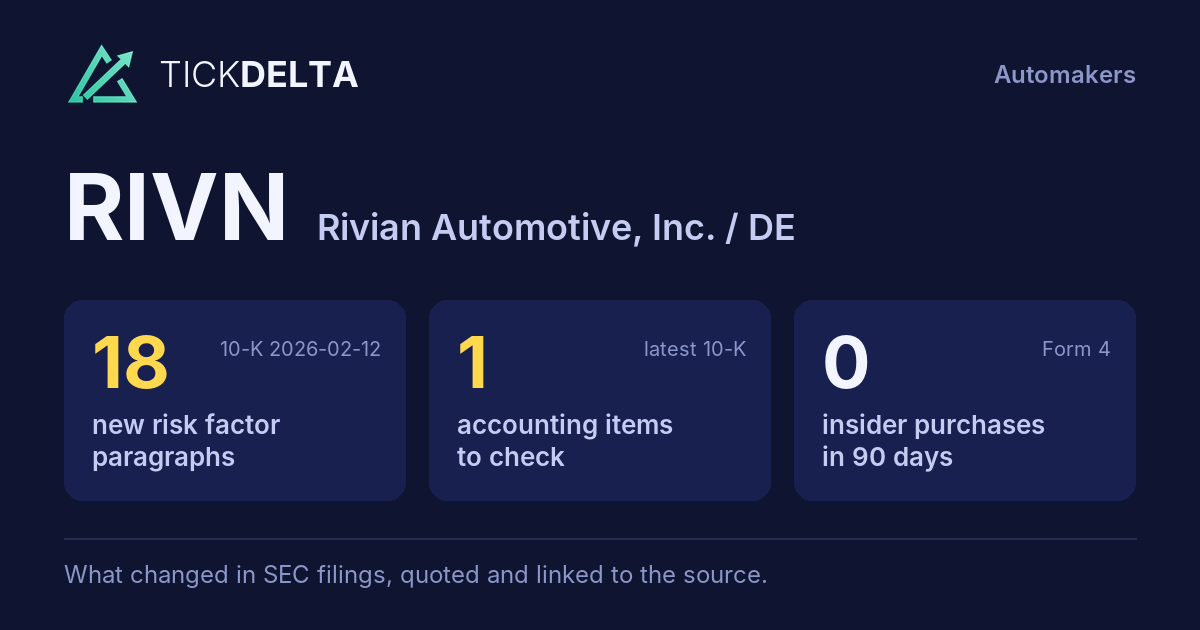
of the text changed · 33,880 words now · 18 new paragraphs, 41 gone
MD&A
35.8%
of the text changed · 7,373 words now · 16 new paragraphs, 13 gone
Legal Proceedings
40.5%
of the text changed · 801 words now
Accounting Policies
30.0%
of the text changed · 2,287 words now
10-K 0001874178-26-000008 (Feb 12, 2026) vs 10-K 0001874178-25-000007 (Feb 24, 2025)
Every paragraph, and how much of it changed
One bar per paragraph, in the order of the 10-K. Height and colour show the share of its words not in the closest paragraph a year earlier; the tallest bars are new paragraphs.
Risk Factors
333 paragraphs · 18 new · 185 reworded · 41 gone · 10-K Feb 12, 2026 against Feb 24, 2025
New paragraph
Reworded (5% of its words or more)
Same or nearly
Paragraph 51 · 48% changed
Every version of it
Paragraph 217 · 47% changed
Every version of it
Paragraph 168 · 45% changed
Every version of it
The credit agreement governing the ABL Facility and Facility, the indenture governing our senior secured floating rate notes due October 2026 (the “2026 Notes”) contain, Indenture, the DOE Loan agreement (if and when funded will funded) and the JV Loan agreement, each contain, and future debt agreements may contain, restrictive covenants, that, among other things, limit our ability to transfer or dispose of assets, merge with other companies or consummate certain changes of control, acquire other companies, incur additional indebtedness and liens and enter into new businesses, and require us to satisfy certain financial covenants, including including, with respect to the ABL Facility, a minimum liquidity covenant. The indentures governing the green convertible unsecured senior notes due March 2029 (“2029 Green Convertible Notes”) and the green convertible unsecured senior notes due October 2030 (“2030 Green Convertible Notes” and together with the 2029 Green Convertible Notes, the “Convertible Notes”) also contain certain restrictive covenants which may limit our ability to enter into some of the foregoing transactions. covenants. We therefore may not be able to engage in any of the foregoing transactions unless we obtain the consent of the lenders or noteholders or terminate, amend or refinance the credit agreement governing the ABL Facility, the indenture governing the 2026 Notes, the DOE Loan or any future debt agreements, if applicable, which may limit our operating flexibility. For example, the covenants under the ABL Facility and the indenture governing the 2026 Notes currently prevent us from incurring borrowings under the DOE Loan, and therefore we will need to amend and/or refinance each of these facilities in order to access funds under the DOE Loan. In addition, the ABL Facility and the 2026 Notes are currently secured by, and when funded the DOE Loan will be secured by (among other collateral), substantially all of the assets of Rivian Holdings, LLC and its material domestic subsidiaries (other than certain excluded subsidiaries). The total principal amount of our secured debt, which we expect will increase significantly upon our accessing funds under the DOE Loan, together with our limited pool of unencumbered assets, may impair our financing flexibility in the future, including our ability to refinance our existing debt on favorable terms or at all. Although the JV Loan is non-recourse to Rivian Automotive, Inc. or any of its subsidiaries (other than the Joint Venture Equityholder), its terms require that we comply with restrictive covenants that are substantially the same as our ABL Facility, as then in effect. In addition, when funded, the JV Loan will be secured by the Joint Venture equity interests owned by the Joint Venture Equityholder, and therefore, when the JV Loan is funded, any such non-compliance could result in foreclosure on the equity interests we indirectly own in the Joint Venture.
Paragraph 242 · 45% changed
Every version of it
Paragraph 49 · 44% changed
Every version of it
Paragraph 22 · 42% changed
Every version of it
•range anxiety, including the decline of an EV’s range resulting from deterioration over time in the battery’s usable capacity; capacity, the quality, reliability, and availability of service and charging stations for EVs, and the costs and challenges of installing home charging equipment, and perceptions about the cost and availability of alternative energy, including the capacity and reliability of the electric grid;
Paragraph 134 · 41% changed
Every version of it
In addition, we earn have earned tradable credits in the operation of our business under various regulations related to ZEVs, GHG, CAFE, EVs, renewable energy and clean fuel. For example, CAFE, GHG emissions standards and the state-level ZEV mandates create a credit-trading program to reduce compliance costs for vehicle manufacturers and allow flexibility for meeting such requirements. These programs allow automakers the flexibility to earn GHG, CAFE and ZEV credits by exceeding the standard in a given model year, overcompliance credits can either be applied to shortfalls in future or past years or traded to other automakers. We have contracted to sell and intend to sell these credits to other regulated entities who can for their use the of these credits to comply with emission standards, renewable energy procurement standards, standards and other regulatory requirements. Such regulatory credits may become more difficult to obtain However, many of these programs have been modified, challenged or decrease in value over time. The phased out. As such, the future of such programs programs, and our ability to continue to earn and sell credits, is uncertain at this time. If these regulatory As a result of such changes, our ability to earn and sell such credits become unavailable or change in the future, it has been impeded, which has had, and could affect our profitability and have a material continue to have, an adverse effect on our business, prospects, financial condition, results of operations, and cash flows. flows in the future.
Paragraph 263 · 49% changed
Every version of it
10-K Feb 24, 2025We may at times engage in voluntary ESG initiatives (such as voluntary disclosures, certifications, or goals, among others) or commitments, and any such initiatives or achievements of such commitments may be costly. For example, we have shared goals around climate, product, and belonging. In addition, our commitment to The Climate Pledge, pursuant to which signatories pledge to reach net-zero emissions by 2040, and subsequent reporting and emissions reductions and offsets could require considerable investments, and our commitments, with all of their contingencies, dependencies, and in certain cases, reliance on third-party verification and/or performance, is complex and ambitious, and we cannot guarantee that we will meet that or any other of our commitments. Our ability to achieve our commitments, as well as any other voluntary ESG initiatives, is subject to numerous risks, many of which are outside of our control. Such risks include, for example, the availability and cost of low or non-carbon based energy sources, the evolving regulatory requirements affecting ESG standards or disclosures, the availability of suppliers that can meet our sustainability and other standards, our ability to recruit, develop, and retain a diverse range of talent, and other items discussed in these risk factors. Additionally, certain disclosures or targets may be based on assumptions, estimates, hypothetical expectations, or third-party information, which are necessarily uncertain and may be prone to errors or subject to misinterpretation given the long timelines involved and the lack of an established single approach in the field to identifying, measuring, and reporting on many ESG matters. Our processes and controls to identify, measure, and report on ESG metrics may change to reflect evolving methodologies, frameworks, protocols, standards, or other requirements, internal controls, and data availability and quality. This may require us to incur significant costs and may impact our ESG initiatives, including reported progress on, and ability to achieve, any of our goals, either on an initial timeline or at all. Implementing and achieving our commitments and other initiatives may also result in increased costs in our supply chain and business operations. Furthermore, if our competitors’ corporate responsibility performance is perceived to be greater than ours, including performance on third-party benchmarks and scores used by certain market participants, potential or current investors or customers may elect to invest or do business with our competitors instead. Even if this is not the case, our current actions may subsequently be determined to be insufficient by various stakeholders, and we may be subject to various adverse consequences or investor or regulator engagement on our ESG initiatives and disclosures, even if such initiatives are currently voluntary. We may not achieve our commitments in the
10-K Feb 12, 2026
Additionally, certain disclosures or targets may be based on assumptions, estimates, hypothetical expectations, or third-party information, which are necessarily uncertain and may be prone to errors or subject to misinterpretation given the long timelines involved and the lack of an established single approach in the field to identifying, measuring, and reporting on many ESG matters. Our processes and controls to identify, measure, and report on ESG metrics may change to reflect evolving methodologies, frameworks, protocols, standards, or other requirements, internal controls, and data availability and quality. This may require us to incur significant costs and may impact our ESG initiatives, including reported progress on, and ability to
Paragraph 51 · 48% changed
Every version of it
10-K Feb 24, 2025On November 12, 2024, we entered into a transaction agreement with the Volkswagen Group to establish a new joint venture (the “Joint Venture”) focusing on vehicle electrical architecture and software development services. There can be no assurance that the Joint Venture will meet its operational objectives, or that we will achieve incremental benefits through savings on material costs, operating expense efficiencies, and future revenue opportunities as a result of the Joint Venture. Even if we were to achieve any of the anticipated benefits of the Joint Venture, it may take us longer than expected to fully realize those benefits or the benefits may ultimately be smaller than anticipated. Further, there is no assurance that the Joint Venture will lead to the successful expansion of the market applications for our software or that such applications will achieve market acceptance or prove to be profitable. An impact on our ability to recognize the benefits of the Joint Venture or any increased expenditure of our resources as a result of the Joint Venture may adversely affect our business, prospects, financial condition, results of operations, and cash flows.
10-K Feb 12, 2026
achieve market acceptance or prove to be profitable. An impact on our ability to recognize the benefits of the Joint Venture or any increased expenditure of our resources as a result of the Joint Venture may adversely affect our business, prospects, financial condition, results of operations, and cash flows.
Paragraph 217 · 47% changed
Every version of it
10-K Feb 24, 2025There can be no assurance that our pending patent applications will issue as patents. We cannot be certain that we are the first inventor of the subject matter to which we have filed a particular patent application, or that we are the first party to file such a patent application. If another party has previously filed a patent application for the same subject matter as we have, we may not be entitled to the protection sought by the patent application. Further, the scope of protection of issued patent claims is often difficult to determine.
10-K Feb 12, 2026
we may not be entitled to the protection sought by the patent application. Further, the scope of protection of issued patent claims is often difficult to determine.
Paragraph 168 · 45% changed
Every version of it
10-K Feb 24, 2025
The credit agreement governing the ABL Facility and the indenture governing our senior secured floating rate notes due October 2026 (the “2026 Notes”) contain, the DOE Loan when funded will contain, and future debt agreements may contain, restrictive covenants, that, among other things, limit our ability to transfer or dispose of assets, merge with other companies or consummate certain changes of control, acquire other companies, incur additional indebtedness and liens and enter into new businesses, and require us to satisfy certain financial covenants, including a minimum liquidity covenant. The indentures governing the green convertible unsecured senior notes due March 2029 (“2029 Green Convertible Notes”) and the green convertible unsecured senior notes due October 2030 (“2030 Green Convertible Notes”) also contain certain restrictive covenants which may limit our ability to enter into some of the foregoing transactions. We therefore may not be able to engage in any of the foregoing transactions unless we obtain the consent of the lenders or noteholders or terminate, amend or refinance the credit agreement governing the ABL Facility, the indenture governing the 2026 Notes, the DOE Loan or any future debt agreements, if applicable, which may limit our operating flexibility. For example, the covenants under the ABL Facility and the indenture governing the 2026 Notes currently prevent us from incurring borrowings under the DOE Loan, and therefore we will need to amend and/or refinance each of these facilities in order to access funds under the DOE Loan. In addition, the ABL Facility and the 2026 Notes are currently secured by, and when funded the DOE Loan will be secured by (among other collateral), substantially all of the assets of Rivian Holdings, LLC and its material domestic subsidiaries (other than certain excluded subsidiaries). The total principal amount of our secured debt, which we expect will increase significantly upon our accessing funds under the DOE Loan, together with our limited pool of unencumbered assets, may impair our financing flexibility in the future, including our ability to refinance our existing debt on favorable terms or at all. Although the JV Loan is non-recourse to Rivian Automotive, Inc. or any of its subsidiaries (other than the Joint Venture Equityholder), its terms require that we comply with restrictive covenants that are substantially the same as our ABL Facility, as then in effect. In addition, when funded, the JV Loan will be secured by the Joint Venture equity interests owned by the Joint Venture Equityholder, and therefore, when the JV Loan is funded, any such non-compliance could result in foreclosure on the equity interests we indirectly own in the Joint Venture.
10-K Feb 12, 2026
The credit agreement governing the ABL Facility, the Indenture, the DOE Loan agreement (if and when funded) and the JV Loan agreement, each contain, and future debt agreements may contain, restrictive covenants, that, among other things, limit our ability to transfer or dispose of assets, merge with other companies or consummate certain changes of control, acquire other companies, incur additional indebtedness and liens and enter into new businesses, and require us to satisfy certain financial covenants, including, with respect to the ABL Facility, a minimum liquidity covenant. The indentures governing the green convertible unsecured senior notes due March 2029 (“2029 Green Convertible Notes”) and the green convertible unsecured senior notes due October 2030 (“2030 Green Convertible Notes” and together with the 2029 Green Convertible Notes, the “Convertible Notes”) also contain certain restrictive covenants. We therefore may not be able to
Paragraph 242 · 45% changed
Every version of it
10-K Feb 24, 2025Any of the foregoing could have a material adverse effect on our business, prospects, financial condition, results of operations, and cash flows.
10-K Feb 12, 2026
In addition, any future prolonged government shutdown could have a negative impact on our business. Such a shutdown could disrupt our supply chain, delay required government approvals and inspections, restrict our ability to access capital markets, and negatively impact consumer and investor confidence, all of which could have a material adverse effect on our business, prospects, financial condition, results of operations, and cash flows.
Paragraph 49 · 44% changed
Every version of it
10-K Feb 24, 2025A significant portion of our revenues has been from one customer that is an affiliate of one of our principal stockholders. If we are unable to maintain this relationship, or if this customer purchases significantly fewer vehicles than we currently anticipate, then our business, prospects, financial condition, results of operations, and cash flows could be materially and adversely affected.
10-K Feb 12, 2026
We are subject to risks associated with our joint venture with Volkswagen Group, including that a significant portion of our software and services revenues has been from Volkswagen Group. If the Joint Venture does not meet its operational objectives, or we do not achieve the anticipated incremental benefits and future revenue opportunities as a result of the Joint Venture then our business, prospects, financial condition, results of operations, and cash flows could be materially and adversely affected.
Paragraph 22 · 42% changed
Every version of it
10-K Feb 24, 2025
•range anxiety, including the decline of an EV’s range resulting from deterioration over time in the battery’s usable capacity;
10-K Feb 12, 2026
•range anxiety, including the decline of an EV’s range resulting from deterioration over time in the battery’s usable capacity, the quality, reliability, and availability of service and charging stations for EVs, and the costs and challenges of installing home charging equipment, and perceptions about the cost and availability of alternative energy, including the capacity and reliability of the electric grid;
Paragraph 134 · 41% changed
Every version of it
10-K Feb 24, 2025
In addition, we earn tradable credits in the operation of our business under various regulations related to ZEVs, GHG, CAFE, renewable energy and clean fuel. For example, CAFE, GHG emissions standards and the state-level ZEV mandates create a credit-trading program to reduce compliance costs for vehicle manufacturers and allow flexibility for meeting such requirements. These programs allow automakers the flexibility to earn GHG, CAFE and ZEV credits by exceeding the standard in a given model year, overcompliance credits can either be applied to shortfalls in future or past years or traded to other automakers. We have contracted to sell and intend to sell these credits to other regulated entities who can use the credits to comply with emission standards, renewable energy procurement standards, and other regulatory requirements. Such regulatory credits may become more difficult to obtain or decrease in value over time. The future of such programs is uncertain at this time. If these regulatory credits become unavailable or change in the future, it could affect our profitability and have a material adverse effect on our business, prospects, financial condition, results of operations, and cash flows.
10-K Feb 12, 2026
In addition, we have earned tradable credits in the operation of our business under various regulations related to EVs, renewable energy and clean fuel. We have contracted to sell these credits to other regulated entities for their use of these credits to comply with emission standards, renewable energy procurement standards and other regulatory requirements. However, many of these programs have been modified, challenged or phased out. As such, the future of such programs, and our ability to continue to earn and sell credits, is uncertain at this time. As a result of such changes, our ability to earn and sell such credits has been impeded, which has had, and could continue to have, an adverse effect on our business, prospects, financial condition, results of operations, and cash flows in the future.
MD&A
80 paragraphs · 16 new · 45 reworded · 13 gone · 10-K Feb 12, 2026 against Feb 24, 2025
New paragraph
Reworded (5% of its words or more)
Same or nearly
Paragraph 71 · 50% changed
Net cash provided by financing activities during the year ended December 31, 2025 primarily resulted from the issuance of $750 million in shares of Class A common stock to Volkswagen Group in connection with the achievement of the Financial Milestone, as well as capital contributed by outside parties in the formation of Mind Robotics, Inc. and Mind Robotics, LLC (see Note 1 "Presentation and Nature of Operations" and Note 19 “Variable Interest expense increased Entities” to our consolidated financial statements included in this Form 10-K for more information). Net cash provided by financing activities during the year ended December 31, 2024 primarily due to resulted from the issuance of the 2029 Green 2026 Convertible Notes and 2030 Green Convertible Notes (“Green Convertible Notes”) in 2023. See Note (see Note 10 “Debt” to our consolidated financial statements included in this Form 10-K for more information. information).
Paragraph 6 · 49% changed
Interconnected by our AI platform, Rivian also built unified intelligence underpins our products and offers a vertically integrated set suite of software and services that span across the entire purchase and ownership process. These services include remarketing, vehicle repair and maintenance, charging, software subscriptions, financing, insurance, and more. Interconnected by our data and analytics backbone, our services are including Autonomy+, designed to deliver fast-paced innovation cycles, structural cost advantages, and exceptional customer experiences.
Paragraph 24 · 48% changed
Paragraph 11 · 47% changed
Paragraph 50 · 47% changed
Paragraph 69 · 46% changed
Net cash provided by financing used in operating activities decreased during the year ended December 31, 2024 2025 compared to the year ended December 31, 2024, primarily resulted from the issuance of the 2026 Convertible Note. driven by a significant reduction in net loss.
Paragraph 13 · 42% changed
•Ability to Manage Costs. Selling our vehicles profitably requires successful and timely execution against multiple cost reduction objectives across the vehicle and our manufacturing operations. The production capacity at our manufacturing facility in Normal, Illinois (“Normal Factory”) is operating significantly below full vehicle production rate capacity. This lower utilization of plant capacity results in the cost of revenues to operate the plant being much higher per unit of production than would be the case if we were manufacturing at capacity. In late September and early October 2025, we completed upgrades to the first quarter of 2024, we announced that initial production of R2 will be at our paint shop in the Normal Factory, resulting enabling an increase in the expansion of production capacity to approximately 215,000 units annually in preparation for the first customer deliveries of annual production. the R2 expected in the second quarter of 2026. Significant capital expenditures will be were required to support the integration of R2 into our Normal Factory. Our Factory, and our future profitability depends upon our ability to scale our production and delivery operations more efficiently at a lower cost per unit. We may incur impairments of our equipment in the plant if the utilization of our plant capacity does not increase in the future. As a result of the updates made to our Normal Factory during the plant retooling upgrade, we accelerated depreciation during the first and second quarter of 2024 and had higher overhead costs per unit due to lower production in the second quarter of 2024. Following the plant retooling upgrade during the second quarter of 2024, we are beginning to experience improved manufacturing efficiencies. As our production capabilities continue to mature, we anticipate these benefits to reduce our cost per vehicle. The introduction of our second generation R1 vehicles has reduced material costs as a result of engineering design changes and improvements in supplier commercial terms. In addition, we expect to leverage previous technologies and platforms while growing sales and service infrastructure to support R2. Achieving cost reductions requires, among other things, a timely launch and associated ramp of R2 and scaling our vehicle production volumes, timely introduction of new components and technologies into production, negotiation of unit price reductions with suppliers, management of our labor and logistics costs, and pursuing opportunities to drive down warranty cost through quality. Should we not achieve such reductions in a timely manner, we could experience adverse impacts to our gross margin and consequently overall profitability.
Paragraph 46 · 40% changed
For the year ended December 31, 2024, 2025, SG&A expenses included $213 $221 million of depreciation and amortization expense and $324 million of stock-based compensation expense. SG&A expenses increased year-over-year primarily due to an $81 million increase in as a result of expanding our go-to-market operations and footprint, including higher payroll and related expenses predominantly from primarily driven by increased headcount, stock-based compensation expenses primarily attributable to an increase in personnel at service centers and spaces, a $55 million increase in sales and marketing expenses to support go-to-market operations, and a $46 million increase in utilities and facilities expenses primarily resulting from an increase in rent and repair and maintenance expense for additional Rivian Adventure Network Direct Current fast chargers (“Rivian Adventure Network”) sites and service centers, partially offset by a $58 million decrease in stock-based compensation expense primarily resulting from a decrease in the total amount of accrued stock-based bonus incentives. incentives, and facilities expenses.
Paragraph 71 · 50% changed
10-K Feb 24, 2025
Interest expense increased for the year ended December 31, 2024 primarily due to the issuance of the 2029 Green Convertible Notes and 2030 Green Convertible Notes (“Green Convertible Notes”) in 2023. See Note 10 “Debt” to our consolidated financial statements included in this Form 10-K for more information.
10-K Feb 12, 2026
Net cash provided by financing activities during the year ended December 31, 2025 primarily resulted from the issuance of $750 million in shares of Class A common stock to Volkswagen Group in connection with the achievement of the Financial Milestone, as well as capital contributed by outside parties in the formation of Mind Robotics, Inc. and Mind Robotics, LLC (see Note 1 "Presentation and Nature of Operations" and Note 19 “Variable Interest Entities” to our consolidated financial statements included in this Form 10-K for more information). Net cash provided by financing activities during the year ended December 31, 2024 primarily resulted from the issuance of the 2026 Convertible Note (see Note 10 “Debt” to our consolidated financial statements included in this Form 10-K for more information).
Paragraph 6 · 49% changed
10-K Feb 24, 2025
Rivian also built and offers a vertically integrated set of software and services that span across the entire purchase and ownership process. These services include remarketing, vehicle repair and maintenance, charging, software subscriptions, financing, insurance, and more. Interconnected by our data and analytics backbone, our services are designed to deliver fast-paced innovation cycles, structural cost advantages, and exceptional customer experiences.
10-K Feb 12, 2026
Interconnected by our AI platform, Rivian unified intelligence underpins our products and suite of software and services including Autonomy+, designed to deliver fast-paced innovation cycles, structural cost advantages, and exceptional customer experiences.
Paragraph 24 · 48% changed
10-K Feb 24, 2025•Government Incentives. There are various government policies, grants, loans, and other incentives, including regulatory credits, designed to increase EV adoption, support the production of EVs and related technologies, and promote the use of alternative fuels, among other objectives. For example, the Inflation Reduction Act of 2022 offers a tax credit for EV purchases or leases contingent upon pricing limits, customer income limits, and assembly, manufacturing, and sourcing requirements. Additionally, we have entered into a loan facility with the Department of Energy, and an amended agreement with the Economic Development Agreement with the State of Georgia and the Joint Development Authority of Jasper County, Morgan County, Newton County and Walton County to support our manufacturing facility near the city of Social Circle, Georgia (the “Stanton Springs North Facility”), and a REV Tax Credit Agreement with the State of Illinois acting by and through the Department of Commerce and Economic Opportunity through which we are eligible for an incentive package to support the renovation and expansion of our Normal Factory. United States federal government incentives are subject to change by the new Congress and presidential administration. Any reduction or elimination of these or other similar incentives, or failure of our vehicles to meet tax credit eligibility requirements, could have a direct impact on demand for our vehicles and a material adverse impact on our business, prospects, financial condition, results of operations, and cash flows. In addition, we earn tradable credits in the operation of our business under various regulations related to zero emission vehicles, greenhouse gas, fuel economy, renewable energy, and clean fuel. We have contracted and intend to sell these credits to other regulated entities who can use the credits to comply with emission standards, renewable energy procurement standards, and other regulatory requirements. The future of such programs is uncertain at this time. If these regulatory credits become unavailable or change in the future, it could affect our profitability and have a material adverse effect on our business, prospects, financial condition, results of operations, and cash flows.
10-K Feb 12, 2026
Newton County and Walton County to support our Stanton Springs North Facility, and a REV Tax Credit Agreement with the State of Illinois acting by and through the Department of Commerce and Economic Opportunity to support the expansion of our Normal Factory. United States federal government incentives are subject to change by Congress and the presidential administration. Any reduction or elimination of relevant incentives, or our failure to meet eligibility requirements, could have a direct impact on demand for our vehicles and a material adverse impact on our business, prospects, financial condition, results of operations, and cash flows.
Paragraph 11 · 47% changed
10-K Feb 24, 2025vehicles, which have been reengineered for more efficiency, lower cost, and higher performance. In the third quarter of 2024, we launched the Rivian pre-owned vehicle program which expands opportunities to gain new customers. Our future financial performance will also depend on our ability to offer software and services that profitably deliver an intuitive, seamless, and compelling customer experience profitably.
10-K Feb 12, 2026
including our software stack, propulsion technology, network architecture, and vehicle electronics, and the platform has been designed for cost efficiency, with a focus on part consolidation or elimination. We continue to develop value-added technologies that enhance our customers’ experience including our autonomy platform, which we believe represent an advantage to Rivian. Our future financial performance will also depend on our ability to offer software and services that profitably deliver an intuitive, seamless, and compelling customer experience.
Paragraph 50 · 47% changed
10-K Feb 24, 2025Interest expense increased for the year ended December 31, 2024 primarily due to the issuance of the 2029 Green Convertible Notes and 2030 Green Convertible Notes (“Green Convertible Notes”) in 2023. See Note 10 “Debt” to our consolidated financial statements included in this Form 10-K for more information.
10-K Feb 12, 2026
Other expense, net increased for the year ended December 31, 2025 primarily due to $186 million of expense recorded for the settlement of securities class action litigation, net of expected insurance recoveries, which was partially offset by the cumulative gain on our equity method investment in Also, Inc. (refer to Note 16 “Commitments and Contingencies” and Note 2 "Equity Method Investments" to our consolidated financial statements included in this Form 10-K for more information).
Paragraph 69 · 46% changed
10-K Feb 24, 2025
Net cash provided by financing activities during the year ended December 31, 2024 primarily resulted from the issuance of the 2026 Convertible Note.
10-K Feb 12, 2026
Net cash used in operating activities decreased during the year ended December 31, 2025 compared to the year ended December 31, 2024, primarily driven by a significant reduction in net loss.
Paragraph 13 · 42% changed
10-K Feb 24, 2025
•Ability to Manage Costs. Selling our vehicles profitably requires successful and timely execution against multiple cost reduction objectives across the vehicle and our manufacturing operations. The production capacity at our manufacturing facility in Normal, Illinois (“Normal Factory”) is operating significantly below full vehicle production rate capacity. This lower utilization of plant capacity results in the cost of revenues to operate the plant being much higher per unit of production than would be the case if we were manufacturing at capacity. In the first quarter of 2024, we announced that initial production of R2 will be at our Normal Factory, resulting in the expansion of production capacity to approximately 215,000 units of annual production. Significant capital expenditures will be required to support the integration of R2 into our Normal Factory. Our future profitability depends upon our ability to scale our production and delivery operations more efficiently at a lower cost per unit. We may incur impairments of our equipment in the plant if the utilization of our plant capacity does not increase in the future. As a result of the updates made to our Normal Factory during the plant retooling upgrade, we accelerated depreciation during the first and second quarter of 2024 and had higher overhead costs per unit due to lower production in the second quarter of 2024. Following the plant retooling upgrade during the second quarter of 2024, we are beginning to experience improved manufacturing efficiencies. As our production capabilities continue to mature, we anticipate these benefits to reduce our cost per vehicle. The introduction of our second generation R1 vehicles has reduced material costs as a result of engineering design changes and improvements in supplier commercial terms. In addition, we expect to leverage previous technologies and platforms while growing sales and service infrastructure to support R2. Achieving cost reductions requires, among other things, a timely launch and associated ramp of R2 and scaling our vehicle production volumes, timely introduction of new components and technologies into production, negotiation of unit price reductions with suppliers, management of our labor and logistics costs, and pursuing opportunities to drive down warranty cost through quality. Should we not achieve such reductions in a timely manner, we could experience adverse impacts to our gross margin and consequently overall profitability.
10-K Feb 12, 2026
•Ability to Manage Costs. Selling our vehicles profitably requires successful and timely execution against multiple cost reduction objectives across the vehicle and our manufacturing operations. The production capacity at our manufacturing facility in Normal, Illinois (“Normal Factory”) is operating significantly below full vehicle production rate capacity. This lower utilization of plant capacity results in the cost of revenues to operate the plant being much higher per unit of production than would be the case if we were manufacturing at capacity. In late September and early October 2025, we completed upgrades to the paint shop in the Normal Factory, enabling an increase in production capacity to 215,000 units annually in preparation for the first customer deliveries of the R2 expected in the second quarter of 2026. Significant capital expenditures were required to support the integration of R2 into our Normal Factory, and our future profitability depends upon our ability to scale our production and delivery operations more efficiently at a lower cost per unit.
Paragraph 46 · 40% changed
10-K Feb 24, 2025
For the year ended December 31, 2024, SG&A expenses included $213 million of depreciation and amortization expense. SG&A expenses increased year-over-year primarily due to an $81 million increase in payroll and related expenses predominantly from an increase in personnel at service centers and spaces, a $55 million increase in sales and marketing expenses to support go-to-market operations, and a $46 million increase in utilities and facilities expenses primarily resulting from an increase in rent and repair and maintenance expense for additional Rivian Adventure Network Direct Current fast chargers (“Rivian Adventure Network”) sites and service centers, partially offset by a $58 million decrease in stock-based compensation expense primarily resulting from a decrease in the total amount of accrued stock-based bonus incentives.
10-K Feb 12, 2026
For the year ended December 31, 2025, SG&A expenses included $221 million of depreciation and amortization expense and $324 million of stock-based compensation expense. SG&A expenses increased as a result of expanding our go-to-market operations and footprint, including higher payroll and related expenses primarily driven by increased headcount, stock-based compensation expenses primarily attributable to an increase in the total amount of accrued stock-based bonus incentives, and facilities expenses.
A paragraph is matched with the one last year that shares the most of its words; under half in common makes it new. The paragraphs shown are the 8 reworded the most in each section.
The paragraph that changed most in each section
The redline
Marked against last year's 10-K: cut words struck through, new words highlighted.
Risk Factors587 words changed in this paragraph; it is 30% similar to last year's version.
We rely on computer systems, hardware, software, technology infrastructure, online sites, AI Technologies (as defined below) and networks for both internal and external operations (collectively, “Technology Systems”). We own and manage some of these Technology Systems but also rely on third parties for a range of Technology Systems and related products and services, including but not limited to cloud computing services. We and certain of our third-party providers collect, maintain and process data about customers, employees, business partners and others, including information that relates to individuals and/or constitutes “personal data,” “personal information,” “personally identifiable information,” or similar terms under applicable data privacy laws (collectively, “Personal Information”) as well as proprietary information belonging to our business such as trade secrets (together, “Confidential Information”). We also engage in certain relationships where we share Confidential Information with our business partners. Threats to our, our partners’ and our vendors and suppliers’ Technology Systems are increasingly diverse and sophisticated and we face numerous and evolving cybersecurity risks that threaten the confidentiality, integrity and availability of our Technology Systems and Confidential Information. Traditional computer “hackers,” malicious code (such as viruses and worms), phishing attempts, employee theft or misuse, denial of service attacks, ransomware attacks, and sophisticated nation-state and nation-state supported actors engage in intrusions and attacks that create risks for our and our vendors and suppliers’ iTechnology Systems, vehicles and products and the information they store and process. Although we have implemented security measures designed to prevent such attacks, our networks and systems may be breached due to the actions of outside parties, employee error, malfeasance, a combination of these, or otherwise, and as a result, an unauthorized party may obtain access to our Technology Systems or data, resulting in data being publicly disclosed, altered, lost, or stolen, which could subject us to liability and adversely impact our financial condition. Further, any breach in our data security could allow malicious parties to access sensitive systems, such as our product lines and the vehicles themselves. Such access could adversely impact the safety of our employees and customers. We and our suppliers have been and continue to be subject to ransomware and phishing attacks. While we seek to learn from all attacks directed at us and implement remedial measures where necessary under the framework of our cybersecurity risk management program we have developed and expect our suppliers to do the same, we cannot guarantee that such remedial measures will prevent material cybersecurity incidents in the future. We also face increasing and evolving disclosure obligations related to cyber and other security events. Despite our cybersecurity risk management program and processes, we may fail to meet our existing or future disclosure obligations and/or may have our disclosures misinterpreted. Remote and hybrid working arrangements at our Company and at many third-party vendors and suppliers also increase cybersecurity risks due to the challenges associated with managing remote computing assets and security vulnerabilities that are present in many non-corporate and home networks. Additionally, the integration of artificial intelligence in our or any suppliers’ operations, products or services is expected to pose new or unknown cybersecurity risks and challenges.Any actual, alleged, or perceived failure to prevent a security breach or to comply with our privacy policies or privacy-related legal obligations, failure in our systems or networks, or any other actual, alleged, or perceived data security incident we or our suppliers suffer, could result in: damage to our reputation; negative publicity; loss of customers and sales; loss of competitive advantages; increased costs to remedy any problems and provide any required notifications, including to regulators and individuals, and otherwise respond to any incident; regulatory investigations and enforcement actions; costly litigation; and other liabilities. In addition, we may incur significant financial and operational costs to investigate, remediate, and implement additional tools, devices, and systems designed to prevent actual or perceived security breaches, and other security or privacy-related incidents. Further, we could also be exposed to a risk of loss or litigation and potential liability under laws (including class actions), regulations, and contracts that protect the privacy and security of Personal Information. Any of these negative outcomes could adversely impact the market perception of our products and customer and investor confidence in our Company, and could materially and adversely affect our business, prospects, financial condition, results of operations, or cash flows.
Source: Item 1A, 10-K 0001874178-26-000008 vs Item 1A, 10-K 0001874178-25-000007
MD&A305 words changed in this paragraph; it is 32% similar to last year's version.
•Government Incentives. There are various government governmental policies, grants, loans, and other incentives, including regulatory credits, designed to increase EV electric vehicle (“EV”) adoption, support the production of EVs and related technologies, and promote the use of alternative fuels, among other objectives. For example, the Inflation Reduction Act of 2022 offers a While certain such incentives, such as 30D and 45W tax credit credits for EV purchases or leases contingent upon pricing limits, customer income limits, and assembly, manufacturing, and sourcing requirements. acquired after September 30, 2025 have been modified, challenged, or phased out, other incentives, such as the 45X tax credit for domestic battery production, remain available. Additionally, we have entered into a loan facility with the Department of Energy, and DOE, an amended agreement with the Economic Development Agreement with the State of Georgia and the Joint Development Authority of Jasper County, Morgan County, Newton County and Walton County to support our manufacturing facility near the city of Social Circle, Georgia (the “Stanton Springs North Facility”), and a REV Tax Credit Agreement with the State of Illinois acting by and through the Department of Commerce and Economic Opportunity through which we are eligible for an incentive package to support the renovation and expansion of our Normal Factory. United States federal government incentives are subject to change by the new Congress and presidential administration. Any reduction or elimination of these or other similar incentives, or failure of our vehicles to meet tax credit eligibility requirements, could have a direct impact on demand for our vehicles and a material adverse impact on our business, prospects, financial condition, results of operations, and cash flows. In addition, we earn tradable credits in the operation of our business under various regulations related to zero emission vehicles, greenhouse gas, fuel economy, renewable energy, and clean fuel. We have contracted and intend to sell these credits to other regulated entities who can use the credits to comply with emission standards, renewable energy procurement standards, and other regulatory requirements. The future of such programs is uncertain at this time. If these regulatory credits become unavailable or change in the future, it could affect our profitability and have a material adverse effect on our business, prospects, financial condition, results of operations, and cash flows.
Source: Item 7, 10-K 0001874178-26-000008 vs Item 7, 10-K 0001874178-25-000007
Legal Proceedings102 words changed in this paragraph; it is 76% similar to last year's version.
•Between March 7, 2022 and April 19, 2022, three alleged stockholders (the “Plaintiffs”) filed lawsuits against Rivian Automotive, Inc., certain of our officers and directors, and Rivian’s IPO underwriters on behalf of a putative class of purchasers of Rivian common stock in our IPO. The three suits were consolidated under the caption Crews v. Rivian Automotive, Inc., et al, 22-cv-01524-RGK-E 22-cv-01524-JLS-E (C.D. Cal.). On July 22, 2022 the lead plaintiff filed an amended consolidated complaint alleging violations of Sections 11, 12(a)(2) and 15 of the Securities Act of 1933 and Sections 10(b) and 20(a) of the Exchange Act and seeking damages, equitable relief and attorneys’ fees and costs. By Order dated February 16, 2023 the Rivian defendants and the underwriter defendants’ motions to dismiss were granted with leave to amend. An Amended Complaint was filed on March 2, 2023, and on 2023. On March 16, 2023 the defendants filed Motions to Dismiss, which were denied by Order dated July 3, 2023. We believe the alleged stockholders’ claims are meritless and intend to vigorously defend against this lawsuit. A similar lawsuit styled Smith, et al. v. Rivian Automotive, Inc., et al., 30-2023-01310105-CU-SL-CXC, was filed by two alleged stockholders in California Superior Court, Orange County on February 28, 2023. The Complaint alleges violations of Sections 11 and 15 of the Securities Act of 1933 and seeks damages, declaratory judgment and attorneys’ fees and costs. Defendants filed a Motion to Dismiss the Complaint on April 6, 2023, which was granted by Order dated June 30, 2023. Plaintiffs filed a Notice of Appeal on September 1, 2023.
Source: Item 3, 10-K 0001874178-26-000008 vs Item 3, 10-K 0001874178-25-000007
Accounting Policies36 words changed in this paragraph; it is 82% similar to last year's version.
Source: Item 8, Note 2 – SUMMARY OF SIGNIFICANT ACCOUNTING POLICIES, 10-K 0001874178-26-000008 vs Item 8, Note 2 – SUMMARY OF SIGNIFICANT ACCOUNTING POLICIES, 10-K 0001874178-25-000007
Sentences and paragraphs added, removed or reworded
Every change, by type
Sentences and paragraphs of RIVN's Risk Factors and MD&A, 10-K Feb 12, 2026 against 10-K Feb 24, 2025. Each links to the text at sec.gov.
Quiet changes are sentences kept from last year with one to four words changed, at least one of them a hedge, a modal or a qualifier (may, could, will, not, significant, material…). A year or date rolling forward is not counted.
The full word list
adverse, adversely, all, although, anticipate, anticipates, any, approximately, believe, believes, can, cannot, certain, could, expect, expects, generally, however, if, intend, intends, largely, likely, many, material, materially, may, might, most, must, never, no, not, possible, primarily, probable, should, significant, significantly, some, substantial, substantially, unlikely, will, would
AddedRisk Factors
incentives, prices of raw materials and components, cost of energy, and governmental regulations, including incentives, tariffs, import regulation, and taxes.
Read it in 10-K Feb 12, 2026 at sec.gov
AddedRisk Factors
Shortages and delays in the supply of certain raw materials, components and equipment necessary to produce our vehicles, and the various internal designs and processes we adopted in an effort to remedy or mitigate impacts of such disruptions and delays have resulted in, and may in the future result in, higher costs. If our suppliers experience substantial financial
Read it in 10-K Feb 12, 2026 at sec.gov
AddedRisk Factors
to insource certain components, supply arrangements with current or future suppliers (with respect to other components offered by such suppliers) may be available on less favorable terms or not at all.
Read it in 10-K Feb 12, 2026 at sec.gov
AddedRisk Factors
As a manufacturer engaged in sales directly to consumers, we face regulatory limitations on and legal challenges to our ability to sell, lease and service vehicles directly, which could materially and adversely affect our ability to sell and lease our vehicles.
Read it in 10-K Feb 12, 2026 at sec.gov
AddedRisk Factors
•successful integration with, and continued access to, third-party charging networks;
Read it in 10-K Feb 12, 2026 at sec.gov
AddedRisk Factors
While certain tax credits and other incentives for alternative energy production, alternative fuel, and EVs have been available in the past, many programs have been modified, challenged or phased out. There is no guarantee that any incentive programs will be available in the future and the cessation and modification of these programs could have an adverse impact on demand for EVs, including our vehicles. Consequently, the reduced availability of and uncertainty related to government and economic incentives, including tax credits, and our ability and that of our customers and competitors to benefit from these credits and incentives, has had and could continue to have an adverse effect our business, prospects, financial condition, results of operations, and cash flows.
Read it in 10-K Feb 12, 2026 at sec.gov
AddedRisk Factors
•complex and unfavorable regulatory, political, economic, legal and labor conditions;
Read it in 10-K Feb 12, 2026 at sec.gov
AddedRisk Factors
•military conflicts, geopolitical tensions, political instability, economic sanctions, incidents of terrorism or responses to these events, pandemics or natural disasters; and
Read it in 10-K Feb 12, 2026 at sec.gov
Show the other 67
AddedRisk Factors
We rely on computer systems, hardware, software, technology infrastructure, online sites, AI Technologies (as defined below) and networks for both internal and external operations (collectively, “Technology Systems”). We own and manage some of these Technology Systems but also rely on third parties for a range of Technology Systems and related products and services, including but not limited to cloud computing services. We and certain of our third-party providers collect, maintain and process data about customers, employees, business partners and others, including information that relates to individuals and/or constitutes “personal data,” “personal information,” “personally identifiable information,” or similar terms under applicable data privacy laws (collectively, “Personal Information”) as well as proprietary information belonging to our business such as trade secrets (together, “Confidential Information”). We also engage in certain relationships where we share
Read it in 10-K Feb 12, 2026 at sec.gov
AddedRisk Factors
Confidential Information with our business partners. Threats to our, our partners’ and our vendors and suppliers’ Technology Systems are increasingly diverse and sophisticated and we face numerous and evolving cybersecurity risks that threaten the confidentiality, integrity and availability of our Technology Systems and Confidential Information.
Read it in 10-K Feb 12, 2026 at sec.gov
AddedRisk Factors
federal level as well, reflecting a trend toward more stringent privacy legislation in the United States. In addition, in 2024 the National Security Division of the U.S. Department of Justice issued a new rule known as the “Data Security Program” related to the transfer of “bulk U.S. sensitive personal data” and “government related data” to “countries of concern” or “covered persons” (as defined in the rule) which is new, complex, and has yet to be enforced, but imposes stringent obligations on companies within its scope.
Read it in 10-K Feb 12, 2026 at sec.gov
AddedRisk Factors
Although we make reasonable efforts to comply with all applicable data protection laws and regulations, our interpretations and efforts may have been or may prove to be insufficient or incorrect. We also generally seek to comply with industry
Read it in 10-K Feb 12, 2026 at sec.gov
RemovedRisk Factors
RemovedRisk Factors
RemovedRisk Factors
RemovedRisk Factors
RemovedRisk Factors
RemovedRisk Factors
RemovedRisk Factors
RemovedRisk Factors
RemovedRisk Factors
RemovedRisk Factors
RemovedRisk Factors
RemovedRisk Factors
RewordedRisk Factors
RewordedRisk Factors
If the production and delivery of new models models, variants, or technologies are delayed or reduced, if they are not manufactured in line with cost and volume targets, or if new models models, variants, technologies or our software product and services do not meet customer expectations or are not well-received by the market for any reason, including due to pricing considerations, competitors’ product introductions, technological innovations, macroeconomic economic conditions, regulatory or other political developments, transportation infrastructure, and changes in quality, safety, reliability, and styling demands and preferences, our revenues and cash flow would be adversely affected and we may not be able to generate sales in sufficient quantities and at high enough prices to be profitable.
Read it in 10-K Feb 12, 2026 at sec.gov
RewordedRisk Factors
A number of factors can impact overall demand and consumer decisions on whether to purchase our vehicles, software or services, including changes in customer preferences, competitive developments, introduction of new vehicles and technologies, general economic or geopolitical conditions (such as decreases in per capita income and level of disposable income, increased and prolonged unemployment, or a decline in consumer confidence), conditions, increases in interest rates that could make financing less attractive for some customers, rates, increased tariffs, economic uncertainty and global or domestic recession, changes to or rollback of government incentives, higher insurance premiums for EVs, lack of charging infrastructure, negative perceptions regarding EV demand and adoption, and any event or incident that generates negative media coverage about us or the safety or quality of EVs.
Read it in 10-K Feb 12, 2026 at sec.gov
RewordedRisk Factors
Changes in business or macroeconomic economic conditions, governmental regulations, currency fluctuations, increased United States tariffs, non-United States retaliatory tariffs or and non-tariff trade barriers including export restrictions in supplier countries, shortages in raw materials, and changes in geopolitical conditions, including the ongoing conflict between Russia and Ukraine and in the Middle East, and related attacks or violence in the broader region, and other factors beyond our control or that we do not presently anticipate could result in significant increases in freight charges and raw material and component costs, costs which could significantly impact our ability to receive raw materials or components.
Read it in 10-K Feb 12, 2026 at sec.gov
RewordedRisk Factors
RewordedRisk Factors
We are dependent on our existing establishing and maintaining relationships with vendors and suppliers, suppliers necessary for the production of our products and services, a significant number of which are single or limited source suppliers, and are also dependent on our ability to source suppliers, for our critical components, and to complete the building out of our supply chain, while effectively managing the risks due to such relationships.
Read it in 10-K Feb 12, 2026 at sec.gov
RewordedRisk Factors
RewordedRisk Factors
Some open-source software licenses may require users who distribute source code for proprietary software containing or linked to open-source software to be publicly disclose all or part of the disclosed in source code to such proprietary software and/or make available any derivative works of the open-source code form under the same open-source license, which could include license if the proprietary source code. software is distributed.
Read it in 10-K Feb 12, 2026 at sec.gov
RewordedRisk Factors
The credit agreement governing the ABL Facility and Facility, the indenture governing our senior secured floating rate notes due October 2026 (the “2026 Notes”) contain, Indenture, the DOE Loan agreement (if and when funded will funded) and the JV Loan agreement, each contain, and future debt agreements may contain, restrictive covenants, that, among other things, limit our ability to transfer or dispose of assets, merge with other companies or consummate certain changes of control, acquire other companies, incur additional indebtedness and liens and enter into new businesses, and require us to satisfy certain financial covenants, including including, with respect to the ABL Facility, a minimum liquidity covenant.
Read it in 10-K Feb 12, 2026 at sec.gov
RewordedRisk Factors
Additionally, recent legislative and executive orders by the new United States presidential administration indicate an intention to reverse actions have reversed much of the previous administration’s policy directives as it relates to clean energy and EVs. EVs and there have been efforts in federal and state governments to scale back emissions regulations.
Read it in 10-K Feb 12, 2026 at sec.gov
RewordedRisk Factors
RewordedRisk Factors
There is no guarantee that we will be able to generate have sufficient cash flow or sales available to meet these various financial covenants, pay the principal and interest when due under our debt agreements or repurchase the 2029 Green Convertible Notes or the 2030 Green Convertible Notes, or pay any cash amounts due upon conversion of such notes.
Read it in 10-K Feb 12, 2026 at sec.gov
Quiet changesRisk Factors
While the prevalence of charging stations generally has been increasing, charging station locations are significantly remain less widespread than gas stations.
Read it in 10-K Feb 12, 2026 at sec.gov
Quiet changesRisk Factors
In addition, if and when funded, the JV Loan will be secured by the Joint Venture equity interests owned by the Joint Venture Equityholder, and therefore, if and when the JV Loan is funded, any such non-compliance could result in foreclosure on the equity interests we indirectly own in the Joint Venture.
Read it in 10-K Feb 12, 2026 at sec.gov
Quiet changesRisk Factors
AddedMD&A
We believe our competitive advantage stems from our product and brand differentiation through vertically integrated technologies as well as our direct-to-customer sales and service model. Product performance benefits from the ability to fully control and continually enhance virtually every aspect of our vehicle’s software, digital experience, and driving dynamics. Our in-house autonomy system has been designed with an AI-centric end-to-end approach and leverages the large amount of miles driven by Rivian vehicles for training, enabling the Company to continuously improve the system. We believe our product performance is increasingly being recognized by customers and has helped Rivian earn some of the industry’s most coveted owner experience awards.
Read it in 10-K Feb 12, 2026 at sec.gov
AddedMD&A
We analyze the results of the business through two reportable segments, Automotive and Software and Services.
Read it in 10-K Feb 12, 2026 at sec.gov
AddedMD&A
Achieving cost reductions requires, among other things, a timely launch and associated ramp of R2 and scaling our vehicle production volumes, timely introduction of new components and technologies into production, negotiation of unit price reductions with suppliers, management of our labor and logistics costs, and pursuing opportunities to drive down warranty costs. Should we not achieve such reductions in a timely manner, we could experience adverse impacts to our gross margin and overall profitability.
Read it in 10-K Feb 12, 2026 at sec.gov
AddedMD&A
manufacturing shutdowns and additional losses, which could delay our ability to achieve profitability and positive operating cash flow. In September 2025, we held a groundbreaking ceremony at our manufacturing facility near the city of Social Circle, Georgia (the “Stanton Springs North Facility”), which we expect to begin constructing in 2026 to support production of our midsize platform (“MSP”). Any delays in the timing or execution of this investment could have an adverse impact on our prospects, financial condition, results of operations, and cash flows, and it could require significant external debt and/or equity financing.
Read it in 10-K Feb 12, 2026 at sec.gov
AddedMD&A
•Government Incentives. There are various governmental policies, grants, loans, and other incentives, including regulatory credits, designed to increase electric vehicle (“EV”) adoption, support the production of EVs and related technologies, and promote the use of alternative fuels, among other objectives. While certain such incentives, such as 30D and 45W tax credits for EV purchases or leases acquired after September 30, 2025 have been modified, challenged, or phased out, other incentives, such as the 45X tax credit for domestic battery production, remain available. Additionally, we have entered into a loan facility with the DOE, an amended Economic Development Agreement with the State of Georgia and the Joint Development Authority of Jasper County, Morgan County,
Read it in 10-K Feb 12, 2026 at sec.gov
AddedMD&A
Automotive revenues decreased for the year ended December 31, 2025, primarily resulting from a decrease in deliveries of 9,332 vehicles, due in part to the expiration of 45W tax credits after September 30, 2025, as well as a decrease in sales of automotive regulatory credits, partially offset by higher average selling prices and a higher mix of R1 deliveries. The increase in average selling prices was driven by a consumer shift towards higher performance variants along with a decline in discounting.
Read it in 10-K Feb 12, 2026 at sec.gov
AddedMD&A
The current global economic landscape presents significant uncertainty, particularly regarding evolving trade regulation, governmental policies, tariffs, and the overall impact these items have on consumer sentiment and demand. These factors have impacted and could continue to impact our global supply chain, material costs and access, and market dynamics. While in the short term we may experience higher conversion costs, lower overhead absorption, and increased warranty expenses as we ramp R2 production and increase our car parc with customer deliveries expected to begin in the second quarter of 2026, in the long term we expect automotive gross profit losses to continue improving over time through the expected margin profile of R2, continued material cost improvements through engineering design changes and commercial supplier negotiations, and increased efficiencies in our conversion activities across our entire fleet.
Read it in 10-K Feb 12, 2026 at sec.gov
AddedMD&A
Effective May 3, 2025, the United States government adjusted tariffs on imported automobile parts under Section 232 of the Trade Expansion Act of 1962, imposing a 25% tariff on many parts but allowing for tariff offset credits for manufacturers with domestic vehicle assembly. The credits are based upon 3.75% of Manufacturer's Suggested Retail Price of United States vehicles produced from April 3, 2025 to April 30, 2030. In October 2025, we received our license to apply tariff offsets through April 30, 2026, and we expect to qualify for additional tariff offsets from May 1, 2026 through April 30, 2030. While we also are subject to tariffs on imported materials containing steel, aluminum, and graphite, as well as reciprocal tariffs from time to time, our ability to self-certify components in United States vehicle manufacturing as of November 1, 2025 allows us to utilize our 232 Automotive tariff offset to eliminate many of these tariffs. We have experienced and could continue to experience increases to our cost of revenues as a result of tariffs.
Read it in 10-K Feb 12, 2026 at sec.gov
AddedMD&A
The increase in software and services gross profit for the year ended December 31, 2025 primarily resulted from the increase in vehicle electrical architecture and software development services provided by the Joint Venture, as well as the increases in vehicle repair and maintenance services and remarketing sales noted above. In the short term we expect software and services gross profit to continue increasing over time as we continue providing vehicle electrical architecture and software development services and remarketing, as serviced vehicles age out of warranty, and through expansion of our paid software offerings such as Autonomy+, Connect+, and FleetOS. While in the long term we expect these factors to result in continued increases in software and services gross profit, we may experience a reduction during 2028 upon the expected satisfaction of the Joint Venture’s combined performance obligation to further develop, customize, and enhance Rivian’s vehicle electrical architecture technology and software for use in the customer’s future vehicle programs.
Read it in 10-K Feb 12, 2026 at sec.gov
AddedMD&A
For the year ended December 31, 2025, R&D expense included $72 million of depreciation and amortization expense and $306 million of stock-based compensation. While R&D expense is relatively unchanged year-over-year, there were increases in engineering, design, and development costs, prototyping costs, and software expenses to support our R2 launch and AI and autonomy initiatives. These increases were offset by a decrease in payroll and related expenses and stock-based compensation expenses resulting from the cost of services provided to Volkswagen AG and its affiliates (“Volkswagen Group”) by the Joint Venture being recorded in cost of revenues for the year ended December 31, 2025. The decrease in
Read it in 10-K Feb 12, 2026 at sec.gov
AddedMD&A
stock-based compensation expenses also resulted from awards that were not outstanding during the year ended December 31, 2025, partially offset by an increase in the total amount of accrued stock-based bonus incentives.
Read it in 10-K Feb 12, 2026 at sec.gov
AddedMD&A
In June 2025, we issued approximately $1.3 billion aggregate principal amount of fixed rate senior secured green notes due January 15, 2031 (“2031 Green Secured Notes”) in a private offering to qualified institutional buyers pursuant to Rule 144A under the Securities Act and outside the United States to non-U.S. persons pursuant to Regulation S under the Securities Act. The 2031 Green Secured Notes were issued pursuant to an indenture dated as of June 12, 2025 (the “Indenture”). The proceeds were primarily used to redeem in full the $1.3 billion aggregate principal amount of the 2026 Notes.
Read it in 10-K Feb 12, 2026 at sec.gov
RemovedMD&A
RemovedMD&A
RemovedMD&A
RemovedMD&A
RemovedMD&A
RemovedMD&A
RemovedMD&A
RemovedMD&A
RemovedMD&A
RemovedMD&A
RemovedMD&A
RemovedMD&A
RewordedMD&A
RewordedMD&A
The year-over-year decrease in Automotive cost of revenues was primarily due to fewer vehicles being produced and delivered, as well as reductions in the cost of raw materials and materials, product components, and conversion costs, resulting in part driven by from the introduction cost of new vehicle technologies to the R1 platform revenue efficiency initiatives and accelerated depreciation that occurred during the plant retooling upgrade in the second quarter of 2024. prior year.
Read it in 10-K Feb 12, 2026 at sec.gov
RewordedMD&A
Net cash used in investing activities decreased during the year ended December 31, 2024 2025 compared to the year ended December 31, 2023, 2024, primarily resulting from additional driven by lower purchases of short-term investments, partially offset by lower maturities of short-term investments that were not offset by additional purchases. and higher capital expenditures related to the expansion of production capacity at our Normal Factory.
Read it in 10-K Feb 12, 2026 at sec.gov
RewordedMD&A
The majority of our Software and Services revenues is derived from remarketing and vehicle repair and maintenance services, as well as new services provided by the Joint Venture Rivian and Volkswagen Group Technologies, LLC (the “Joint Venture”) to further develop, customize, and enhance Rivian’s existing vehicle electrical architecture and software technology for use in future vehicle programs. programs, as well as remarketing and vehicle repair and maintenance services.
Read it in 10-K Feb 12, 2026 at sec.gov
RewordedMD&A
The year-over-year increase in Software software and services cost of revenues was primarily due to increased volumes of vehicle repair and maintenance services and remarketing sales, as well as new resulted from increases in vehicle electrical architecture and software development services, remarketing sales, and vehicle repair and maintenance services.
Read it in 10-K Feb 12, 2026 at sec.gov
RewordedMD&A
Interest expense increased decreased for the year ended December 31, 2024 2025 primarily due to reduced interest rates resulting from the issuance refinancing of the 2029 2026 Notes into the 2031 Green Convertible Secured Notes and 2030 Green Convertible Notes (“Green Convertible Notes”) in 2023. June 2025.
Read it in 10-K Feb 12, 2026 at sec.gov
RewordedMD&A
RewordedMD&A
RewordedMD&A
We have experienced and may continue to experience experiencing cost fluctuations and disruptions in supply of raw materials and product components that could impact our financial performance. components, including as a result of the imposition of tariffs and other trade barriers.
Read it in 10-K Feb 12, 2026 at sec.gov
RewordedMD&A
A hypothetical 10% change in estimated failure rates or estimated repair or replacement costs would have resulted in the following approximate changes in the warranty reserve for the year ended December 31, 2024 (in millions):
Read it in 10-K Feb 12, 2026 at sec.gov
RewordedMD&A
We currently have low brand awareness but through expect investments in our investment in marketing and our communication strategy, we expect strategy over the long term to see translate into substantial increases in brand awareness, translating into resulting in more sales of our vehicles and increasing our base of customers.
Read it in 10-K Feb 12, 2026 at sec.gov
RewordedMD&A
To this end, we have made substantial investments in our facilities, including recent upgrades to our Normal Factory to support the integration of R2, and we intend to continue making investments, including technology updates, to drive growth as we scale vehicle production and deliveries, expand our offerings, and strengthen our core capabilities.
Read it in 10-K Feb 12, 2026 at sec.gov
Sources
The two latest 10-Ks on EDGAR, section by section. Each change links to the text at sec.gov.
Also
New risk factors: paragraphs with nothing like them last year, quoted in full.
Work with it
Excel workbook · CSV. Google Sheet that stays up to date: paste =IMPORTDATA("https://tickdelta.com/company/RIVN/export.csv") into a cell.