Screener / SEC EDGAR /CIK 0000917273 /10-K filed Feb 18, 2026, compared with Feb 24, 2025 /Numbers from the XBRL of the 10-Ks
Nasdaq Technology · Semiconductors

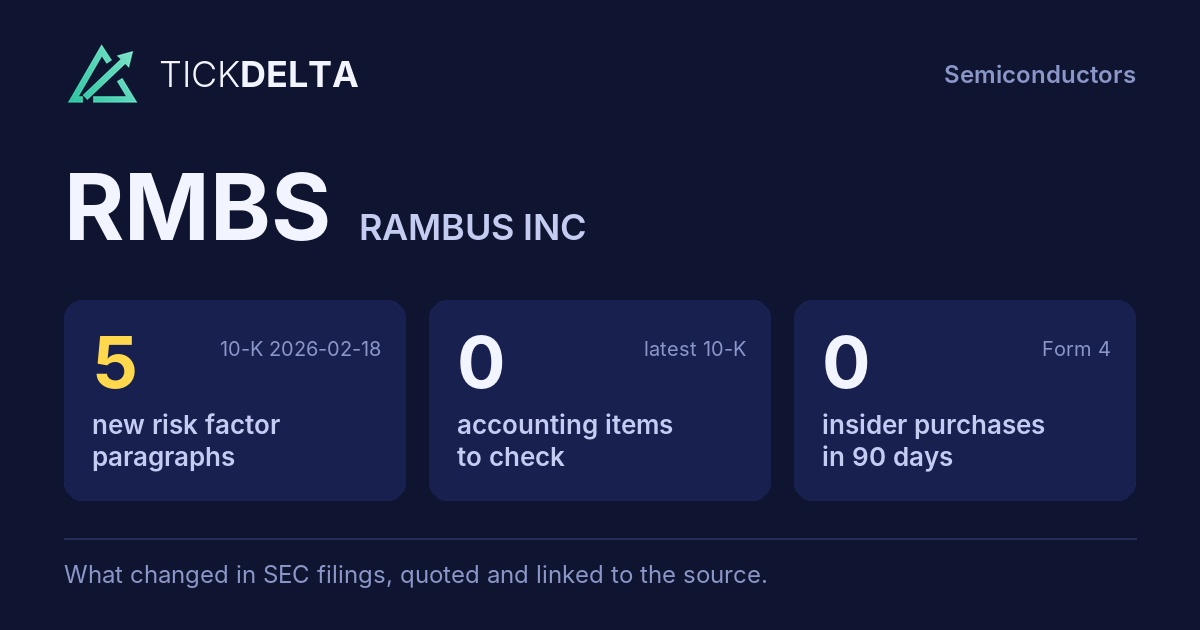
Rambus Inc RMBS

Compare with peers Embed
SEC comment letters, last 20 years

4 reviews of RMBS's filings by SEC staff

UPLOAD and CORRESP
Reviews 4 latest letter Apr 27, 2022
Questions asked 14 each answered in the company's own letter
No closing letter 0 reviews without a letter saying the staff completed it

When the SEC's staff reviews a filing, it writes to the company with numbered questions, and the company answers each one in a letter. SEC publishes the exchange once the review is over, at least 20 business days later. A question is not an accusation; most reviews end with the company adding detail to its next filing.

How the reviews went

Every review on EDGAR, from the first staff letter to the letter that closes it

  1. 1. Staff letters 6 UPLOAD
  2. 2. Questions in them 14 numbered comments
  3. 3. Company replies 6 CORRESP
  4. 4. Reviews closed 4 of 4 closing letter

Half the closed reviews took 41 days or less from the first letter to the closing letter.

Form 10-K for the Year Ended December 31, 2021

2022-04-27 to 2022-06-06 · 2 questions · 2 letters from the SEC, 2 from the company
Review closed 2022-06-06
RevenueNon-GAAP measuresDerivatives and hedging
After reviewing your response to this comment, we may have additional comments. Exhibit 99.1 · Non-GAAP Financial Information, page 3
SEC asked
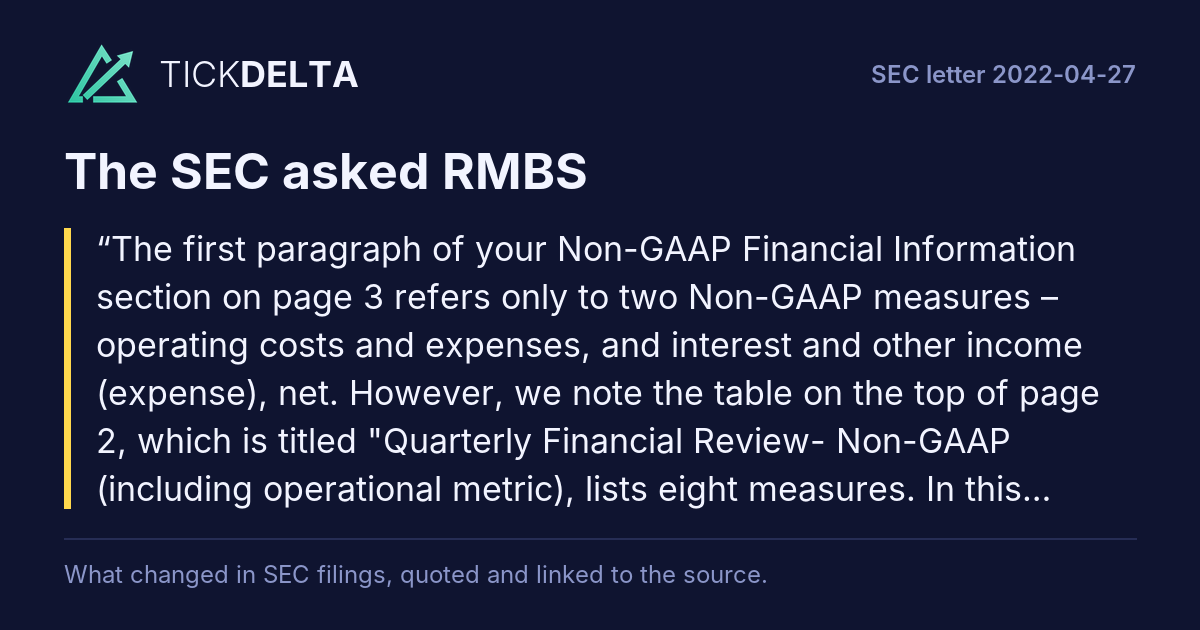
The first paragraph of your Non-GAAP Financial Information section on page 3 refers only to two Non-GAAP measures – operating costs and expenses, and interest and other income (expense), net. However, we note the table on the top of page 2, which is titled "Quarterly Financial Review- Non-GAAP (including operational metric), lists eight measures.
Rest of the question

In this regard, please refrain from identifying items as Non-GAAP that have no adjustments to GAAP measures. We note that the amounts in the table for product revenue, contract and other revenue, cost of contract and other revenue, and diluted share count are unchanged from the GAAP amounts on the first page of your earnings release. Please revise your table to clearly disclose the nature of any measures that are Non-GAAP in order to differentiate them from the GAAP amounts. Also, please revise the section on page 3 to include narrative disclosure on the Non-GAAP measure cost of product revenue as well as fully explaining the metric licensing billings and its related adjustments. In closing, we remind you that the company and its management are responsible for the accuracy and adequacy of their disclosures, notwithstanding any review, comments, action or absence of action by the staff.

RMBS answered
We respectfully advise the Staff that the Company will clearly disclose the nature of all measures in the table referenced in the comment to clearly identify if they are either a GAAP measure, a Non-GAAP measure or an operational metric. We have conformed this presentation in the Company’s latest Current Report on Form

8-K filed on May 2, 2022 and will continue to do so in future filings. Please see table below.
Rest of the answer

We have also provided a full explanation for the licensing billings operational metric and its related adjustments as noted in footnote 2 of the table below.

Quarterly Financial Review - Supplemental Information(1)

Three Months Ended

March 31,

(In millions)

2022

2021

Licensing billings (operational metric)

(2)

$

64.1

63.5

Product revenue (GAAP)

48.0

30.8

Contract and other revenue (GAAP)

20.6

10.7

Non-GAAP cost of product revenue

18.3

11.3

Cost of contract and other revenue (GAAP)

0.6

1.6

Non-GAAP total operating expenses

56.0

45.3

Non-GAAP interest and other income (expense), net

(0.3

)

(0.6

Diluted share count (GAAP)

113

116

(1)

See “Supplemental Reconciliation of GAAP to Non-GAAP Results” table included below.

Licensing billings is an operational metric that reflects amounts invoiced to our licensing customers during the period, as adjusted for certain differences relating to advanced payments for variable licensing agreements.

Additionally, the

Company has included in its latest Current Report on Form 8-K filed on May 2, 2022 and will continue to do so in future filings, the Non-GAAP Financial Information narrative to include cost of product revenue in the disclosure.

Read in the reply
In its next report

First report after the company's reply of May 10, 2022: 10-Q filed Aug 5, 2022 ↗, against the 10-Q filed Nov 5, 2021 ↗.

Tickdelta does not hold the text of both reports, so they are not compared here.

Financial Statements · Notes to Consolidated Financial Statements
SEC asked
Convertible Notes, page 18 1. We note your disclosure that the 2023 partial repurchase of notes resulted in the conversion feature and warrants being subject to derivative accounting. Please tell us the features of the repurchase that necessitated derivative accounting and explain to us how this loss on the fair value adjustment of derivatives was determined or calculated.
Rest of the question

In this regard, we note no disclosures regarding fair value measurements of derivatives.

RMBS answered
We respectfully advise the Staff that the features that necessitated derivative accounting were specifically related to (1) the underlying conversion feature embedded in the 2023 convertible notes that were repurchased (or “conversion feature”), (2) the settlement provision of the warrants that were retired and (3) the settlement provision of bond hedge call options that were retired. These transactions are collectively referred to as “2023 notes partial repurchase”.
Rest of the answer

Please see below for further background and description of these features and the relevant accounting guidance that was applied.

The corresponding loss on changes in fair value of derivatives was based on the changes in fair value of the bifurcated conversion feature and the warrants, offset by the bond hedge call options, from the date that the 2023 notes partial repurchase agreement was entered into through the date of settlement. Please see below for further discussion on relevant accounting guidance that was applied.

We have disclosed the face value, carrying value and the fair value of the convertible notes with the conversion feature for the convertible notes not subject to the repurchase agreement outstanding as of March 31, 2022 in the table at the bottom of page 17 of Note 8, Fair Value of Financial Instruments, in the Unaudited Condensed Consolidated Financial Statements for the Quarter Ended

March 31, 2022. Also included in that table is the face value, carrying value, and the fair value of the unsettled portion of the convertible notes subject to the repurchase agreement representing the recombined host debt instrument and its related conversion feature as of March 31, 2022. This unsettled portion related to the conversion feature is not subject to an on-going mark-to-market adjustment and is not a derivative as of March 31, 2022 as the settlement amount was determined (in part) on the basis of changes in the

Company’s share price between March 3, 2022 and March 29, 2022 (the “estimated volume-weighted average price or estimated VWAP”). The warrants, bond hedge call options, and the majority of the convertible debt that was subject to the repurchase agreement was settled during the period, and as such, were not included in this table.

Background of 2023 Notes Partial

Repurchase

The Company entered into various agreements with certain noteholders and banks on March 2, 2022 to (1) repurchase

$123.1 million of principal amount of the $172.5 million of principal amount of convertible notes originally issued in 2017, (2) settle a corresponding portion of the warrants originally issued in 2017, and (3) settle a corresponding portion of the bond hedge call options originally purchased in 2017.

The March 2, 2022 agreements required cash settlement of the convertible debt

(including the embedded conversion feature) and net cash settlement of the warrants and bond hedge call options for individual settlement amounts, each settlement amount is determined (in part) on the basis of changes in estimated VWAP between

March 3, 2022 and March 29, 2022.

On March 31, 2022, the Company (1) paid $174.5 million in cash to repurchase the majority of the convertible debt that the holders agreed to be repurchased, (2) paid $55.1 million in cash to settle the warrants, and (3) received $72.4 million in cash to settle the bond hedge call options, subject to the March 2,

2022 agreements. Additionally, on April 1, 2022, the Company paid $24.6 million in cash to repurchase the remaining portion of the 2023 partial repurchase of the convertible notes.

Derivative Accounting

Prior to the repurchase of the convertible notes on March 2, 2022, the embedded conversion feature, the bond hedge call options, and the warrants were considered to be indexed to the Company’s own equity under ASC 815-40-15 and met the equity classification conditions in ASC 815-40-25. They met the ASC

815-40 derivative scope exception and did not require derivative accounting (including the embedded conversion feature which was not bifurcated from the host debt instrument).

However, since the March 2, 2022 agreements required cash settlements, the conversion feature, the bond hedge call options, and warrants no longer met the equity classification conditions in ASC 815-40-25 to qualify for the ASC

815-40 derivative scope exception as of March 2, 2022. Therefore, an equity derivative embedded in the convertible notes subject to the March 2, 2022 agreement was bifurcated and the bifurcated equity derivative, the bond hedge call options and warrants were required to be accounted for as derivatives measured at fair value upon entering into the repurchase and settlement agreements on March 2, 2022, with subsequent changes in fair value recorded in earnings by the Company. The settlement amount related to the bifurcated equity derivative, the bond hedge call option, and the warrants was determined on March 29, 2022. The bond hedge call option and warrants were settled in cash on

March 31, 2022. The Company settled the majority of the convertible debt that the holders agreed to be repurchased on March 31, 2022 in cash and settled the remaining portion of the convertible debt subject to the March 2, 2022 agreement on

April 1, 2022 in cash.

Loss on Fair Value Adjustment of Derivatives, Net

Upon entering into the 2023 notes partial repurchase on March 2, 2022, the bifurcated embedded equity feature, the bond hedge call options and warrants, were subject to derivative accounting. Consequently, the Company determined their fair values on March 2, 2022 using a Monte Carlo simulation model, which included an assumption based on the VWAP of the Company’s stock price between

Upon the settlement of the 2023 notes partial repurchase, the conversion feature, the bond hedge call options, and warrants were valued at their fair value of $172.6 million, $72.4 million and $55.1 million, respectively.

The difference between the cash settlement value on March 29, 2022 and fair value on March 2, 2022 represents the loss on the fair value adjustment of the derivatives. Consequently, the Company recorded a net loss on fair value adjustment of

$8.3 million.
Read in the reply

Also in this review: closing letter, 2022-06-06
Form 10-K for the Fiscal Year Ended December 31, 2017

2018-09-19 to 2018-10-30 · 1 question · 1 letter from the SEC, 1 from the company
Review closed 2018-10-30
Revenue
Note 3. Revenue Recognition, page 16
SEC asked
We note that for variable royalty arrangements that you have concluded are fixed in substance you recognize revenue upon control of the underlying intellectual property transferring to the licensee. Please clarify for us how you are applying the sales-based and usage-based royalty revenue constraint in ASC 606-10-55-65 through 55-65B to these variable royalty arrangements.
Rest of the question

Describe to us the terms of the variable royalty payments and how you were able to conclude that they represented fixed payments to be recognized at a point in time.

RMBS answered
We respectfully advise the Staff that the Company had only two variable royalty agreements (referred to as “Contract A” and “Contract B” hereafter) and concluded both were fixed in substance, and therefore, recognized as revenue upon control of the underlying intellectual property transferring to the licensee. Both of these agreements were signed prior to the adoption of ASC 606 (note that the Company adopted the provisions of ASC 606 using the modified retrospective method as of January 1, 2018).
Rest of the answer

There were no other royalty agreements that the Company has accounted for under a similar manner. For both agreements, the Company considered the sales-based and usage-based royalty revenue constraint in ASC 606-10-55-65 through 55-65B. However, based on the fact pattern for the agreements, as discussed below, the Company concluded that these variable royalty arrangements were fixed in substance, and as such, the Company recognized revenue upon the granting of rights to the underlying intellectual property to the licensee in accordance with ASC 606-10-32-5 through 32-14. Note that the licensing use rights represent the sole performance obligation for both agreements.

With regards to Contract A, the Company signed the intellectual property license agreement in 2013. In this arrangement, the total consideration under the agreement was calculated as a percentage of the customer’s quarterly revenue, constrained by a maximum quarterly payment amount, further constrained by a lifetime contractual maximum amount. The Company reached this lifetime contractual maximum amount in 2016 prior to the adoption of ASC 606. Though the lifetime contractual maximum amount had been reached, payments for the related amounts continue to be payable through 2020, per the terms of the agreement. For the sake of clarity, when the lifetime contractual maximum amount was achieved, the amounts became fixed.

With regards to Contract B, the Company signed the intellectual property license agreement in 2016. In this arrangement, the total consideration under the agreement was calculated as a percentage of the customer’s total quarterly revenue, subject to a maximum amount per calendar quarter during the term of the arrangement. As part of the ASC 606 adoption process, the Company assessed the customer’s quarterly revenue and determined that the percentage of the customer’s revenue calculation consistently exceeded the quarterly maximum amount by approximately 900%, which was known to the Company at the time of negotiating the terms of the agreement. Because of the significant overage, it had always been the Company’s expectation that the stated quarterly maximum amount would be the effective payment amount during the term of the agreement. Accordingly, the Company determined that as the percentage of revenue calculation exceeded the maximum amount by such a large margin, in essence the quarterly maximum amount was fixed in substance.

Read in the reply
In its next report

First report after the company's reply of Oct 2, 2018: 10-Q filed Nov 2, 2018 ↗, against the 10-Q filed Aug 3, 2018 ↗.

Tickdelta does not hold the text of both reports, so they are not compared here.

Also in this review: closing letter, 2018-10-30

Form 10-K

2016-06-07 to 2016-06-28 · 2 questions · 1 letter from the SEC, 1 from the company
Review closed 2016-06-28
RevenueRussia and Ukraine
General
SEC asked (1)
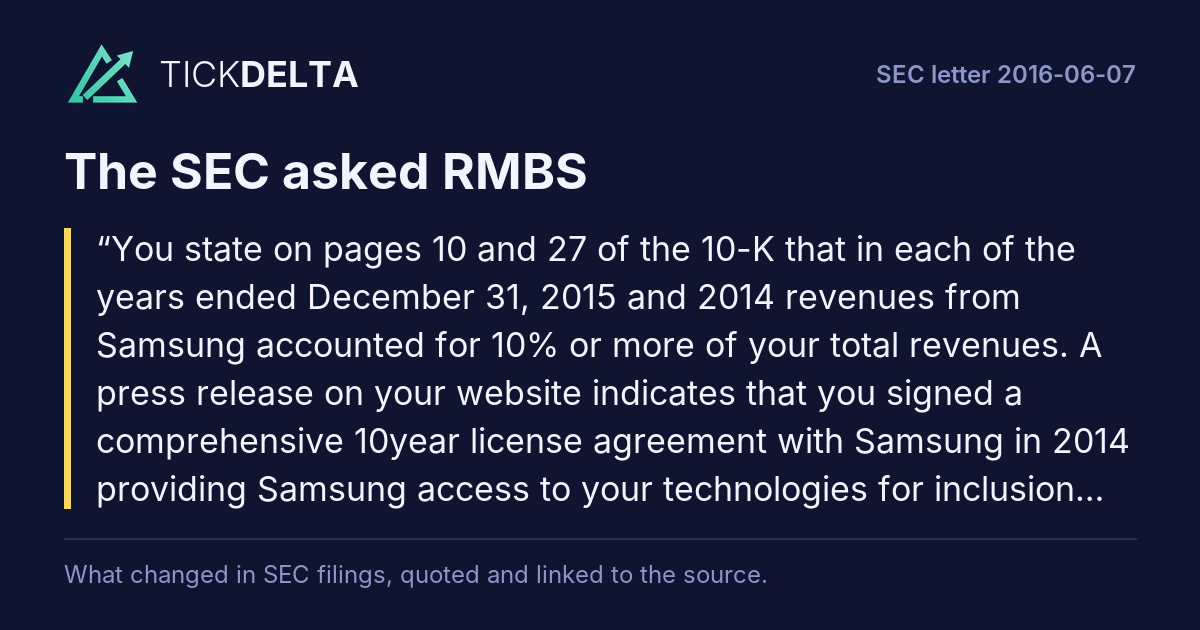
You state on pages 10 and 27 of the 10-K that in each of the years ended December 31, 2015 and 2014 revenues from Samsung accounted for 10% or more of your total revenues. A press release on your website indicates that you signed a comprehensive 10year license agreement with Samsung in 2014 providing Samsung access to your technologies for inclusion in Samsung products.
Rest of the question

The Samsung website indicates that Samsung has a store in Sudan and that Samsung televisions are available in Syria. Additionally, a 2013 news article refers to a Samsung license and a Samsung franchise in Syria. Sudan and Syria are designated by the Department of State as state sponsors of terrorism, and are subject to U.S. economic sanctions and export controls. Please describe to us the nature and extent of any past, current, and anticipated contacts with Sudan and Syria, whether through subsidiaries, partners, customers or other direct or indirect arrangements. You should describe any services, products, information or technology you have provided to Sudan or Syria, directly or indirectly, and any agreements, commercial arrangements, or other contacts you have had with the governments of those countries or entities they control.

RMBS answered
We respectfully advise the Staff that the Company has not during the period covered by our Form 10-K, and does not currently provide, and has no future plans to provide, any services, products, information or technologies to Sudan or Syria, their governments or entities they control. The Company has not entered into any agreements or arrangements with Sudan or Syria, or any individuals or entities therein, and has no future plans to enter into any such agreements or arrangements.
Rest of the answer

Moreover, the Company does not maintain any offices or other facilities in Sudan or Syria, has no employees in either of those countries, and has no assets or liabilities associated with activities in either of those countries.

United States Securities and Exchange Commission

Samsung Electronics Co., Ltd. (“Samsung”) has a license to portions of the

Company’s patent portfolio, and the Company’s provision of those rights to Samsung were made in compliance with applicable export control and economic sanctions regulations. Specifically, the Company licenses its patent portfolio to

Samsung to cover Samsung’s use of certain memory and semiconductor products and some other technologies in Samsung products as covered in the applicable license agreement, as amended, which was filed with the Commission as Exhibit 10.2 to Form

10-Q on May 3, 2010 and Exhibit 10.17 to Form 10-K on February 21, 2014. The licensing agreement governing the use of those patented technologies prevents Samsung from transferring the patents to any other entity – including entities in Sudan and Syria, as set forth in Sections 2.1(a) and 9.4 of the license agreement. Samsung pays the Company a designated amount or royalties under the licensing agreement.

The Company believes that Samsung incorporates and substantially transforms its technology by incorporating it into foreign-produced items.

The Company notes that foreign-produced items that do not satisfy the “direct product” rule under the Export Administration Regulations are not subject to U.S. export controls or U.S. economic sanctions laws. Samsung does not provide the

Company with country-based information related to their sales of foreign-produced items, and the Company has no knowledge of whether its technology is, or will in the future be, incorporated into Samsung products sold into Sudan or Syria. As noted above, the Company does not have any relationship, connection, or contact with any person or entity in Sudan or Syria.

The Company has export control and economic sanctions policies and procedures in place and is committed to compliance with these laws. The Company’s export compliance procedures include training for key personnel and procedures for screening customer agreements. In addition, the Company has a Code of Business Conduct and Ethics that applies to all Company employees wherever they are located or doing business, and which sets forth the Company’s policy that all Company directors, officers, employees, agents, and contractors must comply with all applicable laws, regulations, rules, and regulatory orders of the cities, states, and countries in which the Company operates and accordingly, all Company directors, officers, and employees must comply with the laws, regulations, rules, and regulatory orders of the United States, including the Export Administration Regulations and U.S. economic sanctions laws promulgated by the Office of Foreign Assets Control.

Read in the reply
General
SEC asked (2)
Please discuss the materiality of any contacts with Sudan and Syria you describe in response to the comment above, and whether those contacts constitute a material investment risk for your security holders. You should address materiality in quantitative terms, including the approximate dollar amounts of any associated revenues, assets, and liabilities for the last three fiscal years and the subsequent interim
Rest of the question

period. Also, address materiality in terms of qualitative factors that a reasonable investor would deem important in making an investment decision, including the potential impact of corporate activities upon a company's reputation and share value. Various state and municipal governments, universities, and other investors have proposed or adopted divestment or similar initiatives regarding investment in companies that do business with U.S.- designated state sponsors of terrorism. You should address the potential impact of the investor sentiment evidenced by such actions directed toward companies that have operations associated with Sudan and Syria.

RMBS answered
As set forth in the response above, the Company is not aware of any direct or indirect, past or current or anticipated, contacts with Sudan or

Syria or governments or entities they control.

***

The Company acknowledges that:

• the Company is responsible for the adequacy and accuracy of the disclosure in the filing;

Staff comments or changes to disclosure in response to Staff comments do not foreclose the Commission from taking any action with respect to the filing; and the Company may not assert Staff comments as a defense in any proceeding initiated by the Commission or any person under
Rest of the answer

the federal securities laws of the United States.

Read in the reply

Also in this review: closing letter, 2016-06-28

Form 10-K for the Fiscal Year Ended December 31, 2013

2014-07-09 to 2014-09-11 · 9 questions · 2 letters from the SEC, 2 from the company
Review closed 2014-09-11
RevenueIncome taxesResults discussion (MD&A)Legal and contingenciesNon-GAAP measuresLiquidity and cash
Notes to Consolidated Financial Statements, page 57 · Note 17 – Income Taxes, page 91
SEC asked (1)
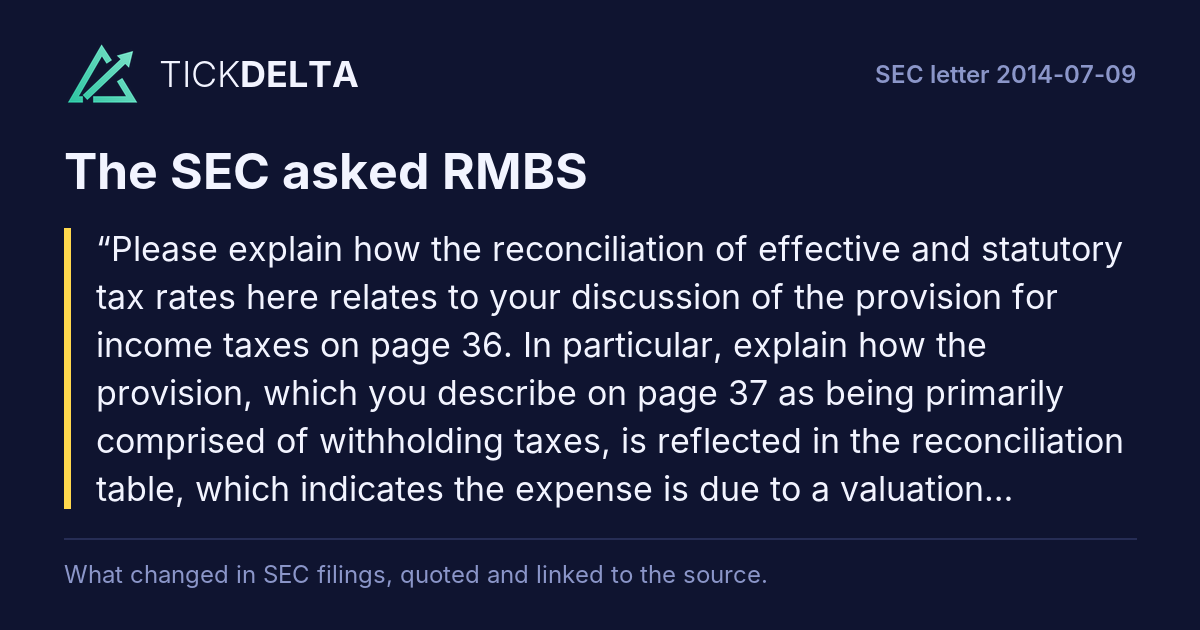
Please explain how the reconciliation of effective and statutory tax rates here relates to your discussion of the provision for income taxes on page 36. In particular, explain how the provision, which you describe on page 37 as being primarily comprised of withholding taxes, is reflected in the reconciliation table, which indicates the expense is due to a valuation allowance.
RMBS answered
We advise the Staff that all of the applicable withholding taxes as described on pages 36 and 37 for the period were included in the “Withholding tax” line of the reconciliation table on page 91 of the Form

10-K. The Company generated foreign tax credits for withholding taxes that were paid in foreign jurisdictions. The income tax benefits from such foreign tax credits fully offset the income tax expense related to the withholding taxes.
Rest of the answer

However, as the Company maintained a full valuation allowance on its deferred tax assets in the U.S., these foreign tax credits relating to withholding taxes generated were subject to such valuation allowance. Accordingly, the income tax benefit from the foreign tax credits was fully offset by the corresponding valuation allowance. The income tax benefit from the foreign tax credits and the offsetting income tax expense for the valuation allowance were included in “foreign tax credit” line and “valuation allowance” line in the reconciliation of the effective and statutory tax rates on page 91, respectively.

Read in the reply
In its next report

First report after the company's reply of Jul 25, 2014: 10-Q filed Oct 24, 2014 ↗, against the 10-Q filed Apr 25, 2014 ↗.

Tickdelta does not hold the text of both reports, so they are not compared here.

Note 19 – Agreements with SK Hynix and Micron, page 97
SEC asked (2)
We note your disclosures here regarding the settlements with each of SK hynix and Micron. We note that you have identified three elements of each of these settlements and allocated the settlement amount amongst the three elements based on relative fair value.
Rest of the question

Your accounting policy disclosure on page 58 indicates that revenues from these settlements related to past royalties are recognized upon execution of the agreement, and that elements that are not related to royalty revenue are recorded as a gain from settlement (recognized as a separate line item in operating expenses). However, based on the accounting described here, it appears that you have deferred revenue recognition for these two elements despite the fact that the agreements have been executed. Please explain to us how you have applied your accounting policy disclosed on page 58 in connection with each of the SK hynix and Micron settlements.

RMBS answered
We advise the Staff that in the accounting policy disclosure on settlements of patent infringement disputes, on page 58, the Company disclosed that “revenues related to past royalties are recognized upon execution of the agreement by both parties, provided that the amounts are fixed or determinable and there are no significant undelivered obligations and collectability is reasonably assured”.
Rest of the answer

As the quarterly payments with respect to the SK hynix and Micron settlements are paid over five and seven year periods, respectively, the Company concluded that the amounts represent an extended payment term arrangement for the consideration. The Company considered the guidance in ASC 985-605 with regards to extended payment terms and analogized it to Rambus’ business of licensing intellectual property. An excerpt from Paragraph 25-34 of ASC 985-605-25 states:

“……any extended payment terms in a software licensing arrangement may indicate that the fee is not fixed or determinable. Further, if payment of a significant portion of the software licensing fee is not due until after expiration of the license or more than twelve months after delivery, the licensing fee should be presumed not to be fixed or determinable.”

Pursuant to the guidance paragraph 25-35 of ASC 985-605-25, as the entire consideration is not fixed or determinable, the Company will not recognize revenue until each payment becomes due and payable.

Read in the reply
In its next report

First report after the company's reply of Jul 25, 2014: 10-Q filed Oct 24, 2014 ↗, against the 10-Q filed Apr 25, 2014 ↗.

Tickdelta does not hold the text of both reports, so they are not compared here.

Note 19 – Agreements with SK Hynix and Micron, page 97
SEC asked (3)
Based on your current accounting, it appears that you will be recognizing approximately $10 million of royalty revenue per quarter ($40 million per year) that relates to the settlement of past infringements for the SK hynix and Micron settlements through the second quarter of 2018 when the SK hynix payments cease. This amount appears to be material to your current revenue amounts.
Rest of the question

Please revise your discussion of your results of operations in future filings to clearly disclose the amount of current period revenue that relates to past infringements, unless such amounts become no longer material.

RMBS answered
We advise the Staff that in future filings in response to the Staff’s comment, the Company intends to disclose the amount of current period revenue that relates to past infringements in its discussion of results of operations. Using the fiscal year ended December 31, 2013 as an example, the disclosure will be as follows:

“Our patent royalties increased approximately $40.4 million to $249.1 million for the year ended December 31, 2013 from $208.7 million for the same period in 2012.
Rest of the answer

The increase in 2013 was primarily due to revenue recognized from the new license agreements signed with SK hynix, Micron, STMicroelectronics and LSI Corporation. Of the $249.1 million patent royalties for the year ended December 31, 2013, $28.9 million are related to royalty revenue from settlement of past infringements with SK hynix and Micron.”

Read in the reply
In its next report

First report after the company's reply of Jul 25, 2014: 10-Q filed Oct 24, 2014 ↗, against the 10-Q filed Apr 25, 2014 ↗.

Tickdelta does not hold the text of both reports, so they are not compared here.

Form 10-Q for the Quarterly Period Ended March 31, 2014 · Note 14. Litigation and Asserted Claims, page 22
SEC asked (4)
We note your disclosures here regarding the settlement agreement you entered into with Nanya. Please provide us with details of the settlement and how you plan to account for the settlement agreement.
RMBS answered
We advise the Staff that on March 21, 2014, Rambus and Nanya Technology Corporation (“Nanya”) entered into a settlement agreement, pursuant to which the parties have agreed to release all claims against each other with respect to all outstanding litigation between them. Pursuant to the settlement agreement, Rambus and Nanya entered into a semiconductor patent license agreement on March 21, 2014 with an effective date of July 1, 2013, under which Nanya licenses from Rambus non-exclusive rights to certain Rambus patents and has agreed to pay Rambus cash amounts over the next eighteen quarters.
Rest of the answer

Under the license agreement, Rambus has granted to Nanya (i) a paid-up perpetual patent license for certain identified Nanya DRAM products and (ii) a five-year term patent license to all other DRAM and other semiconductor products. Each license is a non-exclusive, non-transferable, royalty-bearing, worldwide patent license, without the right to sublicense, solely under the applicable patent claims of Rambus for such licensed products, to make (including have made), use, sell, offer for sale and/or import such licensed products until the expiration or termination of the license pursuant to the terms of the license agreement. The license agreement requires that Nanya pay Rambus cash payments over the next eighteen quarters of a fixed amount each quarter, commencing in the quarter ended September 30, 2013. Additional payments or certain adjustments to the payments by Nanya to Rambus under the license agreement may be due for certain acquisitions of businesses or assets by Nanya involving unlicensed products. The license agreement and the licenses granted thereunder may be modified under certain conditions and may be terminated upon a material breach by a party of its obligations under the agreement, a bankruptcy event involving a party or a change of control of Nanya subject to certain conditions.

The Company determined that there is only one element in the arrangement – license of intellectual property. The deliverable is to provide the customer, Nanya, with the right to use Rambus’ patents. The license amounts represented an extended payment term arrangement for the consideration. As mentioned in the response to comment #2 and #3 above, we considered the guidance in Paragraph 25-35 of ASC 985-605-25, which analogizes to Rambus’ business of licensing intellectual property, with regards to extended payment terms. Accordingly, the fee receivable hereunder is presumed not to be fixed or determinable until the payments are due and payable.

We respectfully advise the Staff that as the amount of revenue recognized in the first quarter of 2014 and for future periods under the Nanya arrangement is not material to the financial statements, the Company did not separately disclose the accounting related to this agreement.

Read in the reply
In its next report

First report after the company's reply of Jul 25, 2014: 10-Q filed Oct 24, 2014 ↗, against the 10-Q filed Apr 25, 2014 ↗.

Tickdelta does not hold the text of both reports, so they are not compared here.

Form 8-K Filed April 21, 2014
SEC asked (5)
Your supplemental reconciliation presents a non-GAAP provision for income taxes. In future filings, please reconcile this to the nearest GAAP measure. Refer to Item 10(e) of Regulation S-K.
RMBS answered
We advise the Staff that the Company will include in future filings, and has included in its latest Current Report on Form 8-K filed on July 21, 2014, a supplemental reconciliation of GAAP to non-GAAP provision for income taxes as follows:

Three Months Ended

Six Months Ended

June 30, 2014

March 31, 2014

June 30, 2013

GAAP provision for income taxes

6,395

5,472

4,743

11,867

9,254

Adjustment to GAAP provision for income taxes

4,242

5,576

(1,892

)

9,818

(307

Non-GAAP provision for income taxes

10,637

11,048

2,851

21,685

8,947

Additionally, in future filings, the Company
Rest of the answer

will provide a supplemental reconciliation of GAAP to non-GAAP effective tax rate as follows:

Supplemental Reconciliation of GAAP to Non-GAAP Effective Tax Rate (1)

GAAP effective tax rate

%

153

103

Adjustment to GAAP effective tax rate

(20

)%

(5

(117

(12

(67

Non-GAAP effective tax rate

(1)

For purposes of internal forecasting, planning and analyzing future periods that assumes net income from operations, the Company estimates a fixed, long-term projected tax rate of approximately 36 percent, which consists of estimated U.S. federal and state tax rates, and excludes tax rates associated with certain items such as withholding tax, tax credits and deferred tax asset valuation allowance. Accordingly, the Company has applied the 36 percent tax rate to its non-GAAP financial results for all periods to assist the Company’s planning for future periods.

In addition, the Company acknowledges that:

•

The Company is responsible for the adequacy and accuracy of the disclosure in its filings with the Commission;

Staff comments or changes to disclosure in response to Staff comments do not foreclose the Commission from taking any action with respect to the Company’s filings; and

The Company may not assert Staff comments as a defense in any proceeding initiated by the Commission or any person under the federal securities laws of the United States.

Read in the reply
In its next report

First report after the company's reply of Jul 25, 2014: 10-Q filed Oct 24, 2014 ↗, against the 10-Q filed Apr 25, 2014 ↗.

Tickdelta does not hold the text of both reports, so they are not compared here.

Notes to Consolidated Financial Statements, page 57 · Note 19 – Agreements with SK Hynix and Micron, page 97
SEC asked (1)
We note your response to prior comment 2. Please explain to us in greater detail why you believe analogy to FASB ASC 985-605-25-33 through 985-605-25-35 is appropriate. Address how you considered the fact that the value of the patent to the counterparty has already been established for the past periods and will not be reduced. Refer to FASB ASC 985-605-25-33.
RMBS answered
We supplementally advise the Staff that consistent with the framework described in Staff Accounting Bulletin 13.A.1, footnote 5, the Company believes that the guidance pursuant to ASC 985-605-25-33 through 985-605-25-35 with respect to extended payment terms is the best reflection of the economics and inherent risks of the license arrangements.
Rest of the answer

Using the SK hynix agreement as an example and while SK hynix is contractually bound to pay the amounts under a court approved settlement, for accounting purposes, the licensing fees under the SK hynix agreement are not considered fixed or determinable at the outset of the agreement for the following reasons:

•

Our patent portfolio is constantly evolving as we develop new technology. Technological obsolescence has always been a risk in patent licensing, since customers could adopt alternate technologies, or certain technologies (and the corresponding patents) could become irrelevant, which could result in customers asking for concessions or additional license rights or a stoppage of payment under an agreement. In the current agreement, even though SK hynix is contractually bound to pay us for past and future royalties over the term of the license, the non-payment of which would result in a breach of contract, if developments in the intellectual property environment indicate that the patent portfolio we have licensed to SK hynix has been weakened, SK hynix may choose to stop payment and renegotiate for concessions, which could impact even the past periods.

Our agreements require our customers to pay us license fees over extended periods of time, typically 5-7 years with the majority of payment being received more than 12 months after a contract becomes effective. In certain circumstances contractual terms have been modified during the term of the original agreement which has led the Company to determine that the fees are not fixed or determinable pursuant to ASC 985-605-25-34.

Further the Company and SK hynix had been involved in prolonged litigation prior to entering into a settlement agreement, which adds another level of uncertainty as it relates to the possibility that SK hynix may not fulfill its payment obligation over the term of the license.

The value of the patents licensed to SK hynix, for both the past and future periods, was established at the outset of the agreement and is a fixed amount. However, based on the reasons stated above the licensing fees are not considered fixed or determinable at the outset of the agreement and as a result revenue is being recognized as the contractual payments become due and payable. The accounting methodology applied for both the past and the future periods is the same - i.e. both past and future licensing fees are recognized in the statement of operations as “revenue”.

Read in the reply
In its next report

First report after the company's reply of Aug 22, 2014: 10-Q filed Oct 24, 2014 ↗, against the 10-Q filed Apr 25, 2014 ↗.

Tickdelta does not hold the text of both reports, so they are not compared here.

Notes to Consolidated Financial Statements, page 57 · Note 19 – Agreements with SK Hynix and Micron, page 97
SEC asked (2)
You state in the response to prior comment 3 that $28.9 million of the royalty revenues recognized in the year ended December 31, 2013 are related to settlement of past infringements with SK hynix and Micron. On page 31 of your June 30, 2014 Form 10-Q, you state that $43.0 million of the royalty revenues for the six months ended June 30, 2014 is related to royalty revenue from settlement of past infringements with
Rest of the question

SK hynix and Micron. We note that these amounts also represent the total amount of royalty revenue recorded for these agreements during the respective periods. Please clarify for us how you are accounting for the royalty revenues related to each of the past and future patent license elements of each settlement.

RMBS answered
We supplementally advise the Staff that based on the fair value determined for the various settlement elements (using SK hynix as an example), the total consideration was $240 million, of which $127.7 million was allocated to the settlement of past matters (i.e. $125.8 million for resolution of past infringements and $1.9 million for the resolution of antitrust litigation) based on relative fair values. In applying the proration between various settlement elements, the Company’s policy is to allocate the settlement consideration received, to the past elements first (i.e.
Rest of the answer

resolution of past infringements and resolution of antitrust litigation) and then to the future license periods. The Company’s rationale is based on the notion that any consideration received must be applied to outstanding past settlement obligations before recognizing any licensing revenue for future periods. Upon receipt of aggregate total payment of $127.7 million consideration related to past matters (approximately 11 quarters of payments), the Company will then start to recognize the remaining consideration received as licensing royalty revenue for the license period. For the $127.7 million consideration related to past matters, which is scheduled to be received from Q3 2013 to Q1 2016, the proceeds are being allocated between revenue and gain from settlement of the antitrust litigation based on these two elements’ relative fair value. The remaining consideration, which represents the future license, will be recognized as royalty revenue, as these amounts become due and payable over the remaining term of the agreement as there are no future performance obligations.

The accounting related to the recognition of the both the past and future settlement elements is the same - meaning both past and future fees are recognized as revenue in the statement of operations. The amounts considered a gain from settlement of the antitrust litigation is classified as gain from settlement in the statement of operations.

Read in the reply
In its next report

First report after the company's reply of Aug 22, 2014: 10-Q filed Oct 24, 2014 ↗, against the 10-Q filed Apr 25, 2014 ↗.

Tickdelta does not hold the text of both reports, so they are not compared here.

Notes to Consolidated Financial Statements, page 57 · Note 19 – Agreements with SK Hynix and Micron, page 97
SEC asked (3)
We note that the settlement agreement with Micron provides for payments of .6% of sales of certain identified Micron products on a quarterly basis over the next 7 years, with payments not to exceed $10 million per quarter of $40 million per rolling twelve-month period. Based on this, it appears that the amount of payments could be less than $280 million.
Rest of the question

Please clarify and also tell us how this uncertainty as to the total amount payable under the settlement agreement impacts your accounting for the settlement agreement. Please also address why you concluded it was appropriate to allocate any amounts to the past infringements in light of the fact that the total settlement amount is contingent upon future sales of products.

RMBS answered
As described in our response to Comment 1 above, pursuant to ASC 985-605-25-33 through 985-605-25-35 the Company is recognizing royalty revenues from license fees for past infringement and future patent licenses, as these amounts become due and payable over the remaining term of the agreements. As a result, any future changes in amounts payable under the agreement will not impact accounting for royalty revenue as the Company is not recognizing any revenue based on non-contingent amounts.
Rest of the answer

However, this would impact our disclosures of past infringement and future patent license payments in the footnote to the financial statements. Notwithstanding that, we advise the Staff that it is our belief that the possibility of receiving less than $280 million over the seven year period from Micron is remote and therefore that it is a reasonable amount to include in our disclosures of future expected cash flows from this arrangement, due to the following reasons:

At Micron’s current licensed product sales level, which include mostly DRAM sales, the calculated royalties based on 0.6% of sales are significantly higher than $10 million. A payment of less than $10 million would require Micron’s licensed product sales to be less than $1.67 billion in any quarter, and its licensed product sales have been significantly higher than the threshold for the past few quarters. The Company believes that the identified Micron products subject to the agreement used in the calculation are substantial to Micron’s business.

The DRAM market has gone through considerable consolidation, and currently has three companies that according to industry sources, provide approximately 91% of the global supply of DRAM’s. The demand for DRAM’s continues to grow, and even with price reductions, industry sources indicates the overall market is expected to be stable to growing in the future. Based on the estimated DRAM revenue and market share data from third party market research companies such as iSuppli, Micron’s forecasted DRAM revenue will trend upwards over the next seven years. Based on data from iSuppli, Micron’s quarterly DRAM revenue for the next seven years are expected to fluctuate between $2.5 billion and $3.4 billion, which are significantly higher than the $1.67 billion sales threshold for the royalty cap of $10 million. As such, we assumed the total payments to be received over the 7 years to be approximately $280 million.

As indicated above, it is our belief that receiving payments of less than $280 million is considered remote and therefore believe that is a reasonable amount to include in our disclosures of future expected cash flows from this arrangement, but if the amount received was ultimately less than $280 million, the amount (lower in this case) would still be recognized in the statement of operations as revenue when the amount is due and payable based on the revenue recognition framework for this arrangement described in our response to Comment 1 above. Therefore, there is no impact to accounting methodology to the fact that these payments are contingent upon future sales, as once the amount is received (which is the first time that revenue would be recognized), the amount is no longer contingent upon any future events.

In regards to why it was appropriate to allocate any amounts to the past infringements in light of the fact that the total settlement amount is contingent upon future sales of products, we followed the guidance provided by Eric C. West, Associate Chief Accountant of the Office of the Chief Accountant of the U.S. Securities and Exchange Commission, in a speech at the 2007 AICPA National Conference on Current

SEC and PCAOB Developments on December 10, 2007 in regards to the accounting for litigation settlements. During the speech, he clearly indicated that “to properly account for [the] arrangement, a company must identify each item given and received and determine whether those items should be recognized…. While [ASC 605-25] was written for multiple element revenue arrangements, we believe that its allocation guidance is also useful to determine how to allocate consideration paid in a multiple element legal settlement. In this regard, we concluded it would be acceptable to value each element of the arrangement and allocate the consideration paid to each element using relative fair values.” Though the total settlement amount is contingent upon future sales of products, the resolution of past infringements has stand-alone value to Micron (resolving past litigations, Micron is no longer subject to potential litigation from the Company and therefore eliminating significant potential damages and legal fees). Accordingly, we concluded that it was appropriate to allocate a portion of the consideration to resolution of past infringements. However, consistent with the discussion above and in our response to Comment 1, such amounts are not recognized until the amounts are due and payable due to the extended payment terms, as well as the contingency for Micron’s sales levels.

Read in the reply
In its next report

First report after the company's reply of Aug 22, 2014: 10-Q filed Oct 24, 2014 ↗, against the 10-Q filed Apr 25, 2014 ↗.

Tickdelta does not hold the text of both reports, so they are not compared here.

Notes to Consolidated Financial Statements, page 57 · Note 19 – Agreements with SK Hynix and Micron, page 97
SEC asked (4)
Please provide us with your detailed analysis regarding the identification of the different elements of the settlement agreements and the determination of the fair value of each of the elements. Discuss specifically how your determination of the elements and fair value reflects the material terms of the agreements.
Rest of the question

In this regard, tell us how you determined the estimated cash flows associated with the past and future license of technology and also how you determined an appropriate royalty rate for each of the past and future licenses of technology.

RMBS answered
We supplementally advise the Staff that consistent with the guidance provided by Eric C. West in a speech at the 2007 AICPA National Conference on Current SEC and PCAOB Developments on December 10, 2007 in regards to the accounting for litigation settlements, we first identified each item given and received and determined whether those items should be recognized.
Rest of the answer

Based on the review of the agreements associated with the SK hynix and Micron settlements, we identified the following deliverables (using SK hynix as an example):

Resolution of past patent infringement (including release and covenant not to sue) (pursuant to Sections 4.1 and 4.6 of the Settlement Agreement, dated June 11, 2013, among Registrant, SK hynix and certain SK hynix affiliates, which was previously filed with the SEC)

Future license of intellectual property (pursuant to Sections 2.1, 2.4 and 2.5 of the Semiconductor Patent License Agreement, dated June 11, 2013, between Registrant and SK hynix, which was previously filed with the SEC)

Resolution of antitrust litigation (including release) (pursuant to Section 4.1 of the

Settlement Agreement, dated June 11, 2013, among Registrant, SK hynix and certain SK hynix affiliates, which was previously filed with the SEC)

Per the guidance in ASC 605-25, we identified the various elements of the arrangement to determine whether each element met the criteria in ASC 605-25 as a separate unit of accounting. As each of the three elements had standalone value to the licensee and there are no rights of return associated with the delivered elements, all three elements were considered separate units of accounting.

We engaged a third party valuation firm in assisting us in determining the fair value of each element related to the settlement. In determining the fair value for each of the three elements, we applied the discounted cash flow (“DCF”) method, a method of the Income Approach:

For the fair value of the resolution of past patent infringement, we first determined the past royalty rates. We used the implied royalty rates based on agreements that we had entered into, with similar customers, during the same time period. We assumed that the royalty proceeds received during the infringement period were reinvested, at the average after-tax return of 10-year government treasuries. We applied the DCF method, to the identified cash flows (based on the relief from royalty method) for the applicable prior periods, to determine the fair value of past patent infringement. The royalty rates used for this calculation were based on past transactions that had been entered into, for similar products, during the period of the past infringement calculations.

For the fair value of the future license, the future royalty rate was based on recent transactions that the Company had entered into, and which extended into future periods similar to the term of the license. The annual estimated cash flows were then discounted to their present value at a discount rate that reflected the estimated weighted average cost of capital for the subject customer.

For the fair value on the resolution of antitrust litigation, in applying the DCF method, cash flow was estimated based on the total legal fees anticipated to be incurred for the appeal and re-trial. The estimated cash flows were then discounted to their present value at an appropriate discount rate to obtain an indication of value. The discount rate utilized reflects estimates of required rates of return for investments that are deemed similar to an investment in the subject asset.

Read in the reply
In its next report

First report after the company's reply of Aug 22, 2014: 10-Q filed Oct 24, 2014 ↗, against the 10-Q filed Apr 25, 2014 ↗.

Tickdelta does not hold the text of both reports, so they are not compared here.

Also in this review: closing letter, 2014-09-11

From the SEC's correspondence on EDGAR: staff letters (form UPLOAD) and company letters (form CORRESP), 16 letters filed since 2014-07-09. Questions and answers are matched by their numbers; topics come from words in each question. The reports are compared word for word (same form, before the first SEC letter against the first report after the company's reply). No AI.

Sources

The SEC's correspondence on EDGAR: staff letters (form UPLOAD) and company letters (form CORRESP), matched question by question. No AI.

Also

Filings: the letters in the filing list.

Work with it

Excel workbook · CSV. Google Sheet that stays up to date: paste =IMPORTDATA("https://tickdelta.com/company/RMBS/export.csv") into a cell.

Next in Owners and insiders:Insider trades
Esc

Type a ticker such as AAPL, a name, an investor such as Buffett, or a topic such as tariffs. ↑ ↓ to move, Enter to open.