Screener / SEC EDGAR /CIK 0001384905 /10-K filed Feb 27, 2026, compared with Feb 26, 2025 /Numbers from the XBRL of the 10-Ks
NYSE Technology · Data Processing

RingCentral, Inc. RNG

Compare with peers Embed
New in the 10-K 12 paragraphs with nothing like them in the 10-K filed Feb 26, 2025 New in the 10-Q 18 paragraphs not in the 10-Q filed Jul 23, 2026 10-Q against the 10-K 69 risk factor paragraphs and sentences added or reworded

New risk paragraphs, branching off last year

Each branch is a paragraph in Risk Factors with nothing like it in the 10-K filed Feb 26, 2025. A box jumps to the paragraph as filed, below.

12 new

Paragraphs with nothing like them in last year's 10-K

Quoted exactly

12 paragraphs in Risk Factors of the 10-K filed Feb 27, 2026 with nothing like them in the 10-K filed Feb 26, 2025. Quoted exactly. Paragraphs that were only edited are under 10-K change.

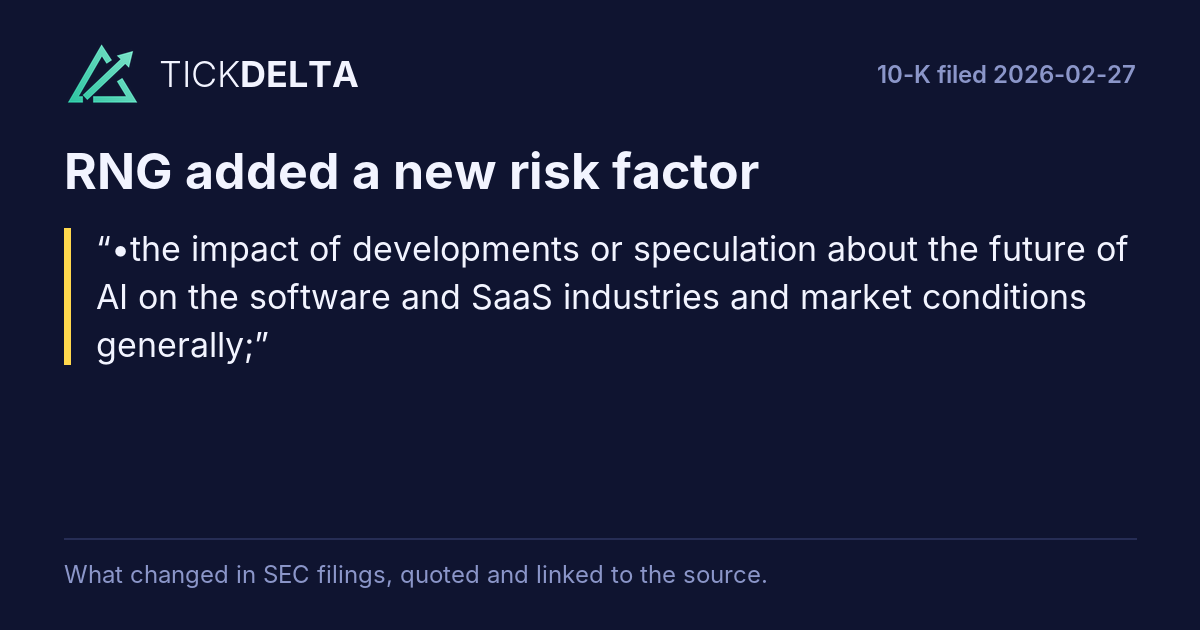
•the impact of developments or speculation about the future of AI on the software and SaaS industries and market conditions generally;

Read in the 10-K

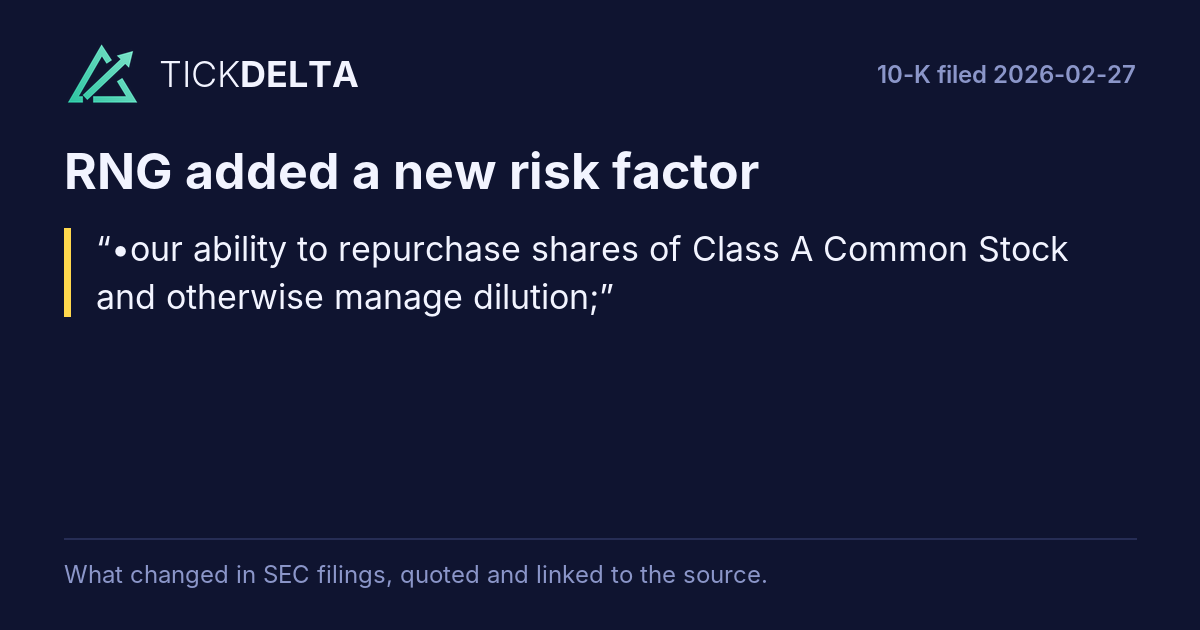
•our ability to repurchase shares of Class A Common Stock and otherwise manage dilution;

Read in the 10-K

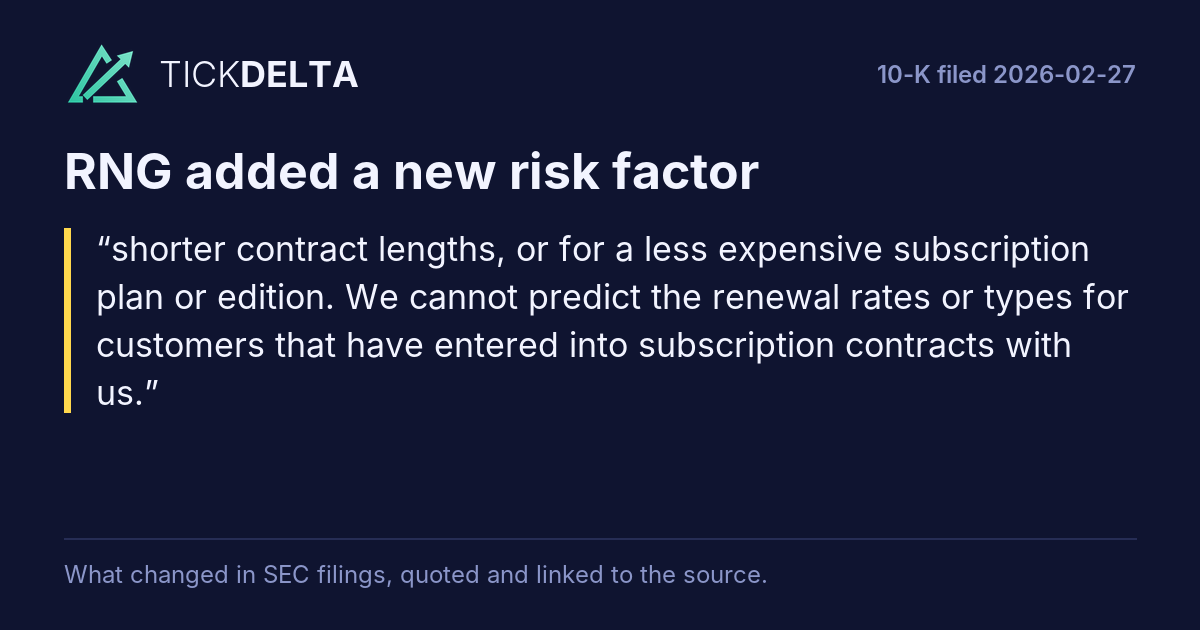
shorter contract lengths, or for a less expensive subscription plan or edition. We cannot predict the renewal rates or types for customers that have entered into subscription contracts with us.

Read in the 10-K

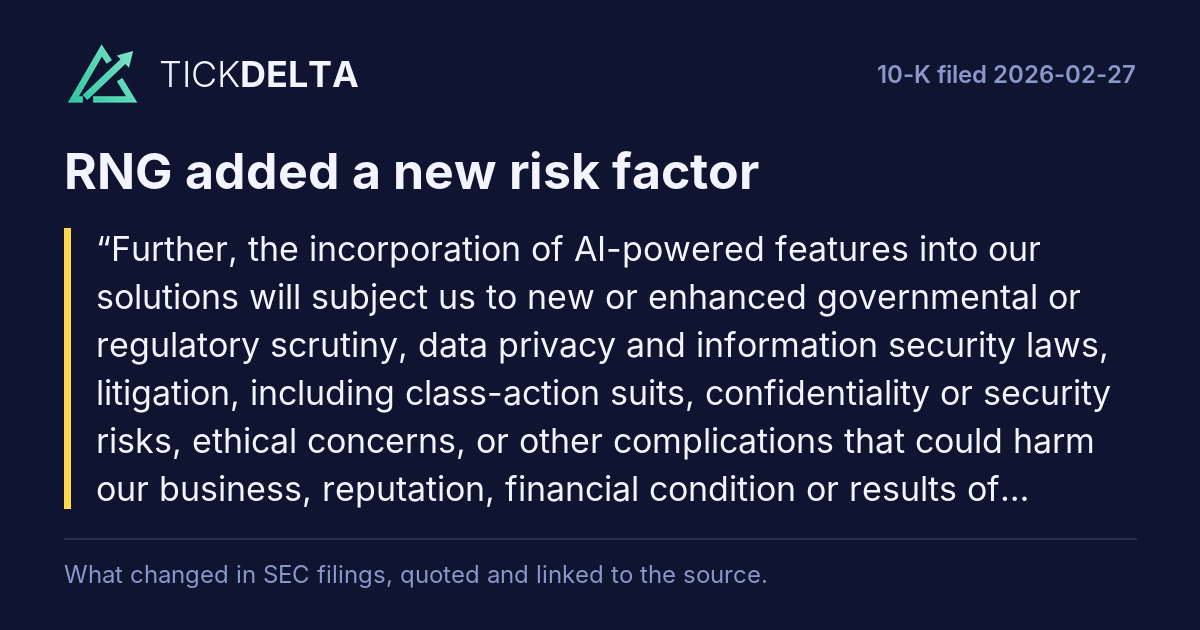
Further, the incorporation of AI-powered features into our solutions will subject us to new or enhanced governmental or regulatory scrutiny, data privacy and information security laws, litigation, including class-action suits, confidentiality or security risks, ethical concerns, or other complications that could harm our business, reputation, financial condition or results of operations. Certain privacy laws extend rights to consumers (such as the right to delete certain personal data) and regulate automated decision making, which may add compliance requirements or challenges to our use of AI technologies. These obligations have in the past and may in the future make it harder for us to conduct our business using AI, lead to regulatory fines or penalties, subject us to litigation, require us to change our business practices, or prevent or limit our use of AI technologies. For example, the FTC has required some companies to turn over (or disgorge) valuable insights or trainings generated through the use of AI technologies where they allege the company has violated privacy and consumer protection laws. If we cannot use AI technologies or that use is restricted, our business may be less efficient, or we may be at a competitive

Read in the 10-K

The use of AI technologies in our business may not produce the desired benefits, and may result in increased liability, reputational harm, or other adverse consequences.

Read in the 10-K
Show the other 6

with international operations and developing and managing sales and distribution channels in international markets, our international expansion efforts may not be successful. In addition, we will face risks in doing business internationally that could materially and adversely affect our business, including:

Read in the 10-K

our subscriptions and reduce overall demand. Even the perception of privacy-related concerns, whether or not valid, may inhibit market adoption of our subscriptions in certain industries.

Read in the 10-K

vendors to the public or others who could make use of the trade secret information would likely preclude that information from being protected as a trade secret.

Read in the 10-K

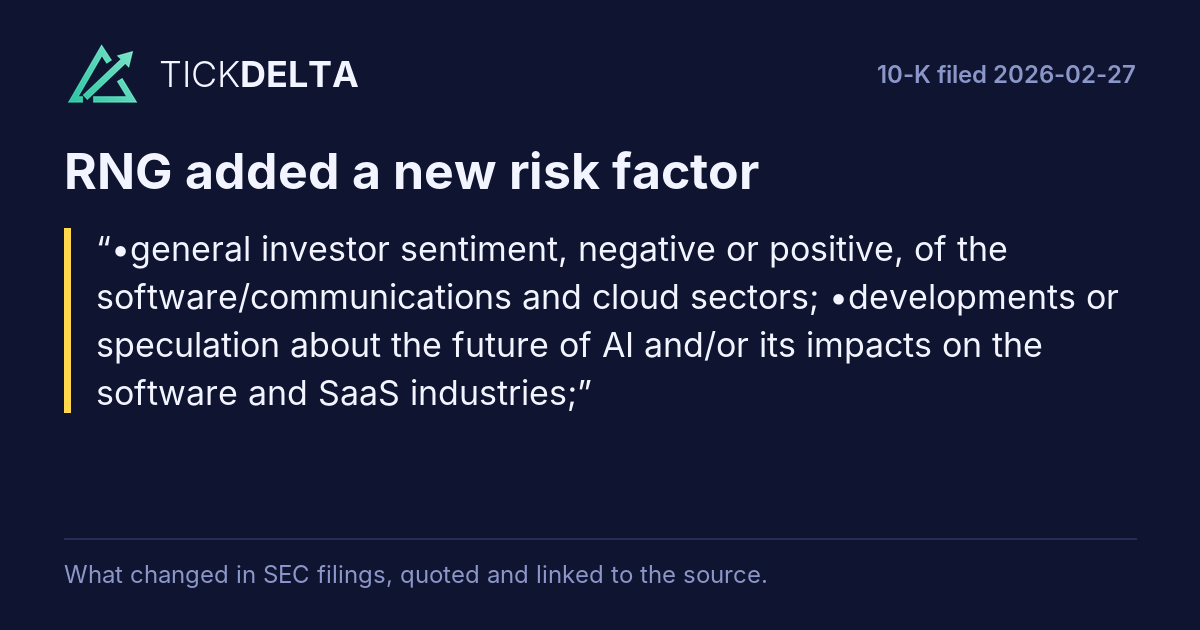
•general investor sentiment, negative or positive, of the software/communications and cloud sectors;

•developments or speculation about the future of AI and/or its impacts on the software and SaaS industries;

Read in the 10-K

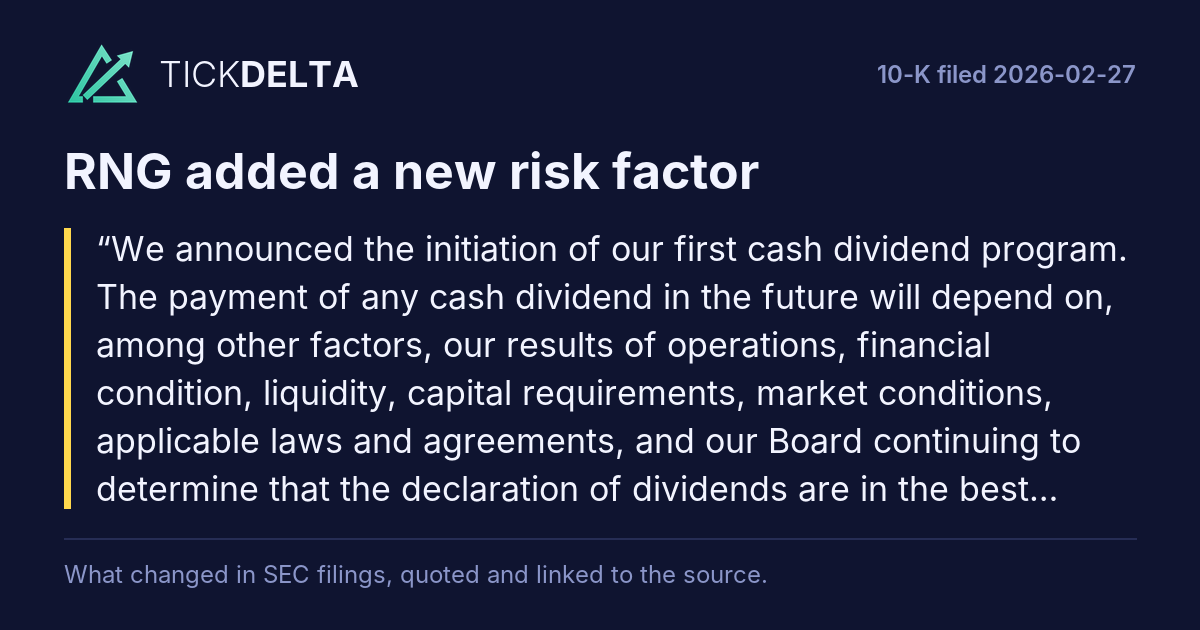
We announced the initiation of our first cash dividend program. The payment of any cash dividend in the future will depend on, among other factors, our results of operations, financial condition, liquidity, capital requirements, market conditions, applicable laws and agreements, and our Board continuing to determine that the declaration of dividends are in the best interests of our stockholders. The declaration and payment of any dividend may be discontinued or reduced at any time, and there can be no assurance that we will declare cash dividends in the future in any particular amounts, or at all.

Read in the 10-K

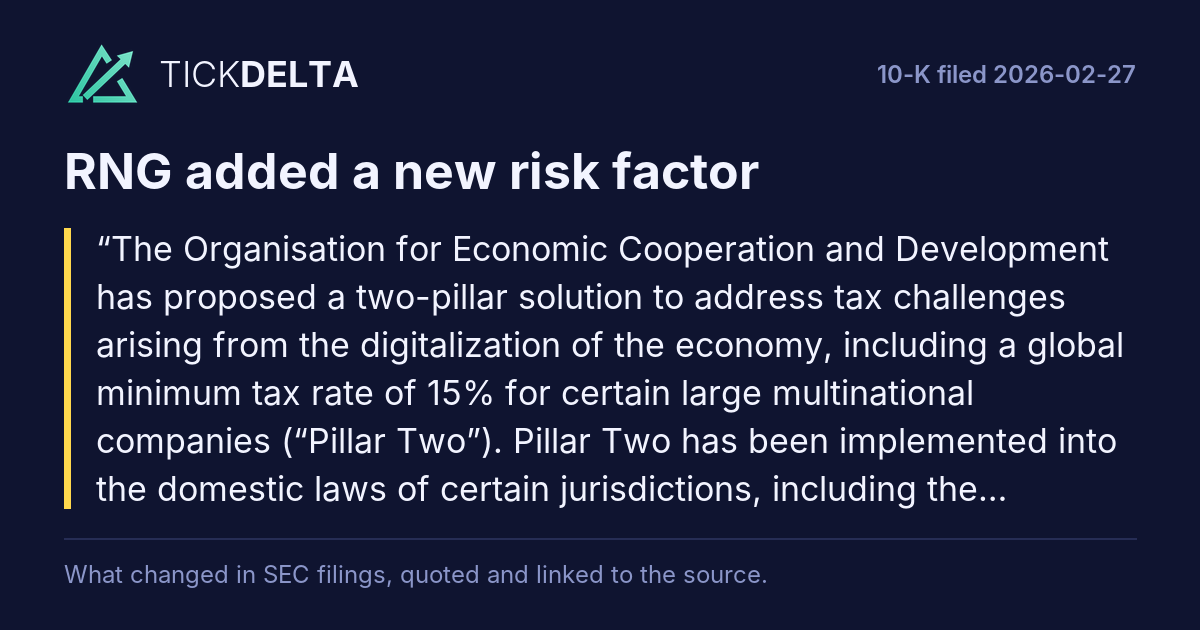
The Organisation for Economic Cooperation and Development has proposed a two-pillar solution to address tax challenges arising from the digitalization of the economy, including a global minimum tax rate of 15% for certain large multinational companies (“Pillar Two”). Pillar Two has been implemented into the domestic laws of certain jurisdictions, including the European Union (the “EU”) Member States, and is being considered for implementation by other countries. On June 28, 2025, the OECD announced a side-by-side elective safe harbor that exempts U.S. multinational enterprises from certain provisions of Pillar Two for fiscal years beginning on or after January 1, 2026. These or any further developments or changes in U.S. federal or state, or international tax laws or tax rulings could adversely affect our effective tax rate and our operating results.

Read in the 10-K

Paragraphs in the 10-Q filed Oct 23, 2026 that were not in the one before

New in the latest 10-Q

18 paragraphs in the 10-Q filed Oct 23, 2026 with nothing like them in the 10-Q filed Jul 23, 2026 (at least half the words must differ; new numbers alone do not count). Quoted exactly, grouped by the item heading above them. This is text that changed, not a judgement of how serious it is.

Financial statements and notes

Certain prior period amounts have been reclassified to conform to the current period presentation. The reclassification had no impact on total assets, results of operations, or cash flows

Read in the 10-Q

As of October 22, 2026, total outstanding principal amount was $ 996.9 million due to a subsequent repayment. In October 2026, the Company also issued a notice to redeem $ 25.0 million aggregate principal amount of its 2030 Senior Notes which will be due and payable on October 23, 2026. Following the redemption, the total outstanding principal amount will be $ 971.9 million.

Read in the 10-Q

During the three months ended September 30, 2026, the Company recognized an incremental right of use assets and liabilities of $ 1.3 million, related to the extension of its corporate headquarters lease through July 31, 2031, pursuant to a Third Amendment to the lease executed on July 22, 2026.

Read in the 10-Q

The Company computes its (benefit from) provision for income taxes for interim periods using an estimated annual effective tax rate based on anticipated annual pretax income or loss. The estimated annual effective tax rate is applied to the Company’s year-to-date income or loss, and is adjusted for discrete items recorded in the period.

Read in the 10-Q

The Company regularly assesses the need for a valuation allowance on its deferred tax assets. In making that assessment, the Company considers both positive and negative evidence related to the likelihood of realization of the deferred tax assets to determine, based on the weight of all available evidence, whether it's more-likely-than-not that some or all of the deferred tax assets will be realized.

Read in the 10-Q
Show the other 13

Historically, the Company concluded that a valuation allowance was required against its deferred tax assets based on management’s determination that it was not more likely than not that those assets would be realized. As of September 30, 2026, the Company concluded that it was more likely than not that its some of its domestic deferred tax assets would be realized and, accordingly, that a valuation allowance against them was no longer required, primarily due to the Company’s cumulative prior twelve quarter U.S. pre-tax income, as well as its recent and anticipated future earnings.

Read in the 10-Q

Based on the Company’s analysis above, the Company concluded that it is more likely than not that the majority of its U.S. deferred tax assets are realizable. As a result, the Company released $ 544.9 million of the valuation allowance on its U.S. deferred tax assets as of September 30, 2026. The release related primarily to U.S. federal and state net operating loss carryforwards, tax credit carryforwards, and capitalized research and development expenditures.

Read in the 10-Q

As the change in valuation allowance occurred during an interim period, the Company included the change in valuation allowance resulting from current year ordinary income in the estimated annual effective tax rate and recorded the release of the valuation allowance as a discrete tax benefit in the interim period. This resulted in the recognition of incremental deferred tax assets and an income tax benefit of $ 544.9 million during the three month months ended September 30, 2026.

Read in the 10-Q

The Company’s judgment regarding the need for a valuation allowance may reasonably change in future reporting periods due to many factors, including changes in expectations of future profitability in the U.S. and changes in tax laws or regulations. The Company will continue to maintain a valuation allowance against deferred tax assets where it believes it is more likely than not that they will not be realized. The remaining U.S. valuation allowance as of September 30, 2026 was $ 43.2 million, maintained against deferred tax assets related to capital losses and certain state net operating losses.

Read in the 10-Q

Our Other gross margins improved due to continued disciplined personnel and vendor spending.

Read in the 10-Q

Benefit from income taxes increased by $541.2 million and $543.0 million, for the three and nine months ended September 30, 2026, respectively, as compared to the respective prior year. The increase was primarily attributable to the partial release of our valuation allowance on certain of our U.S. federal and state deferred tax assets in the three months ended September 30, 2026, which generated a $544.9 million income tax benefit. For further detail, refer to Note 12, Income Taxes in Part I, Item 1 of this Quarterly Report on Form 10-Q for additional information.

Read in the 10-Q

We account for income taxes using the asset and liability approach. Deferred tax assets and liabilities are recognized for the future tax consequences attributable to temporary differences between the financial statement carrying amounts of existing assets and liabilities and their respective tax bases, as well as net operating loss and tax credit carryforwards. A valuation allowance reduces deferred tax assets to the amount that we believe is more likely than not to be realized.

Read in the 10-Q

As of September 30, 2026, we demonstrated sustained profitability in the U.S. and we expect to continue to generate U.S. taxable income for the year ending December 31, 2026. Based on our analysis of available positive and negative evidence, we concluded that, as of September 30, 2026, it is more likely than not that a significant portion of our U.S. deferred tax assets, net of the remaining valuation allowance, will be realized. As a result of this change in judgment, we released $544.9 million of our valuation allowance on U.S. deferred tax assets during the three months ended September 30, 2026. This resulted in the recognition of deferred tax assets and an income tax benefit of $544.9 million during the three months ended September 30, 2026. For further detail, refer to Note 12, Income Taxes, to our unaudited condensed consolidated financial statements included elsewhere in this Quarterly Report on Form 10-Q.

Read in the 10-Q

Our judgment regarding the need for a valuation allowance may reasonably change in future reporting periods due to many factors, including changes in expectations of future U.S. profitability and changes in tax laws or regulations. We will continue to maintain a valuation allowance against deferred tax assets where we believe it is more likely than not that they will not be realized.

Read in the 10-Q

Risk Factors

We use foundational LLMs developed and operated by third parties in our products and internal operations. We do not control the availability, pricing, or terms of use of these models, and some of these providers offer or may offer competing products. A limited number of providers supply the models on which a significant portion of our AI-powered features depend. If a provider restricts or discontinues access, raises prices, experiences outages or security incidents, or otherwise becomes unable to provide its models, we may need to transition to alternative models, which could require significant time and expense and may not be possible on commercially reasonable terms or at all. In addition, using these models involves transmitting data, which may include confidential or personal information, to systems we do not control, exposing us to data security and privacy risks. Any of these events could disrupt our solutions or operations, increase our costs, or otherwise adversely affect our business, results of operations, and financial condition.

Read in the 10-Q

expenditures than we currently anticipate in order to compensate for this higher turnover by increasing the number of new customers or upselling existing customers, and such additional marketing and/or sales expenditures could harm our business and results of operations.

Read in the 10-Q

ability to attract and retain customers. Our reputation and business may be harmed by news or social media coverage, including but not limited to coverage that presents, or relies on, inaccurate, misleading, incomplete, or otherwise damaging information. If we fail to sufficiently invest in, promote and maintain our brand, our business could be materially and adversely affected.

Read in the 10-Q

penalties. Additionally, in the U.S., both customers and third-party network service providers may seek relief from the relevant state public utility commission, the FCC, or in state or federal court for violation of local number portability requirements.

Read in the 10-Q

The 10-Q's risk factors against the 10-K

Item 1A of the 10-Q filed Oct 23, 2026 against Item 1A of the 10-K filed Feb 27, 2026. A 10-Q repeats only the risks that changed, so a 10-K paragraph that is missing from it is not counted as removed. Added is a paragraph with nothing like it in the 10-K, Reworded a sentence that is in both with several words changed, Quiet changes a sentence in both where one to four words changed and one is a hedge or a modal (cut words struck through, new words highlighted). Text on the page, not a score; each links to the filing at sec.gov.

Added10-Q Oct 23, 2026 vs 10-K Feb 27, 2026
agentic AI introduces risks that are distinct from generative AI or other AI tools, including the potential for AI agents to operate unpredictably, exceed their prescribed authorizations, or fail to align with internal policies or legal obligations. Errors or unintended actions taken by these AI agents could have a material adverse impact on the company, its regulatory compliance, and financial condition. We do not know whether these investments will be successful. If customers do not widely adopt any new or enhanced services and applications, we may not be able to realize a return on our investment. If we are unable to develop, license, or acquire new or enhanced services and applications on a timely and cost-effective basis, or if such new or enhanced services and applications do not achieve market acceptance, our business, financial condition, and results of operations may be materially and adversely affected.

Read it in the 10-Q at sec.gov

Added10-Q Oct 23, 2026 vs 10-K Feb 27, 2026
We use foundational LLMs developed and operated by third parties in our products and internal operations. We do not control the availability, pricing, or terms of use of these models, and some of these providers offer or may offer competing products. A limited number of providers supply the models on which a significant portion of our AI-powered features depend. If a provider restricts or discontinues access, raises prices, experiences outages or security incidents, or otherwise becomes unable to provide its models, we may need to transition to alternative models, which could require significant time and expense and may not be possible on commercially reasonable terms or at all. In addition, using these models involves transmitting data, which may include confidential or personal information, to systems we do not control, exposing us to data security and privacy risks. Any of these events could disrupt our solutions or operations, increase our costs, or otherwise adversely affect our business, results of operations, and financial condition.

Read it in the 10-Q at sec.gov

Added10-Q Oct 23, 2026 vs 10-K Feb 27, 2026
expenditures than we currently anticipate in order to compensate for this higher turnover by increasing the number of new customers or upselling existing customers, and such additional marketing and/or sales expenditures could harm our business and results of operations.

Read it in the 10-Q at sec.gov

Added10-Q Oct 23, 2026 vs 10-K Feb 27, 2026
ability to attract and retain customers. Our reputation and business may be harmed by news or social media coverage, including but not limited to coverage that presents, or relies on, inaccurate, misleading, incomplete, or otherwise damaging information. If we fail to sufficiently invest in, promote and maintain our brand, our business could be materially and adversely affected.

Read it in the 10-Q at sec.gov

Added10-Q Oct 23, 2026 vs 10-K Feb 27, 2026
penalties. Additionally, in the U.S., both customers and third-party network service providers may seek relief from the relevant state public utility commission, the FCC, or in state or federal court for violation of local number portability requirements.

Read it in the 10-Q at sec.gov

Show the other 16
Reworded10-Q Oct 23, 2026 vs 10-K Feb 27, 2026
Our competitors include but are not limited to: 8x8, Inc., Dialpad, Inc., LogMeIn, GoTo Group, Inc., Microsoft Corporation, Nextiva, Inc., Twilio Inc., Ericsson, Zoom, Amazon.com, Inc., AT&T Inc., BT Group plc, TELUS Corporation, Vodafone Group Plc, Deutsche Telekom, Avaya LLC, Mitel Networks Corporation, Cisco Systems, Inc., Alphabet Inc., Meta Platforms, Inc., Oracle Corporation, Salesforce Inc., Five9, Inc., NICE (including LiveVox Holdings, Inc.), Genesys Telecommunications Laboratories, Inc., Talkdesk, Inc., Verint Systems Inc., Calabrio, Inc., yellow.ai, ON24, Inc., Cvent Holding Corp., Gong.io Inc., Alianza, Inc., and Outreach Corporation.

Read it in the 10-Q at sec.govThe 10-K sentence

Reworded10-Q Oct 23, 2026 vs 10-K Feb 27, 2026
In addition, third parties may have attempted in the past, and may attempt in the future, to induce employees, sub-contractors, or consultants into disclosing customer credentials and other account information using social engineering and other methods, which can result in unauthorized access to customer accounts and customer data, unauthorized use of customers’ services, charges to customers for fraudulent usage and costs that we must pay to third-party network service providers.

Read it in the 10-Q at sec.govThe 10-K sentence

Reworded10-Q Oct 23, 2026 vs 10-K Feb 27, 2026
If a significant number of customers terminate, reduce, or fail to renew their subscriptions, or do not pay their subscription fees, we may be required to incur significantly higher marketing and/or sales expenditures than we currently anticipate in order to compensate for this higher turnover by increasing the number of new customers or upselling existing customers, and such additional marketing and/or sales expenditures could harm our business and results of operations.

Read it in the 10-Q at sec.govThe 10-K sentence

Reworded10-Q Oct 23, 2026 vs 10-K Feb 27, 2026
Our competitors include but are not limited to: 8x8, Inc., Dialpad, Inc., LogMeIn, Inc., Microsoft Corporation, Nextiva, Inc., Twilio Inc., Ericsson, Zoom, Amazon.com, Inc., AT&T Inc., BT Group plc, TELUS Corporation, Vodafone Group Plc, Deutsche Telekom, Avaya LLC, Mitel Networks Corporation, Cisco Systems, Inc., Alphabet Inc., Meta Platforms, Inc., Oracle Corporation, Salesforce Inc., Five9, Inc., NICE (including LiveVox Holdings, Inc.), Inc. and Cognigy GmbH), Genesys Telecommunications Laboratories, Inc., Talkdesk, Inc., Verint Systems Inc., Calabrio, Inc., yellow.ai, ON24, Inc., Cvent Holding Corp., Gong.io Inc., Alianza, Inc., and Outreach Corporation.

Read it in the 10-Q at sec.govThe 10-K sentence

Reworded10-Q Oct 23, 2026 vs 10-K Feb 27, 2026
On June 28, 2025, January 5, 2026, the OECD announced a side-by-side elective safe harbor that exempts U.S. multinational enterprises from certain provisions of Pillar Two for fiscal years beginning on or after January 1, 2026. 2026, but does not provide an exemption from “qualified domestic minimum top-up taxes”, which have been implemented into the domestic law in a number of jurisdictions in which we operate.

Read it in the 10-Q at sec.govThe 10-K sentence

Reworded10-Q Oct 23, 2026 vs 10-K Feb 27, 2026
Subject to certain conditions, we may borrow additional amounts under the Credit Agreement, as amended, including up to $305.0 million under our existing Revolving Credit Facility available for draw until September 11, 2030, and up to $650.0 million of Term Loan commitments (the “Term Loan Commitments”). under our Credit Agreement.

Read it in the 10-Q at sec.govThe 10-K sentence

Reworded10-Q Oct 23, 2026 vs 10-K Feb 27, 2026
In addition, California legislation limits the use of NOLs and tax credits for taxable years beginning on or after January 1, 2024, and before January 1, 2027, which These limitations may adversely affect our company if we earn taxable income in the impacted tax years.

Read it in the 10-Q at sec.govThe 10-K sentence

Reworded10-Q Oct 23, 2026 vs 10-K Feb 27, 2026
As a communications service provider, we are subject to existing or potential FCC federal regulations relating including, but not limited to privacy and data protection, national security, disability access, porting of numbers, cooperation with law enforcement, emergency dialing, wiretapping, outage reporting, call authentication, robocalling and other anti-fraud measures, robocalling and robotexting and junk faxes, Federal Universal Service Fund (“USF”) contributions, and other requirements and regulations. national security-related requirements.

Read it in the 10-Q at sec.govThe 10-K sentence

Reworded10-Q Oct 23, 2026 vs 10-K Feb 27, 2026
This is particularly acute as AI and automation continues agentic AI continue to transform our industry and we face the increasing risk that certain of our products and services may become redundant, obsolete, or less relevant. relevant, particularly to the extent that customers are more easily able to develop their own solutions with AI and agentic AI technologies.

Read it in the 10-Q at sec.govThe 10-K sentence

Reworded10-Q Oct 23, 2026 vs 10-K Feb 27, 2026
CPNI includes information such as the phone numbers called by a customer, the frequency, duration, and timing of such calls, call log information and any services purchased by the consumer, such as call waiting, call forwarding, and caller ID, in addition to other information that may appear on a customer’s bill.

Read it in the 10-Q at sec.govThe 10-K sentence

Reworded10-Q Oct 23, 2026 vs 10-K Feb 27, 2026
In addition, improper disclosure of trade secret information by our current or former employees, consultants, third-party contractors, customers, or vendors to the public or others who could make use of the trade secret information would likely preclude that information from being protected as a trade secret.

Read it in the 10-Q at sec.govThe 10-K sentence

Reworded10-Q Oct 23, 2026 vs 10-K Feb 27, 2026
In addition, California legislation limits (SB 167) suspends the use of NOLs and tax credits for taxable years beginning on or after January 1, 2024, and before January 1, 2027, which may adversely affect our company if we earn taxable income in the impacted tax years. 2027.

Read it in the 10-Q at sec.govThe 10-K sentence

Quiet changes10-Q Oct 23, 2026 vs 10-K Feb 27, 2026
For example, in 2023, the SEC adopted cybersecurity risk management and disclosure rules, which require the disclosure of information pertaining to material cybersecurity incidents and cybersecurity risk management, strategy, and governance.

Read it in the 10-Q at sec.govThe 10-K sentence

The first 21 of 69 are shown (at most 12 of each type).

Phrases used for the first time

Two-word phrases in Risk Factors of the 10-K filed Feb 27, 2026 that are in none of the 1 earlier 10-Ks stored, back to Feb 26, 2025

dividend payments ×6commitments remain ×4remain available ×4thereafter term ×4achieving profitability ×3maintain profitability ×3cash dividend ×3past incurred ×2flows prior ×2retain grow ×2deliver contact ×2center sms ×2maintain net ×2saas industries ×2non-tariff trade ×2help drive ×2
Where each one is used
  • dividend payments: We cannot guarantee that share repurchases or dividend payments will enhance long-term stockholder value. Share repurchases and dividend payments could also increase volatility of the trading price of our stock and will diminish our cash reserves.
  • commitments remain: As of December 31, 2025, we had $609.1 million principal amount of our 0% convertible senior notes due 2026 (the “2026 Convertible Notes”) outstanding and $350.0 million principal amount of our 8.5% senior notes due 2030 (the “2030 Senior Notes” and, together with the 2026 Convertible Notes, the “Notes”)...
  • remain available: As of December 31, 2025, we had $609.1 million principal amount of our 0% convertible senior notes due 2026 (the “2026 Convertible Notes”) outstanding and $350.0 million principal amount of our 8.5% senior notes due 2030 (the “2030 Senior Notes” and, together with the 2026 Convertible Notes, the “Notes”)...
  • thereafter term: As of December 31, 2025, we had $609.1 million principal amount of our 0% convertible senior notes due 2026 (the “2026 Convertible Notes”) outstanding and $350.0 million principal amount of our 8.5% senior notes due 2030 (the “2030 Senior Notes” and, together with the 2026 Convertible Notes, the “Notes”)...
  • achieving profitability: •We have in the past incurred significant losses and negative cash flows prior to achieving profitability, and we may not be able to maintain profitability in the future.
  • maintain profitability: •We have in the past incurred significant losses and negative cash flows prior to achieving profitability, and we may not be able to maintain profitability in the future.
  • cash dividend: Our board of directors has authorized share repurchase and dividend programs. We plan to fund share repurchases and dividends from our future cash flow generation, as well as from additional potential sources of cash. Under our share repurchase program, share repurchases may be made at our discretion from time to...
  • past incurred: •We have in the past incurred significant losses and negative cash flows prior to achieving profitability, and we may not be able to maintain profitability in the future.

The 10-K at sec.gov

Used at least twice, small words left out. Counted, not picked: a phrase can be new because the company renamed something.

What was taken out

10 paragraphs of last year's Risk Factors with nothing like them now. The longest are quoted.

Across all companies
In addition, the option counterparties are financial institutions and we will be subject to the risk that one or more of the counterparties may default or otherwise fail to perform, or may exercise certain rights to terminate, their obligations under the capped call transactions. If an option counterparty becomes subject to insolvency proceedings, we will become an unsecured creditor in those proceedings with a claim equal to our exposure at the time under such transaction. Our exposure will depend on many factors but, generally, it will increase if the market price or the volatility of...
In the 10-K filed Feb 26, 2025
We currently do not plan to declare dividends on shares of our common stock in the foreseeable future and plan to, instead, retain any earnings to finance our operations and growth. In addition, the Revolving Credit Facility contains restrictive covenants that limit our ability to pay dividends. Because we have never paid cash dividends and do not anticipate paying any cash dividends on our common stock in the foreseeable future, the only opportunity to achieve a return on an investor’s investment in our company will be if the market price of our Class A Common Stock appreciates and the...
In the 10-K filed Feb 26, 2025
Pillar Two legislative changes, when enacted by various countries in which we do business, are not anticipated to have a material impact on our tax liabilities. We will continue to monitor legislative and regulatory developments to assess potential impacts that Pillar Two rules may have on our business, operating results and financial condition. Any further developments or changes in U.S. federal or state, or international tax laws or tax rulings could adversely affect our effective tax rate and our operating results. There can be no assurance that our effective tax rates, tax payments,...
In the 10-K filed Feb 26, 2025
The counterparties or their respective affiliates may modify their hedge positions by entering into or unwinding various derivatives with respect to our Class A Common Stock and/or purchasing or selling our Class A Common Stock or other securities of ours in secondary market transactions at any time prior to the maturity of the 2026 Convertible Notes (and are likely to do so on each exercise date of the capped call transactions). This activity could also cause or prevent an increase or a decrease in the market price of our Class A Common Stock.
In the 10-K filed Feb 26, 2025

Sources

Item 1A of each 10-K and 10-Q on EDGAR, quoted exactly. Each paragraph links to the filing at sec.gov.

Also

10-K change: what was reworded or cut, section by section.

Work with it

Excel workbook · CSV. Google Sheet that stays up to date: paste =IMPORTDATA("https://tickdelta.com/company/RNG/export.csv") into a cell.

Next:10-K change
Esc

Type a ticker such as AAPL, a name, an investor such as Buffett, or a topic such as tariffs. ↑ ↓ to move, Enter to open.