Paragraph 58 · 49% changed
Every version of it
Screener
/
SEC EDGAR
/CIK 0000715072
/10-K filed Mar 2, 2026, compared with Feb 26, 2025
/Numbers from the XBRL of the 10-Ks
NYSE
Financials · Banks
Renasant Corp RNST
The 10-K against last year's
197 changes: 22 added, 46 removed, 126 reworded, 3 quiet changes
10-K Mar 2, 2026 vs Feb 26, 2025
Risk Factors
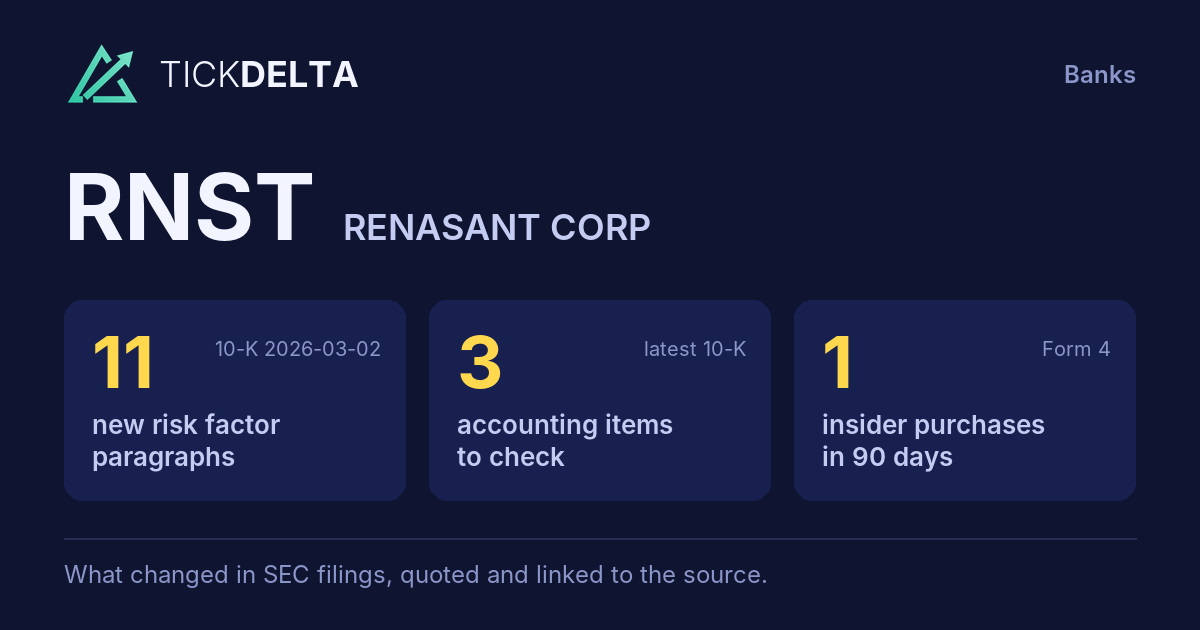
18.3%
of the text changed · 9,627 words now · 11 new paragraphs, 31 gone
MD&A
24.7%
of the text changed · 13,537 words now · 11 new paragraphs, 15 gone
Accounting Policies
29.3%
of the text changed · 8,164 words now
10-K 0000715072-26-000017 (Mar 2, 2026) vs 10-K 0000715072-25-000054 (Feb 26, 2025) Not compared: Legal Proceedings.
Every paragraph, and how much of it changed
One bar per paragraph, in the order of the 10-K. Height and colour show the share of its words not in the closest paragraph a year earlier; the tallest bars are new paragraphs.
Risk Factors
111 paragraphs · 11 new · 29 reworded · 31 gone · 10-K Mar 2, 2026 against Feb 26, 2025
New paragraph
Reworded (5% of its words or more)
Same or nearly
Paragraph 17 · 38% changed
Every version of it
Paragraph 42 · 34% changed
Every version of it
Paragraph 41 · 31% changed
Every version of it
New regulations, as well as significant changes to existing regulations, relating to every facet of our operations, operations have been proposed or may be proposed in the future. New laws and regulations, and changes to (or repeal of) existing laws, regulations or policies, as well as changes in interpretation, implementation or enforcement of the foregoing, could affect us and/or the Bank in substantial and unpredictable ways. Among other impacts, new or revised laws and regulations could limit the types of financial services and products we may offer or fees we may charge, require extensive new disclosures in our public filings, increase the ability of non-banks to offer competing financial services and products and/or otherwise result in continuing uncertainty regarding legal and regulatory compliance matters. Any of the foregoing may, in turn, necessitate that we hire additional employees, acquire or develop new software, implement new processes and procedures and otherwise incur
Paragraph 79 · 24% changed
Every version of it
We have grown our business through the acquisition of entire financial institutions (most recently, our acquisition of The First on April 1, 2025) and non-bank commercial finance companies and through de novo branching. We intend to continue pursuing this growth strategy for the foreseeable future, including our proposed merger with The First. future. Our prospects must be considered in light of the risks, expenses and difficulties frequently encountered by companies when expanding their franchise, including the following:
Paragraph 65 · 22% changed
Every version of it
financial assets. These threats, which are designed to obtain unauthorized access to confidential information belonging to the Company or its customers, manipulate or destroy data or systems, disrupt service on the Company’s systems, or steal money through the use of “ransomware” or unauthorized funds transfers, are increasing in frequency and sophistication and are often facilitated by artificial intelligence AI tools. In addition, our systems are threatened by unpredictable events such as terrorist attacks, power outages or tornadoes or other natural disasters. The Company may not be able to effectively implement, develop and manage critical systems and information technology infrastructure to facilitate strategic business initiatives, which could impair our ability to achieve financial, operational, compliance and strategic objectives and negatively affect our business, financial condition or results of operations.
Paragraph 16 · 14% changed
Every version of it
Volatility in interest rates may also result in disintermediation, which is the flow of funds away from financial institutions into direct investments, such as U.S. Government and Agency securities and other investment vehicles, including mutual funds, which generally pay higher rates of return than financial institutions because of the absence of federal deposit insurance premiums and reserve requirements. The interest rate increases in 2022 and 2023 were followed by significant outflows of funds from financial institutions (including the Company) into mutual funds and other investment vehicles, increasing the competition for, and cost of, deposits. Disintermediation could also result in material adverse effects on our financial condition and results of operations.
Paragraph 7 · 14% changed
Every version of it
In addition, bank regulatory agencies our federal and state banking regulators periodically review the allowance for credit losses and may require an increase in the provision for credit losses losses, downgrades of loan ratings or even the recognition of further loan charge-offs or downgrades, charge-offs, based on judgments different than those of management. In addition, if charge-offs in future periods exceed the allowance provision for credit losses, losses for such period, we will may incur additional provision expense to maintain the allowance for credit losses at its current levels or to increase the allowance for credit losses. losses above its current levels, if management determines that credit trends warrant greater reserves. Any increase in our provision for credit losses will result in a decrease in net income and, possibly, capital and may have a material adverse effect on our financial condition and results of operations. A discussion of the policies and procedures related to management’s process for determining the appropriate level of the allowance for credit losses is set forth under the headings “Critical Accounting Policies and Estimates” and “Risk Management – Credit Risk and Allowance for Credit Losses on Loans and Unfunded Commitments” in Item 7, Management’s Discussion and Analysis of Financial Condition and Results of Operations, in this report.
Paragraph 58 · 49% changed
Every version of it
10-K Feb 26, 2025Failure to perform in any of these areas could significantly weaken our competitive position, which could adversely affect our growth and profitability, which, in turn, could have a material adverse effect on our financial condition and results of operations.
10-K Mar 2, 2026
may elect, or be required by our regulators, to adopt additional risk management practices or other limits on our activities, which could have a material adverse effect on our financial condition and results of operations.
Paragraph 17 · 38% changed
Every version of it
10-K Feb 26, 2025Volatility in interest rates may also result in disintermediation, which is the flow of funds away from financial institutions into direct investments, such as U.S. Government and Agency securities and other investment vehicles, including mutual funds, which generally pay higher rates of return than financial institutions because of the absence of federal deposit insurance premiums and reserve requirements. The interest rate increases in 2022 and 2023 were followed by significant outflows of funds from financial institutions (including the Company) into mutual funds and other investment vehicles, increasing the competition for, and cost of, deposits. Disintermediation could also result in material adverse effects on our financial condition and results of operations.
10-K Mar 2, 2026
funds from financial institutions (including the Company) into mutual funds and other investment vehicles, increasing the competition for, and cost of, deposits. Disintermediation could also result in material adverse effects on our financial condition and results of operations.
Paragraph 42 · 34% changed
Every version of it
10-K Feb 26, 2025New regulations, as well as significant changes to existing regulations, relating to every facet of our operations, have been proposed or may be proposed in the future. New laws and regulations, and changes to (or repeal of) existing laws, regulations or policies, as well as changes in interpretation, implementation or enforcement of the foregoing, could affect us and/or the Bank in substantial and unpredictable ways. Among other impacts, new or revised laws and regulations could limit the types of financial services and products we may offer or fees we may charge, require extensive new disclosures in our public filings, increase the ability of non-banks to offer competing financial services and products and/or otherwise result in continuing uncertainty regarding legal and regulatory compliance matters. Any of the foregoing may, in turn, necessitate that we hire additional employees, acquire or develop new software, implement new processes and procedures and otherwise incur
10-K Mar 2, 2026
financial services and products we may offer or fees we may charge, require extensive new disclosures in our public filings, increase the ability of non-banks to offer competing financial services and products and/or otherwise result in continuing uncertainty regarding legal and regulatory compliance matters. Any of the foregoing may, in turn, necessitate that we hire additional employees, acquire or develop new software, implement new processes and procedures and otherwise incur substantial additional costs as part of our efforts to comply with our legal and regulatory obligations. In addition, these efforts may divert management time and attention from initiatives designed to grow the Company and the Bank and enhance our earnings and profitability.
Paragraph 41 · 31% changed
Every version of it
10-K Feb 26, 2025
New regulations, as well as significant changes to existing regulations, relating to every facet of our operations, have been proposed or may be proposed in the future. New laws and regulations, and changes to (or repeal of) existing laws, regulations or policies, as well as changes in interpretation, implementation or enforcement of the foregoing, could affect us and/or the Bank in substantial and unpredictable ways. Among other impacts, new or revised laws and regulations could limit the types of financial services and products we may offer or fees we may charge, require extensive new disclosures in our public filings, increase the ability of non-banks to offer competing financial services and products and/or otherwise result in continuing uncertainty regarding legal and regulatory compliance matters. Any of the foregoing may, in turn, necessitate that we hire additional employees, acquire or develop new software, implement new processes and procedures and otherwise incur
10-K Mar 2, 2026
New regulations, as well as significant changes to existing regulations, relating to every facet of our operations have been proposed or may be proposed in the future. New laws and regulations, and changes to (or repeal of) existing laws, regulations or policies, as well as changes in interpretation, implementation or enforcement of the foregoing, could affect us and/or the Bank in substantial and unpredictable ways. Among other impacts, new or revised laws and regulations could limit the types of
Paragraph 79 · 24% changed
Every version of it
10-K Feb 26, 2025
companies and through de novo branching. We intend to continue pursuing this growth strategy for the foreseeable future, including our proposed merger with The First. Our prospects must be considered in light of the risks, expenses and difficulties frequently encountered by companies when expanding their franchise, including the following:
10-K Mar 2, 2026
We have grown our business through the acquisition of entire financial institutions (most recently, our acquisition of The First on April 1, 2025) and non-bank commercial finance companies and through de novo branching. We intend to continue pursuing this growth strategy for the foreseeable future. Our prospects must be considered in light of the risks, expenses and difficulties frequently encountered by companies when expanding their franchise, including the following:
Paragraph 65 · 22% changed
Every version of it
10-K Feb 26, 2025
facilitated by artificial intelligence tools. In addition, our systems are threatened by unpredictable events such as terrorist attacks, power outages or tornadoes or other natural disasters. The Company may not be able to effectively implement, develop and manage critical systems and information technology infrastructure to facilitate strategic business initiatives, which could impair our ability to achieve financial, operational, compliance and strategic objectives and negatively affect our business, financial condition or results of operations.
10-K Mar 2, 2026
financial assets. These threats, which are designed to obtain unauthorized access to confidential information belonging to the Company or its customers, manipulate or destroy data or systems, disrupt service on the Company’s systems, or steal money through the use of “ransomware” or unauthorized funds transfers, are increasing in frequency and sophistication and are often facilitated by AI tools. In addition, our systems are threatened by unpredictable events such as terrorist attacks, power outages or tornadoes or other natural disasters. The Company may not be able to effectively implement, develop and manage critical systems and information technology infrastructure to facilitate strategic business initiatives, which could impair our ability to achieve financial, operational, compliance and strategic objectives and negatively affect our business, financial condition or results of operations.
Paragraph 16 · 14% changed
Every version of it
10-K Feb 26, 2025
Volatility in interest rates may also result in disintermediation, which is the flow of funds away from financial institutions into direct investments, such as U.S. Government and Agency securities and other investment vehicles, including mutual funds, which generally pay higher rates of return than financial institutions because of the absence of federal deposit insurance premiums and reserve requirements. The interest rate increases in 2022 and 2023 were followed by significant outflows of funds from financial institutions (including the Company) into mutual funds and other investment vehicles, increasing the competition for, and cost of, deposits. Disintermediation could also result in material adverse effects on our financial condition and results of operations.
10-K Mar 2, 2026
Volatility in interest rates may also result in disintermediation, which is the flow of funds away from financial institutions into direct investments, such as U.S. Government and Agency securities and other investment vehicles, including mutual funds, which generally pay higher rates of return than financial institutions because of the absence of federal deposit insurance premiums and reserve requirements. The interest rate increases in 2022 and 2023 were followed by significant outflows of
Paragraph 7 · 14% changed
Every version of it
10-K Feb 26, 2025
In addition, bank regulatory agencies periodically review the allowance for credit losses and may require an increase in the provision for credit losses or the recognition of further loan charge-offs or downgrades, based on judgments different than those of management. In addition, if charge-offs in future periods exceed the allowance for credit losses, we will incur additional provision expense to increase the allowance for credit losses. Any increase in our provision for credit losses will result in a decrease in net income and, possibly, capital and may have a material adverse effect on our financial condition and results of operations. A discussion of the policies and procedures related to management’s process for determining the appropriate level of the allowance for credit losses is set forth under the headings “Critical Accounting Policies and Estimates” and “Risk Management – Credit Risk and Allowance for Credit Losses on Loans and Unfunded Commitments” in Item 7, Management’s Discussion and Analysis of Financial Condition and Results of Operations, in this report.
10-K Mar 2, 2026
In addition, our federal and state banking regulators periodically review the allowance for credit losses and may require an increase in the provision for credit losses, downgrades of loan ratings or even the recognition of further loan charge-offs, based on judgments different than those of management. In addition, if charge-offs in future periods exceed the provision for credit losses for such period, we may incur additional provision expense to maintain the allowance for credit losses at its current levels or to increase the allowance for credit losses above its current levels, if management determines that credit trends warrant greater reserves. Any increase in our provision for credit losses will result in a decrease in net income and, possibly, capital and may have a material adverse effect on our financial condition and results of operations. A discussion of the policies and procedures related to management’s process for determining the appropriate level of the allowance for credit losses is set forth under the headings “Critical Accounting Policies and Estimates” and “Risk Management – Credit Risk and Allowance for Credit Losses on Loans and Unfunded Commitments” in Item 7, Management’s Discussion and Analysis of Financial Condition and Results of Operations, in this report.
MD&A
169 paragraphs · 11 new · 92 reworded · 15 gone · 10-K Mar 2, 2026 against Feb 26, 2025
New paragraph
Reworded (5% of its words or more)
Same or nearly
Paragraph 7 · 48% changed
Paragraph 6 · 46% changed
Paragraph 12 · 46% changed
Paragraph 9 · 44% changed
Paragraph 27 · 44% changed
The following table sets forth the scheduled maturity distribution and weighted average yield based on the amortized cost of the debt securities in our investment portfolio as of December 31, 2024.Amortized Cost Yield Held to Maturity: Obligations of states and political subdivisions Maturing within one year $ 1,494 2.61% Maturing after one year through five years 6,017 1.00% Maturing after five years through ten years 127,004 1.57% Maturing after ten years 150,027 1.85% Residential mortgage-backed securities not due at a single maturity date: Government agency MBS 372,414 1.93% Government agency CMO 354,882 1.86% Commercial mortgage-backed securities not due at a single maturity date: Government agency MBS 16,961 1.79% Government agency CMO 43,662 1.79% Other debt securities not due at a single maturity date: 53,683 2.68% Available for Sale: Obligations of states and political subdivisions Maturing within one year or less 1,997 5.46% Maturing after one year through five years 4,301 3.72% Maturing after five years through ten years 9,891 1.50% Maturing after ten years 4,077 1.30% Other debt securities Maturing within one year or less — —% Maturing after one year through five years 37,557 6.29% Maturing after five years through ten years 24,884 4.87% Maturing after ten years — —% Residential mortgage-backed securities not due at a single maturity date: Government agency MBS 185,292 1.95% Government agency CMO 475,311 1.99% Commercial mortgage-backed securities not due at a single maturity date: Government agency MBS 11,373 3.53% Government agency CMO 146,510 2.24% Other debt securities not due at a single maturity date: 67,734 6.01% $ 2,095,071 2.20% 2025.
Paragraph 11 · 42% changed
Paragraph 121 · 42% changed
Paragraph 103 · 41% changed
Allowance for Credit Losses on Loans; Provision for Credit Losses on Loans. The allowance for credit losses is available to absorb credit losses inherent in the loans held for investment portfolio. Loan losses are charged against the allowance for credit losses when management confirms the uncollectability of a loan balance. Subsequent recoveries, if any, are credited to the allowance. Management evaluates the adequacy of the allowance on a quarterly basis. For an in-depth discussion of our accounting policies and our methodology for determining the appropriate level of the allowance for credit losses, please refer to the information in the “Critical Accounting Policies and Estimates” section above as well as the information under the headings “Loans and the Allowance for Credit Losses” and “Business Combinations, Accounting for Purchased Credit Deteriorated Loans and Related Assets” in Note 1, “Significant Accounting Policies,” in the Notes to Consolidated Financial Statements in Item 8, Financial Statements and Supplementary Data, in this report.
Paragraph 7 · 48% changed
10-K Feb 26, 2025— Net interest income decreased $7,131 to $512,196 for 2024 as compared to $519,327 for 2023. The decrease from 2023 to 2024 was due to the increase in deposit costs more than offsetting the increase in interest income from higher yields, bolstered by the growth in our average earning assets exceeding the growth in interest bearing deposits.
10-K Mar 2, 2026
Net interest income increased $291,773 to $803,969 for 2025 as compared to $512,196 for 2024. The increase from 2024 to 2025 was primarily due to the addition of The First’s loan portfolio and strong organic loan growth in 2025.
Paragraph 6 · 46% changed
10-K Feb 26, 2025In July 2024, the Company completed its public offering of an aggregate of 7,187,500 shares of its common stock with net proceeds of $217,000.
10-K Mar 2, 2026
The Company repurchased, at an average price of $34.29, 388,940 shares of its common stock in the fourth quarter of 2025 as part of its publicly-announced stock repurchase program.
Paragraph 12 · 46% changed
10-K Feb 26, 2025— Deposits totaled $14,572,612 at December 31, 2024 compared to $14,076,785 at December 31, 2023. The Company used core retail deposit growth to paydown $461,441 in brokered deposits during the year.
10-K Mar 2, 2026
Deposits totaled $21,473,070 at December 31, 2025 compared to $14,572,612 at December 31, 2024. The Company assumed $6,449,393 of deposits from the merger with The First.
Paragraph 9 · 44% changed
10-K Feb 26, 2025— Noninterest income was $203,660 for 2024 compared to $113,075 for 2023. The increase in noninterest income is primarily attributable to the sale of Renasant Insurance in 2024 resulting in a pre-tax gross gain on sale of $53,349. Also in 2023, the Company recognized net losses on sales of securities (including impairments) in connection with the repositioning of our securities portfolio.
10-K Mar 2, 2026
Noninterest income was $181,880 for 2025 compared to $203,660 for 2024. The decrease in noninterest income is primarily attributable to the elevated level of noninterest income in 2024 from the sale of Renasant Insurance, Inc. that resulted in a pre-tax gross gain on sale of $53,349, offset by fee and other noninterest income generated from the operations acquired in the merger with The First.
Paragraph 27 · 44% changed
10-K Feb 26, 2025
The following table sets forth the scheduled maturity distribution and weighted average yield based on the amortized cost of the debt securities in our investment portfolio as of December 31, 2024.Amortized Cost Yield Held to Maturity: Obligations of states and political subdivisions Maturing within one year $ 1,494 2.61% Maturing after one year through five years 6,017 1.00% Maturing after five years through ten years 127,004 1.57% Maturing after ten years 150,027 1.85% Residential mortgage-backed securities not due at a single maturity date: Government agency MBS 372,414 1.93% Government agency CMO 354,882 1.86% Commercial mortgage-backed securities not due at a single maturity date: Government agency MBS 16,961 1.79% Government agency CMO 43,662 1.79% Other debt securities not due at a single maturity date: 53,683 2.68% Available for Sale: Obligations of states and political subdivisions Maturing within one year or less 1,997 5.46% Maturing after one year through five years 4,301 3.72% Maturing after five years through ten years 9,891 1.50% Maturing after ten years 4,077 1.30% Other debt securities Maturing within one year or less — —% Maturing after one year through five years 37,557 6.29% Maturing after five years through ten years 24,884 4.87% Maturing after ten years — —% Residential mortgage-backed securities not due at a single maturity date: Government agency MBS 185,292 1.95% Government agency CMO 475,311 1.99% Commercial mortgage-backed securities not due at a single maturity date: Government agency MBS 11,373 3.53% Government agency CMO 146,510 2.24% Other debt securities not due at a single maturity date: 67,734 6.01% $ 2,095,071 2.20%
10-K Mar 2, 2026
The following table sets forth the scheduled maturity distribution and weighted average yield based on the amortized cost of the debt securities in our investment portfolio as of December 31, 2025.
Paragraph 11 · 42% changed
10-K Feb 26, 2025— Loans, net of unearned income, were $12,885,020 at December 31, 2024 compared to $12,351,230 at December 31, 2023, an increase of 4.3%.
10-K Mar 2, 2026
Loans held for investment, net of unearned income, were $19,047,039 at December 31, 2025 compared to $12,885,020 at December 31, 2024. The Company acquired $5,173,334 of loans from the merger with The First.
Paragraph 121 · 42% changed
10-K Feb 26, 2025For more information about the Company’s securities, see Note 2, “Securities,” in the Notes to Consolidated Financial Statements in Item 8, Financial Statements and Supplementary Data, in this report.
10-K Mar 2, 2026
Certain modifications of loans made to borrowers experiencing financial difficulty. See the information under the heading “Certain Modifications to Borrowers Experiencing Financial Difficulties” in Note 3, “Loans,” in Item 8, Financials Statements and Supplementary Data, in this report for more information.
Paragraph 103 · 41% changed
10-K Feb 26, 2025
Allowance for Credit Losses on Loans; Provision for Credit Losses on Loans. The allowance for credit losses is available to absorb credit losses inherent in the loans held for investment portfolio. Loan losses are charged against the allowance for credit losses when management confirms the uncollectability of a loan balance. Subsequent recoveries, if any, are credited to the allowance. Management evaluates the adequacy of the allowance on a quarterly basis. For an in-depth discussion of our accounting policies and our methodology for determining the appropriate level of the allowance for credit losses, please refer to the information in the “Critical Accounting Policies and Estimates” section above as well as the information under the headings “Loans and the Allowance for Credit Losses” and “Business Combinations, Accounting for Purchased Credit Deteriorated Loans and Related Assets” in Note 1, “Significant Accounting Policies,” in the Notes to Consolidated Financial Statements in Item 8, Financial Statements and Supplementary Data, in this report.
10-K Mar 2, 2026
Allowance for Credit Losses on Loans; Provision for Credit Losses on Loans. The allowance for credit losses is available to absorb credit losses inherent in the loans held for investment portfolio. Loan losses are charged against the allowance for credit losses when management confirms the uncollectability of a loan balance. Subsequent recoveries, if any, are credited to the
A paragraph is matched with the one last year that shares the most of its words; under half in common makes it new. The paragraphs shown are the 8 reworded the most in each section.
The paragraph that changed most in each section
The redline
Marked against last year's 10-K: cut words struck through, new words highlighted.
MD&A217 words changed in this paragraph; it is 32% similar to last year's version.
In addition to results presented in accordance with GAAP, generally accepted accounting principles in the United States of America (“GAAP”), this document report contains certain non-GAAP financial measures, namely, return on average tangible shareholders’ equity, return on average tangible assets and adjusted diluted earnings per share, adjusted net interest margin, the ratio of tangible equity to tangible assets. assets, adjusted return on average assets, return on average tangible assets and on average tangible common equity, adjusted return on average tangible common equity and adjusted efficiency ratio. These non-GAAP financial measures adjust GAAP financial measures to exclude intangible assets. assets, including related amortization, and/or certain gains or charges (such as, for 2025, merger and conversion related expenses), with respect to which the Company is unable to accurately predict when these charges will be incurred or, when incurred, the amount thereof. Management uses these non-GAAP financial measures when evaluating capital utilization and adequacy. In addition, the Company believes that these non-GAAP financial measures facilitate the making of period-to-period comparisons and are meaningful indicators of its operating performance, particularly because these measures are widely used by industry analysts for companies with merger and acquisition activities. Also, because intangible assets such as goodwill and the core deposit intangible can vary extensively from company to company and are excluded from the calculation of a financial institution’s regulatory capital, the Company believes that the presentation of this non-GAAP financial information allows readers to more easily compare the Company’s results to information provided in other regulatory reports and the results of other companies. The reconciliations from GAAP to non-GAAP for these financial measures are below.
Source: Item 7, 10-K 0000715072-26-000017 vs Item 7, 10-K 0000715072-25-000054
Accounting Policies216 words changed in this paragraph; it is 50% similar to last year's version.
Loans are considered past due if the required principal and interest payments have not been received as of the date such payments were due. Generally, the recognition of interest on mortgage and commercial and industrial loans is discontinued at the time the loan is 90 days past due unless the credit is well-secured and in process of collection. Consumer and other retail loans are typically charged-off no later than the time the loan is 120 days past due. In all cases, loans are placed on nonaccrual status or charged-off at an earlier date if collection of principal or interest is considered doubtful. Loans may be placed on nonaccrual regardless of whether or not such loans are considered past due. All interest accrued for the current year, but not collected, for loans that are placed on nonaccrual or charged-off is reversed against interest income; the amount of interest income recognized on nonaccrual loans was immaterial for the years ended December 31, 2024, 2023 and 2022. The interest on these loans is accounted for on the cash-basis or cost-recovery method, until qualifying for return to accrual. Loans are returned to accrual status when all the principal and interest amounts contractually due are brought current and future payments are reasonably assured. As a result, the Company has made an accounting policy election to exclude accrued interest from the measurement of the allowance for credit losses. As of December 31, 2024 and 2023, the Company has accrued interest receivable for loans of $54,395 and $54,804, respectively, which is recorded in the “Other assets” line item on the Consolidated Balance Sheets. Although the Company made the election to exclude accrued interest from the measurement of the allowance for credit losses, the Company did have an allowance for credit losses on interest deferred as part of the loan deferral program implemented in response to the COVID-19 pandemic of $732 and $1,244, respectively, as of December 31, 2024 and 2023.
Source: Item 8, Note 1 – Significant Accounting Policies, 10-K 0000715072-26-000017 vs Item 8, Note 1 – Significant Accounting Policies, 10-K 0000715072-25-000054
Risk Factors72 words changed in this paragraph; it is 68% similar to last year's version.
New regulations, as well as significant changes to existing regulations, relating to every facet of our operations, operations have been proposed or may be proposed in the future. New laws and regulations, and changes to (or repeal of) existing laws, regulations or policies, as well as changes in interpretation, implementation or enforcement of the foregoing, could affect us and/or the Bank in substantial and unpredictable ways. Among other impacts, new or revised laws and regulations could limit the types of financial services and products we may offer or fees we may charge, require extensive new disclosures in our public filings, increase the ability of non-banks to offer competing financial services and products and/or otherwise result in continuing uncertainty regarding legal and regulatory compliance matters. Any of the foregoing may, in turn, necessitate that we hire additional employees, acquire or develop new software, implement new processes and procedures and otherwise incur
Source: Item 1A, 10-K 0000715072-26-000017 vs Item 1A, 10-K 0000715072-25-000054
Sentences and paragraphs added, removed or reworded
Every change, by type
Sentences and paragraphs of RNST's Risk Factors and MD&A, 10-K Mar 2, 2026 against 10-K Feb 26, 2025. Each links to the text at sec.gov.
Quiet changes are sentences kept from last year with one to four words changed, at least one of them a hedge, a modal or a qualifier (may, could, will, not, significant, material…). A year or date rolling forward is not counted.
The full word list
adverse, adversely, all, although, anticipate, anticipates, any, approximately, believe, believes, can, cannot, certain, could, expect, expects, generally, however, if, intend, intends, largely, likely, many, material, materially, may, might, most, must, never, no, not, possible, primarily, probable, should, significant, significantly, some, substantial, substantially, unlikely, will, would
AddedRisk Factors
companies, fintech companies and other financial intermediaries. Many of these competitors have fewer regulatory constraints and may have lower cost structures than the Company.
Read it in 10-K Mar 2, 2026 at sec.gov
AddedRisk Factors
•the impact of legislative, regulatory and technological changes and our ability to timely leverage the benefits or mitigate the risks resulting from such changes;
Read it in 10-K Mar 2, 2026 at sec.gov
AddedRisk Factors
The Company’s development and use of artificial intelligence, including generative and agentic artificial intelligence and machine learning, presents risks and challenges that may materially and adversely impact the Company’s business.
Read it in 10-K Mar 2, 2026 at sec.gov
AddedRisk Factors
The banking industry is subject to rapid and significant technological change. To effectively compete in this environment, the Company and its vendors, clients and counterparties have begun to incorporate AI technologies into certain business processes, services, and products. There are significant risks involved in deploying AI technologies, and no assurance can be provided that our use of AI will produce the intended results, or that the use of AI by our vendors will improve the quality of the products or services they deliver. Additionally, because the Company relies on AI models developed by third parties, we are dependent in part on the manner in which those third parties develop and train their models. Risk can result from poorly designed models or the use of faulty data, inadequate model testing or validation, narrow or limited human oversight, inadequate planning or due diligence, inappropriate or controversial data practices by developers or end-users, and other factors adversely affecting public opinion of AI and the acceptance of AI solutions. Furthermore, given the rapid pace of adoption of AI tools by vendors and service providers, we may not be aware of the use of AI solutions prior to such tools being introduced into our business
Read it in 10-K Mar 2, 2026 at sec.gov
AddedRisk Factors
environment. Any of these risks could expose the Company to liability or material and adverse legal or regulatory consequences and harm the Company’s reputation and the public perception of our business or the effectiveness of our security measures.
Read it in 10-K Mar 2, 2026 at sec.gov
AddedRisk Factors
The inherent shortcomings of current AI technologies can lead to concerns around safety and soundness, fair access to financial services, fair treatment of consumers and compliance with applicable laws and regulations. AI models, particularly generative AI models, sometimes produce outputs or take action that is incorrect, reflects biases included in the data sets on which they are trained, results in the release of private, confidential, or proprietary information, infringes on the intellectual property rights of others, or is otherwise harmful. In addition, the novelty and complexity of many AI models makes it difficult to understand why they generate particular outputs. This limited transparency creates challenges when assessing the proper operation of AI models, understanding and monitoring the capabilities of AI models, reducing erroneous output, eliminating bias, and complying with regulations that require documentation or an explanation of the basis on which decisions are made. The legal and regulatory environment relating to AI is uncertain and rapidly evolving, and includes regulatory schemes specifically targeting AI as well as provisions in intellectual property, privacy, consumer protection, employment and other laws applicable to the use of AI. We may not anticipate how to respond to these rapidly evolving frameworks, and we may need to expend resources to adjust our operations or offerings if the legal frameworks are inconsistent across jurisdictions. Moreover, because AI technology itself is highly complex and rapidly developing, it is not possible to predict all of the legal, operational or technological risks that may arise relating to the use of AI, and the increase in the Company’s costs to address such risks, which may be material.
Read it in 10-K Mar 2, 2026 at sec.gov
AddedRisk Factors
We recently identified a material weakness in our internal control over financial reporting, which could impact the Company’s ability to report its results of operations and financial condition accurately and in a timely manner.
Read it in 10-K Mar 2, 2026 at sec.gov
AddedRisk Factors
Section 404 of the Sarbanes-Oxley Act of 2002, as amended, requires that we evaluate and determine the effectiveness of our internal control over financial reporting and provide a management report on internal control over financial reporting, which must be attested to by our independent registered public accounting firm. As of December 31, 2025, we identified a material weakness in the Company’s internal control over financial reporting and concluded that the Company’s internal control over financial reporting was not effective due to this material weakness. A material weakness is a deficiency, or a combination of deficiencies, in internal control over financial reporting such that there is a reasonable possibility that a material misstatement of our annual or interim consolidated financial statements would not be prevented or detected on a timely basis.
Read it in 10-K Mar 2, 2026 at sec.gov
Show the other 65
AddedRisk Factors
The material weakness that we identified in the Company’s internal control over financial reporting related to the manual journal entry process impacting the Company’s general ledger accounts. We determined that, for a subset of journal entries that are manually entered into the Company’s general ledger, we failed to maintain effective segregation of duties. With respect to this subset of manual journal entries, it was possible for an individual to record an entry into our general ledger without prior approval. This material weakness did not result in any material misstatements to our consolidated financial statements and does not require any changes to previously filed financial statements, and we have concluded that our financial statements and other financial information included in this report and other periodic filings present fairly, in all material respects, our financial condition, results of operations, and cash flows for the periods presented in accordance with GAAP.
Read it in 10-K Mar 2, 2026 at sec.gov
AddedRisk Factors
Management’s report on internal controls over financial reporting and our plan for remediation of the identified material weakness is contained in Item 9A, Controls and Procedures, of this report. Until the remediation plan is fully implemented, tested and deemed effective, we cannot provide assurance that our actions will adequately remediate the material weakness in the near term or at all, or that we will be able to identify and remediate any additional control deficiency, including any material weakness, that may arise in the future. Effective internal control over financial reporting is necessary for us to provide reliable and timely financial reports and, together with adequate disclosure controls and procedures, are designed to reasonably detect and prevent fraud. The occurrence of, or failure to remediate, this material weakness and any future material weaknesses in our internal control over financial reporting may adversely affect the accuracy and reliability and timeliness of our financial statements, result in harm to our reputation, require us to incur additional compliance costs, and have other consequences that could materially and adversely affect our business and our stock price.
Read it in 10-K Mar 2, 2026 at sec.gov
AddedRisk Factors
expected revenue increases, cost savings, increases in geographic or product presence and/or other projected benefits from an acquisition could have a material adverse effect on our financial condition and results of operations.
Read it in 10-K Mar 2, 2026 at sec.gov
RemovedRisk Factors
RemovedRisk Factors
RemovedRisk Factors
RemovedRisk Factors
RemovedRisk Factors
RemovedRisk Factors
RemovedRisk Factors
RemovedRisk Factors
RemovedRisk Factors
RemovedRisk Factors
RemovedRisk Factors
RemovedRisk Factors
RewordedRisk Factors
In addition, if charge-offs in future periods exceed the allowance provision for credit losses, losses for such period, we will may incur additional provision expense to maintain the allowance for credit losses at its current levels or to increase the allowance for credit losses. losses above its current levels, if management determines that credit trends warrant greater reserves.
Read it in 10-K Mar 2, 2026 at sec.gov
RewordedRisk Factors
Although the 100/300 Test is not a limit on our lending activity, if any future results of a 100/300 Test evaluation show us to have a potential CRE concentration risk, we may elect, or be required by our regulators, to adopt additional risk management practices or other limits on our activities, which could have a material adverse effect on our financial condition and results of operations.
Read it in 10-K Mar 2, 2026 at sec.gov
RewordedRisk Factors
As of February 18, 2025, 20, 2026, there were 150,000,000 250,000,000 shares of our common stock authorized, of which 63,657,444 94,142,307 shares were outstanding, and we anticipate issuing approximately 31.8 million shares in connection with the completion of our merger with The First. outstanding.
Read it in 10-K Mar 2, 2026 at sec.gov
RewordedRisk Factors
We cannot assure investors that our acquisitions will have positive results, including results relating to: correctly assessing the asset quality of the assets acquired; the total cost of integration, integration (“integration” encompassing not just systems conversion but also the combination of the customers, employees, processes and procedures of the acquired entity into our own), including management attention and resources; the time required to complete the integration successfully; the amount of longer-term cost savings; being able to profitably deploy funds acquired in the transaction; retaining the existing client relationships; or the overall performance of the combined business.
Read it in 10-K Mar 2, 2026 at sec.gov
RewordedRisk Factors
The interest rate increases in 2022 and 2023 were followed by significant outflows of funds from financial institutions (including the Company) into mutual funds and other investment vehicles, increasing the competition for, and cost of, deposits.
Read it in 10-K Mar 2, 2026 at sec.gov
RewordedRisk Factors
The information under Note 19, “Restrictions on Cash, Securities, Bank Dividends, Loans or Advances,” in the Notes to Consolidated Financial Statements in Item 8, Financial Statements and Supplementary Data, in this report provides a detailed discussion about the restrictions governing the Bank’s ability to transfer funds to us.
Read it in 10-K Mar 2, 2026 at sec.gov
RewordedRisk Factors
In addition, bank regulatory agencies our federal and state banking regulators periodically review the allowance for credit losses and may require an increase in the provision for credit losses losses, downgrades of loan ratings or even the recognition of further loan charge-offs or downgrades, charge-offs, based on judgments different than those of management.
Read it in 10-K Mar 2, 2026 at sec.gov
RewordedRisk Factors
Credit quality monitoring procedures and indicators can include an assessment of problem loans, the types of loans, historical loss experience, new lending products, emerging credit trends, changes in the size and character of loan categories and other factors, including the Company’s risk rating system, regulatory guidance and economic conditions, such as the unemployment rate and GDP growth, as well as trends in the market values of underlying collateral securing loans, all as determined based on input from management, loan review staff and other sources. loans.
Read it in 10-K Mar 2, 2026 at sec.gov
RewordedRisk Factors
Any of the foregoing may, in turn, necessitate that we hire additional employees, acquire or develop new software, implement new processes and procedures and otherwise incur substantial additional costs as part of our efforts to comply with our legal and regulatory obligations.
Read it in 10-K Mar 2, 2026 at sec.gov
RewordedRisk Factors
Weak economic conditions are can be characterized by deflation, by, among other things, fluctuations in debt and equity capital markets, a lack of liquidity and/or depressed prices in the secondary market for mortgage loans, increased delinquencies on mortgage, consumer and C&I loans, residential and commercial real estate price declines and lower home sales and commercial activity.
Read it in 10-K Mar 2, 2026 at sec.gov
RewordedRisk Factors
We intend to continue pursuing this growth strategy for the foreseeable future, including our proposed merger with The First. future.
Read it in 10-K Mar 2, 2026 at sec.gov
RewordedRisk Factors
We also face competition from many other types of financial institutions (including savings and loans and credit unions), finance companies, brokerage firms, insurance companies, factoring companies, fintech companies and other financial intermediaries.
Read it in 10-K Mar 2, 2026 at sec.gov
Quiet changesRisk Factors
Changes in monetary policy by the Federal Reserve, including changes in interest rates, could influence not only the interest we receive on loans and securities and the interest we pay on deposits and borrowings, but such changes could may also affect (1) our ability to originate loans and generate deposits or access other sources of liquidity, which could reduce the amount of fee income generated, and (2) the fair value of our financial assets and liabilities.
Read it in 10-K Mar 2, 2026 at sec.gov
Quiet changesRisk Factors
In connection with the merger with The First, we will assume assumed all of The First’s liabilities by operation of law.
Read it in 10-K Mar 2, 2026 at sec.gov
AddedMD&A
On April 1, 2025, the Company completed its merger with The First. As of the effective date of the merger, The First operated 116 locations throughout Louisiana, Mississippi, Alabama, Georgia and Florida, and had $7,572,811 in assets, $5,173,334 in loans and $6,449,393 in deposits, net of purchase accounting adjustments.
Read it in 10-K Mar 2, 2026 at sec.gov
AddedMD&A
In October 2025, the Company redeemed $60,000 in subordinated notes assumed as part of the merger with The First.
Read it in 10-K Mar 2, 2026 at sec.gov
AddedMD&A
On April 1, 2025 the Company completed its merger with The First. At closing, The First merged with and into the Company, with the Company the surviving corporation in the merger; immediately thereafter, The First Bank merged with and into Renasant Bank, with Renasant Bank the surviving banking corporation in the merger. For more information, including the fair value of assets acquired and liabilities assumed, see Note 2, “Mergers and Acquisitions,” in the Notes to Consolidated Financial Statements in Item 8, Financial Statements and Supplementary Data, in this report.
Read it in 10-K Mar 2, 2026 at sec.gov
AddedMD&A
Note: Weighted-average loan-to-value is calculated using the most recent appraisal available.
Read it in 10-K Mar 2, 2026 at sec.gov
AddedMD&A
the Company’s insurance agency of $53,349, somewhat offset by additional income associated with the acquisition of The First’s operations.
Read it in 10-K Mar 2, 2026 at sec.gov
AddedMD&A
Income tax expense for 2025 and 2024 was $45,460 and $49,508, respectively. The effective tax rates for those years were 20.05% and 20.21%, respectively.
Read it in 10-K Mar 2, 2026 at sec.gov
AddedMD&A
On July 4, 2025, the One Big Beautiful Bill Act (“OBBBA”), which contains a broad range of tax provisions, was signed into law in the U.S. While we expect to take advantage of certain provisions of this legislation, such as the reinstatement of 100% first year bonus depreciation, the OBBBA is not expected to have a material impact on the Company’s income tax expense.
Read it in 10-K Mar 2, 2026 at sec.gov
AddedMD&A
DBCF. In addition, Federal Reserve regulations prohibit a member bank from paying a dividend without prior approval from the Federal Reserve if either (1) the total of all dividends declared during the calendar year, including the proposed dividend, exceeds the sum of the bank’s net income for the current year plus its retained net income of the prior two calendar years or (2) the dividend would exceed the bank’s undivided profits as reportable on its Reports of Condition and Income. In this latter scenario, Federal Reserve regulations also require that at least two-thirds of the bank’s shareholders approve the proposed dividend. Accordingly, the approval of the DBCF is required prior to the Bank paying dividends to the Company, and under certain circumstances Federal Reserve approval may also be required.
Read it in 10-K Mar 2, 2026 at sec.gov
AddedMD&A
The Company has junior subordinated debentures with a carrying value of $140,632 at December 31, 2025, of which $136,235 are included in the Company’s Tier 2 capital. The Company has subordinated notes with a carrying value of $359,124 at December 31, 2025, and $316,698 at December 31, 2024 included in the Company’s Tier 2 capital. On October 1, 2025, the Company redeemed $60,000 in subordinated notes assumed as part of its merger with The First.
Read it in 10-K Mar 2, 2026 at sec.gov
AddedMD&A
In addition to results presented in accordance with generally accepted accounting principles in the United States of America (“GAAP”), this report contains non-GAAP financial measures, namely, adjusted diluted earnings per share, adjusted net interest margin, the ratio of tangible equity to tangible assets, adjusted return on average assets, return on average tangible assets and on average tangible common equity, adjusted return on average tangible common equity and adjusted efficiency ratio. These non-GAAP financial measures adjust GAAP financial measures to exclude intangible assets, including related amortization, and/or certain gains or charges (such as, for 2025, merger and conversion related expenses), with respect to which the Company is unable to accurately predict when these charges will be incurred or, when incurred, the amount thereof. Management uses these non-GAAP financial measures when evaluating capital utilization and adequacy. In addition, the Company believes that these
Read it in 10-K Mar 2, 2026 at sec.gov
AddedMD&A
2025 2024 2023 Adjusted Diluted Earnings Per Share Average diluted shares outstanding (M) 87,514,783 59,748,790 56,448,163 Diluted earnings per share (GAAP): A/M $ 2.07 $ 3.27 $ 2.56 Adjusted diluted earnings per share (non-GAAP): C/M $ 3.06 $ 2.76 $ 3.15 Adjusted Return on Average Assets and Return on Average Tangible Assets Return on average assets (GAAP): A/G 0.74 % 1.11 % 0.84 % Adjusted return on average assets (non-GAAP): C/G 1.10 0.94 1.03 Return on average tangible assets (non-GAAP): B/H 0.88 1.20 0.92 Adjusted Return on Average Tangible Common Equity Return on average equity (GAAP): A/E 5.14 7.92 6.50 Return on average tangible equity (non-GAAP): B/F 9.65 13.63 12.29 Adjusted return on average tangible equity (non-GAAP): D/F 13.79 11.55 15.02 Tangible Shareholders’ Equity to Tangible Assets Shareholders’ equity to assets (GAAP): I/K 14.52 % 14.85 % 13.23 % Tangible shareholders’ equity to tangible assets (non-GAAP): J/L 9.26 % 9.84 % 7.87 % Adjusted Efficiency Ratio Net interest income (FTE) (GAAP) (N) $ 820,641 $ 522,526 $ 530,340 Total noninterest income (GAAP) (O) $ 181,880 $ 203,660 $ 113,075 Gain on sales of MSR (1,467) (3,724) (547) Gain on extinguishment of debt — (56) (620) Gain on sale of insurance agency — (53,349) — Losses on sales of securities (including impairments) — — 41,790 Total adjusted noninterest income (non-GAAP) (P) $ 180,413 $ 146,531 $ 153,698 Noninterest expense (GAAP) (Q) $ 651,660 $ 461,618 $ 439,622 Amortization of intangibles (27,103) (4,691) (5,380) Merger and conversion expense (49,331) (13,349) — Total adjusted noninterest expense (non-GAAP) (R) $ 575,226 $ 443,578 $ 434,242 Efficiency ratio (GAAP): Q/(N+O) 65.00 % 63.57 % 68.33 % Adjusted efficiency ratio (non-GAAP): R/(N+P) 57.46 % 66.30 % 63.48 % Adjusted Net Interest Income and Adjusted Net Interest Margin Net interest income (FTE) (GAAP) $ 820,641 $ 522,526 $ 530,340 Net interest income collected on problem loans (7,236) (770) (219) Accretion recognized on purchased loans (48,886) (3,402) (4,166) Amortization recognized on purchased time deposits 7,391 — — Amortization recognized on purchased long term borrowings 2,244 — — Adjusted net interest income (FTE) (non-GAAP) (S) $ 774,154 $ 518,354 $ 525,955
Read it in 10-K Mar 2, 2026 at sec.gov
RemovedMD&A
RemovedMD&A
RemovedMD&A
RemovedMD&A
RemovedMD&A
RemovedMD&A
RemovedMD&A
RemovedMD&A
RemovedMD&A
RemovedMD&A
RemovedMD&A
RemovedMD&A
RewordedMD&A
Noninterest-bearing deposits decreased increased to 23.49% of total deposits at December 31, 2025, as compared to 23.36% of total deposits at December 31, 2024, as compared to 25.46% of total deposits at December 31, 2023, due to the assumption of noninterest-bearing deposits being moved in connection with our acquisition of The First, offset by such deposits moving to other types of deposits or financial products bearing higher interest rates.
Read it in 10-K Mar 2, 2026 at sec.gov
RewordedMD&A
In 2024, 2025, investment income, on a tax equivalent basis, decreased $9,124 increased $60,683 to $103,812 from $43,129 from $52,253 in 2023, 2024, primarily due to the decrease in the balance acquisition of the securities portfolio during the year, offset slightly by The First’s investment portfolio, as well as the increase in yield on securities during 2024 due to from the sale or maturity of lower yielding securities.
Read it in 10-K Mar 2, 2026 at sec.gov
RewordedMD&A
The increase decrease in noninterest income is primarily attributable to the elevated level of noninterest income in 2024 from the sale of Renasant Insurance in 2024 resulting Insurance, Inc. that resulted in a pre-tax gross gain on sale of $53,349. $53,349, offset by fee and other noninterest income generated from the operations acquired in the merger with The First.
Read it in 10-K Mar 2, 2026 at sec.gov
RewordedMD&A
During 2024 2025 and 2023, 2024, the Company contributed approximately $1,255 $1,125 and $1,392, $1,255, respectively, to charitable organizations throughout Mississippi, Georgia and Alabama, for government economic development programs, which it received a dollar-for-dollar tax credit, and such contributions are included in our advertising and public relations expense. expense, and for which the Company received a dollar-for-dollar tax credit.
Read it in 10-K Mar 2, 2026 at sec.gov
RewordedMD&A
RewordedMD&A
The collateral real estate is marketed and sold at public auction for fair market value (based upon recent appraisals described in by realtors engaged by the above paragraph), Bank with fees associated with the foreclosure foreclosure, maintenance and marketing of the real estate being deducted from the sales price.
Read it in 10-K Mar 2, 2026 at sec.gov
RewordedMD&A
Although we consider all reasonably-available information that we believe is relevant to making the assumptions that underlie the Company’s determination of the appropriate amount of the allowance for credit losses, if actual economic or other conditions ultimately differ substantially from the assumptions we used in making the evaluation, then future adjustments (positive or negative) to the allowance may be necessary. necessary, although it is difficult to quantify within any degree of precision the extent of the adjustment that may be necessary if actual conditions vary from our assumptions.
Read it in 10-K Mar 2, 2026 at sec.gov
RewordedMD&A
The increase in salaries and employee benefits is primarily due attributable to the addition of The First’s employees, and to a lesser extent to annual merit increases implemented in April 2024 along with increased health and life insurance costs due to unusual claims experience. 2025.
Read it in 10-K Mar 2, 2026 at sec.gov
RewordedMD&A
The allowance for credit losses and the related provision for credit losses is the accounting estimate most important to the presentation of our financial statements that involves considerable subjective judgment and evaluation by management is the allowance for credit losses and the related provision for credit losses. management.
Read it in 10-K Mar 2, 2026 at sec.gov
RewordedMD&A
The Company recorded a provision for credit losses on loans of $11,248 $92,573 (which included the Day 1 provision of $62,190), or 0.53% of average loans during 2024, 2025, as compared to $18,793 $11,248, or 0.16% of average loans during 2023. 2024.
Read it in 10-K Mar 2, 2026 at sec.gov
RewordedMD&A
RewordedMD&A
Quiet changesMD&A
This percentage will fluctuate fluctuates based on a number of factors, including the extent of our loan growth and whether the Company has excess liquidity on its balance sheet.
Read it in 10-K Mar 2, 2026 at sec.gov
Sources
The two latest 10-Ks on EDGAR, section by section. Each change links to the text at sec.gov.
Also
New risk factors: paragraphs with nothing like them last year, quoted in full.
Work with it
Excel workbook · CSV. Google Sheet that stays up to date: paste =IMPORTDATA("https://tickdelta.com/company/RNST/export.csv") into a cell.