Paragraph 159 · 50% changed
Every version of it
Screener
/
SEC EDGAR
/CIK 0001720592
/10-K filed Mar 9, 2026, compared with Mar 3, 2025
/Numbers from the XBRL of the 10-Ks
Nasdaq
Industrials · Business Services
Repay Holdings Corp RPAY
The 10-K against last year's
91 changes: 6 added, 14 removed, 70 reworded, 1 quiet changes
10-K Mar 9, 2026 vs Mar 3, 2025
Risk Factors
12.3%
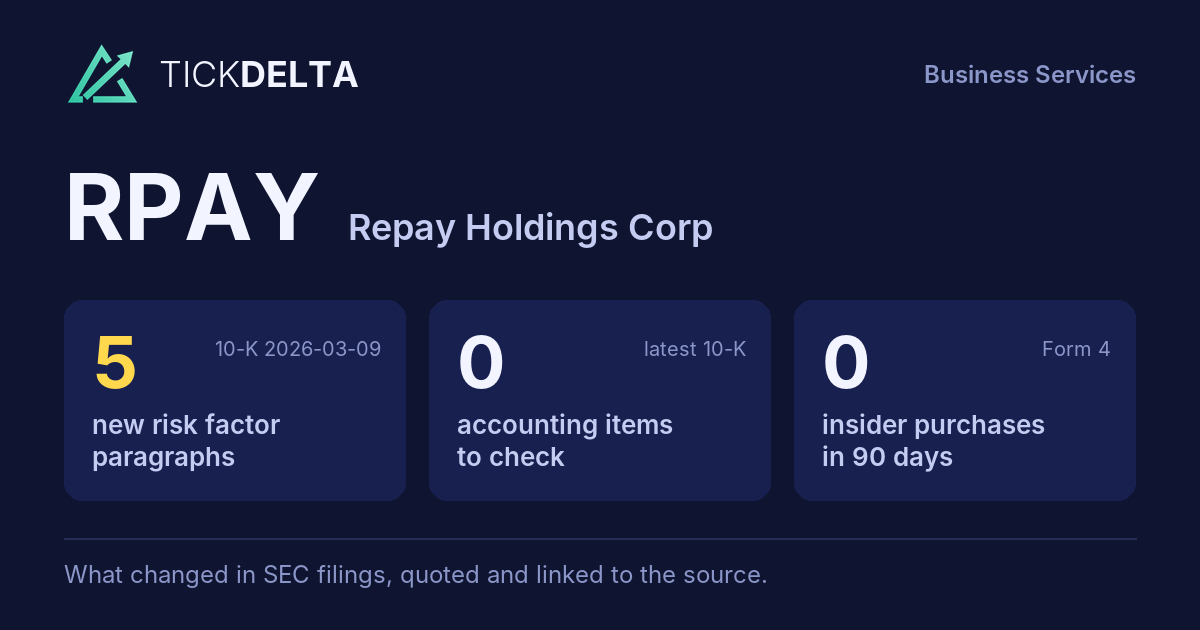
of the text changed · 16,464 words now · 5 new paragraphs, 6 gone
MD&A
18.8%
of the text changed · 7,021 words now · 1 new paragraphs, 8 gone
Legal Proceedings
16.9%
of the text changed · 430 words now
Accounting Policies
17.9%
of the text changed · 5,255 words now
10-K 0001193125-26-098518 (Mar 9, 2026) vs 10-K 0000950170-25-030855 (Mar 3, 2025)
Every paragraph, and how much of it changed
One bar per paragraph, in the order of the 10-K. Height and colour show the share of its words not in the closest paragraph a year earlier; the tallest bars are new paragraphs.
Risk Factors
187 paragraphs · 5 new · 49 reworded · 6 gone · 10-K Mar 9, 2026 against Mar 3, 2025
New paragraph
Reworded (5% of its words or more)
Same or nearly
Paragraph 18 · 48% changed
Every version of it
The continued growth and development of our payment processing services and solutions will depend on our ability to anticipate and adapt to changes in consumer and business behavior. behavior, client expectations and technology adoption. Any failure to timely integrate emerging payment methods into our software, to anticipate consumer or business behavior changes or to contract with processing partners that support such emerging payment technologies could cause us to lose traction among our clients or referral sources, including industry associations, resulting in a corresponding loss of revenue, if those methods become popular among end-users of their services.
Paragraph 112 · 48% changed
Every version of it
Similarly, our clients in the receivables management industry are typically subject to a complex and evolving framework of federal and state rules laws and regulations that establish specific requirements and procedures that debt collectors must follow when collecting consumer accounts. The CFPB and the FTC have devoted substantial attention to govern debt collection activities, practices. These requirements are enforced by multiple regulatory authorities and, as a result, the CFPB in some cases, through private litigation, and the FTC have brought multiple investigations regulatory priorities, interpretations and enforcement actions against approaches may vary over time. Increased scrutiny of debt collectors for violations of collection practices—whether through rulemaking, guidance, supervisory activity or enforcement actions—could result in investigations, penalties or required changes to our clients’ business practices. In addition, the FDCPA and other applicable laws. Continued regulatory scrutiny by the CFPB and the FTC over debt collection practices may result in additional investigations and enforcement actions against our clients in the receivables management industry. The FDCPA also provides comparable state laws provide for private rights of action against debt collectors, and permits debtors to recover including the potential for actual damages, statutory damages and attorneys’ fees and costs for violations of its terms. costs.
Paragraph 115 · 48% changed
Every version of it
We provide payment processing services through our various operating subsidiaries. We, along with our third party service providers, use structural arrangements designed to remove our activities from the scope of money transmitter regulation. There can be no assurance that these structural arrangements will remain effective as money transmitter laws continue to evolve or that the applicable regulatory bodies, particularly state agencies, will view our payment processing activities as compliant. Any determination that we are in fact required to be licensed under the state money transmission statutes may require substantial expenditures of time and money and could lead to liability in the nature of penalties or fines, which would have a materially adverse effect on our business and our financial results.
Paragraph 106 · 46% changed
Every version of it
Paragraph 169 · 42% changed
Every version of it
Paragraph 38 · 39% changed
Every version of it
Paragraph 145 · 38% changed
Every version of it
Certain provisions of the 2029 Notes and the indentures indenture could make a third party attempt to acquire us more difficult or expensive. For example, if a takeover constitutes a fundamental change, then we will be required to make an offer to the holders of the Notes to repurchase for cash all or part of their outstanding Notes. In addition, if a takeover constitutes a make-whole fundamental change, then we may be required to increase the conversion rate temporarily. In either case, and in other cases, our obligations under the Notes could increase the cost of acquiring us or otherwise discourage a third party from acquiring us or removing incumbent management, including in a transaction that you may view as favorable.
Paragraph 159 · 50% changed
Every version of it
10-K Mar 3, 2025In certain cases, payments under the Tax Receivable Agreement may exceed the actual tax benefits we realize or be accelerated.
10-K Mar 9, 2026
result, in certain circumstances, we could make payments under the Tax Receivable Agreement in excess of our actual income or franchise tax savings, which could materially impair our financial condition.
Paragraph 18 · 48% changed
Every version of it
10-K Mar 3, 2025
The continued growth and development of our payment processing services and solutions will depend on our ability to anticipate and adapt to changes in consumer and business behavior. Any failure to timely integrate emerging payment methods into our software, to anticipate consumer or business behavior changes or to contract with processing partners that support such emerging payment technologies could cause us to lose traction among our clients or referral sources, including industry associations, resulting in a corresponding loss of revenue, if those methods become popular among end-users of their services.
10-K Mar 9, 2026
The continued growth and development of our payment processing services and solutions will depend on our ability to anticipate and adapt to changes in consumer and business behavior, client expectations and technology adoption. Any failure
Paragraph 112 · 48% changed
Every version of it
10-K Mar 3, 2025
Similarly, our clients in the receivables management industry are typically subject to federal and state rules and regulations that establish specific requirements and procedures that debt collectors must follow when collecting consumer accounts. The CFPB and the FTC have devoted substantial attention to debt collection activities, and, as a result, the CFPB and the FTC have brought multiple investigations and enforcement actions against debt collectors for violations of the FDCPA and other applicable laws. Continued regulatory scrutiny by the CFPB and the FTC over debt collection practices may result in additional investigations and enforcement actions against our clients in the receivables management industry. The FDCPA also provides for private rights of action against debt collectors, and permits debtors to recover actual damages, statutory damages and attorneys’ fees and costs for violations of its terms.
10-K Mar 9, 2026
Similarly, our clients in the receivables management industry are subject to a complex and evolving framework of federal and state laws and regulations that govern debt collection practices. These requirements are enforced by multiple regulatory authorities and, in some cases, through private litigation, and regulatory priorities, interpretations and enforcement approaches may vary over time. Increased scrutiny of debt collection practices—whether through rulemaking, guidance, supervisory activity or enforcement actions—could result in investigations, penalties or required changes to our clients’ business practices. In addition, the FDCPA and comparable state laws provide for private rights of action against debt collectors, including the potential for actual damages, statutory damages and attorneys’ fees and costs.
Paragraph 115 · 48% changed
Every version of it
10-K Mar 3, 2025
We provide payment processing services through our various operating subsidiaries. We, along with our third party service providers, use structural arrangements designed to remove our activities from the scope of money transmitter regulation. There can be no assurance that these structural arrangements will remain effective as money transmitter laws continue to evolve or that the applicable regulatory bodies, particularly state agencies, will view our payment processing activities as compliant. Any determination that we are in fact required to be licensed under the state money transmission statutes may require substantial expenditures of time and money and could lead to liability in the nature of penalties or fines, which would have a materially adverse effect on our business and our financial results.
10-K Mar 9, 2026
We provide payment processing services through our various operating subsidiaries. We, along with our third party service providers, use structural arrangements designed to remove our activities from the scope of money transmitter regulation.
Paragraph 106 · 46% changed
Every version of it
10-K Mar 3, 2025Many of our clients desire to impose a convenience fee or a surcharge in connection with their customers’ use of a credit or debit card or other form of electronic payment. Recent federal actions aimed at addressing so-called “junk fees” have heightened regulatory scrutiny in this area, further complicating compliance with various state laws and regulations that impose prohibitions or other limitations on those types of fees or charges. The interpretation of these laws and regulations, as well as evolving payment network rules, continue to change, which can create uncertainty. These developments could negatively affect the willingness of some of our clients to accept credit or debit card or other electronic payment or result in less favorable terms to us in exchange for our clients to absorb those fees and costs, all of which would negatively affect our business.
10-K Mar 9, 2026
the willingness of some of our clients to accept credit or debit card or other electronic payment or result in less favorable terms to us in exchange for our clients to absorb those fees and costs, all of which would negatively affect our business.
Paragraph 169 · 42% changed
Every version of it
10-K Mar 3, 2025Historically, our Class A common stock has experienced substantial price volatility. For example, the closing price per share of our Class A common stock on The Nasdaq Capital Market ranged from a low of $7.13 to a high of $11.05 during the period from January 2, 2024 to December 31, 2024. This volatility could be the result of changes in our volumes, revenue, earnings and margins or general market and economic factors. If our future operating results or margins are below the expectations of stock market analysts or our investors, our stock price will likely decline.
10-K Mar 9, 2026
earnings and margins or general market and economic factors. If our future operating results or margins are below the expectations of stock market analysts or our investors, our stock price will likely decline.
Paragraph 38 · 39% changed
Every version of it
10-K Mar 3, 2025If these sponsorships are terminated and we are unable to secure a replacement sponsor bank within the applicable wind down period, we will not be able to process electronic payment transactions. While we maintain relationships with multiple sponsor banks for flexibility in the processing of payment volume and in the pricing of our clients’ solutions, the loss of or termination of a relationship with a sponsor bank or a significant decrease in the amount of payment volume that a sponsor bank processes for us could reduce such flexibility and negatively affect our business. To the extent the number of our sponsor banks decreases, we will become increasingly reliant on our remaining sponsor banks, which would materially adversely affect our business should our relationship with any of such remaining banks be terminated or otherwise disrupted. Furthermore, our agreements with our sponsor banks provide the sponsor banks with substantial discretion in approving certain elements of our business practices, including our solicitation, application and underwriting procedures for clients. Our sponsor banks’ actions under these agreements could be detrimental to us.
10-K Mar 9, 2026
our business should our relationship with any of such remaining banks be terminated or otherwise disrupted. Furthermore, our agreements with our sponsor banks provide the sponsor banks with substantial discretion in approving certain elements of our business practices, including our solicitation, application and underwriting procedures for clients. Our sponsor banks’ actions under these agreements could be detrimental to us.
Paragraph 145 · 38% changed
Every version of it
10-K Mar 3, 2025
Certain provisions of the Notes and the indentures could make a third party attempt to acquire us more difficult or expensive. For example, if a takeover constitutes a fundamental change, then we will be required to make an offer to the holders of the Notes to repurchase for cash all or part of their outstanding Notes. In addition, if a takeover constitutes a make-whole fundamental change, then we may be required to increase the conversion rate temporarily. In either case, and in other cases, our obligations under the Notes could increase the cost of acquiring us or otherwise discourage a third party from acquiring us or removing incumbent management, including in a transaction that you may view as favorable.
10-K Mar 9, 2026
Certain provisions of the 2029 Notes and the indenture could make a third party attempt to acquire us more difficult or expensive. For example, if a takeover constitutes a fundamental change, then we will be required to make an offer to the
MD&A
102 paragraphs · 1 new · 40 reworded · 8 gone · 10-K Mar 9, 2026 against Mar 3, 2025
New paragraph
Reworded (5% of its words or more)
Same or nearly
Paragraph 86 · 45% changed
On December 29, 2021, January 26, 2026, we increased borrowed $110.0 million under our then existing senior secured credit facilities by $60.0 million to provide for a $185.0 million revolving credit facility pursuant to an amendment to the Second Amended Credit Agreement. On February 9, 2023, we further amended Outstanding borrowing under the revolving credit facility will accrue interest at an adjusted SOFR rate plus a margin as provided in the Second Amended Credit Agreement to replace LIBOR with term SOFR as the interest rate benchmark. Agreement.
Paragraph 31 · 41% changed
The income tax benefit was $0.6 $5.9 million for the year ended December 31, 2024, 2025, reflecting the expected income tax benefit on the loss generated over the same period. This was a result of the operating loss incurred by the Company, Company primarily driven offset by the change in fair value of the tax receivable liability, impairment loss, loss on business disposition, stock-based compensation deductions and the amortization of assets acquired in the Business Combination Combination, the impact of taxes not being provided for certain non-controlling interests, and prior acquisitions. stock-based compensation expense net tax shortfall. The income tax benefit was $2.1 $0.6 million for the year ended December 31, 2023, which reflected 2024. This was a result of the expected income operating loss incurred by the Company, taxes imposed on earnings in certain state jurisdictions, stock based-compensation expense net shortfall, and the creation of Federal and state research and development credits and partially offset by certain state rate changes on deferred taxes, stock-based compensation expense net tax benefit shortfall, and the differential in tax rates on the loss generated over the same period. foreign based earnings.
Paragraph 61 · 34% changed
The increases decreases in Adjusted EBITDA, EBITDA and Adjusted Net Income and improvement increase in net income (loss) loss attributable to the Company for the year ended December 31, 2024 2025 were primarily due to the organic growth of our business from newly signed clients, the growth of existing clients, clients and cost savings initiatives being more than offset from impacts from previously announced client losses and political media spending during 2024 associated with the 2024 election cycle in our media payments business and cost savings initiatives that reduced both cost of services and selling, general and administrative expenses as a percentage of revenue. business. In addition, the increase in net loss attributable to the Company for the year ended December 31, 2025 was impacted by the goodwill impairment loss.
Paragraph 79 · 31% changed
Net cash used in financing activities was $17.5 $130.2 million for the year ended December 31, 2022, 2025, due to the repayments of the 2026 Notes, treasury shares repurchase, shares repurchased under the Incentive Plan, ESPP and Share Repurchase Program, as well as a payment under the Ventanex earnout payment. TRA and the payments for tax withholding related to shares vesting under the Incentive Plan and ESPP.
Paragraph 24 · 30% changed
Selling, general and administrative expenses were $142.0 million for the year ended December 31, 2025 and $145.5 million for the year ended December 31, 2024 and $148.7 million for the year ended December 31, 2023, 2024, a decrease of $3.2 $3.5 million or 2.1%, 2.4%, primarily due to a $3.0 $6.1 million decrease in transaction equity compensation expenses related to the disposition of BCS and $2.2 million decrease in the prior year period. compensation expenses, partially offset by a $3.4 increase in legal and other litigation fees and a $1.5 million increase in professional service fees.
Paragraph 27 · 29% changed
Interest income was $4.1 million for the year ended December 31, 2025 and $6.0 million for the year ended December 31, 2024 and $2.8 million for the year ended December 31, 2023, an increase 2024, a decrease of $3.2 $1.9 million, due to higher lower average interest rates earned on our cash and cash equivalents. equivalents and lower average cash balance during the second half of year primarily due to the use of cash to reduce the amount of 2026 Notes outstanding.
Paragraph 82 · 29% changed
Paragraph 52 · 26% changed
(g)For the year ended December 31, 2024, 2025, reflects one-time processing settlements, franchise taxes and other non-income based taxes, non-recurring legal and other litigation expenses and payments made to third-parties in connection with our IT security and personnel. For the year ended December 31, 2023, reflects payments made to third-parties in connection with an expansion of our personnel, franchise taxes and other non-income based taxes and one-time payments to certain partners. For the year ended December 31, 2022, reflects one-time payments to certain clients and partners, payments made to third-parties in connection with a significant expansion of our personnel, franchise taxes and other non-income based taxes, other payments related to COVID-19 and non-cash rent expense.
Paragraph 86 · 45% changed
10-K Mar 3, 2025
On December 29, 2021, we increased our then existing senior secured credit facilities by $60.0 million to provide for a $185.0 million revolving credit facility pursuant to an amendment to the Amended Credit Agreement. On February 9, 2023, we further amended the Amended Credit Agreement to replace LIBOR with term SOFR as the interest rate benchmark.
10-K Mar 9, 2026
On January 26, 2026, we borrowed $110.0 million under our revolving credit facility pursuant to the Second Amended Credit Agreement. Outstanding borrowing under the revolving credit facility will accrue interest at an adjusted SOFR rate plus a margin as provided in the Second Amended Credit Agreement.
Paragraph 31 · 41% changed
10-K Mar 3, 2025
The income tax benefit was $0.6 million for the year ended December 31, 2024, reflecting the expected income tax benefit on the loss generated over the same period. This was a result of the operating loss incurred by the Company, primarily driven by the change in fair value of the tax receivable liability, impairment loss, loss on business disposition, stock-based compensation deductions and the amortization of assets acquired in the Business Combination and prior acquisitions. The income tax benefit was $2.1 million for the year ended December 31, 2023, which reflected the expected income tax benefit on the loss generated over the same period.
10-K Mar 9, 2026
The income tax benefit was $5.9 million for the year ended December 31, 2025, reflecting the expected income tax benefit on the loss generated over the same period. This was a result of the operating loss incurred by the Company primarily offset by impairment loss of assets acquired in the Business Combination, the impact of taxes not being provided for certain non-controlling interests, and stock-based compensation expense net tax shortfall. The income tax benefit was $0.6 million for the year ended December 31, 2024. This was a result of the operating loss incurred by the Company, taxes imposed on earnings in certain state jurisdictions, stock based-compensation expense net shortfall, and the creation of Federal and state research and development credits and partially offset by certain state rate changes on deferred taxes, stock-based compensation expense net tax shortfall, and the differential in tax rates on foreign based earnings.
Paragraph 61 · 34% changed
10-K Mar 3, 2025
The increases in Adjusted EBITDA, Adjusted Net Income and improvement in net income (loss) attributable to the Company for the year ended December 31, 2024 were primarily due to the organic growth of our business from newly signed clients, the growth of existing clients, political media spending associated with the 2024 election cycle in our media payments business and cost savings initiatives that reduced both cost of services and selling, general and administrative expenses as a percentage of revenue.
10-K Mar 9, 2026
The decreases in Adjusted EBITDA and Adjusted Net Income and increase in net loss attributable to the Company for the year ended December 31, 2025 were primarily due to the organic growth of our business from newly signed clients, the growth of existing clients and cost savings initiatives being more than offset from impacts from previously announced client losses and political media spending during 2024 associated with the 2024 election cycle in our media payments business. In addition, the increase in net loss attributable to the Company for the year ended December 31, 2025 was impacted by the goodwill impairment loss.
Paragraph 79 · 31% changed
10-K Mar 3, 2025
Net cash used in financing activities was $17.5 million for the year ended December 31, 2022, due to the shares repurchased under the Incentive Plan, ESPP and Share Repurchase Program, as well as the Ventanex earnout payment.
10-K Mar 9, 2026
Net cash used in financing activities was $130.2 million for the year ended December 31, 2025, due to the repayments of the 2026 Notes, treasury shares repurchase, shares repurchased under the Share Repurchase Program, a payment under the TRA and the payments for tax withholding related to shares vesting under the Incentive Plan and ESPP.
Paragraph 24 · 30% changed
10-K Mar 3, 2025
Selling, general and administrative expenses were $145.5 million for the year ended December 31, 2024 and $148.7 million for the year ended December 31, 2023, a decrease of $3.2 million or 2.1%, primarily due to a $3.0 million decrease in transaction expenses related to the disposition of BCS in the prior year period.
10-K Mar 9, 2026
Selling, general and administrative expenses were $142.0 million for the year ended December 31, 2025 and $145.5 million for the year ended December 31, 2024, a decrease of $3.5 million or 2.4%, primarily due to a $6.1 million decrease in equity compensation expenses and $2.2 million decrease in compensation expenses, partially offset by a $3.4 increase in legal and other litigation fees and a $1.5 million increase in professional service fees.
Paragraph 27 · 29% changed
10-K Mar 3, 2025
Interest income was $6.0 million for the year ended December 31, 2024 and $2.8 million for the year ended December 31, 2023, an increase of $3.2 million, due to higher average interest rates earned on our cash and cash equivalents.
10-K Mar 9, 2026
Interest income was $4.1 million for the year ended December 31, 2025 and $6.0 million for the year ended December 31, 2024, a decrease of $1.9 million, due to lower average interest rates earned on our cash and cash equivalents and lower average cash balance during the second half of year primarily due to the use of cash to reduce the amount of 2026 Notes outstanding.
Paragraph 82 · 29% changed
10-K Mar 3, 2025On December 29, 2021, we increased our then existing senior secured credit facilities by $60.0 million to provide for a $185.0 million revolving credit facility pursuant to an amendment to the Amended Credit Agreement. On February 9, 2023, we further amended the Amended Credit Agreement to replace LIBOR with term SOFR as the interest rate benchmark.
10-K Mar 9, 2026
Our Amended Credit Agreement provided for a $185.0 million revolving credit facility in favor of Hawk Parent. On February 9, 2023, we amended the Amended Credit Agreement to replace LIBOR with term SOFR as the interest rate benchmark.
Paragraph 52 · 26% changed
10-K Mar 3, 2025
(g)For the year ended December 31, 2024, reflects one-time processing settlements, franchise taxes and other non-income based taxes, non-recurring legal and other litigation expenses and payments made to third-parties in connection with our IT security and personnel. For the year ended December 31, 2023, reflects payments made to third-parties in connection with an expansion of our personnel, franchise taxes and other non-income based taxes and one-time payments to certain partners. For the year ended December 31, 2022, reflects one-time payments to certain clients and partners, payments made to third-parties in connection with a significant expansion of our personnel, franchise taxes and other non-income based taxes, other payments related to COVID-19 and non-cash rent expense.
10-K Mar 9, 2026
(g)For the year ended December 31, 2025, reflects franchise taxes and other non-income based taxes, non-recurring legal and other litigation expenses and payments made to third-parties in connection with our IT security and
A paragraph is matched with the one last year that shares the most of its words; under half in common makes it new. The paragraphs shown are the 8 reworded the most in each section.
The paragraph that changed most in each section
The redline
Marked against last year's 10-K: cut words struck through, new words highlighted.
Risk Factors226 words changed in this paragraph; it is 38% similar to last year's version.
We depend on the ability and experience of a number of our key personnel who have substantial experience with our operations, the rapidly changing payment processing industry and the vertical markets in which we offer our products and services. Many of our key personnel have worked for us for a significant amount of time or were recruited by us specifically due to their experience. Our success depends in part upon on the reputation continued service and influence within the industry expertise of our senior managers who have, over the years, management and other key personnel, many of whom have developed long standing significant institutional knowledge and favorable industry experience. Our senior leaders and other key employees have developed important relationships with the card networks and our sponsor banks, key clients, software integration partners, vendors, card associations, sponsor banks partners and other payment processing and service providers. It is possible that providers, and the loss of the services one or more of senior executives these individuals could disrupt our operations, strategic initiatives or client relationships. From time to time, we have experienced, and may continue to experience, turnover in key managers could have management or other critical roles, and there can be no assurance that we will be able to retain or replace such personnel with individuals possessing comparable experience, expertise or industry relationships on a material adverse effect on our business, financial condition and results of operations. In addition, contractual obligations related to confidentiality assignment of intellectual property rights, non-solicitation and non-competition may be ineffective timely basis, or unenforceable, and departing employees may share our proprietary information with competitors or seek to solicit our software integration partners or clients or recruit our key personnel to competing businesses in ways that could adversely impact us. at all.
Source: Item 1A, 10-K 0001193125-26-098518 vs Item 1A, 10-K 0000950170-25-030855
Accounting Policies174 words changed in this paragraph; it is 65% similar to last year's version.
The Company performs a qualitative goodwill assessment at the reporting unit level at least annually, or more frequently as events occur or circumstances change that would more-likely-than-not reduce the fair value of a reporting unit below its carrying amount. Factors considered in the Company’s qualitative assessment include financial performance, financial forecasts, macroeconomic conditions, industry and market conditions, cost factors, market capitalization, carrying value, and events affecting the reporting units. If, after considering all relevant events and circumstances, the Company determines it is more-likely-than-not that the fair value of a reporting unit is less than its carrying amount, then it is necessary to perform a quantitative impairment test. If the Company elects to bypass the qualitative analysis, or concludes from the Company’s qualitative analysis that it is more-likely-than-not that the fair value of a reporting unit is less than its carrying amount, a quantitative impairment test is performed by comparing the fair value of each reporting unit with its carrying amount. If the fair value is greater than the carrying amount, then the reporting unit’s goodwill is deemed not to be impaired. If the fair value is less than the carrying amount, a non-cash impairment loss is recognized for the amount by which a reporting unit’s carrying amount exceeds its fair value, without exceeding the total amount of goodwill allocated to that reporting unit. Management estimates the fair value of the reporting units using a combination of a DCF calculation, which is a form of the income approach, and a market multiples calculation, which is a form of the market approach. The Company uses internal forecasts to estimate future cash flows expected to be generated by the reporting units when preparing DCF models under the income approach. To discount these cash flows, the Company uses an estimated weighted average cost of capital, which incorporates market and company-specific risk factors. The Company applies comparable publicly traded companies’ multiples (e.g., revenue or Adjusted EBITDA) to the Company’s reporting units’ financial forecasts when using market multiples under the market approach.
Source: Item 8, Note 2 – Basis of Presentation and Summary of Significant Accounting Policies, 10-K 0001193125-26-098518 vs Item 8, Note 2 – Basis of Presentation and Summary of Significant Accounting Policies, 10-K 0000950170-25-030855
MD&A117 words changed in this paragraph; it is 53% similar to last year's version.
The income tax benefit was $0.6 $5.9 million for the year ended December 31, 2024, 2025, reflecting the expected income tax benefit on the loss generated over the same period. This was a result of the operating loss incurred by the Company, Company primarily driven offset by the change in fair value of the tax receivable liability, impairment loss, loss on business disposition, stock-based compensation deductions and the amortization of assets acquired in the Business Combination Combination, the impact of taxes not being provided for certain non-controlling interests, and prior acquisitions. stock-based compensation expense net tax shortfall. The income tax benefit was $2.1 $0.6 million for the year ended December 31, 2023, which reflected 2024. This was a result of the expected income operating loss incurred by the Company, taxes imposed on earnings in certain state jurisdictions, stock based-compensation expense net shortfall, and the creation of Federal and state research and development credits and partially offset by certain state rate changes on deferred taxes, stock-based compensation expense net tax benefit shortfall, and the differential in tax rates on the loss generated over the same period. foreign based earnings.
Source: Item 7, 10-K 0001193125-26-098518 vs Item 7, 10-K 0000950170-25-030855
Legal Proceedings63 words changed in this paragraph; it is 43% similar to last year's version.
On July 12, 2024, December 22, 2025, the Company entered an agreement with a third party to sublease one of the operating leases. No The Company performed an impairment test was performed due analysis and used the market approach to calculate the anticipated sublease income exceeding the lease costs for the term fair value of the sublease. associated ROU asset. An impairment loss of $0.4 million related to Consumer Payments segment was recorded within Impairment loss in the Company’s Consolidated Statements of Operations as the result of the reassessment.
Source: Item 3, via Note 11 – Commitments and Contingencies, 10-K 0001193125-26-098518 vs Item 3, via Note 11 – Commitments and Contingencies, 10-K 0000950170-25-030855
Sentences and paragraphs added, removed or reworded
Every change, by type
Sentences and paragraphs of RPAY's Risk Factors and MD&A, 10-K Mar 9, 2026 against 10-K Mar 3, 2025. Each links to the text at sec.gov.
Quiet changes are sentences kept from last year with one to four words changed, at least one of them a hedge, a modal or a qualifier (may, could, will, not, significant, material…). A year or date rolling forward is not counted.
The full word list
adverse, adversely, all, although, anticipate, anticipates, any, approximately, believe, believes, can, cannot, certain, could, expect, expects, generally, however, if, intend, intends, largely, likely, many, material, materially, may, might, most, must, never, no, not, possible, primarily, probable, should, significant, significantly, some, substantial, substantially, unlikely, will, would
AddedRisk Factors
third parties, and we may not be able to obtain or retain licenses and technologies from these third parties on reasonable terms or at all. The loss of intellectual property protection or the inability to license or otherwise use third-party intellectual property could harm our business and ability to compete. We regularly engage third parties for offshore development activities, which may heighten all of the risks noted above.
Read it in 10-K Mar 9, 2026 at sec.gov
AddedRisk Factors
We depend on the ability and experience of a number of our key personnel who have substantial experience with our operations, the rapidly changing payment processing industry and the vertical markets in which we offer our products and services. Our success depends in part on the continued service and expertise of our senior management and other key personnel, many of whom have developed significant institutional knowledge and industry experience. Our senior leaders and other key employees have developed important relationships with the card networks and our sponsor banks, key clients, software integration partners and other payment processing and service providers, and the loss of one or more of these individuals could disrupt our operations, strategic initiatives or client relationships. From time to time, we have experienced, and may continue to experience, turnover in key management or other critical roles, and there can be no assurance that we will be able to retain or replace such personnel with individuals possessing comparable experience, expertise or industry relationships on a timely basis, or at all.
Read it in 10-K Mar 9, 2026 at sec.gov
AddedRisk Factors
Periods of actual or perceived stress in the banking or broader financial services sector—whether resulting from liquidity concerns, changes in regulatory expectations, macroeconomic conditions or other factors—could adversely affect the financial institutions with which we do business or the terms on which they provide services to us. Any failure of, or material adverse development affecting, one or more of our sponsor banks or other financial institution counterparties, or market concerns regarding their financial condition, could impair our liquidity, disrupt our ability to process transactions for clients, or negatively affect our relationships with clients and partner. Similarly, adverse developments affecting the financial institutions on which our clients rely could negatively impact our clients’ operations or financial condition, which in turn could reduce payment volumes processed through our platform or otherwise adversely affect our business, financial condition or results of operations.
Read it in 10-K Mar 9, 2026 at sec.gov
AddedRisk Factors
Our indebtedness under the Second Amended Credit Agreement bears interest at a variable rate, primarily based on the Secured Overnight Financing Rate (“SOFR”), and, as a result, our interest expense may increase if market interest rates rise, which could adversely affect our cash flows and results of operations.
Read it in 10-K Mar 9, 2026 at sec.gov
AddedRisk Factors
from any value attributable to such cash balances as a result of their ownership of Class A common stock following an exchange of their Post-Merger Repay Units, notwithstanding that such holders may previously have participated as holders of Post-Merger Repay Units in distributions by Hawk Parent that resulted in such excess cash balances being held by us.
Read it in 10-K Mar 9, 2026 at sec.gov
RemovedRisk Factors
RemovedRisk Factors
RemovedRisk Factors
Show the other 37
RemovedRisk Factors
RemovedRisk Factors
RemovedRisk Factors
RewordedRisk Factors
To the extent that we do not distribute such excess cash as dividends on Class A common stock or otherwise undertake ameliorative actions between Post-Merger Repay Units and shares of Class A common stock and instead, for example, hold such cash balances, Repay Unitholders that hold interests in Hawk Parent pre-Business Combination may benefit from any value attributable to such cash balances as a result of their ownership of Class A common stock following an exchange of their Post-Merger Repay Units, notwithstanding that such holders may previously have participated as holders of Post-Merger Repay Units in distributions by Hawk Parent that resulted in such excess cash balances being held by us.
Read it in 10-K Mar 9, 2026 at sec.gov
RewordedRisk Factors
The termination by our service or technology providers of their arrangements with us or their failure to perform their services efficiently and effectively may adversely affect our relationships with our clients and, if we cannot find alternate providers quickly, may cause those clients to terminate their relationships with us.
Read it in 10-K Mar 9, 2026 at sec.gov
RewordedRisk Factors
RewordedRisk Factors
Although we generally require that our agreements with our software integration partners or service providers include confidentiality obligations that restrict these parties from using or disclosing any client or consumer data except as necessary to perform their services under the applicable agreements, obligations, we cannot guarantee that these contractual measures will prevent the unauthorized use, modification, destruction or disclosure of data or allow us to seek reimbursement from the contracted party.
Read it in 10-K Mar 9, 2026 at sec.gov
RewordedRisk Factors
Also, because of the rapid pace of technological change in our industry, aspects of our business and our services rely on technologies developed or licensed by third parties, and we may not be able to obtain or retain licenses and technologies from these third parties on reasonable terms or at all.
Read it in 10-K Mar 9, 2026 at sec.gov
RewordedRisk Factors
Similarly, our clients in the receivables management industry are typically subject to a complex and evolving framework of federal and state rules laws and regulations that establish specific requirements and procedures that govern debt collectors must follow when collecting consumer accounts. collection practices.
Read it in 10-K Mar 9, 2026 at sec.gov
RewordedRisk Factors
In the event of an acceleration of our indebtedness, we could be forced to apply all available cash flows to repay such debt, which would reduce or eliminate distributions to us, which could also force us into bankruptcy or liquidation.
Read it in 10-K Mar 9, 2026 at sec.gov
RewordedRisk Factors
Our failure to repurchase the 2029 Notes at a time when the repurchase is required by the indenture governing the 2026 Notes and the indenture governing the 2029 Notes (together the “indentures”) (the “indenture”) or to pay any cash payable on future conversions of the 2029 Notes as required by the indentures, indenture, would constitute a default under the indentures. indenture.
Read it in 10-K Mar 9, 2026 at sec.gov
RewordedRisk Factors
To the extent the number of our sponsor banks decreases, we will become increasingly reliant on our remaining sponsor banks, which would materially adversely affect our business should our relationship with any of such remaining banks be terminated or otherwise disrupted.
Read it in 10-K Mar 9, 2026 at sec.gov
RewordedRisk Factors
Depending on how our products and services evolve, we may be subject to a variety of additional laws and regulations, including those governing money transmission, gift cards and other prepaid access instruments, electronic funds transfers, anti-money laundering, counter-terrorist financing, restrictions on foreign assets, banking and lending, and import and export restrictions.
Read it in 10-K Mar 9, 2026 at sec.gov
RewordedRisk Factors
For example, if a takeover constitutes a fundamental change, then we will be required to make an offer to the holders of the Notes to repurchase for cash all or part of their outstanding Notes.
Read it in 10-K Mar 9, 2026 at sec.gov
RewordedRisk Factors
We may not have the ability to raise the funds necessary to settle conversions of the 2026 Notes or the 2029 Notes, or to repurchase the 2026 Notes or the 2029 Notes upon a fundamental change, and our future debt may contain, limitations on our ability to pay cash upon conversion or repurchase of the 2026 Notes and the 2029 Notes.
Read it in 10-K Mar 9, 2026 at sec.gov
AddedMD&A
Repurchase Program. As of December 31, 2025, we had approximately $23.0 million remaining capacity under the Share Repurchase Program.
Read it in 10-K Mar 9, 2026 at sec.gov
RemovedMD&A
RemovedMD&A
RemovedMD&A
RemovedMD&A
RemovedMD&A
RemovedMD&A
RemovedMD&A
RemovedMD&A
RewordedMD&A
The increases decreases in Adjusted EBITDA, EBITDA and Adjusted Net Income and improvement increase in net income (loss) loss attributable to the Company for the year ended December 31, 2024 2025 were primarily due to the organic growth of our business from newly signed clients, the growth of existing clients, clients and cost savings initiatives being more than offset from impacts from previously announced client losses and political media spending during 2024 associated with the 2024 election cycle in our media payments business and cost savings initiatives that reduced both cost of services and selling, general and administrative expenses as a percentage of revenue. business.
Read it in 10-K Mar 9, 2026 at sec.gov
RewordedMD&A
This was a result of the operating loss incurred by the Company, Company primarily driven offset by the change in fair value of the tax receivable liability, impairment loss, loss on business disposition, stock-based compensation deductions and the amortization of assets acquired in the Business Combination Combination, the impact of taxes not being provided for certain non-controlling interests, and prior acquisitions. stock-based compensation expense net tax shortfall.
Read it in 10-K Mar 9, 2026 at sec.gov
RewordedMD&A
Net cash used in financing activities was $17.5 $130.2 million for the year ended December 31, 2022, 2025, due to the repayments of the 2026 Notes, treasury shares repurchase, shares repurchased under the Incentive Plan, ESPP and Share Repurchase Program, as well as a payment under the Ventanex earnout payment. TRA and the payments for tax withholding related to shares vesting under the Incentive Plan and ESPP.
Read it in 10-K Mar 9, 2026 at sec.gov
RewordedMD&A
We have been monitoring the current economic environment in the U.S. and globally – characterized by heightened inflation inflationary pressures in certain cost categories (including changes in wages), rising wages and technology-related expenses), elevated interest rates, supply chain issues, slower rate levels, tighter credit conditions, uneven economic growth and recent banking system volatility. periodic volatility in financial markets.
Read it in 10-K Mar 9, 2026 at sec.gov
RewordedMD&A
We incurred a loss, related to accretion expense and fair value adjustment of the tax receivable liability of $13.5 million for the year ended December 31, 2025 compared to a net loss of $14.5 million for the year ended December 31, 2024 compared to 2024, a net loss decrease of $6.6 million for the year ended December 31, 2023, an increase of $7.9 $1.0 million.
Read it in 10-K Mar 9, 2026 at sec.gov
RewordedMD&A
(e)Primarily consists of (i) during the year ended December 31, 2025 and 2024, professional service fees incurred in connection with prior transactions, transactions and (ii) during the year ended December 31, 2023, professional service fees and other costs incurred in connection with the disposition of BCS and (iii) during the year ended December 31, 2022, professional service fees and other costs incurred in connection with the acquisitions of BillingTree, Kontrol and Payix. BCS.
Read it in 10-K Mar 9, 2026 at sec.gov
RewordedMD&A
Total revenue was $309.3 million for the year ended December 31, 2025 and $313.0 million for the year ended December 31, 2024 and $296.6 million for the year ended December 31, 2023, an increase 2024, a decrease of $16.4 $3.8 million or 5.5%. 1.2%.
Read it in 10-K Mar 9, 2026 at sec.gov
RewordedMD&A
Revenue for the Business Payments segment was $48.4 million for the year ended December 31, 2025 and $52.9 million for the year ended December 31, 2024 and $38.1 million for the year ended December 31, 2023, 2024, representing a $14.9 $4.5 million or 39.1% 8.5% year-over-year increase. decrease.
Read it in 10-K Mar 9, 2026 at sec.gov
RewordedMD&A
Gross profit for the Business Payments segment was $33.3 million for the year ended December 31, 2025 and $39.1 million for the year ended December 31, 2024 and $28.0 million for the year ended December 31, 2023, 2024, representing a $11.2 $5.8 million or 40.0% 14.9% year-over-year increase. decrease.
Read it in 10-K Mar 9, 2026 at sec.gov
RewordedMD&A
We incurred an a non-cash impairment loss of $75.8 $242.7 million for during the year ended December 31, 2023, 2025, primarily due to a $75.7 $241.7 million goodwill impairment loss related to the Business Consumer Payments segment and a $0.1 million trade name write-off related to Media Payments. segment.
Read it in 10-K Mar 9, 2026 at sec.gov
RewordedMD&A
This facility matures on the earlier of (a) July 10, 2029, 2029 or (b) the date that is 91 days prior to the maturity date of the 2026 Notes (subject to certain exceptions for adequate liquidity) and (c) the date that is 91 days prior to the maturity date of the 2029 Notes (subject to certain exceptions for adequate liquidity).
Read it in 10-K Mar 9, 2026 at sec.gov
RewordedMD&A
Costs of services were $77.2 million for the year ended December 31, 2025 and $71.6 million for the year ended December 31, 2024 and $69.7 million for the year ended December 31, 2023, 2024, an increase of $1.9 $5.6 million or 2.8%. 7.8%.
Read it in 10-K Mar 9, 2026 at sec.gov
Quiet changesMD&A
We will settle any conversions of the 2029 Notes by paying cash up to the aggregate principal amount of the 2029 Notes to be converted and cash, shares of Class A common stock or a combination of cash and shares, at our election, in respect of the remainder, if any, of our conversion obligation in excess of the aggregate principal amount of the 2029 Notes being converted.
Read it in 10-K Mar 9, 2026 at sec.gov
Sources
The two latest 10-Ks on EDGAR, section by section. Each change links to the text at sec.gov.
Also
New risk factors: paragraphs with nothing like them last year, quoted in full.
Work with it
Excel workbook · CSV. Google Sheet that stays up to date: paste =IMPORTDATA("https://tickdelta.com/company/RPAY/export.csv") into a cell.