Screener / SEC EDGAR /CIK 0000315852 /10-K filed Feb 24, 2026, compared with Feb 25, 2025 /Numbers from the XBRL of the 10-Ks
NYSE Energy · Oil & Gas Production

Range Resources Corp RRC

Compare with peers Embed
The 10-K against last year's

97 changes: 9 added, 5 removed, 79 reworded, 4 quiet changes

10-K Feb 24, 2026 vs Feb 25, 2025

10-K 0001193125-26-067292 (Feb 24, 2026) vs 10-K 0000950170-25-026789 (Feb 25, 2025) Not compared: Accounting Policies.

Every paragraph, and how much of it changed

One bar per paragraph, in the order of the 10-K. Height and colour show the share of its words not in the closest paragraph a year earlier; the tallest bars are new paragraphs.

Risk Factors

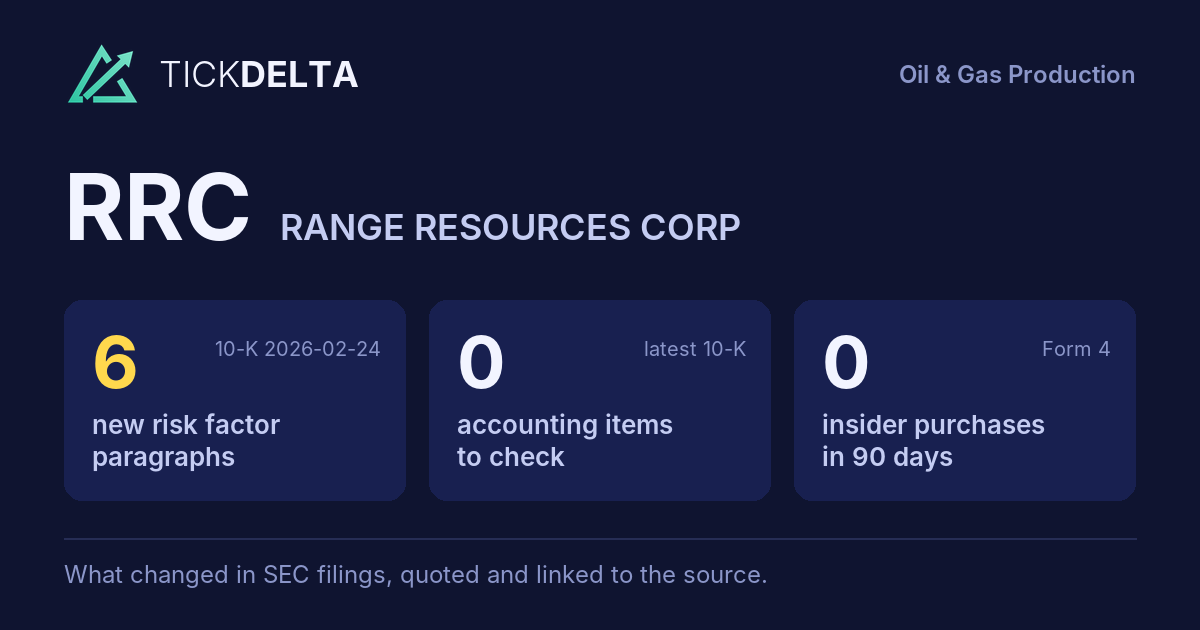
106 paragraphs · 6 new · 33 reworded · 3 gone · 10-K Feb 24, 2026 against Feb 25, 2025
New paragraph Reworded (5% of its words or more) Same or nearly
Paragraph 68 · 47% changed Every version of it
Environmental regulations and pollution liability could expose us to significant costs and penalties. We may incur significant costs and liabilities in complying with existing or future environmental laws, regulations and enforcement policies or initiatives. Some of these environmental laws and regulations may impose strict, joint and several liability regardless of fault or knowledge, which could subject us to liability for conduct that was lawful at the time it occurred, or conditions caused by prior owners or operators or which relate to third party sites where we have taken materials for recycling or disposal. Pennsylvania law also imposes criminal liability for certain releases of substances, regardless of fault or intent. Failure to comply with these laws and regulations may result in the occurrence of delays, cancellations or restrictions in permitting or performance of our projects or other operations and subject us to administrative, civil and/or criminal penalties, corrective actions and orders enjoining some or all of our operations. Our operations may be impacted by new and amended laws and regulations and reinterpretations of existing laws and regulations or increased government enforcement relating to environmental laws. For example, properly handled drilling fluids and produced water are currently exempt from regulation as hazardous waste under RCRA, and instead are regulated under RCRA’s non-hazardous waste provisions. It is possible that the EPA may in the future propose rulemaking that designates such wastes as hazardous rather than non-hazardous, and a similar designation may be made at the state level. Should this occur at the federal and/or state level it could result in significant costs to attain and maintain compliance.
Paragraph 36 · 46% changed Every version of it
As a result of cross-default provisions in our borrowing arrangements, we may be unable to satisfy all of our outstanding obligations in the event of a default on our part. The terms of our senior indebtedness, including our revolving credit facility, contain cross-default provisions which provide that we will be in default under such agreements in the event of certain defaults under our indentures or other loan agreements. Accordingly, should an event of default above certain thresholds occur under any of those agreements, we face the prospect of being in default under all of our debt agreements, obligated in such instance to satisfy all of our outstanding indebtedness but in all probability unable to satisfy all of our outstanding obligations simultaneously. In such an event, we might not be able to obtain alternative financing or, if we are able to obtain such financing, we might not be able to obtain it on terms acceptable to us, which would negatively affect our ability to continue our business plan, make capital expenditures and finance our operations.
Paragraph 73 · 41% changed Every version of it
Federal and state governments have from time to time considered legislation and regulations to reduce GHG emissions, including, but not limited to the implementation of GHG monitoring and reporting for the natural gas industry which includes certain of our operations. For additional details please refer to Government Governmental Regulation in Item 1, Environmental and Occupational Health and Safety Matters, specifically the Air emissions and Climate change sections above. There have also been a number of state and regional efforts that have emerged that seek to track and reduce GHG emissions by means of cap and trade programs where emitters would be required to acquire and surrender emission allowances in return for emitting GHGs. In September 2020, the PEQB The Pennsylvania Environmental Quality Board approved a draft resolution rule in 2020 to enter participate in the Regional Greenhouse Gas Initiative ("RGGI"), (“RGGI”), a cooperative effort among the states of Connecticut, Delaware, Maine, Maryland, Massachusetts, New Hampshire, New Jersey, New York, Rhode Island and Vermont to cap and reduce power sector multi-state program capping CO2 emissions from fossil-fuel-fired electric power plants. However, Subsequent legal challenges resulted in response to the PEQB's resolution to join the RGGI, the Pennsylvania General Assembly adopted a resolution on December 15, 2021, expressing its disapproval of the state's efforts to enroll in RGGI, stating that the RGGI would drive up energy costs and result in thousands of lost jobs. On January 10, 2022, former Governor Wolf vetoed the disapproval resolution. In April 2022, the Pennsylvania senate failed to override former Governor Wolf's veto and as a result, Pennsylvania officially joined the RGGI. However, in July 2022, the 2022 Commonwealth Court of Pennsylvania issued an order blocking the state from participating staying Pennsylvania’s participation in the RGGI until the court ruled on its constitutionality. On RGGI, and, in November 1, 2023, the Pennsylvania Commonwealth Court ruled that funds generated through the RGGI are an unconstitutional tax, effectively preventing the state from participating in RGGI. Pennsylvania Governor Josh Shapiro then appealed to the Pennsylvania Supreme Court. In parallel, throughout 2024 and 2025 the Pennsylvania General Assembly advanced legislation to repeal the RGGI regulation and to bar participation absent specific legislative authorization while executive-branch policymakers pursued alternative, Pennsylvania-specific cap-and-invest concepts. However, in November 2025, Governor Shapiro signed a bill as part of a deal to resolve an ongoing budget impasse that, among other things, withdrew the Commonwealth of Pennsylvania from the RGGI (and rendered moot the related legislation in the Pennsylvania General Assembly), ending years of political and legal conflict over whether the state should join the multistate cap and trade program. We will continue to monitor these developments because any carbon-pricing program applicable to in-state generators could influence in-state power-sector gas demand, basis differentials, and, indirectly, our price realizations and development plans. We also initiated our
Paragraph 101 · 33% changed Every version of it
•cybersecurity threats to gain unauthorized access to sensitive information or to render data or computer systems unusable; unusable, which may become more sophisticated with the use of artificial intelligence;
Paragraph 59 · 28% changed Every version of it
Additionally, local governments in Pennsylvania are authorized to adopt and implement ordinances and impose certain restrictions regarding siting of well sites, tank pads and other related facilities. Approval from one or more local governmental bodies, some following a public hearing, may be required before commencing construction of facilities which can result in delay, increased expense or, in some cases, prevention of development. Moreover, new initiatives or regulations could propose new setback distances or further restrictions on our ability to conduct certain operations such as hydraulic fracturing or disposal of substances generated by our operations, including, but not limited to, produced water, drilling fluids and other wastes associated with our operations. For example, in January 2024, the DEP announced that it would implement a policy requiring natural gas well operators to disclose chemicals they use in drilling and hydraulic fracturing operations before the chemicals are used on-site. Further, in November 2024, Cecil Township, located in Washington County, Pennsylvania, adopted an ordinance that increased the setback distance for oil and gas operations from 500 feet to 2,500 feet from protected structures like residences and businesses and 5,000 feet from schools and hospitals. See also above Land Use and Setbacks. Separately, the DEP received a citizen petition for rulemaking to expand setback distances from natural gas operations across Pennsylvania. On December 9, 2025, the Pennsylvania Environmental Quality Board (PEQB) accepted the citizen petition for rulemaking moving the petition forward for the DEP’s review and study of the requested rulemaking. We do not expect action on the requested rulemaking for the foreseeable future and believe that the petition and requested rulemaking are unlawful. We will continue to monitor this petition, the requested rulemaking and any related developments to assess potential impacts to our operations. Currently there are a few states that have elected to ban or severely limit hydraulic fracturing. Should Pennsylvania or the federal government ban hydraulic fracturing, it would preclude economic development of our Marcellus Shale reserves potentially resulting in severe negative financial consequences to us.
Paragraph 63 · 28% changed Every version of it
Our business depends on natural gas and oil transportation and NGLs processing facilities facilities, which are owned by others and depends on our ability to contract with those parties. Our ability to sell our natural gas, NGLs and oil production depends in part on the availability, proximity and capacity of gathering and transportation pipeline systems, processing facilities, rail cars, trucks or vessels owned by third parties and our ability to contract with those third parties. The lack of available capacity on these systems and facilities could result in the shut-in of producing wells or the delay or discontinuance of development plans for properties. Changes in intrastate pipeline rate design for Section 311 service could increase fixed transportation costs and reduce flexibility. If intrastate pipelines that provide interstate transportation under the Natural Gas Policy Act Section 311 adopt or maintain rate designs with higher fixed (reservation) charges, our transportation costs could increase and our flexibility to manage volumes through variable charges could decline. Because we depend on third‑party systems to gather and transport our production, higher fixed fees or related tariff changes could reduce our netbacks, contribute to curtailments in constrained periods, and adversely affect our results of operations and cash flows. See also above above, Our producing properties are concentrated in Pennsylvania, making us vulnerable to risks associated with operating in one geographic and political region.
Paragraph 78 · 26% changed Every version of it
On March 6, 2024, the SEC adopted rules that would require public companies to disclose extensive climate change-related information in certain of their SEC filings. However, on March 15, 2024, a federal appellate court imposed a temporary stay pending judicial review of such new rules, and in response, on April 4, 2024, the SEC issued an order staying any amendments to such rules pending the completion of judicial review of the federal appellate court petitions. On February 11, 2025, the acting chairman of the SEC released a statement that he has directed the SEC staff to request that the court not schedule the case for argument to provide time for the SEC to deliberate the appropriate next steps in litigation related to The Enhancement and Standardization of Climate-Related Disclosures for Investors rule. On March 27, 2025, the SEC commissioners voted to end the defense of The Enhancement and Standardization of Climate-Related Disclosures for Investors rule. While the final form SEC has ceased defending the previously approved climate disclosure rules and substance of these rules notified the court accordingly (leaving them stayed and unlikely to take effect under the current administration), other state-level jurisdictions have already implemented or are not yet known and the ultimate scope and impact on our business is uncertain, compliance with the rules may result currently developing climate disclosure requirements for large companies that operate in increased legal, accounting, operational, technology and financial compliance costs. their jurisdictions.
Paragraph 53 · 22% changed Every version of it
Our identified drilling locations are scheduled out over multiple years, making them susceptible to uncertainties that could materially alter the occurrence or timing of their drilling. Our management team has specifically identified and scheduled certain drilling locations for future multi-year drilling activities on our existing acreage. Our ability to drill and develop these locations depends on a number of uncertainties, including natural gas, NGLs and oil prices, the availability and cost of capital, drilling and production costs, the availability of drilling services and equipment, drilling results, obtaining lease agreements and managing lease expirations, transportation constraints, permits, regulatory and zoning approvals and other factors. Unless production is established within the spacing units covering acreage subject to an expiration, the leases for such acreage will expire. Because of these uncertain factors, our actual drilling activities may materially differ from those presently identified. In addition, we will require significant capital over a prolonged period in order to pursue the development of these locations, and we may not be able to raise or generate the capital required to do so. Any drilling activities we are able to conduct on these locations may not be successful or result in our ability to add proved reserves to our overall proved reserves or may result in a downward revision of our estimated proved reserves, which could have a material adverse effect on our business and results of operations and financial condition.

MD&A

112 paragraphs · 3 new · 66 reworded · 2 gone · 10-K Feb 24, 2026 against Feb 25, 2025
New paragraph Reworded (5% of its words or more) Same or nearly
Paragraph 90 · 48% changed
As of December 31, 2024, 2025, we had $1.7 $1.2 billion of total debt outstanding. Our next significant long-term debt maturity is in the amount outstanding, of $608.7 million due in May 2025, which is currently classified as a short term liability on the consolidated balance sheet. Anticipated cash annual interest payments related to our fixed-rate debt, based on the amount $1.1 billion outstanding at December 31, 2024, is $23.8 million on our 4.75% are senior notes and $49.5 million on our 8.25% senior notes, while anticipated cash which bore interest at fixed rates averaging 6.7%. Our expected annual incurred interest for the our 4.875% senior notes is $12.4 $73.2 million assuming debt balances remain the same. Bank debt totaling $118.0 million bears interest at a floating rate which was 5.6% as these of December 31, 2025. Annual expected interest for the bank credit facility is $9.3 million assuming there is no change to the debt balance and interest rate from December 31, 2025. These expectations do not include the impacts from the subsequent payoff in January 2026 of the 8.25% senior notes are due 2029 as described in May 2025. Note 6.
Paragraph 77 · 48% changed
Repayment Borrowing on credit facility in 2025 was $1.3 billion of senior notes which approximately $447.0 million was utilized for 2024 includes the repurchase repayment of $79.7 million principal of our 4.875% senior notes due 2025, 2025 at a discount. their maturity date in May. Borrowings net of repayments for 2025 brought the credit facility balance to $118.0 million as of December 31, 2025.
Paragraph 80 · 40% changed
Repayment of senior notes for 2024 2025 includes the repurchase payoff of $79.7 million principal of our 4.875% senior notes due 2025, 2025 at a discount. its maturity date through utilization of cash and borrowing on our credit facility.
Paragraph 26 · 37% changed
The year ended December 31, 2024 2025 also included the following highlights to enhance our returns of capital and balance sheet, return capital to investors and preserve liquidity: sheet highlights:
Paragraph 29 · 35% changed
•repurchased in the open market $79.7 $2.2 million face value principal amount of our 4.875% senior notes due 2025 at a discount; discount and repaid the remaining $606.5 million principal balance of our 4.875% senior notes due 2025 at par by utilizing cash on hand and borrowing on our credit facility;
Paragraph 31 · 32% changed
During 2024, we invested $57.9 million to acquire unproved acreage compared to $40.1 million in 2023. We continue •enabled longer laterals and enhanced efficiency through continued selective acreage leasing and lease renewals to consolidate our acreage positions in the Marcellus Shale play in Pennsylvania. Pennsylvania by investing $51.8 million to acquire unproved acreage; and
Paragraph 82 · 31% changed
Our main sources of liquidity are cash on hand, internally generated cash flow from operations, capital market transactions and our bank credit facility. facility and capital market transactions. At December 31, 2024, 2025, we had approximately $1.6 $1.7 billion of liquidity consisting of cash on hand and availability under our bank credit facility. On January 15, 2026 we fully redeemed the $600 million principal balance of our 8.25% senior notes due 2029 by utilizing borrowings on our credit facility, reducing liquidity to approximately $1.1 billion as of January 31, 2026. See Note 6 to our consolidated financial statements for more information.
Paragraph 27 · 31% changed
•paid $77.5 $85.7 million in dividends or $0.32 dividends, increasing per share dividend by 12.5% to an annual $0.36 per common share compared to $0.32 per common share in 2023; 2024;

A paragraph is matched with the one last year that shares the most of its words; under half in common makes it new. The paragraphs shown are the 8 reworded the most in each section.

The paragraph that changed most in each section

The redline

Marked against last year's 10-K: cut words struck through, new words highlighted.

Risk Factors312 words changed in this paragraph; it is 50% similar to last year's version.
Federal and state governments have from time to time considered legislation and regulations to reduce GHG emissions, including, but not limited to the implementation of GHG monitoring and reporting for the natural gas industry which includes certain of our operations. For additional details please refer to Government Governmental Regulation in Item 1, Environmental and Occupational Health and Safety Matters, specifically the Air emissions and Climate change sections above. There have also been a number of state and regional efforts that have emerged that seek to track and reduce GHG emissions by means of cap and trade programs where emitters would be required to acquire and surrender emission allowances in return for emitting GHGs. In September 2020, the PEQB The Pennsylvania Environmental Quality Board approved a draft resolution rule in 2020 to enter participate in the Regional Greenhouse Gas Initiative ("RGGI"), (“RGGI”), a cooperative effort among the states of Connecticut, Delaware, Maine, Maryland, Massachusetts, New Hampshire, New Jersey, New York, Rhode Island and Vermont to cap and reduce power sector multi-state program capping CO2 emissions from fossil-fuel-fired electric power plants. However, Subsequent legal challenges resulted in response to the PEQB's resolution to join the RGGI, the Pennsylvania General Assembly adopted a resolution on December 15, 2021, expressing its disapproval of the state's efforts to enroll in RGGI, stating that the RGGI would drive up energy costs and result in thousands of lost jobs. On January 10, 2022, former Governor Wolf vetoed the disapproval resolution. In April 2022, the Pennsylvania senate failed to override former Governor Wolf's veto and as a result, Pennsylvania officially joined the RGGI. However, in July 2022, the 2022 Commonwealth Court of Pennsylvania issued an order blocking the state from participating staying Pennsylvania’s participation in the RGGI until the court ruled on its constitutionality. On RGGI, and, in November 1, 2023, the Pennsylvania Commonwealth Court ruled that funds generated through the RGGI are an unconstitutional tax, effectively preventing the state from participating in RGGI. Pennsylvania Governor Josh Shapiro then appealed to the Pennsylvania Supreme Court. In parallel, throughout 2024 and 2025 the Pennsylvania General Assembly advanced legislation to repeal the RGGI regulation and to bar participation absent specific legislative authorization while executive-branch policymakers pursued alternative, Pennsylvania-specific cap-and-invest concepts. However, in November 2025, Governor Shapiro signed a bill as part of a deal to resolve an ongoing budget impasse that, among other things, withdrew the Commonwealth of Pennsylvania from the RGGI (and rendered moot the related legislation in the Pennsylvania General Assembly), ending years of political and legal conflict over whether the state should join the multistate cap and trade program. We will continue to monitor these developments because any carbon-pricing program applicable to in-state generators could influence in-state power-sector gas demand, basis differentials, and, indirectly, our price realizations and development plans. We also initiated our

Source: Item 1A, 10-K 0001193125-26-067292 vs Item 1A, 10-K 0000950170-25-026789

MD&A154 words changed in this paragraph; it is 30% similar to last year's version.
As of December 31, 2024, 2025, we had $1.7 $1.2 billion of total debt outstanding. Our next significant long-term debt maturity is in the amount outstanding, of $608.7 million due in May 2025, which is currently classified as a short term liability on the consolidated balance sheet. Anticipated cash annual interest payments related to our fixed-rate debt, based on the amount $1.1 billion outstanding at December 31, 2024, is $23.8 million on our 4.75% are senior notes and $49.5 million on our 8.25% senior notes, while anticipated cash which bore interest at fixed rates averaging 6.7%. Our expected annual incurred interest for the our 4.875% senior notes is $12.4 $73.2 million assuming debt balances remain the same. Bank debt totaling $118.0 million bears interest at a floating rate which was 5.6% as these of December 31, 2025. Annual expected interest for the bank credit facility is $9.3 million assuming there is no change to the debt balance and interest rate from December 31, 2025. These expectations do not include the impacts from the subsequent payoff in January 2026 of the 8.25% senior notes are due 2029 as described in May 2025. Note 6.

Source: Item 7, 10-K 0001193125-26-067292 vs Item 7, 10-K 0000950170-25-026789

Sentences and paragraphs added, removed or reworded

Every change, by type

Sentences and paragraphs of RRC's Risk Factors and MD&A, 10-K Feb 24, 2026 against 10-K Feb 25, 2025. Each links to the text at sec.gov.

Quiet changes are sentences kept from last year with one to four words changed, at least one of them a hedge, a modal or a qualifier (may, could, will, not, significant, material…). A year or date rolling forward is not counted.

The full word list

adverse, adversely, all, although, anticipate, anticipates, any, approximately, believe, believes, can, cannot, certain, could, expect, expects, generally, however, if, intend, intends, largely, likely, many, material, materially, may, might, most, must, never, no, not, possible, primarily, probable, should, significant, significantly, some, substantial, substantially, unlikely, will, would

AddedRisk Factors
Competition in the oil and gas industry is intense, making it more difficult for us to acquire properties, market products and secure and retain trained personnel. Our ability to acquire additional drilling locations and to find and develop reserves in the future will depend on our ability to evaluate and select suitable properties and to consummate transactions in a highly competitive environment for acquiring properties, marketing products and securing equipment and trained personnel. Also, there is substantial competition for capital available for investment in the oil and natural gas industry. Many of our competitors possess and employ financial, technical and personnel resources substantially greater than ours. Those companies may be able to pay more for productive natural gas properties and exploratory drilling locations and to evaluate, bid for and purchase a greater number of properties and prospects than our financial or personnel resources permit.
Read it in 10-K Feb 24, 2026 at sec.gov
AddedRisk Factors
Unless we replace our reserves, our reserves and production will decline, which could adversely affect our business, financial condition and results of operations. Unless we successfully replace the reserves that we produce, our reserves will decline as reserves are depleted, eventually resulting in a decrease in natural gas, NGLs and oil production and lower revenues and cash flow from operations. Our future production is, therefore, highly dependent on our level of success in finding or acquiring additional reserves. We may not be able to replace reserves through our exploration, development and extraction activities or by acquiring properties at acceptable costs which would result in a reduction in proved reserves and production over time. If we are unable to
Read it in 10-K Feb 24, 2026 at sec.gov
AddedRisk Factors
In July 2025, OBBBA was signed into law which includes, among other things, a permanent reinstatement of 100% bonus depreciation on certain property, plant and equipment assets in the first year placed in service and a domestic research and experimental expenditures deduction. These provisions generally extend or replace provisions within the Tax Cuts & Jobs Act passed in 2017 that were previously set to expire at the end of 2025. While we believe the provisions of OBBBA are largely beneficial to our financial condition and cash flows, compliance with the provisions may result in additional costs and our cash flow may be negatively affected.
Read it in 10-K Feb 24, 2026 at sec.gov
RemovedRisk Factors
commercially viable quantities. Furthermore, our drilling and producing operations may be curtailed, delayed, or canceled as a result of a variety of factors, including, but not limited to:
Read it in 10-K Feb 25, 2025 at sec.gov
RemovedRisk Factors
performance rules and reporting obligations concerning drilling, completion and production operations; threatened or endangered species and waterway protection efforts; and climate related initiatives.
Read it in 10-K Feb 25, 2025 at sec.gov
Show the other 34
RemovedRisk Factors
effectively preventing the state from participating in RGGI. Pennsylvania Governor Josh Shapiro appealed that decision to the state's Supreme Court and that appeal remains pending. Moreover, in 2023, Pennsylvania Governor Josh Shapiro created the "RGGI Working Group" and tasked them with measuring RGGI or an alternative against a three-part test: protect and create energy jobs, take real action to address climate change, and ensure reliable, affordable power for consumers in the long-term. While the RGGI Working Group agreed that a cap-and-trade regulation would meet these goals, they did not conclude that RGGI is the correct program for Pennsylvania, citing wider concerns regarding increased energy costs and job loss. The RGGI Working Group gave Governor Shapiro a list of recommendations in a four-page memo, suggesting, among other things, Governor Shapiro explore a cap-and-trade program that includes Washington, D.C. and 13 states whose electric grids are run by PJM Interconnection, while encouraging the PJM-run states to reach consensus on carbon trading. As a result on March 13, 2024, Governor Shapiro announced a proposal to adopt a carbon-pricing program in the state similar to RGGI. As part of that announcement, Governor Shapiro said he would support legislation to make Pennsylvania’s power plant owners pay for their greenhouse gas emissions and require utilities to buy more electricity from renewable sources. More recently, in September 2024, the Pennsylvania Senate voted in favor of a bill repealing the carbon tax portion of RGGI, but the bill was not considered in the Pennsylvania House of Representatives prior to the conclusion of the legislative session. The same legislation was reintroduced in 2025 and passed the Pennsylvania Senate in 2025. The reintroduced legislation awaits consideration in the Pennsylvania House of Representatives. In the absence of participation in the RGGI, the DEP is evaluating other regulations to achieve the emissions reductions. We have initiated our own internal goals to reduce GHG emissions from our operations, such as us setting a goal of net zero Scope 1 and 2 GHG emissions by 2025, which we expect to achieve. However, there are a variety of factors that may prevent us from meeting that goal, including but not limited to operational malfunctions, availability of equipment and services, engineering results, capital constraints and availability and success of carbon offsetting initiatives. We continue to evaluate a range of technology and other measures, such as carbon offsets, that could assist with meeting this goal. Failure or a perception (whether or not valid) of failure to meet our GHG emissions goals could damage our reputation and negatively impact our stock price.
Read it in 10-K Feb 25, 2025 at sec.gov
RewordedRisk Factors
On Subsequent legal challenges resulted in a July 2022 Commonwealth Court of Pennsylvania order staying Pennsylvania’s participation in RGGI, and, in November 1, 2023, the Pennsylvania Commonwealth Court ruled that funds generated through the RGGI are an unconstitutional tax, effectively preventing the state from participating in RGGI.
Read it in 10-K Feb 24, 2026 at sec.gov
RewordedRisk Factors
Matters subject to laws and regulations affecting our business include, but are not limited to: the amount and types of substances and material that may be released into the environment, including GHGs; responding to unexpected releases of regulated substances or materials to the environment; the sourcing, transport transportation and disposal of water used in the drilling and completions process; permits, performance rules and reporting obligations concerning drilling, completion and production operations; threatened or endangered species and waterway protection efforts; and climate related initiatives.
Read it in 10-K Feb 24, 2026 at sec.gov
RewordedRisk Factors
Furthermore, the shift to a hybrid systems model including on-premises and cloud environments has transformed how systems interconnect, how data is stored, how users interact with applications and what end user devices are utilized.
Read it in 10-K Feb 24, 2026 at sec.gov
RewordedRisk Factors
Compliance with new and expanding laws from numerous governmental departments and agencies often increases our cost of doing business, delays our operations and decreases our profitability. profitability and additional uncertainty can be introduced through varying court interpretations of such laws.
Read it in 10-K Feb 24, 2026 at sec.gov
RewordedRisk Factors
Some of these environmental laws and regulations may impose strict, joint and several liability regardless of fault or knowledge, which could subject us to liability for conduct that was lawful at the time it occurred, or conditions caused by prior owners or operators or which relate to third party sites where we have taken materials for recycling or disposal.
Read it in 10-K Feb 24, 2026 at sec.gov
RewordedRisk Factors
Federal and state regulation of natural gas and oil production and transportation, tax and energy policies, changes in supply and demand, pipeline pressures, damage to or destruction of pipelines pipelines, obstacles or impediments due to coal or other mineral extraction activities and general economic conditions could adversely affect our ability to produce, gather and transport natural gas, NGLs and oil.
Read it in 10-K Feb 24, 2026 at sec.gov
RewordedRisk Factors
Companies which do not adapt to or comply with investor or stockholder ESG expectations and standards or which are perceived to have not responded appropriately to the growing concern for ESG issues, regardless of whether there is a legal requirement to do so, may suffer from reputational damage and the financial condition, results of operations or cash flows of such a company could be materially and adversely affected. affected, or could also have limited access to certain capital markets.
Read it in 10-K Feb 24, 2026 at sec.gov
RewordedRisk Factors
Some of these Despite the declining trend, some institutional lenders may elect not to provide funding for us which could result in restriction, delay or cancellation of drilling programs, development or production activities or impair our ability to operate economically.
Read it in 10-K Feb 24, 2026 at sec.gov
RewordedRisk Factors
To a limited extent, we maintain business interruption insurance related to three third-party processing plants key facilities and connecting lines for our wells in Pennsylvania where we are insured for potential catastrophic losses from the interruption of production caused by a covered loss of or damage to the processing plants; however, such insurance is limited and may not adequately protect us from all potential consequences, damages and losses.
Read it in 10-K Feb 24, 2026 at sec.gov
RewordedRisk Factors
Spills or other unauthorized releases of hazardous or regulated substances by us, our contractors or resulting from our operations could expose us to material losses, expenditures and liabilities, including civil and criminal liabilities, in each case under environmental laws and regulation regulations and we are currently and have in the past been involved in such investigations, remediation and monitoring activities.
Read it in 10-K Feb 24, 2026 at sec.gov
Quiet changesRisk Factors
Volatility of natural gas, NGLs and oil prices significantly affects our cash flow and capital resources and could significantly hamper our ability to operate economically.
Read it in 10-K Feb 24, 2026 at sec.gov
Quiet changesRisk Factors
In However in January 2025, the Federal Reserve issued a statement announcing it has withdrawn from the Network of Central Banks and Supervisors for the Greening of the Financial System.
Read it in 10-K Feb 24, 2026 at sec.gov
AddedMD&A
On November 28, 2025, our board of directors announced the approval of a dividend of $0.09 per share payable on December 26, 2025, to stockholders of record at the close of business on December 12, 2025. The determination of the amount of future dividends, if any, to be declared and paid is at the sole discretion of the board of directors and primarily depends on cash flow, capital expenditures, debt covenants and various other factors.
Read it in 10-K Feb 24, 2026 at sec.gov
RemovedMD&A
Commodity prices have remained volatile. Benchmarks for natural gas and oil decreased in 2024 compared to 2023 while NGLs benchmarks remained comparable. As a result, we experienced decreases in our price realizations when compared to the same period of 2023. Despite lower prices, we continued to focus on creating long-term value for our stockholders along with positioning ourselves to be a responsible and reliable supplier of natural gas, NGLs and oil.
Read it in 10-K Feb 25, 2025 at sec.gov
RewordedMD&A
We continue to monitor the impact of the actions of OPEC and other large producing nations, the Russia-Ukraine conflict, hostilities tensions in the Middle East, global inventories of natural gas, NGLs and oil, future U.S infrastructure investment, future monetary and fiscal policy policy, tariffs and their impacts on global trade and energy demand and governmental policies aimed at transitioning towards lower carbon energy, and we expect prices for commodities we produce to remain volatile given the complex dynamics of supply and demand that exist in the global energy markets. energy.
Read it in 10-K Feb 24, 2026 at sec.gov
RewordedMD&A
We continue to monitor the impact of the actions of OPEC and other large producing nations, the Russia-Ukraine conflict, hostilities in the Middle East, global inventories of gas, NGLs and oil, future monetary and fiscal policy and governmental policies aimed at transitioning towards lower carbon energy, and we expect prices for commodities we produce to remain volatile given the complex dynamics of supply and demand that exist in the global energy markets.
Read it in 10-K Feb 24, 2026 at sec.gov
RewordedMD&A
Year Ended December 31, 2024 2023 Derivative fair value income per consolidated statements of income $ 56,726 $ 821,154 Non-cash fair value (loss) income: ⁽ᵃ⁾ (a) Natural gas derivatives $ (1,138) $ (364,467) $ 557,419 NGLs derivatives — — Oil derivatives — (11,199) 23,301 Divestiture contingent consideration — (13,080) Total non-cash fair value (loss) income ⁽ᵃ⁾ loss (a) $ (1,138) $ (375,666) $ 567,640 Net cash receipt (payment) on derivative settlements:
Read it in 10-K Feb 24, 2026 at sec.gov
RewordedMD&A
Year Ended December 31, 2025 2024 2023 Sources of cash and cash equivalents Operating activities $ 1,171,324 $ 944,514 $ 977,892 Disposal of assets 187 313 872 Borrowing on credit facility 1,334,000 — 185,000 Other 35,226 66,363 124,722 Total sources of cash and cash equivalents $ 2,540,737 $ 1,011,190 $ 1,288,486 Uses of cash and cash equivalent equivalents Additions to natural gas gas, NGLs and oil properties $ (581,489) $ (570,426) $ (571,819) Repayments on credit facility (1,216,000) — (204,000) Acreage purchases (56,814) (56,085) (34,410) Additions to field service assets and other (3,212) (2,069) (701) Repayment of senior notes (608,699) (79,272) (60,934) Treasury stock purchases (230,568) (65,260) (19,042) Dividends paid (85,680) (77,463) (77,241) Other (62,561) (68,099) (108,572) Total uses of cash and cash equivalents $ (2,845,023) $ (918,674) $ (1,076,719)
Read it in 10-K Feb 24, 2026 at sec.gov
RewordedMD&A
In addition, the global energy crisis shortage experienced in recent years further highlighted the low cost need for affordable and low emissions shale gas resource base in North America, reliable fuel sources, supporting continued strong structural demand growth for United States liquefied natural gas LNG exports, as well as domestic industrial gas demand and power electricity generation.
Read it in 10-K Feb 24, 2026 at sec.gov
RewordedMD&A
The year ended December 31, 2024 2025 includes a $21.2 $31.6 million impact fee compared to $21.8 $21.2 million in the year ended December 31, 2023, 2024, with the decrease increase primarily due to a decrease an increase in the average fee per well. well caused by higher natural gas prices in 2025 compared to 2024.
Read it in 10-K Feb 24, 2026 at sec.gov
RewordedMD&A
Year Ended December 31, 2025 2024 2023 Change % Direct operating expense $ 0.12 0.13 $ 0.12 $ — — 0.01 8 Taxes other than income 0.04 0.03 0.03 — — 0.01 33 General and administrative expense 0.22 0.21 0.01 5 0.22 — — Interest expense 0.13 0.15 0.16 (0.01) (6 (0.02) (13 Depletion, depreciation and amortization expense 0.45 0.45 — —
Read it in 10-K Feb 24, 2026 at sec.gov
RewordedMD&A
During 2024, 2025, we recognized net income of $658.0 million, or $2.74 per diluted common share compared to $266.3 million, or $1.09 per diluted common share compared to $871.1 million, or $3.57 per diluted common share during 2023. 2024.
Read it in 10-K Feb 24, 2026 at sec.gov
RewordedMD&A
We generated $944.5 million $1.2 billion of cash from operating activities in 2024, 2025, which is $33.4 $226.8 million lower when higher compared to 2023 2024 and reflects lower higher realized prices combined with and higher comparative working capital outflows. production volumes.
Read it in 10-K Feb 24, 2026 at sec.gov
RewordedMD&A
The decrease increase in net income for the year ended December 31, 2024 when 2025 compared to 2023 2024 is primarily due to lower higher realized prices and lower derivative fair value income which are partially offset by combined with slightly higher production.
Read it in 10-K Feb 24, 2026 at sec.gov
RewordedMD&A
Repayment of senior notes for 2024 2025 includes the repurchase payoff of $79.7 million principal of our 4.875% senior notes due 2025, 2025 at a discount. its maturity date through utilization of cash and borrowing on our credit facility.
Read it in 10-K Feb 24, 2026 at sec.gov
RewordedMD&A
These As shown in the table below, these third-party costs are higher than the prior year due to an increase in electricity costs, FERC charges and an increase in NGLs volumes and higher prices throughout the year which increases processing cost.
Read it in 10-K Feb 24, 2026 at sec.gov

Sources

The two latest 10-Ks on EDGAR, section by section. Each change links to the text at sec.gov.

Also

New risk factors: paragraphs with nothing like them last year, quoted in full.

Work with it

Excel workbook · CSV. Google Sheet that stays up to date: paste =IMPORTDATA("https://tickdelta.com/company/RRC/export.csv") into a cell.

Next:Related parties
Esc

Type a ticker such as AAPL, a name, an investor such as Buffett, or a topic such as tariffs. ↑ ↓ to move, Enter to open.