tickdelta
Sign in

Tickdelta is free for now. Sign up and get Pro free

← Screener

RTXRTX Corporation

Industrials · Aircraft Engines · NYSE

RTX Corporation is an aerospace and defense company that provides advanced systems and services for commercial, military, and government customers worldwide. 10-K, Item 1

Headquarters
Arlington, VA
CEO
Christopher T. Calio
Next results
around Jan 26, 2027
Compare with peers → Embed

When the SEC's staff reviews a filing, it writes to the company with numbered questions, and the company answers each one in a letter. SEC publishes the exchange once the review is over, at least 20 business days later. Below: what the staff asked RTX, and the company's answer to each question, quoted from the letters. A question is not an accusation; most reviews end with the company adding detail to its next filing.

Schedule 14A

2022-09-08 to 2022-10-06 · 3 questions · 1 letter from the SEC, 0 from the company
Review closed 2022-10-06
Controls
SEC letter of 2022-09-08 ↗ no reply letter on EDGAR (the company may have answered in an amended filing)
Definitive Proxy Statement on Schedule 14A filed March 14, 2022 · General
SEC asked (1)
Please expand your discussion of the reasons you believe that your leadership structure is appropriate to address how the experience of your Lead Director is brought to bear in connection with your board’s role in risk oversight.
RTX answered

No reply letter found.

Definitive Proxy Statement on Schedule 14A filed March 14, 2022 · General
SEC asked (2)
Please expand upon the role that your Lead Director plays in the leadership of the board. For example, please enhance your disclosure to address whether or not your Lead Director may: • represent the board in communications with shareholders and other stakeholders; or • require board consideration of, and/or override your CEO on, any risk matters.
RTX answered

No reply letter found.

Definitive Proxy Statement on Schedule 14A filed March 14, 2022 · General
SEC asked (3)
Please expand upon how your board administers its risk oversight function. For example, please disclose: • why your board elected to retain direct oversight responsibility for the major strategic risks identified rather than assign oversight to a board committee; • the timeframe over which you evaluate risks (e.g., short-term, intermediate-term, or long-term) and how you apply different oversight standards based
Rest of the question

upon the immediacy of the risk assessed; • whether you consult with outside advisors and experts to anticipate future threats and trends, and how often you re-assess your risk environment; • how the board interacts with management to address existing risks and identify significant emerging risks; and • how your risk oversight process aligns with your disclosure controls and procedures.

RTX answered

No reply letter found.
Also in this review: closing letter, 2022-10-06
Form 10-K for the Fiscal Year Ended December 31, 2018

2019-08-09 to 2019-08-21 · 2 questions · 1 letter from the SEC, 2 from the company
Review closed 2019-08-21
Legal and contingenciesNon-GAAP measuresSegments
Notes to Financial Statements · Note 18: Contingent Liabilities, page 82
SEC asked (1)
Please disclose the range of reasonable possible losses in excess of your asbestos-related accrual as required by ASC 450-20-50-3 and 50-4.
RTX answered
Please disclose the range of reasonable possible losses in excess of your asbestos-related accrual as required by ASC 450-20-50-3 and 50-4.

Regarding the request above we will modify future disclosures to reflect the following:

The amounts recorded by UTC for asbestos-related liabilities are based on currently available information and assumptions that we believe are reasonable and are made with input from outside actuarial experts.
Rest of the answer

The estimated range of total liabilities to resolve all pending and unasserted potential future asbestos claims through 2059 is approximately $335 million to $390 million. Where no amount within a range of estimates is more likely, the minimum is accrued. We have recorded the minimum amount of $335 million, which is principally recorded in Other long-term liabilities on our Consolidated Balance Sheet as of December

31, 2018.

Read in the reply ↗
In its next report

First report after the company's reply of 2019-08-15: 10-Q filed 2019-10-25 ↗, against the 10-Q filed 2019-07-26 ↗.

Tickdelta does not hold the text of both reports, so they are not compared here.

Form 8-K filed July 23, 2019 · Exhibit 99, page 2
SEC asked (2)
You disclose the non-GAAP measure "adjusted operating profit" for each of your segments along with a consolidated total. However, it appears that within the presentation there is not a reconciliation to the most directly-comparable GAAP measure but instead a narrative on how the measure was derived.
Rest of the question

Please reconcile adjusted operating profit to the most directly-comparable GAAP measure pursuant to Item 10(e)(1)(i)(B) of Regulation S-K and tell us the comparable GAAP measure.

RTX answered
While we disclosed the components of the adjustments to the segments’ operating profit (GAAP) and the narrative explains how the non-GAAP measure (adjusted operating profit) is derived, we will modify future filings to include a table similar in format to Attachment A that shows the reconciliation by each segment between the GAAP and the non-GAAP measure along with the consolidated total. Read in the reply ↗
In its next report

First report after the company's reply of 2019-08-15: 10-Q filed 2019-10-25 ↗, against the 10-Q filed 2019-07-26 ↗.

Tickdelta does not hold the text of both reports, so they are not compared here.

Also in this review: company letter, 2019-08-15, closing letter, 2019-08-21

Form S-4

2019-08-09 to 2019-09-05 · 2 questions · 2 letters from the SEC, 2 from the company
No closing letter
Risk factorsLegal and contingenciesDerivatives and hedging
SEC letter of 2019-08-09 ↗ no reply letter on EDGAR (the company may have answered in an amended filing)
General
SEC asked
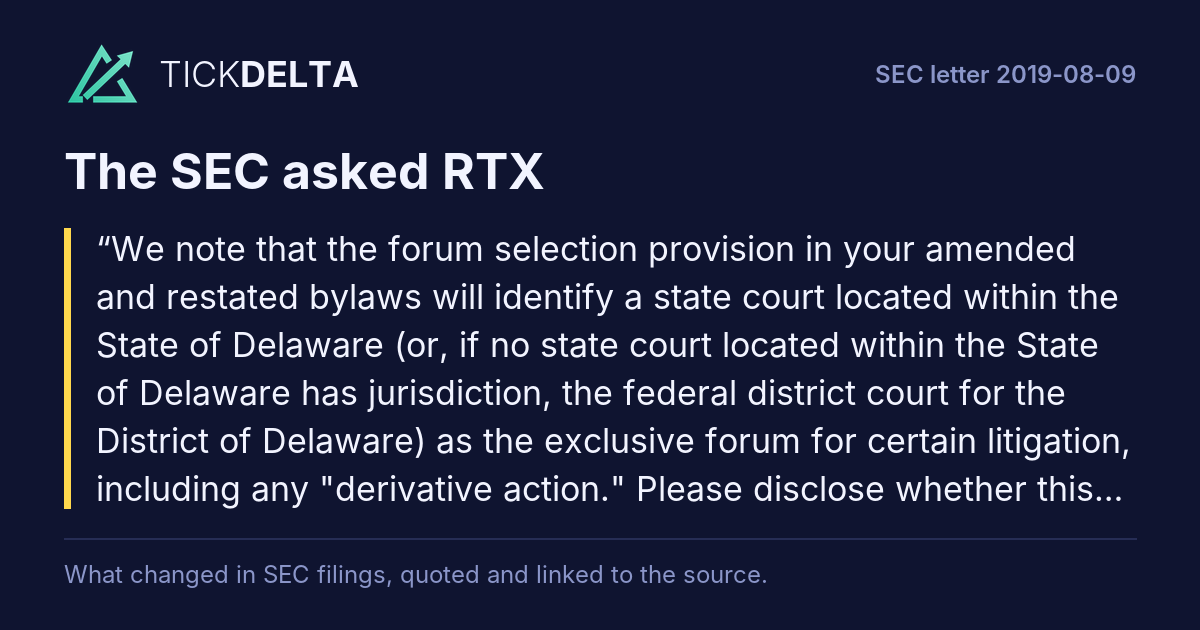
We note that the forum selection provision in your amended and restated bylaws will identify a state court located within the State of Delaware (or, if no state court located within the State of Delaware has jurisdiction, the federal district court for the District of Delaware) as the exclusive forum for certain litigation, including any "derivative action." Please disclose whether this provision applies to actions
Rest of the question

arising under the Securities Act or Exchange Act. If so, please also provide risk factor disclosure describing any risks to investors, and state that there is uncertainty as to whether a court would enforce such provision. If the provision applies to Securities Act claims, please also state that investors cannot waive compliance with the federal securities laws and the rules and regulations thereunder. In that regard, we note that Section 22 of the Securities Act creates concurrent jurisdiction for federal and state courts over all suits brought to enforce any duty or liability created by the Securities Act or the rules and regulations thereunder.

RTX answered

No reply letter found.

Amended Form S-4 Filed August 15, 2019 · Certain Projected Synergies, page 117
SEC asked
Please revise to explain the difference between gross and net synergies.
RTX answered
In response to the Staff’s comment, we have revised the disclosure on page 118 of Amendment No. 2. Read in the reply ↗

Also in this review: company letter, 2019-09-05

Form 10-K

2018-09-12 to 2018-10-09 · 1 question · 1 letter from the SEC, 1 from the company
Review closed 2018-10-09
RevenueClimate
Note 2 - Revenue Recognition, page 9
SEC asked
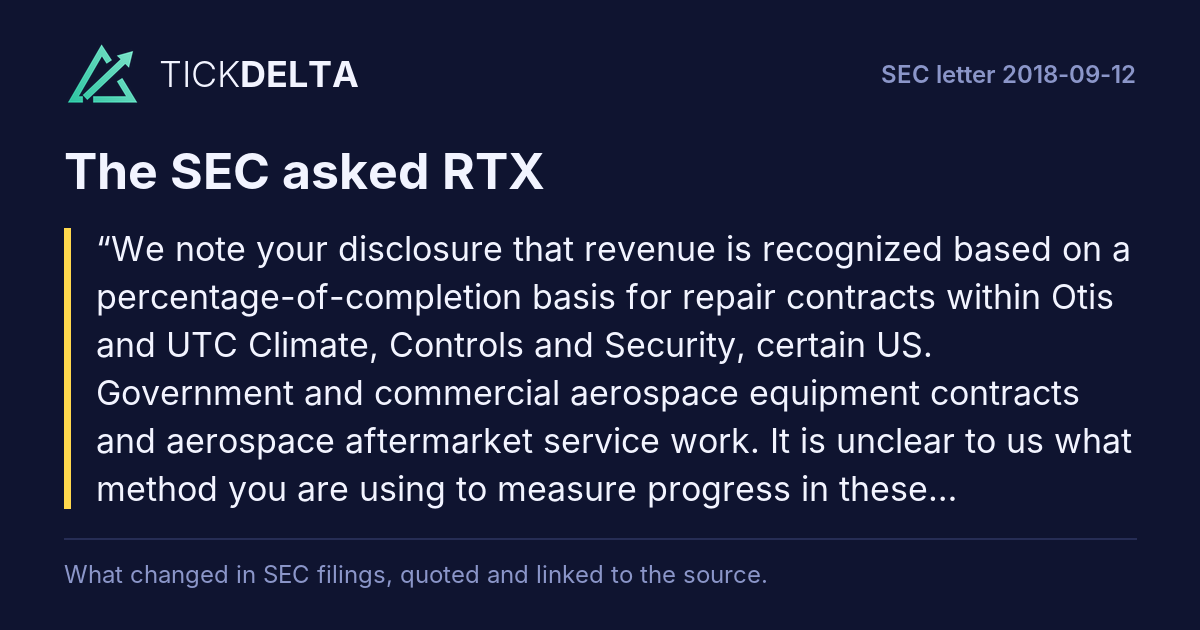
We note your disclosure that revenue is recognized based on a percentage-of-completion basis for repair contracts within Otis and UTC Climate, Controls and Security, certain US. Government and commercial aerospace equipment contracts and aerospace aftermarket service work.
Rest of the question

It is unclear to us what method you are using to measure progress in these arrangements and how this disclosure reconciles to other statements you have made regarding over-time revenue recognition. Reference ASC 606-10-55-16 and ASC 606-1050-18.

RTX answered
We recognize revenue for repair contracts at Otis and UTC Climate, Controls and Security, certain U.S. Government and commercial aerospace equipment contracts, and aerospace aftermarket service work on an over-time basis. For these contracts, we use an input method of revenue recognition where revenue is recognized using costs incurred to date relative to total estimated costs at completion.
Rest of the answer

Incurred costs represent work performed, which corresponds with and best depicts the transfer of control to the customer.

An over-time revenue recognition model is used for repair contracts at Otis and UTC Climate, Controls and Security because the customer simultaneously receives and consumes the benefits of repair services as we perform those services. An over-time revenue recognition model is used for certain U.S. Government aerospace equipment contracts and aerospace aftermarket service work because our performance creates or enhances an asset that is controlled by the customer. We apply an over-time revenue recognition model to certain commercial aerospace equipment contracts because the product being produced for the customer has no alternative use and we have contractual right to payment.

In future filings, we will clarify our disclosure for these revenue streams in which performance obligations are satisfied over-time to include the method used to recognize revenue and explain why the method used provides a faithful depiction of the transfer of goods and services. Our future disclosures regarding our adoption of ASU 2014-09 and its related amendments will include the following:

The New Revenue Standard changed the revenue recognition practices for a number of revenue streams across our businesses, although the most significant impacts are concentrated in our aerospace units. Several of our businesses, which previously accounted for revenue on a point in time basis are now required to use an over-time revenue recognition model when their contracts meet one or more of the mandatory criteria established in the New Revenue Standard. Revenue is now recognized on an over-time basis using an input method for repair contracts within Otis and UTC Climate, Controls & Security; certain U.S. Government and commercial aerospace equipment contracts; and aerospace aftermarket service work. We measure progress toward completion for these contracts using costs incurred to date relative to total estimated costs at completion. Incurred costs represent work performed, which corresponds with and best depicts the transfer of control to the customer. For these businesses, unrecognized sales related to the satisfied portion of the performance obligations of contracts in process as of the date of adoption of the New Revenue Standard of approximately $220 million were recorded through retained earnings. The ongoing effect on our reported revenues of recognizing revenue on an over-time basis within these businesses is not expected to be materially different than the previous revenue recognition method.

Read in the reply ↗
In its next report

First report after the company's reply of 2018-09-19: 10-Q filed 2018-10-26 ↗, against the 10-Q filed 2018-07-27 ↗.

Tickdelta does not hold the text of both reports, so they are not compared here.

Also in this review: closing letter, 2018-10-09

Form S-4

2017-11-06 to 2017-11-06 · 8 questions · 1 letter from the SEC, 0 from the company
No closing letter
Results discussion (MD&A)Income taxes
SEC letter of 2017-11-06 ↗ no reply letter on EDGAR (the company may have answered in an amended filing)
Summary, page 12 · Interests of Rockwell Collins’ Directors and Executive Officers in the Merger, page 18
SEC asked (1)
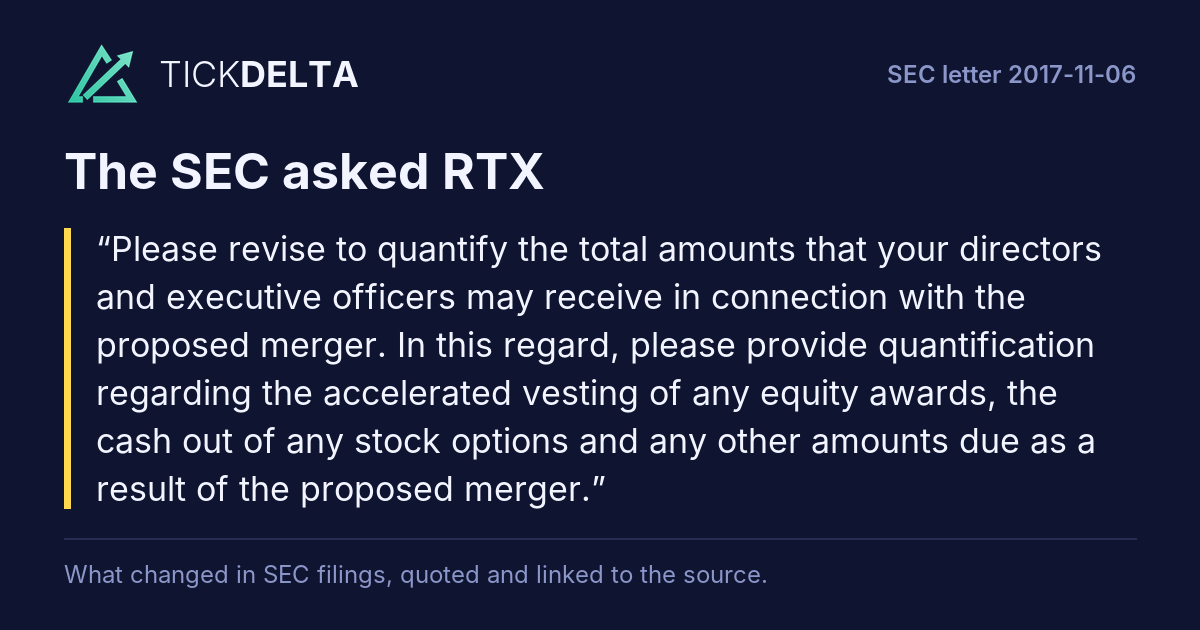
Please revise to quantify the total amounts that your directors and executive officers may receive in connection with the proposed merger. In this regard, please provide quantification regarding the accelerated vesting of any equity awards, the cash out of any stock options and any other amounts due as a result of the proposed merger.
RTX answered

No reply letter found.

Background of the Merger, page 50
SEC asked (2)
We note your disclosure that on June 6, 2017, UTC presented a proposed strategic partnership, which included a premium to Rockwell Collins shareowners when the partnership was formed. Please revise to discuss the proposed strategic partnership in greater detail, as well as the Rockwell Collins Board’s concerns about the proposed strategic partnership, or advise.
Rest of the question

To the extent a specific premium was proposed by UTC, please revise to clarify such premium.

RTX answered

No reply letter found.

Background of the Merger, page 50
SEC asked (3)
We note your disclosure on August 17, 2017 that Company B contacted Rockwell Collins to suggest that the parties evaluate a possible investment in Rockwell Collins by Company B. Please revise to discuss the potential investment in greater detail or advise. Please also revise to discuss in greater detail why Rockwell Collins was not interested in pursuing this potential investment.
RTX answered

No reply letter found.

Opinions of Rockwell Collins’ Financial Advisors, page 64
SEC asked (4)
Please provide us with copies of the board books and any other materials prepared by your financial advisors.
RTX answered

No reply letter found.

Certain Rockwell Collins Unaudited Prospective Financial Information, page 77
SEC asked (5)
Please revise this section to describe the key assumptions relied upon by Rockwell Collins’ management in the preparation of the unaudited financial forecasts so that recipients of the proxy statement/prospectus can have a better understanding of the basis for and limitations of the forecasts.
RTX answered

No reply letter found.

Interests of Directors and Executive Officers of Rockwell Collins in the Merger, page 81 · Treatment of DSU Awards, page 83
SEC asked (6)
To the extent quantifiable, please revise to add a table to disclose the value of the awards for each executive officer.
RTX answered

No reply letter found.

U.S. Federal Income Tax Consequences, page 91
SEC asked (7)
Please refer to the first paragraph and your disclosure that this is a “general discussion.” Please remove such disclaimer and revise to clarify that the disclosure in this section addresses the material U.S. federal income tax consequences of the proposed merger. Refer to Item 4(a)(6) of Form S-4. Please also revise the proxy statement/prospectus throughout as applicable.
RTX answered

No reply letter found.

Exhibit 99.1
SEC asked (8)
Please mark your form of proxy “Preliminary Copy.” Refer to Rule 14a-6(e)(1) of the Securities Exchange Act of 1934.
RTX answered

No reply letter found.

5 other letters: notices that a filing will not be reviewed, requests to declare a registration effective, and the like

From the SEC's correspondence on EDGAR: staff letters (form UPLOAD) and company letters (form CORRESP), 19 letters filed since 2017-11-06. Questions and answers are matched by their numbers; topics come from words in each question. The reports are compared word for word (same form, before the first SEC letter against the first report after the company's reply). No AI.

Work on RTX in a spreadsheet: Excel workbook (a sheet per section, ten years by column, charts, links to the filings) · CSV. For a Google Sheet that stays up to date, paste =IMPORTDATA("https://tickdelta.com/company/RTX/export.csv") into a cell.