Form 10-K
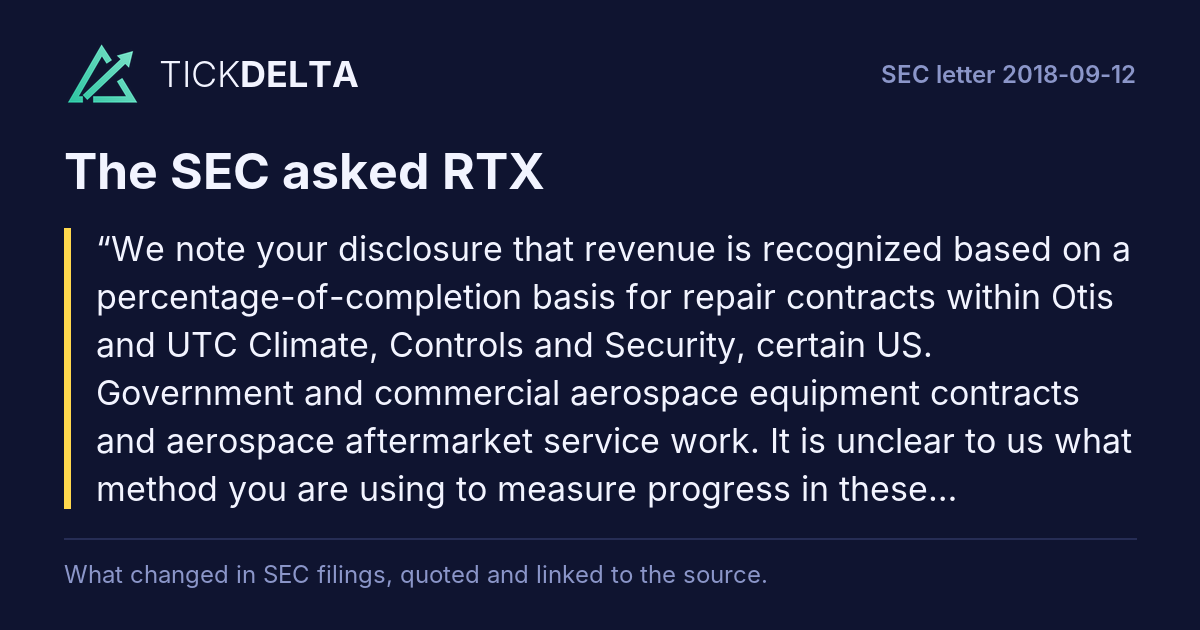
We note your disclosure that revenue is recognized based on a percentage-of-completion basis for repair contracts within Otis and UTC Climate, Controls and Security, certain US. Government and commercial aerospace equipment contracts and aerospace aftermarket service work.Rest of the question
It is unclear to us what method you are using to measure progress in these arrangements and how this disclosure reconciles to other statements you have made regarding over-time revenue recognition. Reference ASC 606-10-55-16 and ASC 606-1050-18.
We recognize revenue for repair contracts at Otis and UTC Climate, Controls and Security, certain U.S. Government and commercial aerospace equipment contracts, and aerospace aftermarket service work on an over-time basis. For these contracts, we use an input method of revenue recognition where revenue is recognized using costs incurred to date relative to total estimated costs at completion.Read in the reply ↗Rest of the answer
Incurred costs represent work performed, which corresponds with and best depicts the transfer of control to the customer.
An over-time revenue recognition model is used for repair contracts at Otis and UTC Climate, Controls and Security because the customer simultaneously receives and consumes the benefits of repair services as we perform those services. An over-time revenue recognition model is used for certain U.S. Government aerospace equipment contracts and aerospace aftermarket service work because our performance creates or enhances an asset that is controlled by the customer. We apply an over-time revenue recognition model to certain commercial aerospace equipment contracts because the product being produced for the customer has no alternative use and we have contractual right to payment.
In future filings, we will clarify our disclosure for these revenue streams in which performance obligations are satisfied over-time to include the method used to recognize revenue and explain why the method used provides a faithful depiction of the transfer of goods and services. Our future disclosures regarding our adoption of ASU 2014-09 and its related amendments will include the following:
The New Revenue Standard changed the revenue recognition practices for a number of revenue streams across our businesses, although the most significant impacts are concentrated in our aerospace units. Several of our businesses, which previously accounted for revenue on a point in time basis are now required to use an over-time revenue recognition model when their contracts meet one or more of the mandatory criteria established in the New Revenue Standard. Revenue is now recognized on an over-time basis using an input method for repair contracts within Otis and UTC Climate, Controls & Security; certain U.S. Government and commercial aerospace equipment contracts; and aerospace aftermarket service work. We measure progress toward completion for these contracts using costs incurred to date relative to total estimated costs at completion. Incurred costs represent work performed, which corresponds with and best depicts the transfer of control to the customer. For these businesses, unrecognized sales related to the satisfied portion of the performance obligations of contracts in process as of the date of adoption of the New Revenue Standard of approximately $220 million were recorded through retained earnings. The ongoing effect on our reported revenues of recognizing revenue on an over-time basis within these businesses is not expected to be materially different than the previous revenue recognition method.
First report after the company's reply of 2018-09-19: 10-Q filed 2018-10-26 ↗, against the 10-Q filed 2018-07-27 ↗.
Tickdelta does not hold the text of both reports, so they are not compared here.
Also in this review: closing letter, 2018-10-09