Screener / SEC EDGAR /CIK 0001469367 /10-K filed Feb 26, 2026, compared with Feb 27, 2025 /Numbers from the XBRL of the 10-Ks
Nasdaq Industrials · Construction - Special Trade Contractors

Sunrun Inc. RUN

Compare with peers Embed
New in the 10-K 21 paragraphs with nothing like them in the 10-K filed Feb 27, 2025 New in the 10-Q 7 paragraphs not in the 10-Q filed Aug 5, 2026 10-Q against the 10-K 68 risk factor paragraphs and sentences added or reworded

New risk paragraphs, branching off last year

Each branch is a paragraph in Risk Factors with nothing like it in the 10-K filed Feb 27, 2025. A box jumps to the paragraph as filed, below.

21 new

Paragraphs with nothing like them in last year's 10-K

Quoted exactly

21 paragraphs in Risk Factors of the 10-K filed Feb 26, 2026 with nothing like them in the 10-K filed Feb 27, 2025. Quoted exactly. Paragraphs that were only edited are under 10-K change.

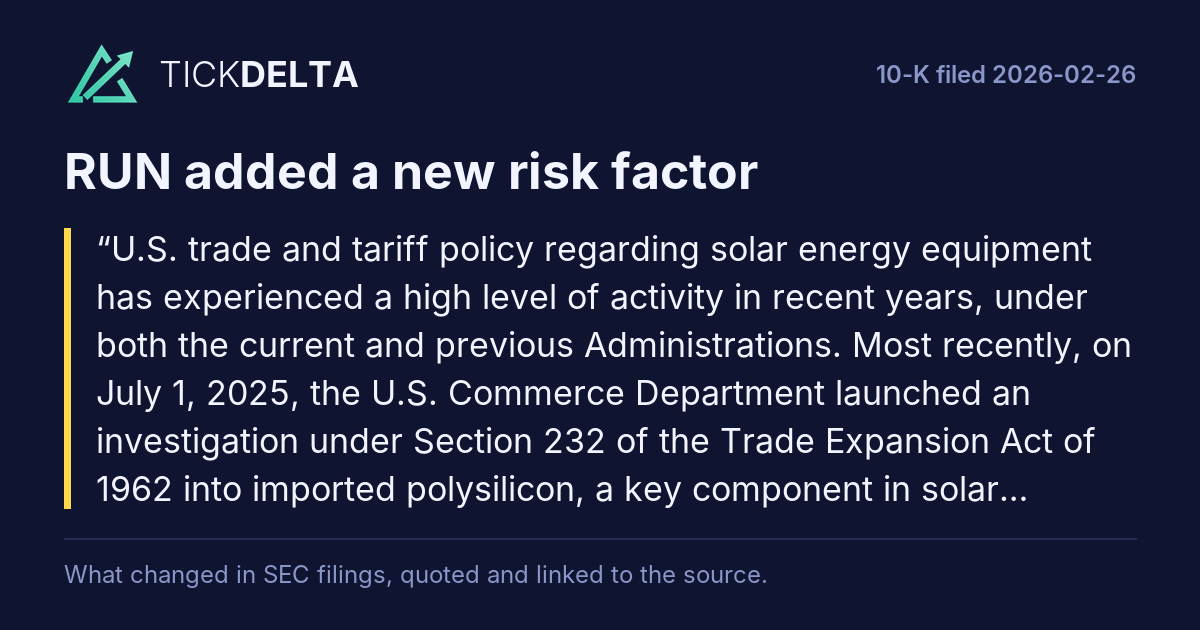
U.S. trade and tariff policy regarding solar energy equipment has experienced a high level of activity in recent years, under both the current and previous Administrations. Most recently, on July 1, 2025, the U.S. Commerce Department launched an investigation under Section 232 of the Trade Expansion Act of 1962 into imported polysilicon, a key component in solar panels. A decision is expected in 2026. If the investigation finds that imported polysilicon poses a national security threat to the United States, the Administration could impose new tariffs on those imports, potentially increasing the price of some of the equipment we procure.

In addition, on April 21, 2025, the U.S. Commerce Department issued final anti-dumping (“AD”) and countervailing duty (“CVD”) rates on crystalline solar cells and modules imported from Vietnam, Malaysia, Thailand and Cambodia. These countries have supplied the majority of imported solar cells and modules to the United States in recent years, and now face new country-wide final AD or CVD tariff rates ranging from 1.92% to 534.67%. The Commerce Department also imposed new tariffs on individual cell and module manufacturers in those countries. The imposition of tariffs generally has an inflationary effect on module prices for solar energy equipment installers, including us.

Read in the 10-K

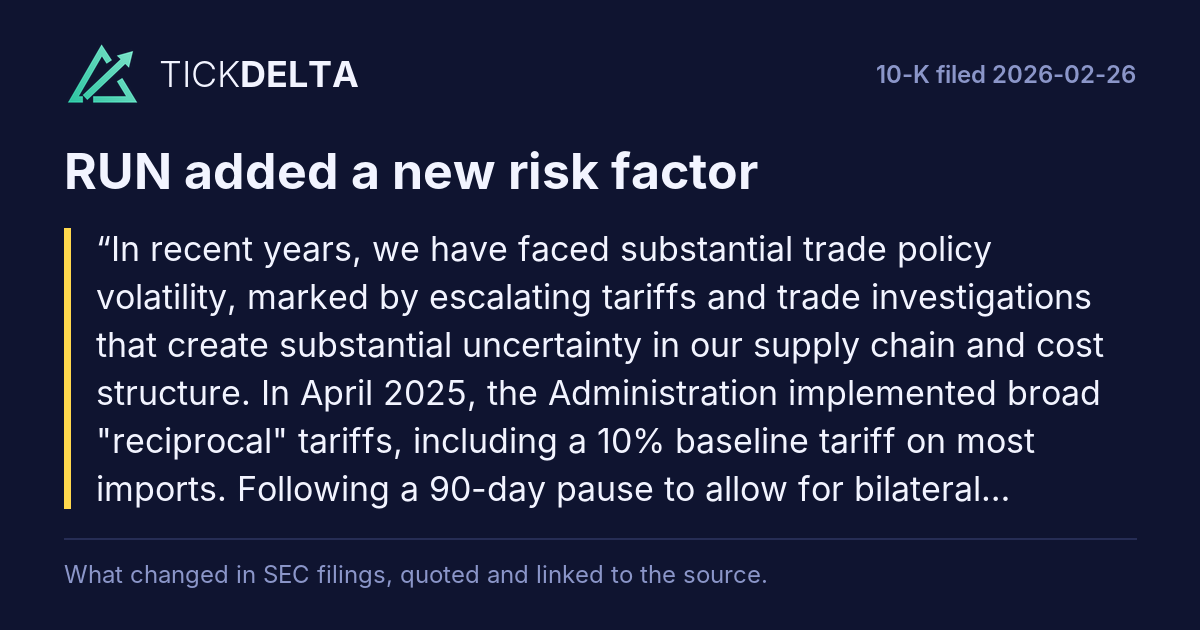
In recent years, we have faced substantial trade policy volatility, marked by escalating tariffs and trade investigations that create substantial uncertainty in our supply chain and cost structure. In April 2025, the Administration implemented broad "reciprocal" tariffs, including a 10% baseline tariff on most imports. Following a 90-day pause to allow for bilateral negotiations, country-specific reciprocal tariffs took effect on August 7, 2025, with rates now ranging from 10% to 50% depending on the country of origin. Existing tariffs on steel, copper and aluminum were notably already increased to 50% for most countries, with specific exemptions for the UK. On February 20, 2026, the U.S. Supreme Court held that the International Emergency Economic Powers Act does not authorize the President to impose tariffs, invalidating some but not all of the recently imposed tariffs. The Trump Administration responded by announcing new tariffs pursuant to another statute, but significant uncertainty remains regarding the legality and effect of such tariffs. In response to such U.S. tariffs, some foreign governments have threatened or instituted retaliatory tariffs on certain U.S. goods and have indicated a willingness to impose additional

tariffs on U.S. products, which could increase tensions and create greater uncertainty and instability in our business dealings and negatively affect our business operations. The legal standing of some reciprocal tariffs is currently under federal court review, though these rulings are stayed pending appeal, meaning the announced tariffs remain in effect.

The trade relationship with China has seen particularly aggressive and fluctuating tariff escalations. While final tariff rates have yet to be determined, other pre-existing U.S. tariffs on Chinese goods generally persist, can change more frequently than previously, and are additive. For example, the current U.S. presidential administration has announced a formal investigation process to consider new national security-based tariffs on imports of semiconductors and semiconductor manufacturing equipment, which are necessary components of our solar panels. The highly fluid situation with China is potentially subject to further changes as this 90-day pause period concludes and with the ongoing sector-specific investigations into polysilicon and semiconductors.

These developments compound existing trade measures, including the previously discussed AD/CVD tariffs on solar cells and modules and the 50% Section 232 tariffs on steel and aluminum. The cumulative effect impacts both our direct equipment procurement costs and the expenses faced by our U.S.-based component suppliers, whose manufacturing inputs are subject to these tariffs.

The unpredictable nature of these policy changes, including their scale, scope, and implementation timeline, creates significant challenges for cost forecasting and supply chain management. While we are actively collaborating with suppliers to establish alternative, less impacted supply chains, these transitions require substantial time for development and scaling. We cannot guarantee that these mitigation efforts will fully offset the adverse effects of these tariff increases on our business operations, financial condition, and results of operations

Read in the 10-K

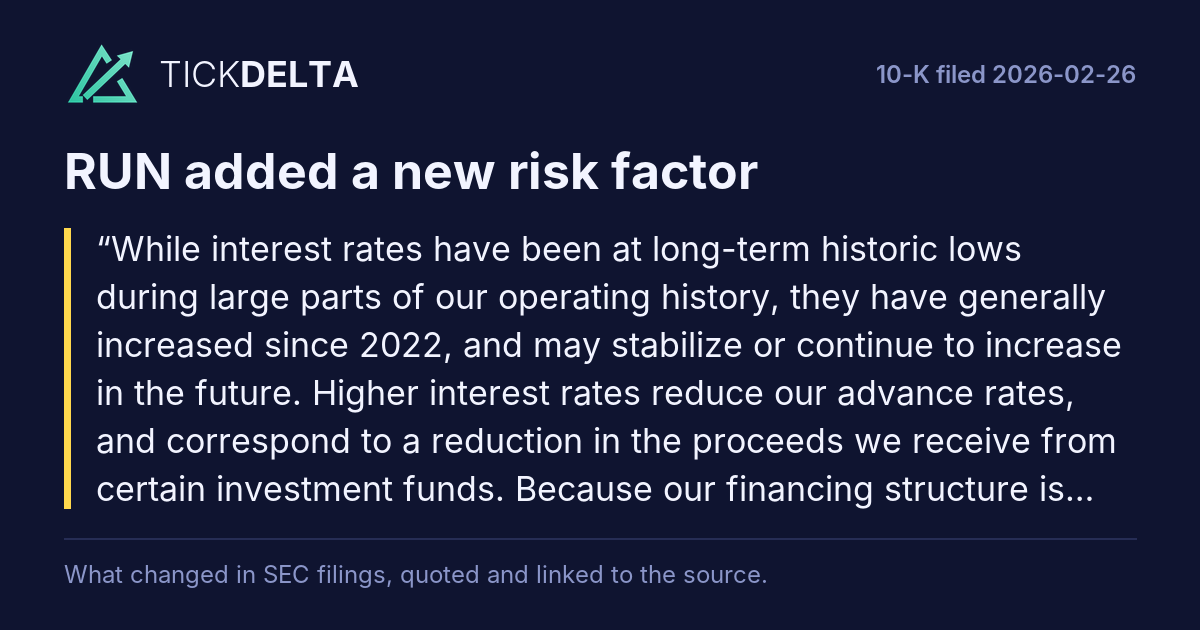
While interest rates have been at long-term historic lows during large parts of our operating history, they have generally increased since 2022, and may stabilize or continue to increase in the future. Higher interest rates reduce our advance rates, and correspond to a reduction in the proceeds we receive from certain investment funds. Because our financing structure is sensitive to volatility in interest rates, higher rates increase our cost of capital and

Read in the 10-K

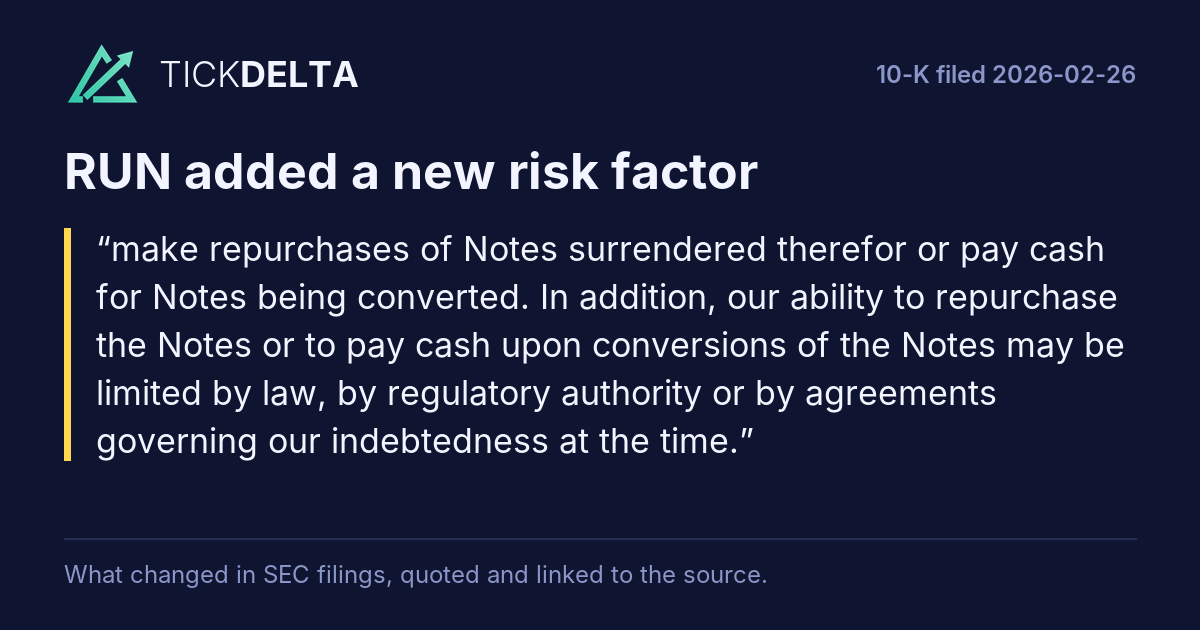
make repurchases of Notes surrendered therefor or pay cash for Notes being converted. In addition, our ability to repurchase the Notes or to pay cash upon conversions of the Notes may be limited by law, by regulatory authority or by agreements governing our indebtedness at the time.

Read in the 10-K

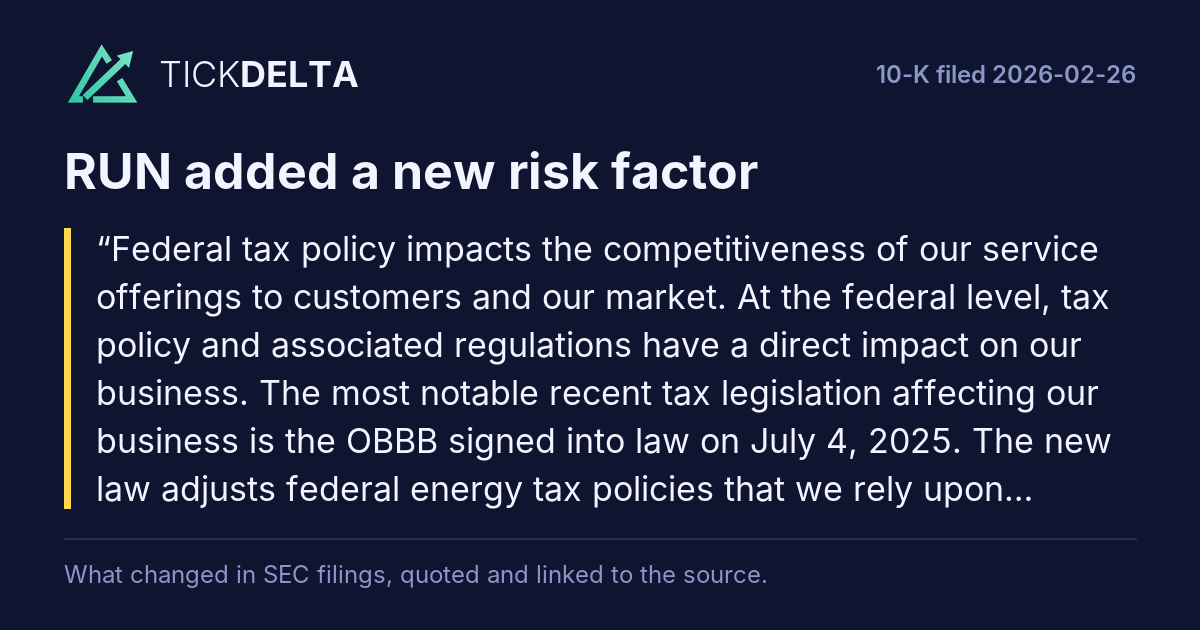
Federal tax policy impacts the competitiveness of our service offerings to customers and our market.

At the federal level, tax policy and associated regulations have a direct impact on our business. The most notable recent tax legislation affecting our business is the OBBB signed into law on July 4, 2025. The new law adjusts federal energy tax policies that we rely upon, including the 48E Clean Electricity Investment Credit and its associated “bonus” credits. For example, while the law maintains the 48E credit for energy storage which begins construction by the end of 2033, it shortens the availability of the 48E credit for solar facilities by requiring construction to begin by July 4, 2026 to maintain the four-year continuity safe-harbor to place a project in service.

Solar facilities which begin construction after July 4, 2026 must be placed in service by the end of 2027. The law also applies new PFE restrictions to the Section 48E credit, which could potentially deny tax credits to entities owned, controlled, or influenced by certain specified foreign entities, and for facilities that use certain components or receive “material assistance” from a PFE, thereby potentially increasing costs, reducing demand or restricting access to tax credits. The law ends the customer-claimed 25D Residential Clean Energy Credit starting in 2026. Changes in the law to the Section 45X Advanced Manufacturing Production Credit could also affect us indirectly, through our suppliers. The implementation of the law through the federal regulatory process could also directly affect our business.

Read in the 10-K
Show the other 5

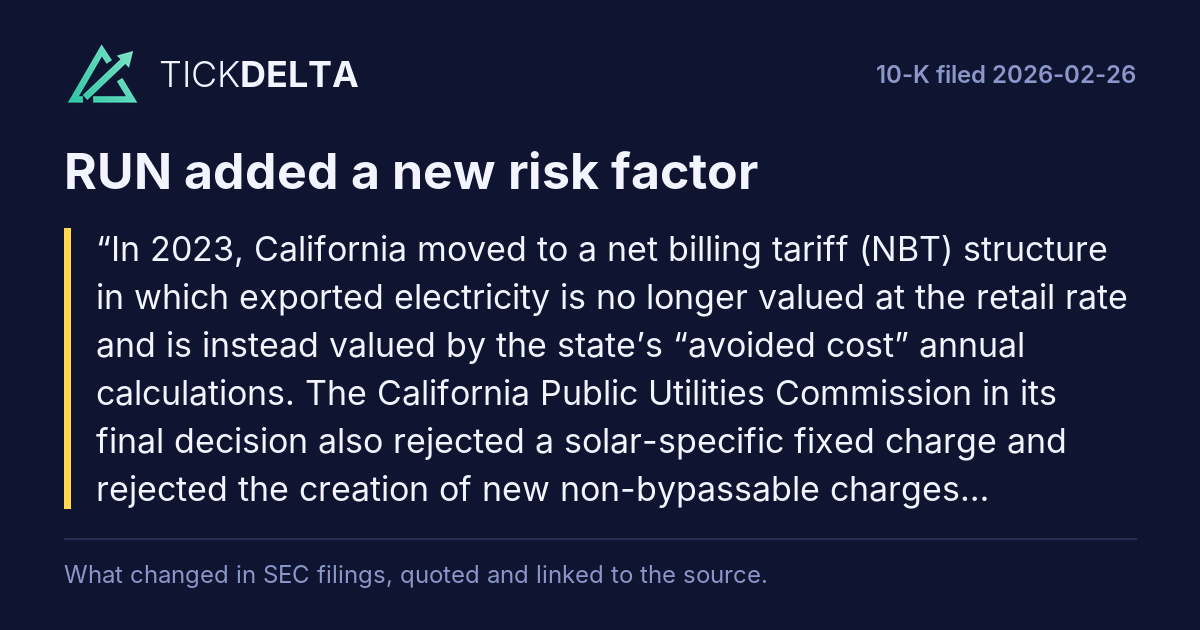
In 2023, California moved to a net billing tariff (NBT) structure in which exported electricity is no longer valued at the retail rate and is instead valued by the state’s “avoided cost” annual calculations. The California Public Utilities Commission in its final decision also rejected a solar-specific fixed charge and rejected the creation of new non-bypassable charges, minimum bills, and grid participation charges for solar and solar plus storage customers.

In 2024 the California Public Utilities Commission (CPUC) approved a fixed charge of $24.15/month for most residential customers, not just solar customers, of the three major investor-owned utility territories, with no change in existing income tiers. The decision added a smaller fixed monthly charge of $6/month and $12/month, respectively, for the two-tiers of existing low-income customers.

Under the new California NBT framework, storage paired with solar has a heightened value proposition to customers. The NBT framework may also result in the introduction of new product offerings and pricing structures by our competitors throughout the solar and utilities industries. This may also result in increased competition and uncertainty regarding the demand for such new products and offerings, which may adversely impact our business and results of operations. Existing customers utilizing net metering under NEM1 or NEM2 billing regimes have been routinely protected. Most recently in 2025, legislation was introduced (AB942) which would have retroactively impacted existing customers’ rights to legacy net metering tariffs. However, the California legislature removed the substantive provisions of the bill and it was held in committee in 2025.

Read in the 10-K

may impact our ability to engage with new customers and expand our relationships with existing customers. If our customers are materially negatively impacted by these factors, our business could be negatively impacted.

Read in the 10-K

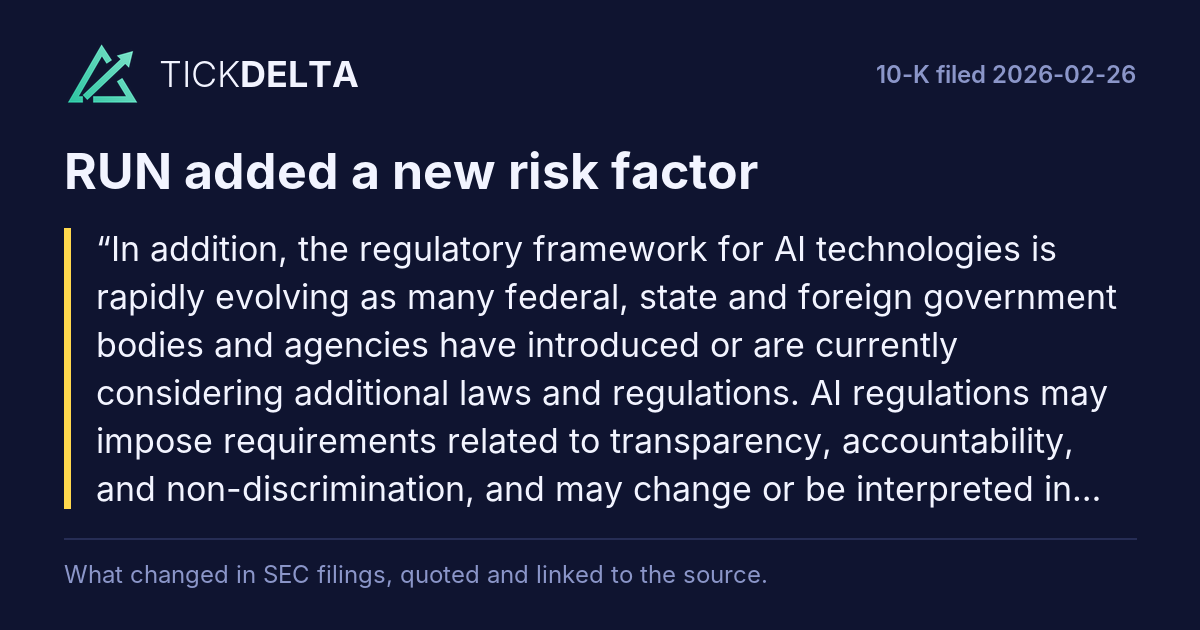
In addition, the regulatory framework for AI technologies is rapidly evolving as many federal, state and foreign government bodies and agencies have introduced or are currently considering additional laws and regulations. AI regulations may impose requirements related to transparency, accountability, and non-discrimination, and may change or be interpreted in ways that could directly affect our business operations. For example, in the United States and Europe, recent and proposed laws regulate the use of automated decision-making and generative AI, and establish requirements for companies that develop, use, or provide AI technologies. These developments create ongoing uncertainty regarding compliance and may require us to adapt our products, services, or practices as regulatory regimes evolve.

It is possible that further new laws and regulations (or interpretations of existing laws and regulations), including around intellectual property, data privacy, competition and antitrust laws, may limit our ability to use AI technologies for our business, or require us to change the way we use AI technologies in a manner that negatively affects the performance of our products, services and business. Compliance with these laws and regulations may require significant resources and increase our operating expenses, and any actual or perceived failure to comply could adversely affect our business, financial condition, results of operations, or competitive position.

Read in the 10-K

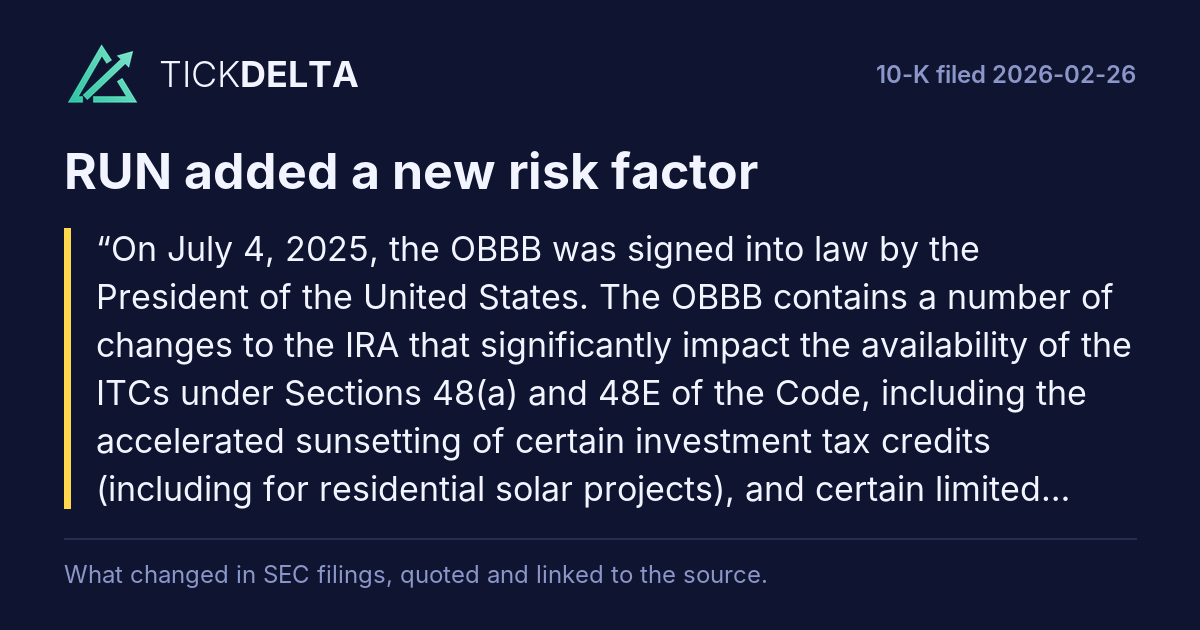
On July 4, 2025, the OBBB was signed into law by the President of the United States. The OBBB contains a number of changes to the IRA that significantly impact the availability of the ITCs under Sections 48(a) and 48E of the Code, including the accelerated sunsetting of certain investment tax credits (including for residential solar projects), and certain limited restrictions on their transferability to third-parties for sale. In particular, ITCs for solar projects under Section 48E are terminated if they do not begin construction by July 4, 2026 unless such projects are placed in service by December 31, 2027. The OBBB also introduces significant restrictions beginning in 2026 around certain PFEs, which will not only impact who can invest in renewable energy projects, but also who can supply components and know-how to develop them. On August 15, 2025, in response to an Executive Order issued by the President of the United States on July 7, 2025, the U.S. Department of Treasury and the IRS issued Notice 2025-42, which provides for beginning of construction rules for wind and solar, revising existing guidance by largely eliminating the long-established 5% safe harbor. However, the 5% safe harbor continues to apply to solar facilities having a maximum output of 1.5 megawatts or less. Therefore, our existing safe harbor strategies should not be

impacted by such guidance. However, Notice 2025-42 did not respond to the portion of the Executive Order regarding beginning of construction for purposes of the new restrictions regarding PFEs and indicated additional guidance is forthcoming. On February 12, 2026, the U.S. Department of Treasury and the IRS issued Notice 2026-15, which provides interim guidance, including regarding safe harbors for purposes of determining a taxpayer’s material assistance from a PFE. The U.S. Department of Treasury and the IRS have indicated that they intend to issue more comprehensive proposed regulations and other guidance with respect to the definitions of a PFE and material assistance from a PFE. We cannot predict with certainty what such guidance, or any other future guidance, will say, or how it will impact our existing safe harboring strategies. We routinely monetize investment tax credits and such monetization is a key component in our financing of solar projects. Obtaining tax equity funding (and tax equity funding on advantageous terms) may become more challenging as a result of the OBBB. Additionally, the benefits of the ITC have historically enhanced our ability to provide competitive pricing for customers. Accordingly, the OBBB could slow our growth and adversely impact our financial results and operational metrics.

Read in the 10-K

Now or in the future, routine IRS audits may subject us to indemnity obligations to investors, and may result in certain limited out-of-pocket costs and potential increased insurance premiums in the future.

Read in the 10-K

Paragraphs in the 10-Q filed Nov 4, 2026 that were not in the one before

New in the latest 10-Q

7 paragraphs in the 10-Q filed Nov 4, 2026 with nothing like them in the 10-Q filed Aug 5, 2026 (at least half the words must differ; new numbers alone do not count). Quoted exactly, grouped by the item heading above them. This is text that changed, not a judgement of how serious it is.

Risk Factors

U.S. trade and tariff policy regarding solar energy equipment has experienced a high level of activity in recent years, under both the current and previous Administrations. On July 1, 2025, the U.S. Commerce Department launched an investigation under Section 232 of the Trade Expansion Act of 1962 into imported polysilicon, a key component in solar panels. Following a year-long investigation, President Trump signed Proclamation 11052 on August 6, 2026, establishing minimum import prices for polysilicon and certain derivative products, along with a 15% tariff on polysilicon derivatives such as wafers, cells, and modules (with rates varying for some trading partners), both effective December 4, 2026. To discourage stockpiling ahead of that date, the Bureau of Industry and Security issued a temporary final rule, effective September 22, 2026, which sets weekly import limits for importers registered on or after August 6, 2026, and allows the U.S. Commerce Department to prohibit further entries by existing importers whose import volumes are substantially greater than their historical averages. Such measures may raise the price of imported solar equipment, which may in turn increase the cost of the equipment we procure. Any increases in the costs of the equipment we procure could have a negative impact on our financial results and adversely impact our business.

Read in the 10-Q

to applicable laws or regulations, including U.S. economic sanctions restrictions on payments to designated persons or jurisdictions.

Read in the 10-Q

(e.g., investigations, fines, penalties, audits, inspections), litigation (including class-action claims), mass arbitration claims, additional reporting requirements and/or oversight, bans on processing personal data, and orders to destroy or not use personal data.

Read in the 10-Q

We depend significantly on our brand and reputation for high-quality solar service offerings, engineering and customer service to attract customers and grow our business. If we fail to continue to deliver our solar service offerings within the planned timelines, if our solar service offerings do not perform as anticipated or if we damage

Read in the 10-Q

certain business practices, significant dedication of management time, diversion of significant operational resources, or otherwise harm our business.

Read in the 10-Q
Show the other 2

indemnify tax equity partners for disallowed ITCs, adjust the terms of future tax equity partnerships, or seek alternative sources of funding for solar energy projects, each of which could have a material adverse effect on our business, financial condition, results of operations and prospects.

Read in the 10-Q

other tax assets could adversely impact our business, financial condition, and results of operations. We have performed an analysis to determine whether an ownership change under Section 382 of the Code had occurred and determined no ownership changes were identified as of December 31, 2025.

Read in the 10-Q

The 10-Q's risk factors against the 10-K

Item 1A of the 10-Q filed Nov 4, 2026 against Item 1A of the 10-K filed Feb 26, 2026. A 10-Q repeats only the risks that changed, so a 10-K paragraph that is missing from it is not counted as removed. Added is a paragraph with nothing like it in the 10-K, Reworded a sentence that is in both with several words changed, Quiet changes a sentence in both where one to four words changed and one is a hedge or a modal (cut words struck through, new words highlighted). Text on the page, not a score; each links to the filing at sec.gov.

Added10-Q Nov 4, 2026 vs 10-K Feb 26, 2026
U.S. trade and tariff policy regarding solar energy equipment has experienced a high level of activity in recent years, under both the current and previous Administrations. On July 1, 2025, the U.S. Commerce Department launched an investigation under Section 232 of the Trade Expansion Act of 1962 into imported polysilicon, a key component in solar panels. Following a year-long investigation, President Trump signed Proclamation 11052 on August 6, 2026, establishing minimum import prices for polysilicon and certain derivative products, along with a 15% tariff on polysilicon derivatives such as wafers, cells, and modules (with rates varying for some trading partners), both effective December 4, 2026. To discourage stockpiling ahead of that date, the Bureau of Industry and Security issued a temporary final rule, effective September 22, 2026, which sets weekly import limits for importers registered on or after August 6, 2026, and allows the U.S. Commerce Department to prohibit further entries by existing importers whose import volumes are substantially greater than their historical averages. Such measures may raise the price of imported solar equipment, which may in turn increase the cost of the equipment we procure. Any increases in the costs of the equipment we procure could have a negative impact on our financial results and adversely impact our business.

Read it in the 10-Q at sec.gov

Added10-Q Nov 4, 2026 vs 10-K Feb 26, 2026
increases in originations, our new installations in California may continue to decline compared to prior periods, which could have a material adverse effect on our business operations and financial performance.

Read it in the 10-Q at sec.gov

Added10-Q Nov 4, 2026 vs 10-K Feb 26, 2026
The threat landscape we face includes, among others: malware and advanced persistent threats; ransomware; social engineering, phishing, and deepfake-enabled impersonation; denial-of-service, credential stuffing, and credential harvesting attacks; supply-chain compromise; software and hardware vulnerabilities; insider misconduct or error; and attacks enhanced or enabled by artificial intelligence. Our distributed workforce, contractors, and third-party service providers expand the set of devices, identities, and access points that must be secured. Severe ransomware attacks in particular can cause significant operational disruption, data loss, and financial harm; extortion payments may mitigate these effects, but we may be unwilling or unable to make them due

Read it in the 10-Q at sec.gov

Added10-Q Nov 4, 2026 vs 10-K Feb 26, 2026
to applicable laws or regulations, including U.S. economic sanctions restrictions on payments to designated persons or jurisdictions.

Read it in the 10-Q at sec.gov

Added10-Q Nov 4, 2026 vs 10-K Feb 26, 2026
We maintain a cybersecurity program designed to prevent, detect, and respond to these threats, including controls such as identity-based access management, endpoint security, network segmentation, and vulnerability management, together with a cross-functional incident response process that includes a defined escalation path and a materiality assessment protocol for evaluating disclosure obligations. We also maintain cybersecurity insurance. No program, however, can prevent all incidents. Security measures may fail or be circumvented; vulnerabilities may not be detected or remediated on a timely basis; and patch and remediation efforts may be delayed. Our ability to monitor the security practices of third parties is inherently limited, and a security incident, operational failure, or service disruption affecting a concentrated or difficult-to-substitute provider, including cloud infrastructure, identity, or collaboration platforms, could affect our operations even where the provider is in compliance with its obligations to us. Cybersecurity insurance coverage is subject to material limitations, including sub-limits for ransomware and extortion events, co-insurance requirements, exclusions for acts of war, hostile acts, or state-sponsored activity, and substantial retentions. While we generally seek to include limitations of liability, indemnification provisions, and data-security obligations in our contracts with customers, vendors, and service providers, we are not always able to negotiate these terms and protections at the scope or cap levels we prefer, and some contracts may omit them entirely. Even where such provisions are in place, they may not be sufficient to protect us from liabilities, damages, or claims, and may be unenforceable in certain jurisdictions.

Read it in the 10-Q at sec.gov

Show the other 20
Added10-Q Nov 4, 2026 vs 10-K Feb 26, 2026
Cybersecurity incidents affecting our grid services operations or distributed energy resource ("DER") fleet could disrupt operations and affect utility partners and customers. We manage a large network of residential energy systems that provide power capacity and other grid services to utilities and grid operators through software platforms, communications networks, equipment controls, and data connections with third parties. These systems include internet-connected inverters, batteries, and metering devices deployed in customer homes, which operate on longer lifecycles than typical enterprise IT and present distinct cybersecurity considerations, including firmware integrity and the need to maintain security over the operational life of the deployed fleet. A cyberattack, system failure, or communications outage could limit our ability to operate these systems, reduce availability during critical grid events, affect data accuracy, or damage equipment, potentially impacting customers, counterparties, and local grid reliability and leading to contractual disputes, regulatory action, or loss of program participation. Cybersecurity requirements for these services continue to evolve at the federal and state levels, which could increase costs, require operational changes, or restrict participation in certain markets.

Read it in the 10-Q at sec.gov

Added10-Q Nov 4, 2026 vs 10-K Feb 26, 2026
A security incident could result in unauthorized access to or disclosure, modification, destruction, or encryption of our sensitive information or systems, or those of third parties with whom we work, and could disrupt our ability to provide services. Applicable data privacy and security obligations may require us to notify affected individuals, customers, regulators, or investors of such incidents. Materiality determinations for disclosure purposes must often be made on short timelines and under conditions of incomplete information, and inaccurate or delayed determinations, or conflicts between SEC disclosure timing and law enforcement delay requests, could result in enforcement action, securities litigation, or reputational harm. The consequences of a security incident, or the perception of one, may include operational disruption, financial loss, regulatory enforcement, litigation and indemnification exposure, and reputational harm that impairs customer acquisition and retention.

Read it in the 10-Q at sec.gov

Added10-Q Nov 4, 2026 vs 10-K Feb 26, 2026
Our employees and personnel use generative artificial intelligence (“AI”) technologies, and the use of these tools may involve personal data and other information subject to privacy laws, contractual obligations, and evolving regulatory requirements. Governments have adopted, and may continue to adopt, additional laws governing AI, which could increase compliance costs, lead to regulatory inquiries, enforcement actions, or litigation, and require changes to how we deploy or use these technologies. We have implemented policies and procedures governing employee, contractor, and service provider use of AI tools, including data submission restrictions and review processes for certain AI-enabled products and services. However, these controls may not prevent all unauthorized, inaccurate, or non-compliant use, and their effectiveness depends on continued training, monitoring, and adaptation as AI technologies and related regulations evolve. If we are unable to use AI effectively, our operations could become less efficient and thereby negatively impact our business, financial condition, results of operations, or competitive position.

Read it in the 10-Q at sec.gov

Added10-Q Nov 4, 2026 vs 10-K Feb 26, 2026
(e.g., investigations, fines, penalties, audits, inspections), litigation (including class-action claims), mass arbitration claims, additional reporting requirements and/or oversight, bans on processing personal data, and orders to destroy or not use personal data.

Read it in the 10-Q at sec.gov

Added10-Q Nov 4, 2026 vs 10-K Feb 26, 2026
We depend significantly on our brand and reputation for high-quality solar service offerings, engineering and customer service to attract customers and grow our business. If we fail to continue to deliver our solar service offerings within the planned timelines, if our solar service offerings do not perform as anticipated or if we damage

Read it in the 10-Q at sec.gov

Added10-Q Nov 4, 2026 vs 10-K Feb 26, 2026
certain business practices, significant dedication of management time, diversion of significant operational resources, or otherwise harm our business.

Read it in the 10-Q at sec.gov

Added10-Q Nov 4, 2026 vs 10-K Feb 26, 2026
other tax assets could adversely impact our business, financial condition, and results of operations. We have performed an analysis to determine whether an ownership change under Section 382 of the Code had occurred and determined no ownership changes were identified as of December 31, 2025.

Read it in the 10-Q at sec.gov

Reworded10-Q Nov 4, 2026 vs 10-K Feb 26, 2026
The Option Counterparties or their respective affiliates may modify their hedge positions by entering into or unwinding various derivatives with respect to our common stock and/or purchasing or selling our common stock or other securities of ours in secondary market transactions prior to the maturity of the Notes (and are likely to do so during the observation period for conversions of Notes following December 1, 2029 for the 2030 Notes or following any repurchase of Notes by us).

Read it in the 10-Q at sec.govThe 10-K sentence

Reworded10-Q Nov 4, 2026 vs 10-K Feb 26, 2026
For example, in January 2026, the current U.S. presidential administration has announced imposed a formal investigation process to consider new 25% Section 232 tariff on a narrow category of advanced semiconductors and indicated that broader national security-based tariffs on imports of semiconductors and semiconductor manufacturing equipment, which are necessary components of our solar panels. panels, could follow depending on the outcome of ongoing trade negotiations.

Read it in the 10-Q at sec.govThe 10-K sentence

Reworded10-Q Nov 4, 2026 vs 10-K Feb 26, 2026
Such These threats are prevalent prevalent, rising, and continue to rise, are increasingly difficult to detect, and come they originate from a variety wide range of sources, actors, including “hackers,” threat actors, “hacktivists,” hackers, hacktivists, organized criminal threat actors, personnel (such as through groups, insiders (through theft or misuse), sophisticated nation states, and nation-state and nation-state-supported actors.

Read it in the 10-Q at sec.govThe 10-K sentence

Reworded10-Q Nov 4, 2026 vs 10-K Feb 26, 2026
If additional laws and regulations affecting direct sales and marketing are passed in the markets in which we operate, it would take time to train our sales professionals to comply with such laws, and we may be exposed to fines restricted in our use of or other penalties for violations of prohibited from utilizing such laws. sales models.

Read it in the 10-Q at sec.govThe 10-K sentence

Reworded10-Q Nov 4, 2026 vs 10-K Feb 26, 2026
If we or the third parties on which we rely fail, or are perceived to have failed, to address or comply with applicable data privacy and security obligations, we could face significant consequences, including but not limited to: government enforcement actions (e.g., investigations, fines, penalties, audits, inspections), litigation (including class-action claims), mass arbitration claims, additional reporting requirements and/or oversight, bans on processing personal data, and orders to destroy or not use personal data.

Read it in the 10-Q at sec.govThe 10-K sentence

Reworded10-Q Nov 4, 2026 vs 10-K Feb 26, 2026
Originations in California continue to be below levels prior to the NBT transition, and without further increases in originations, our new installations in California may continue to decline compared to prior periods, which could have a material adverse effect on our business operations and financial performance.

Read it in the 10-Q at sec.govThe 10-K sentence

Reworded10-Q Nov 4, 2026 vs 10-K Feb 26, 2026
Cyber-attacks, malicious internet-based activity, online and offline fraud, and other similar activities malicious activity threaten the confidentiality, integrity, and availability of our sensitive this information and information technology systems, the systems on which we and those of the our third parties with whom we work. rely.

Read it in the 10-Q at sec.govThe 10-K sentence

Reworded10-Q Nov 4, 2026 vs 10-K Feb 26, 2026
Any investigations, actions, adoption or amendment of regulations relating to the marketing of our products to residential consumers could divert management’s attention from our business, require us to modify our operations and incur significant additional expenses, which could have an adverse effect on our business, financial condition, and results of operations or could reduce the number of our potential customers.

Read it in the 10-Q at sec.govThe 10-K sentence

Reworded10-Q Nov 4, 2026 vs 10-K Feb 26, 2026
In response to such certain U.S. tariffs, some foreign governments have threatened or instituted retaliatory tariffs on certain U.S. goods and have indicated a willingness to impose additional tariffs on U.S. products, which could increase tensions and create greater uncertainty and instability in our business dealings and negatively affect our business operations.

Read it in the 10-Q at sec.govThe 10-K sentence

Reworded10-Q Nov 4, 2026 vs 10-K Feb 26, 2026
While final tariff rates have yet to be determined, other pre-existing Certain U.S. tariffs on Chinese goods generally persist, can change more frequently than previously, and in a number of contexts, are additive. additive to prior regulatory frameworks.

Read it in the 10-Q at sec.govThe 10-K sentence

Reworded10-Q Nov 4, 2026 vs 10-K Feb 26, 2026
Any shortage, bottlenecks, delay, detentions, or component price change from these suppliers, or the acquisition of any of these suppliers by a competitor, could result in sales and installation delays, cancellations, and loss of market share.

Read it in the 10-Q at sec.govThe 10-K sentence

Reworded10-Q Nov 4, 2026 vs 10-K Feb 26, 2026
If additional laws and regulations affecting direct sales and marketing are passed in the markets in which we operate, In addition, it would take time to train our sales professionals to comply with such laws, and we may be exposed to fines or other penalties for violations of such laws.

Read it in the 10-Q at sec.govThe 10-K sentence

The first 25 of 68 are shown (at most 12 of each type).

Phrases used for the first time

Two-word phrases in Risk Factors of the 10-K filed Feb 26, 2026 that are in none of the 1 earlier 10-Ks stored, back to Feb 27, 2025

system partners ×30foreign entities ×3potentially increasing ×3commerce department ×3new tariffs ×3reciprocal tariffs ×3tax policy ×3battery service ×3annual defaults ×3safe harbor ×3notable recent ×2legislation affecting ×2new law ×2tax policies ×2clean electricity ×2electricity investment ×2
Where each one is used
  • system partners: Furthermore, we face competition from purely finance-driven nonintegrated competitors that subcontract out the installation of energy systems, from installation businesses (including energy system partners) that seek financing from external parties, from large construction companies and from electrical and roofing...
  • foreign entities: Home battery storage and solar energy has yet to achieve broad market acceptance and depends in part on continued support in the form of rebates, tax credits, and other incentives from federal, state and local governments. For example, the most notable recent federal tax legislation affecting our business is the...
  • potentially increasing: Home battery storage and solar energy has yet to achieve broad market acceptance and depends in part on continued support in the form of rebates, tax credits, and other incentives from federal, state and local governments. For example, the most notable recent federal tax legislation affecting our business is the...
  • commerce department: U.S. trade and tariff policy regarding solar energy equipment has experienced a high level of activity in recent years, under both the current and previous Administrations. Most recently, on July 1, 2025, the U.S. Commerce Department launched an investigation under Section 232 of the Trade Expansion Act of 1962...
  • new tariffs: U.S. trade and tariff policy regarding solar energy equipment has experienced a high level of activity in recent years, under both the current and previous Administrations. Most recently, on July 1, 2025, the U.S. Commerce Department launched an investigation under Section 232 of the Trade Expansion Act of 1962...
  • reciprocal tariffs: In recent years, we have faced substantial trade policy volatility, marked by escalating tariffs and trade investigations that create substantial uncertainty in our supply chain and cost structure. In April 2025, the Administration implemented broad "reciprocal" tariffs, including a 10% baseline tariff on most...
  • tax policy: Federal tax policy impacts the competitiveness of our service offerings to customers and our market.
  • battery service: Electric utility statutes and regulations and changes to such statutes or regulations may present technical, regulatory and economic barriers to the purchase and use of our solar and battery service offerings that may significantly reduce demand for such offerings.

The 10-K at sec.gov

Used at least twice, small words left out. Counted, not picked: a phrase can be new because the company renamed something.

What was taken out

19 paragraphs of last year's Risk Factors with nothing like them now. The longest are quoted.

Across all companies
In August 2021, an anonymous group of U.S. solar manufacturers filed petitions with Commerce alleging that Chinese companies were evading antidumping and countervailing duty orders on crystalline silicon photovoltaic cells and modules, which are used in the production of solar panels. Ultimately, Commerce objected to the anonymous nature of the petition, and it expired. Subsequently, on February 8, 2022, Auxin Solar, a U.S.-based solar panel manufacturer, submitted a petition to Commerce to request country-wide circumvention inquiries pursuant to Section 781(b) of the Tariff Act of 1930...
In the 10-K filed Feb 27, 2025
Most notably, as a result of the finalization of the NEM proceeding on December 15, 2022 by the California Public Utilities Commission (“CPUC”), California moved to a NBT structure in which exported electricity is no longer valued at the retail rate and is instead valued by the state’s “avoided cost” annual calculations, which substantially decreases the credit allocated to an exported electron during the day. The final California NEM decision rejected a very controversial solar-specific fixed charge and rejected the creation of new non-bypassable charges, minimum bills, and grid...
In the 10-K filed Feb 27, 2025
The final California NEM decision presents a significant change to the residential solar market in California. Under this new framework, storage paired with solar has a heightened value proposition to customers, and we have seen an increased demand for our solar plus storage offerings, thereby increasing the importance of procuring a variety of battery storage products and potentially accentuating supply chain risks related to battery storage systems. The new NBT pricing framework may also result in the introduction of new product offerings and pricing structures by our competitors...
In the 10-K filed Feb 27, 2025
In addition, on April 24, 2024, antidumping (“AD”) and countervailing duty (“CVD”) petitions were filed against Cambodia, Malaysia, Thailand, and Vietnam. AD and CVD measures (typically, in the form of tariffs) are used to remedy the economic advantage created by unfair foreign pricing and government subsidies. The U.S. Department of Commerce (“Commerce”) is responsible for investigating dumping and subsidization. Preliminary determinations in the AD investigations were issued on December 2, 2024 and ranged from 0% - 271%. Importers are now required to pay cash deposits (estimated duties)...
In the 10-K filed Feb 27, 2025

Sources

Item 1A of each 10-K and 10-Q on EDGAR, quoted exactly. Each paragraph links to the filing at sec.gov.

Also

10-K change: what was reworded or cut, section by section.

Work with it

Excel workbook · CSV. Google Sheet that stays up to date: paste =IMPORTDATA("https://tickdelta.com/company/RUN/export.csv") into a cell.

Next:10-K change
Esc

Type a ticker such as AAPL, a name, an investor such as Buffett, or a topic such as tariffs. ↑ ↓ to move, Enter to open.