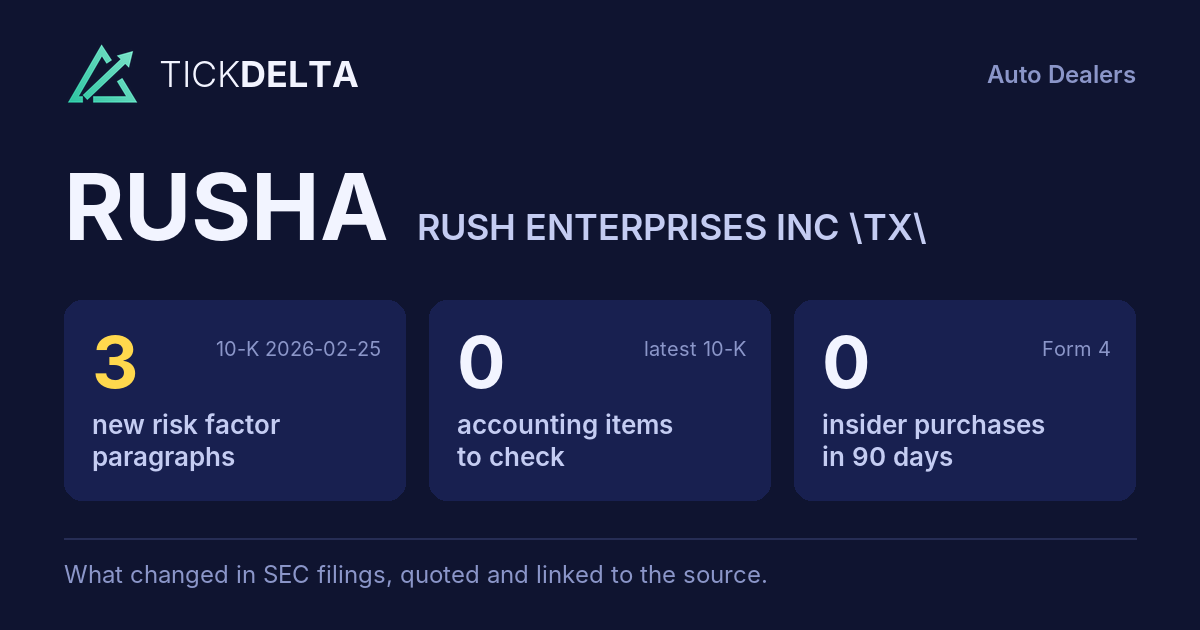
Screener / SEC EDGAR /CIK 0001012019 /10-K filed Feb 25, 2026, compared with Feb 24, 2025 /Numbers from the XBRL of the 10-Ks
Nasdaq Consumer discretionary · Auto Dealers

Rush Enterprises Inc TX RUSHA

Compare with peers Embed
The 10-K against last year's

89 changes: 4 added, 83 reworded, 2 quiet changes

10-K Feb 25, 2026 vs Feb 24, 2025

10-K 0001437749-26-005424 (Feb 25, 2026) vs 10-K 0001437749-25-004794 (Feb 24, 2025)

Every paragraph, and how much of it changed

One bar per paragraph, in the order of the 10-K. Height and colour show the share of its words not in the closest paragraph a year earlier; the tallest bars are new paragraphs.

Risk Factors

76 paragraphs · 3 new · 10 reworded · 0 gone · 10-K Feb 25, 2026 against Feb 24, 2025
New paragraph Reworded (5% of its words or more) Same or nearly
Paragraph 54 · 45% changed Every version of it
Laws and regulations intended to achieve the goal of significantly reducing engine emissions associated with the operation of commercial vehicles are complex and subject to change. Currently, the commercial vehicle industry is subject to the EPA 2027 Low NOx and the EPA’s GHG-3 rule, each of which are is scheduled to become effective starting in model year 2027. While the EPA 2027 Low NOx rule is expected to maintain the current emission limits, it is expected to be modified with respect to certain other provisions, such as reducing the required duration of manufacturers’ engine warranties. In addition, owners and commercial fleets that register or operate commercial vehicles in the State of California are also were subject to certain of CARB’s HD Omnibus and Advanced Clean Truck rules, both of which engine emissions rules that became effective in January 2024. It is widely expected that the current GHG-3 rule will be revoked or modified by a branch of However, Congress recently rescinded the federal government, but it is less clear whether a branch of the federal government may attempt to revoke or modify the EPA 2027 Low NOx rule. Recently, CARB revoked its request for a waiver from the EPA with respect to the Advanced Clean Fleet rule. In addition, the EPA recently announced that it has asked Congress to review the previously granted preemption waivers that CARB received with respect to the HD Omnibus and Advanced Clean Truck rules. The current head of the EPA believes that these waivers should have been approved by Congress prior to becoming effective. It is also worth noting that there are currently multiple lawsuits pending where plaintiffs are challenging CARB’s rules on the basis that, amongst other things, such rules are preempted by other federal laws and that the EPA exceeded previously granted to CARB. These waivers were the basis of CARB’s ability to enact its authority in granting the own engine emissions rules, and a federal judge has temporarily enjoined CARB from enforcing such rules. Congress’ rescission of CARB’s federal preemption waivers with respect is subject to the HD Omnibus multiple legal challenges, and Advanced Clean Truck rules. There are also multiple lawsuits pending where plaintiffs are challenging the GHG-3 rule on multiple grounds, including that the EPA exceeded its statutory authority in creating the rule. In July 2023, CARB and various manufacturers of heavy-duty commercial vehicles and engines, including PACCAR, International Motors, Ford, Hino, Isuzu and Cummins, entered into the Clean Truck Partnership, whereby the manufacturers agreed to comply with CARB’s emission requirements where applicable, regardless of whether any entity challenges CARB’s rule-making authority, and CARB agreed to work with manufacturers to provide reasonable lead time to meet CARB’s requirements and before imposing new regulations. It it is unclear what effect, if any, the outcome of the multiple lawsuits challenging the HD Omnibus and Advanced Clean Truck rules, or Congress’ decisions with respect to the EPA’s previously granted waivers, might have on the Clean Truck Partnership. when such challenges will be resolved.
Paragraph 37 · 28% changed Every version of it
Given the current uncertainty in connection with recently proposed tariffs against Canada, Mexico enacted 25% tariff on certain medium– and China, heavy– duty commercial vehicles and parts (the “Commercial Vehicle Tariffs”), we believe that certain commercial vehicle orders currently reflected in our backlog could be cancelled in the event that such tariffs are enacted and significantly increase the aggregate price that our customers will have to pay for such vehicles. However, we are confident that any price increases will be well below the 25% tariff rate and at this time, we do not expect the Commercial Vehicle Tariffs to significantly impact our backlog.
Paragraph 50 · 26% changed Every version of it
We are subject to risks associated with commercial vehicles and parts manufactured outside of the United States. States, and the Commercial Vehicle Tariffs may impact demand for certain of the commercial vehicles and parts that we sell.
Paragraph 55 · 24% changed Every version of it
A group of seventeen U.S. states and the District of Columbia entered into a joint memorandum of understanding that adopts at least a portion of CARB’s emissions regulations and commits each of them to work together to advance and accelerate the market for electric Class 3 through 8 commercial vehicles. Six of the states that signed are states where we sell new operate commercial vehicles: vehicle dealerships: California, Colorado, Nevada, New Mexico, North Carolina and Virginia. The signatories to the memorandum all agreed on a goal of ensuring that 100% of new Class 3 through 8 commercial vehicles are zero emission by 2050, with an interim target of 30% zero emission vehicles by 2030, although multiple of these states have recently announced plans to delay various aspects of CARB’s regulations. Attaining these If CARB were to prevail in its legal challenges against Congress’ recission of the EPA waivers, attaining the goals stated by CARB and the signers of the joint memorandum would likely require the adoption of new laws and regulations and we cannot predict at this time whether such laws and regulations would have an adverse impact on our business. Similarly, if the EPA’s policies change in the future, we believe the EPA could issue a new endangerment finding with respect to GHG emissions, which would allow the EPA to potentially create a new rule similar to the recently voided GHG rules, which would have required commercial vehicle engine manufacturers to manufacture an increasing percentage of “zero-emission” vehicles over time, which would likely have reduced the number of diesel ICE vehicles that would have been manufactured over that time period.
Paragraph 56 · 13% changed Every version of it
Engine emissions rules and regulations could result in increased compliance costs, additional operating restrictions and affect demand for the products that we sell in certain markets. and services that we offer. For example, we believe that the HD Omnibus and Advanced Clean Truck rules, and certain of CARB’s engine emissions rules that became effective in January 2024, along with the uncertainty regarding CARB’s enforcement of the same, resulted in our California dealerships selling less new commercial vehicles in both 2024 and 2025 than they would have absent such rules. While the reduction in the number of new commercial vehicles that we were able to sell in 2024 and 2025 due to CARB’s rules was not material to our financial results, our success going forward depends on the ability of our manufacturers to successfully supply new commercial vehicles that comply with existing and future emissions rules and regulations in each of the markets in which we operate.
Paragraph 60 · 11% changed Every version of it
We have, from time to time, experienced threats to our data and systems, including malware, ransomware, phishing and computer virus attacks. As discussed above, we are continuously developing and enhancing our controls, processes, and practices designed to protect our systems, computers, software, data, and networks from attack, damage, or unauthorized access. This continued development and enhancement requires us to expend significant additional resources. However, we may not anticipate or combat all types of future attacks until after they have been launched. In addition, the rapid evolution and increased availability of AI may intensify cybersecurity risks by making cyber-attacks more sophisticated and cybersecurity incidents more difficult to detect, contain, and mitigate. If any of these breaches of security occur, we will be required to expend additional capital and other resources, including costs to deploy additional personnel and protection technologies, train employees and engage third-party experts and consultants.
Paragraph 28 · 7% changed Every version of it
The concerns over climate change may impact our business in the future. Our current business model depends on our ability to sell, and provide services to, commercial vehicles primarily powered by diesel and gasoline internal combustion engines, which produce nitrogen oxide and greenhouse gas emissions. While the manufacturers we represent have made substantial progress in reducing the amount of nitrogen oxide and greenhouse gas emissions that result from internal combustion engines, it is widely accepted that alternative fuel vehicles will constitute an increasing portion of the commercial vehicles that are necessary sold in the future as technology improves and costs decrease, or in the event that government regulations require manufacturers to address climate change. produce alternative fuel vehicles. Reductions in the sale and use of commercial vehicles powered by internal combustion engines creates risks to our historical business operations and we cannot predict the future costs to our business resulting from these developments. However, we also believe that an industry transition away from internal combustion engines presents significant opportunities for us. Due in large part to the geographic reach of our dealership network, relationships with both the manufacturers we represent and our customers and our access to capital, we believe we are well-positioned to serve our customers’ evolving needs and help them reduce their nitrogen oxide and greenhouse gas emissions by helping them integrate more alternative fuel vehicles into their fleets and providing various services related thereto.

MD&A

87 paragraphs · 1 new · 46 reworded · 0 gone · 10-K Feb 25, 2026 against Feb 24, 2025
New paragraph Reworded (5% of its words or more) Same or nearly
Paragraph 23 · 50% changed
Inventories are stated at the lower of cost or net realizable value. Cost is determined by specific identification of new and used commercial vehicle inventory. An allowance is provided when it is anticipated that cost will exceed The estimated net realizable value. value of new and used commercial inventory is determined based on an analysis of historical sales trends, the impact of market trends and economic conditions, and forecasts of future demand. Our historical estimates of these costs and the related provisions have not differed materially from actual results. However, unforeseen adverse future economic and market conditions could result in our actual results differing materially from our estimates.
Paragraph 46 · 42% changed
We sold 2,105 new light-duty 6,977 used commercial vehicles in 2024, 2025, a 13.9% increase 1.9% decrease compared to 1,848 new light-duty 7,110 used commercial vehicles in 2023. 2024. The decrease was primarily a result of the freight recession.
Paragraph 55 · 41% changed
Gross margins from commercial vehicle lease and rental sales decreased to 27.8% in 2025, from 28.0% in 2024, from 29.9% in 2023. 2024. This decrease is primarily related to a decrease in rental utilization rates. We expect gross margins from lease and rental sales of approximately 27.0% to 29.0% during 2025. Our policy is to depreciate our lease and rental fleet using a straight-line method over each customer’s contractual lease term. The lease unit is depreciated to a residual value that approximates fair value at the expiration of the lease term. This policy results in us realizing reasonable gross margins while the unit is in service and a corresponding gain or loss on sale when the unit is sold at the end of the lease term. 2026.
Paragraph 71 · 34% changed
We have no other material commitments for capital expenditures as are currently under contract to build a new facility on the land adjacent to our current location in Huntley, Illinois with a current budget of December 31, 2024. However, we $23.6 million and a new facility in Conroe, Texas with a budget of $20.0 million. We will continue to purchase vehicles for our lease and rental operations and authorize capital expenditures for the improvement or expansion of our existing dealership facilities and construction or purchase of new facilities based on market opportunities.
Paragraph 48 · 27% changed
Finance and insurance revenues decreased $2.3 $0.8 million, or 9.4%, 3.9%, in 2024, 2025, compared to 2023. 2024. This decrease is was primarily due to the mix of purchasers of commercial vehicles. We are more likely provide financing to owner-operators decreased new and smaller fleets, which comprised a smaller percentage of commercial used vehicle sales during 2024. sales. Finance and insurance revenues have limited direct costs and, therefore, contribute a disproportionate share of our operating profits.
Paragraph 54 · 27% changed
Gross margins on used commercial vehicle sales increased decreased to 13.6% in 2025, from 18.9% in 2024, from 12.4% in 2023. 2024. This increase decrease was primarily due to the successful execution of our used commercial vehicle sales strategy. a shift in customer mix between wholesale and retail. We expect margins on used commercial vehicles to range between 13.0% 11.0% and 18.0% 16.0% in 2025. 2026.
Paragraph 52 · 23% changed
Gross margins on new Class 8 truck sales decreased to 8.9% 8.6% in 2024, 2025, from 9.7% in 2023. 2024. The decrease in gross margins was primarily due to the freight recession and a more competitive sales environment. In 2025, 2026, we expect overall gross margins from new heavy-duty truck sales of approximately 8.5% to 9.5%.
Paragraph 19 · 23% changed
In 2025, 2026, we expect demand for Aftermarket Products and Services to remain relatively weak through the first few months of 2025 due to the slower than expected freight recovery and continued low fleet utilization from our over-the-road customers. quarter. However, we are optimistic that freight markets will improve in 2026 and that demand will pick up as the year progresses, and we progresses. We believe that an improved freight market, along with our continued focus on growing our national account customer base and our focus on other aftermarket strategic initiatives initiatives, will result in aftermarket revenue growth this year.

A paragraph is matched with the one last year that shares the most of its words; under half in common makes it new. The paragraphs shown are the 7 reworded the most in each section.

The paragraph that changed most in each section

The redline

Marked against last year's 10-K: cut words struck through, new words highlighted.

Risk Factors117 words changed in this paragraph; it is 72% similar to last year's version.
A group of seventeen U.S. states and the District of Columbia entered into a joint memorandum of understanding that adopts at least a portion of CARB’s emissions regulations and commits each of them to work together to advance and accelerate the market for electric Class 3 through 8 commercial vehicles. Six of the states that signed are states where we sell new operate commercial vehicles: vehicle dealerships: California, Colorado, Nevada, New Mexico, North Carolina and Virginia. The signatories to the memorandum all agreed on a goal of ensuring that 100% of new Class 3 through 8 commercial vehicles are zero emission by 2050, with an interim target of 30% zero emission vehicles by 2030, although multiple of these states have recently announced plans to delay various aspects of CARB’s regulations. Attaining these If CARB were to prevail in its legal challenges against Congress’ recission of the EPA waivers, attaining the goals stated by CARB and the signers of the joint memorandum would likely require the adoption of new laws and regulations and we cannot predict at this time whether such laws and regulations would have an adverse impact on our business. Similarly, if the EPA’s policies change in the future, we believe the EPA could issue a new endangerment finding with respect to GHG emissions, which would allow the EPA to potentially create a new rule similar to the recently voided GHG rules, which would have required commercial vehicle engine manufacturers to manufacture an increasing percentage of “zero-emission” vehicles over time, which would likely have reduced the number of diesel ICE vehicles that would have been manufactured over that time period.

Source: Item 1A, 10-K 0001437749-26-005424 vs Item 1A, 10-K 0001437749-25-004794

MD&A107 words changed in this paragraph; it is 78% similar to last year's version.
On July 15, 2022, RTC Canada entered into the RTC Canada Floor Plan Credit Agreement (as amended) with BMO. Pursuant to the terms of the RTC Canada Floor Plan Credit Agreement, Agreement (as amended), BMO originally agreed to make up to $116.7 million CAD of revolving credit loans to finance RTC Canada’s purchase of new and used vehicle inventory. On June 13, 2025, the RTC Canada Floor Plan Credit Agreement was amended to increase the loan commitment to $171.7 million CAD. Loans to purchase used vehicle inventory are limited to twenty percent (20%) of the credit limit available at such time. RTC Canada may borrow, repay and reborrow loans from time to time until the maturity date, provided, however, that the outstanding principal amount on any date shall not exceed the credit limits set forth above with respect to new and used vehicles. Advances required to be made in CAD dollars under the RTC Canada Floor Plan Credit Agreement bear interest per annum, payable monthly, at CORRA, plus 1.27%. Advances required to be made in USD dollars bear interest per annum, payable monthly, at SOFR (as defined in the agreement), SOFR, plus 1.20%. The RTC Canada Floor Plan Credit Agreement expires on September 14, 2026. On December 31, 2024, September 30, 2025, we had approximately $78.2 $81.7 million CAD outstanding under the RTC Canada Floor Plan Credit Agreement. The average daily outstanding borrowings under the RTC Canada Floor Plan Credit Agreement were $80.7 million during the twelve months ended December 31, 2024. We utilize our excess cash on hand to pay down our outstanding borrowings under the RTC Canada Floor Plan Credit Agreement, and the resulting interest earned is recognized as an offset to our gross interest expense under the RTC Canada Floor Plan Credit Agreement.

Source: Item 7, 10-K 0001437749-26-005424 vs Item 7, 10-K 0001437749-25-004794

Accounting Policies77 words changed in this paragraph; it is 47% similar to last year's version.
On January 3, 2022, a subsidiary of Cummins, Inc. acquired a The Company recognizes the investment for its 50% equity interest in Natural Gas Fuel Systems, LLC (“NGFS”) from the Company for $27.5 million. NGFS previously conducted business as Momentum Fuel Technologies. The $12.5 million gain realized on the transaction is included in Other income on the Consolidated Statements with a subsidiary of Income for the year ended December 31, 2022. The Company is accounting for the business as a joint venture and recognizes the investment Cummins, Inc. using the equity method. The Company’s equity income in NGFS is included in the line-item Other income on the Consolidated Statements of Income.

Source: Item 8, Note 2 – SIGNIFICANT ACCOUNTING POLICIES:, 10-K 0001437749-26-005424 vs Item 8, Note 2 – SIGNIFICANT ACCOUNTING POLICIES:, 10-K 0001437749-25-004794

Legal Proceedings9 words changed in this paragraph; it is 97% similar to last year's version.
From time to time, the Company is involved in litigation arising out of its operations in the ordinary course of business. The Company maintains liability insurance, insurance through self-insurance self-insurance, a captive insurer and third-party excess insurance, including product liability coverage, in amounts deemed adequate by management. However, an uninsured or partially insured claim, or claim for which indemnification is not available, could have a material adverse effect on the Company’s financial condition or results of operations. As of December 31, 2024, 2025, the Company believes that there are no pending claims or litigation, individually or in the aggregate, that are reasonably likely possible to have a material adverse effect on its financial position or results of operations. However, due to the inherent uncertainty of litigation, there can be no assurance that the resolution of any particular claim or proceeding would not have a material adverse effect on the Company’s financial condition or results of operations for the fiscal period in which such resolution occurred.

Source: Item 3, via Note 14 – COMMITMENTS AND CONTINGENCIES:, 10-K 0001437749-26-005424 vs Item 3, via Note 14 – COMMITMENTS AND CONTINGENCIES:, 10-K 0001437749-25-004794

Sentences and paragraphs added, removed or reworded

Every change, by type

Sentences and paragraphs of RUSHA's Risk Factors and MD&A, 10-K Feb 25, 2026 against 10-K Feb 24, 2025. Each links to the text at sec.gov.

Quiet changes are sentences kept from last year with one to four words changed, at least one of them a hedge, a modal or a qualifier (may, could, will, not, significant, material…). A year or date rolling forward is not counted.

The full word list

adverse, adversely, all, although, anticipate, anticipates, any, approximately, believe, believes, can, cannot, certain, could, expect, expects, generally, however, if, intend, intends, largely, likely, many, material, materially, may, might, most, must, never, no, not, possible, primarily, probable, should, significant, significantly, some, substantial, substantially, unlikely, will, would

AddedRisk Factors
We use AI in our business and challenges with properly incorporating AI into our business and managing its use could result in reputational harm, competitive harm and legal liability.
Read it in 10-K Feb 25, 2026 at sec.gov
AddedRisk Factors
We incorporate AI into various aspects of our business and certain of the products and services that we offer, and we intend to continue expanding our use of AI in our business operations. If we are unable to effectively integrate AI into our business processes or keep pace with rapidly evolving AI technological developments, we may face a competitive disadvantage. At the same time, the use or offering of AI technologies may result in new or expanded risks and liabilities, including enhanced government or regulatory scrutiny, litigation, privacy and compliance issues, ethical concerns, confidentiality, reputational harm, and security risks. It is difficult to predict all the risks related to the use of AI. Changes in laws, rules, directives, and regulations governing the use of AI may adversely affect our ability to develop and use AI or subject us to legal liability. The cost of complying with laws and regulations governing AI could be significant and would increase our operating expenses, which could adversely affect our business, financial condition, results of operations and cash flows. Further, market demand and acceptance of AI technologies are uncertain, and our efforts to further incorporate AI into our business processes may not succeed.
Read it in 10-K Feb 25, 2026 at sec.gov
AddedRisk Factors
The recently enacted Commercial Vehicle Tariffs may impact demand for certain of the commercial vehicles and parts that we sell. However, the practical implementation and effects of these tariffs, including the amount that such tariffs will increase prices of the products we sell, remain fluid, as the manufacturers we represent continue to work to reduce the impact of such tariffs in numerous ways, including by modifying the location of where certain assembly and manufacturing operations occur. While we cannot predict how the Commercial Vehicle Tariffs will impact demand, we are confident that any price increases will be well below the 25% tariff rate on all the products that we sell.
Read it in 10-K Feb 25, 2026 at sec.gov
RewordedRisk Factors
While the manufacturers we represent have made substantial progress in reducing the amount of nitrogen oxide and greenhouse gas emissions that result from internal combustion engines, it is widely accepted that alternative fuel vehicles will constitute an increasing portion of the commercial vehicles that are necessary sold in the future as technology improves and costs decrease, or in the event that government regulations require manufacturers to address climate change. produce alternative fuel vehicles.
Read it in 10-K Feb 25, 2026 at sec.gov
RewordedRisk Factors
Attaining these If CARB were to prevail in its legal challenges against Congress’ recission of the EPA waivers, attaining the goals stated by CARB and the signers of the joint memorandum would likely require the adoption of new laws and regulations and we cannot predict at this time whether such laws and regulations would have an adverse impact on our business.
Read it in 10-K Feb 25, 2026 at sec.gov
RewordedRisk Factors
For example, we believe that the HD Omnibus and Advanced Clean Truck rules, and certain of CARB’s engine emissions rules that became effective in January 2024, along with the uncertainty regarding CARB’s enforcement of the same, resulted in our California dealerships selling less new commercial vehicles in both 2024 and 2025 than they would have absent such rules.
Read it in 10-K Feb 25, 2026 at sec.gov
RewordedRisk Factors
Given the current uncertainty in connection with recently proposed tariffs against Canada, Mexico enacted 25% tariff on certain medium– and China, heavy– duty commercial vehicles and parts (the “Commercial Vehicle Tariffs”), we believe that certain commercial vehicle orders currently reflected in our backlog could be cancelled in the event that such tariffs are enacted and significantly increase the aggregate price that our customers will have to pay for such vehicles.
Read it in 10-K Feb 25, 2026 at sec.gov
RewordedRisk Factors
We are subject to risks associated with commercial vehicles and parts manufactured outside of the United States. States, and the Commercial Vehicle Tariffs may impact demand for certain of the commercial vehicles and parts that we sell.
Read it in 10-K Feb 25, 2026 at sec.gov
Show the other 20
RewordedRisk Factors
In addition, owners and commercial fleets that register or operate commercial vehicles in the State of California are also were subject to certain of CARB’s HD Omnibus and Advanced Clean Truck rules, both of which engine emissions rules that became effective in January 2024.
Read it in 10-K Feb 25, 2026 at sec.gov
RewordedRisk Factors
Engine emissions rules and regulations could result in increased compliance costs, additional operating restrictions and affect demand for the products that we sell in certain markets. and services that we offer.
Read it in 10-K Feb 25, 2026 at sec.gov
RewordedRisk Factors
Currently, the commercial vehicle industry is subject to the EPA 2027 Low NOx and the EPA’s GHG-3 rule, each of which are is scheduled to become effective starting in model year 2027.
Read it in 10-K Feb 25, 2026 at sec.gov
RewordedRisk Factors
As of December 31, 2024, 2025, the three-month average daily trading volume of our Class B common stock was approximately 17,000 36,000 shares, with twenty-three eleven days having a trading volume below 10,000 shares.
Read it in 10-K Feb 25, 2026 at sec.gov
AddedMD&A
In accordance with U.S. GAAP, we report floorplan borrowings financed with lenders affiliated with our vehicle manufacturers within Cash Flows from Operating Activities in the Consolidated Statements of Cash Flows. We report floorplan borrowings financed with lenders that are not affiliated with our vehicle manufacturers within Cash Flows from Financing Activities in the Consolidated Statements of Cash Flows. Refer to Note 7 - Floorplan Notes Payable and Line of Credit and Note 8 - Long-Term Debt within our Notes to Consolidated Financial Statements for additional discussion of our floorplan financing agreements and other debt structure.
Read it in 10-K Feb 25, 2026 at sec.gov
RewordedMD&A
Net change in operating assets and liabilities were primarily the result of $34.8 $1.8 million from the decrease in customer deposits and $12.2 deposits, $15.8 million from the decrease in accrued liabilities, $73.2 from the decrease in accounts receivable and $354.9 from the decrease in inventory which were offset primarily by cash outflows of $91.7 $112.6 million from an increase the decrease in accounts receivable, $81.9 floor plan financing from our manufacturers, $13.7 million from the decrease in accounts payable and $85.1 $34.8 million from an increase the decrease in inventory. current assets.
Read it in 10-K Feb 25, 2026 at sec.gov
RewordedMD&A
The decrease in new and used commercial vehicle revenues was primarily a result of weak demand for Class 8 trucks caused by the ongoing freight recession and high interest rates, which was partially offset by strong demand for Class 4 through 7 medium-duty commercial vehicles. uncertainty with respect to U.S. trade policy and engine emissions regulations.
Read it in 10-K Feb 25, 2026 at sec.gov
RewordedMD&A
The Effective September 30, 2025, the WF Credit Agreement expires on was amended to, amongst other things, extend the expiration date to September 14, 2026, 30, 2028, although, upon the occurrence and during the continuance of an event of default, the WF Agent agent has the right to, or upon the request of the required lenders must, terminate the commitments and declare all outstanding principal and interest due and payable.
Read it in 10-K Feb 25, 2026 at sec.gov
RewordedMD&A
In 2025, 2026, we expect demand for Aftermarket Products and Services to remain relatively weak through the first few months of 2025 due to the slower than expected freight recovery and continued low fleet utilization from our over-the-road customers. quarter.
Read it in 10-K Feb 25, 2026 at sec.gov
RewordedMD&A
However, we are optimistic that demand will pick up as the year progresses, and we We believe that an improved freight market, along with our continued focus on growing our national account customer base and our focus on other aftermarket strategic initiatives initiatives, will result in aftermarket revenue growth this year.
Read it in 10-K Feb 25, 2026 at sec.gov
RewordedMD&A
The increase decrease in our Class 4 through 7 commercial vehicle sales in 2024 2025 was primarily a result of strong demand challenging market conditions and increased production of commercial vehicles from the manufacturers we represent. regulatory uncertainty.
Read it in 10-K Feb 25, 2026 at sec.gov
RewordedMD&A
The cash outflows consisted primarily of $1,846.8 $1,270.5 million used for principal repayments of long-term debt and finance lease obligations and $10.1 obligations, $1.4 million for taxes paid related to net share settlement of equity awards. awards and $69.0 million from net draws on floor plan note payable (non-trade).
Read it in 10-K Feb 25, 2026 at sec.gov
RewordedMD&A
We expect net interest expense in 2025 to decrease in 2026 compared to 2024 2025 due to decreased commercial vehicle inventory levels and levels, lower interest rates. rates and how we choose to finance our vehicle inventory.
Read it in 10-K Feb 25, 2026 at sec.gov
RewordedMD&A
Research currently estimates 252,000 218,225 new Class 8 trucks 4 through 7 commercial vehicles will be sold in the United States in 2025, 2026, compared to approximately 247,337 217,412 new Class 8 4 through 7 trucks sold in 2024. 2025.
Read it in 10-K Feb 25, 2026 at sec.gov
RewordedMD&A
This increase in commercial vehicle lease and rental revenues was primarily a result of steady growth in our full-service lease portfolio, supported by strong customer demand for lease commercial vehicles, and a modernized fleet, which was partially offset by decreased rental utilization.
Read it in 10-K Feb 25, 2026 at sec.gov
RewordedMD&A
Our new Class 8 heavy-duty 4 through 7 medium-duty unit sales (including buses) decreased 11.4%, 4.8%, compared to 2023, which 2024, and accounted for 6.1% 5.7% of the total U.S. market and 1.7% 6.3% of the total Canadian market.
Read it in 10-K Feb 25, 2026 at sec.gov
RewordedMD&A
Pursuant to the terms of the PLC Agreement, as amended by that certain amendment entered into on December 16, 2024, Agreement (as amended), PLC agreed to make up to $500.0 million of revolving credit loans to finance certain of our capital expenditures, including commercial vehicle purchases and other equipment to be leased or rented through our PacLease franchises.
Read it in 10-K Feb 25, 2026 at sec.gov
Quiet changesMD&A
However, we We will continue to purchase vehicles for our lease and rental operations and authorize capital expenditures for the improvement or expansion of our existing dealership facilities and construction or purchase of new facilities based on market opportunities.
Read it in 10-K Feb 25, 2026 at sec.gov

Sources

The two latest 10-Ks on EDGAR, section by section. Each change links to the text at sec.gov.

Also

New risk factors: paragraphs with nothing like them last year, quoted in full.

Work with it

Excel workbook · CSV. Google Sheet that stays up to date: paste =IMPORTDATA("https://tickdelta.com/company/RUSHA/export.csv") into a cell.

Next:Related parties
Esc

Type a ticker such as AAPL, a name, an investor such as Buffett, or a topic such as tariffs. ↑ ↓ to move, Enter to open.