Paragraph 249 · 46% changed
Every version of it
Screener
/
SEC EDGAR
/CIK 0001628171
/10-K filed Feb 25, 2026, compared with Feb 26, 2025
/Numbers from the XBRL of the 10-Ks
Nasdaq
Health care · Biotechnology
Revolution Medicines, Inc. RVMD
The 10-K against last year's
219 changes: 61 added, 69 removed, 85 reworded, 4 quiet changes
10-K Feb 25, 2026 vs Feb 26, 2025
Risk Factors
14.3%
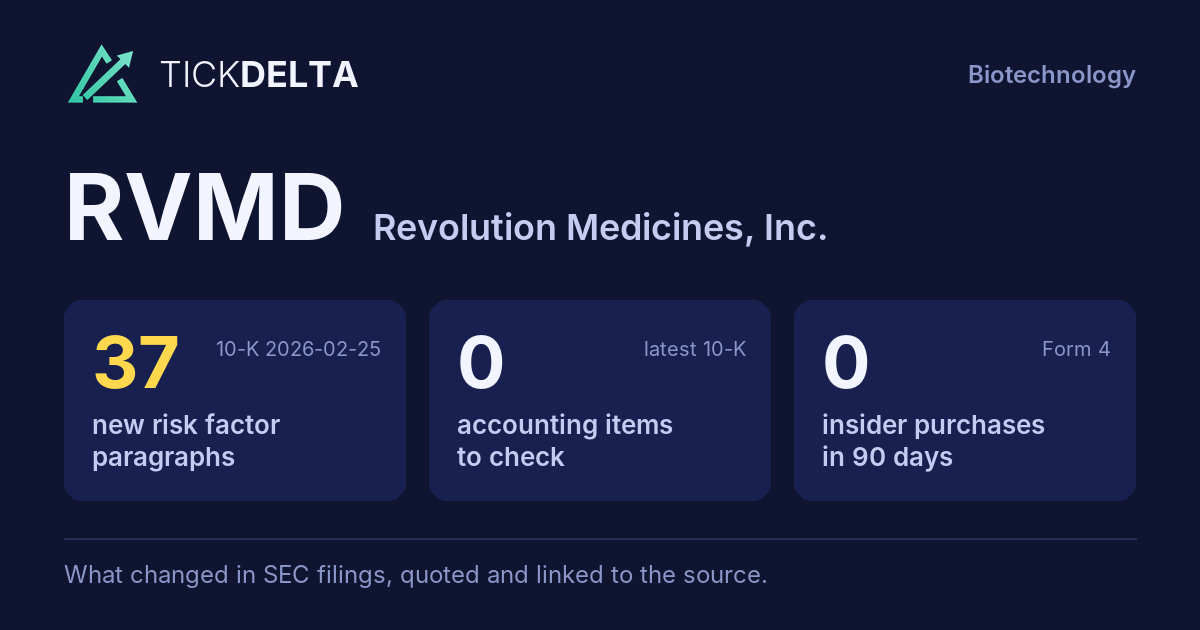
of the text changed · 41,356 words now · 37 new paragraphs, 29 gone
MD&A
49.8%
of the text changed · 5,675 words now · 24 new paragraphs, 40 gone
Legal Proceedings
23.8%
of the text changed · 280 words now
Accounting Policies
12.0%
of the text changed · 4,464 words now
10-K 0001193125-26-071563 (Feb 25, 2026) vs 10-K 0000950170-25-027736 (Feb 26, 2025)
Every paragraph, and how much of it changed
One bar per paragraph, in the order of the 10-K. Height and colour show the share of its words not in the closest paragraph a year earlier; the tallest bars are new paragraphs.
Risk Factors
511 paragraphs · 37 new · 99 reworded · 29 gone · 10-K Feb 25, 2026 against Feb 26, 2025
New paragraph
Reworded (5% of its words or more)
Same or nearly
Paragraph 264 · 46% changed
Every version of it
The processing of personal data in the European Economic Area (EEA) is governed by the General Data Protection Regulation (the GDPR). The GDPR imposes stringent requirements for controllers and processors of personal data. The GDPR applies extraterritorially, and we may be subject to the GDPR because of our data processing activities that involve the personal data of individuals located in the EEA, or in the context of our activities within the EEA, such as in connection with any EEA clinical trials. The GDPR may impose additional imposes comprehensive data privacy compliance obligations and liability in relation to our collection and use of personal data, including a principle of accountability and the personal data that we process, obligation to demonstrate compliance through policies, procedures, training and we may be required to put in place additional mechanisms to ensure compliance with its requirements. This may be onerous and may interrupt or delay our development activities. audit. If we or our vendors fail to comply with the GDPR and the applicable national data protection laws of the EEA member states, or if regulators assert we have failed to comply with these laws, it may lead to regulatory enforcement actions, which can result in, among other things, monetary penalties of up to €20,000,000 or up to 4% of the total worldwide annual turnover of the noncompliant undertaking for the preceding financial year, whichever is higher, and other administrative penalties. The GDPR also imposes strict rules on the transfer of personal data out of the EEA to the United States and other third countries that have not been found to provide adequate protection to such personal data, and the efficacy and longevity of current transfer mechanisms between the EEA and the United States remains uncertain. Case law from the Court of Justice of the European Union states that reliance on the standard contractual clauses – a standard form of contract approved by the European Commission as an adequate personal data transfer mechanism – alone may not necessarily be sufficient in all circumstances, and that transfers must be assessed on a case-by-case basis.
Paragraph 86 · 45% changed
Every version of it
We recently initiated the are evaluating our product candidates in registrational trials, including RASolute 302 study 302, RASolute 303, RASolute 304, RASolute 305, and the RASolve 301 study with daraxonrasib, 301, and are currently planning additional registrational clinical trials for RMC-6236 daraxonrasib and our other RAS(ON) inhibitors. These studies may not produce results that are consistent with expectations or that are predicted by our earlier clinical observations for these compounds. Our plans for these and future planned registrational trials are, and will be based on our observations from the results of early-stage clinical trials using the same product candidates. Based on data from early-stage clinical trials, we will select, subject to regulatory feedback, the proposed indication, line of therapy, study design and dose and dose schedule for our registrational studies. However, these registrational studies, if initiated, may not be successful and may not produce results that are consistent with our expectations, based on our earlier clinical observations, including because other trial designs may have greater likelihood of development success.
Paragraph 223 · 45% changed
Every version of it
zoldonrasib was granted breakthrough therapy designation for the treatment of adult patients with KRAS G12D-mutated locally advanced or metastatic NSCLC who have been previously treated with anti-PD-1/PD-L1 therapy and platinum-based chemotherapy; and elironrasib was granted breakthrough therapy designation for the treatment of adult patients with KRAS G12C-mutated locally advanced or metastatic NSCLC who have received prior chemotherapy and immunotherapy but have not been previously treated with a KRAS G12C inhibitor. The receipt of these breakthrough therapy designation (and any future designations we may receive for a product candidate) may not result in a faster development process, review or approval compared to drugs considered for approval under conventional FDA procedures and does not assure ultimate approval by the FDA. In addition, even if a product candidate qualifies as a breakthrough therapy, the FDA may later decide that the drug no longer meets the conditions for qualification and rescind the designation.
Paragraph 196 · 44% changed
Every version of it
The regulations that govern marketing approvals, pricing and reimbursement for new products vary widely from country to country. Some countries require approval of the sale price of a product before it can be marketed. In many countries, the pricing review period begins after marketing approval is granted. In some foreign markets, prescription pharmaceutical pricing remains subject to continuing government control even after initial approval is granted. As a result, we or our potential future collaboration partners might obtain marketing approval for a product candidate in a particular country, but then be subject to price regulations that delay the commercial launch of the product candidate, possibly for lengthy time periods, and negatively impact the revenues we are able to generate from the sale of the product candidate in that country. Adverse pricing limitations may hinder our ability to recoup our investment in one or more product candidates, even if our product candidates obtain marketing approval.
Paragraph 30 · 43% changed
Every version of it
Paragraph 389 · 42% changed
Every version of it
Paragraph 6 · 40% changed
Every version of it
Paragraph 249 · 46% changed
Every version of it
10-K Feb 26, 2025Moreover, payment methodologies may be subject to changes in healthcare legislation and regulatory initiatives. In August 2022, the Inflation Reduction Act of 2022 (IRA) was signed into law. Among other things, the IRA requires manufacturers of certain drugs to engage in price negotiations with Medicare (beginning in 2026), with prices that can be negotiated subject to a cap; imposes rebates under Medicare Part B and Medicare Part D to penalize price increases that outpace inflation (first due in 2023); and replaces the Part D coverage gap discount program with a new manufacturer discounting program (which began in 2025). The IRA permits the Secretary of the Department of Health and Human Services (HHS) to implement many of these provisions through guidance, as opposed to regulation, for the initial years. HHS has and will continue to issue and update guidance as these programs are implemented. In August 2024, HHS announced the negotiated prices for the initial ten drugs, which will first be effective in 2026, and in January 2025, HHS announced the second set of drugs that will be subject to price negotiations. Because the Medicare drug price negotiation program is currently subject to legal challenges, and for other reasons, it is currently unclear how the IRA will be effectuated, and the impact of the IRA on our business and the pharmaceutical industry cannot yet be fully determined.
10-K Feb 25, 2026
For example, in August 2022, the Inflation Reduction Act of 2022 (IRA) was signed into law. Among other things, the IRA requires manufacturers of certain drugs to engage in price negotiations with Medicare, with prices that can be negotiated subject to a cap; imposes rebates under Medicare Part B and Medicare Part D to penalize price increases that outpace inflation (first due in 2023); and
Paragraph 264 · 46% changed
Every version of it
10-K Feb 26, 2025
The processing of personal data in the European Economic Area (EEA) is governed by the General Data Protection Regulation (the GDPR). The GDPR imposes stringent requirements for controllers and processors of personal data. The GDPR applies extraterritorially, and we may be subject to the GDPR because of our data processing activities that involve the personal data of individuals located in the EEA, or in the context of our activities within the EEA, such as in connection with any EEA clinical trials. The GDPR may impose additional obligations and liability in relation to the personal data that we process, and we may be required to put in place additional mechanisms to ensure compliance with its requirements. This may be onerous and may interrupt or delay our development activities. If we or our vendors fail to comply with the GDPR and the applicable national data protection laws of the EEA member states, or if regulators assert we have failed to comply with these laws, it may lead to regulatory enforcement actions, which can result in, among other things, monetary penalties of up to €20,000,000 or up to 4% of the total worldwide annual turnover of the noncompliant undertaking for the preceding financial year, whichever is higher, and other administrative penalties. The GDPR also imposes strict rules on the transfer of personal data out of the EEA to the United States and other third countries that have not been found to provide adequate protection to such personal data, and the efficacy and longevity of current transfer mechanisms between the EEA and the United States remains uncertain. Case law from the Court of Justice of the European Union states that reliance on the standard contractual clauses – a standard form of contract approved by the European Commission as an adequate personal data transfer mechanism – alone may not necessarily be sufficient in all circumstances, and that transfers must be assessed on a case-by-case basis.
10-K Feb 25, 2026
The processing of personal data in the European Economic Area (EEA) is governed by the General Data Protection Regulation (the GDPR). The GDPR imposes stringent requirements for controllers and processors of personal data. The GDPR applies extraterritorially, and we may be subject to the GDPR because of our data processing activities that involve the personal data of individuals located in the EEA, or in the context of our activities within the EEA, such as in connection with any EEA clinical trials. The GDPR imposes comprehensive data privacy compliance obligations in relation to our collection and use of personal data, including a principle of accountability and the obligation to demonstrate compliance through policies, procedures, training and audit. If we or our vendors fail to comply with the GDPR and the applicable national data protection laws of the EEA member states, or if
Paragraph 86 · 45% changed
Every version of it
10-K Feb 26, 2025
We recently initiated the RASolute 302 study and the RASolve 301 study with daraxonrasib, and are currently planning additional registrational clinical trials for RMC-6236 and our other RAS(ON) inhibitors. These studies may not produce results that are consistent with expectations or that are predicted by our earlier clinical observations for these compounds. Our plans for these and future planned registrational trials are, and will be based on our observations from the results of early-stage clinical trials using the same product candidates. Based on data from early-stage clinical trials, we will select, subject to regulatory feedback, the proposed indication, line of therapy, study design and dose and dose schedule for our registrational studies. However, these registrational studies, if initiated, may not be successful and may not produce results that are consistent with our expectations, based on our earlier clinical observations, including because other trial designs may have greater likelihood of development success.
10-K Feb 25, 2026
We are evaluating our product candidates in registrational trials, including RASolute 302, RASolute 303, RASolute 304, RASolute 305, and RASolve 301, and are currently planning additional registrational clinical trials for daraxonrasib and our other RAS(ON) inhibitors. These studies may not produce results that are consistent with expectations or that are predicted by our earlier clinical
Paragraph 223 · 45% changed
Every version of it
10-K Feb 26, 2025
does not assure ultimate approval by the FDA. In addition, even if a product candidate qualifies as a breakthrough therapy, the FDA may later decide that the drug no longer meets the conditions for qualification and rescind the designation.
10-K Feb 25, 2026
zoldonrasib was granted breakthrough therapy designation for the treatment of adult patients with KRAS G12D-mutated locally advanced or metastatic NSCLC who have been previously treated with anti-PD-1/PD-L1 therapy and platinum-based chemotherapy; and elironrasib was granted breakthrough therapy designation for the treatment of adult patients with KRAS G12C-mutated locally advanced or metastatic NSCLC who have received prior chemotherapy and immunotherapy but have not been previously treated with a KRAS G12C inhibitor. The receipt of these breakthrough therapy designation (and any future designations we may receive for a product candidate) may not result in a faster development process, review or approval compared to drugs considered for approval under conventional FDA procedures and does not assure ultimate approval by the FDA. In addition, even if a product candidate qualifies as a breakthrough therapy, the FDA may later decide that the drug no longer meets the conditions for qualification and rescind the designation.
Paragraph 196 · 44% changed
Every version of it
10-K Feb 26, 2025
The regulations that govern marketing approvals, pricing and reimbursement for new products vary widely from country to country. Some countries require approval of the sale price of a product before it can be marketed. In many countries, the pricing review period begins after marketing approval is granted. In some foreign markets, prescription pharmaceutical pricing remains subject to continuing government control even after initial approval is granted. As a result, we or our potential future collaboration partners might obtain marketing approval for a product candidate in a particular country, but then be subject to price regulations that delay the commercial launch of the product candidate, possibly for lengthy time periods, and negatively impact the revenues we are able to generate from the sale of the product candidate in that country. Adverse pricing limitations may hinder our ability to recoup our investment in one or more product candidates, even if our product candidates obtain marketing approval.
10-K Feb 25, 2026
The regulations that govern marketing approvals, pricing and reimbursement for new products vary widely from country to country. Some countries require approval of the sale price of a product before it can be marketed. In many countries, the pricing review period
Paragraph 30 · 43% changed
Every version of it
10-K Feb 26, 2025Our ability to raise additional funds will depend on financial, economic and other factors, many of which are beyond our control. Additional funds may not be available when we need them, on terms that are acceptable to us, or at all. If adequate funds are not available to us on a timely basis, we may be required to:
10-K Feb 25, 2026
If we need to raise additional capital to fund our operations, funding may not be available to us on acceptable terms, or at all. If we are unable to obtain adequate financing when needed, we may have to:
Paragraph 389 · 42% changed
Every version of it
10-K Feb 26, 2025Even if we believe third-party intellectual property claims are without merit, there is no assurance that a court would find in our favor on questions of infringement, validity, enforceability or priority. A court of competent jurisdiction could hold that third-party patents asserted against us are valid, enforceable and infringed, which could materially and adversely affect our ability to commercialize any of our product candidates and any other product candidates or technologies covered by the asserted third-party patents. In order to successfully challenge the validity of a U.S. patent in federal court, we would need to overcome a presumption of validity. As this burden is a high one requiring us to present clear and convincing evidence as to the invalidity of a U.S. patent claim, there is no assurance that a court of competent jurisdiction would invalidate the claims of any such U.S. patent. If we are found to infringe, misappropriate or otherwise violate a third party’s intellectual property rights, and we are unsuccessful in demonstrating that these rights are invalid or unenforceable, we could be required to obtain a license from such a third party in order to continue developing and marketing our products and technology. However, we may not be able to obtain any required license on commercially reasonable terms or at all. Even if we were able to obtain a license, it could be non-exclusive, thereby giving our competitors access to the same technologies licensed to us. We could be forced, including by court order, to cease commercializing the infringing technology or product. A finding of infringement could prevent us from commercializing our product candidates or force us to cease some of our business operations. In the event of a successful claim of infringement against us, we may have to pay substantial damages, including treble damages and attorneys’ fees for willful infringement, pay royalties and other fees, redesign our infringing product candidate or obtain one or more licenses from third parties, which may be impossible or require substantial time and monetary expenditure. Claims that we have misappropriated the confidential information or trade secrets of third parties could have a similar negative impact on our business.
10-K Feb 25, 2026
product. A finding of infringement could prevent us from commercializing our product candidates or force us to cease some of our business operations. In the event of a successful claim of infringement against us, we may have to pay substantial damages, including treble damages and attorneys’ fees for willful infringement, pay royalties and other fees, redesign our infringing product candidate or obtain one or more licenses from third parties, which may be impossible or require substantial time and monetary expenditure. Claims that we have misappropriated the confidential information or trade secrets of third parties could have a similar negative impact on our business.
Paragraph 6 · 40% changed
Every version of it
10-K Feb 26, 2025Our ability to generate revenue from product sales and achieve profitability depends on our ability, alone or with our collaboration partners, to successfully complete the development of, and obtain the regulatory approvals necessary to commercialize, our development programs. We do not anticipate generating revenue from product sales for the next several years, if ever. Our ability to generate future revenue from product sales depends heavily on our, and any potential future collaborators’, success in:
10-K Feb 25, 2026
We have never generated revenue from product sales and our ability to generate future revenue from product sales and achieve profitability depends heavily on our, and any potential future collaborators’, success in:
MD&A
92 paragraphs · 24 new · 37 reworded · 40 gone · 10-K Feb 25, 2026 against Feb 26, 2025
New paragraph
Reworded (5% of its words or more)
Same or nearly
Paragraph 84 · 47% changed
In June 2025, we entered into the Royalty Purchase Agreement with Royalty Pharma. Pursuant to the Royalty Purchase Agreement, Royalty Pharma purchased from us the right to receive tiered royalty payments on worldwide net product sales of daraxonrasib and zoldonrasib, if zoldonrasib is approved for the same indication or subset of the same indication for which daraxonrasib is approved. For additional information regarding the terms of the EQRx Acquisition, Royalty Purchase Agreement, see “Note 3. Acquisition” 10. Liability related to the sale of future royalties” in the “Notes to Consolidated Financial Statements” contained in Part II, Item 8 of this Annual Report on Form 10-K.
Paragraph 54 · 43% changed
Interest income expense increased by $39.4 $24.2 million for during the year ended December 31, 2024, 2025 compared to 2023 2024 due to a larger cash, cash equivalents interest expense and marketable securities balance and higher interest rates. issuance costs amortization under the Royalty Purchase Agreement.
Paragraph 22 · 42% changed
Paragraph 5 · 42% changed
Paragraph 65 · 41% changed
Paragraph 7 · 36% changed
Elironrasib (RMC-6291) is designed as a RAS(ON) oral G12C-selective tri-complex G12C-selective inhibitor. It is designed to exhibit subnanomolar potency for suppressing RAS pathway signaling and growth of RAS G12C-bearing cancer cells and is engineered to be highly selective for RAS G12C over wild-type RAS and other cellular targets. Elironrasib is designed to be differentiated from first-generation KRAS(OFF) G12C inhibitors, which sequester the KRAS(OFF) G12C form, by its mechanism of directly inhibiting the RAS(ON) G12C form. In July 2025, elironrasib received Breakthrough Therapy Designation from the FDA for the treatment of adult patients with KRAS G12C-mutated locally advanced or metastatic NSCLC who have received prior chemotherapy and immunotherapy but have not been previously treated with a KRAS G12C inhibitor.
Paragraph 19 · 36% changed
Paragraph 4 · 34% changed
We are advancing a deep pipeline of RAS(ON) Inhibitors, including daraxonrasib (RMC-6236), our RAS(ON) multi-selective inhibitor; inhibitor, zoldonrasib (RMC-9805), our G12D-selective inhibitor, elironrasib (RMC-6291), our G12C-selective inhibitor; inhibitor, and zoldonrasib (RMC-9805), RMC-5127, our G12D-selective G12V-selective inhibitor. Together, we consider these three clinical-stage candidates as the first wave of RAS(ON) inhibitors that we are advancing through clinical development. We also currently plan to advance RMC-5127 (G12V) into clinical development. In addition, we have other preclinical-stage RAS(ON) inhibitor Inhibitor clinical development opportunities, including the RAS(ON) mutant-selective inhibitors RMC-0708 (Q61H) and RMC-8839 (G13C). (G13C) and additional novel targeted approaches for patients with RAS-addicted cancers.
Paragraph 84 · 47% changed
10-K Feb 26, 2025
For additional information regarding the terms of the EQRx Acquisition, see “Note 3. Acquisition” in the “Notes to Consolidated Financial Statements” contained in Part II, Item 8 of this Annual Report on Form 10-K.
10-K Feb 25, 2026
In June 2025, we entered into the Royalty Purchase Agreement with Royalty Pharma. Pursuant to the Royalty Purchase Agreement, Royalty Pharma purchased from us the right to receive tiered royalty payments on worldwide net product sales of daraxonrasib and zoldonrasib, if zoldonrasib is approved for the same indication or subset of the same indication for which daraxonrasib is approved. For additional information regarding the Royalty Purchase Agreement, see “Note 10. Liability related to the sale of future royalties” in the “Notes to Consolidated Financial Statements” contained in Part II, Item 8 of this Annual Report on Form 10-K.
Paragraph 54 · 43% changed
10-K Feb 26, 2025
Interest income increased by $39.4 million for the year ended December 31, 2024, compared to 2023 due to a larger cash, cash equivalents and marketable securities balance and higher interest rates.
10-K Feb 25, 2026
Interest expense increased by $24.2 million during the year ended December 31, 2025 compared to 2024 due to interest expense and issuance costs amortization under the Royalty Purchase Agreement.
Paragraph 22 · 42% changed
10-K Feb 26, 2025We currently expect to initiate a global, randomized Phase 3 daraxonrasib monotherapy study in patients with first-line (1L) metastatic PDAC in the second half of 2025. We also currently expect to initiate a global, randomized Phase 3 monotherapy study of daraxonrasib as adjuvant treatment for patients with resectable PDAC in the second half of 2025.
10-K Feb 25, 2026
We also currently expect to initiate RASolve 308, a global, randomized placebo-controlled Phase 3 registrational trial evaluating zoldonrasib in combination with standard of care in patients with 1L metastatic RAS G12D NSCLC in the first half of 2026.
Paragraph 5 · 42% changed
10-K Feb 26, 2025Daraxonrasib (RMC-6236), our RAS(ON) multi-selective inhibitor, is designed as an oral, RAS-selective tri-complex inhibitor of multiple RAS(ON) variants containing cancer driver mutations at all three of the major RAS mutation hotspot positions (G12, G13 and Q61). Daraxonrasib inhibits all three major RAS isoforms, suppressing the mutant cancer driver and cooperating wild-type RAS proteins.
10-K Feb 25, 2026
Daraxonrasib, our RAS(ON) multi-selective inhibitor, is designed as an oral, RAS-selective tri-complex inhibitor of multiple RAS(ON) variants containing cancer driver mutations at all three of the major RAS mutation hotspot positions, G12, G13, and Q61. Daraxonrasib inhibits all three major RAS isoforms, suppressing the mutant cancer driver and cooperating wild-type RAS proteins. In October 2025, the U.S. Food and Drug Administration (FDA) granted us a non-transferable voucher for daraxonrasib in pancreatic ductal adenocarcinoma (PDAC) under the Commissioner’s National Priority Voucher (CNPV) pilot program. Also in October 2025, daraxonrasib was granted Orphan Drug Designation by the FDA for the treatment of pancreatic cancer. In June 2025, daraxonrasib received Breakthrough Therapy Designation from the FDA for previously treated metastatic PDAC in patients with KRAS G12 mutations.
Paragraph 65 · 41% changed
10-K Feb 26, 2025Our operations have been financed primarily by our public offerings of common stock, the EQRx Acquisition and $188.7 million received under the Sanofi Agreement from June 2018 through June 2023 for upfront payments and for research and development cost reimbursement.
10-K Feb 25, 2026
To date, our operations have been financed primarily by our public offerings of common stock, the EQRx Acquisition and the sale of future royalties.
Paragraph 7 · 36% changed
10-K Feb 26, 2025
Elironrasib (RMC-6291) is designed as a RAS(ON) oral tri-complex G12C-selective inhibitor. It is designed to exhibit subnanomolar potency for suppressing RAS pathway signaling and growth of RAS G12C-bearing cancer cells and is engineered to be highly selective for RAS G12C over wild-type RAS and other cellular targets. Elironrasib is designed to be differentiated from
10-K Feb 25, 2026
Elironrasib is designed as a RAS(ON) oral G12C-selective tri-complex inhibitor. It is designed to exhibit subnanomolar potency for suppressing RAS pathway signaling and growth of RAS G12C-bearing cancer cells and is engineered to be highly selective for RAS G12C over wild-type RAS and other cellular targets. Elironrasib is designed to be differentiated from first-generation KRAS(OFF) G12C inhibitors, which sequester the KRAS(OFF) G12C form, by its mechanism of directly inhibiting the RAS(ON) G12C form. In July 2025, elironrasib received Breakthrough Therapy Designation from the FDA for the treatment of adult patients with KRAS G12C-mutated locally advanced or metastatic NSCLC who have received prior chemotherapy and immunotherapy but have not been previously treated with a KRAS G12C inhibitor.
Paragraph 19 · 36% changed
10-K Feb 26, 2025We currently expect to initiate a global, randomized Phase 3 daraxonrasib monotherapy study in patients with first-line (1L) metastatic PDAC in the second half of 2025. We also currently expect to initiate a global, randomized Phase 3 monotherapy study of daraxonrasib as adjuvant treatment for patients with resectable PDAC in the second half of 2025.
10-K Feb 25, 2026
In addition, we expect to initiate RASolute 309, a global, randomized Phase 3 registrational trial evaluating the combination of daraxonrasib with zoldonrasib in patients with 1L PDAC in the second half of 2026.
Paragraph 4 · 34% changed
10-K Feb 26, 2025
We are advancing a deep pipeline of RAS(ON) Inhibitors, including daraxonrasib (RMC-6236), our RAS(ON) multi-selective inhibitor; elironrasib (RMC-6291), our G12C-selective inhibitor; and zoldonrasib (RMC-9805), our G12D-selective inhibitor. Together, we consider these three clinical-stage candidates as the first wave of RAS(ON) inhibitors that we are advancing through clinical development. We also currently plan to advance RMC-5127 (G12V) into clinical development. In addition, we have other preclinical-stage RAS(ON) inhibitor clinical development opportunities, including the RAS(ON) mutant-selective inhibitors RMC-0708 (Q61H) and RMC-8839 (G13C).
10-K Feb 25, 2026
We are advancing a deep pipeline of RAS(ON) Inhibitors, including daraxonrasib (RMC-6236), our multi-selective inhibitor, zoldonrasib (RMC-9805), our G12D-selective inhibitor, elironrasib (RMC-6291), our G12C-selective inhibitor, and RMC-5127, our G12V-selective inhibitor. We also have other preclinical-stage RAS(ON) Inhibitor clinical development opportunities, including the RAS(ON) mutant-selective inhibitors RMC-0708 (Q61H) and RMC-8839 (G13C) and additional novel targeted approaches for patients with RAS-addicted cancers.
A paragraph is matched with the one last year that shares the most of its words; under half in common makes it new. The paragraphs shown are the 8 reworded the most in each section.
The paragraph that changed most in each section
The redline
Marked against last year's 10-K: cut words struck through, new words highlighted.
Risk Factors313 words changed in this paragraph; it is 53% similar to last year's version.
As our operations and business grow, we may become subject to or affected by new or additional data protection laws and regulations and face increased scrutiny or attention from regulatory authorities. In the United States, the Health Insurance Portability and Accountability Act of 1996 (HIPAA) imposes, among other things, certain standards relating to the privacy, security, transmission and breach reporting of individually identifiable health information. We may obtain health information from third parties (including research institutions from which we obtain clinical trial data) that are subject to privacy and security requirements under HIPAA. While we do not believe that we are currently acting as a covered entity or business associate under HIPAA and thus are not directly regulated under HIPAA, any person may be prosecuted under HIPAA’s criminal provisions either directly or under aiding-and-abetting or conspiracy principles. Consequently, depending on the facts and circumstances, we could face substantial criminal penalties if we knowingly receive individually identifiable health information from a HIPAA-covered healthcare provider or research institution that has not satisfied HIPAA’s requirements for disclosure of individually identifiable health information. Additionally in the U.S., the Federal Trade Commission (FTC) and many state Attorneys General continue to enforce federal and state consumer protection laws against companies for online collection, use, dissemination and security practices that appear to be unfair or deceptive. Further, in 2024, the National Security Division of the U.S. Department of Justice (DOJ) issued a rule in 2024—referred to as the “Data Security Program” (DSP)—to implement Executive Order 14117 aimed at preventing access to “bulk U.S. sensitive personal data” and “government-related data” by “countries of concern” (including China, Russia, Iran, North Korea, Cuba, and Venezuela) and “covered persons” (as all such terms are defined in the DSP). Effective as of April 2025, and fully enforceable as of July 2025, the DSP imposes stringent obligations on companies within its scope and prohibits or restricts “covered data transactions” that grant countries of concern or covered persons access to bulk U.S. sensitive personal data or any amount of government-related data. The DSP is new, complex and has yet to be enforced, and as such, there is a risk that our interpretation of its applicability, scope, and requirements is incorrect, incomplete, or misapplied. Compliance with the DSP may require us to invest heavily in data security and compliance measures, such as implementing and complying with the Cybersecurity and Infrastructure Security Agency’s guidelines and other burdensome recordkeeping, reporting, and auditing requirements. It may also require us to implement new processes, stop or restrict certain data transfers, alter the geographic scope of our operations, cease doing business with certain third parties or using certain tools or vendors, or change how data flows throughout our business, any of which could materially impact our business operations or hinder our ability to grow our business. Finally, non-compliance with the DSP could result in significant civil or criminal penalties, which could materially adversely affect our business, results of operations, and financial condition.
Source: Item 1A, 10-K 0001193125-26-071563 vs Item 1A, 10-K 0000950170-25-027736
Accounting Policies165 words changed in this paragraph; it is 32% similar to last year's version.
In November 2023, December 2025, the FASB issued ASU 2023-07, Segment 2025-11, Interim Reporting (Topic 280), Improvements 270), Narrow-Scope Improvements. The amendments in this guidance clarify interim disclosure requirements and the applicability of Topic 270 resulting in a comprehensive list of interim disclosures with a goal to Reportable Segment Disclosures (ASU 2023-07). ASU 2023-07 improves reportable segment disclosure requirements, primarily through enhanced disclosures about significant segment expenses. enhance consistency in interim reporting for all entities. The guidance is will be effective for public business entities for fiscal years interim reporting periods within annual reporting periods beginning after December 15, 2023, and interim periods within fiscal years, beginning after December 15, 2024. Early application is 2027, with early adoption permitted. The guidance is to amendments in this Update can be applied either prospectively or retrospectively to any or all prior periods presented in the financial statements. Upon transition, the segment expense categories and amounts disclosed in the prior periods should be based on the significant segment expense categories identified and disclosed in the period of adoption. The Company adopted is currently evaluating the impact of the standard for the year ended December 31, 2024 with disclosures included in Note 2, Summary of significant accounting policies. on its consolidated financial statements.
Source: Item 8, Note 2 – Summary of significant accounting policies, 10-K 0001193125-26-071563 vs Item 8, Note 2 – Summary of significant accounting policies, 10-K 0000950170-25-027736
MD&A117 words changed in this paragraph; it is 69% similar to last year's version.
During the year ended December 31, 2024, 2025, cash used in operating activities of $557.4 $897.7 million was attributable to a net loss of $600.1 million, $1.1 billion, partially offset by $42.3 $146.7 million in non-cash charges and by a net change of $0.4 $86.8 million in our operating assets and liabilities. The non-cash charges primarily consisted of stock-based compensation expense of $79.2 $118.4 million, depreciation and amortization a $24.2 million non-cash interest expense on liability related to sale of $7.6 million, amortization of operating lease right-of-use asset of $4.2 million, offset by net amortization of premium on marketable securities of $44.6 million and future royalties, change in the fair value of warrant liability and contingent earn-out shares of $4.3 $15.4 million, depreciation and amortization of $8.7 million, and amortization of operating lease right-of-use asset of $7.9 million, offset by net amortization of premium on marketable securities of $27.8 million. The change in operating assets and liabilities was primarily due to a $9.7 million increase in prepaid expenses and other current assets, a $5.9 million increase in other noncurrent assets, a $6.5 million decrease in accounts payable, offset by a $22.0 $112.3 million increase in accrued expenses and other current liabilities primarily related to clinical trial and clinical supply manufacturing expenses and increased personnel related expenses due to increased headcount and a $1.3 $9.5 million increase in accounts payable, offset by a $9.7 million increase in prepaid expenses and other current assets, a $12.9 million increase in other noncurrent assets, a $12.0 million increase in long-term deposits and a $1.0 million decrease in accounts receivable. operating lease liability.
Source: Item 7, 10-K 0001193125-26-071563 vs Item 7, 10-K 0000950170-25-027736
Legal Proceedings69 words changed in this paragraph; it is 80% similar to last year's version.
On December 9, 2024, Nemeth v. Casdin, et al., Case No. 2024-1268-KSJM (Del. Ch.), was filed in the Court of Chancery of the State of Delaware (the Complaint) arising from CM Life Sciences III., Inc.’s (CMLS III) December 17, 2021 merger with EQRx., EQRx, Inc. (Legacy EQRx) (the Merger). The Complaint was filed by former stockholders of CMLS III and brings claims for breach of fiduciary duty and unjust enrichment against members of CMLS III’s board of directors, CMLS III’s officers, and CMLS III’s sponsor in connection with the Merger. The Complaint also brings claims for aiding and abetting breaches of fiduciary duties against certain investment firms involved with the merger process, the Company, solely as successor-in-interest to EQRx, and Legacy EQRx’s former Executive Chairman and CEO, Alexis Borisy, who is also on our the Company’s board of directors. Defendants’ response Defendants moved to dismiss the Complaint is due in February 2025. The parties reached an agreement to resolve the matter, which was filed with the court on February 28, 2025. January 6, 2026, and remains subject to court approval. We have recorded an accrual of $5.0 million in accrued and other current liabilities as of December 31, 2025, based on its expected contribution under the agreement and anticipated insurance recoveries.
Source: Item 3, 10-K 0001193125-26-071563 vs Item 3, 10-K 0000950170-25-027736
Sentences and paragraphs added, removed or reworded
Every change, by type
Sentences and paragraphs of RVMD's Risk Factors and MD&A, 10-K Feb 25, 2026 against 10-K Feb 26, 2025. Each links to the text at sec.gov.
Quiet changes are sentences kept from last year with one to four words changed, at least one of them a hedge, a modal or a qualifier (may, could, will, not, significant, material…). A year or date rolling forward is not counted.
The full word list
adverse, adversely, all, although, anticipate, anticipates, any, approximately, believe, believes, can, cannot, certain, could, expect, expects, generally, however, if, intend, intends, largely, likely, many, material, materially, may, might, most, must, never, no, not, possible, primarily, probable, should, significant, significantly, some, substantial, substantially, unlikely, will, would
AddedRisk Factors
The Royalty Pharma Agreements place restrictions on our operating and financial flexibility. If we fail to comply with certain covenants in the Royalty Pharma Agreements, our financial condition and results of operations may be harmed.
Read it in 10-K Feb 25, 2026 at sec.gov
AddedRisk Factors
In June 2025, we entered into the Royalty Purchase Agreement with Royalty Pharma and the Loan Agreement with an affiliate of Royalty Pharma and Wilmington Trust, National Association, as the administrative agent (collectively, the Royalty Pharma Agreements). The Royalty Pharma Agreements contain various customary covenants that impose on us certain obligations with respect to payment, reporting, intellectual property, certain license agreements, and certain other actions, as well as indemnification obligations. Compliance with these covenants may limit our flexibility in operating our business and our ability to take actions that might otherwise be advantageous to us and our stockholders.
Read it in 10-K Feb 25, 2026 at sec.gov
AddedRisk Factors
Under the Royalty Purchase Agreement, we have diligence obligations with respect to certain clinical trials, regulatory submissions and marketing approvals. There are also covenants that, among other things and subject to certain conditions, limit our ability to create or incur certain liens or dispose of certain assets related to the RMC-6236 Products. Pursuant to the Royalty Purchase Agreement, we have granted to Royalty Pharma a back-up security interest in certain assets to secure our obligations under the Royalty Purchase Agreement. If we are unable to comply with our obligations, Royalty Pharma may be entitled to take possession of such assets, which could significantly harm our business, financial condition and results of operations.
Read it in 10-K Feb 25, 2026 at sec.gov
AddedRisk Factors
The Loan Agreement also subjects us to various customary covenants that limit our ability to, among other activities (but subject to certain customary exceptions): (i) pay dividends, redeem stock or make other distributions or investments; (ii) incur additional debt; (iii) transfer or sell assets; (iv) create liens; (v) engage in certain transactions with affiliates; (vi) create restrictions on dividends or other payments by our subsidiaries; and (vii) merge, consolidate or effect other fundamental changes.
Read it in 10-K Feb 25, 2026 at sec.gov
AddedRisk Factors
Any indebtedness we incur, including under the Loan Agreement, combined with our other financial obligations and contractual commitments could have significant adverse consequences, including:
Read it in 10-K Feb 25, 2026 at sec.gov
AddedRisk Factors
•requiring us to dedicate a portion of our cash resources to the payment of interest and principal, reducing money available to fund working capital, capital expenditures, product candidate development and other general corporate purposes;
Read it in 10-K Feb 25, 2026 at sec.gov
AddedRisk Factors
•increasing our vulnerability to adverse changes in general economic, industry and market conditions;
Read it in 10-K Feb 25, 2026 at sec.gov
AddedRisk Factors
•subjecting us to restrictive covenants that may reduce our ability to take certain corporate actions or obtain further debt or equity financings;
Read it in 10-K Feb 25, 2026 at sec.gov
Show the other 68
AddedRisk Factors
•increasing our need to meet minimum net sales requirements when our future sales are uncertain;
Read it in 10-K Feb 25, 2026 at sec.gov
AddedRisk Factors
•limiting our flexibility in planning for, or reacting to, changes in our business and the industry in which we compete; and
Read it in 10-K Feb 25, 2026 at sec.gov
AddedRisk Factors
•placing us at a competitive disadvantage compared to our competitors that have less debt or better debt servicing options.
Read it in 10-K Feb 25, 2026 at sec.gov
AddedRisk Factors
We intend to satisfy our current and future debt service obligations with our then-existing cash and cash equivalents. However, we may not have sufficient funds, and may be unable to arrange for additional financing, to pay the amounts due under the Loan Agreement or any other debt instruments. Failure to satisfy our current and future debt obligations, including covenants to take or avoid specific actions, under the Loan Agreement could result in an event of default and, as a result, the lender(s) could accelerate all of the amounts due, and the lender(s) could seek to enforce their security interests in any collateral securing such indebtedness. The lender(s) under the Loan Agreement have rights senior to our stockholders in receiving proceeds from a liquidation. In addition, the covenants under the Loan Agreement, and the pledge of our assets (including our intellectual property) as collateral could limit our ability to obtain additional debt financing. If we raise any additional debt financing, the terms of such additional debt could further restrict our operating and financial flexibility.
Read it in 10-K Feb 25, 2026 at sec.gov
RemovedRisk Factors
RemovedRisk Factors
RemovedRisk Factors
RemovedRisk Factors
RemovedRisk Factors
RemovedRisk Factors
RemovedRisk Factors
RemovedRisk Factors
RemovedRisk Factors
RemovedRisk Factors
RemovedRisk Factors
RemovedRisk Factors
RewordedRisk Factors
RewordedRisk Factors
RewordedRisk Factors
In addition, even if we obtain while the FDA has granted orphan drug designation to daraxonrasib for the treatment of pancreatic cancer, the corresponding marketing exclusivity for such designation (and any future designations we may receive for a product candidate, that exclusivity candidate) may not effectively protect the product candidate from competition because different therapies can be approved for the same approved use or indication within the applicable disease or condition.
Read it in 10-K Feb 25, 2026 at sec.gov
RewordedRisk Factors
In addition, if we are unable to effectively manage our outsourced activities or if the quality or accuracy of the services provided by consultants is compromised for any reason, our clinical trials may be extended, delayed or terminated, and we may not be able to obtain marketing approval of any current or future product candidates or otherwise advance our business.
Read it in 10-K Feb 25, 2026 at sec.gov
RewordedRisk Factors
We are evaluating certain of our product candidates in both exploratory and pivotal clinical trials, both as monotherapy and in combination regimens, and currently plan to conduct pivotal clinical trials for our RAS(ON) inhibitors, including the RASolute 302 study 302, RASolute 303, RASolute 304, RASolute 305, and the RASolve 301 study with daraxonrasib, both of which we recently initiated. 301.
Read it in 10-K Feb 25, 2026 at sec.gov
RewordedRisk Factors
Under the Orphan Drug Act, the FDA may designate a drug as an orphan drug if it is a drug intended to treat a rare disease or condition, which is generally defined as a patient population of fewer than 200,000 individuals annually in the United States, or a patient population greater than 200,000 in the United States where there is no reasonable expectation that the cost of developing the drug will be recovered from sales in the United States.
Read it in 10-K Feb 25, 2026 at sec.gov
RewordedRisk Factors
We recently initiated the are evaluating our product candidates in registrational trials, including RASolute 302 study 302, RASolute 303, RASolute 304, RASolute 305, and the RASolve 301 study with daraxonrasib, 301, and are currently planning additional registrational clinical trials for RMC-6236 daraxonrasib and our other RAS(ON) inhibitors.
Read it in 10-K Feb 25, 2026 at sec.gov
RewordedRisk Factors
After March 2013, under the Leahy-Smith America Invents Act (the Leahy-Smith Act) enacted in September 2011, the United States transitioned to a first inventor to file system in which, assuming that other requirements for patentability are met, the first inventor to file a patent application will be entitled to the patent on an invention regardless of whether a third party was the first to invent the claimed invention.
Read it in 10-K Feb 25, 2026 at sec.gov
RewordedRisk Factors
The European Commission’s proposal for revision of several legislative instruments related to medicinal products was published in on April 2023, and would, among other things, potentially reduce the duration of regulatory data protection and revise the eligibility for expedited pathways. 26 2023.
Read it in 10-K Feb 25, 2026 at sec.gov
RewordedRisk Factors
We have funded our operations to date primarily with proceeds from the sale of common stock and preferred stock, the acquisition of EQRx, and the Royalty Purchase Agreement, as well as upfront payments and research and development cost reimbursement received under our collaboration agreement with Genzyme Corporation, an affiliate of the Sanofi (the Sanofi Agreement). Agreement.
Read it in 10-K Feb 25, 2026 at sec.gov
RewordedRisk Factors
Among other things, the IRA requires manufacturers of certain drugs to engage in price negotiations with Medicare (beginning in 2026), Medicare, with prices that can be negotiated subject to a cap; imposes rebates under Medicare Part B and Medicare Part D to penalize price increases that outpace inflation (first due in 2023); and replaces the Part D coverage gap discount program with a new manufacturer discounting program (which began in 2025).
Read it in 10-K Feb 25, 2026 at sec.gov
RewordedRisk Factors
Any failure or perceived failure by us to comply with federal, state or foreign laws or regulations, our internal policies and procedures or our contracts governing our processing of personal information could result in negative publicity, government investigations and enforcement actions, claims by third parties and damage to our reputation.
Read it in 10-K Feb 25, 2026 at sec.gov
Quiet changesRisk Factors
Our product candidates will require substantial additional development time and resources before we will be able to apply for or receive regulatory approvals and, if approved, begin generating revenue from product sales.
Read it in 10-K Feb 25, 2026 at sec.gov
Quiet changesRisk Factors
AddedMD&A
We have designed a new class of RAS(ON) Inhibitors in order to overcome RAS-driven drug resistance and thereby extend the clinical benefit of RAS(ON) Inhibitors. We currently expect to initiate a first-in-human clinical trial from this class of RAS(ON) Inhibitors in the fourth quarter of 2026.
Read it in 10-K Feb 25, 2026 at sec.gov
AddedMD&A
Variants in RAS proteins are among the most common oncogenic drivers of cancer. Based on tumor mutation frequencies from Foundation Medicine data, scaled to estimated patient numbers using cancer incidence from the American Cancer Society Cancer Facts and Figures, there are an estimated more than 190,000 new RAS mutant cancer diagnoses each year in the U.S. These include approximately 60,000 patients with NSCLC, representing approximately 30% of NSCLC diagnoses, approximately 75,000 patients with colorectal cancer (CRC), representing approximately 50% of CRC diagnoses, and approximately 56,000 patients with PDAC, representing more than 90% of PDAC diagnoses.
Read it in 10-K Feb 25, 2026 at sec.gov
AddedMD&A
Pancreatic cancer is one of the most common and difficult-to-treat cancers and patients have historically had limited treatment options. Because of this unmet need and the prevalence of RAS as a driver of PDAC, we believe that pancreatic cancer represents a particularly compelling opportunity for RAS-targeted therapies.
Read it in 10-K Feb 25, 2026 at sec.gov
AddedMD&A
Based on encouraging early-stage clinical results, we are evaluating daraxonrasib and zoldonrasib in the following global, randomized Phase 3 registrational studies in PDAC:
Read it in 10-K Feb 25, 2026 at sec.gov
AddedMD&A
•RASolute 302: comparing daraxonrasib against chemotherapy in patients with second line (2L) PDAC; a clinical readout for this study is currently expected in the first half of 2026;
Read it in 10-K Feb 25, 2026 at sec.gov
AddedMD&A
•RASolute 303: comparing daraxonrasib with and without chemotherapy against chemotherapy in patients with first line (1L) metastatic PDAC;
Read it in 10-K Feb 25, 2026 at sec.gov
AddedMD&A
•RASolute 304: evaluating daraxonrasib as an adjuvant therapy in patients with resectable PDAC; and
Read it in 10-K Feb 25, 2026 at sec.gov
AddedMD&A
•RASolute 305: comparing zoldonrasib in combination with the investigator’s choice of either gemcitabine nab-paclitaxel or modified FOLFIRINOX against the investigator’s choice of the chemotherapies in patients with 1L metastatic PDAC in a placebo-controlled study.
Read it in 10-K Feb 25, 2026 at sec.gov
AddedMD&A
NSCLC is another major cancer type in which RAS mutations are common. While advances in immunotherapy and chemotherapy have improved outcomes for some individuals, many patients with RAS mutant NSCLC continue to experience disease progression, highlighting the need for new targeted approaches. Importantly, RAS mutations in NSCLC extend beyond a single subtype, leaving a significant portion of patients without broadly effective targeted treatment options.
Read it in 10-K Feb 25, 2026 at sec.gov
AddedMD&A
Based on encouraging early-stage clinical results we are evaluating daraxonrasib in RASolve 301, a global, randomized Phase 3 registrational trial comparing daraxonrasib versus docetaxel in patients with locally advanced or metastatic RAS mutant NSCLC who have been treated with immunotherapy and platinum-containing chemotherapy. We currently expect to substantially complete enrollment in RASolve 301 in 2026.
Read it in 10-K Feb 25, 2026 at sec.gov
AddedMD&A
We currently expect to provide an update on our plans for advancing daraxonrasib combination therapy in 1L NSCLC in 2026. We also currently expect to share an update on our registrational strategy for elironrasib in NSCLC in 2026.
Read it in 10-K Feb 25, 2026 at sec.gov
AddedMD&A
Colorectal cancers are genetically complex and heterogeneous, and patients with RAS mutant disease typically have limited targeted treatment options, particularly after progression on standard therapies. As a result, outcomes remain poor for many patients, underscoring the need for new therapeutic approaches that more effectively address the underlying drivers of the disease.
Read it in 10-K Feb 25, 2026 at sec.gov
RemovedMD&A
RemovedMD&A
RemovedMD&A
RemovedMD&A
RemovedMD&A
RemovedMD&A
RemovedMD&A
RemovedMD&A
RemovedMD&A
RemovedMD&A
RemovedMD&A
RemovedMD&A
RewordedMD&A
The increase in research and development expenses during the year ended December 31, 2024 was primarily due to a $61.0 million increase in daraxonrasib expenses, primarily attributable to higher clinical trial and manufacturing expenses, including a $162.1 million increase related to daraxonrasib expenses, a $56.1 million increase related to zoldonrasib expenses and a $18.6 million increase related to elironrasib expenses; a $31.8 $75.6 million increase in salaries and other employee-related expenses due to increased headcount to support our research and development programs; a $23.5 million increase in zoldonrasib expenses, primarily attributable to higher clinical trial expenses; a $22.4 million increase in elironrasib expenses, primarily attributable to higher clinical trial expenses; a $16.8 million increase in stock-based compensation; a $14.9 $29.1 million increase in other research and development expenses as a result of higher rent, utilities and information technology expenses associated with increased headcount; a $27.4 million increase in stock-based compensation; and a $7.9 $19.8 million increase in preclinical research portfolio expenses; partially offset by a $9.3 million decrease in other RAS companion inhibitor program expenses.
Read it in 10-K Feb 25, 2026 at sec.gov
RewordedMD&A
The change in operating assets and liabilities was primarily due to a $9.7 million increase in prepaid expenses and other current assets, a $5.9 million increase in other noncurrent assets, a $6.5 million decrease in accounts payable, offset by a $22.0 $112.3 million increase in accrued expenses and other current liabilities primarily related to clinical trial and clinical supply manufacturing expenses and increased personnel related expenses due to increased headcount and a $1.3 $9.5 million increase in accounts payable, offset by a $9.7 million increase in prepaid expenses and other current assets, a $12.9 million increase in other noncurrent assets, a $12.0 million increase in long-term deposits and a $1.0 million decrease in accounts receivable. operating lease liability.
Read it in 10-K Feb 25, 2026 at sec.gov
RewordedMD&A
Daraxonrasib (RMC-6236) $ 330,982 $ 168,911 $ 107,947 $ 60,964 162,071 Zoldonrasib (RMC-9805) 120,193 64,112 56,081 Elironrasib (RMC-6291) 73,671 55,034 32,593 22,441 Zoldonrasib (RMC-9805) 64,112 40,657 23,455 18,637 RMC-5127 12,824 — 12,824 RAS companion inhibitors 746 6,955 16,252 (9,297) (6,209) Preclinical programs 92,875 73,089 65,156 7,933 19,786 Total third-party research and development expenses 631,291 368,101 262,605 105,496 263,190 Salaries and other employee-related expenses 189,064 113,475 81,658 31,817 75,589 Stock-based compensation expense 78,356 50,973 34,126 16,847 27,383 Amortization of intangible assets 870 1,069 1,068 1 (199) Other research and development costs 87,751 58,607 43,687 14,920 29,144 Total research and development expense $ 987,332 $ 592,225 $ 423,144 $ 169,081 395,107
Read it in 10-K Feb 25, 2026 at sec.gov
RewordedMD&A
The increase in general and administrative expenses during the year ended December 31, 2024 was primarily due to a $6.7 $34.4 million increase in pre-commercial development commercial preparation expenses; a $4.5 $28.6 million increase in salaries and other employee-related expenses due to increased headcount; a $4.5 $11.8 million increase in stock-based compensation expense; a $10.2 million increase in legal and accounting fees; a $8.2 million increase in facilities and other allocated expenses as a result of higher rent, utilities and information technology expenses associated with increased headcount; and a $3.3 $2.9 million increase in legal and accounting fees; and a $1.2 million increase in insurance and other fees. professional expenses.
Read it in 10-K Feb 25, 2026 at sec.gov
RewordedMD&A
During the year ended December 31, 2024, 2025, cash provided by financing activities of $959.4 $621.5 million was primarily comprised of $823.0 million in net proceeds from the issuance of common stock and pre-funded warrants from the December 2024 underwritten public offering, $118.7 $347.9 million in net proceeds from the issuance of common stock under the 2024 ATM and ATM, $244.2 million in net proceeds from the 2021 ATM, $12.3 sale of future royalties, $21.1 million in proceeds from the issuance of common stock upon the exercise of stock options and $5.0 $8.0 million in proceeds from the issuance of common stock under the employee stock purchase plan.
Read it in 10-K Feb 25, 2026 at sec.gov
RewordedMD&A
During the year ended December 31, 2023, 2025, cash used in provided by investing activities of $342.6 $118.1 million was primarily comprised of cash provided by maturities of marketable securities of $1.9 billion and sale of marketable securities of $6.4 million, offset by purchases of marketable securities of $1.1 $1.8 billion and purchases of property and equipment of $7.7 million, offset by cash provided by maturities of marketable securities of $724.0 $16.0 million.
Read it in 10-K Feb 25, 2026 at sec.gov
RewordedMD&A
RewordedMD&A
RewordedMD&A
We also currently expect to initiate RASolve 308, a global, randomized placebo-controlled Phase 3 daraxonrasib monotherapy study registrational trial evaluating zoldonrasib in combination with standard of care in patients with first-line (1L) 1L metastatic PDAC RAS G12D NSCLC in the second first half of 2025. 2026.
Read it in 10-K Feb 25, 2026 at sec.gov
RewordedMD&A
In August 2024, February 2026, we terminated the 2021 2024 ATM and entered into a new sales agreement with TD Cowen to sell shares of our common stock, from time to time, with aggregate gross proceeds of up to $500 million, $1 billion, through an at-the-market equity offering program (the 2024 ATM). 2026 ATM) under which TD Cowen agreed to act as our sales agent.
Read it in 10-K Feb 25, 2026 at sec.gov
RewordedMD&A
RewordedMD&A
Change in fair value of warrant liability and contingent earn-out shares, consists of change in fair value of warrants and earn-out shares 4,323 115 4,208 assumed as part of the EQRx, Inc. acquisition.
Read it in 10-K Feb 25, 2026 at sec.gov
Quiet changesMD&A
Each pre-funded warrant will be is exercisable from the date of issuance until fully exercised, subject to an ownership limitation.
Read it in 10-K Feb 25, 2026 at sec.gov
Quiet changesMD&A
We will require substantial additional financing funds for our development efforts for our current and future programs and to prepare for their potential commercialization.
Read it in 10-K Feb 25, 2026 at sec.gov
Sources
The two latest 10-Ks on EDGAR, section by section. Each change links to the text at sec.gov.
Also
New risk factors: paragraphs with nothing like them last year, quoted in full.
Work with it
Excel workbook · CSV. Google Sheet that stays up to date: paste =IMPORTDATA("https://tickdelta.com/company/RVMD/export.csv") into a cell.