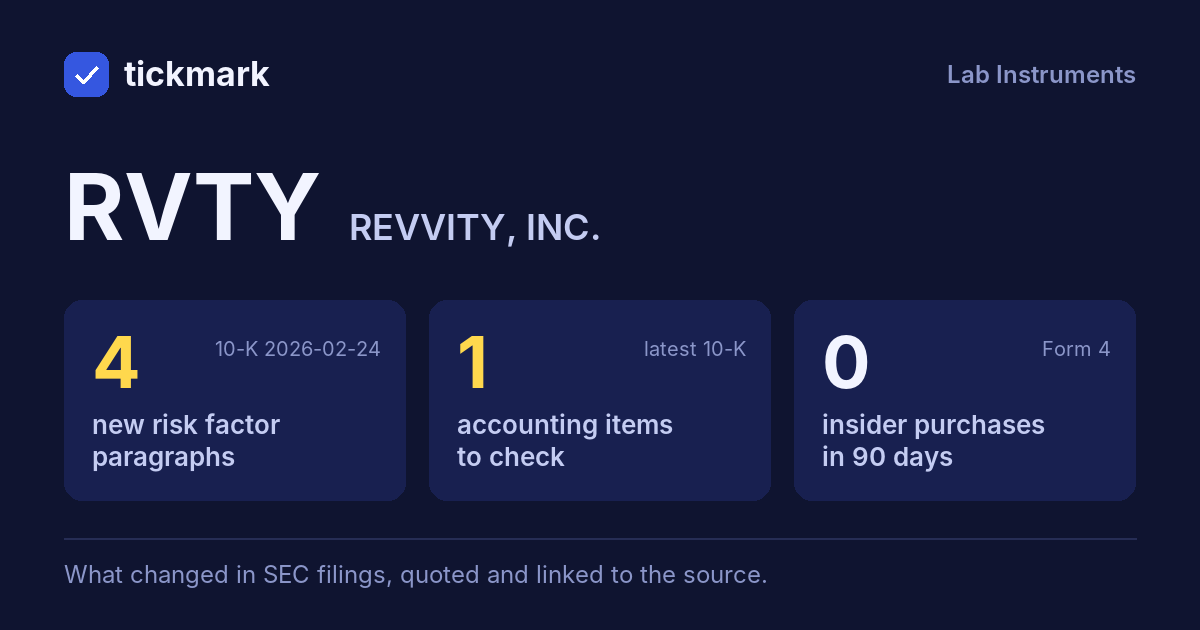
Sentences and paragraphs of RVTY's Risk Factors and MD&A, 10-K 2026-02-24 against 10-K 2025-02-25.
Each links to the text at sec.gov.
AddedRisk Factors
•changes in trade policy applicable to the regions in which we do business, including changes in U.S. trade policies or the imposition of higher tariffs on products being shipped into and from the U.S.,
Read it in 10-K 2026-02-24 at sec.gov ↗
AddedRisk Factors
Uncertainties related to the development, deployment and use of AI to advance our product offerings and improve internal operations may result in harm to our business and reputation.
Read it in 10-K 2026-02-24 at sec.gov ↗
AddedRisk Factors
We are advancing AI across our product and service offerings, and we are in the initial phases of expanding AI into the core functions of our business. The development and deployment of AI presents both risks and opportunities, and the implementation process could adversely impact the operations of our business as a whole. AI algorithms utilized in the deployment may be flawed or based on datasets that are biased or insufficient, and do not adequately take into account the underlying nature of our business. Failure to adequately train our employees during the deployment of AI could adversely impact our business or result in delays or errors in our offerings. Our competitiveness could also be negatively impacted by our failure to timely develop or deploy AI in our products and services, particularly if our competitors are successful in AI advancements in their products and services. The development of AI technology will require significant investment in resources and human capital and could increase our costs. There is uncertainty related to the legal and regulatory landscape surrounding rapidly evolving AI technologies, particularly in the areas of cybersecurity, intellectual property, and privacy and data protection. Failure to comply or appropriately respond to this developing landscape may result in increased legal liability, adverse regulatory action, or reputational damage.
Read it in 10-K 2026-02-24 at sec.gov ↗
AddedRisk Factors
We cannot predict the scope, timing, or impact of threatened U.S. tariffs on imports, the extent to which other countries may impose retaliatory trade restrictions, or the terms of future trade policy changes. Tariffs implemented during fiscal year 2025 increased our cost of revenue by approximately $25 million and reduced our gross margin by approximately $20 million, primarily affecting products manufactured in Europe for the U.S. market. While we have implemented mitigation strategies including manufacturing optimization, supplier collaboration, pricing adjustments, and temporary cost measures, these actions may not fully offset the impact of existing or future tariffs. Additional tariffs or trade restrictions may materially and adversely affect our results of operations, financial condition, and competitive position.
Read it in 10-K 2026-02-24 at sec.gov ↗
AddedMD&A
post-acquisition added an incremental expense of $0.6 million for fiscal year 2024. Amortization of intangible assets was $141.1 million for fiscal year 2025, as compared to $144.4 million for fiscal year 2024.
Read it in 10-K 2026-02-24 at sec.gov ↗
AddedMD&A
Tariffs enacted and implemented during fiscal year 2025 increased our cost of revenue by approximately $25 million. Through proactive mitigation efforts, the net impact on gross margin was approximately $20 million. The majority of this impact affected products manufactured in Europe and sold in the U.S. market. Our comprehensive mitigation strategy included manufacturing optimization, supplier collaboration, selective pricing adjustments, and targeted temporary cost measures to minimize ongoing financial exposure.
Read it in 10-K 2026-02-24 at sec.gov ↗
AddedMD&A
Our outstanding €500,000 Principal 1.875% Senior Unsecured Notes due in 2026 (“2026 Notes”) will mature in July 2026. We expect to repay the 2026 Notes with our existing cash on hand or borrowings under our senior unsecured revolving credit facility, or a combination thereof.
Read it in 10-K 2026-02-24 at sec.gov ↗
AddedMD&A
Income taxes: Significant judgment is required in determining our worldwide provision for income taxes and recording the related tax assets and liabilities. In the ordinary course of our business, there are operational decisions, transactions, facts and circumstances, and calculations for which the ultimate tax determination is not certain. Furthermore, our tax positions are periodically subject to challenge by taxing authorities throughout the world. We provide reserves for potential payments of tax to various tax authorities related to uncertain tax positions. These reserves are based on a determination of whether a tax benefit taken by the Company in its tax filings is more likely than not to be sustained upon audit based on its technical merits. The tax benefit recognized is measured as the largest amount that is more likely than not to be realized upon ultimate settlement. We regularly review our tax positions in each significant taxing jurisdiction and adjustments are made to our unrecognized tax benefits when: (i) facts and circumstances regarding a tax position change, causing a change in our judgment regarding that tax position; (ii) a tax position is effectively settled with a tax authority at a differing amount; and/or (iii) the statute of limitations expires regarding a tax position. Any significant impact as a result of changes in underlying facts, law, tax rates, tax audit, or review could lead to adjustments to one or more of our income tax expense, our effective tax rate, or our cash flow, see Note 6, Income Taxes, in the Notes to the Financial Statements.
Read it in 10-K 2026-02-24 at sec.gov ↗
Show the other 1
AddedMD&A
Deferred tax assets and liabilities are recognized for the estimated future tax consequences attributable to differences between the financial statement carrying amounts of assets and liabilities and their respective tax bases. This method also requires the recognition of future tax benefits such as net operating loss carryforwards and tax credits, to the extent that realization of such benefits is more likely than not. We have established valuation allowances against a variety of deferred tax assets, including state net operating loss carryforwards, state income tax credit carryforwards, and certain foreign tax attributes. Valuation allowances take into consideration our ability to utilize these deferred tax assets and reduce the value of such items to the amount that is deemed more likely than not to be recoverable. In evaluating our ability to recover our deferred tax assets within the jurisdiction from which they arise, we consider all available positive and negative evidence, including reversals of deferred tax liabilities, projected future taxable income, tax planning strategies, and results of recent operations. In projecting future taxable income, we begin with historical results adjusted for non-recurring income and expense and incorporate assumptions and judgments about the future pretax operating income adjusted for items that do not have tax consequences. These assumptions about future taxable income require significant judgment and are consistent with the plans and estimates we are using to manage the underlying business. Changes in our assumptions regarding the appropriate amount for valuation allowances could result in an increase or decrease in the valuation allowance, with a corresponding charge or benefit to our tax provision.
Read it in 10-K 2026-02-24 at sec.gov ↗