tickdelta
Sign in

Tickdelta is free for now. Sign up and get Pro free

← Screener

RVTYRevvity

Health care · Lab Instruments · NYSE

We are a leading provider of health science solutions, technologies, expertise and services that deliver complete workflows from discovery to development, and diagnosis to cure. 10-K, Item 1

Employees
11,000
Headquarters
Waltham, MA
CEO
Prahlad R. Singh
Next results
around Jan 12, 2027
Compare with peers → Embed

When the SEC's staff reviews a filing, it writes to the company with numbered questions, and the company answers each one in a letter. SEC publishes the exchange once the review is over, at least 20 business days later. Below: what the staff asked RVTY, and the company's answer to each question, quoted from the letters. A question is not an accusation; most reviews end with the company adding detail to its next filing.

Form 10-K for the Fiscal Year Ended January 2, 2022

2022-06-30 to 2022-07-12 · 1 question · 1 letter from the SEC, 1 from the company
Review closed 2022-07-12
Results discussion (MD&A)Liquidity and cash
Item 2. Management's Discussion and Analysis of Financial Condition and Results of · Operations, page 25
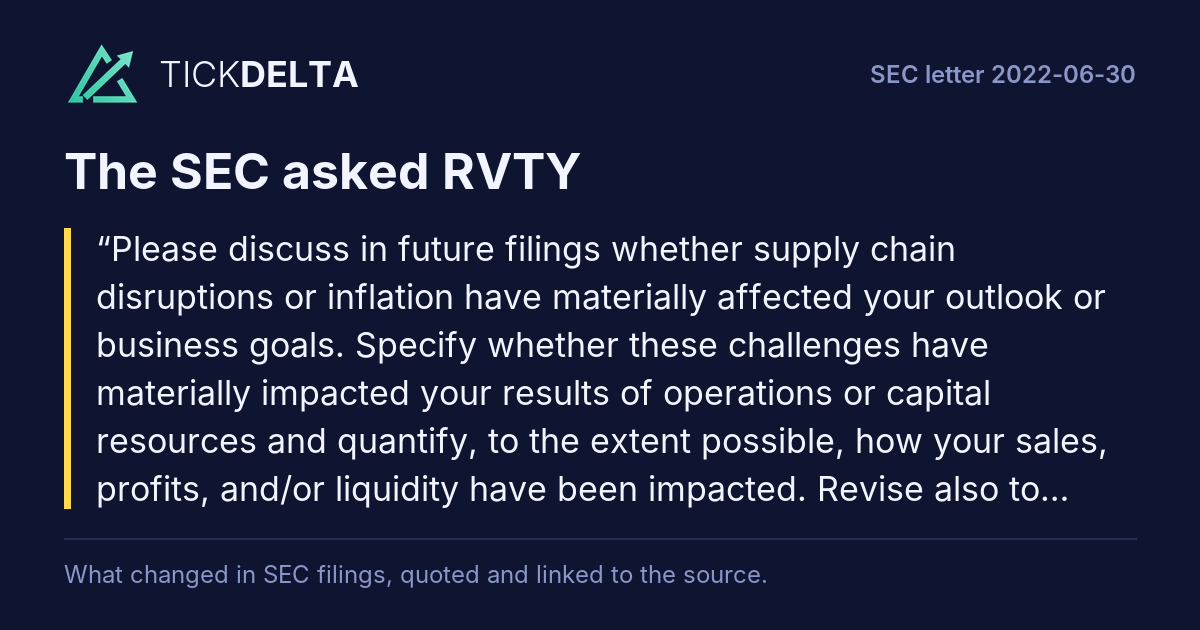
SEC asked
Please discuss in future filings whether supply chain disruptions or inflation have materially affected your outlook or business goals. Specify whether these challenges have materially impacted your results of operations or capital resources and quantify, to the extent possible, how your sales, profits, and/or liquidity have been impacted.
Rest of the question

Revise also to discuss in future filings any known trends or uncertainties resulting from mitigation efforts undertaken, if any. Explain whether any mitigation efforts introduce new material risks, including those related to product quality, reliability, or regulatory approval of products.

RVTY answered
1:

We acknowledge the Staff’s comment, and commencing with the quarter ended July 3, 2022 filing, the Company will provide additional disclosures discussing whether supply chain disruptions or inflation have materially affected our outlook or business goals and whether these challenges have materially impacted our results of operations or capital resources. We will provide quantitative disclosures, to the extent possible, of its impact to our sales, profits and/or liquidity.
Rest of the answer

We will also disclose any known trends or uncertainties resulting from mitigation efforts undertaken, if any, and whether any mitigation efforts introduce new material risks, including those related to product quality, reliability or regulatory approval of products.

If you or the Staff should have additional questions or comments, please do not hesitate to contact me at 781-663-5654.

Read in the reply ↗
In its next report

First report after the company's reply of 2022-07-08: 10-Q filed 2022-08-09 ↗, against the 10-Q filed 2022-05-10 ↗.

Tickdelta does not hold the text of both reports, so they are not compared here.
Also in this review: closing letter, 2022-07-12
Form 10-K for the Fiscal Year Ended December 31, 2017

2018-11-16 to 2018-11-29 · 1 question · 1 letter from the SEC, 1 from the company
Review closed 2018-11-29
Russia and Ukraine
General
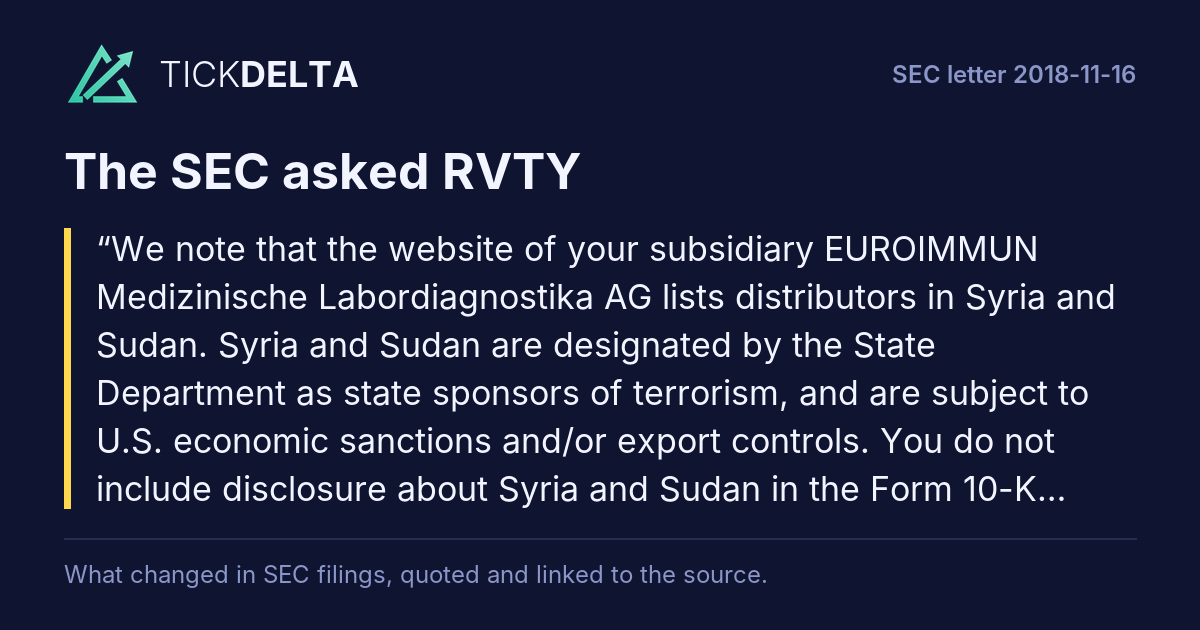
SEC asked
We note that the website of your subsidiary EUROIMMUN Medizinische Labordiagnostika AG lists distributors in Syria and Sudan. Syria and Sudan are designated by the State Department as state sponsors of terrorism, and are subject to U.S. economic sanctions and/or export controls. You do not include disclosure about Syria and Sudan in the Form 10-K.
Rest of the question

Please describe to us the nature and extent of your past, current and anticipated contacts with Syria and Sudan, including contacts with their governments, whether through subsidiaries, distributors or other direct or indirect arrangements.

RVTY answered
PerkinElmer did not include disclosure about Syria and Sudan (the “Sanctioned Countries”) in its Form 10-K for the Fiscal Year Ended December 31, 2017 because PerkinElmer did not make material sales or maintain any material operations or contacts in the Sanctioned Countries during 2017.

In 2015 and 2016, PerkinElmer did not make any sales or maintain any material operations or contacts in the Sanctioned Countries.

As noted in the Commission’s letter, EUROIMMUN AG (“EUROIMMUN”), which was acquired by PerkinElmer on December 17, 2017, maintains relationships with a distributor in each of the
Rest of the answer

Sanctioned Countries. PerkinElmer also makes minimal sales into Sudan through its Tulip Diagnostics Pvt Ltd (“Tulip”) business headquartered in Goa, India, which was also acquired by

PerkinElmer on January 31, 2017. The nature of PerkinElmer’s contacts in the Sanctioned Countries is limited to the relationships with and sales of human disease diagnostic products and medical devices through distributors in these businesses.

In 2017, PerkinElmer made aggregate sales to Sudan of €3,335 through its Tulip business.

To date in 2018, PerkinElmer has made sales into Sudan of €5,493 through its Tulip business and €170,638 through its EUROIMMUN business. To date in 2018, PerkinElmer has made sales into Syria through its EUROIMMUN business of €39,730.

PerkinElmer anticipates a similar level of sales into the Sanctioned Countries in the future. Certain of the sales made to the Sanctioned Countries were made to hospitals, laboratories or other health care facilities, which may be owned or controlled in whole or in part by government agencies.

PerkinElmer’s activities in the Sanctioned Countries have been performed in full compliance with applicable U.S. laws and regulations, including regulations promulgated by the Department of the Treasury’s Office of Foreign Assets Control (“OFAC”) and/or the Department of Commerce’s Bureau of Industry and Security (“BIS”). Any anticipated contacts with and activities in the Sanctioned Countries relate solely to similar activities in compliance with all applicable U.S. laws and regulations, including, to the extent necessary, pursuant to any required licenses or exceptions therefrom.

Trade control and sanctions compliance at PerkinElmer is overseen by its International Trade Compliance (“ITC”) organization under the Office of the

General Counsel. PerkinElmer’s ITC organization maintains a formal trade compliance program that includes policies, procedures, and employee training designed to ensure that all activity relating to trade compliance and the Sanctioned

Countries is conducted in conformity with applicable U.S. laws and regulations.

PerkinElmer reported revenue of approximately $2,256,982,000 for the 2017 fiscal year and has forecast to exceed this revenue total in 2018. None of the activities described above in the Sanctioned Countries involve amounts that are material to PerkinElmer, either individually or in the aggregate, and

PerkinElmer does not consider the level of activity described above to be quantitatively material.

2 | Page

Because PerkinElmer sells small quantities of product into the Sanctioned Countries designed to detect and prevent human disease, and because PerkinElmer’s minimal contacts with the Sanctioned Countries are in full compliance with applicable U.S. laws and regulations and are consistent with our robust ITC compliance program described above, we do not believe that these activities constitute material information or would otherwise be viewed negatively by our investors.

If you would like to speak with me regarding these matters, please do not hesitate to call me at (781) 552-1187.

Read in the reply ↗

Also in this review: closing letter, 2018-11-29

Form 10-K for the Fiscal Year Ended December 30, 2012

2013-11-25 to 2013-12-16 · 4 questions · 1 letter from the SEC, 1 from the company
Review closed 2013-12-16
Liquidity and cashIncome taxesResults discussion (MD&A)
Operations · Liquidity and Capital Resources, page 43
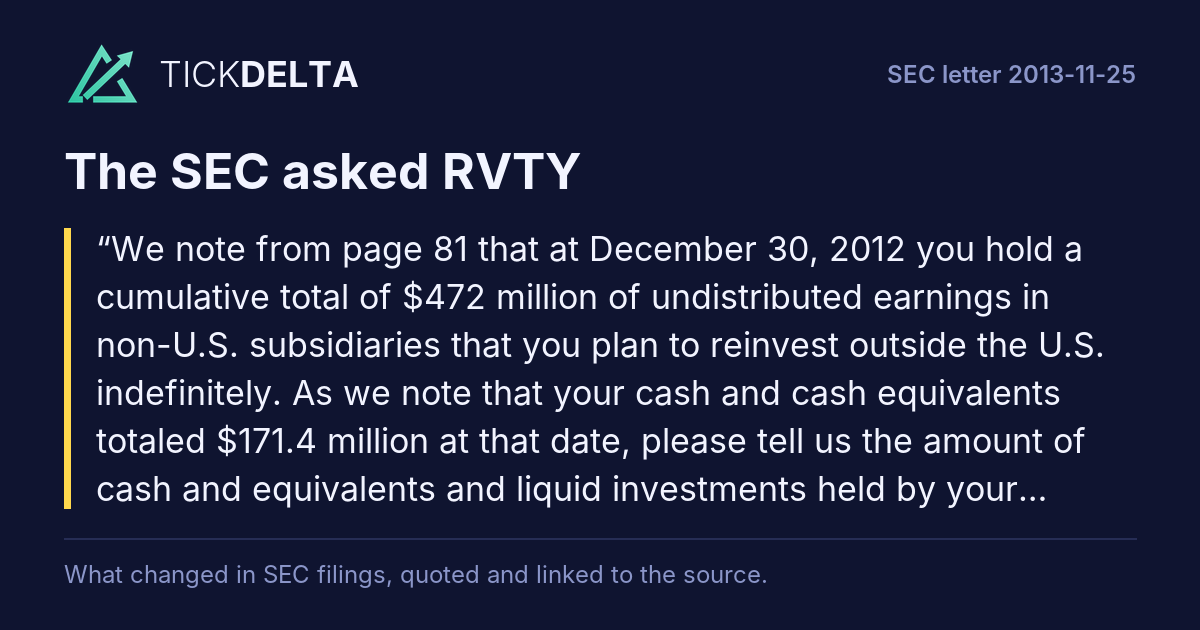
SEC asked (1)
We note from page 81 that at December 30, 2012 you hold a cumulative total of $472 million of undistributed earnings in non-U.S. subsidiaries that you plan to reinvest outside the U.S. indefinitely. As we note that your cash and cash equivalents totaled $171.4 million at that date, please tell us the amount of cash and equivalents and liquid investments held by your foreign subsidiaries at December 30, 2012 and
Rest of the question

quantify the amount that would not be available for use in the U.S. without incurring U.S taxes.

RVTY answered
1:

The amount of cash and cash equivalents held by the Company’s non-U.S. subsidiaries at December 30, 2012 was $166.4 million, or 97% of the total amount of cash and cash equivalents on the Company’s balance sheet. The Company had no other liquid investments at December 30, 2012. The Company would incur U.S. taxes on $146.9 million of the $166.4 million of cash and cash equivalents held outside the U.S. at December 30, 2012, if transferred to the U.S. without proper planning.
Rest of the answer

However, as part of the Company’s planned repatriation, which is discussed on page 81 in Note 6 to the consolidated financial statements included in the 2012 Form 10-K, the Company made a provision for the U.S. taxes on $120.8 million of unremitted earnings of non-U.S. subsidiaries at December 30, 2012. The Company has remitted $120.8 million to the U.S. during fiscal year 2013 in accordance with its planned repatriation with minimal U.S. taxes incurred.

Please see our response to comment #2 regarding supplemental disclosures that will be in future filings.

Read in the reply ↗
In its next report

First report after the company's reply of 2013-12-10: 10-K filed 2014-02-25 ↗, against the 10-K filed 2013-02-26 ↗.

Tickdelta does not hold the text of both reports, so they are not compared here.

Operations · Liquidity and Capital Resources, page 43
SEC asked (2)
Further, as we note from page 109 that the majority of your net long-lived assets are in the U.S., please discuss for us the impact on your liquidity and capital positions if cash and cash equivalents as well as liquid investments held by your foreign subsidiaries were not available for use in the U.S.
Rest of the question

Similarly, discuss the impact of income tax liabilities you would incur if you were to repatriate the cash and cash equivalents as well as liquid investments held by your foreign subsidiaries to the U.S.

RVTY answered
2:

The Company believes that there would be no material impact on the Company’s liquidity and capital positions if cash and cash equivalents held by its non-U.S. subsidiaries were not available for use in the U.S. The Company anticipates that its U.S. operations will generate sufficient cash to fund its liquidity needs in the U.S., which includes working capital requirements, capital expenditures, interest and principal payments on debt, pension funding, and dividends on common stock.
Rest of the answer

In addition, as of December 30, 2012, the Company had a senior unsecured revolving credit facility with $429.7 million of additional borrowing capacity. The Company believes that U.S. operating cash flow, together with access to its senior unsecured revolving credit facility, will be adequate to meet any requirements to fund its liquidity needs in the U.S.

The Company utilizes a variety of tax planning and financing strategies to ensure that the cash and cash equivalents held by the Company and its non-U.S. subsidiaries is available in the locations in which it is needed without incurring significant tax costs in the foreseeable future. As discussed in the Company’s response to comment #1 above, as part of the Company’s planned repatriation, which is discussed on page 81 in Note 6 to the consolidated financial statements included in the 2012 Form 10-K, the Company made a provision for the U.S. taxes on $120.8 million of unremitted earnings of non-U.S. subsidiaries at

December 30, 2012. The Company has remitted $120.8 million to the U.S. during fiscal year 2013 in accordance with its planned repatriation with minimal U.S. taxes incurred, which were not significant to the Company’s liquidity and capital positions.

In future filings on Form 10-K and Form 10-Q, the Company will supplement its disclosure in the Liquidity and Capital Resources discussion in the Management’s Discussion and Analysis of Financial Condition and Results of Operations to include a discussion of the amount of cash and cash equivalents held by the Company’s non-U.S.

subsidiaries. Below, we have supplemented the 2012 disclosure to provide an example of the disclosure we intend to provide in future filings:

At December 30, 2012, we had cash and cash equivalents of $171.4 million, of which $166.4 million was held by our non-U.S.

subsidiaries, and $429.7 million of additional borrowing capacity available under a senior unsecured revolving credit facility. We had no other liquid investments at December 30, 2012.

We utilize a variety of tax planning and financing strategies to ensure that our worldwide cash is available in the locations in which it is needed. As a result of the Caliper acquisition, we concluded in fiscal year 2011 that certain foreign operations did not require the same level of capital as previously expected, and therefore we planned to repatriate approximately $350.0 million of previously unremitted earnings and have provided for the estimated taxes on the repatriation of those earnings. As a result of the planned repatriation, we recorded an increase to our tax provision of $79.7 million in continuing operations during the fourth quarter of fiscal year 2011. We expect to utilize tax attributes, primarily those acquired in the Caliper acquisition, to minimize the cash taxes paid on the repatriation. As of December 30, 2012, we had remitted $229.2 million of the $350.0 million planned repatriation and we expect to remit the remainder of the planned repatriation amount by the end of fiscal year 2013. Of the $166.4 million of cash and cash equivalents held by our non-U.S. subsidiaries at

December 30, 2012, we would incur U.S. taxes on $146.9 million if transferred to the U.S. without proper planning. However, at December 30, 2012 as part of our planned repatriation, we provided for the U.S. taxes on $120.8 million of unremitted earnings of our non-U.S. subsidiaries. We intend to remit $120.8 million to the U.S. during fiscal year 2013 in accordance with our planned repatriation with minimal U.S. taxes expected to be incurred. We expect the remaining accumulated non-U.S. cash balances will remain outside of the U.S. and that we will meet U.S. liquidity needs through future cash flows, use of U.S. cash balances, external borrowings, or some combination of these sources.

Item 8. Financial Statements

Note 4.

Read in the reply ↗
In its next report

First report after the company's reply of 2013-12-10: 10-K filed 2014-02-25 ↗, against the 10-K filed 2013-02-26 ↗.

Tickdelta does not hold the text of both reports, so they are not compared here.

Item 8. Financial Statements · Note 4. Restructuring and Contract Termination Charges, net, page 74
SEC asked (3)
With respect to your Q3 2012 restructuring plan, we note that you do not expect to complete the plan until the fourth quarter of fiscal 2015. Please summarize for us the terms of the plan and discuss how you are accounting for and measuring the associated costs. Refer to FASB ASC 420-10-25, 10-30 and 10-55.
RVTY answered
3:

The Q3 2012 restructuring plan related primarily to workforce reductions at one of the Company’s non-U.S. subsidiaries. The reductions were part of reorganization activities intended to shift certain of the Company’s Southern European operations into a newly established shared service center. During the third quarter of fiscal year 2012, the Company negotiated and agreed to a workforce reduction plan in coordination and consultation with the local works council, subject to local law.
Rest of the answer

The workforce reduction plan set forth the terms and benefits for the involuntary employee terminations, and detailed those employees that would receive their severance payment as a lump sum and those employees that would receive their severance payment in monthly installments paid through the fourth quarter of fiscal year 2015. All affected employees were notified of termination during the third quarter of fiscal year 2012, and no employees were required to provide services beyond the minimum retention period. The majority of the severance benefits will be paid out as of the end of fiscal year 2013.

These severance benefits were accounted for as a one-time involuntary benefit arrangement. These benefits were accounted for under FASB ASC 420-10-30-5 whereby the fair value of the liability was calculated at the measurement date and recognized immediately as an expense since future services were not required in order to receive the benefits. This was also consistent with management’s approval and commitment to the restructuring plan and the communication of the plan details to affected employees within the third quarter of fiscal year 2012. The restructuring plan identified the number of employees to be terminated, their job classification or function, their location and the date that the plan was expected to be completed. The plan established the terms of the benefit arrangement by employee and the amount of benefits that they would receive upon their involuntarily termination. There were no significant changes to the plan and no material modifications or changes to the plan after communication of the plan to the affected employees.

Read in the reply ↗
In its next report

First report after the company's reply of 2013-12-10: 10-K filed 2014-02-25 ↗, against the 10-K filed 2013-02-26 ↗.

Tickdelta does not hold the text of both reports, so they are not compared here.

Note 6. Income Taxes, page 77
SEC asked (4)
Please tell us the nature of the change in your valuation allowance of $14.4 million in fiscal 2012 that resulted in the tax benefit of $17.9 million.
RVTY answered
4:

The

Company regularly evaluates positive and negative evidence available to determine if valuation allowances are required or if existing valuation allowances are no longer required. The change in the Company’s valuation allowance during fiscal year 2012 was primarily due to the reversal of valuation allowances for two of the Company’s non-U.S. subsidiaries when it became more likely than not that the subsidiaries’ deferred tax assets would be realized.
Rest of the answer

For the first non-U.S.

subsidiary, in the fourth quarter of 2012, the subsidiary’s operating results shifted from three years of cumulative losses to three years of cumulative income, with the latter years being considerably more profitable. This shift in operating results as well as strong projections of future income was sufficient positive evidence to release the existing valuation allowance. For the second non-U.S. subsidiary, the Company identified and implemented a tax strategy, as a result of recent acquisition activity, in which this non-U.S. subsidiary, which held accumulated losses, was merged with a group of profitable non-U.S. subsidiaries. Completing this merger permitted the Company to file a consolidated return and utilize the historical losses of the non-U.S. subsidiary to offset the profits from the group of profitable subsidiaries. Therefore, the valuation allowance was no longer required and the valuation allowance was reversed.

In future filings the Company will supplement its disclosure in the Notes to Consolidated Financial Statements to include a description of the events and circumstances related to significant changes in the valuation allowance.

Pursuant to the request of the Staff contained in your letter, the Company acknowledges that it is responsible for the adequacy and accuracy of the disclosure in the filing; that Staff comments or changes to disclosure in response to the Staff’s comments do not foreclose the Commission from taking any action with respect to the filing; and that the Company may not assert Staff comments as a defense in any proceeding initiated by the Commission or any person under the federal securities laws of the United States.

If you or the Staff should have additional questions or comments, please do not hesitate to contact me at 781-663-5654.

Read in the reply ↗
In its next report

First report after the company's reply of 2013-12-10: 10-K filed 2014-02-25 ↗, against the 10-K filed 2013-02-26 ↗.

Tickdelta does not hold the text of both reports, so they are not compared here.

Also in this review: closing letter, 2013-12-16

From the SEC's correspondence on EDGAR: staff letters (form UPLOAD) and company letters (form CORRESP), 9 letters filed since 2013-11-25. Questions and answers are matched by their numbers; topics come from words in each question. The reports are compared word for word (same form, before the first SEC letter against the first report after the company's reply). No AI.

Work on RVTY in a spreadsheet: Excel workbook (a sheet per section, ten years by column, charts, links to the filings) · CSV. For a Google Sheet that stays up to date, paste =IMPORTDATA("https://tickdelta.com/company/RVTY/export.csv") into a cell.