Recursion Pharmaceuticals, Inc. RXRX
New risk paragraphs, branching off last year
Each branch is a paragraph in Risk Factors with nothing like it in the 10-K filed Feb 28, 2025. A box jumps to the paragraph as filed, below.
Paragraphs with nothing like them in last year's 10-K
14 paragraphs in Risk Factors of the 10-K filed Feb 25, 2026 with nothing like them in the 10-K filed Feb 28, 2025. Quoted exactly. Paragraphs that were only edited are under 10-K change.
maintain our research and development efforts, develop a pipeline of drug candidates, enter into collaborations, or even continue our operations.
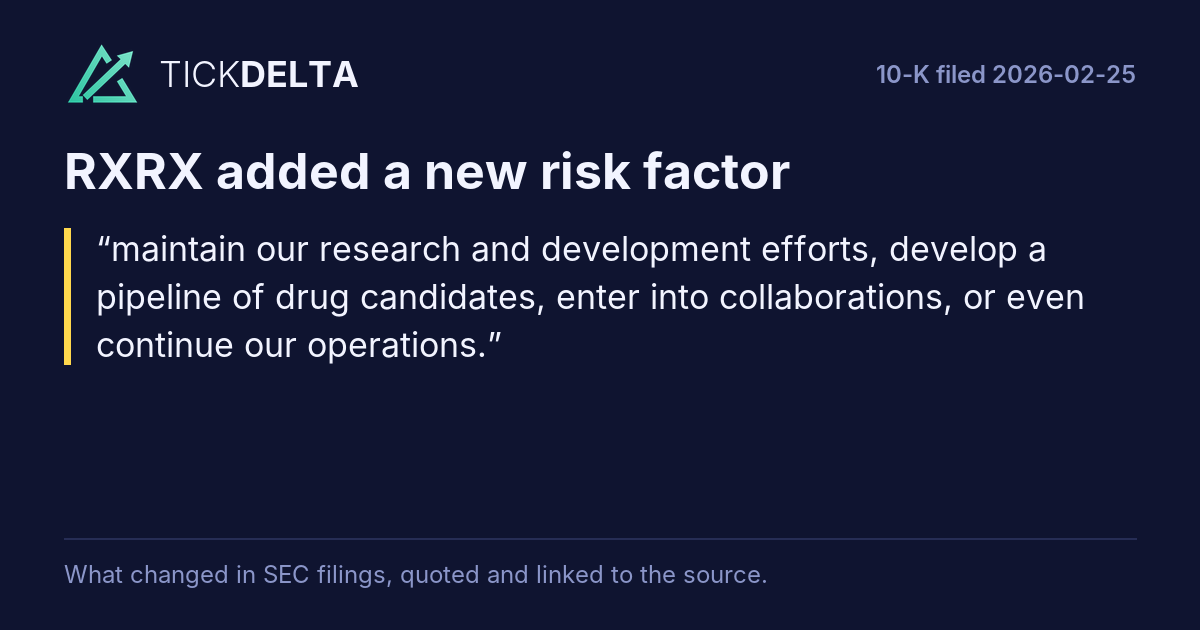
issued patent claims covering the composition of matter of REC-994, REC-2282, REC-4881, REC-3964, REC-617, REC-1245, REC-3565, REC-102, or REC-4539.
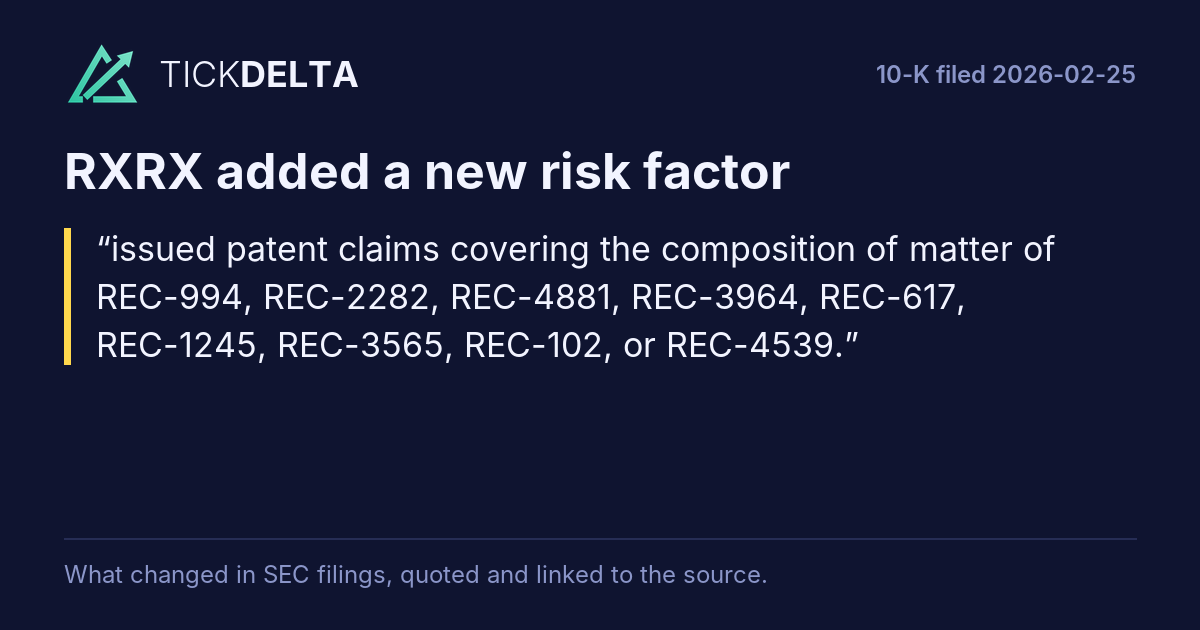
Increasing scrutiny and changing expectations from governments, regulators, and third-parties relating to environmental, social and governance (ESG) policies and practices may cause us to incur additional costs, expose us to additional risks or impact our reputation.
In recent years, there has been increasing public focus and scrutiny from certain investors, employees and other stakeholders concerning corporate responsibility, specifically related to ESG factors. In addition to the changing rules and regulations related to ESG matters imposed by governmental and self-regulatory organizations, a variety of third-party organizations, institutional investors and customers evaluate the performance of companies on ESG topics, and the results of these assessments are widely publicized. These changing rules, regulations and stakeholder expectations have resulted in, and are likely to continue to result in, increased general and administrative expenses and increased management time and attention spent complying with or meeting such regulations and expectations. Reduced access to or increased cost of capital may occur as financial institutions and investors increase expectations related to ESG matters. Third-party providers of ESG ratings and reports on companies have increased in number, resulting in varied and, in some cases, inconsistent standards and frameworks. Topics considered in such assessments include, among others, our efforts and impacts with respect to climate change; diversity, equity and inclusion (DEI); and the role of our board of directors in supervising various sustainability issues.
Developing and acting on initiatives within the scope of ESG, and collecting, measuring and reporting ESG-related information and metrics can be costly, difficult, and time consuming and is subject to evolving reporting standards. We may also communicate certain initiatives and goals, regarding environmental matters, diversity, social investments and other ESG-related matters, in our SEC filings or in other public disclosures. These initiatives and goals within the scope of ESG could be difficult and expensive to implement, the technologies needed to implement them may not be cost effective and may not advance at a sufficient pace, and we could be criticized for the accuracy, adequacy or completeness of the disclosure. Furthermore, statements about our ESG-related initiatives and goals, and progress against those goals, may be based on standards for measuring progress that are still developing, internal controls and processes that continue to evolve and assumptions that are subject to change in the future. In addition, we could be criticized for the scope or nature of such initiatives or goals, or for any revisions to these goals. If our ESG-related data, processes and reporting are incomplete or inaccurate, or if we fail to achieve progress with respect to our goals, including our previously announced commitments to reduce greenhouse gas emissions, within the scope of ESG on a timely basis, or at all, our reputation, business, financial performance and growth could be adversely affected. In addition, in recent years “anti-ESG” sentiment has gained momentum across the U.S., with several states and Congress having proposed or enacted “anti-ESG” policies, legislation, or initiatives or issued related legal opinions, and the President having recently issued an executive order opposing DEI initiatives in the private sector. Such anti-ESG and anti-DEI-related policies, legislation, initiatives, litigation, legal opinions, and scrutiny could result in our facing additional compliance obligations, becoming the subject of investigations and enforcement actions, or sustaining reputational harm.
If our business practices do not meet evolving investor, government agency or other stakeholder expectations and standards with respect to ESG, then our reputation, our ability to attract or retain employees and the market price of our securities could be negatively impacted. New governmental regulations could result in new directives and new or more stringent forms of ESG oversight and disclosures which may lead to increased expenditures for sustainability initiatives, which in turn could have a material adverse effect on our business, financial condition, cash flows and results of operations and could cause the market value of our common stock to decline.
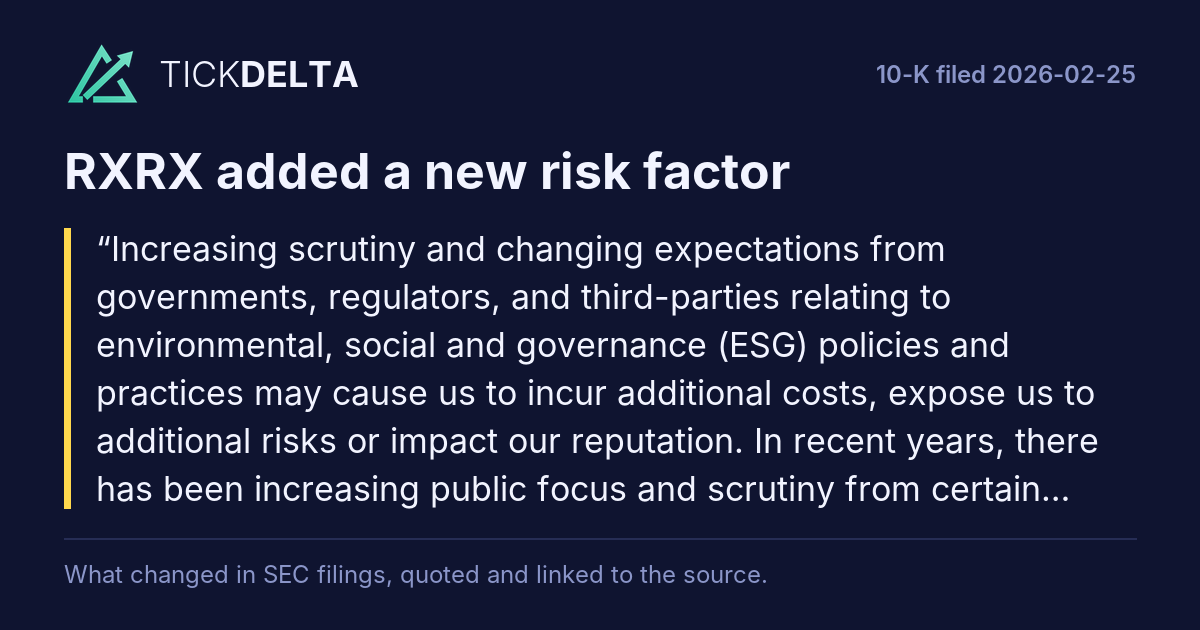
not engaged in practices that purposefully and unfairly undercut market prices and drive price hikes in the U.S. In November 2025, CMS announced a voluntary initiative called the GENEROUS Model (GENErating cost Reductions for U.S. Medicaid Model) to introduce the option of most-favored-nation pricing to the Medicaid program, whereby a drug manufacturer may voluntarily offer supplemental rebates to participating state Medicaid programs for a manufacturer’s covered outpatient drugs. Government agreements with pharmaceutical companies and other measures that use most-favored-nation pricing targets for prescription drugs or that increase generic and biosimilar drug entry sooner than expected can have a material adverse effect on our industry, ability to set adequate pricing for new drugs to recover R&D costs, ability to attract potential investors and potential buyers in the future, or the pricing of our approved product in the U.S. and in foreign countries. The impact of future legislative, executive, and administrative actions and agency rules implemented by the current administration on us and the pharmaceutical industry as a whole is unclear. The implementation of cost containment measures or other healthcare reforms may prevent us from being able to generate revenue, attain profitability, or commercialize our product candidates if approved. Complying with any new legislation and regulatory changes could be time-intensive and expensive, resulting in a material adverse effect on our business, and expose us to greater liability.
We currently have operations in the United States (Salt Lake City and New York), The United Kingdom (London and Milton Park) and Canada (Montreal). While these locations are in or near major biotechnology and technology hubs,
Show the other 3
If we achieve success in our clinical trials, we would need to scale our operations to support commercialization, and we may encounter difficulties in managing this growth.
While we do not anticipate significant growth in our workforce or the scope of our operations in the near-term, our long-term strategy depends on the successful development and subsequent commercialization of our product candidates. If we achieve positive clinical results, we expect to experience a period of rapid scaling to build the necessary development, regulatory, sales, marketing, and distribution capabilities. To manage this future growth, we must continue to improve our managerial, operational, and financial systems. Shifting from a research-focused organization to a commercial-stage company presents significant operational and cultural challenges. We may not be able to effectively manage this future expansion or recruit and train the additional qualified personnel required for commercialization. If we are unable to manage this long-term scaling effectively, our ability to generate revenue from our product candidates would be compromised.
We may acquire additional businesses, products, form strategic alliances, or create joint ventures and we may not realize the benefits of such transactions.
We have recently undertaken a cost reduction plan and may do so again in the future. The assumptions underlying these activities may prove to be inaccurate, or we may fail to achieve the expected benefits therefrom.
As part of our strategic positioning to reduce costs and adapt to regulatory policy uncertainty, we announced in June 2025 a cost reduction plan to promote the long-term sustainability and scalability of the Company. As part of this plan, we have reduced our workforce. This reduction in force, and any other future reductions, and the attrition that may occur following them, result in the loss of institutional knowledge and expertise and the reallocation and combination of certain roles and responsibilities across the organization, all of which could adversely affect our operations. These actions and other additional measures we might take to reduce costs could strain our workforce, divert management attention, yield attrition beyond our intended reduction in force, reduce employee morale, cause us to delay, limit, reduce or eliminate certain development plans or otherwise interfere with our ability to operate and grow our business effectively, each of which could have an adverse impact on our business, operating results and financial condition. We may not complete the current or any cost reduction plan and reorganization on
the anticipated timetable, and even if successfully completed, we may not achieve the anticipated cost savings, operating efficiencies or other benefits of such activities.
Paragraphs in the 10-Q filed Nov 2, 2026 that were not in the one before
New in the latest 10-Q
45 paragraphs in the 10-Q filed Nov 2, 2026 with nothing like them in the 10-Q filed Aug 5, 2026 (at least half the words must differ; new numbers alone do not count). Quoted exactly, grouped by the item heading above them. This is text that changed, not a judgement of how serious it is.
10-Q
• the timing and outcome of our ongoing discussions with the FDA regarding a registrational path for REC-4881, including the design and timing of initiation of a registrational trial of REC-4881 in familial adenomatous polyposis;
Read in the 10-Q
• the planned expansion of REC-1245 into indication-specific cohorts, including endometrial cancer, at the selected expansion dose, and the timing of additional data from our clinical trial of REC-1245;
Read in the 10-Q
• Sanofi’s plans for the development candidate optioned under our collaboration, including the timing of any Phase 1 clinical trial, and our eligibility to receive future milestone payments and royalties under the collaboration;
Read in the 10-Q
• the extent to which interim, preliminary, or topline data from our clinical trials may be predictive of final results;
Read in the 10-Q
Financial statements and notes
In September 2026, the Company entered into an amendment to the Tempus agreement (the Amendment). Pursuant to the Amendment, the Company agreed to extend the term of the arrangement by a year, while eliminating the Company’s right to terminate for convenience. The Amendment also revised the amount of the annual license fees payable by the Company to $ 14.0 million, payable on each of the third, fourth, and fifth anniversaries of the effective date, with at least $ 4.0 million payable in cash, with the remainder in the form of shares of Class A Common Stock of the Company, cash, or a combination thereof, at the election of the Company; and decrease the aggregate total of unique records of de-identified data the Company may access during the term.
Read in the 10-Q
Show the other 40
Also in September 2026, the Company entered into an RNA Foundation Model License Agreement (the TxFM License Agreement) with Tempus, pursuant to which the Company granted Tempus a non-exclusive, non-sublicensable, non-transferable, worldwide license to the Company's TxFM Model solely for use within the field of oncology. Permitted uses include diagnostic applications, clinical applications, and Tempus's internal research and development. The TxFM License Agreement has a term of two years from its effective date. In consideration for the license, Tempus will pay the Company a non-refundable license fee of $ 12.0 million in two installments of
Read in the 10-Q
$ 6.0 million each; the first due upon execution of the TxFM License Agreement and the other due on the first anniversary of the effective date. Tempus will also provide the Company with access to a certain number of de-identified pathology records with linked clinical data during the term of the TxFM License Agreement.
Read in the 10-Q
September 30, December 31, (in thousands) 2026 2025 ───────────────────────────────────────────────────────────────────────────────────────────────────────── Accrued compensation $ 25,081 $ 31,771 Accrued compute and software liabilities 7,297 8,278 Accrued development expenses 4,292 2,693 Accrued early discovery expenses 4,335 4,581 Accrued professional fees 1,092 1,232 Materials received not invoiced 332 703 Accrued taxes, other than income taxes 3,985 3,436 Unearned grants 3,160 — Accrued license fees — 3,000 Accrued other expenses 17,077 14,536 Accrued expense and other liabilities $ 66,651 $ 70,230
Read in the 10-Q
inhibitor program for the treatment of hypophosphatasia (HPP), represented substantially all of the fair value of the gross assets acquired.
Read in the 10-Q
During the three months ended September 30, 2026, Recursion entered into three subleases for portions of the Company’s leased office and laboratory space in Salt Lake City, Utah, United States and Toronto, Ontario, Canada. The subleases have terms ranging from approximately 3 to 6 years. Each of these subleases were classified as
Read in the 10-Q
operating leases and as such, the Company still holds the related right-of-use assets and lease liabilities on its Condensed Consolidated Balance Sheets. The sublease income is recognized on a straight-line basis over the sublease term within “Other income, net” in the Condensed Consolidated Statements of Operations. Sublease income was not material, either individually or in the aggregate, for the three and nine months ended September 30, 2026. The subleases are not material to the condensed consolidated financial statements, either individually or in the aggregate.
Read in the 10-Q
infrastructure expenses consist of costs incurred to develop, maintain and operate the technology platform and the infrastructure that supports research and development activities. General and administrative costs primarily include the general and administrative costs within its Condensed Consolidated Statements of Operations, however it excludes depreciation, amortization and stock-based compensation, which instead are included in their respective categories.
Read in the 10-Q
For the three months ended September 30, 2026, Recursion revised its significant segment expenses breakout in light of the evolving composition of its activities. The comparative periods have been presented in accordance with these updated significant segment expenses.
Read in the 10-Q
Recursion is a leading clinical-stage company pioneering AI-enabled drug discovery and development decoding biology to radically improve lives. Recursion is advancing a portfolio of differentiated investigational medicines across its wholly owned and partnered pipeline in oncology, rare disease, neuroscience, immunology, and other therapeutic areas with significant unmet need. Enabling its mission is the Recursion OS, an AI-native, end-to-end drug discovery and development platform integrating biology, chemistry, and clinical development into a unified intelligence system. Powered by proprietary multimodal data, purpose-built AI models, and bilingual teams fluent in both science and AI, the Recursion OS is designed to translate complex science into medicines that matter - faster, better, and at scale - for patients who are waiting.
Read in the 10-Q
Positive Phase 2 results from ongoing TUPELO trial of REC-4881 in FAP highlight activity across GI tract and on larger polyps
Read in the 10-Q
FAP is a genetically defined driver of GI cancer, affecting >50,000 patients in the US and EU5 who face major surgeries and life-long surveillance with no approved therapies, representing a potential $15 billion opportunity, based on Company estimates. Among the approximately 35,000 post-colectomy patients, upper GI disease represents the highest unmet need in FAP, due to risks of bleeding and perforation from polyp removal, high complication and morbidity rates from surgery, and higher cancer risk.
Read in the 10-Q
REC-4881, a potential first-in-class oral therapy granted FDA Orphan Drug and Fast Track designations, is designed to address both Wnt/β-catenin initiation and MAPK evolution pathways. The opportunity was identified through unbiased phenotypic screening using Recursion’s proprietary AI foundation models, which revealed MEK1/2 inhibition as a potential way to reverse cellular phenotypes associated with APC loss, a previously unappreciated synthetic rescue relationship.
Read in the 10-Q
On November 2, Recursion announced further positive data from its ongoing Phase 1b/2 TUPELO trial of REC-4881, an investigational, oral MEK1/2 inhibitor in development for FAP. These data were presented by Lisa Boardman, M.D., Professor of Medicine at Mayo Clinic, in a presidential plenary session at The Collaborative Group of the Americas on Inherited Gastrointestinal Cancer (CGA-IGC) Annual Meeting in Denver, Colorado.
Read in the 10-Q
• Deep, durable reductions in total polyp burden, strengthened in the expanded adult FAP population (18+): After 12 weeks of REC-4881 (4 mg QD), 87% of patients (13 of 15) had a reduction in total polyp burden, with a 47% median reduction; approximately 1 in 3 achieved reductions of ≥65%. Twelve weeks after stopping treatment, 85% of evaluable patients (11 of 13) remained below baseline.
Read in the 10-Q
• Activity across the upper and lower GI tract, including near-clearance: After 12 weeks of treatment, median polyp burden reductions were 55% in the upper GI and 50% in the lower GI, supporting REC-4881’s potential as a single oral therapy to address FAP across the GI tract.
Read in the 10-Q
• Upper GI, the area of greatest unmet need in FAP (results first reported Oct. 15): 92% of patients (12 of 13) had reductions after 12 weeks of treatment, with two patients achieving ≥98% reductions; half (6 of 12) improved by at least one Spigelman stage; and 92% (11 of 12) remained below baseline 12 weeks after stopping treatment.
Read in the 10-Q
• New lower GI results highlight breadth of activity: 9 of 11 patients (82%) with measurable lower GI polyp burden at baseline had reductions after 12 weeks of treatment, with a 50% median reduction and 1 in 3 achieving ≥65%; 70% of evaluable patients remained below baseline 12 weeks after stopping treatment.
Read in the 10-Q
• New analysis shows substantial reductions in larger, higher-risk polyps: 6 of 8 patients with polyps >5 mm at baseline had fewer of these polyps after 12 weeks of treatment. Four achieved reductions of ≥80%, including two whose counts fell from more than 90 polyps to one. Six of eight remained below their baseline count 12 weeks after stopping treatment.
Read in the 10-Q
• No new safety signals observed: Favorable chronic dosing safety profile. The highest-grade treatment-related adverse event was Grade 1 or 2 in 21 of 26 patients (81%) and Grade 3 in four patients (15%); one patient had no TRAEs. No Grade 4 or 5 TRAEs, and no additional discontinuations since the previous data cutoff.
Read in the 10-Q
The Company anticipates initiating a registrational trial in the second half of 2027, pending ongoing FDA discussions, and will provide additional details later this year.
Read in the 10-Q
Early data from the Phase 1 dose-escalation portion of DAHLIA, our ongoing open-label Phase 1/2 study of REC-1245, show the following (data cutoff: August 21, 2026):
Read in the 10-Q
REC-1245 is a potential first-in-class oral molecular glue designed to exploit a synthetic-lethal vulnerability in cancers by degrading RBM39, a splicing factor that regulates genes involved in DNA repair and stress response. The Recursion platform contributed each of the three core elements of the program: the target, the molecule and the initial hypotheses on which patients are most likely to benefit. The target emerged from Recursion’s platform, which found that degrading RBM39 mimics the loss of CDK12, while sparing CDK13-associated liabilities. REC-1245 was identified within 18 months after screening only 204 compounds using Recursion’s design platform. The same platform-derived biology pointed to tumors intrinsically primed by replication stress and reliance on accurate splicing, including hard-to-treat cancers such as endometrial, hepatocellular and ovarian cancers and transcriptionally driven tumors.
Read in the 10-Q
• Three partial responses per RECIST 1.1 criteria (2 confirmed, 1 unconfirmed) in heavily pretreated patients with endometrial cancer and hepatocellular carcinoma, all at doses of 45 mg once daily (QD) or higher, with a disease control rate of 91.7% at those doses (n=12).
Read in the 10-Q
• Recursion has selected 45 mg QD for exploratory expansion cohorts, including endometrial cancer, where limited second-line treatments are approved; at the 45 mg QD dose (n=10), no dose-limiting toxicities or treatment-related serious adverse events were observed, and treatment-related adverse events were predominantly Grade 1 or 2. Most frequent TRAEs were Grade 1 or Grade 2 fatigue and anemia (30% each).
Read in the 10-Q
• Preliminary dose expansion data in endometrial cancer are expected in the second half of 2027. Dose escalation will also continue in other solid tumor indications.
Read in the 10-Q
As announced in October 2026, given the promising data in REC-4881 and REC-1245, Recursion plans to continue to focus resources on its high-impact partnerships and internal programs including REC-4881 (MEK1/2 - familial adenomatous polyposis), REC-1245 (RBM39 - endometrial cancer and other solid tumors), REC-4539 (LSD1 - solid tumors and hematology), REC-7735 (PI3Kα H1047R - solid tumors) and REC-102 (ENPP1 - hypophosphatasia). Recursion intends to pursue partnership opportunities to advance REC-617 (CDK7) and REC-3565 (MALT1).
Read in the 10-Q
Partnered Discovery Highlights Recursion’s 9th Milestone Achieved in Past Two Years
Read in the 10-Q
Sanofi has optioned the first development candidate from the two companies’ multi-program research collaboration. The candidate has now been added to Sanofi’s development pipeline and is expected to enter Phase 1 clinical trials in 2027, with Sanofi funding and leading further development and commercialization to advance the program toward patients.
Read in the 10-Q
The potential first-in-class oral small molecule was designed to achieve a differentiated profile against a challenging dual target implicated in inflammatory disease. Optimizing for this target pair required navigating complex and competing chemistry constraints to achieve the desired balance of drug-like properties. The candidate was delivered by the combination of Recursion’s integrated AI-enabled drug design platform and small-molecule chemistry capabilities with Sanofi’s deep expertise in drug discovery and immunology. Recursion applied multiple computational design approaches across iterative cycles of prediction, chemical design, synthesis, and experimental validation to rapidly explore and optimize a complex chemical space.
Read in the 10-Q
With the first development candidate optioned, the collaboration has now achieved six progress-based milestones across five programs. Additional programs across the collaboration continue to advance. Over the next 12 months, other programs in the joint portfolio have the potential to reach development candidate and other progress-based milestones.
Read in the 10-Q
Recursion announced that its Board of Directors has appointed Fred Hassan as Chair, effective October 31, 2026.
Read in the 10-Q
Mr. Hassan brings more than four decades of pharmaceutical leadership spanning company transformation, drug development, commercialization, investing and Board service. As Chairman and Chief Executive Officer of Schering-Plough, he led a transformation that restored sales growth and strong cash flow while expanding the company’s Phase 3 pipeline from three new molecular entities to eight. He previously served as Chairman and Chief Executive Officer of Pharmacia.
Read in the 10-Q
Mr. Hassan also brings extensive perspective from across the biotechnology and investment ecosystem. He serves as Lead Independent Director of BridgeBio Pharma, where his Board tenure has spanned the FDA approval and U.S. launch of Attruby, and as Executive Chair of Norstella, the pharmaceutical intelligence company behind
Read in the 10-Q
Citeline, MMIT and Evaluate. His prior Board roles include Amgen and Prometheus Biosciences. He is also a Director at Warburg Pincus, where he previously served as Partner and Managing Director.
Read in the 10-Q
As part of the streamlining of our operations, which includes the rationalization of facilities and office locations, we continue to align our real estate footprint with our current operating needs. The Company has taken several steps during the three months ended September 30, 2026, including the signing of three subleases related to portions of our Salt Lake City headquarters and our Toronto office helping to decrease our total costs. Additionally, we signed a lease extension for portions of the Company’s leased office and laboratory space in Salt Lake City, Utah. This included achieving a reduction in our monthly fixed rent costs for these spaces.
Read in the 10-Q
(in thousands, except percentages) Three months ended September 30, Change Nine months ended Change
Read in the 10-Q
For the three months ended September 30, 2026, Recursion revised its research and development breakout in light of the evolving composition of its R&D activities. The comparative periods have been presented in accordance with these updated R&D categories.
Read in the 10-Q
Significant components of research and development expense include our clinical expenses by product candidate. These include the costs for the related candidate starting at first patient dosed in a Phase 1 trial, including personnel costs and an allocation of indirect costs, these costs are tracked by candidate. The internal and partnered discovery category includes expenses for pre-clinical assets and external collaborations. Platform technology and infrastructure expenses consist of costs incurred to develop, maintain and operate the technology platform and the infrastructure that supports research and development activities. These costs are not tracked by candidate. The personnel category includes all personnel expenses other than those attributed to clinical candidates. Data records primarily relate to Tempus records purchased.
Read in the 10-Q
Research and development expenses were $99.1 million for the three months ended September 30, 2026, a decrease of $21.9 million, or 18%, compared to $121.1 million for the same period in 2025. Clinical costs increased by $3.7 million overall. Costs for our FAP REC-4881 and RBM39 REC-1245 programs rose by a combined $6.5 million as trials relating to these assets progressed. This increase was partially offset by a $2.7 million reduction in other clinical expenses as we decreased investment in other clinical programs. Internal and partnered discovery costs decreased by $25.3 million, primarily because the prior-year period included $22.8 million of in-process research and development (IPR&D) costs related to the acquisition of ENPP1. Stock-based compensation decreased by $4.4 million as a result of reduced headcount and the timing and value of award issuances. Depreciation and amortization decreased by $4.5 million due to assets becoming fully depreciated. Data records expense was $5.8 million, compared to none in the prior-year period, reflecting the timing of record purchases under our agreement with Tempus.
Read in the 10-Q
Research and development expenses were $276.6 million for the nine months ended September 30, 2026, a decrease of $102.7 million, or 27%, compared to $379.3 million for the same period in 2025. Clinical costs increased by $4.3 million overall. Costs for our FAP REC-4881 and RBM39 REC-1245 programs rose by a combined $9.8 million as trials relating to these assets progressed. This increase was partially offset by a $5.5 million reduction in other clinical expenses as we decreased investment in other clinical programs. Internal and partnered discovery costs decreased by $37.4 million, which included the effect of the $22.8 million of ENPP1 IPR&D costs incurred in the prior-year period and internal efficiencies. Personnel costs and stock-based compensation decreased by $11.0 million and $14.2 million, respectively, as a result of headcount reductions and the timing and value of stock-based award issuances. Depreciation and amortization decreased by $6.1 million due to assets becoming fully depreciated. Data records expense decreased by $41.0 million, reflecting the timing of record purchases under our agreement with Tempus.
Read in the 10-Q
The 10-Q's risk factors against the 10-K
Item 1A of the 10-Q filed Nov 2, 2026 against Item 1A of the 10-K filed Feb 25, 2026.
A 10-Q repeats only the risks that changed, so a 10-K paragraph that is missing from it is not counted as removed.
Added is a paragraph with nothing like it in the 10-K, Reworded a sentence that is in both with several words changed,
Quiet changes a sentence in both where one to four words changed and one is a hedge or a modal
(cut words struck through, new words highlighted).
Text on the page, not a score; each links to the filing at sec.gov.
What the 10-Q itself says about its risk factors:Investing in our common stock involves a high degree of risk. For a detailed discussion of the risks that affect our business, please refer to the section titled Part I, Item 1A. “Risk Factors” of our 2025 Annual Report.
Read in the 10-Q
1 paragraph in the 10-Q's Item 1A, and none of them adds, rewords or quietly edits a paragraph of the 10-K's.
Phrases used for the first time
Two-word phrases in Risk Factors of the 10-K filed Feb 25, 2026 that are in none of the 1 earlier 10-Ks stored, back to Feb 28, 2025
Where each one is used
- see part: For example, we have from time to time raised capital through the issuance of shares of Class A common stock in public offerings, private placements, and “at-the-market” offerings and may do so in the future. In February 2026, we entered into a sales agreement for an at-the-market offering for the sale of up to...
- milton park: Our facilities in Salt Lake City, Utah and Milton Park, United Kingdom have not been reviewed or pre-approved by any regulatory agency, such as the FDA. An inspection by the FDA could disrupt our ability to generate data and develop drug candidates. Our laboratory facilities are designed to incorporate a...
- new york: Our current operations are located in Salt Lake City, Utah; New York City, New York; London and Milton Park, United Kingdom; and Montreal, Canada. A natural disaster or other serious unplanned event, such as flood, fire, explosion, earthquake, extreme weather condition, pandemic (including COVID-19), power...
- cost reduction: not engaged in practices that purposefully and unfairly undercut market prices and drive price hikes in the U.S. In November 2025, CMS announced a voluntary initiative called the GENEROUS Model (GENErating cost Reductions for U.S. Medicaid Model) to introduce the option of most-favored-nation pricing to the...
- reduction plan: We have recently undertaken a cost reduction plan and may do so again in the future. The assumptions underlying these activities may prove to be inaccurate, or we may fail to achieve the expected benefits therefrom.
- at-the-market offering: For example, we have from time to time raised capital through the issuance of shares of Class A common stock in public offerings, private placements, and “at-the-market” offerings and may do so in the future. In February 2026, we entered into a sales agreement for an at-the-market offering for the sale of up to...
- stock see: For example, we have from time to time raised capital through the issuance of shares of Class A common stock in public offerings, private placements, and “at-the-market” offerings and may do so in the future. In February 2026, we entered into a sales agreement for an at-the-market offering for the sale of up to...
- rallybio corporation’s: For example, we have from time to time raised capital through the issuance of shares of Class A common stock in public offerings, private placements, and “at-the-market” offerings and may do so in the future. In February 2026, we entered into a sales agreement for an at-the-market offering for the sale of up to...
Used at least twice, small words left out. Counted, not picked: a phrase can be new because the company renamed something.
What was taken out
17 paragraphs of last year's Risk Factors with nothing like them now. The longest are quoted.
Sources
Item 1A of each 10-K and 10-Q on EDGAR, quoted exactly. Each paragraph links to the filing at sec.gov.
Also
10-K change: what was reworded or cut, section by section.
Work with it
Excel workbook · CSV. Google Sheet that stays up to date: paste =IMPORTDATA("https://tickdelta.com/company/RXRX/export.csv") into a cell.