Screener / SEC EDGAR /CIK 0000052827 /10-K filed Feb 23, 2026, compared with Feb 21, 2025 /Numbers from the XBRL of the 10-Ks
NYSE Real estate · REIT

Rayonier Inc RYN

Compare with peers Embed
The 10-K against last year's

187 changes: 50 added, 31 removed, 105 reworded, 1 quiet changes

10-K Feb 23, 2026 vs Feb 21, 2025

10-K 0000052827-26-000036 (Feb 23, 2026) vs 10-K 0000052827-25-000018 (Feb 21, 2025) Not compared: Legal Proceedings.

Every paragraph, and how much of it changed

One bar per paragraph, in the order of the 10-K. Height and colour show the share of its words not in the closest paragraph a year earlier; the tallest bars are new paragraphs.

Risk Factors

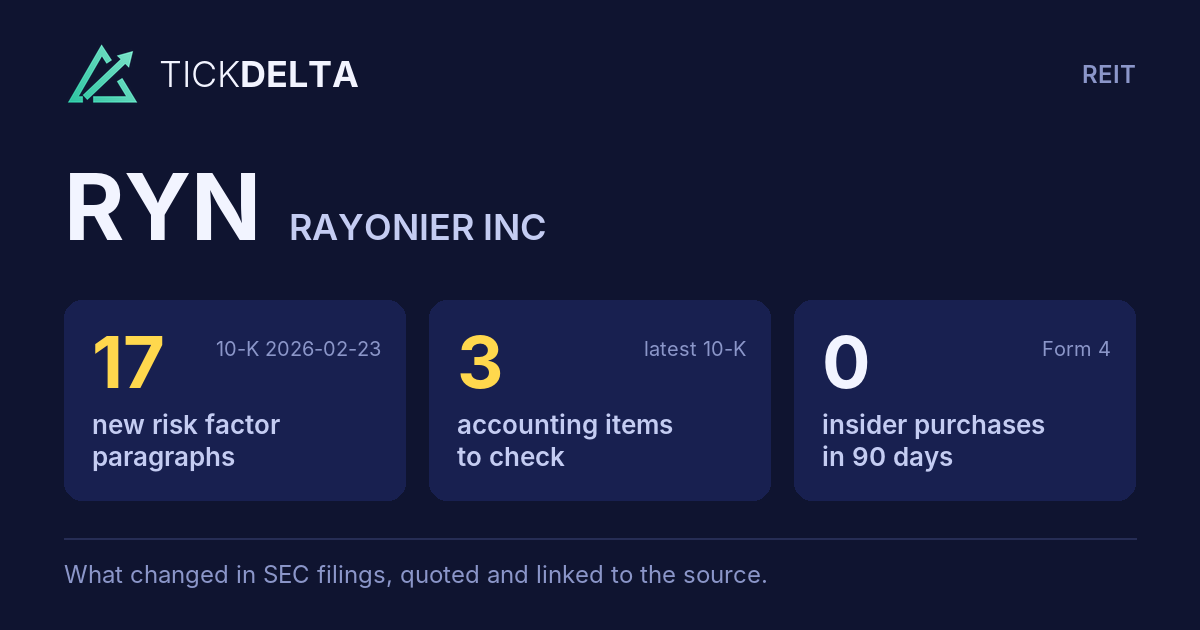
65 paragraphs · 17 new · 14 reworded · 11 gone · 10-K Feb 23, 2026 against Feb 21, 2025
New paragraph Reworded (5% of its words or more) Same or nearly
Paragraph 5 · 40% changed Every version of it
In our Timber and Wood Products segments, the level of residential construction activity, including home repair and remodeling activity, is the primary driver of sawtimber and finished product demand. In addition, demand for logs can be affected by the demand for wood chips in the pulp and paper and engineered wood products markets, as well as the bio-energy production markets. The ongoing level of activity in these markets is subject to fluctuation due to future changes in economic conditions, inflation, interest rates, government subsidies, credit availability, population growth, weather conditions, geopolitical tensions, the imposition of tariffs on our and our customers’ finished products and other factors. Declining demand for paper products has led to closures and curtailments of containerboard and pulp mill, reducing demand and pricing for pulpwood and wood chips in certain regions. Historical prices for our manufactured wood products have been volatile as a result of fluctuating demand, particularly in recent years, and we have limited influence over the timing and extent of price changes for such products. In our timber business, our sawlog price realizations in Idaho are directly influenced by the fluctuation in lumber prices as we index a significant portion of these sawlogs under long-term supply agreements on a four-week lag to lumber prices. Changes in global economic conditions, such as new timber supply sources and changes in currency exchange rates, foreign interest rates and foreign and domestic trade policies, can also negatively impact demand for our timber, logs and wood products. For example, overseas demand can indirectly impact pricing and supply in North American timber and logs. lumber markets. In addition, the industries Pacific Northwest and Idaho, a greater proportion of timberland is government owned than in the southern states where we operate. For more than 20 years, environmental concerns and other factors have limited timber sales by federal agencies, which historically have been major suppliers of timber to the forest products industry, particularly in the West. Recent federal and state actions – including new executive orders and increased timber sales by the Bureau of Land Management and the U.S. Forest Service – aim to expand timber harvesting on government owned lands in Idaho. Any substantial increase in federal timber sales could materially increase the regional supply of harvestable timber, depress timber prices, intensify competition, and adversely affect our customers participate are highly competitive results of operations and may experience overcapacity or reductions in demand, all of which may affect demand for and pricing of our products. cash flows. Our financial
Paragraph 52 · 24% changed Every version of it
Overall, it is reasonably likely that legislative and regulatory activity in this area will in some way affect Rayonier and the U.S. customers of our Southern Timber and Pacific Northwest Timber Wood Products segments, but it is unclear at this time what the nature of the impact will be. We anticipate increases in legal and reporting requirements at the state, federal and international level regarding climate change. These evolving requirements may increase compliance costs, divert resources and create inefficiencies, particularly if timelines change, and may negatively impact our business and reputation. We continue to monitor political and regulatory developments in this area, but their overall impact on Rayonier, from a cost, benefit and financial performance standpoint, remains uncertain at this time.
Paragraph 35 · 14% changed Every version of it
We rely on information technology networks and systems, including the Internet, to process, transmit and store electronic information and to manage or support a variety of our business processes, including manufacturing process controls, financial transactions and maintenance of records, which may include confidential information. We rely on commercially available systems, software, tools and monitoring to provide security for processing, transmitting and storing confidential information, such as personally identifiable information. Although we have taken steps to protect the security of the data maintained in our information systems, it is possible that our security measures and those of our information technology vendors will not be able to prevent the systems’ improper functioning or the improper disclosure of personally identifiable information, such as in the event of cyber-attacks. Security breaches, including physical or electronic break-ins, computer viruses, attacks by hackers and similar breaches, can create system disruptions, shutdowns or unauthorized disclosure of confidential information. The rapid evolution and increased adoption of artificial intelligence technologies, by us or by third parties, may also heighten our cybersecurity risks by making cyberattacks more difficult to prevent, detect, contain and mitigate. Any failure to maintain proper function, security and availability of our information systems and those of our information technology vendors could interrupt our operations, damage our reputation, or subject us to liability claims or regulatory penalties, any one of which could materially and adversely affect our financial condition and results of operations.
Paragraph 3 · 12% changed Every version of it
The acceleration of inflation in the United States and global economies could adversely affect us. In particular, increases in the cost and availability of labor for us and our contractors could increase our costs, compress our margins and impact harvest levels. In addition, increases in energy and fuel costs could affect our results of operations. Energy costs are a significant operating expense for logging and hauling contractors who support us and the customers of our wood products and standing timber. A rise in energy costs could have a negative effect on the cost and availability of such contractors. Additionally, rising energy costs could have a negative impact on the cost of ocean freight for our exported products. Recent changes in U.S. trade policy have resulted in sharply higher import tariffs on goods imported from certain countries. Our wood products operations are particularly impacted, as some specialized equipment and parts are sourced from outside the U.S. Higher tariffs have increased acquisition and maintenance costs, leading to greater operational expenses, supply chain disruptions, reduced margins and constraints on capital investments. Moreover, our selling, general and administrative costs could increase. More generally, an increase in inflation and interest rates could have an adverse impact on our cost of capital, which could impact the value of our long-lived assets, our ability to economically acquire additional assets, the cost of debt and the value of our equity. One of the factors that may influence the price of our common shares is our annual dividend yield as compared to the yields on other financial instruments. An increase in market interest rates could cause increases in discount rates and, accordingly, a decline in property values and total returns for timberland assets. Thus, an increase in market interest rates could result in higher yields on other financial instruments and could adversely affect the relative attractiveness of an investment in our equity and, accordingly, the trading price of our common shares. These macroeconomic factors impacting us are beyond our control and could have a material adverse effect on our business, financial condition, results of operations and the value of our equity.
Paragraph 9 · 11% changed Every version of it
The markets in which we operate are highly competitive, and we compete with companies that have substantially greater financial resources than we do in each of these businesses. The competitive pressures relating to our Timber and Wood Products segments are primarily driven by the level of demand, quantity of product supply supply, and quality of the timber offered by competitors in the domestic and export markets, each of which may impact pricing. With respect to our Real Estate segment, we compete with other owners of entitled and unentitled properties. Each property has unique attributes, but overall quantity of supply and price for residential, commercial, industrial and rural properties in the geographic areas in which we operate are the most significant competitive drivers. The markets in which our Trading segment operates are very competitive with numerous entities competing for export log supply at different ports across New Zealand.
Paragraph 12 · 10% changed Every version of it
The global economy has been negatively impacted by the military conflicts between Russia and Ukraine, as well as in the Middle East. The duration and outcomes of these conflicts and their residual effects are uncertain. Global log and lumber markets have exhibited increased volatility as sanctions have been imposed on Russia by the United States, the United Kingdom and the European Union in response to Russia’s invasion of Ukraine. Additionally, the conflict and related hostilities in the Middle East have increased the potential for disruptions to shipping in the Red Sea, affected the cost and availability of ocean freight providers and elevated US military operations in the region. While we do not expect our operations to be directly impacted by these conflicts at this time, changes in the cost of ocean freight, and changes in global wood and commodity flows, especially energy commodities, could impact the markets in which we operate, which may in turn negatively impact our business, results of operations, supply chain and financial condition. In addition, the effects of the ongoing conflicts could heighten certain of our other known risks described herein.
Paragraph 31 · 8% changed Every version of it
We formerly owned or operated or may own or acquire timberlands or properties that may require environmental remediation or otherwise be subject to environmental and other liabilities. We owned or operated manufacturing facilities and discontinued operations that we do not currently own, and we may currently own or may acquire timberlands and other properties in the future that are subject to environmental liabilities, such as remediation of soil, sediment and groundwater contamination and other existing or potential liabilities. In connection with the spin-off of our Performance Fibers business in 2014, and pursuant to the related Separation and Distribution Agreement between us and Rayonier Advanced Materials, Rayonier Advanced Materials has assumed any environmental liability of ours in connection with the manufacturing facilities and discontinued operations related to the Performance Fibers business and has agreed to indemnify and hold us harmless in connection with such environmental liabilities. However, in the event we seek indemnification from Rayonier Advanced Materials, we cannot provide any assurance that a court will enforce our indemnification right if challenged by Rayonier Advanced Materials or that Rayonier Advanced Materials will be able to fund any amounts for indemnification owed to us. Similarly, in connection with our spin-off of Clearwater Paper Corporation in 2008, the parties agreed to indemnify each other for certain specified liabilities associated with current and former pulp and paper manufacturing facilities no longer operated by us. We may be liable for presently unknown environmental liabilities at these sites either directly or derivatively should we be unable to enforce our indemnification rights or should Clearwater Paper be unable to fund any amounts of indemnification owed to us. In addition, the cost of investigation and remediation of contaminated timberlands and properties that we currently own or acquire in the future could increase operating costs and adversely affect financial results. We could also incur substantial costs, such as civil or criminal fines, sanctions and enforcement actions (including orders limiting our operations or requiring corrective measures, installation of pollution control equipment or other remedial actions), clean-up and closure costs, and third-party claims for property damage and personal injury as a result of violations of, or liabilities under, environmental laws and regulations related to such timberlands or properties.
Paragraph 44 · 7% changed Every version of it
We believe our Operating Partnership qualifies as a partnership for U.S. federal income tax purposes. As a partnership, our Operating Partnership is not subject to U.S. federal income tax on its income. Instead, each of the partners is allocated its share of our Operating Partnership’s income. We cannot assure you, however, that the IRS will not challenge the status of our Operating Partnership as a partnership for U.S. federal income tax purposes. If the IRS were to successfully challenge the status of our Operating Partnership as a partnership, it would be taxable as a corporation. In such event, this would reduce the amount of distributions that our Operating Partnership could make, which could have further implications as to our ability to maintain our status as a REIT. This would substantially reduce our cash available to pay distributions and the return on a unitholder and/or shareholder’s investment.

MD&A

173 paragraphs · 33 new · 102 reworded · 20 gone · 10-K Feb 23, 2026 against Feb 21, 2025
New paragraph Reworded (5% of its words or more) Same or nearly
Paragraph 76 · 50% changed
Full-year interest expense income of $36.9 $24.3 million decreased $11.4 increased $16.1 million versus the prior year, primarily due to lower average outstanding debt a higher cash balance following the Large Dispositions completed in late 2024 and the gain from a terminated cash flow hedge. sale of the Company’s New Zealand joint venture interest in the second quarter of 2025.
Paragraph 80 · 50% changed
During the fourth quarter, the The Company repurchased 488,017 approximately 2.9 million shares at an average price of $30.10 $24.29 per share, or $14.7 approximately $70.5 million in total. In December, total during 2025. Following the mid-October merger announcement, the Company’s ability to repurchase shares was generally restricted pending the close of the transaction. As of December 31, 2025, the Company announced a new $300 had approximately 161.4 million share repurchase authorization, replacing our previous $100 common shares outstanding, 1.7 million Redeemable Operating Partnership Units outstanding, and $229.5 million remaining on its current share repurchase authorization.
Paragraph 105 · 50% changed
In 2025, 2026, we expect to achieve full-year harvest volumes in our Southern Timber segment of 6.9 12.1 to 7.1 12.6 million tons—a modest tons—reflecting the increase in harvest volumes versus the prior year, primarily our sustainable yield due to the carryover of some planned 2024 volume into 2025, partially offset by reduced volume from the recent disposition in Oklahoma. Further, while we merger with PotlatchDeltic. We further expect that regional pine stumpage realizations to will trend modestly higher as from fourth-quarter levels during the year progresses, as supply-demand conditions normalize. However, we anticipate expect that full-year 2026 average pine stumpage realizations for the combined company’s Southern Timber segment will be slightly lower versus than the standalone realizations for Rayonier in the prior year, due in part to the continued impact of salvage volume year based on the market. Lastly, we expect slightly lower non-timber income for full-year 2025 as compared to pro forma geographic mix of the prior year, which benefited from significant pipeline easement activity. combined company.
Paragraph 106 · 50% changed
In our Pacific Northwest Timber segment, we expect to achieve full-year harvest volumes of approximately 0.9 2.0 to 2.3 million tons, which reflects tons—reflecting the reduction increase in our Pacific Northwest sustainable yield resulting from due to the recent dispositions in Washington. Further, we merger with PotlatchDeltic. We further expect that full-year weighted 2026 average log pricing for the combined company’s Northwest Timber segment will increase modestly versus be higher than the standalone pricing for Rayonier in the prior year based on improving demand conditions, a higher mix of sawtimber, and the pro forma geographic mix of the combined company. However, we anticipate that the combined company’s pricing in the Northwest will have increased sensitivity to lumber pricing compared to legacy Rayonier, as a result significant portion of improving demand conditions. our sawlog sales in Idaho are indexed to lumber prices.
Paragraph 28 · 49% changed
The following table contains the summarized balance sheet provides key financial information by segment and on a consolidated basis for the consolidated obligor group of debt issued by Rayonier, L.P. for the two three years ended December 31:
Paragraph 108 · 49% changed
In our Real Estate segment, we are encouraged anticipate a consistent level of activity in 2026, driven by the continued strong demand and value realizations for our HBU properties, and we expect another solid year in both our a combined pipeline of rural land sales program as well as our improved and development projects projects. Our expectations for a steady pace of closings are based on our current pipeline of transactions. However, similar to 2024, we anticipate very light closing activity in the first quarter. transaction timing and project development stages.
Paragraph 44 · 47% changed
(a)Estimated (c)Estimated percentage of export volume, which volume includes volumes sold direct exports and log sales to third-party exporters in addition to direct exports through our log export program. exporters.
Paragraph 161 · 47% changed
(a)Costs related to disposition initiatives the merger with PotlatchDeltic include legal, advisory, accounting, due diligence, consulting and other due diligence costs incurred in connection related to the merger with the Company’s asset disposition plan, PotlatchDeltic, which was announced in November 2023. subsequently closed on January 30, 2026.

A paragraph is matched with the one last year that shares the most of its words; under half in common makes it new. The paragraphs shown are the 8 reworded the most in each section.

The paragraph that changed most in each section

The redline

Marked against last year's 10-K: cut words struck through, new words highlighted.

Risk Factors276 words changed in this paragraph; it is 50% similar to last year's version.
In our Timber and Wood Products segments, the level of residential construction activity, including home repair and remodeling activity, is the primary driver of sawtimber and finished product demand. In addition, demand for logs can be affected by the demand for wood chips in the pulp and paper and engineered wood products markets, as well as the bio-energy production markets. The ongoing level of activity in these markets is subject to fluctuation due to future changes in economic conditions, inflation, interest rates, government subsidies, credit availability, population growth, weather conditions, geopolitical tensions, the imposition of tariffs on our and our customers’ finished products and other factors. Declining demand for paper products has led to closures and curtailments of containerboard and pulp mill, reducing demand and pricing for pulpwood and wood chips in certain regions. Historical prices for our manufactured wood products have been volatile as a result of fluctuating demand, particularly in recent years, and we have limited influence over the timing and extent of price changes for such products. In our timber business, our sawlog price realizations in Idaho are directly influenced by the fluctuation in lumber prices as we index a significant portion of these sawlogs under long-term supply agreements on a four-week lag to lumber prices. Changes in global economic conditions, such as new timber supply sources and changes in currency exchange rates, foreign interest rates and foreign and domestic trade policies, can also negatively impact demand for our timber, logs and wood products. For example, overseas demand can indirectly impact pricing and supply in North American timber and logs. lumber markets. In addition, the industries Pacific Northwest and Idaho, a greater proportion of timberland is government owned than in the southern states where we operate. For more than 20 years, environmental concerns and other factors have limited timber sales by federal agencies, which historically have been major suppliers of timber to the forest products industry, particularly in the West. Recent federal and state actions – including new executive orders and increased timber sales by the Bureau of Land Management and the U.S. Forest Service – aim to expand timber harvesting on government owned lands in Idaho. Any substantial increase in federal timber sales could materially increase the regional supply of harvestable timber, depress timber prices, intensify competition, and adversely affect our customers participate are highly competitive results of operations and may experience overcapacity or reductions in demand, all of which may affect demand for and pricing of our products. cash flows. Our financial

Source: Item 1A, 10-K 0000052827-26-000036 vs Item 1A, 10-K 0000052827-25-000018

MD&A247 words changed in this paragraph; it is 34% similar to last year's version.
New Zealand Timber Overview Discontinued Operations * 2025 2024 2023 2022 Sales Volume (in thousands of tons) Domestic Pulpwood (Delivered) 240 225 388 Domestic Sawtimber (Delivered) 674 677 686 Export Pulpwood (Delivered) 282 230 182 Export Sawtimber (Delivered) 1,292 1,344 1,360 Total Volume 2,487 2,476 2,616 % Delivered Volume (vs. Total Volume) 100 % 100 % 100 % % Sawtimber Volume (vs. Total Volume) 79 % 82 % 78 % % Export Volume (vs. Total Volume) (a) 63 % 64 % 59 % Delivered Log Pricing (in dollars per ton) Domestic Pulpwood $32.83 $34.58 $33.50 Domestic Sawtimber 66.05 66.31 71.87 Export Sawtimber 105.86 102.39 124.91 Weighted Average Log Price $86.59 $85.27 $96.77 Summary Financial Data by Historical Segment (in millions of dollars) New Zealand Timber Timber Sales $101.6 $215.3 $211.1 $253.1 Less: Cut and Haul (42.1) (85.5) (84.5) (94.3) Less: Port and Freight (30.7) (75.3) (64.8) (94.1) Net Stumpage Sales $28.9 $54.5 $61.8 $64.8 Carbon Credit Sales — 22.4 23.4 19.8 Other Non-Timber Sales 0.5 0.8 1.0 1.1 Total New Zealand Timber Sales $102.2 $238.6 $235.5 $274.1 Operating Real Estate Land Sales — 15.5 — Total Real Estate Sales — $15.5 — Trading Trading Sales 6.6 19.7 31.7 Non-Timber Sales 0.5 1.5 1.8 Total Trading Sales $7.2 $21.2 $33.5 Corporate / Intersegment Eliminations Non-Timber Sales — (0.2) (0.5) Total Corporate / Intersegment Eliminations — ($0.2) ($0.5) Total sales from discontinued operations $109.3 $275.1 $268.6 Income $33.5 $26.0 $30.6 (+) Timber write-offs resulting from casualty events (b) operations of discontinued operations, net of tax $1.9 $28.1 $19.2 Gain on sale of discontinued operations 404.4 — 2.3 — (+) Depreciation, depletion and amortization 20.3 21.7 23.9 Adjusted EBITDA (c) $53.8 $50.0 $54.5 Other Data New Zealand Dollar to U.S. Dollar Exchange Rate (d) 0.6094 0.6117 0.6350 Net Plantable Year-End Acres (in thousands) 287 297 297 Export Sawtimber (in dollars per JAS m3) $123.08 $119.04 $145.23 Domestic Sawtimber (in $NZD per tonne) $119.22 $119.25 $124.50 Income from discontinued operations $406.3 $28.1 $19.2

Source: Item 7, 10-K 0000052827-26-000036 vs Item 7, 10-K 0000052827-25-000018

Accounting Policies198 words changed in this paragraph; it is 43% similar to last year's version.
Goodwill represents represented the excess of the acquisition cost of the our New Zealand Timber segment operations over the fair value of the net assets acquired. Goodwill is was not amortized, but is periodically was reviewed for impairment. An impairment test for this reporting unit’s goodwill is performed annually and annually—or whenever events or circumstances indicate that the value of goodwill may be impaired. indicated a potential impairment. We compare compared the fair value of the our New Zealand Timber segment, operations, using an independent valuation for the New Zealand forest assets, to its carrying value amount including goodwill. The independent This valuation of the New Zealand forest assets is based on discounted cash flow models where the fair value is calculated using cash flows from sustainable forest management plans. The fair value of the forest assets is measured as represented the present value of anticipated cash flows from one over a single biological growth cycle based on of the productive forest land, taking into consideration timberland, incorporating specific environmental, operational, and market restrictions. constraints. These cash flow valuations involve a number of estimates that require models relied on significant Level 3 inputs, including broad assumptions and significant judgment regarding future harvest yields, price realizations, and operational performance. The annual impairment test was performed as of October 1, 2024; the estimated fair value of the New Zealand Timber segment exceeded its carrying value and no impairment was recorded. Except for changes in the New Zealand foreign exchange rate, there have been no adjustments to the carrying value of goodwill since the initial recognition. See Note 23 — Other Assets for additional information.

Source: Item 8, Note 1 – SUMMARY OF SIGNIFICANT ACCOUNTING POLICIES, 10-K 0000052827-26-000036 vs Item 8, Note 1 – SUMMARY OF SIGNIFICANT ACCOUNTING POLICIES, 10-K 0000052827-25-000018

Sentences and paragraphs added, removed or reworded

Every change, by type

Sentences and paragraphs of RYN's Risk Factors and MD&A, 10-K Feb 23, 2026 against 10-K Feb 21, 2025. Each links to the text at sec.gov.

Quiet changes are sentences kept from last year with one to four words changed, at least one of them a hedge, a modal or a qualifier (may, could, will, not, significant, material…). A year or date rolling forward is not counted.

The full word list

adverse, adversely, all, although, anticipate, anticipates, any, approximately, believe, believes, can, cannot, certain, could, expect, expects, generally, however, if, intend, intends, largely, likely, many, material, materially, may, might, most, must, never, no, not, possible, primarily, probable, should, significant, significantly, some, substantial, substantially, unlikely, will, would

AddedRisk Factors
performance in Idaho is particularly sensitive to changes in timber supply and pricing, and future policy shifts or expanded federal harvesting could have a negative impact on our business. In addition, the industries in which our customers participate are highly competitive and may experience overcapacity or reductions in demand, all of which may affect demand for and pricing of our products.
Read it in 10-K Feb 23, 2026 at sec.gov
AddedRisk Factors
Our wood products are commodities that are widely available from other producers. Because commodity products have few distinguishing properties from producer to producer, competition for these products is based primarily on price, which is determined by supply relative to demand, and competition from substitute products. Prices for our products are affected by many factors outside our control, and we have no influence over the timing and extent of market price changes, which often are volatile. Our profitability with respect to these products depends, in part, on managing our costs, particularly raw material, labor and energy costs, which represent significant components of our operating costs. These costs can fluctuate due to factors beyond our control including changes in demand, supply chain disruptions, and inflation or deflation, all of which could adversely affect our results of operations and cash flows. In addition, our wood products facilities are capital intensive, which leads to high fixed costs and generally results in continued production as long as prices are sufficient to cover variable costs. The conditions have contributed to substantial price competition, particularly during periods of reduced demand. Some of our wood products competitors may currently be lower-cost producers than we are or may benefit from weak currencies relative to the U.S. dollar and these competitors may be less adversely affected than we are by price decreases. Wood products are also subject to significant competition from a variety of substitute products, including non-wood and engineered wood products. To the extent there is a significant increase in competitive pressure from substitute products or other domestic or foreign suppliers, our business could be adversely affected.
Read it in 10-K Feb 23, 2026 at sec.gov
AddedRisk Factors
A material disruption at one or more of our manufacturing facilities could prevent us from meeting customer demand, reduce our sales or negatively affect our results of operations and financial condition.
Read it in 10-K Feb 23, 2026 at sec.gov
AddedRisk Factors
Any of our manufacturing facilities or machines could unexpectedly cease to operate for a number of reasons, including unscheduled maintenance outages, prolonged power failures, equipment failures, raw material shortages, equipment and maintenance part shortages, cyber events, labor difficulties or labor availability due to quarantine requirements, disruptions in the transportation infrastructure, fire, ice storms, floods, windstorms, tornadoes, hurricanes or other catastrophes, terrorism or threats of terrorism, government regulations and other operational problems. We cannot predict the duration of any such downtime or extent of facility damage. Downtime and facility damage have prevented us and could prevent us in the future from meeting customer demand for our products and/or require us to make unplanned expenditures. If one or more machines or facilities were to incur significant downtime, our ability to meet our production targets and satisfy customer demand could be impaired, resulting in lower sales and income.
Read it in 10-K Feb 23, 2026 at sec.gov
AddedRisk Factors
Certain employees at one of our sawmills are covered under a collective bargaining agreement that expires in 2026. If our unionized workers were to engage in a strike or other work stoppage, or other non-unionized operations were to become unionized, we could experience a significant disruption of operations at our facilities or higher ongoing labor costs. A strike or other work stoppage in the facilities of any of our major customers or suppliers could also have similar effects on us.
Read it in 10-K Feb 23, 2026 at sec.gov
AddedRisk Factors
Following the merger, we now have a qualified defined benefit pension plan covering certain of our current and former employees which, at December 31, 2025, was 90.9% funded. Future actions involving our qualified and unqualified defined benefit and other postretirement plans, such as annuity buyouts and lump-sum payouts, could cause us to incur significant pension and postretirement settlement and curtailment charges and may require significant cash contributions to maintain a legally required funded status. The measurement of the pension benefit obligation, determination of pension plan net periodic costs and the requirements for funding our pension plans are based on a number of actuarial assumptions, including the expected rate of return on plan assets and the discount rate applied to the pension obligation. Changes in plan asset returns and long-term interest rates could increase our costs under our defined benefit pension plans and may significantly affect future contribution requirements. It is unknown what the actual investment return or our pension assets will be in future years and what interest rates may
Read it in 10-K Feb 23, 2026 at sec.gov
Show the other 64
AddedRisk Factors
be at any given point in time. Accordingly, we cannot provide any assurance of what our actual pension plan costs will be in the future, or if we will be required under applicable law to make future material plan contributions.
Read it in 10-K Feb 23, 2026 at sec.gov
AddedRisk Factors
As described elsewhere in this Annual Report on Form 10-K, the Company recently completed its merger of equals with PotlatchDeltic (the “Merger”). The risks, contingencies and other uncertainties that could have a material adverse effect on the results of operations, cash flows and financial position of the Company following the Merger include:
Read it in 10-K Feb 23, 2026 at sec.gov
RemovedRisk Factors
Although the majority of our customers are in the U.S., a significant portion of our sales are to end markets outside of the U.S., including China, South Korea, Japan, India, and New Zealand. The export of our products into international markets results in risks inherent in conducting business pursuant to international laws, regulations and customs. International sales may contribute to future growth. The risks associated with our business outside the U.S. include:
Read it in 10-K Feb 21, 2025 at sec.gov
RemovedRisk Factors
•trade protection laws, policies and measures and other regulatory requirements affecting trade and investment, including loss or modification of exemptions for taxes and tariffs, imposition of new tariffs and duties and import and export licensing requirements;
Read it in 10-K Feb 21, 2025 at sec.gov
RemovedRisk Factors
•negative impacts from the imposition and/or threatened imposition of substantial tariffs on forest products imports into U.S. trading partner countries in connection with trade tensions between the U.S. and those countries;
Read it in 10-K Feb 21, 2025 at sec.gov
RemovedRisk Factors
cyberattacks more difficult to prevent, detect, contain and mitigate. Any failure to maintain proper function, security and availability of our information systems and those of our information technology vendors could interrupt our operations, damage our reputation, or subject us to liability claims or regulatory penalties, any one of which could materially and adversely affect our financial condition and results of operations.
Read it in 10-K Feb 21, 2025 at sec.gov
RewordedRisk Factors
Similarly, recent legislation proposed regulatory changes in Oregon has resulted Washington would result in the addition of significant buffers and riparian management zones adjacent to streams, which has reduced would reduce the areas within which we may harvest.
Read it in 10-K Feb 23, 2026 at sec.gov
RewordedRisk Factors
The competitive pressures relating to our Timber and Wood Products segments are primarily driven by the level of demand, quantity of product supply supply, and quality of the timber offered by competitors in the domestic and export markets, each of which may impact pricing.
Read it in 10-K Feb 23, 2026 at sec.gov
RewordedRisk Factors
The rapid evolution and increased adoption of artificial intelligence technologies, by us or by third parties, may also heighten our cybersecurity risks by making cyberattacks more difficult to prevent, detect, contain and mitigate.
Read it in 10-K Feb 23, 2026 at sec.gov
RewordedRisk Factors
If any of our transportation providers were to fail to deliver timber supply or logs to our customers in a timely manner, or were to damage wood products, timber supply or logs during transport, we may be unable to sell it them at full value, or at all.
Read it in 10-K Feb 23, 2026 at sec.gov
RewordedRisk Factors
In our Southern Timber, Pacific Northwest Timber and New Zealand Timber segments, any delay associated with a filing could result in a delay or restriction in replanting, thinning, insect control, fire control or harvesting, any of which could have an adverse effect on our operating results.
Read it in 10-K Feb 23, 2026 at sec.gov
RewordedRisk Factors
Our Timber and Wood Products segments depend on logging and transportation services provided by third parties, both domestically and internationally, including by railroad, trucks and/or ships.
Read it in 10-K Feb 23, 2026 at sec.gov
RewordedRisk Factors
Any threatened or actual lawsuit could delay harvesting on our timberlands, affect how we operate or limit our ability to modify or invest in our real estate. estate and wood products manufacturing facilities.
Read it in 10-K Feb 23, 2026 at sec.gov
RewordedRisk Factors
In our Timber and Wood Products segments, the level of residential construction activity, including home repair and remodeling activity, is the primary driver of sawtimber and finished product demand.
Read it in 10-K Feb 23, 2026 at sec.gov
RewordedRisk Factors
Changes in global economic conditions, such as new timber supply sources and changes in currency exchange rates, foreign interest rates and foreign and domestic trade policies, can also negatively impact demand for our timber timber, logs and logs. wood products.
Read it in 10-K Feb 23, 2026 at sec.gov
RewordedRisk Factors
Should demand for housing become elevated, harvest levels and demand for lumber may further increase, placing more pressure on the existing supply of logging and shipping contractors.
Read it in 10-K Feb 23, 2026 at sec.gov
RewordedRisk Factors
Any significant failure or unavailability of third-party logging or transportation providers, or further increases in transportation rates, labor rates and/or fuel costs, may result in higher logging and shipping costs or the inability to capitalize on stronger log and lumber prices to the extent logging and shipping contractors cannot be secured at a competitive cost.
Read it in 10-K Feb 23, 2026 at sec.gov
AddedMD&A
In June 2025, we completed the sale of our 77% interest in a New Zealand joint venture. Consequently, these operations are classified as discontinued operations for all periods presented. See Note 2 — Discontinued Operations for additional information.
Read it in 10-K Feb 23, 2026 at sec.gov
AddedMD&A
Effective with the third quarter of 2025, we realigned our reporting segments to reflect how our CODM, the Chief Executive Officer, evaluates performance and allocates capital. As part of the realignment, the previously reported Trading segment’s log trading activities conducted in the U.S. South and Pacific Northwest are now reported in the respective Southern Timber or Pacific Northwest Timber segments based on geographical location for all periods presented. See Note 3 — Segment and Geographical Information for further discussion of our reportable segments.
Read it in 10-K Feb 23, 2026 at sec.gov
AddedMD&A
On January 30, 2026, Rayonier completed its merger with PotlatchDeltic Corporation (“PotlatchDeltic”) in a merger-of-equals transaction. Under the terms of the merger agreement, PotlatchDeltic stockholders received 1.8185 Rayonier common shares and $0.61 in cash for each PotlatchDeltic share held. In connection with the closing, we issued approximately 140.9 million Rayonier common shares.
Read it in 10-K Feb 23, 2026 at sec.gov
AddedMD&A
This transaction significantly expands our timberland portfolio and introduces wood products manufacturing capabilities, enhancing our scale, geographic diversity, and long-term growth prospects. The merger is expected to be accounted for as a business combination with Rayonier as the acquirer. Additional details regarding the transaction are provided in Note 1 — Summary of Significant Accounting Policies.
Read it in 10-K Feb 23, 2026 at sec.gov
AddedMD&A
The following MD&A reflects our continuing operations as of December 31, 2025. Consequently, these disclosures do not include the impact of the PotlatchDeltic merger, which was completed as a subsequent event on January 30, 2026. Where applicable, we have specifically noted the anticipated effects of the merger or references to the combined company. For details regarding the divestiture of our New Zealand joint venture, see Note 2 — Discontinued Operations.
Read it in 10-K Feb 23, 2026 at sec.gov
AddedMD&A
The Southern Timber and Pacific Northwest Timber segments are sensitive to the strength of U.S. lumber markets, which are closely tied to housing starts. These markets are currently impacted by a 10% ad valorem duty on softwood timber and lumber imports that took effect on October 14, 2025. This duty followed a Section 232 investigation under the Trade Expansion Act of 1962, which was authorized by Executive Order 14223, Addressing the Threat to National Security from Imports of Timber, Lumber, and Their Derivative Products (March 1, 2025). These tariffs, along with higher duties on Canadian lumber from the sixth administrative review of the anti-dumping and countervailing order on softwood lumber from Canada, and a weaker U.S. dollar, could increase domestic lumber prices and production of wood products to meet domestic demand, which could likewise increase domestic log demand and pricing. However, these gains may be partially offset by anticipated easing in Canadian duties in the second half of 2026 following the seventh administrative review of anti-dumping and countervailing duties, softer end-market demand due to increased construction costs and/or weaker overall market conditions stemming from changes in trade policy and/or broader economic uncertainty.
Read it in 10-K Feb 23, 2026 at sec.gov
AddedMD&A
Pricing within our timber segments is subject to broad macroeconomic influences and local market conditions. Residential construction activity is a key macroeconomic factor. Locally, prices can fluctuate based on weather patterns, available log inventories, mill demand, and access to export markets. Currently, in our Southern Timber segment, pine stumpage realizations continue to be constrained by overall softer demand for pulpwood and sawtimber, due in part to recent mill closures. Meanwhile, the Pacific Northwest Timber segment has seen generally stable weighted-average delivered log prices due to balanced supply and demand. While Executive Order 14225, Immediate Expansion of American Timber Production (March 1, 2025) could increase the supply of available timber from federal lands, any potential impacts would likely be most prevalent in the Pacific Northwest. Further, despite the potential long-term increase in the supply of federal harvest volumes, significant logistical, legal and infrastructure-related challenges will likely limit near-term market impacts.
Read it in 10-K Feb 23, 2026 at sec.gov
AddedMD&A
Real estate cost of sales includes the cost basis of land and any timber conveyed to the buyer, real estate development costs, and closing costs. For developed residential or commercial land sales, cost of sales includes both development costs incurred and estimates of future development costs required to complete the project.
Read it in 10-K Feb 23, 2026 at sec.gov
AddedMD&A
Allocating common development costs—such as infrastructure, roadways, and utilities—requires significant management judgment. Costs are allocated to each acre or lot based on its relative sales value compared to the estimated total sales value of the entire project. We reevaluate these estimates at least annually, or more frequently if warranted by changes in market conditions or project scope. Any adjustments to these estimates are allocated prospectively to the remaining units available for sale. Significant changes in our assumptions regarding total project costs or future selling prices could impact the timing and amount of cost of sales recognized in our Consolidated Statements of Income and Comprehensive Income (Loss). See Note 1 — Summary of Significant Accounting Policies for additional information.
Read it in 10-K Feb 23, 2026 at sec.gov
RemovedMD&A
During 2024, we acquired approximately 7,000 acres of timberland for $22.8 million. For further information on acquisitions, see Note 4 — Timberland Acquisitions. In addition, we closed on Large Dispositions totaling approximately 200,000 acres for an aggregate sale price of $495 million (~$2,475/acre). These dispositions consisted of approximately 91,000 acres in Southeast Oklahoma and 109,000 acres on the Olympic Peninsula in Northwest Washington. See Item 7 — Results of Operations and Note 2 — Segment and Geographical Information for additional information regarding the Large Dispositions.
Read it in 10-K Feb 21, 2025 at sec.gov
RemovedMD&A
Pricing in our timber segments is influenced by macroeconomic factors, including residential construction activity, and can also vary considerably on a local level based on weather, the available inventory of logs, mill demand, and export market access. In our Southern Timber segment, pine pulpwood net stumpage realizations
Read it in 10-K Feb 21, 2025 at sec.gov
RemovedMD&A
have been negatively impacted by increased log supply from salvage timber across the region, while pine sawtimber net stumpage realizations have remained constrained by softer demand from lumber mills and have also been negatively impacted by the availability of salvage timber. In our Pacific Northwest Timber segment, weighted-average delivered log prices remain under pressure due to soft domestic demand and reduced export market tension. In our New Zealand Timber segment, lower levels of construction activity in China continue to negatively impact export market demand and prices.
Read it in 10-K Feb 21, 2025 at sec.gov
RemovedMD&A
(f)Gain associated with the multi-family apartment complex sale attributable to NCI represents the gain recognized in connection with the sale of property by the Bainbridge Landing joint venture attributable to noncontrolling interests.
Read it in 10-K Feb 21, 2025 at sec.gov
RemovedMD&A
Refer to Item 7 - “Management’s Discussion and Analysis of Financial Condition and Results of Operations” section contained in our Annual Report on Form 10-K for the year ended December 31, 2023 for the results of operations discussion for the fiscal year ended December 31, 2023 compared to the fiscal year ended December 31, 2022.
Read it in 10-K Feb 21, 2025 at sec.gov
RemovedMD&A
In our New Zealand Timber segment, we expect full-year harvest volumes of 2.5 to 2.7 million tons. We expect that full-year domestic and export sawtimber pricing will improve modestly relative to the full-year pricing achieved in 2024 as supply-demand fundamentals continue to improve. We further anticipate a modest increase in carbon credit sales in 2025, as pricing appears to have stabilized following a period of unusual market volatility.
Read it in 10-K Feb 21, 2025 at sec.gov
RemovedMD&A
While we currently anticipate to execute the remainder of Plan as announced, facts and circumstances could change in the future, which may change our strategy or preclude us from executing the Plan as intended. See Item 1A — Risk Factors in this Annual Report on Form 10-K for additional information.
Read it in 10-K Feb 21, 2025 at sec.gov
RewordedMD&A
Financial Information (in millions of dollars) 2025 2024 2023 2022 Sales Southern Timber $250.4 $264.1 $264.2 $228.3 $251.6 $265.1 Pacific Northwest Timber 100.8 124.1 162.2 New Zealand Timber 238.6 235.5 274.1 83.6 108.0 133.3 Real Estate Improved Development 47.2 30.8 30.7 35.4 Unimproved Development 5.1 12.4 0.1 — Rural 48.6 72.9 99.7 59.5 Timberland & Non-Strategic 16.1 53.5 0.6 3.3 11.4 Conservation Easement — 1.1 — — Deferred Revenue/Other (a) 18.3 15.5 13.9 1.2 Large Dispositions — 495.0 242.2 30.5 Total Real Estate 643.8 172.6 628.3 390.0 138.0 Trading 29.6 43.7 71.0 Intersegment Eliminations (0.2) (0.5) (0.4) Total Sales $1,263.0 $1,056.9 $909.1 $484.5 $987.9 $788.4 Operating Income (Loss) Southern Timber $61.1 $77.9 $76.3 $96.6 Pacific Northwest Timber (b) 1.9 (6.3) (9.0) 15.2 New Zealand Timber (c) 33.5 26.0 30.6 (8.7) Real Estate (d) 340.4 (b) 62.3 335.1 156.6 58.5 Trading (0.1) 0.5 0.4 Corporate and other (e) (42.9) (39.1) (35.5) (c) (42.0) (42.6) (39.6) Operating Income 402.5 211.3 165.8 83.3 364.1 184.7 Interest expense, net (f) (36.9) (48.3) (36.2) (d) (26.3) (33.8) (45.2) Interest and other income 24.3 8.2 1.8 Other miscellaneous (expense) income, net (g) 10.4 20.6 2.6 (e) (6.7) 1.3 18.3 Income tax expense (h) (7.0) (5.1) (9.4) (expense) benefit (f) (0.5) 1.1 (0.3) Income from Continuing Operations 74.1 340.9 159.3 Income from operations of discontinued operations, net of tax 1.9 28.1 19.2 Gain on sale of discontinued operations 404.4 — — Income from Discontinued Operations 406.3 28.1 19.2 Net Income 480.4 369.0 178.5 122.8 Less:
Read it in 10-K Feb 23, 2026 at sec.gov
RewordedMD&A
Capital Expenditures By Segment * 2025 2024 2023 2022 Timber Capital Expenditures (in millions of dollars) Southern Timber Reforestation, silviculture and other capital expenditures $25.6 $31.9 $30.6 $24.1 Property taxes 7.7 7.5 7.3 7.1 Lease payments 2.3 2.6 2.8 3.1 Allocated overhead 5.9 6.4 5.9 4.9 Subtotal Southern Timber $41.6 $48.4 $46.5 $39.3 Pacific Northwest Timber Reforestation, silviculture and other capital expenditures 5.1 8.1 10.9 10.5 Property taxes 0.4 0.5 0.9 1.1 Allocated overhead 2.7 4.7 5.6 5.2 Subtotal Pacific Northwest Timber $8.3 $13.3 $17.4 $16.8 New Zealand Timber Reforestation, silviculture and other capital expenditures 8.7 8.6 10.9 Property taxes 0.8 0.8 0.8 Lease payments 5.5 4.5 4.4 Allocated overhead 2.7 2.8 2.4 Subtotal New Zealand Timber $17.7 $16.7 $18.5 Total Timber Segments Capital Expenditures $79.4 $80.5 $74.5 $49.8 $61.7 $63.9 Real Estate 0.3 0.2 0.3 0.3 Corporate — — 0.6 — Total Capital Expenditures $79.8 $81.4 $74.8 $50.0 $62.1 $64.8 Timberland Acquisitions Southern Timber — $22.8 $10.5 $457.8 Pacific Northwest Timber — — 3.6 — New Zealand Timber — — 0.7 Total Timberland Acquisitions — $22.8 $14.1 $458.5 Real Estate Development Investments (a) $22.4 $25.8 $23.1 $13.7
Read it in 10-K Feb 23, 2026 at sec.gov
RewordedMD&A
Port and Freight — (1.8) (5.2) (2.8) Net Stumpage Sales $40.5 $51.4 $56.1 $91.1 Trading Sales 1.8 7.2 9.1 Land-Based Solutions (d) (e) 0.1 0.1 1.4 — Other Non-Timber Sales 5.4 5.5 4.9 5.6 Total Sales $100.8 $124.1 $162.2 $83.6 $108.0 $133.3 Operating Income (Loss) Income $1.9 ($6.3) ($9.0) $15.2 (+) Timber write-offs resulting from casualty events (e) — — 0.7 ($8.7) (+) Depreciation, depletion and amortization 21.8 31.7 36.9 48.0 Adjusted EBITDA (f) $23.7 $25.4 $27.9 $63.9 $28.3 Other Data Year-End Acres (in thousands) 307 308 418 474 Northwest Sawtimber (in dollars per MBF) (g) (a)(g) $709 $660 $711 $849
Read it in 10-K Feb 23, 2026 at sec.gov
RewordedMD&A
Adjusted EBITDA is defined as earnings before interest, taxes, depreciation, depletion, amortization, the non-cash cost of land and improved development, non-operating expense and income, income and expense, from operations of discontinued operations, gain on sale of discontinued operations, costs related to the merger with PotlatchDeltic, asset impairment charges, restructuring charges, costs related to disposition initiatives, restructuring charges, timber write-offs resulting from casualty events, gain associated with the multi-family apartment complex sale attributable to noncontrolling interests initiatives and Large Dispositions.
Read it in 10-K Feb 23, 2026 at sec.gov
RewordedMD&A
Net income attributable to noncontrolling interests in the Operating Partnership (6.2) (4.9) (2.9) (2.4) Net Income Attributable to Rayonier Inc. $474.4 $359.1 $173.5 $107.1 Adjusted EBITDA (i) (g) Southern Timber $130.1 $151.3 $156.2 $156.9 $156.3 Pacific Northwest Timber 23.7 25.4 27.9 63.9 New Zealand Timber 53.8 50.0 54.5 28.3 Real Estate 106.8 127.1 92.4 99.3 72.7 Trading (0.1) 0.5 0.4 Corporate and other (38.4) (37.4) (34.2) (32.9) (38.8) (37.9) Total Adjusted EBITDA (i) $298.8 $296.5 $314.2 (g) $248.0 $230.2 $246.0
Read it in 10-K Feb 23, 2026 at sec.gov
RewordedMD&A
In 2025, 2026, we expect to achieve full-year harvest volumes in our Southern Timber segment of 6.9 12.1 to 7.1 12.6 million tons—a modest tons—reflecting the increase in harvest volumes versus the prior year, primarily our sustainable yield due to the carryover of some planned 2024 volume into 2025, partially offset by reduced volume from the recent disposition in Oklahoma. merger with PotlatchDeltic.
Read it in 10-K Feb 23, 2026 at sec.gov
RewordedMD&A
Average delivered prices for domestic sawtimber decreased 8% increased 4% to $89.79 $93.37 per ton versus $97.71 $89.79 per ton in the prior year due to a combination of weaker year, driven by improved demand from domestic lumber mills, reduced export market tension, and an unfavorable species mills— partially in anticipation of additional duties on Canadian lumber—and a favorable geographic mix.
Read it in 10-K Feb 23, 2026 at sec.gov
RewordedMD&A
An operating loss Operating income of $6.3 $1.9 million versus an operating loss of $9.0 $6.3 million in the prior year was driven by lower costs ($5.9 million), lower depletion rates ($2.9 ($2.6 million) and lower costs ($2.1 higher net stumpage realizations ($1.6 million), partially offset by lower net stumpage realizations ($1.1 million), lower non-timber income ($0.7 million), and lower volumes ($0.5 ($1.9 million).
Read it in 10-K Feb 23, 2026 at sec.gov
RewordedMD&A
Operating income of $77.9 $61.1 million increased $1.6 decreased $16.8 million versus the prior year due to higher lower net stumpage realizations ($18.0 million), lower non-timber income ($13.2 ($3.6 million), lower depletion rates ($1.1 million) and lower higher costs ($0.1 ($0.3 million), partially offset by lower net stumpage realizations ($7.0 depletion rates ($4.7 million) and lower higher volumes ($5.8 ($0.4 million).
Read it in 10-K Feb 23, 2026 at sec.gov
RewordedMD&A
Average delivered pulpwood prices decreased 23% increased 13% to $29.88 $33.65 per ton versus $38.78 $29.88 per ton in the prior year due to softer mill demand year, as a reduction in the region. sawmill residuals tightened regional supply and improved market tension.
Read it in 10-K Feb 23, 2026 at sec.gov
RewordedMD&A
Full-year 2024 income tax benefit of $1.1 million versus income tax expense of $7.0 $0.3 million increased $1.9 million versus in the prior year as a result of higher taxable income, partially offset by is primarily due to a $1.2 million tax benefit associated with the pension termination and settlement.
Read it in 10-K Feb 23, 2026 at sec.gov
RewordedMD&A
Full-year corporate and other operating expense of $42.9 $42.0 million increased $3.8 decreased $0.6 million versus the prior year, primarily due to $1.6 million of costs related to disposition initiatives and $1.1 million of restructuring charges, as well as higher lower compensation and benefit related benefit-related expenses.
Read it in 10-K Feb 23, 2026 at sec.gov

Sources

The two latest 10-Ks on EDGAR, section by section. Each change links to the text at sec.gov.

Also

New risk factors: paragraphs with nothing like them last year, quoted in full.

Work with it

Excel workbook · CSV. Google Sheet that stays up to date: paste =IMPORTDATA("https://tickdelta.com/company/RYN/export.csv") into a cell.

Next:Related parties
Esc

Type a ticker such as AAPL, a name, an investor such as Buffett, or a topic such as tariffs. ↑ ↓ to move, Enter to open.