Paragraph 28 · 48% changed
Every version of it
Screener
/
SEC EDGAR
/CIK 0001571123
/10-K filed Mar 16, 2026, compared with Mar 17, 2025
/Numbers from the XBRL of the 10-Ks
Nasdaq
Technology · IT Services
Science Applications International Corp SAIC
The 10-K against last year's
87 changes: 18 added, 21 removed, 46 reworded, 2 quiet changes
10-K Mar 16, 2026 vs Mar 17, 2025
Risk Factors
7.5%
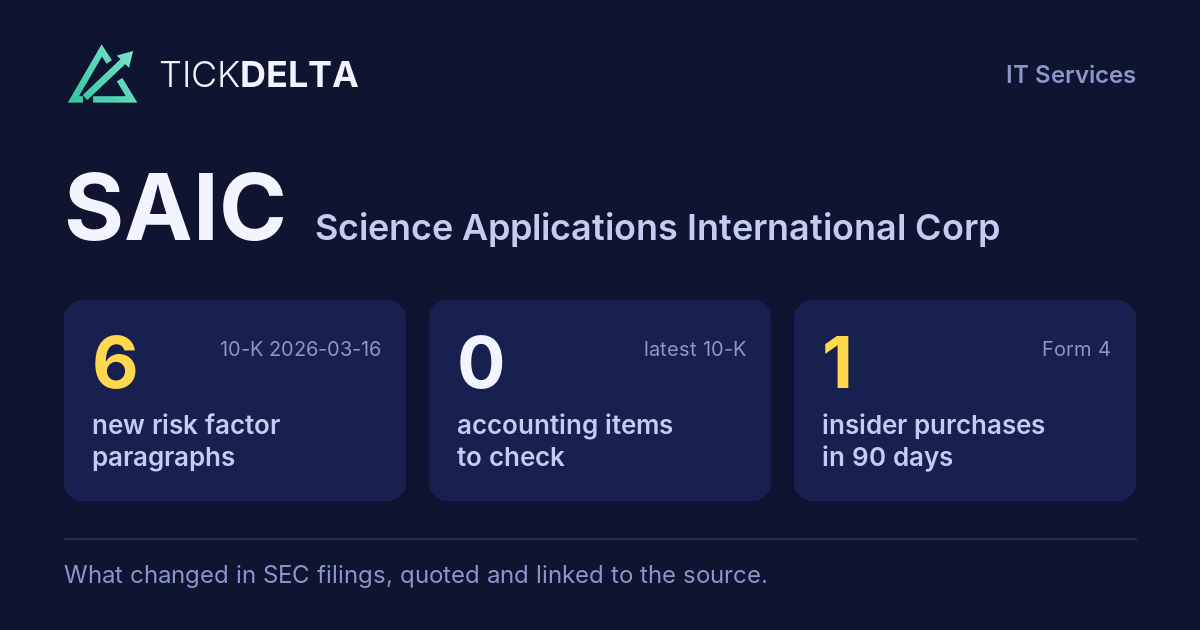
of the text changed · 7,953 words now · 6 new paragraphs, 2 gone
MD&A
25.5%
of the text changed · 8,344 words now · 12 new paragraphs, 19 gone
Legal Proceedings
16.1%
of the text changed · 726 words now
Accounting Policies
8.9%
of the text changed · 6,154 words now
10-K 0001571123-26-000029 (Mar 16, 2026) vs 10-K 0001571123-25-000022 (Mar 17, 2025)
Every paragraph, and how much of it changed
One bar per paragraph, in the order of the 10-K. Height and colour show the share of its words not in the closest paragraph a year earlier; the tallest bars are new paragraphs.
Risk Factors
106 paragraphs · 6 new · 22 reworded · 2 gone · 10-K Mar 16, 2026 against Mar 17, 2025
New paragraph
Reworded (5% of its words or more)
Same or nearly
Paragraph 86 · 42% changed
Every version of it
Paragraph 23 · 31% changed
Every version of it
Federal legislation, regulations, executive orders, and other initiatives dealing with, among other things, procurement reform, the mitigation of potential OCIs, the deterrence of fraud, the U.S. government taking ownership stakes in certain competitors, the threat of contract cancellation if timely performance is not met, the elimination of diversity, equity, and inclusion (“DEI”), and changes in corporate environmental obligations, could affect our business. A recent executive order was issued to limit stock buy-backs, dividends or other forms of corporate distribution if certain contractors underperform on critical defense supply contracts. We will continue to monitor to determine if this ultimately affects our future revenues, cash flows and profitability. Additionally, we are subject to the laws and regulations of the states in which we operate, which, at times, may conflict with federal laws and regulations, introducing ambiguity.
Paragraph 68 · 26% changed
Every version of it
Many of the systems and networks that we develop, install, and maintain for our customers involve managing and protecting personal information and information relating to national security and other sensitive government functions. While we have programs designed to comply with relevant privacy and security laws and restrictions, if a system or network that we develop, install, or maintain were to fail or experience a security breach or service interruption (whether caused by us, third-party service providers, cybersecurity threats, or other events), we may experience loss of revenue, remediation costs, claims for damages, or contract termination. This could cause serious harm to our reputation and prevent us from having access to, or being eligible for, further work involving these systems and networks. Our errors and omissions liability insurance may not adequately compensate us for the damages that we incur, and our results could be adversely affected.
Paragraph 62 · 19% changed
Every version of it
We use and deploy AI solutions for our customers that could harm our reputation or reputation, create liability if they do not function as predicted. predicted, or we are required to discontinue their use.
Paragraph 106 · 18% changed
Every version of it
Except where required by law, we expressly disclaim a duty to update or revise any forward-looking statements after the date of this Form 10-K to reflect subsequent events, changed circumstances or expectations, or revised estimates and assumptions. The forward-looking statements in this Form 10-K are intended to be subject to the safe harbor protections in the federal securities laws.
Paragraph 26 · 18% changed
Every version of it
Paragraph 85 · 17% changed
Every version of it
We provide services and solutions in support of U.S. government customers in countries that are politically unstable, active conflict zones, or subject to high-risk intelligence operations. Operating in these environments may increase the risk of an incident resulting in injury or loss of life, property damage or destruction, or the inability to meet our contractual obligations. It is impossible to predict the impact that these regulatory, geopolitical, and other factors may have on our business in the future.
Paragraph 28 · 48% changed
Every version of it
10-K Mar 17, 2025Similarly, recent executive orders related to energy and the environment suggest a shift towards deregulation at the federal level. Although deregulation initiatives could provide short-term relief from regulatory obligations, the executive orders introduce uncertainty and risk, including the potential for legal challenges and the possibility of new environmental policies at the state or local levels that may impose stricter regulations. We are actively monitoring and adapting to changes in environmental laws, assessing the physical risks posed by climate change, and implementing sustainability initiatives aimed at reducing the environmental impact of our operations. However, the full extent of these risks and their potential impact on our business remains uncertain and could materially affect its financial performance.
10-K Mar 16, 2026
implementing sustainability initiatives aimed at reducing the environmental impact of our operations. However, the full extent of these risks and their potential impact on our business remains uncertain and could materially affect its financial performance.
Paragraph 86 · 42% changed
Every version of it
10-K Mar 17, 2025We provide services and solutions in support of U.S. government customers in countries that are politically unstable, active conflict zones, or subject to high-risk intelligence operations. Operating in these environments may increase the risk of an incident resulting in injury or loss of life, property damage or destruction, or the inability to meet our contractual obligations. It is impossible to predict the impact that these regulatory, geopolitical, and other factors may have on our business in the future.
10-K Mar 16, 2026
meet our contractual obligations. It is impossible to predict the impact that these regulatory, geopolitical, and other factors may have on our business in the future.
Paragraph 23 · 31% changed
Every version of it
10-K Mar 17, 2025
Federal legislation, regulations, executive orders, and other initiatives dealing with, among other things, procurement reform, the mitigation of potential OCIs, the deterrence of fraud, the elimination of diversity, equity, and inclusion (“DEI”), and changes in corporate environmental obligations, could affect our business. Additionally, we are subject to the laws and regulations of the states in which we operate, which, at times, may conflict with federal laws and regulations, introducing ambiguity.
10-K Mar 16, 2026
Federal legislation, regulations, executive orders, and other initiatives dealing with, among other things, procurement reform, the mitigation of potential OCIs, the deterrence of fraud, the U.S. government taking ownership stakes in certain competitors, the threat of contract cancellation if timely performance is not met, the elimination of diversity, equity, and inclusion (“DEI”), and changes in corporate environmental obligations, could affect our business. A recent executive order was issued to limit stock buy-backs, dividends or other forms of corporate distribution if certain contractors underperform on critical defense supply contracts. We will continue to monitor to determine if this ultimately affects our future revenues, cash flows and profitability. Additionally, we are subject to the laws and regulations of the states in which we operate, which, at times, may conflict with federal laws and regulations, introducing ambiguity.
Paragraph 68 · 26% changed
Every version of it
10-K Mar 17, 2025
Many of the systems and networks that we develop, install, and maintain for our customers involve managing and protecting personal information and information relating to national security and other sensitive government functions. While we have programs designed to comply with relevant privacy and security laws and restrictions, if a system or network that we develop, install, or maintain were to fail or experience a security breach or service interruption (whether caused by us, third-party service providers, cybersecurity threats, or other events), we may
10-K Mar 16, 2026
Many of the systems and networks that we develop, install, and maintain for our customers involve managing and protecting personal information and information relating to national security and other sensitive government functions. While we have programs designed to comply with relevant privacy and security laws and restrictions, if a system or network that we develop, install, or maintain were to fail or experience a security breach or service interruption (whether caused by us, third-party service providers, cybersecurity threats, or other events), we may experience loss of revenue, remediation costs, claims for damages, or contract termination. This could cause serious harm to our reputation and prevent us from having access to, or being eligible for, further work involving these systems and networks. Our errors and omissions liability insurance may not adequately compensate us for the damages that we incur, and our results could be adversely affected.
Paragraph 62 · 19% changed
Every version of it
10-K Mar 17, 2025
We use and deploy AI solutions for our customers that could harm our reputation or create liability if they do not function as predicted.
10-K Mar 16, 2026
We use and deploy AI solutions for our customers that could harm our reputation, create liability if they do not function as predicted, or we are required to discontinue their use.
Paragraph 106 · 18% changed
Every version of it
10-K Mar 17, 2025
Except where required by law, we expressly disclaim a duty to update or revise any forward-looking statements after the date of this Form 10-K to reflect subsequent events, changed circumstances or expectations, or revised
10-K Mar 16, 2026
Except where required by law, we expressly disclaim a duty to update or revise any forward-looking statements after the date of this Form 10-K to reflect subsequent events, changed circumstances or expectations, or revised estimates and assumptions. The forward-looking statements in this Form 10-K are intended to be subject to the safe harbor protections in the federal securities laws.
Paragraph 26 · 18% changed
Every version of it
10-K Mar 17, 2025The FAR Council recently proposed significant revisions to the FAR related to OCIs, which, if adopted, could limit our ability to bid on certain contracts and/or require us to modify or restructure some business relationships. They could also impose additional compliance burdens and constraints on our business operations. Increased costs related to identifying, assessing, and mitigating OCI's could negatively impact our profitability.
10-K Mar 16, 2026
An executive order was issued to overhaul the FAR, including simplifying the procurement process and potentially changing the criteria for cost allowability and compliance, which could negatively impact our profitability. In addition, the FAR Council recently proposed significant revisions to the FAR related to OCIs, which, if adopted, could limit our ability to bid on certain contracts and/or require us to modify or restructure some business relationships. They could also impose additional compliance burdens and constraints on our business operations. Increased costs related to identifying, assessing, and mitigating OCI's could negatively impact our profitability.
Paragraph 85 · 17% changed
Every version of it
10-K Mar 17, 2025
We provide services and solutions in support of U.S. government customers in countries that are politically unstable, active conflict zones, or subject to high-risk intelligence operations. Operating in these environments may increase the risk of an incident resulting in injury or loss of life, property damage or destruction, or the inability to meet our contractual obligations. It is impossible to predict the impact that these regulatory, geopolitical, and other factors may have on our business in the future.
10-K Mar 16, 2026
We provide services and solutions in support of U.S. government customers in countries that are politically unstable, active conflict zones, or subject to high-risk intelligence operations. Operating in these environments may increase the risk of an incident resulting in injury or loss of life, property damage or destruction, or the inability to
MD&A
121 paragraphs · 12 new · 45 reworded · 19 gone · 10-K Mar 16, 2026 against Mar 17, 2025
New paragraph
Reworded (5% of its words or more)
Same or nearly
Paragraph 54 · 49% changed
EBITDA and Adjusted EBITDA. The performance measure EBITDA is calculated by taking net income and excluding interest and loss on sale of receivables, provision for income taxes, and depreciation and amortization. Adjusted EBITDA is a performance measure that excludes costs the impact of non-recurring transactions and activities that we do not consider to be indicative of our ongoing operating performance. Adjusted EBITDA is calculated by taking EBITDA and excluding acquisition acquisition, integration, restructuring and integration costs, impairments, restructuring impairment costs, and any other material non-recurring costs. Integration costs are costs to integrate acquired companies including costs of strategic consulting services, facility consolidation and employee related costs such as retention and severance costs. The acquisition and integration costs relate to our acquisitions. See Note 1—Business Overview and Summary of Significant Accounting Policies and Note 5—Restructuring and Impairment to the consolidated financial statements contained within this report for information related to our Acquisition, integration, restructuring and impairment costs. costs represent costs incurred related to acquisitions, reorganizations, facilities optimization efforts, and impairments of long-lived assets, along with associated depreciation. Recovery of acquisition, integration, restructuring and impairment costs represents costs recovered through our indirect rates in accordance with Cost Accounting Standards. Executive transition costs, net of recoveries, represent costs associated with the departure of our CEO and other executives in the third quarter of the fiscal year 2026, net of the portion recovered through our indirect rates in accordance with Cost Accounting Standards. Costs related to the settlement of federal tax audits represent costs related to the IRS audit settlement for fiscal years 2016 through 2019. The (Gain) loss on divestitures, net of transaction costs includes gains associated with the deconsolidation of FSA and the sale of the Supply Chain Business.
Paragraph 18 · 48% changed
The Department U.S. government administration has put in place a number of Government Efficiency is driving changes in executive orders and actions which could affect our business. In addition, the U.S government performs an ongoing evaluation of the structure and priorities of Federal agencies. Reductions in personnel, changes in agency alignment, and required reviews of new contracting activity Agencies are slowing new awards. In addition, agencies are expected to conduct conducting comprehensive reviews of existing and new contracting activity to identify potential efficiencies or nonalignment with new Administration priorities. SAIC Our contracts have been, and will be continue to be, subject to these reviews. We have not experienced a material financial statement impact from recent executive orders or program cancellations across the government. However, ongoing reductions in personnel, changes in agency alignment, required reviews of new contracting activity, decreases or delays in new or existing contract awards and in government spending on the types of programs that we support, and terminations or stop-work-orders and delay in funding on government contracts on which we are currently performing could adversely affect our future revenues, cash flows and profitability.
Paragraph 24 · 47% changed
Paragraph 48 · 46% changed
Paragraph 47 · 42% changed
Corporate Year Ended January 30, 2026 Percent change January 31, 2025 Percent change February 2, 2024 Percent change February 3, 2023 (dollars in millions) Operating (loss) income $ (45) 131% $ 147 (241)% $ (104) Depreciation of property, plant and equipment 23 (8)% 25 (17)% 30 Acquisition and integration costs(1) (2) (300)% 1 (92)% 13 Restructuring and impairment costs 8 (65)% 23 (4)% 24 Depreciation included in restructuring and impairment costs (1) —% (1) (67)% (3) Recovery of acquisition and integration costs and restructuring and impairment costs(2) (3) (50)% (6) (50)% (12) (Gain) loss on divestitures, net of transaction costs — (100)% (240) 100% — Adjusted operating loss(3) loss $ (4) (80)% $ (20) (61)% $ (51) (2)% $ (52)
Paragraph 59 · 42% changed
Paragraph 35 · 41% changed
Operating Income. Operating income as a percentage of revenues decreased from fiscal 2024 2025 to fiscal 2025 2026 primarily due to a $233 million gain recognized from executive transition costs, net of recoveries, the sale of the Supply Chain Business and a $7 million gain recognized from the deconsolidation of FSA in the prior year. This was partially offset by improved profitability across our contract portfolio, the favorable resolution of the Assault Amphibious Vehicle ("AAV") contract termination, lower termination in the prior year ($13 million), costs related to the settlement of federal tax audits, and timing and volume mix in our contract portfolio, partially offset by a recovery of costs from the settlement of a patent infringement matter.
Paragraph 32 · 37% changed
Revenues. Revenues decreased $91 $217 million from fiscal 2024 2025 to fiscal 2025 2026 primarily due to the sale of the Supply Chain Business ($188 million) in the prior year, contract completions and contract completions. This was partially offset by ramp up down in volume on existing and contracts, including approximately $26 million attributable to the government shutdown, partially offset by new contracts. Revenues attributed to SilverEdge for the year ended January 30, 2026 were $27 million. Adjusting for the impact acquisition of the divestiture, SilverEdge, revenues grew 1.7%. contracted by approximately 3.3%.
Paragraph 54 · 49% changed
10-K Mar 17, 2025
EBITDA and Adjusted EBITDA. The performance measure EBITDA is calculated by taking net income and excluding interest and loss on sale of receivables, provision for income taxes, and depreciation and amortization. Adjusted EBITDA is a performance measure that excludes costs that we do not consider to be indicative of our ongoing performance. Adjusted EBITDA is calculated by taking EBITDA and excluding acquisition and integration costs, impairments, restructuring costs, and any other material non-recurring costs. Integration costs are costs to integrate acquired companies including costs of strategic consulting services, facility consolidation and employee related costs such as retention and severance costs. The acquisition and integration costs relate to our acquisitions. See Note 1—Business Overview and Summary of Significant Accounting Policies and Note 5—Restructuring and Impairment to the consolidated financial statements contained within this report for information related to our restructuring and impairment costs.
10-K Mar 16, 2026
EBITDA and Adjusted EBITDA. The performance measure EBITDA is calculated by taking net income and excluding interest and loss on sale of receivables, provision for income taxes, and depreciation and amortization. Adjusted EBITDA is a performance measure that excludes the impact of non-recurring transactions and activities that we do not consider to be indicative of our ongoing operating performance. Adjusted EBITDA is calculated by taking EBITDA and excluding acquisition, integration, restructuring and impairment costs, and any other material non-recurring costs. Acquisition, integration, restructuring and impairment costs represent costs incurred related to acquisitions, reorganizations, facilities optimization efforts, and impairments of long-lived assets, along with associated depreciation. Recovery of acquisition, integration, restructuring and impairment costs represents costs recovered through our indirect rates in accordance with Cost Accounting Standards. Executive transition costs, net of recoveries, represent costs associated with the departure of our CEO and other executives in the third quarter of the fiscal year 2026, net of the portion recovered through our indirect rates in accordance with Cost Accounting Standards. Costs related to the settlement of federal tax audits represent costs related to the IRS audit settlement for fiscal years 2016 through 2019. The (Gain) loss on divestitures, net of transaction costs includes gains associated with the deconsolidation of FSA and the sale of the Supply Chain Business.
Paragraph 18 · 48% changed
10-K Mar 17, 2025
The Department of Government Efficiency is driving changes in the structure and priorities of Federal agencies. Reductions in personnel, changes in agency alignment, and required reviews of new contracting activity are slowing new awards. In addition, agencies are expected to conduct comprehensive reviews of existing contracting activity to identify potential efficiencies or nonalignment with new Administration priorities. SAIC contracts will be subject to these reviews.
10-K Mar 16, 2026
The U.S. government administration has put in place a number of executive orders and actions which could affect our business. In addition, the U.S government performs an ongoing evaluation of the structure and priorities of Federal agencies. Agencies are conducting comprehensive reviews of existing and new contracting activity to identify potential efficiencies or nonalignment with new Administration priorities. Our contracts have been, and will continue to be, subject to these reviews. We have not experienced a material financial statement impact from recent executive orders or program cancellations across the government. However, ongoing reductions in personnel, changes in agency alignment, required reviews of new contracting activity, decreases or delays in new or existing contract awards and in government spending on the types of programs that we support, and terminations or stop-work-orders and delay in funding on government contracts on which we are currently performing could adversely affect our future revenues, cash flows and profitability.
Paragraph 24 · 47% changed
10-K Mar 17, 2025During fiscal 2023 and fiscal 2025, we amended our Credit Facility. See Note 11—Debt Obligations to the consolidated financial statements contained within this report for additional information.
10-K Mar 16, 2026
On October 15, 2025, we acquired SilverEdge Government Solutions ("SilverEdge"), an innovative provider of mission-driven technology solutions and products. The acquisition advances our strategy to provide mission focused solutions and commercial products to our customers. See Note 4—Acquisitions and Divestitures to the consolidated financial statements contained within this report for additional information.
Paragraph 48 · 46% changed
10-K Mar 17, 2025Selling, General and Administrative Expenses. Selling, general and administrative expenses decreased $34 million from fiscal 2024 to fiscal 2025 primarily due to lower incentive-based compensation expense and lower stock-based compensation related to the restructuring and executive transition.
10-K Mar 16, 2026
Adjusted operating loss. Adjusted operating loss decreased from fiscal 2025 to fiscal 2026 primarily due to recovery of costs from the settlement of a patent infringement matter and lower other selling, general and administrative expenses.
Paragraph 47 · 42% changed
10-K Mar 17, 2025
Corporate Year Ended January 31, 2025 Percent change February 2, 2024 Percent change February 3, 2023 (dollars in millions) Operating (loss) income $ (45) 131% $ 147 (241)% $ (104) Depreciation of property, plant and equipment 23 (8)% 25 (17)% 30 Acquisition and integration costs(1) (2) (300)% 1 (92)% 13 Restructuring and impairment costs 8 (65)% 23 (4)% 24 Depreciation included in restructuring and impairment costs (1) —% (1) (67)% (3) Recovery of acquisition and integration costs and restructuring and impairment costs(2) (3) (50)% (6) (50)% (12) (Gain) loss on divestitures, net of transaction costs — (100)% (240) 100% — Adjusted operating loss(3) $ (20) (61)% $ (51) (2)% $ (52)
10-K Mar 16, 2026
Corporate Year Ended January 30, 2026 Percent change January 31, 2025 Percent change February 2, 2024 (dollars in millions) Adjusted operating loss $ (4) (80)% $ (20) (61)% $ (51)
Paragraph 59 · 42% changed
10-K Mar 17, 2025Operating and adjusted operating income. Operating and adjusted operating income as a percentage of revenues increased from fiscal 2024 to fiscal 2025 primarily due to ramp up in volume on existing and new contracts, and the resolution of the AAV contract termination, partially offset by contract completions and the gain on sale of the Supply Chain Business in the prior year.
10-K Mar 16, 2026
Adjusted operating income and adjusted EBITDA as a percentage of revenues increased from fiscal 2025 to fiscal 2026 primarily due to a recovery of costs from the settlement of a patent infringement matter and lower other selling, general and administrative expenses, partially offset by the favorable resolution of the AAV contract termination in the prior year ($13 million), and timing and volume mix in our contract portfolio.
Paragraph 35 · 41% changed
10-K Mar 17, 2025
Operating Income. Operating income as a percentage of revenues decreased from fiscal 2024 to fiscal 2025 primarily due to a $233 million gain recognized from the sale of the Supply Chain Business and a $7 million gain recognized from the deconsolidation of FSA in the prior year. This was partially offset by improved profitability across our contract portfolio, the resolution of the Assault Amphibious Vehicle ("AAV") contract termination, lower
10-K Mar 16, 2026
Operating Income. Operating income as a percentage of revenues decreased from fiscal 2025 to fiscal 2026 primarily due to executive transition costs, net of recoveries, the favorable resolution of the Assault Amphibious Vehicle ("AAV") contract termination in the prior year ($13 million), costs related to the settlement of federal tax audits, and timing and volume mix in our contract portfolio, partially offset by a recovery of costs from the settlement of a patent infringement matter.
Paragraph 32 · 37% changed
10-K Mar 17, 2025
Revenues. Revenues decreased $91 million from fiscal 2024 to fiscal 2025 primarily due to the sale of the Supply Chain Business ($188 million) in the prior year, and contract completions. This was partially offset by ramp up in volume on existing and new contracts. Adjusting for the impact of the divestiture, revenues grew 1.7%.
10-K Mar 16, 2026
Revenues. Revenues decreased $217 million from fiscal 2025 to fiscal 2026 primarily due to contract completions and ramp down in volume on existing contracts, including approximately $26 million attributable to the government shutdown, partially offset by new contracts. Revenues attributed to SilverEdge for the year ended January 30, 2026 were $27 million. Adjusting for the acquisition of SilverEdge, revenues contracted by approximately 3.3%.
A paragraph is matched with the one last year that shares the most of its words; under half in common makes it new. The paragraphs shown are the 8 reworded the most in each section.
The paragraph that changed most in each section
The redline
Marked against last year's 10-K: cut words struck through, new words highlighted.
MD&A216 words changed in this paragraph; it is 40% similar to last year's version.
EBITDA and Adjusted EBITDA. The performance measure EBITDA is calculated by taking net income and excluding interest and loss on sale of receivables, provision for income taxes, and depreciation and amortization. Adjusted EBITDA is a performance measure that excludes costs the impact of non-recurring transactions and activities that we do not consider to be indicative of our ongoing operating performance. Adjusted EBITDA is calculated by taking EBITDA and excluding acquisition acquisition, integration, restructuring and integration costs, impairments, restructuring impairment costs, and any other material non-recurring costs. Integration costs are costs to integrate acquired companies including costs of strategic consulting services, facility consolidation and employee related costs such as retention and severance costs. The acquisition and integration costs relate to our acquisitions. See Note 1—Business Overview and Summary of Significant Accounting Policies and Note 5—Restructuring and Impairment to the consolidated financial statements contained within this report for information related to our Acquisition, integration, restructuring and impairment costs. costs represent costs incurred related to acquisitions, reorganizations, facilities optimization efforts, and impairments of long-lived assets, along with associated depreciation. Recovery of acquisition, integration, restructuring and impairment costs represents costs recovered through our indirect rates in accordance with Cost Accounting Standards. Executive transition costs, net of recoveries, represent costs associated with the departure of our CEO and other executives in the third quarter of the fiscal year 2026, net of the portion recovered through our indirect rates in accordance with Cost Accounting Standards. Costs related to the settlement of federal tax audits represent costs related to the IRS audit settlement for fiscal years 2016 through 2019. The (Gain) loss on divestitures, net of transaction costs includes gains associated with the deconsolidation of FSA and the sale of the Supply Chain Business.
Source: Item 7, 10-K 0001571123-26-000029 vs Item 7, 10-K 0001571123-25-000022
Risk Factors64 words changed in this paragraph; it is 69% similar to last year's version.
Federal legislation, regulations, executive orders, and other initiatives dealing with, among other things, procurement reform, the mitigation of potential OCIs, the deterrence of fraud, the U.S. government taking ownership stakes in certain competitors, the threat of contract cancellation if timely performance is not met, the elimination of diversity, equity, and inclusion (“DEI”), and changes in corporate environmental obligations, could affect our business. A recent executive order was issued to limit stock buy-backs, dividends or other forms of corporate distribution if certain contractors underperform on critical defense supply contracts. We will continue to monitor to determine if this ultimately affects our future revenues, cash flows and profitability. Additionally, we are subject to the laws and regulations of the states in which we operate, which, at times, may conflict with federal laws and regulations, introducing ambiguity.
Source: Item 1A, 10-K 0001571123-26-000029 vs Item 1A, 10-K 0001571123-25-000022
Legal Proceedings51 words changed in this paragraph; it is 69% similar to last year's version.
In April 2022 and October 2023, the Company received Federal Grand Jury Subpoenas in connection with a criminal investigation being conducted by the U.S. Department of Justice, Antitrust Division ("DOJ"). As required by the subpoenas, the Company has provided the DOJ with a broad range of documents related to the investigation, and the Company’s collection and production process remains ongoing. The Company is fully cooperating with the investigation. At this time, it is not possible to determine whether the Company will incur, or to reasonably estimate the amount of, any fines, penalties or further liabilities in connection with the investigation pursuant to which the subpoenas were issued.
Source: Item 3, via Note 17 – Legal Proceedings and Other Commitments and Contingencies:, 10-K 0001571123-26-000029 vs Item 3, via Note 17 – Legal Proceedings and Other Commitments and Contingencies :, 10-K 0001571123-25-000022
Accounting Policies49 words changed in this paragraph; it is 50% similar to last year's version.
Certain amounts in the prior year financial statements have been reclassified to conform to the current year presentation. "Acquisition and integration costs" are now "Contributions to investments" was previously presented in "Other" within "Other operating (income) expense" "Cash flows from investing activities" on the consolidated statements of income. "Inventories, net" are now presented within "Other current assets" on the consolidated balance sheets. "Amortization of off-market customer contracts," "Amortization of debt issuance costs," cash flows.
Source: 10-K text, Note 1 – Business Overview and Summary of Significant Accounting Policies:, 10-K 0001571123-26-000029 vs 10-K text, Note 1 – Business Overview and Summary of Significant Accounting Policies:, 10-K 0001571123-25-000022
Sentences and paragraphs added, removed or reworded
Every change, by type
Sentences and paragraphs of SAIC's Risk Factors and MD&A, 10-K Mar 16, 2026 against 10-K Mar 17, 2025. Each links to the text at sec.gov.
Quiet changes are sentences kept from last year with one to four words changed, at least one of them a hedge, a modal or a qualifier (may, could, will, not, significant, material…). A year or date rolling forward is not counted.
The full word list
adverse, adversely, all, although, anticipate, anticipates, any, approximately, believe, believes, can, cannot, certain, could, expect, expects, generally, however, if, intend, intends, largely, likely, many, material, materially, may, might, most, must, never, no, not, possible, primarily, probable, should, significant, significantly, some, substantial, substantially, unlikely, will, would
AddedRisk Factors
The DoW has released a new Acquisition Transformation Strategy to rebuild the defense industrial base, which prioritizes speed and execution in the acquisition process, and may restructure contract requirements, reorganize the DoW workforce, shift its acquisition strategy toward longer-term contract structures, and require increased upfront investment on R&D-based concepts and solutions. We will remain engaged and responsive to these new requirements and assess impacts on our procurement, contracting and program execution.
Read it in 10-K Mar 16, 2026 at sec.gov
AddedRisk Factors
We are subject to income and other taxes in the U.S. and various foreign jurisdictions. Our future effective tax rates, profitability, cash flows, and financial position could be adversely affected by changes in applicable domestic or foreign tax laws, regulations, treaties, or policies (including those with retroactive effect), or their interpretation and application. This includes unanticipated changes in our tax provisions, increases in tax liabilities from final determinations of tax audits, disputes, litigation, or agreements, reevaluation of uncertain tax positions, or other factors requiring significant judgment.
Read it in 10-K Mar 16, 2026 at sec.gov
AddedRisk Factors
In July 2025, the One Big Beautiful Bill Act (the “Act”) was enacted, making permanent or extending many provisions from the prior Tax Cuts and Jobs Act ("TCJA") while introducing key changes such as the repeal of mandatory capitalization of research and development expenditures, restoration of 100% depreciation for qualified property placed in service after January 19, 2025, and other modifications to deductions, credits, and incentives. These provisions have favorably affected our fiscal year 2026 results, including lower tax payments, improved cash flows from accelerated deductions on R&D, and an overall reduction in near-term cash tax liabilities compared to prior years impacted by TCJA amortization requirements.
Read it in 10-K Mar 16, 2026 at sec.gov
AddedRisk Factors
or obtain adequate insurance in the future. The outcome of litigation and other claims, including those described under “Legal Proceedings” in Part I, Item 3 of this report, is inherently uncertain, and management’s view of these matters may change in the future.
Read it in 10-K Mar 16, 2026 at sec.gov
AddedRisk Factors
required work in person, produce operational or other unforeseen challenges, and in the longer term, threaten our performance of contracts, any of which could harm our business and its results.
Read it in 10-K Mar 16, 2026 at sec.gov
AddedRisk Factors
other issues in the banking industry, including changes in legislation and regulation, it may have an adverse impact on our operational and financial performance.
Read it in 10-K Mar 16, 2026 at sec.gov
RemovedRisk Factors
RemovedRisk Factors
Show the other 50
RewordedRisk Factors
In the shorter term, a climate-related event could temporarily impede our ability to do the required work in person, produce operational or other unforeseen challenges, and in the longer term, threaten our performance of contracts, any of which could harm our business and its results.
Read it in 10-K Mar 16, 2026 at sec.gov
RewordedRisk Factors
Our use and deployment of AI solutions and capabilities could be limited by, or subject to regulatory action action, supply chain risk, or legal liability under, proposed rules or legislation regarding privacy, intellectual property, and other laws. laws, which could ultimately affect our competitiveness in bids or impair our performance on existing contracts.
Read it in 10-K Mar 16, 2026 at sec.gov
RewordedRisk Factors
Additionally, if our customers, suppliers, insurers, joint venture partners, sureties, or other parties with which we partner are materially impacted by a bank failure or other issues in the banking industry, including changes in legislation and regulation, it may have an adverse impact on our operational and financial performance.
Read it in 10-K Mar 16, 2026 at sec.gov
RewordedRisk Factors
Federal legislation, regulations, executive orders, and other initiatives dealing with, among other things, procurement reform, the mitigation of potential OCIs, the deterrence of fraud, the U.S. government taking ownership stakes in certain competitors, the threat of contract cancellation if timely performance is not met, the elimination of diversity, equity, and inclusion (“DEI”), and changes in corporate environmental obligations, could affect our business.
Read it in 10-K Mar 16, 2026 at sec.gov
RewordedRisk Factors
The development methods and algorithms of these solutions could be flawed, and the datasets could contain incorrect or biased information. information, which may require us to discontinue use of certain AI technology immediately or within short timelines.
Read it in 10-K Mar 16, 2026 at sec.gov
RewordedRisk Factors
In addition, it is possible that an impasse on policy issues could threaten impact continuous government funding for the Department of Homeland Security through September 30, 2025, or result in another federal government shutdown, 2026, which could cause us to incur labor or other costs without reimbursement under customer contracts or the delay or cancellation of key programs, and could adversely affect our operations, cash flows, and financial results.
Read it in 10-K Mar 16, 2026 at sec.gov
RewordedRisk Factors
In fiscal 2025, 2026, approximately 16%, 62%, 22% and 62% 16% of our total revenues came from cost-reimbursable contracts, T&M contracts and FFP contracts, T&M and cost-reimbursable contracts, respectively.
Read it in 10-K Mar 16, 2026 at sec.gov
RewordedRisk Factors
The new Department U.S. government performs ongoing evaluations of Government Efficiency (“DOGE”) is currently evaluating federal agencies and existing government contracts, grants, and programs for affordability, efficiency, and alignment with U.S. government objectives.
Read it in 10-K Mar 16, 2026 at sec.gov
RewordedRisk Factors
We use and deploy AI solutions for our customers that could harm our reputation or reputation, create liability if they do not function as predicted. predicted, or we are required to discontinue their use.
Read it in 10-K Mar 16, 2026 at sec.gov
RewordedRisk Factors
We are actively monitoring and adapting to changes in environmental laws, assessing the physical risks posed by climate change, and implementing sustainability initiatives aimed at reducing the environmental impact of our operations.
Read it in 10-K Mar 16, 2026 at sec.gov
RewordedRisk Factors
While we have programs designed to comply with relevant privacy and security laws and restrictions, if a system or network that we develop, install, or maintain were to fail or experience a security breach or service interruption (whether caused by us, third-party service providers, cybersecurity threats, or other events), we may experience loss of revenue, remediation costs, claims for damages, or contract termination.
Read it in 10-K Mar 16, 2026 at sec.gov
RewordedRisk Factors
If we deploy AI solutions that have unintended consequences or are more controversial than we anticipate, our customers may seek redress, and we may experience reputational harm that could affect our business or financial results. results, including increased costs, schedule delays, or operational disruptions.
Read it in 10-K Mar 16, 2026 at sec.gov
AddedMD&A
Effective January 31, 2026, the first day of fiscal 2027, we completed a business reorganization that consolidated our five business groups into three. The reorganization is designed to simplify our structure and optimize operations and customer focus for growth. The consolidated business groups will continue to report directly to our Chief Executive Officer (“CEO”) who will continue to be the chief operating decision maker (“CODM”). We do not expect the reorganization to have an impact on our reportable segments.
Read it in 10-K Mar 16, 2026 at sec.gov
AddedMD&A
In July 2025, Congress passed a budget reconciliation package that will add approximately $150 billion in new non-border defense spending, and $175 billion in new border security and enforcement spending, among other provisions. This funding is available to agencies immediately, and can be used through GFY 2029. Portions of this new funding will increase spending in areas addressable to us, including new investments in Naval operations and border surveillance. The measure also extended and expanded key tax provisions that will positively impact our Company.
Read it in 10-K Mar 16, 2026 at sec.gov
AddedMD&A
On October 1, 2025, the federal government shut down following the expiration of the March 2025 CR. On November 12, 2025, the President signed a spending agreement that officially reopened the government after 43 days. The agreement includes three full-year appropriations bills, including the Agriculture-FDA, Military Construction-Veterans Affairs, and Legislative Branch packages.
Read it in 10-K Mar 16, 2026 at sec.gov
AddedMD&A
In February 2026, the President signed an appropriations package that finalized full-year funding for most government agencies. All agencies and functions funded by those bills will now be covered in full through September 30, 2026, the close of GFY 2026. The Department of Homeland Security is currently the only remaining agency with a delay in approved appropriations for GFY 2026 and is currently shut down. If the shutdown continues for an extended period of time, it could have an adverse impact on our financial outlook.
Read it in 10-K Mar 16, 2026 at sec.gov
AddedMD&A
As part of the budget reconciliation package signed into law in July 2025, the federal debt limit was increased by $5 trillion. This is expected to extend protection from a potential government default until at least the end of calendar year 2026.
Read it in 10-K Mar 16, 2026 at sec.gov
AddedMD&A
Selling, General and Administrative Expenses. Selling, general and administrative expenses increased $11 million from fiscal 2025 to fiscal 2026 primarily due to executive transition costs, net of recoveries and costs related to the settlement of federal tax audits, partially offset by a recovery of costs from the settlement of a patent infringement matter (see Note 17—Legal Proceedings and Other Commitments and Contingencies for additional information).
Read it in 10-K Mar 16, 2026 at sec.gov
AddedMD&A
Income Taxes. Our effective income tax rate for fiscal 2026 was 7.5%, compared to 15.5% for fiscal 2025. This decrease was primarily driven by a $47 million tax benefit related to an IRS audit settlement, pending final
Read it in 10-K Mar 16, 2026 at sec.gov
AddedMD&A
administrative approvals, covering fiscal years 2016 through 2019, and adjustments in liabilities for uncertain tax positions related to other open tax years.
Read it in 10-K Mar 16, 2026 at sec.gov
AddedMD&A
On July 4, 2025, the One Big Beautiful Bill Act (the “Act”) was enacted, introducing significant changes to U.S. corporate income tax laws. One key provision of the Act permanently reinstates the immediate expensing of U.S. research and development expenditures, resulting in a cash tax benefit in the current year. Based on our interpretation, the Act results in an increase to our income taxes receivable with an offsetting decrease to our deferred tax assets and an increase to our effective tax rate for the year. These impacts are reflected in our current period effective tax rate but may change as we await further interpretive guidance from the IRS.
Read it in 10-K Mar 16, 2026 at sec.gov
AddedMD&A
contracts, which may cover multiple future years, under which we are obligated to perform, less revenues previously recognized on these contracts.
Read it in 10-K Mar 16, 2026 at sec.gov
AddedMD&A
Borrowings under our Term Loan Facilities and our Revolving Credit Facility ("Credit Facility") incur interest at a variable rate.
Read it in 10-K Mar 16, 2026 at sec.gov
AddedMD&A
We may repurchase shares in accordance with established repurchase plans. We retire our common stock upon repurchase with the excess over par value allocated to additional paid-in capital. When repurchases for the period exceed total additional-paid-in-capital, the excess repurchases are recorded as a reduction to retained earnings. We have not made any material purchases of common stock other than in connection with established share repurchase plans.
Read it in 10-K Mar 16, 2026 at sec.gov
RemovedMD&A
RemovedMD&A
RemovedMD&A
RemovedMD&A
RemovedMD&A
RemovedMD&A
RemovedMD&A
RemovedMD&A
RemovedMD&A
RemovedMD&A
RemovedMD&A
RemovedMD&A
RewordedMD&A
Year Ended January 30, 2026 January 31, 2025 February 2, 2024 February 3, 2023 (in (dollars in millions) Revenues $ 7,262 $ 7,479 $ 7,444 Operating income $ 7,704 Net 521 $ 563 $ 741 Operating income 362 477 303 Interest expense, net and loss on sale of receivables 140 129 126 Provision for income taxes 66 143 72 Depreciation and amortization 140 142 157 EBITDA 708 891 658 EBITDA as a percentage of revenues 9.5 7.2 % 12.0 7.5 % 8.5 10.0 % Acquisition Depreciation of property, plant, and integration costs(1) (2) 1 13 Restructuring equipment 30 25 26 Amortization of intangible assets 119 115 115 Acquisition, integration, restructuring and impairment costs 8 23 16 6 24 Depreciation included in restructuring and impairment costs (1) (1) (3) (1) Recovery of acquisition and integration costs and acquisition, integration, restructuring and impairment costs(2) costs(1) (6) (3) (6) (12) Gain Executive transition costs, net of recoveries 16 — — Costs related to the settlement of federal tax audits 7 — — (Gain) loss on divestitures, net of transaction costs — — (240) — Adjusted EBITDA operating income $ 710 702 $ 668 705 $ 680 659 Adjusted EBITDA operating income as a percentage of revenues 9.5 9.7 % 9.0 9.4 % 8.8 8.9 %
Read it in 10-K Mar 16, 2026 at sec.gov
RewordedMD&A
Year Ended January 30, 2026 January 31, 2025 February 2, 2024 February 3, 2023 (in (dollars in millions) Revenues $ 7,262 $ 7,479 $ 7,444 $ 7,704 Net income $ 358 $ 362 $ 477 303 Interest expense, net and loss on sale of receivables 140 140 129 126 Provision for income taxes 29 66 143 72 Depreciation and amortization 149 140 142 157 EBITDA 676 708 891 658 EBITDA as a percentage of revenues 9.3 % 9.5 % 12.0 % 8.5 % Acquisition and integration costs(1) (2) 1 13 Restructuring Acquisition, integration, restructuring and impairment costs 8 23 16 6 24 Depreciation included in restructuring and impairment costs (1) (1) (3) (1) Recovery of acquisition and integration costs and acquisition, integration, restructuring and impairment costs(2) costs(1) (6) (3) (6) (12) Gain Executive transition costs, net of recoveries 16 — — Costs related to the settlement of federal tax audits 7 — — (Gain) loss on divestitures, net of transaction costs — — (240) — Adjusted EBITDA $ 708 $ 710 $ 668 $ 680 Adjusted EBITDA as a percentage of revenues 9.7 % 9.5 % 9.0 % 8.8 %
Read it in 10-K Mar 16, 2026 at sec.gov
RewordedMD&A
RewordedMD&A
The following discussion and analysis of our financial condition and results of operations, and quantitative and qualitative disclosures about market risk should be read in conjunction with our consolidated financial statements and the related notes included in this Form 10-K. 10-K, as well as Part II, Item 7 "Management’s Discussion and Analysis of Financial Condition and Results of Operations” of our Form 10-K for the year ended January 31, 2025, which provides additional information on comparisons of fiscal 2025 and 2024.
Read it in 10-K Mar 16, 2026 at sec.gov
RewordedMD&A
Fiscal 2026 began on February 1, 2025 and ended on January 30, 2026, fiscal 2025 began on February 3, 2024 and ended on January 31, 2025, and fiscal 2024 began on February 4, 2023 and ended on February 2, 2024, and fiscal 2023 began on January 29, 2022 and ended on February 3, 2023. 2024.
Read it in 10-K Mar 16, 2026 at sec.gov
RewordedMD&A
Cash used in financing activities decreased by $263 million in fiscal 2025 2026 compared to the prior year period primarily due to higher proceeds from borrowings, net of principal payments of $399 million, partially offset by higher plan share and debt issuance costs, and a decrease in stock repurchases of $170 million in the current year.
Read it in 10-K Mar 16, 2026 at sec.gov
RewordedMD&A
RewordedMD&A
RewordedMD&A
Funded backlog for contracts with non-government customers represents the estimated value on contracts, which may cover multiple future years, under which we are obligated to perform, less revenues previously recognized on these contracts.
Read it in 10-K Mar 16, 2026 at sec.gov
RewordedMD&A
Year Ended January 30, 2026 January 31, 2025 February 2, 2024 February 3, 2023 (in millions) Net cash provided by operating activities $ 609 $ 494 $ 396 $ 532 Net cash (used in) provided by investing activities (248) (35) 314 (36) Net cash used in financing activities (235) (498) (725) (493) Total increase (decrease) increase in cash, cash equivalents and restricted cash $ 126 $ (39) $ (15) $ 3
Read it in 10-K Mar 16, 2026 at sec.gov
RewordedMD&A
Revenues increased $126 decreased $145 million from fiscal 2024 2025 to fiscal 2025 2026 primarily due to contract completions and ramp up down in volume on existing and new contracts, partially offset by contract completions. new contracts.
Read it in 10-K Mar 16, 2026 at sec.gov
RewordedMD&A
Revenues increased $126 decreased $72 million from fiscal 2024 2025 to fiscal 2025 2026 primarily due to ramp up down in volume on existing contracts and new contracts, contract completions, partially offset by contract completions. new contracts.
Read it in 10-K Mar 16, 2026 at sec.gov
Quiet changesMD&A
As a services provider, our business generally currently requires minimal infrastructure investment.
Read it in 10-K Mar 16, 2026 at sec.gov
Quiet changesMD&A
We record substantially all tangible and intangible assets acquired and liabilities assumed in a business combination at fair value as of the acquisition date.
Read it in 10-K Mar 16, 2026 at sec.gov
Sources
The two latest 10-Ks on EDGAR, section by section. Each change links to the text at sec.gov.
Also
New risk factors: paragraphs with nothing like them last year, quoted in full.
Work with it
Excel workbook · CSV. Google Sheet that stays up to date: paste =IMPORTDATA("https://tickdelta.com/company/SAIC/export.csv") into a cell.