Paragraph 62 · 34% changed
Every version of it
Screener
/
SEC EDGAR
/CIK 0000897723
/10-K filed Nov 13, 2025, compared with Nov 27, 2024
/Numbers from the XBRL of the 10-Ks
Nasdaq
Technology · Electronic Components
Sanmina Corp SANM
The 10-K against last year's
107 changes: 22 added, 14 removed, 71 reworded
10-K Nov 13, 2025 vs Nov 27, 2024
Risk Factors
17.9%
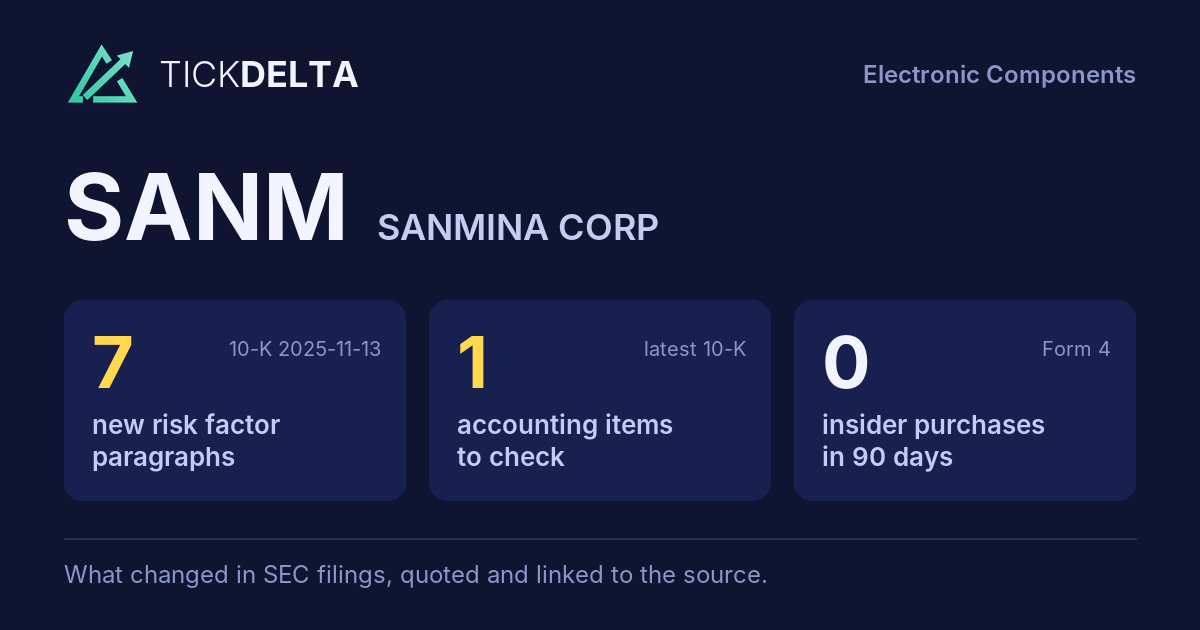
of the text changed · 8,736 words now · 7 new paragraphs, 8 gone
MD&A
25.1%
of the text changed · 7,597 words now · 15 new paragraphs, 6 gone
Legal Proceedings
27.3%
of the text changed · 2,055 words now
Accounting Policies
23.8%
of the text changed · 4,177 words now
10-K 0000897723-25-000042 (Nov 13, 2025) vs 10-K 0000897723-24-000056 (Nov 27, 2024)
Every paragraph, and how much of it changed
One bar per paragraph, in the order of the 10-K. Height and colour show the share of its words not in the closest paragraph a year earlier; the tallest bars are new paragraphs.
Risk Factors
107 paragraphs · 7 new · 29 reworded · 8 gone · 10-K Nov 13, 2025 against Nov 27, 2024
New paragraph
Reworded (5% of its words or more)
Same or nearly
Paragraph 45 · 32% changed
Every version of it
Paragraph 7 · 30% changed
Every version of it
We realize a substantial portion of our revenue from communications equipment customers. customers, including cloud service providers and data center operators. This market is highly competitive, particularly in the area of price. Should any of our larger customers in this market fail to effectively compete with their competitors, they could reduce their orders to us or experience liquidity difficulties, either of which could have the effect of substantially reducing our revenue and net income. In addition, recent customer finished goods inventory adjustments reduced demand for our services from this end market, negatively impacting our revenue during fiscal 2024. There can be no assurance when this adjustment will be complete or that we will not experience declines in demand in this or in other end markets in the future.
Paragraph 90 · 24% changed
Every version of it
Paragraph 101 · 23% changed
Every version of it
We carry various forms of business and liability insurance in types and amounts we believe are reasonable and customary for similarly situated companies in our industry. However, our insurance program does not generally cover losses due to failure to comply with typical customer warranties for workmanship, product and medical device liability, intellectual property infringement, product recall claims, or environmental contamination. In particular, our insurance coverage with respect to damages to or closure of our facilities, or damages to our customers’ products caused by cyberattacks, outages and certain natural disasters, such as earthquakes, epidemics and pandemics (such as the COVID-19 pandemic), is limited and is subject to policy deductibles, coverage limits, and exclusions, and as a result, may not be sufficient to cover all of our losses. For example, our policies have very limited coverage for damages due to earthquakes or losses caused by business disruptions. In addition, such coverage may not continue to be available at commercially reasonable rates and terms. Our policies generally
Paragraph 102 · 23% changed
Every version of it
natural disasters, such as earthquakes, epidemics and pandemics, is limited and is subject to policy deductibles, coverage limits, and exclusions, and as a result, may not be sufficient to cover all of our losses. For example, our policies have very limited coverage for damages due to earthquakes or losses caused by business disruptions. In addition, such coverage may not continue to be available at commercially reasonable rates and terms. Our policies generally have deductibles and/or limits or may be limited to certain lines or business or customer engagements that reduce the amount of our potential recoveries from insurance. As a result, not all of our potential business losses are covered under our insurance policies. Should we sustain a significant uncovered loss, our net income will be reduced. Additionally, if one or more counterparties to our insurance coverage were to fail, we would bear the entire amount of an otherwise insured loss.
Paragraph 76 · 22% changed
Every version of it
Our liquidity is dependent on a number of factors, including profitability, business volume, inventory levels, the extension of trade credit by our suppliers, the degree of alignment of payment terms from our suppliers with payment terms granted to our customers, the amount we invest in our facilities and equipment, the timing of acquisitions and divestitures, the schedule for repayment of our outstanding indebtedness, the timing of stock repurchases, the amount available to borrow under the Fifth Amended and Restated Credit Agreement, dated as of September 27, 2022, as amended (the “Credit Agreement”), our credit facilities, and the amount of accounts receivable eligible and accepted for sale under our factoring programs. In the event we need or desire additional liquidity beyond the sources described above to maintain or expand our business levels, make acquisitions or repurchase stock, there can be no assurance that such additional liquidity will be available on acceptable terms or at all. The sale of receivables under our factoring programs is subject to the approval of the banks or customers involved and there can be no assurance that we will be able to sell the maximum amount of receivables permitted by these programs when desired. In addition, because the interest rate we pay for borrowings under the Credit Agreement and the interest rate used to calculate the purchase price for receivables under our factoring programs are variable, the currently high interest rates resulting from actions taken by the Federal Reserve to reduce inflation both increases the amount of interest expense we pay, which reduces net income, and also reduces the amount of proceeds we receive from purchasers under our receivables factoring program, which reduces operating cash flow.
Paragraph 11 · 21% changed
Every version of it
•conditions in the global economy as a whole and in the industries we serve, which have been significantly impacted by supply chain disruptions, inflationary pressures and pressures, higher interest rates; rates and, more recently, significant changes in U.S. and international trade policies;
Paragraph 62 · 34% changed
Every version of it
10-K Nov 27, 2024We rely on internal and cloud-based networks and systems furnished by third parties for worldwide financial reporting, inventory management, procurement, invoicing, employee payroll and benefits administration and email communications, among other functions. In addition, our 42Q manufacturing execution solutions software used by us and certain of our customers operates in the cloud. Despite our business continuity planning, including maintaining redundant data sites and network availability, both our internal and cloud-based infrastructure may be susceptible to outages due to fire, floods, power loss, telecommunications failures, terrorist attacks, performance failures by our IT vendors and similar events. For example, in July 2024, a misconfigured system update initiated by one of our network security vendors caused our worldwide manufacturing operations to be temporarily disrupted. In addition, our systems, like those of other large companies, are regularly subject to third-party hacking attempts. Despite the implementation of numerous network security measures, both our internal and our cloud-based infrastructure may also be vulnerable to such hacking attempts, the installation of computer viruses, malware or similar disruptions either by third parties or employees with access to key IT infrastructure. Cybersecurity attacks can come in many forms, including distributed denial of service attacks, advanced persistent threat, phishing, business email compromise efforts and ransomware attacks. There can be no assurance that a future malware attack or hacking attempt will not be successful in breaching our systems. Hacking, malware and other cybersecurity attacks, if not prevented, could lead to the collection and disclosure of sensitive personal or confidential information relating to our business, customers, employees or others, exposing us to legal liability and causing us to suffer reputational damage. In addition, our SCI defense and aerospace business is subject to U.S. government regulations requiring the safeguarding of certain unclassified government information and to report to the U.S. government certain cyber incidents that affect such information. The increasing sophistication of cyberattacks requires us to continually evaluate new technologies and processes intended to detect and prevent these attacks. Our insurance coverage for cyberattacks is limited. There can be no assurance that our cybersecurity measures will be sufficient to protect the data we manage. If we and our cloud infrastructure vendors are not successful in preventing such outages and cyberattacks, our operations could be disrupted, we could incur losses, including losses relating to claims by our customers, employees or privacy regulators relating to loss of personal or confidential business information, the willingness of customers to do business with us may be damaged and, in the case of our defense business, we could be barred from future participation in U.S. government programs.
10-K Nov 13, 2025
to the collection and disclosure of sensitive personal or confidential information relating to our business, customers, employees or others, exposing us to legal liability and causing us to suffer reputational damage. In addition, our SCI defense and aerospace business is subject to U.S. government regulations requiring the safeguarding of certain unclassified government information and to report to the U.S. government certain cyber incidents that affect such information. The increasing sophistication of cyberattacks requires us to continually evaluate new technologies and processes intended to detect and prevent these attacks. Our insurance coverage for cyberattacks is limited. There can be no assurance that our cybersecurity measures will be sufficient to protect the data we manage. If we and our cloud infrastructure vendors are not successful in preventing such outages and cyberattacks, our operations could be disrupted, we could incur losses, including losses relating to claims by our customers, employees or privacy regulators relating to loss of personal or confidential business information, the willingness of customers to do business with us may be damaged and, in the case of our defense business, we could be barred from future participation in U.S. government programs.
Paragraph 45 · 32% changed
Every version of it
10-K Nov 27, 2024Although we maintain significant manufacturing capacity in the U.S., the majority of our manufacturing operations are located outside the U.S. The U.S., China, the E.U. and several other countries have imposed tariffs on certain imported products. In particular, the U.S. has imposed tariffs impacting certain components and products imported from China by us into the U.S. These tariffs apply to both components imported into the U.S. from China for use in the manufacture of products at our U.S. plants and to certain of our customers’ products that we manufacture for them in China and that are then imported into the U.S. Any decision by a large number of our customers to cease using our manufacturing services due to the application of tariffs would materially reduce our revenue and net income. Depending on the outcome of the U.S. presidential election, a broad increase in tariffs on all imported components is possible. Our gross margins would be reduced in the event we are for any reason unable to pass on any tariffs that we incur to our customers. Although our customers are generally liable for tariffs we pay on their behalf on importation of components used in the manufacture of their products, our gross margins would be reduced in the event we are for any reason unable to recover tariffs or duties from our customers. Further, although we are required to pay tariffs upon importation of the components, we may not be able to recover these amounts from our customers until sometime later, if at all, which would adversely impact our operating cash flow in a given period.
10-K Nov 13, 2025
The U.S. has recently announced or enacted broad increases in tariffs on all imported components, as well as on aluminum, steel, copper and derivatives thereof, subject to limited exceptions. As a result, we are exposed to increased tariffs with respect to components, products and certain raw materials we import into the U.S. from China, Mexico and other countries, with some exceptions. Although our customers are generally liable for tariffs we pay on their behalf on importation of components used in the manufacture of their products and the importation of the products themselves, our gross margins would be reduced, potentially significantly, in the event we are for any reason unable to fully recover tariffs or duties from our customers. Any decision by a large number of our customers to cease using our non-U.S. manufacturing locations due to the application of increased tariffs would materially reduce our revenue and net income. Further, although we are required to pay tariffs upon importation of the components, we may not be able to recover these amounts from our customers until sometime later, if at all, which could materially adversely impact our operating cash flow in a given period, especially if the recently announced higher tariffs actually take effect.
Paragraph 7 · 30% changed
Every version of it
10-K Nov 27, 2024
We realize a substantial portion of our revenue from communications equipment customers. This market is highly competitive, particularly in the area of price. Should any of our larger customers in this market fail to effectively compete with their competitors, they could reduce their orders to us or experience liquidity difficulties, either of which could have the effect of substantially reducing our revenue and net income. In addition, recent customer finished goods inventory adjustments reduced demand for our services from this end market, negatively impacting our revenue during fiscal 2024. There can be no assurance when this adjustment will be complete or that we will not experience declines in demand in this or in other end markets in the future.
10-K Nov 13, 2025
We realize a substantial portion of our revenue from communications equipment customers, including cloud service providers and data center operators. This market is highly competitive, particularly in the area of price. Should any of our larger customers in this market fail to effectively compete with their competitors, they could reduce their orders to us or experience liquidity difficulties, either of which could have the effect of substantially reducing our revenue and net income.
Paragraph 90 · 24% changed
Every version of it
10-K Nov 27, 2024In addition, we have in the past recorded, and may be required to record in the future, goodwill and other intangible assets in connection with our acquisitions. We evaluate, at least on an annual basis, whether events or circumstances have occurred that indicate all, or a portion, of the carrying amount of our goodwill and other intangible assets may no longer be recoverable. Should we determine in the future that our goodwill or other intangible assets have become impaired, an impairment charge to earnings would become necessary, which could be significant. For example, during our fiscal 2018 annual goodwill impairment analysis, we fully impaired goodwill of $31 million associated with the acquisition of a storage software business we purchased in 2016.
10-K Nov 13, 2025
Finally, we have in the past recorded, and, as a result of the closing of the ZT Systems acquisition, will be required to record substantial goodwill and other intangible assets on our balance sheet. We evaluate, at least on an annual basis, whether events or circumstances have occurred that indicate all, or a portion, of the carrying amount of our goodwill and other intangible assets may no longer be recoverable. Should we determine in the future that our goodwill or other intangible assets have become impaired, an impairment charge to earnings would become necessary, which could be significant.
Paragraph 101 · 23% changed
Every version of it
10-K Nov 27, 2024
We carry various forms of business and liability insurance in types and amounts we believe are reasonable and customary for similarly situated companies in our industry. However, our insurance program does not generally cover losses due to failure to comply with typical customer warranties for workmanship, product and medical device liability, intellectual property infringement, product recall claims, or environmental contamination. In particular, our insurance coverage with respect to damages to or closure of our facilities, or damages to our customers’ products caused by cyberattacks, outages and certain natural disasters, such as earthquakes, epidemics and pandemics (such as the COVID-19 pandemic), is limited and is subject to policy deductibles, coverage limits, and exclusions, and as a result, may not be sufficient to cover all of our losses. For example, our policies have very limited coverage for damages due to earthquakes or losses caused by business disruptions. In addition, such coverage may not continue to be available at commercially reasonable rates and terms. Our policies generally
10-K Nov 13, 2025
We carry various forms of business and liability insurance in types and amounts we believe are reasonable and customary for similarly situated companies in our industry. However, our insurance program does not generally cover losses due to failure to comply with typical customer warranties for workmanship, product and medical device liability, intellectual property infringement, product recall claims, or environmental contamination. In particular, our insurance coverage with respect to damages to or closure of our facilities, or damages to our customers’ products caused by cyberattacks, outages and certain
Paragraph 102 · 23% changed
Every version of it
10-K Nov 27, 2024
have deductibles and/or limits or may be limited to certain lines or business or customer engagements that reduce the amount of our potential recoveries from insurance. As a result, not all of our potential business losses are covered under our insurance policies. Should we sustain a significant uncovered loss, our net income will be reduced. Additionally, if one or more counterparties to our insurance coverage were to fail, we would bear the entire amount of an otherwise insured loss.
10-K Nov 13, 2025
natural disasters, such as earthquakes, epidemics and pandemics, is limited and is subject to policy deductibles, coverage limits, and exclusions, and as a result, may not be sufficient to cover all of our losses. For example, our policies have very limited coverage for damages due to earthquakes or losses caused by business disruptions. In addition, such coverage may not continue to be available at commercially reasonable rates and terms. Our policies generally have deductibles and/or limits or may be limited to certain lines or business or customer engagements that reduce the amount of our potential recoveries from insurance. As a result, not all of our potential business losses are covered under our insurance policies. Should we sustain a significant uncovered loss, our net income will be reduced. Additionally, if one or more counterparties to our insurance coverage were to fail, we would bear the entire amount of an otherwise insured loss.
Paragraph 76 · 22% changed
Every version of it
10-K Nov 27, 2024
Our liquidity is dependent on a number of factors, including profitability, business volume, inventory levels, the extension of trade credit by our suppliers, the degree of alignment of payment terms from our suppliers with payment terms granted to our customers, the amount we invest in our facilities and equipment, the timing of acquisitions and divestitures, the schedule for repayment of our outstanding indebtedness, the timing of stock repurchases, the amount available to borrow under the Fifth Amended and Restated Credit Agreement, dated as of September 27, 2022, as amended (the “Credit Agreement”), and the amount of accounts receivable eligible and accepted for sale under our factoring programs. In the event we need or desire additional liquidity beyond the sources described above to maintain or expand our business levels, make acquisitions or repurchase stock, there can be no assurance that such additional liquidity will be available on acceptable terms or at all. The sale of receivables under our factoring programs is subject to the approval of the banks or customers involved and there can be no assurance that we will be able to sell the maximum amount of receivables permitted by these programs when desired. In addition, because the interest rate we pay for borrowings under the Credit Agreement and the interest rate used to calculate the purchase price for receivables under our factoring programs are variable, the currently high interest rates resulting from actions taken by the Federal Reserve to reduce inflation both increases the amount of interest expense we pay, which reduces net income, and also reduces the amount of proceeds we receive from purchasers under our receivables factoring program, which reduces operating cash flow.
10-K Nov 13, 2025
Our liquidity is dependent on a number of factors, including profitability, business volume, inventory levels, the extension of trade credit by our suppliers, the degree of alignment of payment terms from our suppliers with payment terms granted to our customers, the amount we invest in our facilities and equipment, the timing of acquisitions and divestitures, the schedule for repayment of our outstanding indebtedness, the timing of stock repurchases, the amount available to borrow under our credit facilities, and the amount of accounts receivable eligible and accepted for sale under our factoring programs. In the event we need or desire additional liquidity beyond the sources described above to maintain or expand our business levels, make acquisitions or repurchase stock, there can be no assurance that such additional liquidity will be available on acceptable terms or at all. The sale of receivables under our factoring programs is subject to the approval of the banks or customers involved and there can be no assurance that we will be able to sell the maximum amount of receivables permitted by these
Paragraph 11 · 21% changed
Every version of it
10-K Nov 27, 2024
•conditions in the global economy as a whole and in the industries we serve, which have been significantly impacted by supply chain disruptions, inflationary pressures and higher interest rates;
10-K Nov 13, 2025
•conditions in the global economy as a whole and in the industries we serve, which have been significantly impacted by supply chain disruptions, inflationary pressures, higher interest rates and, more recently, significant changes in U.S. and international trade policies;
MD&A
93 paragraphs · 15 new · 53 reworded · 6 gone · 10-K Nov 13, 2025 against Nov 27, 2024
New paragraph
Reworded (5% of its words or more)
Same or nearly
Paragraph 28 · 50% changed
Consolidation— In accordance with Accounting Standards Codification 810, we consolidate our Indian manufacturing entity, even though we only hold 49.9% of its outstanding shares. This is because we have the unilateral ability to make all significant financial and operating decisions for the entity. We concluded that, despite not having a majority ownership interest, ownership, we have a controlling financial interest in SIPL through interest, which requires us to consolidate the management services contract. Therefore, we have, by contract, the unilateral ability to control the significant decisions made in the ordinary course of SIPL’s business and, as such, we consolidate SIPL. However, we entity. We periodically assess whether this arrangement to determine if there is any changes change in facts and circumstances have occurred that could might require us to deconsolidate SIPL. the entity.
Paragraph 35 · 49% changed
The decrease increase in sales was primarily due to reduced demand caused by customers in some end markets, particularly communications networks, making adjustments to absorb their finished goods inventory. The impact of this was partially offset by new program wins and program ramps ramp-ups in our automotive and communications networks and cloud infrastructure, as well as our medical end markets.
Paragraph 47 · 48% changed
Other expense income (expense), net was $1 $(11) million in 2024, $20 2025 and $(1) million in 2023 and a $26 million in 2022. 2024. The decrease increase in other expense in 2024 2025 was primarily caused by a $12 million decrease in discount of sold receivables in 2024 due to significantly lower factoring levels and an incremental market-value gain of $5 million in the market value of on participant investment accounts in our deferred compensation plan. plan compared to 2024 as a result of the total return swap contract (“TRS”) entered in the second quarter of 2025 that substantially offsets changes in the deferred compensation plan liabilities elections made by plan participants.
Paragraph 60 · 46% changed
Paragraph 15 · 46% changed
Paragraph 66 · 45% changed
Paragraph 8 · 38% changed
A core component of our business strategy is to establish secure and retain long-term customer partnerships with companies. leading companies in growth industries, capitalizing on our global/regional footprint and unique value proposition in advanced electronics manufacturing. We provide tailored solutions by leveraging our technical capabilities in design, technology, assembly, integration, and after-sales services, aligning them with facilities globally. Historically, we have had substantial recurring sales to existing customers. Sales to our ten largest customers typically represent approximately 50% of our net sales in any given year. sales.
Paragraph 57 · 34% changed
Paragraph 28 · 50% changed
10-K Nov 27, 2024
concluded that, despite not having a majority ownership interest, we have a controlling financial interest in SIPL through the management services contract. Therefore, we have, by contract, the unilateral ability to control the significant decisions made in the ordinary course of SIPL’s business and, as such, we consolidate SIPL. However, we periodically assess whether any changes in facts and circumstances have occurred that could require us to deconsolidate SIPL.
10-K Nov 13, 2025
Consolidation— In accordance with Accounting Standards Codification 810, we consolidate our Indian manufacturing entity, even though we only hold 49.9% of its outstanding shares. This is because we have the unilateral ability to make all significant financial and operating decisions for the entity. We concluded that, despite not having a majority ownership, we have a controlling financial interest, which requires us to consolidate the entity. We periodically assess this arrangement to determine if there is any change in facts and circumstances that might require us to deconsolidate the entity.
Paragraph 35 · 49% changed
10-K Nov 27, 2024
The decrease in sales was primarily due to reduced demand caused by customers in some end markets, particularly communications networks, making adjustments to absorb their finished goods inventory. The impact of this was partially offset by new program wins and program ramps in our automotive and communications networks end markets.
10-K Nov 13, 2025
The increase in sales was primarily due to new program wins and program ramp-ups in our communications networks and cloud infrastructure, as well as our medical end markets.
Paragraph 47 · 48% changed
10-K Nov 27, 2024
Other expense was $1 million in 2024, $20 million in 2023 and a $26 million in 2022. The decrease in other expense in 2024 was primarily caused by a $12 million decrease in discount of sold receivables in 2024 due to significantly lower factoring levels and an incremental gain of $5 million in the market value of participant investment accounts in our deferred compensation plan.
10-K Nov 13, 2025
Other income (expense), net was $(11) million in 2025 and $(1) million in 2024. The increase in other expense in 2025 was primarily caused by a lower market-value gain on participant investment accounts in our deferred compensation plan compared to 2024 as a result of the total return swap contract (“TRS”) entered in the second quarter of 2025 that substantially offsets changes in the deferred compensation plan liabilities elections made by plan participants.
Paragraph 60 · 46% changed
10-K Nov 27, 2024As of September 28, September 30, 2024 2023 Days sales outstanding (1) 56 55 Contract asset days (2) 18 20 Inventory turns (3) 5.2 5.1 Days inventory on hand (4) 70 72 Accounts payable days (5) 71 80 Cash cycle days (6) 73 67
10-K Nov 13, 2025
(6) Cash cycle days is calculated as the sum of days in accounts receivable, contract asset days and days in inventory, minus the sum of accounts payable days and customer inventory advances days.
Paragraph 15 · 46% changed
10-K Nov 27, 2024A summary of our operating lease obligations as of September 28, 2024 can be found in Note 7 “Leases” of the notes to the Consolidated Financial Statements contained in this report.
10-K Nov 13, 2025
See Note 16, “Business Combination” of the notes to the Consolidated Financial Statements contained in this report for more information.
Paragraph 66 · 45% changed
10-K Nov 27, 2024During 2023, we generated $527 million of cash from earnings, excluding non-cash items, and used $292 million of cash primarily because of a decrease in accounts payable of $418 million and an increase in accounts receivable of $89 million, partially offset by a decrease in inventories of $210 million. The decrease in accounts payable was primarily attributable to lower inventory receipts and an unfavorable mix of supplier payment terms, resulting in DPO decreasing from 90 days in 2022 to 80 days in 2023. The decrease in inventories was primarily due to lower business volume and our efforts to reduce inventory to more appropriate levels primarily by working with customers to ensure their demand forecasts are reasonable and incorporate appropriate lead times to secure materials. The increase in accounts receivable was primarily attributable to higher business volume and unfavorable customer payment terms mix.
10-K Nov 13, 2025
cash primarily because of a decrease in accounts payable of $112 million and an increase in accounts receivable of $104 million, partially offset by an increase in deferred revenue and customer advances of $89 million. The decrease in accounts payable was primarily attributable to an unfavorable mix of supplier payment terms and lower inventory receipts. The increase in accounts receivable was primarily attributable to unfavorable customer payment terms mix. The change in deferred revenue and customer advances is driven by increased customer deposits against raw material inventory purchases.
Paragraph 8 · 38% changed
10-K Nov 27, 2024
A core component of our business strategy is to establish and retain long-term customer partnerships with companies. Historically, we have had substantial recurring sales to existing customers. Sales to our ten largest customers typically represent approximately 50% of our net sales in any given year.
10-K Nov 13, 2025
A core component of our business strategy is to secure and retain long-term customer partnerships with leading companies in growth industries, capitalizing on our global/regional footprint and unique value proposition in advanced electronics manufacturing. We provide tailored solutions by leveraging our technical capabilities in design, technology, assembly, integration, and after-sales services, aligning them with facilities globally. Historically, we have had substantial recurring sales to existing customers. Sales to our ten largest customers represent approximately 50% of net sales.
Paragraph 57 · 34% changed
10-K Nov 27, 2024(4)Days inventory on hand (a measure of how quickly we turn inventory into sales) is calculated as the ratio of average inventory for the quarter to average daily cost of sales for the quarter.
10-K Nov 13, 2025
(3) Days in inventory (a measure of how quickly we turn inventory into sales) is calculated as inventory at the end of the current quarter divided by cost of sales for the quarter multiplied by 90 days.
A paragraph is matched with the one last year that shares the most of its words; under half in common makes it new. The paragraphs shown are the 8 reworded the most in each section.
The paragraph that changed most in each section
The redline
Marked against last year's 10-K: cut words struck through, new words highlighted.
Risk Factors269 words changed in this paragraph; it is 43% similar to last year's version.
Source: Item 1A, 10-K 0000897723-25-000042 vs Item 1A, 10-K 0000897723-24-000056
Accounting Policies197 words changed in this paragraph; it is 39% similar to last year's version.
The Company recognizes revenue for the majority of its contracts on an over time basis. This is primarily due to the fact that the Company does not have an alternative use for the end products it manufactures for its customers and has an enforceable right to payment, including a reasonable profit, for work in progress upon a customer’s cancellation of a contract for convenience. In certain circumstances, the Company recognizes over time because its customer simultaneously receives and consumes the benefits provided by the Company’s services or the Company’s customer controls the end product as the Company performs manufacturing services (continuous transfer of control). For these contracts, revenue is recognized on an over time basis using the cost-to-cost method (ratio of costs incurred to date to total estimated costs at completion) which the Company believes best depicts the transfer of control to the customer. At least 95% of the Company’s revenue is recognized on an over time basis, which is as products are manufactured or services are performed. Because of this, and the fact that there is no work in process or finished goods inventory associated with contracts for which revenue is recognized on an over-time basis, 99% or more of the Company’s inventory at the end of a given period is in the form of raw materials. For contracts for which revenue is required to be recognized at a point in time, the Company recognizes revenue when it has transferred control of the related goods, which generally occurs upon shipment or delivery of the goods to the customer.
Source: Item 8, Note 2 – Summary of Significant Accounting Policies, 10-K 0000897723-25-000042 vs Item 8, Note 2 – Summary of Significant Accounting Policies, 10-K 0000897723-24-000056
MD&A186 words changed in this paragraph; it is 33% similar to last year's version.
During 2023, 2025, we generated $527 $432 million of cash from earnings, excluding non-cash items, and used $292 generated $189 million of cash primarily because of a decrease increases in accounts payable of $418 $99 million, accrued liabilities and other of $75 million and an increase deferred revenue and customer advances of $663 million, partially offset by increases in accounts receivable of $89 $64 million, partially offset by a decrease in contract assets of $42 million and inventories of $210 $543 million. These increases were consistent with the growth in business volume. The decrease change in accounts payable was primarily attributable deferred revenue and customer advances is driven by increased customer deposits against raw material inventory purchases. During the third quarter of 2025, we initiated a program change with our customers that resulted in all inventory advance payments from customers to lower inventory receipts and an unfavorable mix of supplier payment terms, resulting offset our working capital investment in DPO decreasing from 90 days in 2022 to 80 days in 2023. The decrease in inventories was primarily due to lower business volume and our efforts to reduce raw materials inventory to more appropriate levels primarily by working with customers to ensure their demand forecasts are reasonable be classified as deferred revenue and incorporate appropriate lead times to secure materials. The increase in accounts receivable was primarily attributable to higher business volume and unfavorable customer payment terms mix. advances.
Source: Item 7, 10-K 0000897723-25-000042 vs Item 7, 10-K 0000897723-24-000056
Legal Proceedings147 words changed in this paragraph; it is 82% similar to last year's version.
In May 2023, Sanmina Corporation the Company and its SCI Technology, Inc. subsidiary (“SCI”) received Civil Investigative Demands (“CIDs”) from the United States Department of Justice (“DOJ”) pursuant to the civil False Claims Act (“FCA”). The stated purpose of the CIDs—a form of subpoena requiring responses to written interrogatories and the production of documents relating to certain contracts, projects, proposals proposals, and business activities of SCI going back to 2010—is to determine whether there is or has been a violation of the FCA with respect to the provision of products and services to the government. These CIDs supplement supplemented several CIDs relating to the same subject matter served upon SCI and certain current and former SCI and Sanmina Corporation employees beginning in August 2020, pursuant to which SCI produced documents and information and certain of the current and former employees provided oral testimony. Sanmina The Company and SCI cooperated with the DOJ investigation. On May 13, 2024, the Company learned that United States of America ex rel. Carl R. Eckert v. SCI Technology, Inc. et al. (the “Eckert Qui Tam Suit”) had been filed under seal by a former SCI employee in June 2020, and is now recently unsealed. On May 13, 2024, the Company also learned that the DOJ had filed a notice in the Eckert Qui Tam Suit stating that, while its investigation would continue, it was declining to intervene at the current time. The As narrowed by a September 23, 2025 court order granting in part and denying in part the Company and SCI’s motion to dismiss, the Eckert Qui Tam Suit, filed by a former SCI employee, Suit alleges on behalf of the United States, 16 States 6 FCA counts that relate substantially to the same contracts and issues that the DOJ has investigated over the past four years, previously had investigated, including making false certifications under the Truth in Negotiations Act and Cost Accounting Standards, claims for submitting false cost and or pricing data, fraudulently inducing and overcharging the government to award contracts and violations through underpayment of certain employees in violation of the Service Contract Act. The complaint suit alleges such claimed violations defrauded the government in an amount approximating $100 million. The complaint million, and seeks, on behalf of the U.S. government, treble damages, civil penalties penalties, interest, attorneys’ fees and interest payable thereon. On October 7, 2024, Sanmina costs, and SCI filed a motion to dismiss the Eckert Qui Tam Suit. A decision on the motion is expected in the first half expenses of calendar 2025. Sanmina Corporation suit. The Company and SCI intend to continue to defend vigorously against the claims made in the Eckert Qui Tam Suit. suit. The Company is unable to predict the ultimate outcome of the Eckert Qui Tam Suit, although a loss currently is currently not considered to be probable or estimable.
Source: Item 3, via Note 9 – Contingencies, 10-K 0000897723-25-000042 vs Item 3, via Note 9 – Contingencies, 10-K 0000897723-24-000056
Sentences and paragraphs added, removed or reworded
Every change, by type
Sentences and paragraphs of SANM's Risk Factors and MD&A, 10-K Nov 13, 2025 against 10-K Nov 27, 2024. Each links to the text at sec.gov.
Quiet changes are sentences kept from last year with one to four words changed, at least one of them a hedge, a modal or a qualifier (may, could, will, not, significant, material…). A year or date rolling forward is not counted.
The full word list
adverse, adversely, all, although, anticipate, anticipates, any, approximately, believe, believes, can, cannot, certain, could, expect, expects, generally, however, if, intend, intends, largely, likely, many, material, materially, may, might, most, must, never, no, not, possible, primarily, probable, should, significant, significantly, some, substantial, substantially, unlikely, will, would
AddedRisk Factors
indemnify us for such liabilities, in which case we could be required to expend significant resources to defend ourselves if named in a product liability suit over such defects.
Read it in 10-K Nov 13, 2025 at sec.gov
AddedRisk Factors
programs when desired. In addition, because the interest rate we pay for borrowings under our credit facilities and the interest rate used to calculate the purchase price for receivables under our factoring programs are variable. When interest rates are high, this both increases the amount of interest expense we pay, which reduces net income, and reduces the amount of proceeds we receive from purchasers under our receivables factoring program, which reduces operating cash flow.
Read it in 10-K Nov 13, 2025 at sec.gov
AddedRisk Factors
From time to time, we may undertake strategic transactions that give us the opportunity to access new customers and new end markets, increase our proprietary product offerings, obtain new manufacturing and service capabilities and technologies, enter new geographic manufacturing locations, lower our manufacturing costs, increase our margins or further develop existing customer relationships. For example, in October 2025, we acquired the data center infrastructure
Read it in 10-K Nov 13, 2025 at sec.gov
AddedRisk Factors
manufacturing business of ZT Systems from Advanced Micro Devices, Inc., and in October 2022, we entered into a joint venture with a wholly owned subsidiary of Reliance Strategic Business Ventures Limited (“RSBVL”).
Read it in 10-K Nov 13, 2025 at sec.gov
AddedRisk Factors
Our ability to realize any of the anticipated benefits from the acquisition of ZT Systems depends on us successfully integrating ZT Systems into our business and executing on our business plan to support large scale data center rack deployments. If we cannot successfully integrate or are delayed in integrating newly acquired businesses or fail to execute our business plan, it would negatively impact our ability to manufacture new products for and to grow our business, which would materially adversely affect our financial condition, results of operations or cash flows. Even if ZT Systems is successfully integrated, the benefits of such acquisition may not be realized within the anticipated time frame or at all. The success of our India joint venture is also subject to a number of risks and uncertainties, including adverse changes in the key markets the joint venture targets and the risks described above under the caption “We are subject to risks arising from our international operations”.
Read it in 10-K Nov 13, 2025 at sec.gov
AddedRisk Factors
Strategic transactions, including the acquisition of ZT Systems, involve a number of risks, uncertainties and costs, including: difficulty in integrating acquired operations and workforce, businesses and products; resolving quality issues involving acquired products; incurring severance and other restructuring costs; diverting management attention from their normal operational duties; maintaining customer, supplier or other favorable business relationships of acquired operations; terminating unfavorable commercial arrangements; losing key employees; integrating the systems of acquired operations into our management information systems; satisfying the liabilities of acquired businesses, including liability for historical contract and intellectual property infringement liabilities, past violations of law and material environmental liabilities; significant transaction and integration costs, or unknown or inestimable liabilities associated with the transaction, such as increased interest expense and compliance with debt covenants or other obligations; and the possibility that we may not realize the expected benefits, cost savings, accretion, synergies, or growth from the transaction, or that such benefits may be delayed. Any of these risks could cause our strategic transactions, including the ZT Systems acquisition and our India joint venture, not to be as profitable or accretive as expected or planned.
Read it in 10-K Nov 13, 2025 at sec.gov
AddedRisk Factors
Separately, we may also choose to divest plants, businesses or products lines in the future. Divestitures reduce revenue and, potentially, margins and can involve the risk of retained liabilities from the operations divested, including environmental liabilities.
Read it in 10-K Nov 13, 2025 at sec.gov
RemovedRisk Factors
Show the other 49
RemovedRisk Factors
RemovedRisk Factors
RemovedRisk Factors
RemovedRisk Factors
RemovedRisk Factors
RemovedRisk Factors
RemovedRisk Factors
RewordedRisk Factors
A sustained increase in energy prices for any reason could increase our raw material, components, operations and transportation costs, which we may not be able to pass on to our customers and which would therefore reduce our profitability, as would any increase in operating costs and investments due to our adoption, whether voluntary or mandatory, of measures to reduce our carbon footprint.
Read it in 10-K Nov 13, 2025 at sec.gov
RewordedRisk Factors
In particular, our insurance coverage with respect to damages to or closure of our facilities, or damages to our customers’ products caused by cyberattacks, outages and certain natural disasters, such as earthquakes, epidemics and pandemics (such as the COVID-19 pandemic), is limited and is subject to policy deductibles, coverage limits, and exclusions, and as a result, may not be sufficient to cover all of our losses.
Read it in 10-K Nov 13, 2025 at sec.gov
RewordedRisk Factors
Factors that can cause such fluctuations include announcements by our customers, suppliers, competitors or other events affecting companies in the electronics industry, such as component shortages, changes in trade and tax policies, currency fluctuations, the impact of natural disasters and global events, such as the COVID-19 pandemic, geopolitical tensions, such as the war in Ukraine conditions and conflict in the Middle East, events, and general market fluctuations and macroeconomic conditions, including concerns about inflation inflation, recession and recession, slowing global economic growth, any of which may cause the market price of our common stock to fluctuate widely.
Read it in 10-K Nov 13, 2025 at sec.gov
RewordedRisk Factors
Even when our customers or suppliers are contractually responsible for defects in the design of a product and defects in components used in the manufacture of such products, there is no guarantee that any indemnities provided by such parties will be adequate to cover all damages to which we may become subject or that these parties will have the financial resources to indemnify us for such liabilities, in which case we could be required to expend significant resources to defend ourselves if named in a product liability suit over such defects.
Read it in 10-K Nov 13, 2025 at sec.gov
RewordedRisk Factors
RewordedRisk Factors
Although we believe our existing cash resources and sources of liquidity, together with cash generated from operations, will be sufficient to meet our working capital requirements for at least the next 12 months, should demand for our services increase significantly over the next 12 months or should we experience significant increases in delinquent or uncollectible accounts receivable for any reason, including recessionary economic conditions, our cash provided by operations could decrease significantly and we could be required to seek additional sources of liquidity to continue our operations at their current level.
Read it in 10-K Nov 13, 2025 at sec.gov
RewordedRisk Factors
Our liquidity is dependent on a number of factors, including profitability, business volume, inventory levels, the extension of trade credit by our suppliers, the degree of alignment of payment terms from our suppliers with payment terms granted to our customers, the amount we invest in our facilities and equipment, the timing of acquisitions and divestitures, the schedule for repayment of our outstanding indebtedness, the timing of stock repurchases, the amount available to borrow under the Fifth Amended and Restated Credit Agreement, dated as of September 27, 2022, as amended (the “Credit Agreement”), our credit facilities, and the amount of accounts receivable eligible and accepted for sale under our factoring programs.
Read it in 10-K Nov 13, 2025 at sec.gov
RewordedRisk Factors
Further, although we are required to pay tariffs upon importation of the components, we may not be able to recover these amounts from our customers until sometime later, if at all, which would could materially adversely impact our operating cash flow in a given period. period, especially if the recently announced higher tariffs actually take effect.
Read it in 10-K Nov 13, 2025 at sec.gov
RewordedRisk Factors
Although our customers are generally liable for tariffs we pay on their behalf on importation of components used in the manufacture of their products, products and the importation of the products themselves, our gross margins would be reduced reduced, potentially significantly, in the event we are for any reason unable to fully recover tariffs or duties from our customers.
Read it in 10-K Nov 13, 2025 at sec.gov
RewordedRisk Factors
RewordedRisk Factors
Further, geopolitical conditions and events like the war in Ukraine and Ukraine, conflict in the Middle East and tensions between the U.S. and China may also impact our operations by affecting our supply chain or impacting our plants located in the region of instability.
Read it in 10-K Nov 13, 2025 at sec.gov
RewordedRisk Factors
We realize a substantial portion of our revenue from communications equipment customers. customers, including cloud service providers and data center operators.
Read it in 10-K Nov 13, 2025 at sec.gov
AddedMD&A
Further, uncertainties around U.S. tariffs, retaliatory tariffs from other countries, and import/export restrictions may impact customer decisions to use our services in certain manufacturing locations and increase the complexity and cost of our supply chain. Although our customers are generally liable for tariffs we pay for components and finished products, our gross margins could be impacted if we are unable to fully recover these costs. The timing of tariff recovery from customers could adversely affect our operating cash flow in a given period.
Read it in 10-K Nov 13, 2025 at sec.gov
AddedMD&A
In line with our strategic intent to expand our presence in the Cloud and Artificial Intelligence ecosystem, we acquired the data center infrastructure manufacturing business, excluding certain research and development functions, of ZT Group Int’l, Inc. (“ZT Systems”), from AMD Design, LLC, a wholly owned subsidiary of Advanced Micro Devices, Inc. On October 27, 2025 (the “Closing Date”), we completed the acquisition of ZT Systems (the “ZT Acquisition”) for an aggregate consideration of $1.6 billion consisting of $1.46 billion in cash consideration (subject to adjustment for certain working capital and other items), a number of shares of our common stock valued at $150 million and up to $450 million contingent cash consideration upon the achievement of certain financial metrics during the three-year period following the closing of ZT Systems acquisition.
Read it in 10-K Nov 13, 2025 at sec.gov
AddedMD&A
determination is made. We only recognize or continue to recognize tax positions that meet a “more likely than not” threshold of being upheld. Interest and penalties related to unrecognized tax benefits are recognized as a component of income tax expense.
Read it in 10-K Nov 13, 2025 at sec.gov
AddedMD&A
Acquisition and integration charges were $34 million in 2025 and are related to the acquisition of ZT Systems. There were no such charges in prior years.
Read it in 10-K Nov 13, 2025 at sec.gov
AddedMD&A
On July 4, 2025, the One Big Beautiful Bill Act (“OBBBA”) was enacted in the U.S. The OBBBA includes significant provisions, such as the permanent extension of certain expiring provisions of the Tax Cuts and Jobs Act, modifications to the international tax framework, and the restoration of favorable tax treatment for certain business provisions. The legislation has multiple effective dates, with certain provisions effective in 2025 and others implemented through 2027. The majority of these changes take effect after our fiscal 2025 tax year. Those that did have an effect on our fiscal 2025, such as 100% bonus reinstatement, have been calculated and included in our provision for income taxes. There was no material impact from the OBBBA to fiscal 2025 financial statements.
Read it in 10-K Nov 13, 2025 at sec.gov
AddedMD&A
Management regularly reviews financial and non-financial performance indicators to assess our operating results. Our working capital requirements are dependent on the effective management of our sales cycle, as well as timing of payments. We believe the metrics set forth below are useful to investors in measuring our liquidity, as future liquidity needs will depend on fluctuations in levels of inventory, contract assets, customer inventory advances, accounts receivable and accounts payable.
Read it in 10-K Nov 13, 2025 at sec.gov
AddedMD&A
In the second quarter of fiscal 2025, we changed the methodology for calculating key working capital management measures to standardize the number of days utilized in calculating the metrics, add a new metric for customer inventory advances days, and update the calculation of inventory turns to present inventory turns net of customer inventory advances, which is consistent with how we manage working capital. Prior period amounts have been conformed to the current period presentation.
Read it in 10-K Nov 13, 2025 at sec.gov
AddedMD&A
(5) Customer inventory advances days (a measure of how long customer deposits for inventory are held) is calculated as customer inventory advances at the end of the current quarter divided by cost of sales for the quarter multiplied by 90 days.
Read it in 10-K Nov 13, 2025 at sec.gov
AddedMD&A
(7) Net inventory turns (annualized) is calculated as 360 days divided by the days in inventory minus customer inventory advances days.
Read it in 10-K Nov 13, 2025 at sec.gov
AddedMD&A
During 2025, we generated $432 million of cash from earnings, excluding non-cash items, and generated $189 million of cash primarily because of increases in accounts payable of $99 million, accrued liabilities and other of $75 million and deferred revenue and customer advances of $663 million, partially offset by increases in accounts receivable of $64 million, contract assets of $42 million and inventories of $543 million. These increases were consistent with the growth in business volume. The change in deferred revenue and customer advances is driven by increased customer deposits against raw material inventory purchases. During the third quarter of 2025, we initiated a program change with our customers that resulted in all inventory advance payments from customers to offset our working capital investment in raw materials inventory to be classified as deferred revenue and customer advances.
Read it in 10-K Nov 13, 2025 at sec.gov
AddedMD&A
During 2024, we generated $447 million of cash from earnings, excluding non-cash items, and used $107 million of
Read it in 10-K Nov 13, 2025 at sec.gov
AddedMD&A
Bridge Loan Facility. On May 18, 2025, in connection with the acquisition of ZT Acquisition, we entered into a commitment letter with certain financial institutions that have agreed to provide us with, subject to satisfaction of customary conditions and covenants, a senior secured 364-day bridge loan facility in an aggregate principal amount of up to $2.5 billion (the “Bridge Loan Facility”) to fund a portion of the purchase consideration and to pay related fees and expenses. The commitment was intended to be drawn only to the extent that permanent financing was not obtained prior to closing the ZT Acquisition. On July 30, 2025, the Bridge Loan Facility was reduced from $2.5 billion to $800 million upon the Company entering into the New Credit Agreement (as defined below) and subsequently on the Closing Date, it was terminated in entirety.
Read it in 10-K Nov 13, 2025 at sec.gov
RemovedMD&A
RemovedMD&A
RemovedMD&A
RemovedMD&A
RemovedMD&A
RemovedMD&A
RewordedMD&A
All statements other than statements of historical fact are statements that could be deemed to be forward-looking statements, including any statements regarding trends in future revenue or results of operations, gross margin, operating margin, expenses, earnings or losses from operations, or cash flow; any statements of the plans, strategies and objectives of management for future operations and the anticipated benefits of such plans, strategies and objectives; any statements regarding future economic conditions or performance; any statements regarding litigation or pending investigations, claims or disputes; any statements regarding the timing of closing of, future cash outlays for, and benefits of acquisitions and other strategic transactions, including our Indian India joint venture; any statements regarding expected restructuring costs and benefits; any statements concerning the adequacy of our current liquidity and the availability of additional sources of liquidity; any statements regarding the potential impact of any future outbreaks, including outbreaks caused by new variants of COVID-19 on our business, results of operations and financial condition; any statements regarding the potential impact of supply chain shortages and inflation on our business; any statements regarding the future impact of tariffs and export controls on our business; any statements relating to future tax rates venture and our expectations concerning developments in the audit by the IRS acquisition of certain tax returns filed by us, including the potential impact of the IRS revenue agent’s report received by us in November 2023; any statements relating to the expected impact of accounting pronouncements not yet adopted; any statements regarding future repurchases of our common stock; any statements of expectation or belief; and any statements of assumptions underlying any of the foregoing. ZT Group Int’l, Inc.
Read it in 10-K Nov 13, 2025 at sec.gov
RewordedMD&A
RewordedMD&A
However, should demand for our services decrease significantly over the next 12 twelve months, should we be unable to recover on inventory obligations owed to us by our customers or should we experience significant increases in delinquent or uncollectible accounts receivable for any reason, our cash provided by operations could decrease significantly and we could be required to seek additional sources of liquidity to continue our operations at their current level.
Read it in 10-K Nov 13, 2025 at sec.gov
RewordedMD&A
RewordedMD&A
In 2024, 2025, we repurchased $254 $114 million of common stock (including $26 stock, paid $43 million in settlement of employee tax withholding obligations), obligations and repaid an aggregate of $22 $18 million of long-term debt and received $6 million of proceeds from issuances of common stock pursuant to stock option exercises. debt.
Read it in 10-K Nov 13, 2025 at sec.gov
RewordedMD&A
CPS gross margin increased to 13.9% in 2025 from 12.8% in 2024 from 11.6% in 2023, 2024, primarily due to significant losses recognized on certain fixed-price customer contracts in 2023 compared to 2024, the effect of which was improved operating efficiencies partially offset by unfavorable product mix.
Read it in 10-K Nov 13, 2025 at sec.gov
RewordedMD&A
Additionally, we are impacted by macroeconomic challenges such as tariffs, inflation, supply chain constraints, foreign currency fluctuations, high interest rates, market volatility, volatility and recession concerns, tariffs and other factors concerns that have been and could be in the future exacerbated by geopolitical conflicts environment such as the war in Ukraine, tensions between the U.S. and other nations, conflict in the Middle East and results of the U.S. presidential election. war in Ukraine.
Read it in 10-K Nov 13, 2025 at sec.gov
RewordedMD&A
RewordedMD&A
Our working capital metrics tend to fluctuate from quarter-to-quarter based on factors such as the linearity of our shipments to customers and purchases from suppliers, customer and supplier mix, the extent to which we factor customer receivables and the negotiation of payment terms with customers and suppliers.
Read it in 10-K Nov 13, 2025 at sec.gov
RewordedMD&A
RewordedMD&A
The tax rate was lower in 2023 and 2022 2025 primarily due to larger discrete items, including recognized tax benefits from the release of certain foreign tax reserves due to lapse of time and expiration of statutes of limitations. reserves.
Read it in 10-K Nov 13, 2025 at sec.gov
RewordedMD&A
Sources
The two latest 10-Ks on EDGAR, section by section. Each change links to the text at sec.gov.
Also
New risk factors: paragraphs with nothing like them last year, quoted in full.
Work with it
Excel workbook · CSV. Google Sheet that stays up to date: paste =IMPORTDATA("https://tickdelta.com/company/SANM/export.csv") into a cell.