Screener / SEC EDGAR /CIK 0001492298 /10-K filed Feb 12, 2026, compared with Feb 19, 2025 /Numbers from the XBRL of the 10-Ks
Nasdaq Real estate · REIT

Sabra Health Care REIT, Inc. SBRA

Compare with peers Embed
The 10-K against last year's

83 changes: 9 added, 13 removed, 61 reworded

10-K Feb 12, 2026 vs Feb 19, 2025

10-K 0001492298-26-000008 (Feb 12, 2026) vs 10-K 0001492298-25-000008 (Feb 19, 2025)

Every paragraph, and how much of it changed

One bar per paragraph, in the order of the 10-K. Height and colour show the share of its words not in the closest paragraph a year earlier; the tallest bars are new paragraphs.

Risk Factors

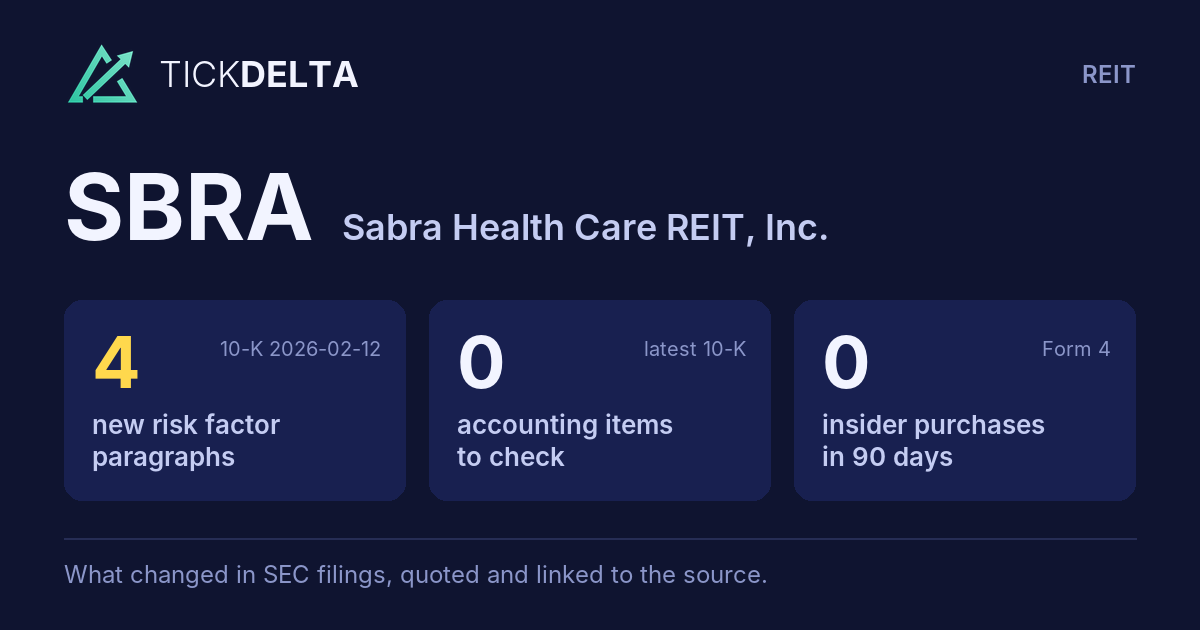
146 paragraphs · 4 new · 40 reworded · 7 gone · 10-K Feb 12, 2026 against Feb 19, 2025
New paragraph Reworded (5% of its words or more) Same or nearly
Paragraph 140 · 49% changed Every version of it
Certain provisions of Maryland law, our charter and our bylaws may have an anti-takeover effect. Sabra is subject to the Maryland business combination statute, which, subject to certain limitations, impose a moratorium on business combinations with “interested stockholders” or affiliates thereof for five years and thereafter impose additional requirements on such business combinations. Our bylaws contain a provision exempting us from the control share provisions of the MGCL, which provide that holders of “control shares” of a corporation (defined as voting shares of stock that, if aggregated with all other shares of stock owned or controlled by the acquirer, would entitle the acquirer to exercise one of three increasing ranges of voting power in electing directors) acquired in a “control share acquisition” (defined as the direct or indirect acquisition of issued and outstanding “control shares”) have no voting rights except to the extent approved by the stockholders by the affirmative vote of at least two-thirds of all of the votes entitled to be cast on the matter, excluding all interested shares. There can be no assurance that this bylaw provision exempting us from the control share provisions will not be amended or eliminated at any time in the future.
Paragraph 38 · 47% changed Every version of it
Climate change may also have indirect effects on our business by increasing the cost of (or making unavailable) property insurance on terms we find acceptable. To the extent that significant changes in the climate occur in areas where our properties are located, we may experience more frequent extreme weather events which may result in physical damage to or a decrease in demand for properties located in these areas or affected by these conditions. In addition, changes in federal and state legislation and regulation on climate change could result in increased capital expenditures to improve the energy efficiency of our existing properties and could also require us to spend more on our new development properties without a corresponding increase in revenue. Should the impact of climate change be material in nature, including destruction of our properties, or occur for lengthy periods of time, our financial condition or results of operations may be adversely affected.
Paragraph 110 · 46% changed Every version of it
Concerns over economic recession, interest rate increases, policy priorities of the U.S. presidential administration, trade wars, labor shortages or inflation have and may contribute to increased volatility and diminished expectations for the economy and markets. Additionally, concern over geopolitical issues may also contribute to prolonged market volatility and instability. For example, the conflicts between Russia and Ukraine and in the Middle East have led to disruption, instability and volatility in global markets and industries. Such conditions could impact real estate fundamentals and result in lower occupancy, lower rental rates, and declining values in our real estate portfolio and in the real estate collateral securing any indebtedness. As a result, the value of our property investments could decrease below the amounts paid for such investments, the value of real estate collateral securing any indebtedness could decrease below the outstanding principal amounts of such indebtedness, and revenues from our properties could decrease due to fewer and/or delinquent tenants or lower rental rates. This could materially adversely affect our revenues, results of operations and financial condition.
Paragraph 63 · 36% changed Every version of it
Our tenants are operators of skilled nursing and other healthcare facilities, and accordingly must be licensed under applicable state law and, depending upon the type of facility, certified or approved as providers under the Medicare and/or Medicaid programs. Prior to the transfer of the operations of such healthcare properties to successor tenants, the new tenant generally must become licensed under state law and, in certain states, receive change-of-ownership approvals under certificate of need laws (which laws provide for a certification that the state has made a determination that a need exists for the beds located on the applicable property). If applicable, Medicare and Medicaid provider approvals may be needed as well. In the event that an existing lease is terminated or expires and a new tenant is found, then any delays in the new tenant receiving regulatory approvals from the applicable federal, state or local government agencies, or the inability of such tenant to receive such approvals, may prolong the period during which we are unable to collect the applicable rent. We could also incur substantial additional expenses in connection with any licensing, receivership or change-of-ownership proceedings.
Paragraph 74 · 35% changed Every version of it
We and our tenants, borrowers and operators rely on information technology networks and systems, including the Internet, to process, transmit and store electronic information, and to manage or support a variety of business processes, including financial transactions and records, personal identifying information, tenant and lease data. While we and our tenants, borrowers and operators maintain various physical, cyber and data security controls, incidents or breaches resulting from technical failures, natural hazards, theft and unintentional or deliberate acts by third parties or insiders attempting to obtain unauthorized access to information, destroy or manipulate data, or disrupt or sabotage information systems do occur and they may have a material impact on our business. The risk of security incidents has generally increased as the number, intensity and sophistication of attacks and intrusions have increased, and we have seen a significant increase in cyber phishing attacks over the past few years. Additionally, cyber threats and the techniques used in cyberattacks change, develop and evolve rapidly, including from emerging technologies, such as advanced forms of artificial intelligence and quantum computing. We have engaged a third-party cybersecurity firm who serves as our dedicated IT team and helps us oversee, implement and manage our processes and controls to assess, identify and manage risks from cybersecurity threats. It is possible that our processes and controls will not detect or protect against all cybersecurity threats or incidents. In addition, any failure on the part of our outsourced IT team to effectively monitor and protect our information systems could make us more vulnerable to cybersecurity incidents. Although, to our knowledge, no cybersecurity incident has been material to our business to date, we have been, and expect to continue to be, subject to cybersecurity threats and attacks of varying degrees, and there can be no assurance that we will not experience a material incident. A data security incident or breach occurring at or involving us could have a material adverse impact on our company. A data security incident or breach occurring at or involving a tenant, borrower or operator could jeopardize the tenant’s or operators’ ability to fulfill its obligations to us and could adversely impact our financial position and results of operations.
Paragraph 12 · 32% changed Every version of it
We are exposed to various operational risks with respect to our Senior Housing - Managed communities that may increase our costs or adversely affect our ability to generate revenues. These risks are similar to the ones described above and below with respect to our tenants and include fluctuations in occupancy and private pay rates; economic conditions; competition; federal, state, local, and industry-regulated licensure, certification and inspection laws, regulations, and standards; the availability and increases in cost of general and professional liability insurance coverage; lawsuits and other legal proceedings arising out of our alleged actions or the alleged actions of our operators; state regulation and rights of residents related to entrance fees; and the availability and increases in the cost of labor (as a result of a shortage of caregivers or other trained personnel, minimum staffing requirements, general inflationary pressures on wages, minimum wage laws or otherwise). Any one or a combination of these factors may adversely affect our business, financial position or results of operations.
Paragraph 95 · 32% changed Every version of it
A breach of any of the covenants or other provisions in our debt agreements could result in an event of default, which, if not cured or waived, could result in such debt becoming immediately due and payable. Further, certain change in control events could result in an event of default under the agreement governing our 2027 Notes. Any of these events of default, in turn, could cause our other debt to become due and payable as a result of cross-acceleration provisions contained in the agreements governing such other debt. We may be unable to maintain compliance with these covenants and, if we fail to do so, we may be unable to obtain waivers from the lenders and holders and/or amend the covenants. In the event that some or all of our debt is accelerated and becomes immediately due and payable, we may not have the funds to repay, or the ability to refinance, such debt.
Paragraph 119 · 27% changed Every version of it
If we fail to qualify as a REIT in any calendar year, we would be required to pay U.S. federal income tax (and any applicable state and local tax) on our taxable income at regular corporate rates, and dividends paid to our stockholders would not be deductible by us in computing our taxable income (although such dividends received by certain non-corporate U.S. taxpayers generally would currently be subject to a preferential rate of taxation). Further, if we fail to qualify as a REIT, we might need to borrow money or sell assets in order to pay any resulting tax. Our payment of income tax would decrease the amount of our income available for distribution to our stockholders. Furthermore, if we fail to maintain our qualification as a REIT, we no longer would be required under U.S. federal tax laws to distribute substantially all of our REIT taxable income to our stockholders. Unless our failure to qualify as a REIT was subject to relief under U.S. federal tax laws, we could not re-elect to qualify as a REIT until the fifth calendar year following the year in which we failed to qualify.

MD&A

121 paragraphs · 5 new · 56 reworded · 6 gone · 10-K Feb 12, 2026 against Feb 19, 2025
New paragraph Reworded (5% of its words or more) Same or nearly
Paragraph 23 · 49% changed
We assess the collectability of rents on a lease-by-lease basis, and in doing so, consider such things as historical bad debts, tenant creditworthiness, current economic trends, facility operating performance, lease structure, credit enhancements (including guarantees), current developments relevant to a tenant’s business specifically and to its business category generally, and changes in tenants’ payment patterns. Our assessment includes an estimation of a tenant’s ability to fulfill all of its rental obligations over the remaining lease term. In addition, with respect to tenants in bankruptcy, management makes estimates of the expected recovery of pre-petition and post-petition claims in assessing the estimated collectability of the related receivable. If at any time we cannot determine that it is probable that substantially all rents over the life of a lease are collectible, rental revenue will be recognized only to the extent of payments received, and all receivables associated with the lease will be written off irrespective of amounts expected to be collectible. Any recoveries of these amounts will be recorded in future periods upon receipt of payment. Write-offs of receivables and any recoveries of previously written-off receivables are recorded as adjustments to rental revenue.
Paragraph 65 · 45% changed
During the year ended December 31, 2025, we recognized a $1.2 million loss on extinguishment of debt related to $2.9 million in payments made to noteholders for early redemption of the 2026 Notes, net of $1.7 million of write-offs associated with unamortized premium. No loss on extinguishment of debt was recognized during the year ended December 31, 2024. During the year ended December 31, 2023, we recognized a $1.5 million loss on extinguishment of debt related to write-offs of deferred financing costs in connection with amending and restating the fifth amended and restated unsecured credit agreement entered into by the Operating Partnership and Sabra Canadian Holdings, LLC and the other parties thereto on September 9, 2019.
Paragraph 31 · 44% changed
On a quarterly basis, we evaluate the collectability of our interest income receivable and establish a reserve for amounts not expected to be collected. Our evaluation includes reviewing credit quality indicators such as payment status, changes affecting the operations of the facilities securing the loans, and national and regional economic factors. The reserve is a valuation allowance that reflects management’s estimate of losses inherent in the interest income receivable balance as of the balance sheet date. The reserve is adjusted through provision for loan losses and other reserves on our consolidated statements of income (loss) and is decreased by charge-offs to specific receivables.
Paragraph 120 · 42% changed
On July 31, 2024, 2025, CMS issued a final rule regarding fiscal year 2025 2026 Medicare rates for skilled nursing facilities providing an estimated net increase of 4.2% 3.2% compared to fiscal year 2024 2025 (comprised of (i) a market basket increase of 3.0% plus (ii) a market basket forecast error adjustment of 1.7% and less (iii) a productivity adjustment of 0.5%). These figures do not incorporate any of the estimated value-based purchasing reductions for skilled nursing facilities. The new payment rates became effective on October 1, 2024. Additionally, the proposed rule expands the civil monetary penalties (“CMP”) that can be imposed for noncompliance to allow for more CMPs per instance and per day. 3.3%
Paragraph 12 · 39% changed
On February 23, 2023, August 5, 2025, we established an at-the-market equity offering program (the “ATM Program”) the ATM Program pursuant to which shares of our common stock having an aggregate gross sales price of up to $500.0 $750.0 million may be sold from time to time (i) by us through a consortium of banks acting as sales agents or directly to the banks acting as principals or (ii) by a consortium of banks acting as forward sellers on behalf of any forward purchasers pursuant to a forward sale agreement. time. See “—Liquidity and Capital Resources.”
Paragraph 53 · 37% changed
During the year ended December 31, 2024, we recognized $381.5 million of rental income compared to $376.3 million for the year ended December 31, 2023. The $5.2 operators after January 1, 2024. These decreases are partially offset by (i) a $7.4 million net increase in rental income is related to (i) a $6.8 million net increase in rental and related revenues related to non-cash rent as the result of changing our estimates of collectability for certain leases that are no longer accounted for on an accrual basis, within our triple-net leased portfolio, (ii) a $6.2 million increase from properties acquired after January 1, 2023, (iii) a $2.4 million increase due to incremental revenue related to capital expenditures, (iv) a $2.2 $6.0 million increase due to lease amendments and annual rental increases based on changes in the Consumer Price Index and (v) Index, (iii) a $1.6 $2.5 million increase from properties that were transitioned to new operators. These increases are partially offset by (i) an $8.5 million decrease from properties disposed of after January 1, 2023, (ii) a $2.9 million net increase in cash and non-cash rent receivable write-offs revenue related to percentage rent, expense recoveries and leases that are no longer not accounted for on an accrual basis, (iii) basis and (iv) a $1.1 $1.4 million decrease in Genesis excess rents in accordance with the terms of the memorandum of understanding entered into with increase from properties acquired after January 1, 2024.
Paragraph 7 · 37% changed
We regularly monitor the effects of economic and market conditions, as well as actions by national, state and local government administrations and regulatory agencies that affect healthcare policy and general market conditions, on our operations and financial position, as well as on the operations and financial position of our tenants and borrowers, in order to respond and adapt to the ongoing changes in our operating environment. See Part I, Item 1A, “Risk Factors” for additional discussion of these risks, as well as the uncertainties we and our tenants and borrowers may face as a result.
Paragraph 68 · 35% changed
During the year ended December 31, 2024, 2025, we recognized $0.4 $3.9 million of loss income from our unconsolidated joint ventures compared to $2.9 $0.4 million of loss for the year ended December 31, 2023. 2024. The $2.5 $4.3 million net improvement is primarily related to (i) a $2.5 million increase in revenues net of operating expenses primarily due to increased occupancy and rates, (ii) a $1.3 million decrease in depreciation expense due to assets that have been fully depreciated and (iii) a $0.2 million decrease in interest expense primarily due to decreased interest rates.

A paragraph is matched with the one last year that shares the most of its words; under half in common makes it new. The paragraphs shown are the 8 reworded the most in each section.

The paragraph that changed most in each section

The redline

Marked against last year's 10-K: cut words struck through, new words highlighted.

MD&A227 words changed in this paragraph; it is 38% similar to last year's version.
During the year ended December 31, 2025, we recognized $14.0 million of other income, including the reclassification of $17.2 million of gain related to six previously terminated interest rate swaps from accumulated other comprehensive loss to other income as the related forecasted transactions were determined to be probable not to occur and $1.7 million of other income related to insurance proceeds received related to a fire that occurred at one of our Senior Housing - Managed communities in 2022. This was partially offset by $3.5 million of transition expenses related to the transition of Senior Housing - Managed communities to new operators and $1.2 million of lease termination expense related to the transition of four facilities from our triple-net portfolio to Senior Housing - Managed communities. During the year ended December 31, 2024, we recognized $2.7 million of other income related to insurance proceeds received related to a fire that occurred at one of our Senior Housing - Managed communities, communities in 2022, including $1.7 million of business interruption insurance income and a $0.5 million gain on insurance proceeds related to the damage incurred at the facility, and a $0.5 million gain related to our cross currency interest rate swaps. During the year ended December 31, 2023, we recognized $2.6 million of other income related to (i) a $3.7 million gain on insurance proceeds received related to property damage incurred at a vacant facility, (ii) $0.5 million of business interruption insurance income related to one Senior Housing - Managed community that was closed due to a fire and (iii) $0.3 million of income related to the sale of licensed beds. This income is partially offset by $1.5 million of transition-related expenses related to the transition of 14 Senior Housing - Managed communities to new operators in 2023.

Source: Item 7, 10-K 0001492298-26-000008 vs Item 7, 10-K 0001492298-25-000008

Risk Factors165 words changed in this paragraph; it is 70% similar to last year's version.
We and our tenants, borrowers and operators rely on information technology networks and systems, including the Internet, to process, transmit and store electronic information, and to manage or support a variety of business processes, including financial transactions and records, personal identifying information, tenant and lease data. While we and our tenants, borrowers and operators maintain various physical, cyber and data security controls, incidents or breaches resulting from technical failures, natural hazards, theft and unintentional or deliberate acts by third parties or insiders attempting to obtain unauthorized access to information, destroy or manipulate data, or disrupt or sabotage information systems do occur and they may have a material impact on our business. The risk of security incidents has generally increased as the number, intensity and sophistication of attacks and intrusions have increased, and we have seen a significant increase in cyber phishing attacks over the past few years. Additionally, cyber threats and the techniques used in cyberattacks change, develop and evolve rapidly, including from emerging technologies, such as advanced forms of artificial intelligence and quantum computing. We have engaged a third-party cybersecurity firm who serves as our dedicated IT team and helps us oversee, implement and manage our processes and controls to assess, identify and manage risks from cybersecurity threats. It is possible that our processes and controls will not detect or protect against all cybersecurity threats or incidents. In addition, any failure on the part of our outsourced IT team to effectively monitor and protect our information systems could make us more vulnerable to cybersecurity incidents. Although, to our knowledge, no cybersecurity incident has been material to our business to date, we have been, and expect to continue to be, subject to cybersecurity threats and attacks of varying degrees, and there can be no assurance that we will not experience a material incident. A data security incident or breach occurring at or involving us could have a material adverse impact on our company. A data security incident or breach occurring at or involving a tenant, borrower or operator could jeopardize the tenant’s or operators’ ability to fulfill its obligations to us and could adversely impact our financial position and results of operations.

Source: Item 1A, 10-K 0001492298-26-000008 vs Item 1A, 10-K 0001492298-25-000008

Accounting Policies138 words changed in this paragraph; it is 59% similar to last year's version.
When available, the Company utilizes quoted market prices from an independent third-party source to determine fair value and classifies such items as Level 1 or Level 2. In instances where the market for a financial instrument is not active, regardless of the availability of a nonbinding quoted market price, observable inputs might not be relevant and could require the Company to make a significant adjustment to derive a fair value measurement. Additionally, in an inactive market, a market price quoted from an independent third party may rely more on models with inputs based on information available only to that independent third party. When the Company determines the market for a financial instrument owned by the Company to be illiquid or when market transactions for similar instruments do not appear orderly, the Company may use several valuation sources (including internal valuations, discounted cash flow analysis and quoted market prices) to establish a fair value. If more than one valuation source is used, the Company will assign weights to the various valuation sources. Additionally, when determining the fair value of liabilities in circumstances in which a quoted price in an active market for an identical liability is not available, the Company measures fair value using (i) a valuation technique that uses the quoted price of the identical liability when traded as an asset or quoted prices for similar liabilities or similar liabilities when traded as assets or (ii) another

Source: 10-K text, Note 2 – SUMMARY OF SIGNIFICANT ACCOUNTING POLICIES, 10-K 0001492298-26-000008 vs 10-K text, Note 2 – SUMMARY OF SIGNIFICANT ACCOUNTING POLICIES, 10-K 0001492298-25-000008

Sentences and paragraphs added, removed or reworded

Every change, by type

Sentences and paragraphs of SBRA's Risk Factors and MD&A, 10-K Feb 12, 2026 against 10-K Feb 19, 2025. Each links to the text at sec.gov.

Quiet changes are sentences kept from last year with one to four words changed, at least one of them a hedge, a modal or a qualifier (may, could, will, not, significant, material…). A year or date rolling forward is not counted.

The full word list

adverse, adversely, all, although, anticipate, anticipates, any, approximately, believe, believes, can, cannot, certain, could, expect, expects, generally, however, if, intend, intends, largely, likely, many, material, materially, may, might, most, must, never, no, not, possible, primarily, probable, should, significant, significantly, some, substantial, substantially, unlikely, will, would

AddedRisk Factors
carrying value of the asset, which could have a material adverse effect on our results of operations. Our estimates of loan reserves, and other accounting estimates, are inherently uncertain and may be subject to future adjustment, leading potentially to an increase in reserves.
Read it in 10-K Feb 12, 2026 at sec.gov
AddedRisk Factors
regulatory requirements and may not be successful. Even if eviction is possible, we may determine not to do so due to reputational or other risks. Bankruptcy or insolvency proceedings typically also result in increased costs to the tenant or borrower, significant management distraction and performance declines.
Read it in 10-K Feb 12, 2026 at sec.gov
AddedRisk Factors
Changes in federal, state, or local laws limiting REIT investments in the health care sector may adversely impact our ability to participate in the ownership of and investment in health care real estate.
Read it in 10-K Feb 12, 2026 at sec.gov
AddedRisk Factors
Legislation potentially impacting REIT ownership and investment in the health care sector has recently been introduced or is under discussion at the federal and state level. These legislative proposals range from additional oversight to prohibitions on investors acquiring or increasing ownership, or operational or financial control, in a nursing home. Such legislation or similar laws or regulations, if enacted, may limit our opportunities to participate in the ownership of, or investment in, health care real estate. Changes in federal, state, or local laws or regulations limiting REIT investment in the health care sector, reducing health care related benefits for REITs, or requiring additional approvals for health care entities to do business with REITs, could have a material adverse effect on our financial condition and operations.
Read it in 10-K Feb 12, 2026 at sec.gov
RemovedRisk Factors
Additionally, in April 2024, CMS issued a final rule that establishes minimum nurse staffing requirements for long-term care facilities (the “Minimum Staffing Standards”). The Minimum Staffing Standards require a total nurse staffing standard of 3.48 hours per resident day (“HPRD”), which must include at least 0.55 HPRD of direct registered nurse care and 2.45 HPRD of direct nurse aide care. Facilities may use any combination of nurse staff (registered nurse, licensed practical nurse and licensed vocational nurse, or nurse aide) to account for the additional 0.48 HPRD needed to comply with the total nurse staffing standard. The Minimum Staffing Standards also require facilities to meet new facility assessment requirements and have a registered nurse onsite 24 hours a day, seven days a week, to provide skilled nursing care. The Minimum Staffing Standards became effective on June 21, 2024, with a compliance deadline for the new facility assessment requirements of August 8, 2024 and a phase-in period consisting of three phases over three years for non-rural facilities and over five years for rural facilities for the staffing requirements. The Minimum Staffing Standards, as implemented in its current form, may exacerbate staffing challenges faced by our tenants, which could adversely affect our business, financial position or results of operations. The Minimum Staffing Standards are currently being challenged in federal court, however there can be no assurance that the outcome of such challenges will be favorable to us.
Read it in 10-K Feb 19, 2025 at sec.gov
RemovedRisk Factors
In February 2016, the Financial Accounting Standards Board issued Topic 842, which supersedes guidance related to accounting for leases and provides for the recognition of lease assets and lease liabilities by lessees for those leases classified as operating leases under previous accounting guidance. The objective of Topic 842 is to establish the principles that lessees and lessors shall apply to report useful information to users of financial statements about the amount, timing and uncertainty of cash flows arising from a lease. We elected to adopt Topic 842 on January 1, 2019 using the modified retrospective transition method. Among other things, under Topic 842, if at any time we cannot determine that it is probable that substantially all rents over the life of a lease are collectible, rental revenue will be recognized only to the extent of payments received and all receivables associated with the lease will be written off, irrespective of amounts expected to be collectible. Recoveries of these amounts will be recorded in future periods upon receipt of payment. Under Topic 842, future write-offs of receivables and any recoveries of previously written-off receivables will be recorded as adjustments to rental revenue. As a result, the adoption of this new accounting standard could cause increased variability related to our reported rental and related revenues, which could increase the volatility in the market price of our common stock.
Read it in 10-K Feb 19, 2025 at sec.gov
Show the other 38
RemovedRisk Factors
ability to meet their financial obligations to us, significant limits on reimbursement rates or on the services reimbursed could have a material adverse effect on their business, financial position or results of operations, which could materially adversely affect their ability to meet their financial obligations to us.
Read it in 10-K Feb 19, 2025 at sec.gov
RemovedRisk Factors
Real estate investments generally cannot be sold quickly. In addition, some and potentially substantially all of our properties serve as collateral for our current and future secured debt obligations and cannot readily be sold unless the
Read it in 10-K Feb 19, 2025 at sec.gov
RewordedRisk Factors
These risks are similar to the ones described above and below with respect to our tenants and include fluctuations in occupancy and private pay rates; economic conditions; competition; federal, state, local, and industry-regulated licensure, certification and inspection laws, regulations, and standards; the availability and increases in cost of general and professional liability insurance coverage; lawsuits and other legal proceedings arising out of our alleged actions or the alleged actions of our operators; state regulation and rights of residents related to entrance fees; and the availability and increases in the cost of labor (as a result of a shortage of caregivers or other trained personnel, minimum staffing requirements, general inflationary pressures on wages, minimum wage laws or otherwise).
Read it in 10-K Feb 12, 2026 at sec.gov
RewordedRisk Factors
Additionally, due to we have in the COVID-19 pandemic in some cases, we had to restructure our tenants’ long-term rent obligations past and may in the future be required to restructure such long-term rent obligations in the future due to other pandemics or epidemics, which may not be on terms that are as favorable to us as those currently in place.
Read it in 10-K Feb 12, 2026 at sec.gov
RewordedRisk Factors
As of December 31, 2024, 2025, we had outstanding indebtedness of $2.4 $2.6 billion, which consisted of $1.8 $1.3 billion of Senior Notes (as defined below), $534.4 million in an aggregate $1.0 billion outstanding under the Term Loans (as defined below), $106.6 below) and Term Loan Credit Agreement, $217.6 million outstanding under our Revolving Credit Facility and aggregate secured indebtedness to third parties of $46.1 $44.0 million on certain of our properties, and we had $893.4 $782.4 million available for borrowing under our Revolving Credit Facility.
Read it in 10-K Feb 12, 2026 at sec.gov
RewordedRisk Factors
The We have in the past been negatively impacted by the COVID-19 pandemic has negatively impacted us and our operations, and another a future pandemic or epidemic may could materially negatively impact us and our operations in the future. operations.
Read it in 10-K Feb 12, 2026 at sec.gov
RewordedRisk Factors
Prior to the transfer of the operations of such healthcare properties to successor tenants, the new tenant generally must become licensed under state law and, in certain states, receive change-of-ownership approvals under certificate of need laws (which laws provide for a certification that the state has made a determination that a need exists for the beds located on the applicable property).
Read it in 10-K Feb 12, 2026 at sec.gov
RewordedRisk Factors
The market for qualified personnel is highly competitive and our tenants, borrowers and Senior Housing - Managed communities have experienced and may continue to experience difficulties in attracting and retaining such personnel, in particular due to a reduction in the supply of such personnel and wage increases relating to the COVID-19 pandemic and inflation. personnel.
Read it in 10-K Feb 12, 2026 at sec.gov
RewordedRisk Factors
Dividends payable by REITs, however, generally are not eligible for the reduced rates. rates, unless they are attributable to dividends received by the REIT from other corporations that would otherwise be eligible for the reduced rate.
Read it in 10-K Feb 12, 2026 at sec.gov
RewordedRisk Factors
Furthermore, expenses for the facilities of our tenants, borrowers and Senior Housing - Managed communities are primarily driven by the costs of labor, food, utilities, taxes, insurance and rent, and these operating costs continue to increase for our tenants, borrowers and Senior Housing - Managed communities.
Read it in 10-K Feb 12, 2026 at sec.gov
RewordedRisk Factors
If we determine that a significant impairment has occurred, we are required to make an adjustment to the net carrying value of the asset, which could have a material adverse effect on our results of operations.
Read it in 10-K Feb 12, 2026 at sec.gov
RewordedRisk Factors
In addition, stockholders who do bring a claim in the Circuit Court for Baltimore City, Maryland could face additional litigation costs in pursuing any such claim, particularly if they do not reside in or near Maryland.
Read it in 10-K Feb 12, 2026 at sec.gov
RewordedRisk Factors
We have engaged a third-party cybersecurity firm who serves as our dedicated IT team and helps us oversee, implement and manage our processes and controls to assess, identify and manage risks from cybersecurity threats.
Read it in 10-K Feb 12, 2026 at sec.gov
AddedMD&A
On July 31, 2025, we redeemed all $500.0 million aggregate principal amount outstanding of the 5.125% senior unsecured notes due 2026. See “—Liquidity and Capital Resources—Material Cash Requirements—Senior Unsecured Notes.”
Read it in 10-K Feb 12, 2026 at sec.gov
AddedMD&A
On July 30, 2025, we and certain of our subsidiaries entered into the Term Loan Credit Agreement. See “—Liquidity and Capital Resources—Material Cash Requirements—Term Loan Credit Agreement.”
Read it in 10-K Feb 12, 2026 at sec.gov
AddedMD&A
(1) Other adjustments for the year ended December 31, 2025 include a $17.2 million gain reclassified from other comprehensive loss related to six terminated interest rate swaps as the related forecasted transactions were determined to be probable not to occur.
Read it in 10-K Feb 12, 2026 at sec.gov
AddedMD&A
On July 31, 2025, we redeemed all $500.0 million aggregate principal amount outstanding of our 5.125% senior unsecured notes due 2026 (the “2026 Notes”) at a premium of 100.575%, plus accrued and unpaid interest. As a result of the redemption, we recognized $1.2 million of redemption related costs and write-offs, consisting of $2.9 million in payments made to noteholders for early redemption net of $1.7 million of write-offs associated with unamortized premium.
Read it in 10-K Feb 12, 2026 at sec.gov
AddedMD&A
On April 22, 2024, CMS issued a final rule that (i) established minimum nurse staffing requirements for long-term care facilities (the “Minimum Staffing Standards”) and (ii) required facilities to meet new facility assessment requirements (the “Assessment Requirements”). The Minimum Staffing Standards were repealed by CMS, effective February 2, 2026, through an interim final rule issued on December 2, 2025. The compliance deadline for the Assessment Requirements was August 8, 2024 and they remain in effect.
Read it in 10-K Feb 12, 2026 at sec.gov
RemovedMD&A
The above factors, together with the impact of COVID-19, have resulted in decreased occupancy and increased operating costs for our tenants and borrowers, which have negatively impacted their operating results and may adversely impact their ability to make full and timely rental payments and debt service payments, respectively, to us. Our Senior Housing - Managed portfolio has been similarly impacted, and we expect that decreased occupancy and increased operating costs will continue to negatively impact the operating results of these investments. While our tenants, borrowers and Senior Housing - Managed portfolio have experienced increases in occupancy, certain of those occupancy rates are still below pre-pandemic levels. On the labor front, our tenants, borrowers and Senior Housing - Managed portfolio have significantly reduced their reliance on agency staffing, which was a mainstay in the wake of COVID-19, and while they continue to experience improvements in both permanent labor availability and overall costs from the worst point of the pandemic, permanent labor supply remains lower and costs remain higher than pre-pandemic levels. We are, however, encouraged by increases our tenants are receiving in reimbursement rates in our skilled nursing/transitional care portfolio, as those increases have led to margin recovery despite occupancy being below pre-pandemic levels.
Read it in 10-K Feb 19, 2025 at sec.gov
RemovedMD&A
On a quarterly basis, we evaluate the collectability of our loan portfolio, including the portion of unfunded loan commitments expected to be funded, and establish an allowance for credit losses. The allowance for credit losses is calculated
Read it in 10-K Feb 19, 2025 at sec.gov
RemovedMD&A
to a $2.7 million increase in revenues net of operating expenses primarily due to increased occupancy, which includes $0.2 million related to one senior housing community acquired by one of our joint ventures after January 1, 2023.
Read it in 10-K Feb 19, 2025 at sec.gov
RemovedMD&A
On October 1, 2019, a case-mix classification system called the skilled nursing facility Patient-Driven Payment Model (“PDPM”) became effective pursuant to a CMS final rule. PDPM focuses on clinically relevant factors, rather than volume-based service, for determining Medicare payment. PDPM adjusts Medicare payments based on each aspect of a resident’s care, most notably for non-therapy ancillaries, which are items and services not related to the provision of therapy such as drugs and medical supplies, thereby more accurately addressing costs associated with medically complex patients. It further adjusts the skilled nursing facility per diem payments to reflect varying costs throughout the stay and incorporates safeguards against potential financial incentives to ensure that beneficiaries receive care consistent with their unique needs and goals.
Read it in 10-K Feb 19, 2025 at sec.gov
RemovedMD&A
On April 22, 2024, CMS issued a final rule that establishes minimum nurse staffing requirements for long-term care facilities (the “Minimum Staffing Standards”). The Minimum Staffing Standards will require a total nurse staffing standard of 3.48 hours per resident day (“HPRD”), which must include at least 0.55 HPRD of direct registered nurse care and 2.45 HPRD of direct nurse aide care. Facilities may use any combination of nurse staff (registered nurse, licensed practical nurse and licensed vocational nurse, or nurse aide) to account for the additional 0.48 HPRD needed to comply with the total nurse staffing standard. Additionally, the Minimum Staffing Standards will require facilities to meet new facility assessment requirements and have a registered nurse onsite 24 hours a day, seven days a week, to provide skilled nursing care. The Minimum Staffing Standards became effective on June 21, 2024, with a compliance deadline for the new facility assessment requirements of August 8, 2024 and a phase-in period consisting of three phases over three years for non-rural facilities and over five years for rural facilities for the staffing requirements. We believe the Minimum Staffing Standards, as implemented in its current form, will exacerbate the staffing challenges already faced by our tenants. The Minimum Staffing Standards are currently being challenged in federal court, however there can be no assurance that the outcome of such challenges will be favorable to us.
Read it in 10-K Feb 19, 2025 at sec.gov
RewordedMD&A
Year Ended December 31, 2025 2024 2023 2022 Net income (loss) attributable to Sabra Health Care REIT, Inc. $ 155,609 $ 126,712 $ 13,756 $ (77,605) Depreciation and amortization of real estate assets 186,996 169,623 183,087 187,782 Depreciation, Depreciation and amortization of real estate assets related to noncontrolling interests (163) — — Depreciation and impairment amortization of real estate assets related to unconsolidated joint ventures 7,584 8,893 8,697 22,095 Net loss (gain) loss on sales of real estate 3,519 (2,095) 76,625 12,011 Net gain on sales of real estate related to unconsolidated joint ventures — — (220) Impairment of real estate 7,322 18,472 14,332 94,042 Other-than-temporary impairment of unconsolidated joint ventures — — 57,778 FFO attributable to Sabra Health Care REIT, Inc. 360,867 321,605 296,497 295,883 Stock-based compensation expense 11,360 8,987 7,917 7,453 Non-cash rental and related revenues (1,020) (3,856) (8,699) 2,183 Non-cash interest income 29 (372) (2,285) Non-cash interest expense 7,970 10,479 12,265 11,094 Non-cash portion of loss on extinguishment of debt (1,730) — 1,541 411 (Recovery of) provision for loan losses and other reserves (1,047) (571) 191 141 Deferred tax valuation allowance related to unconsolidated joint ventures — — 19,613 Other adjustments related to unconsolidated joint ventures 313 472 502 (5,155) Other adjustments 1,043 1,491 3,686 (1) (15,142) 1,072 1,119 AFFO attributable to Sabra Health Care REIT, Inc. $ 361,571 $ 338,188 $ 311,333 $ 333,024 FFO attributable to Sabra Health Care REIT, Inc. per diluted common share $ 1.48 $ 1.36 $ 1.27 $ 1.28 AFFO attributable to Sabra Health Care REIT, Inc. per diluted common share $ 1.47 $ 1.43 $ 1.33 $ 1.43 Weighted average number of common shares outstanding, diluted:
Read it in 10-K Feb 12, 2026 at sec.gov
RewordedMD&A
The $32.7 $46.6 million net increase is primarily due to (i) a $19.1 $27.0 million increase related to seven 14 Senior Housing - Managed communities acquired after January 1, 2024, (ii) a $12.3 million increase related to nine facilities that were transitioned to Senior Housing - Managed communities after January 1, 2023, (ii) a $6.9 million increase related to four Senior Housing - Managed communities acquired after January 1, 2023, 2024, (iii) a $3.1 $3.3 million increase in employee compensation primarily due to increased labor rates and staffing, (iv) a $2.1 $1.7 million increase in management fees, dining expenses and housekeeping costs due to increased occupancy, (v) a $1.4 $1.2 million increase related to one Senior Housing - Managed community that was closed due to a fire in 2022 and did not fully reopen until November 2024, (vi) a $1.1 million increase in marketing, administrative utilities primarily due to increased rates and corporate overhead expenses usage and (vi) (vii) a $0.4 million increase in taxes primarily due to changes property taxes, partially offset by a $0.8 million decrease in estimates. repairs and maintenance expense.
Read it in 10-K Feb 12, 2026 at sec.gov
RewordedMD&A
During the year ended December 31, 2024, 2025, net cash used in investing activities was $109.0 $378.0 million and included $136.4 $452.9 million used for the acquisition of 11 facilities, additional units on the campus of one of our facilities and the operations of four facilities, $54.7 Senior Housing - Managed communities previously leased under triple-net operating leases, $41.5 million used for additions to real estate, $21.6 $6.9 million used to provide funding for loans receivable, $2.8 million used to provide funding for a preferred equity investment receivable and $1.3 $1.2 million used for the investment in an unconsolidated joint venture, partially offset by $96.0 $88.6 million of net proceeds from the sales of real estate, $5.9 $20.7 million in repayments of loans receivable, $6.8 million of distributions in excess of earnings from unconsolidated joint ventures, $4.5 million of proceeds from net investment hedges, $2.5 million in repayments of preferred equity investments, $3.6 million in repayments of loans receivable investments and $2.4 $1.6 million in insurance proceeds.
Read it in 10-K Feb 12, 2026 at sec.gov
RewordedMD&A
On February 23, 2023, August 5, 2025, we established an at-the-market equity offering program (the “ATM Program”) the ATM Program pursuant to which shares of our common stock having an aggregate gross sales price of up to $500.0 $750.0 million may be sold from time to time (i) by us through a consortium of banks acting as sales agents or directly to the banks acting as principals or (ii) by a consortium of banks acting as forward sellers on behalf of any forward purchasers pursuant to a forward sale agreement. time.
Read it in 10-K Feb 12, 2026 at sec.gov
RewordedMD&A
The $2.6 $3.6 million net increase is primarily related to a $3.2 $3.1 million net increase in compensation, including a $1.0 million increase in stock-based compensation, for our teammates as a result of compensation driven by changes in performance-based payout assumptions on incentive compensation and annual salary adjustments, partially offset by adjustments and a $0.5 $1.0 million decrease increase in insurance expense. legal and professional fees due to increased transaction activity.
Read it in 10-K Feb 12, 2026 at sec.gov
RewordedMD&A
During the year ended December 31, 2024, 2025, we acquired three 11 Senior Housing - Managed communities communities, three of which were acquired through a consolidated joint venture in which we have a 95% equity interest, and acquired 24 units on the campus of one of our Senior Housing - Leased community communities for aggregate consideration of $136.4 $434.5 million, including acquisition costs.
Read it in 10-K Feb 12, 2026 at sec.gov
RewordedMD&A
During the year ended December 31, 2024, 2025, we utilized the forward feature of the ATM Program to allow for the sale of up to 7.5 14.1 million shares of our common stock at an initial weighted average price of $15.47 $18.71 per share, net of commissions, and we settled 6.0 million these shares at a weighted average net price remained outstanding as of $14.90 per share, after commissions and fees, resulting in net proceeds of $89.2 million. December 31, 2025.
Read it in 10-K Feb 12, 2026 at sec.gov
RewordedMD&A
This income is was partially offset by $1.5 $3.5 million of transition-related transition expenses related to the transition of 14 Senior Housing - Managed communities to new operators in 2023. and $1.2 million of lease termination expense related to the transition of four facilities from our triple-net portfolio to Senior Housing - Managed communities.
Read it in 10-K Feb 12, 2026 at sec.gov
RewordedMD&A
If at any time we cannot determine that it is probable that substantially all rents over the life of a lease are collectible, rental revenue will be recognized only to the extent of payments received, and all receivables associated with the lease will be written off irrespective of amounts expected to be collectible.
Read it in 10-K Feb 12, 2026 at sec.gov
RewordedMD&A
On July 31, 2024, 2025, CMS issued a final rule regarding fiscal year 2025 2026 Medicare rates for skilled nursing facilities providing an estimated net increase of 4.2% 3.2% compared to fiscal year 2024 2025 (comprised of (i) a market basket increase of 3.0% plus (ii) a market basket forecast error adjustment of 1.7% and less (iii) a productivity adjustment of 0.5%). 3.3%
Read it in 10-K Feb 12, 2026 at sec.gov
RewordedMD&A
These decreases increases are partially offset by a $4.9 $3.6 million increase decrease from properties acquired disposed of after January 1, 2023 2024 and a $1.9 $1.4 million increase from additions decrease due to real estate. assets that have been fully depreciated.
Read it in 10-K Feb 12, 2026 at sec.gov
RewordedMD&A
During the year ended December 31, 2024, 2025, we utilized the forward feature of the Prior ATM Program to allow for the sale of up to 7.5 15.3 million shares of our common stock at an initial weighted average price of $15.47 $17.69 per share, net of commissions, and we settled 6.0 issued 13.6 million shares in settlement of certain outstanding forward sale agreements, at a weighted average net price of $14.90 $17.26 per share, after commissions and fees, resulting in net proceeds of $89.2 $234.8 million.
Read it in 10-K Feb 12, 2026 at sec.gov

Sources

The two latest 10-Ks on EDGAR, section by section. Each change links to the text at sec.gov.

Also

New risk factors: paragraphs with nothing like them last year, quoted in full.

Work with it

Excel workbook · CSV. Google Sheet that stays up to date: paste =IMPORTDATA("https://tickdelta.com/company/SBRA/export.csv") into a cell.

Next:Related parties
Esc

Type a ticker such as AAPL, a name, an investor such as Buffett, or a topic such as tariffs. ↑ ↓ to move, Enter to open.