58 paragraphs in Risk Factors of the 10-K filed Nov 14, 2025
with nothing like them in the 10-K filed Nov 20, 2024. Quoted exactly.
Paragraphs that were only edited are under 10-K change.
Compared with the Risk Factors in the latest 10-K of the other 46 Consumer discretionary companies:
a paragraph with at least half its words the same at another company is called similar, and the companies are listed under it.
A paragraph most of them have is marked boilerplate. No line means no other company has one like it.
This counts text; it does not say how serious a risk is.
Various factors, events, or conditions may result in a diminution or erosion of trust in our brand value. Adverse developments pertaining to the matters discussed elsewhere in this risk factors section may negatively impact the value of our brands. Such developments may include difficulties executing strategic initiatives, adapting to shifting consumer preferences, or managing global operations, and challenges stemming from macroeconomic volatility, supply chain pressures and disruptions, or an evolving competitive, regulatory, social, and geopolitical landscape. The impact of such developments on the value of our brands may be exacerbated if they receive considerable publicity or if they result in litigation. The value of our brands may be affected by actual or perceived developments, whether isolated or recurring, whether the result of actions by us or our business partners or the result of external developments, and whether such developments are in our control. Negative commentary about Starbucks, even if inaccurate or malicious, has in the past, and could in the future, damage the value of our brand, and adverse impacts may be compounded by social media, video-sharing, and messaging platforms that could dramatically increase the speed with which negative publicity may be disseminated, often before we have a meaningful opportunity to investigate, respond to, and address an issue. In addition, we cannot ensure that our store partners, licensees, or other business partners will not act or refrain from acting in a manner that adversely affects the value and relevance of our brand. Because brand value is based in part on consumer perceptions on a variety of subjective qualities, it may be difficult to address developments negatively impacting the value of our brands in a timely and effective manner to mitigate harm.
The diminution of, or erosion of trust in, our brand value may have negative consequences for the Company. Consumer demand for our products and our brand value could diminish significantly if we or our employees, licensees, or other business partners fail to preserve the quality of our products, or act, or are perceived to act, in an unethical, illegal, or otherwise inappropriate manner. To the extent third parties object to actions or positions taken or perceived to have been taken by us, it may generate negative sentiment around our business. Developments affecting the value of our brands have in the past, and may in the future, trigger boycotts of our stores, products, and brand. Each of these consequences, individually and collectively, could have potentially material impacts on our brand value, business performance, and financial results.
Read in the 10-K ↗
Our continued success depends on our ability to adapt brand, marketing, promotional, advertising, and pricing strategies to shifting economic conditions, competitive pressures, and evolving customer preferences. We operate in a complex and costly
marketing environment. Decisions to collaborate or refrain from collaborating with certain parties may impact our brand image and, consequently, our financial performance. Our programs may not always reach consumers as intended, particularly given the wide range of generational, geographical, cultural, and socioeconomic characteristics and channels of communication used by our customers, and effective resource allocation across channels, including digital, is critical. Additionally, factors such as operating costs, competitor strategies, and inflation may affect our pricing decisions, which could impact demand. For example, there is no guarantee future cost increases will be absorbed by customers. If our marketing or pricing strategies underperform relative to competitors, our sales and market share could decline. Likewise, if we do not continuously strengthen our capabilities in marketing, data analytics (including artificial intelligence and machine learning) and innovation to understand and maintain or grow consumer interest, brand loyalty, and market share while strategically expanding into other profitable categories of the commercial beverage industry, our business could be negatively affected.
Read in the 10-K ↗
We undertake these initiatives in the context of ongoing efforts to adapt to shifting consumer behaviors amid economic volatility, optimize our mix of licensed and company-operated stores, expand relevant product offerings across dayparts, and drive growth in cold beverages and Channel Development partnerships, while also advancing appropriate sustainability efforts, managing climate-related risks, and reducing operating costs. Risks to successful and timely implementation of these initiatives include delays or cancellations of store openings due to labor or material shortages, permit procurement issues, or lack of suitable real estate; supply chain scalability and sustainability challenges; underperformance or delays in product innovation; remodel disruptions or cost overruns; coordination and execution challenges; failure to realize cost savings; increased taxation; regulatory constraints, including public health mandates; credit rating deterioration; and geopolitical instability. If these initiatives fail to deliver expected results or we do not fully realize their intended benefits, our financial performance may suffer. Additionally, prioritizing these efforts over other organizational needs or misallocating resources could materially impact our business and operating results.
Managing growth—particularly in international markets—requires balancing local autonomy with consistency in our goals, policies, and standards. Ineffectively balancing these imperatives could materially harm our business results and financial performance.
Furthermore, we may be unsuccessful in implementing strategic initiatives through large acquisitions, integrations, divestitures, partnerships, joint ventures, or other strategic transactions. If we are unable to complete such transactions or successfully integrate and develop acquired businesses, including the effective management of integration activities, we could fail to achieve the expected increases in revenues and operating results or the anticipated synergies and cost savings. In the past we have been, and in the future we may be, unable to realize the expected benefits of strategic transactions, or it may also take longer than expected to realize the expected benefits. This has in the past required, and may in the future require, us to assess potential impairment of assets, including goodwill and intangibles. Any resulting impairment charges could materially affect our financial results.
Read in the 10-K ↗
Our success depends on attracting and retaining customers. Financial performance may be adversely affected by reduced discretionary spending, lack of acceptance of new products, brands, or platforms, or declining demand for existing offerings. We have previously been, and may in the future be, unable to accurately predict consumer demand for our products. This has
resulted, and may in the future result, in insufficient or excess inventory, increased inventory markdowns, and higher costs. Any of these outcomes could adversely affect our results of operations and financial condition.
Similar paragraph at 3 of 46 other Consumer discretionary companies:
ABNB,
NCLH,
TJXAdditionally, health concerns related to ingredients such as caffeine, dairy, sugar, or allergens—whether accurate or not—along with increased litigation, regulation and regulatory scrutiny, or taxes on certain food components, ingredients, or additives, could reduce demand and harm our results. Shifts in consumer behavior, including dietary changes or use of weight-loss drugs, may also impact sales.
Read in the 10-K ↗
We may experience food or beverage-safety incidents such as contamination, mislabeling, or adulteration during any stage of production or preparation. We rely on third-party suppliers for many of our ingredients and finished products. A failure to meet quality standards—even if due to factors beyond our control—could result in public exposure, regulatory scrutiny or action, litigation (including product liability claims and class actions), or temporary store closures, which could materially harm our business. Additionally, clean water is essential for beverage preparation, and access may be limited in certain international markets. As we expand our offerings requiring temperature control, the risk of food-safety incidents increases if proper conditions are not maintained due to mechanical failure or human error. Such incidents may harm our brand and reputation and could negatively impact our business and financial performance.
Reports—whether accurate or not—of food- or beverage-safety issues such as contamination, mislabeling, or adulteration during any stage of production or preparation have historically harmed the reputations of companies in our industry. Any perceived association with such incidents, even if unfounded, could harm our reputation and materially impact our business and financial performance. Food-safety incidents involving competitors or shared suppliers, even if unrelated to Starbucks, could generate negative publicity and impact our sales regionally or globally. In addition, real or perceived concerns about food safety issues, such as phthalates, per- and polyfluoroalkyl substances (PFAS), microplastics or heavy metals in the U.S. food supply chain, could impact consumers’ confidence in our offerings. Confirmed food-safety issues may also result in product recalls. A widespread product recall could lead to significant financial losses from recall costs, inventory destruction, lost sales, and reputational damage. Declines in customer traffic due to safety concerns, negative publicity, or store closures could adversely affect our operations.
Read in the 10-K ↗
Our growth depends in part on our ability to open new stores and operate them profitably within projected timelines. Store development costs have risen due to construction labor inflation and increased material and equipment expenses. Each new store involves substantial startup costs and a ramp-up period during which profitability may be delayed as we train partners and build a customer base. If we fail to attract sufficient customers or offset higher startup costs, new stores may underperform relative to existing ones.
Similar paragraph at 1 of 46 other Consumer discretionary companies:
CMGStore development is subject to risks including site selection, lease negotiations, permitting and regulatory compliance, contractor availability, labor and material costs, and external disruptions such as weather events, natural disasters, or pandemics. We also face competition for prime locations, contractors, and qualified personnel. Additionally, new stores may
cannibalize sales from nearby existing locations. Failure to manage these risks could result in increased costs and lower-than-expected sales and earnings, materially affecting our operating results.
We also invest in remodeling and maintaining existing stores. If costs exceed projections, closures last longer than planned, or remodeled stores underperform, we may not achieve expected returns, which could negatively impact our financial results.
Read in the 10-K ↗
Our financial performance is heavily reliant on our North America operating segment, which accounted for approximately 74% of total net revenues in fiscal year 2025. A slowdown or decline in this segment—particularly in the U.S.—has in the past, and could in the future, materially impact our overall business, as other segments may not offset the shortfall. Given its maturity and role as the primary source of operating cash flow, reduced performance in North America could limit our ability to fund international expansion, strategic initiatives, and shareholder returns.
Read in the 10-K ↗
The International segment is a critical profit center. Achievement of our growth targets is partially dependent on sustained performance and growth internationally, particularly in the markets operated by our larger regional licensees and in key company-owned markets outside North America. If one or more of these international markets fail to achieve stable revenues and earnings—due to economic downturns or other factors—our consolidated results could be materially impacted.
In addition to the risks that apply to our business generally, wherever conducted, our International business may also be subject to certain additional risks and risks that take on a different magnitude or character in the context of our international business. Success in international markets can depend on factors distinct from those in the U.S., including regional taste preferences, varying consumer acceptance of our products, and differing regulatory regimes across markets. International operations may also face higher occupancy and operating costs due to elevated rents and regulatory compliance. Finally, because many markets are in earlier development stages, operating expenses as a percentage of revenue tend to be higher than in more established markets. Each of these factors present risks to our business performance and financial results.
Read in the 10-K ↗
17 more
•Governmental trade and investment restrictions, such as tariffs, export duties, ownership limits, and favoritism toward local competitors;
•Delays in store openings due to external factors, competition, or limited access to affordable real estate, potentially impacting financial performance;
•Operational and supply chain challenges abroad, including staffing, logistics, product consistency, and cultural or language barriers;
Read in the 10-K ↗
•Local employment laws increasing the cost and complexity of hiring and termination;
•Foreign currency fluctuations and restrictions on currency use or fund repatriation; and
Read in the 10-K ↗
Coffee supply and pricing are influenced by factors in producing countries, including weather and extreme weather events, water availability, natural disasters, crop disease, input costs, inventory levels, political and economic conditions, and actions by organizations seeking to influence global prices. Climate change may intensify these risks—for example, droughts or frosts in Brazil have in the past driven price increases. Speculative trading also contributes to volatility. Tariffs have also affected, and in the future may affect, our costs to procure coffee. Given coffee’s central role in our operations and our limited ability to fully hedge against price increases, rising costs or supply shortages could materially impact our profitability and ability to meet customer demand. We supply strategic products, including coffee, to our licensees, and we may have limited ability to pass along increased costs.
We also rely on significant quantities of dairy products and plant-based alternatives, such as oat and almond milk, as well as other commodities including tea, cocoa, produce, meats, eggs, energy, and packaging materials. Price increases or supply disruptions—whether due to shortages, processing delays, tariffs, or other factors—could materially affect our profitability, particularly in international markets.
Read in the 10-K ↗
Even without acute disruptions, our supply chain may not fully meet current or future business needs. We cannot guarantee that suppliers will support our growth or continue providing products at current volumes or favorable prices and other terms. Delays or cost inefficiencies in supply could impair growth and adversely affect our business, financial condition, and results. Inaccurate sales forecasting or insufficient inventory may lead to expedited shipping costs, stockouts, and diminished customer and partner satisfaction. Conversely, overestimating demand—especially for new products—can result in inventory write-offs. Failure to scale and improve forecasting, planning, production, and logistics could frustrate customers, reduce sales, and harm our brand reputation.
We are subject to risks from changes to the trade policies and tariff and import/export regulations by the U.S. and other foreign governments.
Similar paragraph at 1 of 46 other Consumer discretionary companies:
LVSChanges in the import and export policies, including trade restrictions such as new, increased, threatened, or retaliatory tariffs or quotas, embargoes, sanctions and countersanctions, safeguards, or customs restrictions by the U.S. and foreign governments, have in the past required, and could in the future require, us to change the way we conduct business and such changes have in the past adversely affected, and could in the future adversely affect, our financial condition, results of operations, reputation, and our relationships with customers, suppliers, and employees in the short- or long-term. It may be time-consuming and expensive for us to alter our business operations to adapt to or comply with any such changes. Likewise, changes in laws and
Similar paragraph at 1 of 46 other Consumer discretionary companies:
TJXpolicies governing foreign trade, manufacturing, development, and investment in the territories or countries where we currently sell our products or conduct our business could adversely affect our business.
Read in the 10-K ↗
Any material disruption to our supply chain—such as the loss of a roasting plant, logistics interruptions, trade restrictions, pandemics, labor shortages, natural disasters, or geopolitical conflicts—could materially impact our business and profitability. We rely on a broad network of domestic and international suppliers to provide high-quality products in compliance with applicable laws, and in certain cases, products are sourced by our licensees directly. As we update our fresh and prepared food offerings, sourcing from regions with limited infrastructure or political instability may present additional challenges. For certain products, we depend on a limited number of suppliers, and their failure to meet our standards, deliver on time, or comply with regulations—factors often beyond our control—could materially harm our operations and financial results.
Read in the 10-K ↗
As a retailer reliant on discretionary spending, our financial results are sensitive to macroeconomic conditions. A prolonged downturn or slow recovery may reduce consumer spending, leading to lower demand or shifts to lower-priced products. Factors such as job loss, inflation, interest rate changes, taxation, credit access, public health crises, trade disputes, and geopolitical instability can all impact consumer behavior, including spending and routines, potentially affecting demand for our products. Reduced customer traffic or transaction value without corresponding cost reductions could pressure margins. If economic uncertainty persists, consumers may adopt lasting changes in spending habits, potentially affecting our sales, profitability, and growth plans.
Similar paragraph at 1 of 46 other Consumer discretionary companies:
CMG
•Changes in tax laws and government regulations, such as the One Big Beautiful Bill Act, enacted in the U.S. in July 2025;
Similar paragraph at 1 of 46 other Consumer discretionary companies:
CMG•Government shutdowns and election-related impacts globally, including regime change and political and civil unrest;
Similar paragraph at 1 of 46 other Consumer discretionary companies:
CMG•Terminations of, or changes in, existing trade agreements among the countries in which we operate;
Similar paragraph at 1 of 46 other Consumer discretionary companies:
CMG•Tariffs imposed on commodities or goods, including recent tariffs imposed or threatened to be imposed by the U.S. on other countries, and any retaliation measures taken by such countries;
Similar paragraph at 1 of 46 other Consumer discretionary companies:
CMG•Labor unrest, geopolitical instability, terrorism, anti-American sentiment, or public health crises—especially in key markets; and
Read in the 10-K ↗
The specialty coffee market is highly competitive across product quality, innovation, service, convenience (e.g., delivery and mobile ordering), and price. We face increasing competition in all channels and markets and do not hold leadership positions in every segment. In the U.S., large quick-service competitors offering coffee, tea, and other competitive products may reduce customer traffic and transaction value. Globally, competition from established brands, new entrants, and smaller specialty operators may hinder growth and impact sales. Furthermore, our competitors may attempt to gain market share by offering products at prices at or below those typically offered by our company, which may require us to increase spending on advertising and promotions and/or reduce prices.
In packaged coffee, tea, and ready-to-drink segments, competition from well-funded players may affect Channel Development profitability.
Our ability to compete depends on product improvement and innovation, pricing, customer experience, and strategic investments in store development, technology, and digital engagement. If we are unable to respond to consumer demand for healthy beverages and foods, or our competitors respond more effectively, this could have a negative effect on our business. However, our competitive strategies may not always succeed and could have unintended consequences. Declines in consumer demand—due to shifting preferences, economic pressures, or changes in routines—could also negatively affect our business.
We recognize that climate-related risks are inherent to global business operations. Climate change can affect the supply and pricing of coffee and other non-coffee inputs due to weather volatility, water scarcity, and other environmental factors in producing regions. It may also impact water availability across our supply chain and markets. Operating in 89 global markets, our properties and operations are increasingly vulnerable to extreme weather events—such as wildfires and droughts—which may disrupt operations, close stores, affect customers and suppliers, and increase costs, potentially resulting in financial losses.
Read in the 10-K ↗
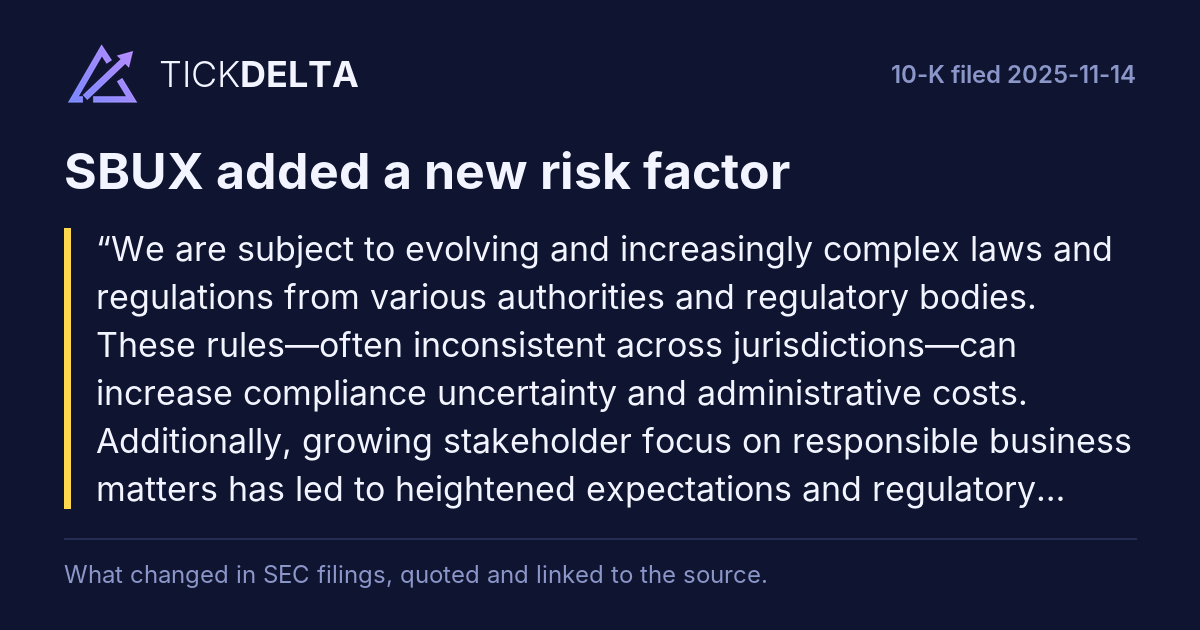
We are subject to evolving and increasingly complex laws and regulations from various authorities and regulatory bodies. These rules—often inconsistent across jurisdictions—can increase compliance uncertainty and administrative costs. Additionally, growing stakeholder focus on responsible business matters has led to heightened expectations and regulatory requirements, such as extended producer responsibility obligations that relate to our product packaging, the EU’s Corporate Sustainability Reporting Directive, or the state of California’s new climate change disclosure requirements. The evolving obligations may increase compliance costs and the risk of noncompliance.
Implementing responsible business initiatives and reporting progress can be costly, complex, and subject to evolving standards, assumptions, and internal controls. Public disclosures may be criticized for accuracy or completeness, and previously reported data may require future adjustments. Failure to meet targets or goals adopted in connection with our responsible business initiatives or otherwise respond to stakeholder expectations on these topics could harm our reputation, reduce customer loyalty, and adversely affect our financial performance. Inadequate progress on responsible business initiatives may also erode trust, trigger negative publicity, litigation, or boycotts, and expose us to civil or criminal liability. Objections from third parties or governments to these initiatives may result in reputational harm, administrative, legislative, or public backlash, or other adverse action, and could negatively impact our financial results or business performance. Such consequences could also result from actual or perceived changes to the scope or extent of our responsible business initiatives, or any discontinuation thereof. Objections may come both from those who believe these initiatives are overly ambitious or inappropriate, and from those who believe they are not ambitious enough. As focus on these issues from consumers, government actors, and other stakeholders intensifies, the risks described in this section may increase.
Read in the 10-K ↗
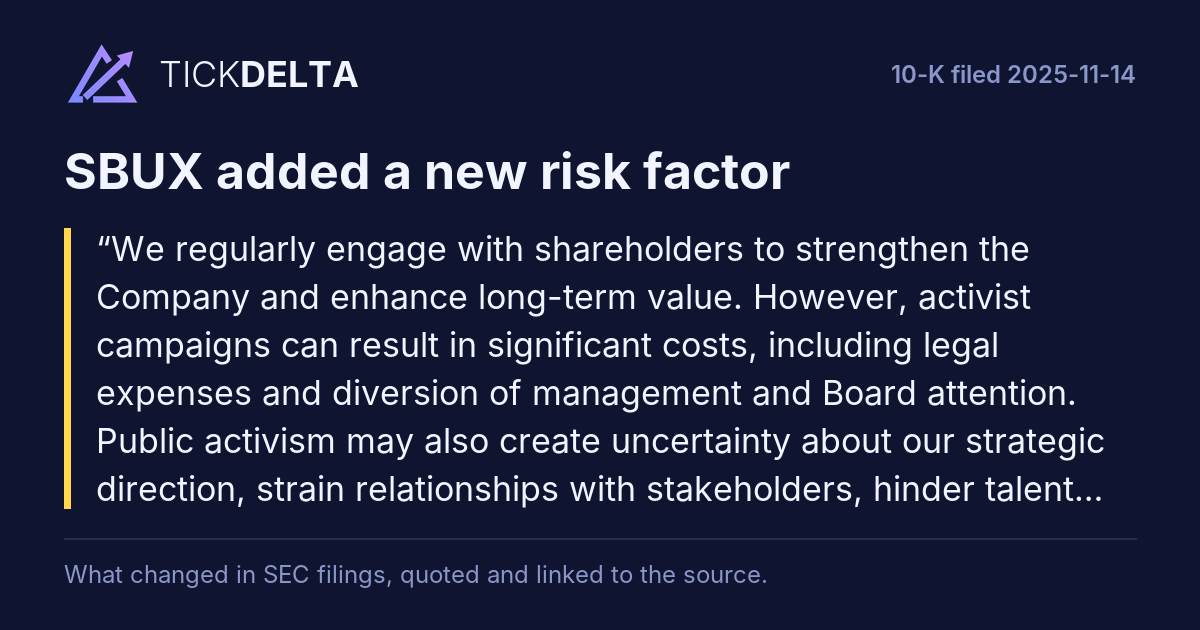
We regularly engage with shareholders to strengthen the Company and enhance long-term value. However, activist campaigns can result in significant costs, including legal expenses and diversion of management and Board attention. Public activism may also create uncertainty about our strategic direction, strain relationships with stakeholders, hinder talent recruitment, and cause stock price volatility unrelated to business fundamentals. Shareholders with substantial holdings may influence key decisions, including director elections, mergers, and amendments to governing documents. These risks could materially affect our business and operating results.
Read in the 10-K ↗
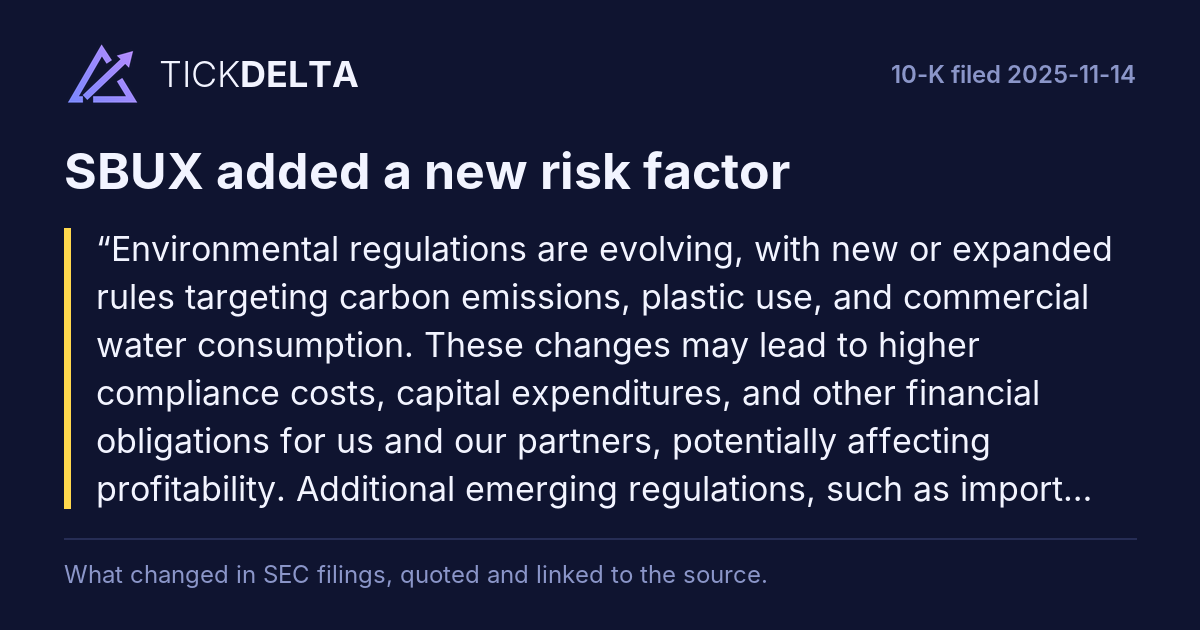
Environmental regulations are evolving, with new or expanded rules targeting carbon emissions, plastic use, and commercial water consumption. These changes may lead to higher compliance costs, capital expenditures, and other financial obligations for us and our partners, potentially affecting profitability. Additional emerging regulations, such as import tariffs tied to alleged human rights violations, may also impact operations. Certain jurisdictions have enacted or proposed taxes or other restrictions on the manufacture, distribution, or sale of certain of our products, particularly beverages containing caloric sweeteners. These taxes and other measures vary in structure and may apply broadly or selectively. Additionally, environmentally focused taxes or other measures, such as plastic packaging levies or extended producer responsibility laws, are gaining traction. These measures can adversely affect our financial performance by raising product costs, reducing consumption, or generating negative publicity.
Separately, the OECD’s Pillar Two initiative establishes a 15% global minimum tax for multinational entities. As of September 28, 2025, several countries where we operate have enacted legislation implementing the OECD’s Pillar Two initiative. While not expected to materially impact our consolidated financial results, we continue to monitor developments.
Overall, the regulatory environment is growing more complex due to evolving laws, market expansion, and jurisdictional conflicts. Due to evolving technologies, such as artificial intelligence technologies, the legal and regulatory landscape is uncertain and evolving, and may impose compliance obligations that could increase our costs or limit how we may use these technologies. Moreover, the costs of monitoring and responding to such regulations could have an adverse effect on our operations or financial condition. Non-compliance—whether by us or our partners—can result in litigation, liability, fines, reputational harm, and financial restatements, all of which may adversely affect our business and results of operations.
Read in the 10-K ↗
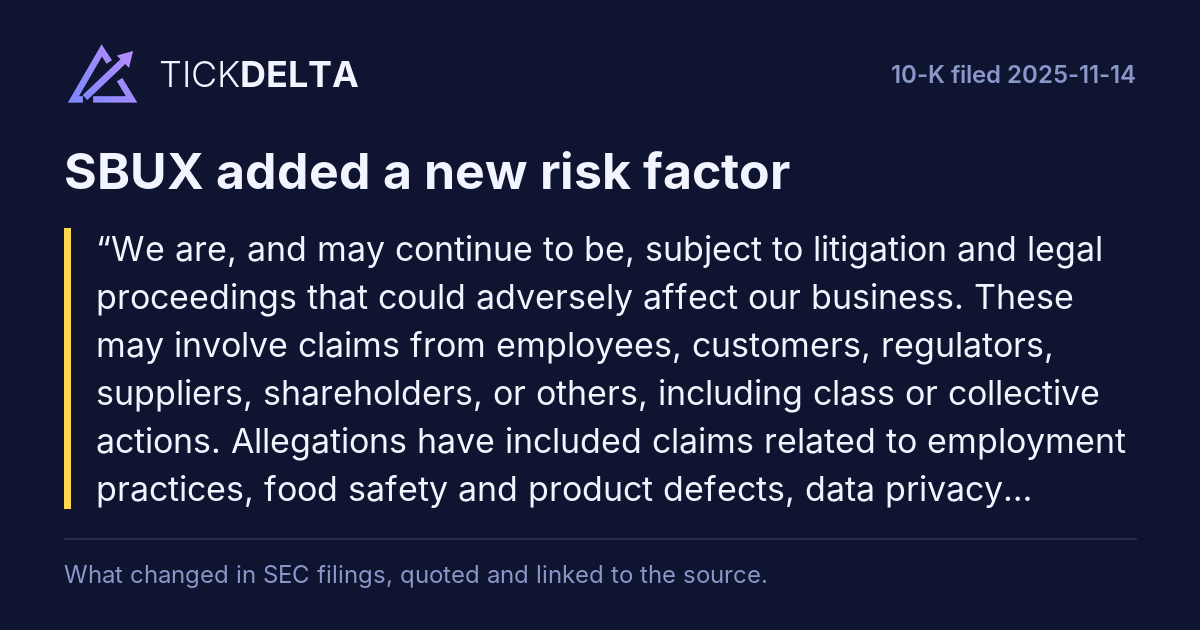
We are, and may continue to be, subject to litigation and legal proceedings that could adversely affect our business. These may involve claims from employees, customers, regulators, suppliers, shareholders, or others, including class or collective actions. Allegations have included claims related to employment practices, food safety and product defects, data privacy, discrimination, personal injury, advertising, intellectual property disputes, securities violations, and other matters. A judgment significantly in excess of any applicable insurance coverage or third-party indemnity could materially adversely affect our financial condition or results of operations. Even unfounded claims can result in substantial legal costs, management distraction, and potential settlements or penalties. Litigation may also generate negative publicity, harming our reputation, customer relationships, and financial performance. See Note 16, Commitments and Contingencies, to the consolidated financial statements included in Item 8 of Part II of this 10-K for information regarding certain legal proceedings in which we are involved.
Read in the 10-K ↗
Our information technology systems and those of our third-party service providers, business partners, and licensees—including those supporting point-of-sale, mobile platforms, payment systems, delivery, rewards, and administrative functions—store personal, financial, and confidential data from customers, employees, business partners, and licensees, as well as proprietary business information. Although we have put in place policies, procedures, and technological safeguards designed to protect the security of this information, we cannot guarantee that this information will not be improperly disclosed or accessed. Like other prominent retail companies, we have experienced cyber-attacks (e.g., phishing) and other attempts to breach or gain unauthorized access to our systems, as have our third-party service providers, business partners, and licensees. We expect such threats to continue and evolve, especially with the rapid evolution and increased adoption of artificial intelligence.
Unauthorized access, theft, or destruction of data or any breach, ransomware attack or other incident affecting our systems—whether through external attacks or internal methods—could result in reputational harm, loss of customers, business disruption, regulatory investigations, litigation (including class actions), and significant financial costs. It may take considerable time for us to investigate and evaluate the full impact of incidents, particularly for sophisticated attacks. Responding to cybersecurity incidents may require substantial investments in technology, personnel, legal compliance, and customer support, including notification and credit monitoring. These costs could materially impact our financial results and divert resources from strategic initiatives. Media reports of actual or perceived vulnerabilities—whether involving us or our third-party service providers, business partners, or licensees—can damage our brand and business, regardless of an incident’s scope or validity.
Read in the 10-K ↗
We are subject to a complex and rapidly evolving landscape of local, national, and international laws and regulations governing the collection, use, retention, protection, disclosure, transfer, and other processing of personal data. These laws and regulations are frequently amended, reinterpreted, and increasingly enforced, often resulting in heightened compliance obligations, litigation risk, and operational costs. Regulatory scrutiny is intensifying, with agencies such as the Federal Trade Commission and state attorneys general applying consumer protection laws to online data practices. The legal landscape remains fluid, with privacy and data protection laws potentially limiting data use, requiring changes to processing practices, exposing us to fines, litigation, or other penalties, or impacting our ability to develop new services. Regulatory changes may include new legislation, invalidation of existing rules, or increased penalties, all of which can impact our ability to develop and offer new products and services. For example, the EU’s GDPR and the U.K. equivalent impose strict data protection requirements and significant penalties for noncompliance. China’s Personal Information Protection Law (PIPL) and Data Security Law similarly regulate personal and non-personal data processing activities and establish data subject rights and obligations for personal information processors, with civil and criminal liabilities for violations. Other jurisdictions served by Starbucks and its licensees are enacting or proposing comparable laws, including restrictions on cross-border data transfers and enhanced data safeguards, which may increase compliance costs and affect business operations.
Read in the 10-K ↗
The increasing adoption of artificial intelligence technologies has led data protection authorities around the world to consider and adopt new and evolving interpretations of privacy and data protection laws, with specific obligations regarding processing of personal data, including required notices, consents, and opt-outs.
Claims we have failed to comply with applicable privacy and data protection laws or to adequately safeguard personal data, even if unfounded, may result in regulatory investigations, enforcement actions, litigation (including class actions), reputational harm, and financial penalties, any of which could materially affect our operations and financial performance.
Read in the 10-K ↗
We rely extensively on interconnected information technology systems to support our operations, including point-of-sale, mobile ordering, payments, supply chain management, loyalty programs, and administrative functions. We also depend on third-party providers for key systems and services, which may lack full redundancy within or across markets. Our growth initiatives—particularly those involving digital engagement and convenience-led formats—depend heavily on the reliability and performance of these systems. Any failure, inadequacy, inefficiency, or interruption could disrupt operations and adversely affect financial results. Our contractual and operational safeguards may not be effective in preventing the failure of these systems or services to operate effectively and be available. Failures—whether due to outages, cyber-attacks, software flaws, misconfigurations, or other disruptions—could materially impact product availability, operational efficiency, and financial performance. If our incident response and recovery plans are ineffective or delayed, remediation efforts may incur significant, unplanned costs.
Emerging technologies, including artificial intelligence and machine learning, may not deliver expected efficiencies and could introduce new risks, such as those related to cybersecurity, data privacy, inaccuracies, hallucinations, bias or discrimination and intellectual property infringement, which may become more pronounced as the Company’s reliance on such technologies increases.
Similar paragraph at 1 of 46 other Consumer discretionary companies:
CMG
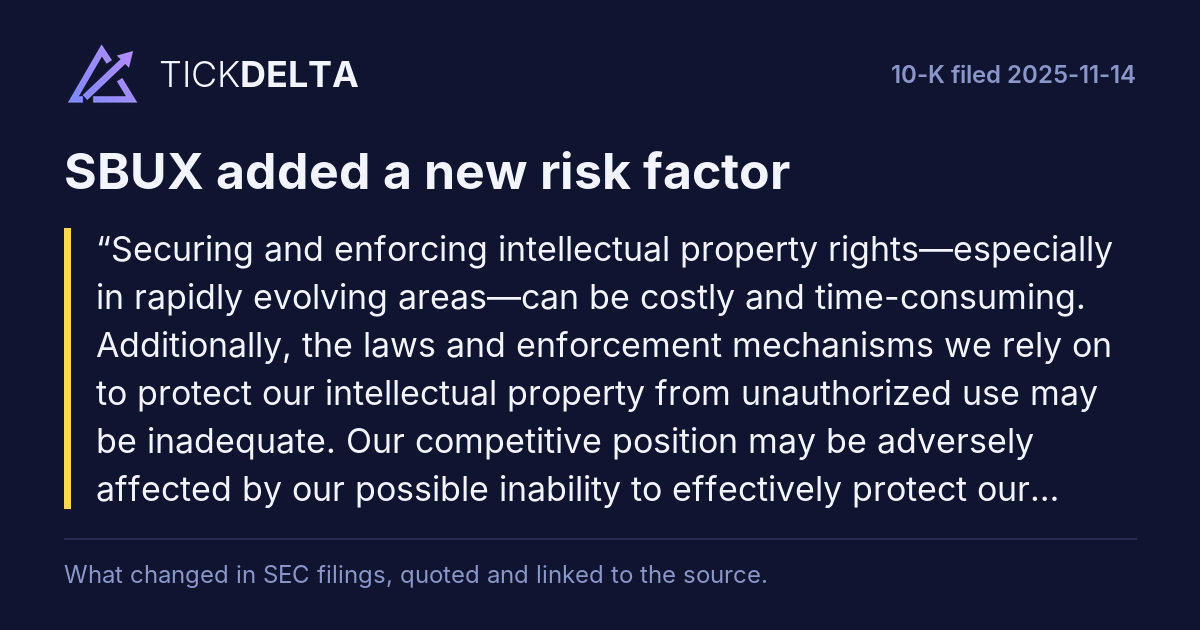
Securing and enforcing intellectual property rights—especially in rapidly evolving areas—can be costly and time-consuming. Additionally, the laws and enforcement mechanisms we rely on to protect our intellectual property from unauthorized use may be inadequate. Our competitive position may be adversely affected by our possible inability to effectively protect our intellectual property.
We also seek to maintain certain intellectual property as trade secrets. The secrecy of such trade secrets and other sensitive information could be compromised, which could cause us to lose the competitive advantage resulting from these trade secrets.
Additionally, we also face the risk of infringing third-party intellectual property rights. Any infringement claims, even unmerited claims, can be time consuming and disruptive to our ability to generate revenues or enter into new market opportunities. Further, such claims may lead to expensive and disruptive litigation or significantly increased costs as a result of our attempt to license the intellectual property rights to avoid infringement of third-party rights. Additionally, licensees and other third parties who hold licenses to our intellectual property may take actions that diminish the value of our intellectual property, further exposing us to reputational and financial risk.
Read in the 10-K ↗
New in the latest 10-Q
27 paragraphs in the 10-Q filed Jul 29, 2026 with nothing like
them in the 10-Q filed Apr 28, 2026 (at least half the words must differ; new numbers alone do not count).
Quoted exactly, grouped by the item heading above them. This is text that changed, not a judgement of how serious it is.
Financial statements and notes
2026 2025 OPERATING ACTIVITIES: Net earnings including noncontrolling interests $ 1,849.0 $ 1,723.5 Adjustments to reconcile net earnings to net cash provided by operating activities: Depreciation and amortization 1,210.8 1,315.5 Deferred income taxes, net 252.1 48.1 Income earned from equity method investees, net (187.8) (184.4) Distributions received from equity method investees 152.9 186.5 Net gain resulting from divestiture of certain operations (536.3) — Stock-based compensation 290.4 244.3 Non-cash lease costs 1,008.1 1,104.9 Loss on disposal, impairment, and accelerated amortization of assets 398.2 143.0 Other 6.3 11.4 Cash provided by/(used in) changes in operating assets and liabilities: Accounts receivable (134.2) (46.4) Inventories (144.8) (477.6) Income taxes payable 362.7 50.7 Accounts payable 144.4 291.1 Deferred revenue 51.2 (5.0) Operating lease liability (1,281.9) (1,144.0) Other operating assets and liabilities 163.0 104.1 Net cash provided by (used in) operating activities 3,604.1 3,365.7 INVESTING ACTIVITIES: Purchases of investments (133.6) (298.2) Sales of investments 22.3 1.1 Maturities and calls of investments 141.7 276.9 Additions to property, plant and equipment (887.8) (1,849.5) Acquisitions, net of cash acquired — (177.1) Net proceeds from the divestiture of certain operations 2,544.2 — Other (116.4) (48.1) Net cash provided by (used in) investing activities 1,570.4 (2,094.9) FINANCING ACTIVITIES: Net proceeds from issuance of short-term debt 2.5 2.4 Repayments of short-term debt — (7.8) Net proceeds from issuance of long-term debt — 1,748.5 Repayments of long-term debt (2,815.9) — Proceeds from issuance of common stock 51.9 59.6 Cash dividends paid (2,118.0) (2,078.1) Minimum tax withholdings on share-based awards (64.7) (80.6) Other — (9.2) Net cash provided by (used in) financing activities (4,944.2) (365.2) Effect of exchange rate changes on cash and cash equivalents (0.3) (19.2) Net increase/(decrease) in cash and cash equivalents 230.0 886.4 CASH AND CASH EQUIVALENTS: Beginning of period 3,219.8 3,286.2 End of period $ 3,449.8 $ 4,172.6 SUPPLEMENTAL DISCLOSURE OF CASH FLOW INFORMATION: Cash paid during the period for: Interest, net of capitalized interest $ 457.4 $ 392.5 Income taxes $ 413.6 $ 568.1
Read in the 10-Q ↗
In the third quarter of fiscal 2026, we announced an additional fiscal 2026 restructuring plan focused on further transformation of our global support organization and non-retail facilities, as well as reducing the future operational complexity of our Starbucks Reserve and Roastery locations resulting in a reassessment and impairment of the associated asset group.
Read in the 10-Q ↗
Under the agreement, Boyu Capital acquired a 60 % interest in Starbucks retail operations in China based on a cash-free, debt-free mutually agreed-upon total enterprise value of approximately $ 4 billion. The transaction was partially financed with debt issued by the newly formed joint venture and we received total consideration with respect to the transaction of $ 3.1 billion, inclusive of our share of the debt proceeds. Starbucks retained a 40 % interest of approximately $ 1.2 billion, accounted for under the equity method of accounting. Our carrying value of the retained investment includes the impact of debt raised by the joint venture in conjunction with the transaction. The Company derecognized net assets with a carrying value of $ 3.4 billion, and reclassified approximately $ 282.8 million of cumulative translation adjustment (“CTA”) losses and net investment hedge losses of $ 99.7 million from accumulated other comprehensive income into earnings. As a result, we recognized a pre-tax gain of $ 536.3 million, which was included in net gain resulting from divestiture of certain operations on our consolidated statements of earnings.
Read in the 10-Q ↗
Total incremental income tax expense associated with the divestiture gain is approximately $ 198.6 million, of which approximately $ 147.8 million was recognized in the third quarter of fiscal 2026, with the remainder expected to be recognized in the fourth quarter of fiscal 2026. The income tax expense is a component of the estimated annual effective tax rate and, accordingly, is recognized in proportion to year-to-date ordinary pre-tax income. We also recognized transaction costs of approximately $ 44.1 million and $ 73.8 million for the quarter and three quarters ended June 28, 2026, respectively.
Read in the 10-Q ↗
Upon completion of the divestiture, the disposal group was deconsolidated from our financial statements and 7,991 company-operated stores previously included in the disposal group were converted to licensed stores within our International segment. We will continue to own and license the Starbucks brand and intellectual property to the joint venture.
Read in the 10-Q ↗
In May 2026, the Company completed cash tender offers for certain series of its senior notes and repurchased approximately $ 1.3 billion aggregate principal amount of such notes using cash proceeds from the divestiture of Starbucks retail operations in China. The notes repurchased consisted of:
Read in the 10-Q ↗
• $ 110.4 million of the $ 500.0 million, 5.000 % Senior Notes (the “February 2034 notes”)
Read in the 10-Q ↗
• $ 200.0 million of the $ 1.0 billion, 4.500 % Senior Notes (the “November 2048 notes”)
Read in the 10-Q ↗
In connection with the redemptions, the Company recognized an immaterial gain on partial extinguishment of debt for the quarter ended June 28, 2026, which is included in Interest income and other, net in the consolidated statement of earnings. In determining the value of the gain, the Company expensed the proportional amount of the related unamortized discount, premium, and debt issuance costs attributable to the repurchased notes.
Read in the 10-Q ↗
(1) Reclassification of CTA from AOCI to earnings upon sale or liquidation of foreign businesses.
Read in the 10-Q ↗
In the third quarter of fiscal 2026, we announced an additional fiscal 2026 restructuring plan focused on further transformation of our global support organization and non-retail facilities, as well as reducing the future operational complexity of our Starbucks Reserve and Roastery locations resulting in a reassessment and impairment of the associated asset group.
Read in the 10-Q ↗
(3) “Other” primarily consists of updates to accrual estimates and adjustments for non-cash charges.
Read in the 10-Q ↗
In the third quarter of fiscal 2026, we announced an additional fiscal 2026 restructuring plan focused on further transformation of our global support organization and non-retail facilities, as well as reducing the future operational complexity of our Starbucks Reserve and Roastery locations resulting in a reassessment and impairment of the associated asset group. Under the plan, the Company expects to capture cost savings through a more streamlined support structure, and a simplified operating model for Starbucks Reserve and Roastery locations.
Read in the 10-Q ↗
As our international business shifts toward a more predominantly licensed model, we will continue evolving how we support our licensed business partners. We expect our international business to be a meaningful contributor to coffeehouse growth over time, supported by our licensed business model and significant opportunities for development in markets globally. We will apply continued discipline to how we grow our global footprint, with a focus on ensuring new coffeehouses meet our expectations for returns and long-term growth.
Read in the 10-Q ↗
Income from equity investees increased $22 million, primarily due to income from our China joint venture, which was formed upon the conversion of Starbucks retail operations in China to our licensed joint venture model in the third quarter of fiscal 2026.
Read in the 10-Q ↗
Income from equity investees increased $27 million, primarily due to income from our China joint venture, which was formed upon the conversion of Starbucks retail operations in China to our licensed joint venture model in the third quarter of fiscal 2026.
Read in the 10-Q ↗
Net gain resulting from divestiture of certain operations was $536.3 million, due to the divestiture of Starbucks retail operations in China during the third quarter of fiscal 2026.
Read in the 10-Q ↗
Net gain resulting from divestiture of certain operations was $536.3 million, due to the divestiture of Starbucks retail operations in China during the third quarter of fiscal 2026.
Read in the 10-Q ↗
In May 2026, the Company completed cash tender offers for certain series of its senior notes and repurchased approximately $1.3 billion aggregate principal amount of such notes using cash proceeds from the divestiture of Starbucks retail operations in China. The notes repurchased consisted of:
Read in the 10-Q ↗
• $273.5 million of the $750.0 million, 4.500% Senior Notes (the “May 2028 notes”)
Read in the 10-Q ↗
• $321.8 million of the $500.0 million, 4.800% Senior Notes (the “May 2030 notes”)
Read in the 10-Q ↗
• $110.4 million of the $500.0 million, 5.000% Senior Notes (the “February 2034 notes”)
Read in the 10-Q ↗
• $410.2 million of the $500.0 million, 5.400% Senior Notes (the “May 2035 notes”)
Read in the 10-Q ↗
• $200.0 million of the $1.0 billion, 4.500% Senior Notes (the “November 2048 notes”)
Read in the 10-Q ↗
In connection with the redemptions, the Company recognized an immaterial gain on partial extinguishment of debt for the quarter ended June 28, 2026, which is included in Interest income and other, net in the consolidated statement of earnings. In determining the value of the gain, the Company expensed the proportional amount of the related unamortized discount, premium, and debt issuance costs attributable to the repurchased notes.
Read in the 10-Q ↗
further build our business. Acquisitions may include increasing our ownership interests in our investees. Any decisions to increase such ownership interests will be driven by valuation and fit with our ownership strategy.
Read in the 10-Q ↗
repayments funded in part by proceeds from the divestiture of Starbucks retail operations in China, combined with the absence of new debt issuances in fiscal 2026 compared to the $1.7 billion raised in fiscal 2025.
Read in the 10-Q ↗
The 10-Q's risk factors against the 10-K
Item 1A of the 10-Q filed Jul 29, 2026 against Item 1A of the 10-K filed Nov 14, 2025.
A 10-Q repeats only the risks that changed, so a 10-K paragraph that is missing from it is not counted as removed.
Added is a paragraph with nothing like it in the 10-K, Reworded a sentence that is in both with several words changed,
Quiet changes a sentence in both where one to four words changed and one is a hedge or a modal
(cut words struck through, new words highlighted and underlined).
Text on the page, not a score; each links to the filing at sec.gov.
Added10-Q 2026-07-29 vs 10-K 2025-11-14
In addition to the other information set forth in this 10-Q, you should carefully consider the risks and uncertainties discussed in Part I, Item 1A. Risk Factors in our 10-K. There have been no material changes to the risk factors disclosed in our 10-K.
Read it in the 10-Q at sec.gov ↗