Screener / SEC EDGAR /CIK 0001001838 /10-K filed Feb 27, 2026, compared with Mar 3, 2025 /Numbers from the XBRL of the 10-Ks
NYSE Materials · Mining

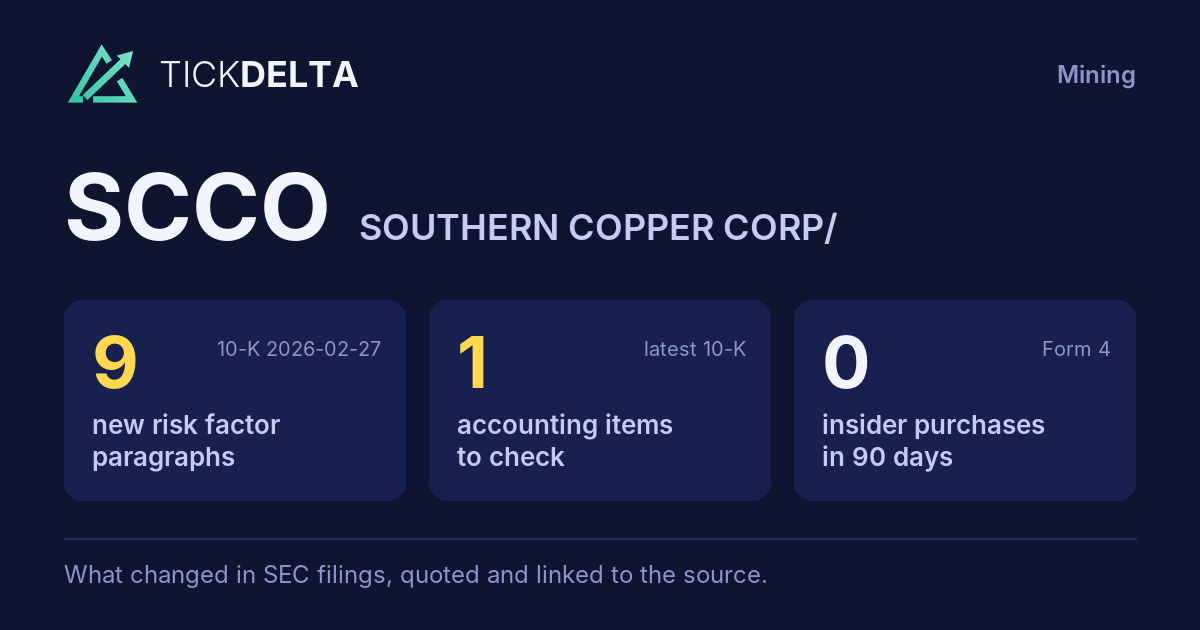
Southern Copper Corp/ SCCO

Compare with peers Embed
New in the 10-K 9 paragraphs with nothing like them in the 10-K filed Mar 3, 2025 New in the 10-Q 20 paragraphs not in the 10-Q filed Jul 31, 2026 10-Q against the 10-K 6 risk factor paragraphs and sentences added or reworded

New risk paragraphs, branching off last year

Each branch is a paragraph in Risk Factors with nothing like it in the 10-K filed Mar 3, 2025. A box jumps to the paragraph as filed, below.

9 new

Paragraphs with nothing like them in last year's 10-K

Quoted exactly

9 paragraphs in Risk Factors of the 10-K filed Feb 27, 2026 with nothing like them in the 10-K filed Mar 3, 2025. Quoted exactly. Paragraphs that were only edited are under 10-K change.

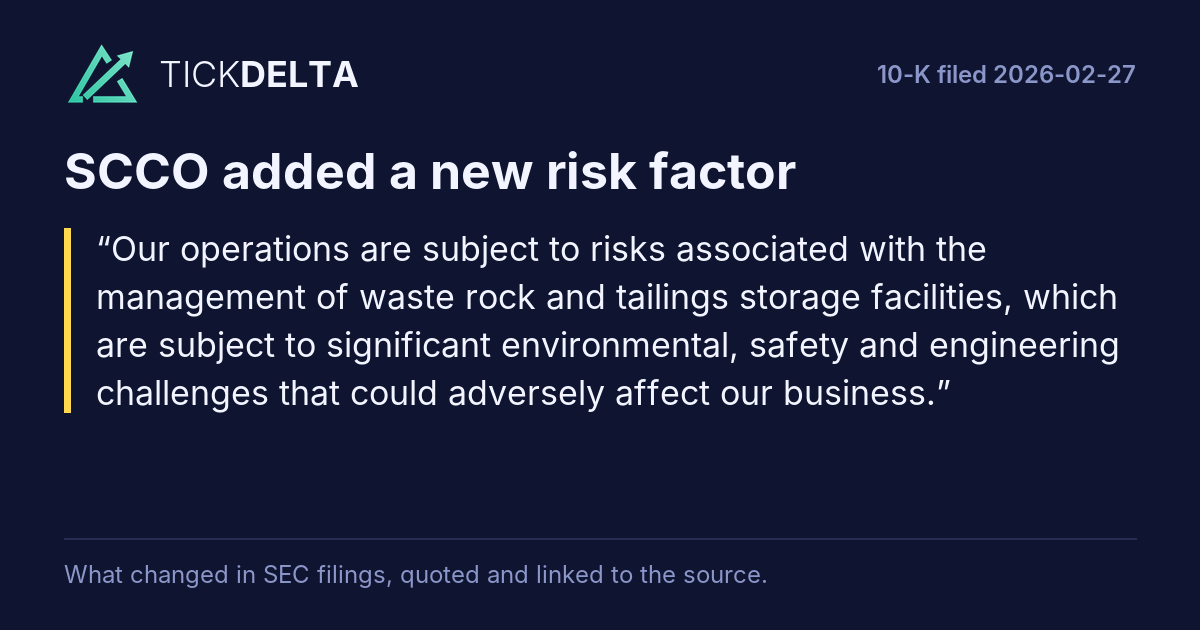
Our operations are subject to risks associated with the management of waste rock and tailings storage facilities, which are subject to significant environmental, safety and engineering challenges that could adversely affect our business.

Read in the 10-K

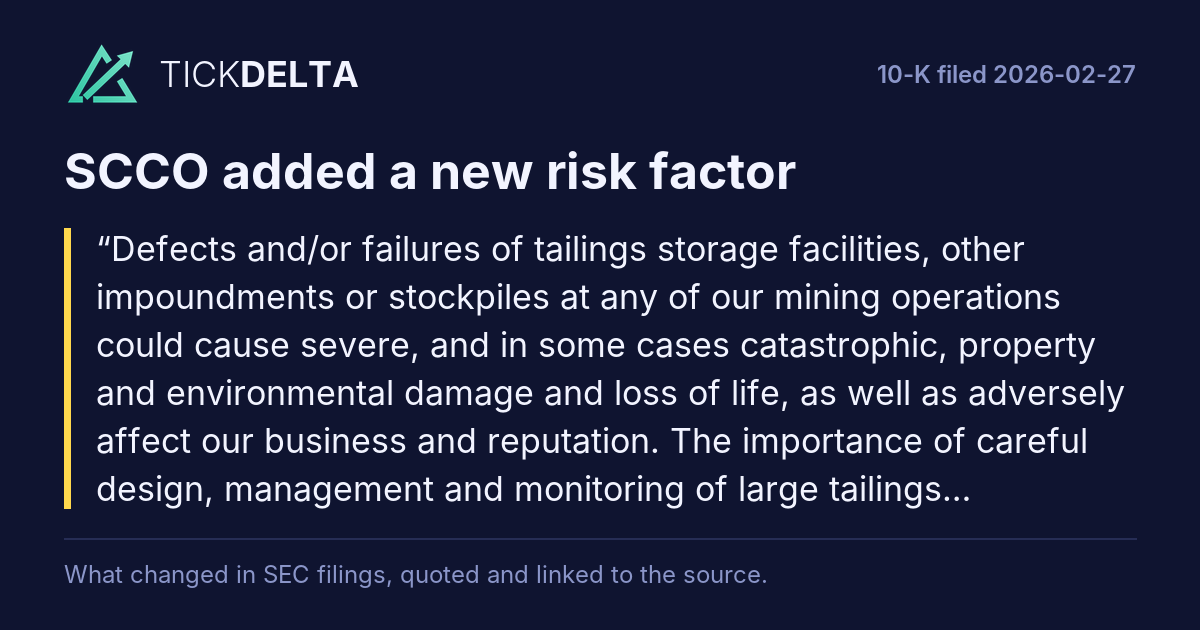
Defects and/or failures of tailings storage facilities, other impoundments or stockpiles at any of our mining operations could cause severe, and in some cases catastrophic, property and environmental damage and loss of life, as well as adversely affect our business and reputation.

The importance of careful design, management and monitoring of large tailings impoundments has grown in recent years due to large-scale tailings dam failures at the mining operations of companies, unaffiliated with the Company, which caused extensive property and environmental damage and, in certain instances, resulted in the loss of life. The failure or loss of integrity of a tailings storage facility or related waste management infrastructure—whether due to operational deficiencies, extreme weather events, seismic activity, regulatory constraints or other factors beyond our control—could result in the release of tailings, process water or other materials, causing environmental harm and potential impacts to surrounding communities, damage to, or destruction of mining operations, resulting in monetary losses and possible legal liability. Such events could materially adversely affect our results of operations and financial condition, disrupt operations, damage our reputation, and subject the Company to regulatory enforcement actions, fines, remediation obligations and claims from governmental authorities or third parties. For more information regarding our tailings dams, please see Item 2 “Properties—Slope Stability—Tailings Dams.”

Read in the 10-K

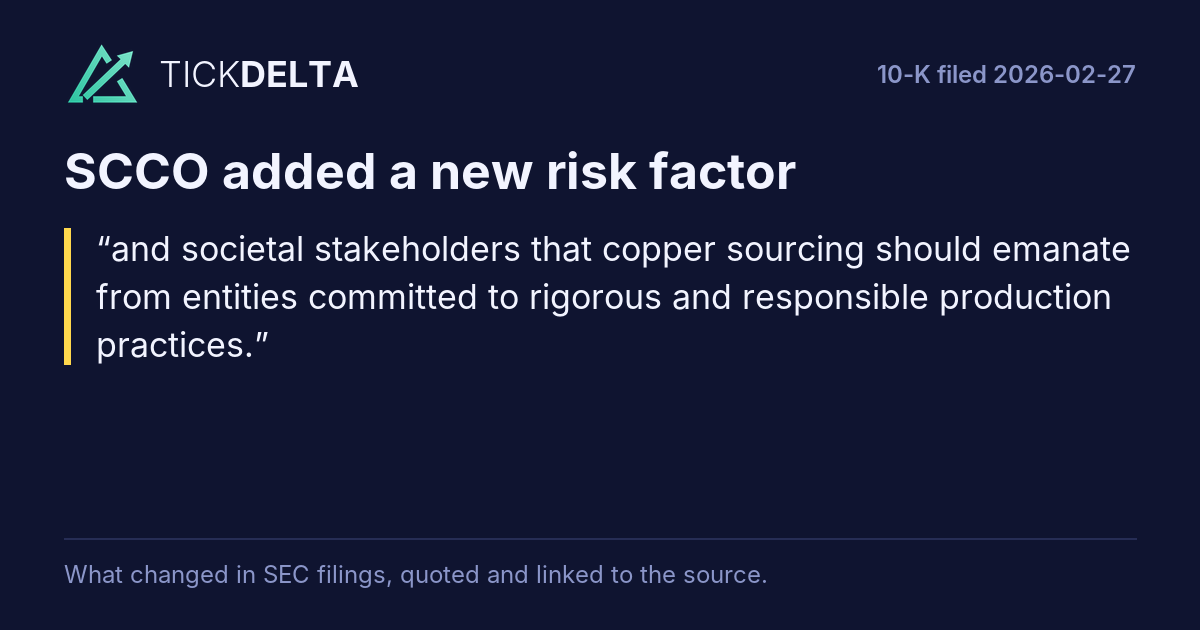
and societal stakeholders that copper sourcing should emanate from entities committed to rigorous and responsible production practices.

Read in the 10-K

facilities. We cannot assure you that our exploration programs will result in the expansion or replacement of current production with new proven and probable mineral reserves.

Read in the 10-K

Our business operations may be adversely affected by changes in regulatory policy or the imposition of new tariffs or other trade restrictions, which could significantly increase our costs, pricing strategies, disrupt our supply chain and complicate international sourcing and customer relationships. Uncertainty about future trade or tariff measures may hinder planning, force pricing adjustments, and reduce our competitiveness. If such developments occur, they could have a material adverse effect on our margins, results of operations and market position.

Changes in international trade policies and relationships may materially adversely affect global commodity prices and market conditions and our business, financial condition and results of operations. The adoption and expansion of trade restrictions; tariffs, taxes or other governmental trade measures and uncertainty about such trade measures could reduce the demand for our products, increase our costs, disrupt customer and supplier relationships and harm the U.S. economy, any of which could materially impair our cash flows, competitive position, financial condition and results of operations. In July 2025, the U.S. announced trade agreements with the European Union and Japan. On July 30, 2025, the U.S. announced a 50% tariff on semi-finished copper products and copper-intensive derivative products, which became effective on August 1, 2025. Additionally, reciprocal tariffs with China have been suspended until November 10, 2026. On February 20, 2026, the U.S. Supreme Court issued an opinion that limited the President’s authority to impose certain tariffs under emergency powers, which may affect the scope, duration and future use of tariff measures by the U.S. presidential administration. In response, the U.S. presidential administration declared they would impose a 15% global tariff. These developments have produced and may continue to produce market volatility for our principal products and our common stock. We cannot assure investors that future tariff actions, trade tensions, or related regulatory changes will not adversely affect our product prices, stock price, financial condition or results of operations.

Read in the 10-K
Show the other 1

On October 10, 2025, the Peruvian congress invoked its powers under the Constitution to remove the President from office, amidst general concerns about rising threats to personal security throughout the country. The president of the

Peruvian congress immediately assumed the presidency, in the absence of a Vice President. However, on February 17, 2026, the interim president was impeached four months into his term. On February 18, 2026, a new interim president was appointed. This new president leads a transitional government in Peru, which is due to hold general elections in April 2026 amidst political turmoil.

Read in the 10-K

Paragraphs in the 10-Q filed Oct 30, 2026 that were not in the one before

New in the latest 10-Q

20 paragraphs in the 10-Q filed Oct 30, 2026 with nothing like them in the 10-Q filed Jul 31, 2026 (at least half the words must differ; new numbers alone do not count). Quoted exactly, grouped by the item heading above them. This is text that changed, not a judgement of how serious it is.

Financial statements and notes

Equity Investment in Affiliate: The Company has a 44.2% participation in Compañia Minera Coimolache S.A. (“Coimolache”), which it accounts for on the equity method. Coimolache owns Tantahuatay, a gold mine located in northern Peru.

Read in the 10-Q

Project update: As of September 30, 2026, the Company has invested $884.3 million in project execution and committed $1,101 million to cover diverse activities, acquisitions and related contracts. Large-scale earthworks have concluded, and 18.9 million metric tonnes of material have been transferred to the La Tapada stripping deposit. Most work orders for the project’s primary equipment have been issued. Purchase orders for the leaching process have been placed to secure the main equipment - which will be outfitted with cutting-edge technology - as well as secondary equipment and materials.

Read in the 10-Q

On the energy supply front, work is advancing at the main electrical sub-stations, and the 220 kV transmission line is in its final stage of construction. In parallel, large-scale earthworks to develop dry and wet areas have been completed. At the project’s main installations, civil work is advancing alongside efforts to assemble metal structures and the main components of the crushing equipment for the primary, secondary, and tertiary crushing circuits (dry area). In the wet area, work to build the solvent extraction (SX) and electrodeposition (EW) facilities, among others, is progressing.

Read in the 10-Q

Project update: Social and environmental management programs are currently being implemented in the communities within the project’s direct area of influence, in accordance with the Framework Agreement signed for the Development of the Tiaparo Peasant Community and the Los Chancas Mining Project. In addition, measures are being taken to regain

Read in the 10-Q

control of the project area, which has been threatened by illegal miners. Regaining control is essential if we are to continue developing our Los Chancas project.

Read in the 10-Q
Show the other 15

Cuajone Expansion - Moquegua: To maintain or potentially increase production levels, the Company is evaluating expanding the Cuajone operation from its current milling capacity of 90,000 tonnes per day to 120,000 tonnes per day (a 33% increase). The expansion will require additional mining equipment and a new production line at the Cuajone concentrator. Current estimates point to a capital cost of $680 million to produce an average of 55,000 tonnes of copper and 1,400 tonnes of molybdenum per year.

Read in the 10-Q

As part of a thoughtful review of the matter, studies are underway to determine the viability of expanding to 150,000 tonnes of milling capacity per day.

Read in the 10-Q

Detailed engineering is still underway for the concentrator, SX-EW plant, water desalination facilities, logistics infrastructure and power delivery.

Read in the 10-Q

Our sustainability ratings continue to improve. In its Corporate Sustainability Assessment 2026 (CSA), S&P Global increased SCC’s rating by two points over last year’s print. The Company ranks among the top three performers in the mining sector, with a rating double that of the industry average. Some of SCC’s individual ratings were top-of-class for the sector: i) transparency and reporting, ii) materiality, iii) risk management, iv) business ethics, v) energy, vi) biodiversity, and vii) community relations.

Read in the 10-Q

Silver Helmet Award for best safety performance. Four operations in Sonora - lime plant, La Caridad mine, the Minera Mexico’s copper smelter and refinery - were awarded the “Silver Helmet” by the Mexican Mining Chamber (CAMIMEX) for their safety and accident prevention metrics. This is the first time that four operations in Sonora

Read in the 10-Q

received this award simultaneously, which attests to our teams’ commitment to strengthen preventive practices, safety controls and worker protection.

Read in the 10-Q

Participative environmental monitoring in Michiquillay. As part of our commitment to promote stakeholders’ active participation in new project development, the Participative Environmental Committee for the Michiquillay project in Peru completed its third verification of environmental performance in 2026. Community leaders and representatives of private entities sit on this Committee, which has the technical capabilities to collect soil, water and air samples and interpret results. Their participation in project development strengthens actions and measures to prevent or manage impacts on the environment and communities.

Read in the 10-Q

Forging Futures program continues to bear fruit in Peru. For the past 14 years, our program “Forjando Futuro” (Forging Futures) has been developing capacities and providing access to local job opportunities in the areas of influence of our operations in Peru and Mexico. Currently, 17% of the jobs on the Tia Maria project are held by locals, who access these opportunities through our onsite offices or in coordination with local contractors. Under this program, we have awarded 700 scholarships to young people to obtain certifications to operate heavy equipment or engage in welding and topography. These efforts strengthen participants’ technical competencies and broaden capacities to successfully insert in the job market.

Read in the 10-Q

• Increase in selling, general and administrative expenses. 9.6 • Increase in exploration expense. 5.7 Operating cost and expenses for the nine months of 2026 $5,318.3

Read in the 10-Q

$23.6 million increase in interest income due to higher cash balances, partially offset by,

Read in the 10-Q

Risk Factors

Our business depends upon information technology systems that may be adversely affected by disruptions, damage, cyber-attacks, failure and risks associated with implementation and integration.

Read in the 10-Q

Our operations depend upon information technology systems that may be subject to disruption, damage or failure from different sources, including, without limitation, the installation of malicious software, security breaches, cyber attacks and defects in design. In recent years, cybersecurity incidents have increased in frequency and include, but are not limited to, malicious software, attempts to gain unauthorized access to data and other electronic security breaches that could lead to disruptions in systems, unauthorized release of confidential or otherwise protected information and the corruption of data. Evolving cybersecurity risks, including the use of artificial intelligence (AI) and machine learning by attackers to enable sophisticated attack techniques or methods, as well as risks arising from compromised, misused, or autonomous AI systems, including frontier large language models and AI agents. Advanced AI technologies may increase the speed, scale, and sophistication of cyber-attacks through the exploitation of previously unknown vulnerabilities and the rapid identification and combination of weaknesses and misconfigurations that are increasingly difficult to predict and detect.

Read in the 10-Q

We have implemented measures for managing and treating potential risks through an information security management system that conducts ongoing monitoring, and ensures the application of controls that are frequently reviewed and tested (as described in Form 10-K, Item 1-C, Cybersecurity).

Read in the 10-Q

Given the unpredictability of the timing, nature and scope of information technology disruptions, we could potentially be subject to manipulation or improper use of our systems and networks, operational delays, situations that compromise

Read in the 10-Q

confidential or otherwise protected information, destruction or corruption of data, security breaches, reputational damage and erosion of stakeholder trust, or financial losses from remedial actions, any of which could have a material adverse effect on the cash flows, competitive position, business operations, financial condition, or results of our operations.

Read in the 10-Q

The 10-Q's risk factors against the 10-K

Item 1A of the 10-Q filed Oct 30, 2026 against Item 1A of the 10-K filed Feb 27, 2026. A 10-Q repeats only the risks that changed, so a 10-K paragraph that is missing from it is not counted as removed. Added is a paragraph with nothing like it in the 10-K, Reworded a sentence that is in both with several words changed, Quiet changes a sentence in both where one to four words changed and one is a hedge or a modal (cut words struck through, new words highlighted). Text on the page, not a score; each links to the filing at sec.gov.

What the 10-Q itself says about its risk factors:The Company's operations and financial results are subject to various risks and uncertainties, including those described in “Risk Factors” included in Part I, Item 1A of our Annual report on Form 10-K for the year ended December 31, 2025 filed with the SEC on February 27, 2026. The following supplements and updates the risk factors previously disclosed in our Annual Report on Form 10-K for the year ended December 31, 2025.

Read in the 10-Q
Added10-Q Oct 30, 2026 vs 10-K Feb 27, 2026
Current and potential military conflicts, along with heightened geopolitical tensions globally, including the ongoing conflict between Israel/Iran and instability in Eastern Europe could adversely impact our operations, global economic conditions and commodity markets. Such events may cause significant disruptions to global supply chains, such as delays in shipping through critical routes like the Strait of Hormuz, increased costs for fuel and energy, and restricted access to key raw materials for our operations. These conditions may result in higher operating costs and reduced margins.

Read it in the 10-Q at sec.gov

Added10-Q Oct 30, 2026 vs 10-K Feb 27, 2026
Such conflicts may also contribute to market volatility, fluctuation in foreign currency exchange rates, access to capital and investor sentiment, which could adversely affect our stock price and the cost of financing. Furthermore, the imposition of economic sanctions, export controls or other trade restrictions by the U.S. or other governments may limit our ability to conduct business in certain regions, disrupt international trade flows and affect demand for our products.

Read it in the 10-Q at sec.gov

Added10-Q Oct 30, 2026 vs 10-K Feb 27, 2026
We have implemented measures for managing and treating potential risks through an information security management system that conducts ongoing monitoring, and ensures the application of controls that are frequently reviewed and tested (as described in Form 10-K, Item 1-C, Cybersecurity).

Read it in the 10-Q at sec.gov

Reworded10-Q Oct 30, 2026 vs 10-K Feb 27, 2026
Given the unpredictability of the timing, nature and scope of information technology disruptions, we could potentially be subject to manipulation or improper use of our systems and networks, operational delays, situations that compromise confidential or otherwise protected information, destruction or corruption of data, security breaches, or financial losses from remedial actions, any of which could have a material adverse effect on the cash flows, competitive position, financial condition or results of our operations.

Read it in the 10-Q at sec.govThe 10-K sentence

Reworded10-Q Oct 30, 2026 vs 10-K Feb 27, 2026
Potential developments in U.S. policy, regulatory uncertainty, threats or imposition of tariffs Geopolitical tensions and trade tensions potential military conflicts may materially affect our business, financial condition and results of operations.

Read it in the 10-Q at sec.govThe 10-K sentence

Show the other 1
Reworded10-Q Oct 30, 2026 vs 10-K Feb 27, 2026
Our operations depend upon information technology systems that may be subject to disruption, damage or failure from different sources, including, without limitation, the installation of malicious software, computer viruses, security breaches, cyber-attacks cyber attacks and defects in design.

Read it in the 10-Q at sec.govThe 10-K sentence

Phrases used for the first time

Two-word phrases in Risk Factors of the 10-K filed Feb 27, 2026 that are in none of the 1 earlier 10-Ks stored, back to Mar 3, 2025

tailings storage ×3storage facilities ×2dust emissions ×2potential impacts ×2waste management ×2tariff measures ×2trade measures ×2presidential administration ×2interim president ×2versus depreciation ×2
Where each one is used
  • tailings storage: Our operations are subject to risks associated with the management of waste rock and tailings storage facilities, which are subject to significant environmental, safety and engineering challenges that could adversely affect our business.
  • storage facilities: Our operations are subject to risks associated with the management of waste rock and tailings storage facilities, which are subject to significant environmental, safety and engineering challenges that could adversely affect our business.
  • dust emissions: The waste rock and tailings produced in our mining operations represent our largest volume of waste material. Managing a high volume of waste rock and tailings presents significant environmental, safety and engineering challenges and risks primarily relating to structural stability, geochemistry, water quality and...
  • potential impacts: The waste rock and tailings produced in our mining operations represent our largest volume of waste material. Managing a high volume of waste rock and tailings presents significant environmental, safety and engineering challenges and risks primarily relating to structural stability, geochemistry, water quality and...
  • waste management: The waste rock and tailings produced in our mining operations represent our largest volume of waste material. Managing a high volume of waste rock and tailings presents significant environmental, safety and engineering challenges and risks primarily relating to structural stability, geochemistry, water quality and...
  • tariff measures: Our business operations may be adversely affected by changes in regulatory policy or the imposition of new tariffs or other trade restrictions, which could significantly increase our costs, pricing strategies, disrupt our supply chain and complicate international sourcing and customer relationships. Uncertainty...
  • trade measures: Changes in international trade policies and relationships may materially adversely affect global commodity prices and market conditions and our business, financial condition and results of operations. The adoption and expansion of trade restrictions; tariffs, taxes or other governmental trade measures and...
  • presidential administration: Changes in international trade policies and relationships may materially adversely affect global commodity prices and market conditions and our business, financial condition and results of operations. The adoption and expansion of trade restrictions; tariffs, taxes or other governmental trade measures and...

The 10-K at sec.gov

Used at least twice, small words left out. Counted, not picked: a phrase can be new because the company renamed something.

What was taken out

7 paragraphs of last year's Risk Factors with nothing like them now. The longest are quoted.

Across all companies
Additionally, changes in international trade policies and relationships may affect global commodity prices and market conditions and could have a material adverse impact on our business and results of operations. The adoption and expansion of trade restrictions; trade tensions; or other changes in governmental policies related to taxes, tariffs, trade agreements or any policies, are difficult to predict and could adversely affect the demand for our products, our costs, our customers, our suppliers and the U.S. economy and, consequently, could have a material adverse effect on our cash...
In the 10-K filed Mar 3, 2025
On December 7, 2022, the Peruvian congress invoked its powers under the Constitution to remove the current President from office. The Vice President immediately assumed the presidency, which has led to considerable turmoil, particularly in the south of Peru, where acts of vandalism and violence escalated. Roadblocks were scattered throughout the country, which negatively affected the normal course of business in various regions. Fortunately, our operations were not impacted. This climate of violence gradually subsided during the year and was replaced by a general concern about the economic...
In the 10-K filed Mar 3, 2025
Our business operations may be adversely affected by changes in regulatory policies. Imposing new tariffs on imports could significantly affect our cost structures and pricing strategies. The uncertainty surrounding potential tariff policies may complicate our supply chain planning and international trade relationships while increasing costs for raw materials and goods. These events, should they materialize, may impact our profitability and competitive positioning in the market.
In the 10-K filed Mar 3, 2025
Our subsidiary, Minera Mexico, is a Mexican company and, as such, may pay dividends only out of net income that has been approved by shareholders. Shareholders must also approve the actual dividend payment, after mandatory legal reserves have been created and losses for prior fiscal years have been satisfied. These legal constraints may limit the
In the 10-K filed Mar 3, 2025

Sources

Item 1A of each 10-K and 10-Q on EDGAR, quoted exactly. Each paragraph links to the filing at sec.gov.

Also

10-K change: what was reworded or cut, section by section.

Work with it

Excel workbook · CSV. Google Sheet that stays up to date: paste =IMPORTDATA("https://tickdelta.com/company/SCCO/export.csv") into a cell.

Next:10-K change
Esc

Type a ticker such as AAPL, a name, an investor such as Buffett, or a topic such as tariffs. ↑ ↓ to move, Enter to open.