Form 10-K for the Fiscal Year Ended December 31, 2022
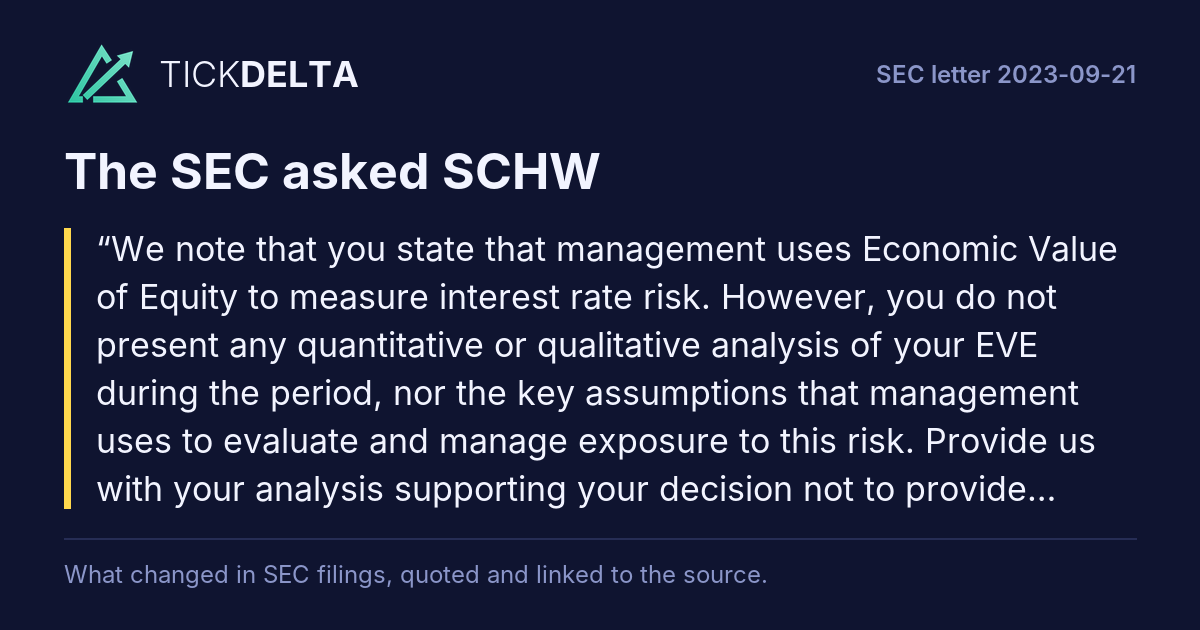
We note that you state that management uses Economic Value of Equity to measure interest rate risk. However, you do not present any quantitative or qualitative analysis of your EVE during the period, nor the key assumptions that management uses to evaluate and manage exposure to this risk. Provide us with your analysis supporting your decision not to provide information related this measure of market risk.Rest of the question
Please refer to Item 305 of Regulation S-K. Also, revise your disclosure to address the key metrics management uses in evaluating EVE to manage your exposure to market risk, and explain any significant changes made as a result of monitoring EVE in reducing your exposure to market risk.
Schwab utilizes multiple approaches to manage interest rate risk, which are described on pages 50-51 of the 2022 Form 10-K. Thus, while management monitors changes in economic value of equity (EVE) sensitivity over time, EVE is only one factor taken into consideration in the management of market risk. As disclosed, the Company utilizes interest rate risk simulations, including net interest revenue and EVE simulations.Read in the reply ↗Rest of the answer
The Company believes that the disclosure regarding net interest revenue simulations are particularly useful and satisfy the quantitative disclosure requirements of Item 305 of Regulation S-K. The results of the net interest revenue simulation sensitivity analyses provide an easily understandable number – that is, the simulated impacts to net interest revenue. In addition, the modeling, assumptions, and parameters employed in the net interest revenue simulations are, by definition, relatively consistent from period-to-period and thus allow for comparisons of that number over time.
We believe that disclosing qualitative information regarding our use of EVE also provides helpful information regarding the Company’s interest rate risk management program. We disclosed in our 2022 Form 10-K that in the management of interest rate risk we establish limits on net interest revenue risk and EVE risk, and to remain within these limits, we manage the maturity, repricing, and cash flow characteristics of the investment portfolios. We stated further that management monitors established guidelines to stay within the Company’s risk appetite. We also presented our key assumptions in our EVE calculation in the 2022 Form 10-K and 2023 Form 10-Qs: specifically, projection of interest rate scenarios with rate floors, prepayment speeds of mortgage-related investments, term structure models of interest rates, non-maturity deposit behavior, and pricing assumptions.
EVE is dependent on model assumptions under a variety of market and economic environments, as discussed on page 51 of the 2022 Form 10-K. The simplicity of the result (i.e., discounted value of net cash flows) belies the dependency of the calculation on assumptions and model inputs. With these extensive model dependencies and the reality of ongoing adjustments in the modeling often from quarter to quarter as we have additional experience with rate environments, understanding changes in modeled EVE and the practical implications can be difficult, and comparability of EVE across periods and among financial firms may not be useful to investors.
Conversations with the investment community indicate that they don’t focus on EVE in their evaluation of the Company’s risk profile and sensitivity to changes in rates, preferring instead quantification of net interest revenue sensitivity. Investors have, however, inquired about other related information that Schwab has either historically disclosed or recently began disclosing (e.g., effective duration), including trends and drivers related to net interest revenue and balance sheet management. In consideration of these and other factors, the Company has historically chosen to present only qualitative information regarding the Company’s use of EVE in managing interest rate risk.
Particularly in light of the banking industry turmoil that occurred in the first quarter of 2023, the Company carefully considered its disclosures related to market risk and liquidity risk, and expanded certain disclosures beginning in its Quarterly Report on Form 10-Q for the quarter ended March 31, 2023 (the “Q1 2023 Form 10-Q”), including those related to interest rate risk management. Beginning in the first quarter of 2023, the Company added disclosures regarding effective duration of components of its balance sheet (see page 16 of our Q1 2023 Form 10-Q), which had become a topic of greater interest with investors. We believe this supplemental disclosure provides additional information for investors regarding the Company’s management of interest rate risk and enables more useful comparisons over time and across firms. Also beginning in our Q1 2023 Form 10-Q, the Company supplemented its qualitative disclosures regarding its interest rate risk simulations and enhanced many disclosures regarding liquidity and changes in its mix of funding sources, including in pages 16-19.
We will continue to evaluate the Company’s disclosures related to interest rate risk management, and will continue to evaluate in future filings the potential need for additional or modified disclosures based on the facts and circumstances present at such time.
First report after the company's reply of 2023-10-11: 10-Q filed 2023-11-08 ↗, against the 10-Q filed 2023-08-08 ↗.
Tickdelta does not hold the text of both reports, so they are not compared here.
We note the disclosure that beginning in 2023, you began to utilize interest rate swap derivative instruments to assist with managing interest rate risk; however, we do not see fulsome disclosure discussing and quantifying the use of derivatives used to manage your interest rate risk.Rest of the question
Please provide a qualitative discussion of how derivatives are used to manage interest rate risk, including the volume and types of derivatives and any additional details regarding the changes in strategy during the periods presented. See Item 305(b)(1)(ii) of Regulation S-K. Additionally, consider disclosing quantitative information about the impact the use of derivatives had on managing your interest rate risk and clarify whether the disclosed outputs from your NIR and EVE simulation reflect the impact of any derivatives used to manage interest rate risk.
In 2023, the Company began to utilize interest rate swaps as part of its interest rate risk management program, and include these derivative instruments in its interest rate risk simulations. As the program began in early 2023, the impact of the use of derivative instruments on the Company’s management of interest rate risk was not material through June 30, 2023.Read in the reply ↗Rest of the answer
As a result, the Company did not provide disclosures regarding the impact of the use of derivative instruments in its management of interest rate risk.
In the Company’s Quarterly Report on Form 10-Q for the quarter ended June 30, 2023 (the “Q2 2023 Form 10-Q” and together with the Q1 2023 Form 10-Q, the “2023 Form 10-Qs”), Schwab provided in Part I – Item 1 – Financial Information – Notes to Condensed Consolidated Financial Statements (“Item 1”) Note 11 Derivative Instruments and Hedging Activities (“Note 11”) discussion of the types of derivatives used by the Company as well as quantitative information to provide investors with an understanding of the sizing and effects of our derivative instruments. As part of the market risk disclosures, on page 18 of the Q2 2023 Form 10-Q, the Company provided a cross reference to Note 11 to avoid duplication of certain disclosures. Note 11 also provides cross references to other footnotes that provide additional disclosure related to our derivative instruments, including to Item 1 – Note 2 Summary of Significant Accounting Policies and New Accounting Standards which provides further discussion of the Company’s accounting for such derivatives.
As part of our disclosure in Note 11, the following statement referenced the size of our outstanding derivative instruments used for interest rate risk management: “The Company had outstanding interest rate swaps with aggregate notional amounts of $8.9 billion at June 30, 2023 that were designated as fair value hedges of interest rate risk.” Note 11 also discloses that the Company’s only outstanding derivative instruments used for hedging purposes as of June 30, 2023 were fair value interest rate swaps on available for sale (AFS) securities. The notional amount of derivative instruments outstanding represented approximately 7% of the $136.9 billion total amortized cost of the Company’s AFS investment securities as of June 30, 2023. Note 11 also disclosed that the impact of our interest rate swaps was $122 million for the six months ended June 30, 2023, or approximately 2% of net interest revenue, though due to the application of hedge accounting, the net impact to net interest revenue of our interest rate risk management (i.e., the combined impact of the interest rate swaps and the hedged AFS securities) was less than $1 million for the six months ended June 30, 2023. In sum, we believe our disclosure clearly shows that the impact of the Company’s use of derivative instruments during the respective periods was immaterial.
In future filings, the Company will clarify that our interest rate risk simulations include the impact of derivative instruments, and additional disclosure will be provided to the extent the impacts of our use of derivative instruments become material to our interest rate risk management program and financial results.
First report after the company's reply of 2023-10-11: 10-Q filed 2023-11-08 ↗, against the 10-Q filed 2023-08-08 ↗.
Tickdelta does not hold the text of both reports, so they are not compared here.
We also note that key assumptions in your interest rate sensitivity analysis include the projection of interest rate scenarios with rate floors, rates and balances of non-maturity client cash held on the balance sheet, prepayment speeds of mortgage-related investments, repricing of financial instruments, and reinvestment of matured or paid-down securities and loans.Rest of the question
Please revise your disclosures in future filings to describe and define the various identified assumptions, whether you use proprietary or third-party data, how the data are used in your modeling and any unique facts and circumstances about them, such as how they have or may respond to unknown facts and circumstances, such as exogenous events. Additionally, please disclose changes in any assumptions used for any comparative period, including changes to the data source used or significant changes in the actual assumption itself due to, and for example, internal data, market conditions or significant changes in the judgments and determinations made by management as you refine your modeling over time. Please see Item 305(a)(1)(ii)(B) of Regulation S-K.
In addition to the portion of our interest rate sensitivity analysis disclosures referenced in the Staff’s comment, we note that we have provided extensive additional disclosure in the subsequent paragraphs on pages 18-19 of the Company’s Q2 2023 Form 10-Q regarding, among other items: the significant components of the Company’s interest-earning assets and interest-bearing liabilities; internal and external factors that influence interest rates on our interest-earning assets and interest-bearing liabilities, including hypothetical directional movement variations in interest revenue comparedRead in the reply ↗Rest of the answer
with interest expense as a result of market interest rate fluctuations; limitations of the simulations such as the use of a statically sized balance sheet; and factors such as those recently experienced in the rising interest rate environment and the Company’s current reliance on higher-cost funding sources.
In regard to changes in assumptions used for comparative periods, the Company has also provided on pages 18-19 of the Company’s Q2 2023 Form 10-Q discussion of material drivers of the changes in net interest revenue sensitivity for comparative periods, including commentary regarding internal and external factors, which, for the periods presented, primarily related to changes in the size and composition of the balance sheet and market interest rates. The Company also included quantitative historical disclosure of interest-earning assets and funding sources as a component of MD&A (see pages 9-10 of the Company’s Q2 2023 Form 10-Q), which provide additional insight into factors influencing the Company’s net interest revenue.
In future filings, the Company will clarify its use of proprietary or third-party data in its interest rate sensitivity analysis and will evaluate the potential need for other modification to the disclosure based on the facts and circumstances present at such time.
First report after the company's reply of 2023-10-11: 10-Q filed 2023-11-08 ↗, against the 10-Q filed 2023-08-08 ↗.
Tickdelta does not hold the text of both reports, so they are not compared here.
In your 10-K you state that the Chief Risk Officer, Global Risk Committee and its subcommittees, and the Board Risk Committee have significant roles in monitoring and providing oversight for risk management and responding to emerging risks.Rest of the question
We also note that during 2023, you have seen significant fluctuations in the composition of your funding sources as clients have moved away from keeping money in your deposit products, and seen a decline in your net interest revenue. We also note the statement in the press release furnished as an exhibit to the April 17, 2023 Form 8-K attributing the reduction in deposit volumes to your clients' preference for other products within the Schwab family. Revise your disclosure in future filings to discuss the roles of your risk management oversight process in identifying and addressing changes to the mix of Schwab products held by your clients during the reported period. Discuss any instances where the relevant committee or sub-committee had to approve a change in order to maintain compliance with your established risk profile, or accepted an increased risk exposure compared to your tolerances set before the Federal Reserve began increasing rates and your clients allocation preferences changed. Also, disclose how the Committees and the rest of your oversight process distinguish between changes in client preferences among your products and a more fundamental move away from Schwab products and any significant actions taken as a result of that evaluation during the reported period. For instance, discuss management's actions in response to deposit outflows on your ability to maintain sufficient capital adequacy for both the parent company and your banking subsidiary to avoid restrictions in your ability to access funding sources including advances or brokered deposits.
Schwab’s risk management oversight process has focused on identifying and addressing changes to our funding sources that result from changes to the mix of Schwab products held by our clients. As we have disclosed, Schwab’s primary funding source is cash generated by client activity which includes bank deposits and cash balances in client brokerage accounts. As part of our risk management oversight process, we monitor and forecast cash balances to ensure sufficient liquidity in relation to changes in deposits and to support management of our investment portfolios and capital.Read in the reply ↗Rest of the answer
The significance of deposit balances in the Company’s management of liquidity and market risk and capital management is discussed in detail in the Company’s 2022 Form 10-K, primarily in MD&A – Risk Management (pages 46-56), and in its Q1 2023 Form 10-Q (pages 14-19) and Q2 2023 Form 10-Q (pages 18-24). We employ a variety of metrics to monitor and manage liquidity, including evaluating current and forecasted deposit flows. We conduct regular liquidity stress testing to ensure our ability to maintain sufficient liquidity to meet operational needs and satisfy applicable regulatory requirements and in the oversight of market and capital risk under both normal and stressed conditions. Results of liquidity stress testing are reported through management level risk committees and to the Board of Directors. A number of early warning indicators are monitored to help identify emerging liquidity stresses in the market or within the organization and are reviewed with management. In addition, the discussion about Market Risk in MD&A – Risk Management (pages 50-51 in our 2022 Form 10-K, and pages 18-20 in our Q2 2023 Form 10-Q) includes extensive detail about the impact of deposit flows to interest rate risk simulations.
The Company has also disclosed trends and uncertainties relating to these risks in its filings. Client cash allocations are heavily influenced by the interest rate environment and other market dynamics. As described in our 2022 Form 10-K and 2023 Form 10-Qs, during 2022 and 2023, the magnitude and speed of short-term interest rate increases exceeded market expectations and related client cash movements out of deposits and into higher yielding cash and fixed income alternatives exceeded forecasts. As these outflows outpaced excess cash on hand and cash generated by maturities and paydowns on our investment and loan portfolios, our banking subsidiaries utilized higher cost supplemental funding sources which negatively impacted our net interest revenue. As clients reallocated cash to money market funds in 2022 and 2023, the Company’s asset management and administration fee revenue increased, though in the second quarter of 2023, the increase was more than offset by lower net interest revenue.
The Company did not adjust its business model and risk tolerance as the Federal Reserve began and continued to increase interest rates and as our clients’ preferences changed to allocate sweep deposit and brokerage cash to higher-yielding investments. Nor was there ever any decision or consideration (other than the issuance of certificates of deposit, which we disclosed) to change the product mix we offer to our clients. As discussed in our 2022 Form 10-K, our risk appetite is defined as the amount of risk the Company is willing to accept in pursuit of our corporate strategy. This risk appetite is developed by executive management and approved by the Board of Directors and reflected in specific risk limits. As disclosed in our 2022 Form 10-K, the Global Risk Committee is responsible for the Company’s risk management and the Financial Risk Oversight Committee provides oversight of and approves credit, market, liquidity, and capital risk policies, limits, and exposures, escalating any key items to the Global Risk Committee.
The Company notes, as disclosed in the 2022 Form 10-K and the 2023 Form 10-Qs that its loans and securities have low credit risk, which was by design and due to its longstanding risk appetite. Because of the low credit risk the Company has an expectation of full-principal recovery for both loans and securities and, therefore, liquidity risk is the primary risk being evaluated in relation to loans and securities. As defined and disclosed in our 2022 Form 10-K, “liquidity risk is the potential that Schwab will be unable to sell assets or meet cash flow obligations when they come due without incurring unacceptable losses.” The Company determined that it had sufficient liquidity from its diversified liquidity sources to hold its securities and loans until maturity or not sell them and realize the unrealized losses due to changes in interest rates.
4.(Continued) Also, disclose how the Committees and the rest of your oversight process distinguish between changes in client preferences among your products and a more fundamental move away from Schwab products and any significant actions taken as a result of that evaluation during the reported period.
Response:
As noted above, during the current rising interest rate environment the Company’s risk committees and risk processes have focused on the impact to Schwab’s funding sources from client behavior in response to rising interest rates and other fixed income and equity market dynamics, which primarily manifested in deposit outflows to invest in higher-yielding investment products driven by the rapid increase in interest rates. The Company’s bank deposits decreased $139.4 billion, or 31%, from December 31, 2021 to June 30, 2023. As we discussed extensively in our 2022 Form 10-K and 2023 Form 10-Qs, these changes in client cash activity were driven by our clients responding to the rising interest rate environment rather than movement away from Schwab products more generally.
This trend and corresponding impacts are evident through consideration of Schwab’s business overall. The Company discloses a number of metrics that provide indications of client engagement with the Company and allocation of client cash among our other products. As several examples, we note the following for the 18-month period from December 31, 2021 through June 30, 2023:
•During 2022 and the first six months of 2023, the Company gathered net new client assets totaling $629.6 billion.
•From December 31, 2021 to June 30, 2023, our clients’ balance of Schwab’s money market funds increased by $246.4 billion, or 168%, and client balances of fixed income securities increased by $366.2 billion, or 103%.
•From December 31, 2021 to June 30, 2023, total client assets decreased $122.2 billion, or 2%, due to offsetting net market losses, while total active brokerage accounts increased 1.2 million, or 4%, and banking accounts increased 167,000, or 10%.
The Company evaluated these metrics and a number of other indicators in regard to the Company’s disclosure that client cash activity in 2022 and 2023 was due to clients’ response to the rising interest rate environment to invest in higher-yielding investment products within Schwab rather than a “fundamental move away from Schwab products”.
4.(Continued) For instance, discuss management’s actions in response to deposit outflows on your ability to maintain sufficient capital adequacy for both the parent company and your banking subsidiary to avoid restrictions in your ability to access funding sources including advances or brokered deposits.
Response:
The Company took a number of actions to address its risk profile and changes to the environment, consistent with its disclosed liquidity and capital management policies and processes, including the following, which were disclosed in the Company’s 2022 Form 10-K and 2023 Form 10-Qs:
•In January and November 2022, Schwab transferred investment securities from the AFS category to the held to maturity (HTM) category with aggregate fair values of $108.8 billion and $79.8 billion, respectively. We disclosed in our 2022 Form 10-K that the transfer of these securities to the HTM category “reduces the Company’s exposure to fluctuations in accumulated other comprehensive income (AOCI) that can result from unrealized gains and losses on AFS securities due to changes in market interest rates.”
◦In the 2022 Form 10-K and 2023 Form 10-Qs we disclosed the requirement that our banking subsidiaries maintain positive tangible capital to allow access to Federal Home Loan Bank (FHLB) advances and noted that our capital management considers minimum tangible capital ratios. These transfers of securities from AFS to HTM reduced the volatility in our tangible capital.
•In the fourth quarter of 2022, the Company began to issue brokered certificates of deposit and utilize FHLB advances as an alternative source of funding to replace deposit outflows that were occurring. Additional issuances of certificates of deposit and FHLB borrowings subsequent to December 31, 2022 were also disclosed in the 2022 Form 10-K.
•In the first quarter of 2023, the Company pledged additional securities to the Federal Reserve to ensure capacity was available should additional sources of liquidity be needed. The Company also disclosed other securities available to pledge to further increase access to lending facilities. In the Company’s Q1 2023 Form 10-Q, the Company again disclosed borrowings from the FHLB, brokered certificates of deposit issued, and repurchase agreements utilized subsequent to March 31, 2023.
•In 2023, the Company began establishing and utilizing new repurchase facilities available to our banking subsidiaries (e.g., the standing repo facility with the Federal Reserve Bank of New York) and our parent entity, The Charles Schwab Corporation, further increasing the diversity of funding sources.
•While not material in the first two quarters of 2023, the Company began utilizing interest rate derivatives as part of its interest rate risk management.
•In the first quarter of 2023, the Company suspended share repurchase activity and disclosed that it was accreting capital given anticipation of changing regulatory expectations and capital requirements. In the second quarter of 2023, after the proposed rules applicable to large banking organizations were released on July 27, 2023, the Company added a non-GAAP financial measure to adjust its Tier 1 Leverage Ratio to show the effect of including AOCI in the ratio as a supplemental measure of the Company’s capital levels.
•In the second quarter of 2023, the Company issued $2.5 billion of senior unsecured notes and contributed capital to its banking subsidiaries.
We will continue to evaluate in future filings the potential need for additional or modified disclosures based on the facts and circumstances present at such time, including with respect to enhancements in deposit monitoring and forecasts incorporated in liquidity and market risk management and capital management.
First report after the company's reply of 2023-10-11: 10-Q filed 2023-11-08 ↗, against the 10-Q filed 2023-08-08 ↗.
Tickdelta does not hold the text of both reports, so they are not compared here.
You discuss changes that you have made to your funding sources, including the sale of additional long term debt, issuing brokered deposits and FHLB advances. We also note that the debt rating for your long term debt was lowered by at least one rating agency.Rest of the question
Revise your disclosure in future filings to address any material impact from changing the mix of funding sources, including the increase in interest and other expenses associated with those funding sources as well as any change in duration. Also, disclose any material regulatory implications from choosing those funding sources, including any impact on your ability to rely on the source in the event that you or your banking subsidiary were to face capital adequacy concerns.
With the rapid increases in short-term interest rates beginning in early 2022, we have provided increasingly detailed disclosures in our 2023 Form 10-Qs and the 2022 Form 10-K regarding the impacts on our financial condition and results of operations. With our increased use of FHLB and other short-term borrowings beginning in the fourth quarter of 2022, we have provided quantitative and qualitative disclosures around the sizing and impacts of our use of supplemental funding (including FHLB borrowings, other short-term borrowings, and brokered certificates of deposit).Read in the reply ↗Rest of the answer
Such disclosures have included ending and average balances of borrowings, weighted average interest rates, maturities, and related cash flow impacts.
We note that the Company frequently issues long-term debt in a variety of market conditions. However, as the Company’s use of higher cost supplemental funding increased in the first and second quarters of 2023, we provided extensive additional disclosures to enable users of the financial statements to understand the impacts of such borrowings. We refer the Staff to the following relevant disclosures made in the Company’s Q2 2023 Form 10-Q that discuss the impacts of the use of higher-cost supplemental funding sources (we note that the Company also included similar disclosures in its Q1 2023 Form 10-Q corresponding with increased use of higher cost supplemental funding sources):
•MD&A – Overview, pages 5-6 which discuss overall drivers of changes in net interest revenue as well as balance sheet management, including disclosure of the use of supplemental funding sources as a result of clients’ allocation of assets to higher yielding cash and fixed income alternatives.
•MD&A – Results of Operations – Net Interest Revenue, pages 9-11 which provide extensive tabular and narrative discussion of the need to utilize higher cost supplemental funding as a significant driver of increased interest expense and its impact on net interest revenue and net interest margin.
•MD&A – Risk Management – Liquidity Risk on pages 20-24, in particular the tabular presentation of amounts, maturities, and weighted-average interest rates on outstanding borrowings on page 21, the amounts, maturities, and weighted-average interest rates on brokered certificates of deposit on page 22, and the narrative discussion of cash flow activity on page 22.
◦We note further narrative discussion on page 21 regarding certain regulatory requirement considerations for borrowing from the FHLB, and additional discussion in MD&A – Capital Management on page 25 regarding our capital position.
•Note 7. Bank Deposits and Note 8. Borrowings on pages 46-48 which provide additional disclosure of brokered certificates of deposit and borrowings.
We will continue to evaluate the impacts of the Company’s mix of funding sources, and will continue to evaluate in future filings the potential need for additional or modified disclosures based on the facts and circumstances present at such time.
First report after the company's reply of 2023-10-11: 10-Q filed 2023-11-08 ↗, against the 10-Q filed 2023-08-08 ↗.
Tickdelta does not hold the text of both reports, so they are not compared here.
We note that in your Form 10-K, you provide a brief risk factor that discusses the potential impact on your business from a substantial decrease in liquidity. However, in the first two reported quarters of 2023, you appear to have seen a significant outflow of deposits, an outflow that appears to have been particularly pronounced during the period immediately following the collapse of Silicon Valley Bank.Rest of the question
However, you did not update the risk factor to discuss your actual experiences with changes to your deposit mix, the availability of liquidity or the costs and availability of replacement funding sources, nor did you discuss the significant events that impacted the availability of liquidity. Please revise your risk factors disclosure. Please ensure that your risk factors discussion is updated to reflect significant changes to the risks.
The last paragraph of our 2022 Form 10-K risk factor titled “A significant decrease in our liquidity could negatively affect our business as well as reduce client confidence in us.” was added in our 2022 Form 10-K to address impacts of recently experienced client cash movements from our sweep products into higher yielding alternatives as a result of the rapid increase in short-term interest rates and our resulting need to use higher cost supplemental funding and the conditions of availability of such funding.Read in the reply ↗Rest of the answer
This paragraph states:
“When short-term interest rates rapidly increase, as they did in 2022, the pace at which clients move certain cash balances out of our sweep features and into higher yielding alternatives generally increases. When these outflows outpace excess cash on hand and cash generated by maturities and paydowns on our investment and loan portfolios, as they recently have, our banking subsidiaries may use temporary supplemental funding, such as advances under Federal Home Loan Bank (FHLB) secured credit facilities, borrowings under repurchase agreements with external financial institutions, and issuances of brokered certificates of deposit, which have higher costs. In addition, to access new FHLB advances or roll over existing advances, our banking subsidiaries must maintain positive tangible capital, as defined by the Federal Housing Finance Agency. Larger unrealized losses on our available for sale (AFS) portfolio due to higher market interest rates could negatively impact our tangible capital.”
Notwithstanding public attention to the collapse of Silicon Valley Bank in March 2023, this event did not have a material impact on the Company’s bank deposits during the first six months of 2023. As we disclosed in our 2023 Form 10-Qs, Schwab’s clients’ bank deposits and brokerage cash accounts primarily originate from our more than 34 million active brokerage accounts, and more than 80% of our bank deposits as of each of the first two quarters qualified for FDIC insurance. While bank deposits decreased $62.3 billion, or 17%, during the first six months of 2023, our clients’ balance of Schwab’s money market funds increased by $114.0 billion, or 41%, and client balances of fixed income securities increased by $129.2 billion, or 22%. We also note that during the first six months of 2023, net new client assets totaled $222.7 billion ($72.9 billion in March alone), active brokerage accounts increased 624,000, or 2%, and banking accounts increased 65,000, or 4%.
The changes in the mix of our funding sources discussed in the risk factor in our 2022 Form 10-K continued into 2023, and the key driver of these changes continued to be the increase in short-term interest rates. As such, when we reviewed the risk factor in connection with our 2023 Form 10-Qs, we determined that there had not been a material change to the risk factor and that an update was not needed.
We also note that we included detailed information in the MD&A section of our Q1 2023 Form 10-Q on clients continuing to allocate assets to higher yielding cash and fixed income alternatives (pages 4-5), our use of higher cost supplemental funding and the impact on net interest revenue (pages 7-9), and liquidity details including availability of funding sources (pages 17-19). We also added line items to our cash flow statement on Proceeds from /Repayments of FHLB borrowings and other short-term borrowings (page 29). Our Q2 2023 Form 10-Q (pages 5-6, 10-11 and 22) included additional detail on our experience over the first six months of 2023 with changes in deposit balances (i.e., clients allocating assets to higher yielding cash and fixed income alternatives) and the additional use and costs of replacement funding sources (i.e., FHLB borrowings and issuances of brokered certificates of deposit), as well as the issuance of long-term debt to provide incremental liquidity. These disclosures also addressed the decrease in FHLB and other short-term borrowings over the second quarter, management’s expectation for the level of supplemental funding balances through 2024 and early 2025, and the risk that additional higher cost supplemental funding may be necessary if client cash allocation movements increased. The discussion about Liquidity Risk in MD&A – Risk Management (page 23) included additional disclosure regarding the Company’s liquidity stress projections and the stability of its funding sources.
We will continue to evaluate in future filings the adequacy of our liquidity risk factor and the potential need to update it based on the facts and circumstances present at such time.
First report after the company's reply of 2023-10-11: 10-Q filed 2023-11-08 ↗, against the 10-Q filed 2023-08-08 ↗.
Tickdelta does not hold the text of both reports, so they are not compared here.
We note your response to comment 1, in which you note that you believe that qualitative information about your use of EVE, combined with your presentation of sensitivity analysis for your exposure to interest revenue simulations, provides investors with the best understanding of your exposure to market risks.Rest of the question
We also note your qualitative discussion of the key areas that management monitors to remain within your risk appetite. In the subsequent quarters, your EVE discussion in the relevant 10-Qs do not discuss whether your assumptions, guidelines or other actions were changed as interest rates or other factors changed. Please confirm that you will expand your qualitative discussion in future filings, to address any qualitative changes made to your models, assumptions, targets or management actions as a result of material changes to the key inputs during the periods presented. Please provide us with your proposed disclosures.
Changes in Schwab’s interest rate sensitivity measures, including economic value of equity (“EVE”) and net interest revenue sensitivity, may be driven by several categorical factors, including changes in market rates, changes in balance sheet composition, and changes in modeling and assumptions disclosed in our 2022 Form 10-K and Quarterly Reports on Form 10-Q (“Form 10-Q”) for the quarters ended March 31, June 30, and September 30, 2023 (the “2023 Form 10-Qs”).Read in the reply ↗Rest of the answer
Changes in EVE sensitivity period-over-period are typically driven primarily by market-related changes in valuations across both assets and liabilities as well as changes in the composition of the balance sheet. As we disclosed in our 2022 Form 10-K and 2023 Form 10-Qs, EVE relies on interest rate models and specific cash flow models that are subject to modification. However, the Company did not implement model or assumption changes for the referenced periods that materially impacted Schwab’s EVE sensitivity metrics. Rather, changes in EVE sensitivity for 2022 and 2023 were driven primarily by impacts from rising market rates and changes in the composition of the balance sheet, including the greater use of higher-cost supplemental funding sources discussed in our 2022 Form 10-K and 2023 Form 10-Qs.
In Schwab’s 2023 Form 10-Qs, the Company provided expanded disclosure related to its management of interest rate risk in light of the rising rate macroeconomic environment. In Schwab’s Form 10-Q for the quarter ended September 30, 2023 (“Q3 2023 Form 10-Q”), the Company provided additional disclosure regarding its EVE sensitivity, including clarification of the Company’s use of proprietary and independent third-party models, as well as qualitative discussion of EVE sensitivity trending. In part, this additional disclosure states:
“We use both proprietary and independent third-party models to simulate EVE sensitivity and related analyses. We develop and maintain client credits and deposits run-off models internally based on historical experience and prevailing client cash realignment behaviors. We rely on third-party models for term structure modeling, prepayment speed modeling for mortgage-backed securities and mortgage loans, and cash flow projections based on interest income, contractual maturities, and prepayments.
As interest rates rose through the first nine months of 2023, EVE sensitivity generally trended higher due to a shortening of liability duration. While the Company’s asset duration remained largely stable during the period of rising interest rates, liability duration shortened significantly and is now shorter than asset duration.”
In future filings, we will provide disclosure regarding the Company’s EVE sensitivity, similar to the disclosures presented in the Company’s Q3 2023 Form 10-Q, and, if applicable based on the facts and circumstances present at the time of future filings, Schwab will disclose changes in its models or assumptions related to its EVE simulations that materially impact the Company’s EVE sensitivity.
First report after the company's reply of 2023-12-21: 10-K filed 2024-02-23 ↗, against the 10-K filed 2023-02-24 ↗.
Tickdelta does not hold the text of both reports, so they are not compared here.
Similarly, in response to comment 2, you indicate the variables that contain assumptions, without providing disclosure about the assumptions themselves (e.g. prepayment speeds, term structure models, non-maturity deposit behavior, etc.).Rest of the question
The subsequent quarterly reports note the same general areas where assumptions support your risk management evaluations, without significantly addressing changes to those assumptions, including in response to the substantial increase in rates. To the extent that the key assumptions used to support your quantitative evaluation of interest rate risk simulations change as a result of significant changes to market rates, address those changes in your market risk disclosure for the relevant periods. For instance, we note that during the period you expanded your presentation of the impact of interest rate changes from a single 100 basis point increase/decrease, to instead present 50, 100 and 200 basis points increase/decrease. However, your presentation continues to assume a "gradual increase or decrease" while referencing other simulations, including instantaneous and/or non-parallel shifts. Given the significant changes in interest rates that have occurred during the current year, provide your analysis as to why you have chosen not to only present the sensitivity analysis based on the gradual rate increase scenario.
The Company’s disclosure of the results of gradual parallel increase/decrease scenarios for interest rates in our net interest revenue simulation mirrors our primary approach for managing interest rate risk, including in defining policies and setting risk limits. Though the Company also analyzes a variety of other scenarios (e.g., gradual non-parallel and instantaneous shifts in interest rates), the Company’s established policies related to interest rate sensitivity primarily utilize gradual parallel increase/decrease scenarios.Read in the reply ↗Rest of the answer
Though we have seen very rapid and large interest rate increases recently, which have had significant impacts to Schwab, these increases have typically been concentrated on short-term parts of the yield curve. The gradual parallel rate shock scenario has been considered by the Company over time more representative of actual scenarios than an instantaneous shock. In 2023, the Federal Funds overnight rate was increased 100 basis points through four 25 basis point increases between February and July.
As referenced in the Staff’s comment, the Company provided additional net interest revenue simulation scenarios in its disclosure beginning in the Company’s Form 10-Q for the quarter ended March 31, 2023, and continuing in the remaining 2023 Form 10-Qs, to provide additional information on multiple rate increase/decrease scenarios to investors. We believe this expanded information can be useful to investors, though inclusion of these additional scenarios in our disclosures was not the result of a change in underlying assumptions or policies.
The Company has continued to provide disclosures that discuss the changes in net interest revenue sensitivity in its 2022 Form 10-K (page 51) and 2023 Form 10-Qs (e.g., page 19 of the Q3 2023 Form 10-Q), which have been primarily driven by impacts from rising market rates and changes in the composition of the balance sheet. Though our net interest revenue simulations rely on interest rate models and cash flow models that are subject to modification, the Company did not implement model or assumption changes for the referenced periods that materially impacted Schwab’s net interest revenue sensitivity metrics.
In future filings, as applicable, Schwab will disclose changes in its models or assumptions related to its net interest revenue simulations that materially impact the Company’s net interest revenue sensitivity. In addition, in future filings, the Company will continue to evaluate the nature and magnitude of net interest revenue simulation scenarios that are most useful to investors, and we will continue to consider the net interest revenue simulation scenarios that are of primary focus by the Company in its management of interest rate risk. In future filings, the Company will also clarify in its disclosures that management primarily utilizes gradual parallel scenarios. Should additional types of net interest revenue simulations become material components of the Company’s management of interest rate risk, the Company will consider expanding disclosure at such time to include any additional scenarios.
First report after the company's reply of 2023-12-21: 10-K filed 2024-02-23 ↗, against the 10-K filed 2023-02-24 ↗.
Tickdelta does not hold the text of both reports, so they are not compared here.
Also in this review: closing letter, 2024-01-22