Screener / SEC EDGAR /CIK 0001662991 /10-K filed Feb 26, 2026, compared with Feb 27, 2025 /Numbers from the XBRL of the 10-Ks
Nasdaq Industrials · Business Services

Sezzle Inc. SEZL

Compare with peers Embed
SEC comment letters, last 20 years

2 reviews of SEZL's filings by SEC staff

UPLOAD and CORRESP
Reviews 2 latest letter May 30, 2025
Questions asked 13 each answered in the company's own letter
No closing letter 1 reviews without a letter saying the staff completed it

When the SEC's staff reviews a filing, it writes to the company with numbered questions, and the company answers each one in a letter. SEC publishes the exchange once the review is over, at least 20 business days later. A question is not an accusation; most reviews end with the company adding detail to its next filing.

How the reviews went

Every review on EDGAR, from the first staff letter to the letter that closes it

  1. 1. Staff letters 4 UPLOAD
  2. 2. Questions in them 13 numbered comments
  3. 3. Company replies 4 CORRESP
  4. 4. Reviews closed 1 of 2 closing letter

Half the closed reviews took 83 days or less from the first letter to the closing letter.

Form 10-K

2025-05-30 to 2025-08-21 · 6 questions · 2 letters from the SEC, 2 from the company
Review closed 2025-08-21
RevenueResults discussion (MD&A)SegmentsLiquidity and cash
Overview · Seasonality, page 52
SEC asked (1)
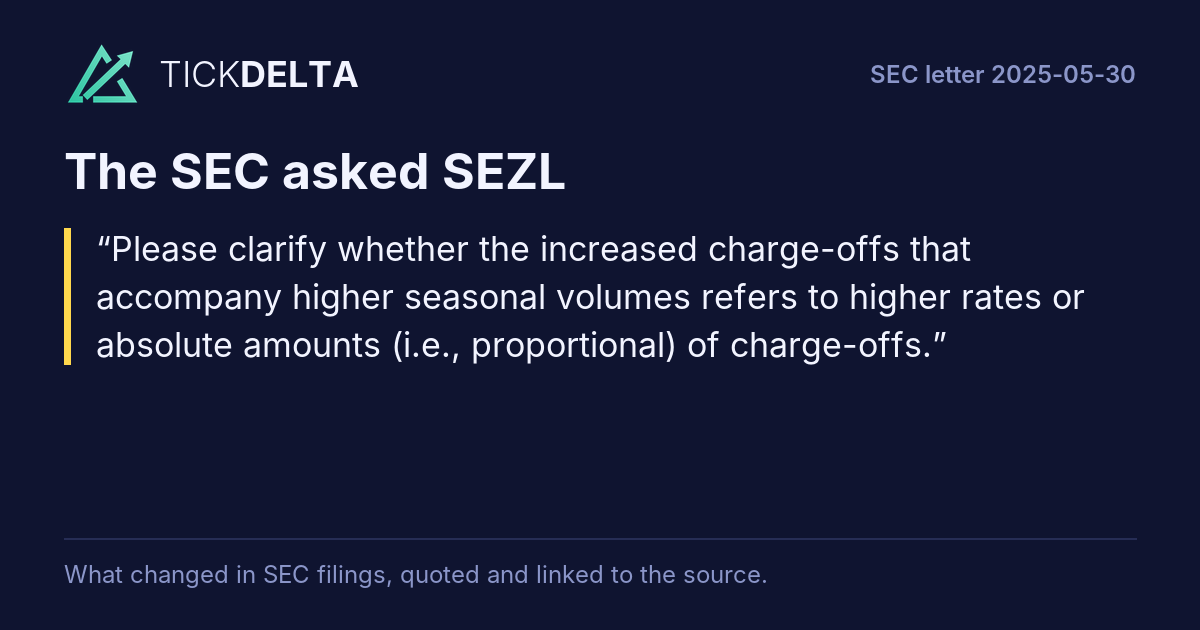
Please clarify whether the increased charge-offs that accompany higher seasonal volumes refers to higher rates or absolute amounts (i.e., proportional) of charge-offs.
SEZL answered
Increased charge-offs accompanying higher seasonal volumes are a combination of higher rates and higher absolute amounts. Gross Merchandise Volume is the highest in our fourth quarter, in line with consumer spending habits during the holiday shopping season. We also see higher loss rates as a percentage of Gross Merchandise Volume in the fourth quarter, resulting from more consumers generally spending more during the holiday shopping season, leading to a higher likelihood of losses.
Read in the reply
Results of Operations · Total Revenues, page 56
SEC asked (2)
Please quantify the extent to which changes in revenue are attributable to changes in price, volume, or the introduction of new products or services. Provision for Credit Losses, page 58 You disclose the provision for credit losses increased due to higher GMV compared to the prior year and changes to consumer underwriting. To the extent possible, please 3. revise to quantify the impacts of each factor on results.
Rest of the question

You state the provision was 20.3% and 14.6% of total revenue in 2024 and 2023, respectively. Tell us why you believe it is meaningful to compare the provision to total revenue rather to revenues derived from extending credit to consumers to which the provision pertains. Finally, tell us your consideration of whether these changes represent known trends or uncertainties that may unfavorably impact you results of operations, profitability, cash flows, and financial condition, or are reasonably likely to cause a material change in the relationship between costs and revenues. Refer to Item 303(b)(2)(ii) of Regulation S-K. Report of Independent Registered Public Accounting Firm, page 65 4. After consulting with your auditors, please tell us your understanding of why they did not disclose a critical audit matter in their auditors' report for the consolidated financial statements for the year ended December 31, 2024, and ask them to modify their auditors' report to state there were no critical audit matters accordingly. Refer to paragraphs 11 through 17 of PCAOB Auditing Standard 3101. Consolidated Statements of Operations and Comprehensive Income, page 67 5. Please tell us your basis for classifying interest expense as other income (expense) rather than an operating expense within operating income. In this regard, we note your disclosure on page 24 that you rely on credit from your lenders to support your business model (i.e., origination of consumer loans) and it appears that merchant fees are in effect an implied interest discount on loans (i.e., interest income). Notes to the Consolidated Financial Statements Note 1. Segments, page 75 6. Your accounting policy states significant expenses "reviewed" by the CODM "include" those that are presented in the consolidated statements of operations. The significant expense principal is based on expense information regularly provided to (or easily computed by) the CODM, whether the CODM reviews that information of not. Please tell us whether segment expense information regularly "provided" to the CODM consists only of the expense line items included on the statement of operations. If so, please revise your policy to state significant segment expenses provided to CODM "are" those presented on the statement of operations. If not, tell us your consideration of the requirements of ASC 280-10-5026A and 55-15A. Note 2. Total Revenues, page 77 7. Please describe for us the entities you refer to as partners and affiliates and from whom you earn interchange fees, promotional incentives, gateway fees, and marketing revenue. Please also revise to clarify the term "as they are earned" in reference to your recognition of interchange fees for loans purchased and promotional incentives. Please clarify for us the components of revenue that fall under the Scope of ASC 310. Disaggregation of Total Revenue, page 78 8. We note you quantify the following revenue amounts: • In tabular form: transaction income, subscription revenue, and income from other services, delineated between amounts recognized under Topics 310 and 606; and • In non-tabular form: the sum of merchant processing, interchange fees, and promotional incentives; the sum of consumer fees and On-Demand revenue; and late payment fees. Please consider enhancing your tabular disclosure to include these and other material sub-components of your three main categories for ease of reference for readers. Please also consider similar disclosure in MD&A. We note you earn revenue from merchants, partners, and consumers. Please tell us what consideration you have given to providing further disaggregation by type of customer. Refer to ASC 606-10-55-91.

SEZL answered
Our total revenue increased 70.1% year-over-year. The launch of several new revenue streams in 2024 contributed to approximately 19% of such increase. Approximately 3% of such increase is attributable to a change in our subscription price, while approximately 30% of such increase is attributable to an increase in subscription volume year-over-year. Approximately 16% of such increase is attributable to a net increase in consumer fees (excluding subscription and new product fees).
Rest of the answer

The remaining approximately

2.1% of increase is attributable to increased volume from miscellaneous revenue streams. To the extent possible and if meaningful to users of our financial statements, we will consider including such disclosures in future filings with the Commission.

Read in the reply
In its next report

First report after the company's reply of Jun 12, 2025: 10-Q filed Aug 8, 2025 ↗, against the 10-Q filed May 8, 2025 ↗.

Tickdelta does not hold the text of both reports, so they are not compared here.
Overview · Seasonality, page 52
SEC asked (1)
We note your response to comment 1. Please confirm you will revise your disclosure to clarify the information provided in your response.
SEZL answered
We confirm that we will revise our seasonality disclosure to clarify the information provided in response to comment 1, beginning with our Quarterly Report on Form 10-Q for the second quarter of 2025.
Read in the reply
Results of Operations · Total Revenue, page 56
SEC asked (2)
We note your response to comment 2. You state you will consider quantifying the extent to which changes in revenue are attributable to changes in price, volume, or the introduction of new products or services if meaningful to users of your financial statements and to the extent possible. Please confirm you will revise to provide such disclosures as required by Item 303(b)(2)(iii) of Regulation S-K.
Rest of the question

In addition, we believe you should make it easy for investors to obtain quantified impacts of factors by stating them in absolute dollars.

SEZL answered
We will revise our disclosures of total revenue to quantify changes in revenue attributable to price, volume, and the introduction of new products and services in absolute dollars to the extent that each of the aforementioned is required to be disclosed consistent with the requirements of Item 303(b)(2)(iii) of Regulation S-K, beginning with our Quarterly Report on Form 10-Q for the second quarter of 2025.
Read in the reply
In its next report

First report after the company's reply of Jul 3, 2025: 10-Q filed Aug 8, 2025 ↗, against the 10-Q filed May 8, 2025 ↗.

Tickdelta does not hold the text of both reports, so they are not compared here.

Provision for Credit Losses, page 58
SEC asked (3)
We note your response to comment 3 and the expectations in the last half of the last paragraph of your response. We are unable to locate such expectations in your filing. Please advise.
SEZL answered
We will revise our disclosures regarding our credit losses to describe our expectations on the effects that increases in Gross Merchandise Volume and changes in our underwriting strategy will have on our credit losses, beginning with our Quarterly Report on Form 10-Q for the second quarter of 2025.
Read in the reply
In its next report

First report after the company's reply of Jul 3, 2025: 10-Q filed Aug 8, 2025 ↗, against the 10-Q filed May 8, 2025 ↗.

Tickdelta does not hold the text of both reports, so they are not compared here.

Consolidated Statements of Operations and Comprehensive Income, page 67
SEC asked (4)
We note your response to comment 5. You disclose on page 55 that you "incur interest expense on a continuous basis as a result of draws on our revolving line of credit to fund consumer notes receivable as well as our Delayed Settlement Incentive Program Further," and on page 75 your "primary source of funding consumer receivables is through a secured line of credit." It appears interest expense is the funding cost
Rest of the question

of your operations and is directly related to the generation of revenues. Please explain your basis for not classifying interest expense related to funding consumer receivables as a funding cost in operating expenses, or revise your presentation in the statement of operations and comprehensive income accordingly. Refer to SAB Topic 11.K.

SEZL answered
We respectfully acknowledge the Staff’s comment. We previously considered and evaluated the impact that SAB Topic 11.K and Article 9 of Regulation S-X have on our consolidated financial statements and disclosures. We present our income statement in accordance with Rule 5-03 of Regulation S-X, consistent with the Company’s resolution of prior comments from the Staff in 2021 with regard to the Company’s Registration Statement on Form 10-12G, as amended.

We also considered whether presenting interest expense within operating expense is material and relevant to an understanding of our
Rest of the answer

operations, in accordance with SAB Topic 11.K. Interest expense is not a cost that directly results from generating our revenue; rather, it is a cost dependent on our current methods of funding capital, including availability under our line of credit, the ability to use funds available under merchant accounts payable, and the availability of equity to finance our consumer receivables. Furthermore, our line of credit is utilized for general corporate purposes beyond funding consumer receivables, such as paying vendors and merchants, remitting payroll, funding share repurchases, and making estimated tax payments. Accordingly, we believe that we appropriately classified our interest expense within “other income (expense)” in the financial statements included in the Annual Report.

* * *

We hope the foregoing answers are responsive to your comments. Please do not hesitate to contact me by telephone at 651-442-0363 with any questions or comments regarding this correspondence.

Read in the reply
In its next report

First report after the company's reply of Jul 3, 2025: 10-Q filed Aug 8, 2025 ↗, against the 10-Q filed May 8, 2025 ↗.

Tickdelta does not hold the text of both reports, so they are not compared here.

Also in this review: closing letter, 2025-08-21

Form S-1

2023-04-18 to 2023-07-28 · 7 questions · 2 letters from the SEC, 2 from the company
No closing letter
Risk factors
Registration Statement on Form S-1 filed March 22, 2023 · Cover Page
SEC asked (1)
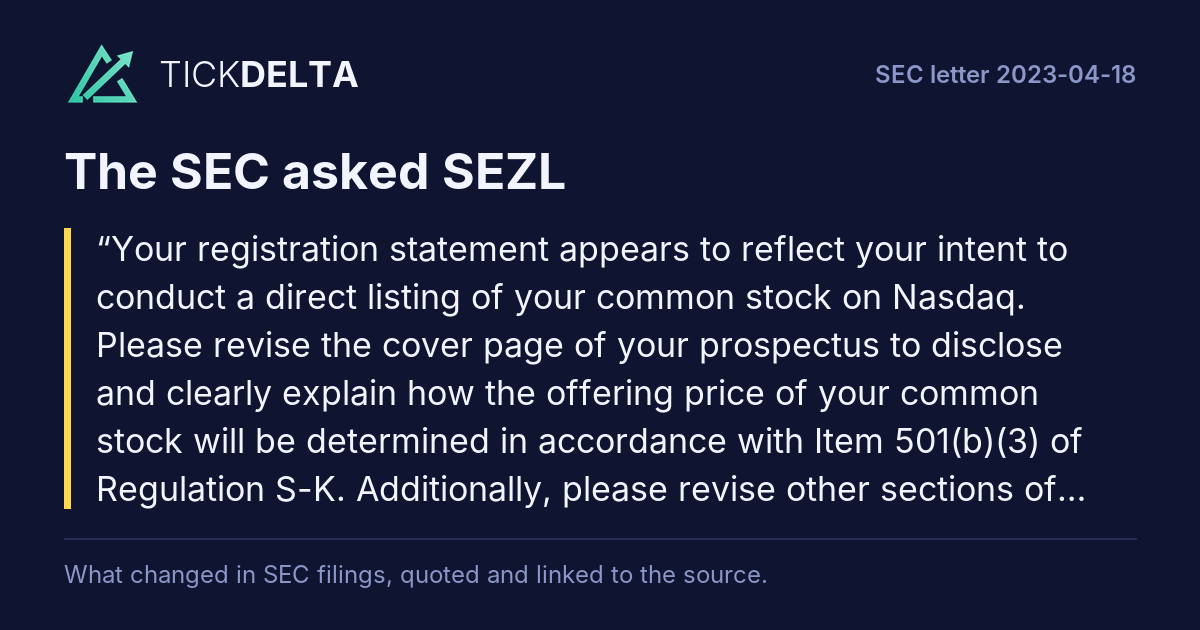
Your registration statement appears to reflect your intent to conduct a direct listing of your common stock on Nasdaq. Please revise the cover page of your prospectus to disclose and clearly explain how the offering price of your common stock will be determined in accordance with Item 501(b)(3) of Regulation S-K.
Rest of the question

Additionally, please revise other sections of the prospectus, such as Risk Factors and Plan of Distribution, to include this disclosure. Last, please clearly state that the sales price in recent private transactions may have little or no relation to the public offering price of your shares.

SEZL answered
The Company is not conducting a “direct listing” as defined in Nasdaq Listing Rule IM-5315-1, or a “direct listing with a capital raise” as defined in Nasdaq Listing Rule

IM-5315-2. Nasdaq Listing Rule IM-5315-1, Determination of Price-Based Requirements for Direct Listings on the Nasdaq Global Select

Market, defines a “direct listing” as a listing on the Nasdaq Global Market by a company that “has sold common equity securities in private placements, which have not been listed on a national securities exchange or traded in the over-the-counter market pursuant to FINRA Form 211 immediately
Rest of the answer

prior to the initial pricing. Similarly, Nasdaq Listing Rule IM-5315-2, Determination of Price-Based

Requirements for Direct Listings with a Capital Raise, states that “in certain cases, a Company that has not previously had its common equity securities registered under the Exchange Act may wish to list its common equity securities on the Exchange at the time of effectiveness of a registration statement pursuant to which the Company will sell shares itself in the opening auction on the first day of trading on the Exchange in addition to or instead of facilitating sales by selling shareholders. Any such listing is referred to as a “Direct Listing with a Capital Raise” where either: (i) only the Company itself is selling shares in the opening auction on the first day of trading; or (ii) the Company is selling shares and selling shareholders may also sell shares in such opening auction.

A company that seeks a direct listing has sold common stock in private placements, has not had its common stock traded on a national securities exchange or the OTC markets, and is not subject to the

Exchange Act. Sezzle, by contrast, has completed an initial public offering in Australia (via a Regulation S exemption from the registration requirements of the Securities Act of 1933, as amended) and its common stock (via CDIs) has been traded on the ASX since July 30, 2019.

The Company’s common stock is also traded on the OTC Pink Sheet Market. Finally, Sezzle is subject to the reporting requirements of the Securities Exchange Act of 1934, as amended, and has been reporting pursuant to such Act since it filed a Form 10 Registration

Statement on April 13, 2021.

Accordingly, Nasdaq Listing Rule IM-5315-1 does not apply, and

Nasdaq has confirmed that the Company is seeking to conduct an uplisting to the Nasdaq Capital Market, rather than a direct listing. The

Amendment changes the tier for which the Company is seeking to uplist to the Nasdaq Capital Market.

The Amendment updates the cover page of the prospectus to explain how the offering price of the Company’s common stock may be determined in accordance with Instruction 2 to Item 501(b)(3) Regulation

S-K, and provides that sales prices of shares in recent private transactions may have little or no relation to the public offering price of the shares. Further, other sections of the prospectus, such as Risk Factors and Plan of Distribution, have been updated as appropriate to respond to the comments set forth elsewhere in the Comment Letter, but do not include disclosures typically included in a direct listing offering, as such disclosures are not applicable to the offering contemplated by the Amendment.

Read in the reply
Registration Statement on Form S-1 filed March 22, 2023 · Cover Page
SEC asked (2)
We note your statement that "[t]here can be no guarantee that we will successfully list our common stock on the Nasdaq Global Market." Please include disclosure as to whether this offering is conditioned upon the listing of your common stock on the Nasdaq Global Market.
SEZL answered
This offering is not conditioned upon the listing of our common stock on the Nasdaq Global Market, and we have revised the prospectus included in the Amendment accordingly.
Read in the reply
Risk Factors, page 17
SEC asked (3)
Please include additional risk factor disclosure discussing how your direct listing differs from a traditional underwritten initial public offering, including the kinds of safeguards associated with a firm commitment underwritten offering that will not be present in connection with your direct listing, possibly resulting in trading price and volume uncertainty.
Rest of the question

Also discuss the applicable Nasdaq rules regarding listing requirements and ongoing compliance.

SEZL answered
As noted above, the Company intends to effectuate an uplisting, and not direct listing, of its common stock. The Amendment includes disclosures discussing how the Company’s uplisting differs from a traditional underwritten initial public offering. We have also discussed the applicable Nasdaq rules regarding listing requirements and ongoing compliance.
Read in the reply
Principal and Registered Stockholders, page 85
SEC asked (4)
We note your statement in the third paragraph of this section beginning with "Because the Registered Stockholders may sell all, some, or none of the shares of our common stock covered by this prospectus..." Please revise your disclosure to clearly state that Registered Stockholders may elect to sell their shares in connection with the direct listing and in market transactions following the direct listing.
Rest of the question

Additionally, please revise your disclosure to identify the number of shares that may be freely sold by the Registered Stockholders in reliance on an exemption from registration such as Rule 144.

SEZL answered
We have revised our disclosure to state that Registered Stockholders may elect to sell their shares in connection with the uplisting and market transactions following the listing. The prospectus also discloses that the Registered Stockholders are eligible to sell 3,015,924 shares of common stock under Rule 144, subject to compliance with such

Rule, and directs investors to review the “Shares Eligible for Future Sale” section of the prospectus for further information.
Read in the reply
Plan of Distribution, page 154
SEC asked (5)
We note that you intend to list your common stock on the Nasdaq. Please revise your disclosure in your Plan of Distribution section to discuss, as applicable, the role of the Nasdaq as the exchange in the offering (e.g., its consultations with any financial advisors in accordance with Nasdaq's listing rules, as well as the lack of involvement of the company).
SEZL answered
As this offering is occurring in connection with an uplisting of the Company’s common stock, there have been no financial advisors engaged by the Company, and Nasdaq’s role in the offering does not include efforts typically required in a direct listing scenario.

We trust that the foregoing has been responsive to the Staff’s comments.
Read in the reply
Cover Page
SEC asked (1)
We note your response to comment 1. Please revise the cover page of your prospectus to disclose and clearly explain how the offering price of your common stock will be determined in accordance with Item 501(b)(3) of Regulation S-K, including, specifically, Instruction 2. If your intent is to offer the securities at a price associated with the ASX, please tell us why you are permitted to do so.
Rest of the question

Additionally, to the extent appropriate, revise other sections of the prospectus, such as Risk Factors and Plan of Distribution, to include this and other relevant disclosure. Last, please revise the cover page to state that the sales of shares in recent private transactions or on the ASX may have little or no relation to the public offering price of the shares.

SEZL answered
As requested, the Amendment updates the cover page and page 39 [risk factors] of the prospectus to state that “the sales of common stock in recent private transactions or on the ASX may have little or no relation to the price at which the Registered Stockholders may sell their shares pursuant to this prospectus.”

The prospectus relates solely to a resale registration statement in which the Registered Stockholders may, from time to time, sell the common stock covered by the prospectus in the manner described in the section of the prospectus titled “Plan of Distribution.” Consistent with
Rest of the answer

Instruction 2 to Item

501(b)(3) of Regulation S-K, (i) the prospectus states that “[t]he Registered Stockholders or their pledgees, assignees or successors-in-interest may offer and sell or otherwise dispose of the shares of common stock described in [the] prospectus from time to time through public or private transactions at prevailing market prices, at prices related to prevailing market prices or at privately negotiated prices,” and (ii) the cover page of the prospectus includes a cross-reference to the Plan of Distribution section of the prospectus, which includes the page number of the prospectus (page 107) and is highlighted by prominent bold font.

The foregoing disclosures are consistent with the disclosures included in resale prospectuses filed by other issuers with the Commission, including those issuers that updated their prospectuses in response to a similar comment from the Commission.

Read in the reply
Cover Page
SEC asked (2)
We note that this offering "is not conditioned upon [y]our successful listing on the Nasdaq Capital Market." Please tell us how you will revise the registration statement if you are not listed on the Nasdaq Capital Market, including whether the method by which you will determine the offering price will change.
SEZL answered
The cover page of the prospectus states that the Company expects that within five business days of the date of the prospectus, the Company’s common stock will begin trading on the Nasdaq Capital Market. Although that remains the Company’s current intention, the effectiveness of the prospectus is not conditioned on the Company being listed on the Nasdaq Capital Market, as is stated on the cover page of the prospectus, and page 38 of the “Risk Factors” section of the prospectus.
Rest of the answer

In the event that listing on the Nasdaq Capital Market does not occur and the

Company determines to cease pursuing such listing, it is the Company’s intention to file a prospectus supplement stating that the

Company has abandoned its plan to list on the Nasdaq Capital Market.

We trust that the foregoing has been responsive to the Staff’s comments. The Company is seeking effectiveness of the prospectus as promptly as possible. If there is anything that the Company can do to expedite the Staff’s review, please contact me at (612) 877-8538 or [email protected].

Read in the reply

Letters without questions

Other letters

UPLOAD and CORRESP
3 other letters: notices that a filing will not be reviewed, requests to declare a registration effective, and the like

From the SEC's correspondence on EDGAR: staff letters (form UPLOAD) and company letters (form CORRESP), 12 letters filed since 2023-04-18. Questions and answers are matched by their numbers; topics come from words in each question. The reports are compared word for word (same form, before the first SEC letter against the first report after the company's reply). No AI.

Sources

The SEC's correspondence on EDGAR: staff letters (form UPLOAD) and company letters (form CORRESP), matched question by question. No AI.

Also

Filings: the letters in the filing list.

Work with it

Excel workbook · CSV. Google Sheet that stays up to date: paste =IMPORTDATA("https://tickdelta.com/company/SEZL/export.csv") into a cell.

Next in Owners and insiders:Insider trades
Esc

Type a ticker such as AAPL, a name, an investor such as Buffett, or a topic such as tariffs. ↑ ↓ to move, Enter to open.