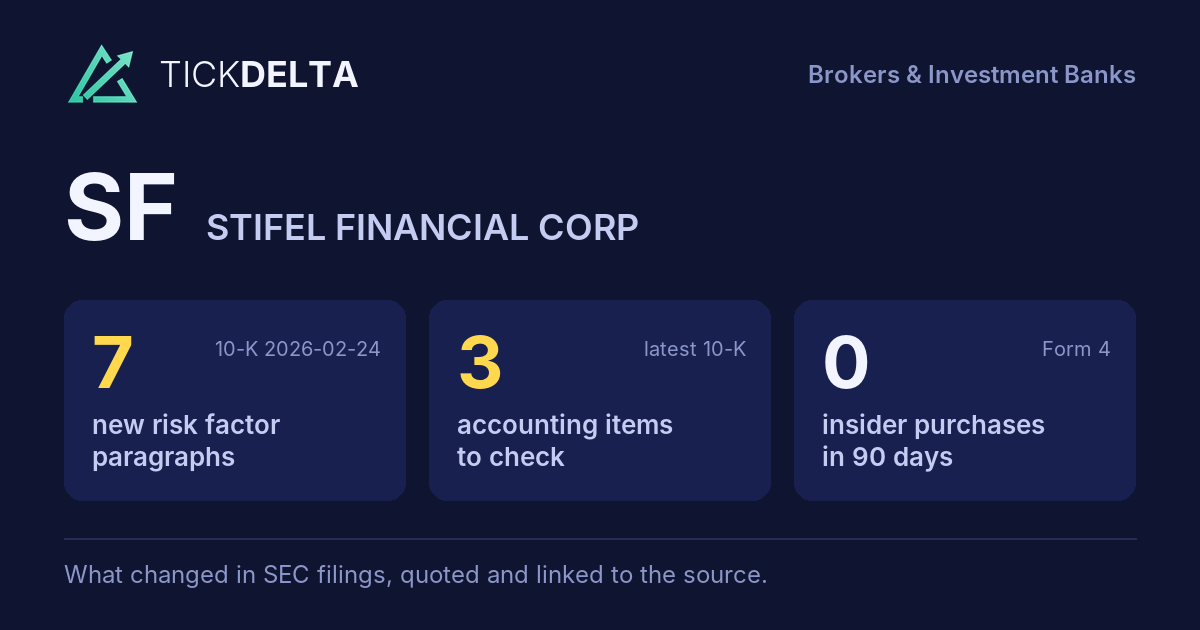
Paragraph 15 · 50% changed
Every version of it
Screener
/
SEC EDGAR
/CIK 0000720672
/10-K filed Feb 24, 2026, compared with Feb 26, 2025
/Numbers from the XBRL of the 10-Ks
NYSE
Financials · Brokers & Investment Banks
Stifel Financial Corp SF
The 10-K against last year's
230 changes: 27 added, 37 removed, 164 reworded, 2 quiet changes
10-K Feb 24, 2026 vs Feb 26, 2025
Risk Factors
16.9%
of the text changed · 12,390 words now · 7 new paragraphs, 2 gone
MD&A
22.4%
of the text changed · 16,168 words now · 20 new paragraphs, 35 gone
Legal Proceedings
76.9%
of the text changed · 1,431 words now
Accounting Policies
17.2%
of the text changed · 7,281 words now
10-K 0001193125-26-067130 (Feb 24, 2026) vs 10-K 0000950170-25-027702 (Feb 26, 2025)
Every paragraph, and how much of it changed
One bar per paragraph, in the order of the 10-K. Height and colour show the share of its words not in the closest paragraph a year earlier; the tallest bars are new paragraphs.
Risk Factors
91 paragraphs · 7 new · 41 reworded · 2 gone · 10-K Feb 24, 2026 against Feb 26, 2025
New paragraph
Reworded (5% of its words or more)
Same or nearly
Paragraph 54 · 44% changed
Every version of it
Paragraph 5 · 43% changed
Every version of it
We rely heavily on bank deposits as a low-cost source of funding for Stifel Bancorp to extend loans to clients and purchase investment securities. Our bank deposits are primarily driven by our multi-bank sweep program in which clients’ cash deposits in their brokerage accounts are swept into FDIC-insured interest-bearing accounts at our bank subsidiaries and various third-party banks. A significant reduction in our domestic clients’ cash balances, a change in the allocation of that cash between our bank subsidiaries and third-party banks, a movement of cash away from our company, or an inability to implement new or modified deposit offerings in order to retain or grow our client base, could significantly impact our ability to continue growing interest-earning assets and/or require us to use higher-cost deposit sources to grow interest-earning assets. Rapidly rising rates, for example, have made and may continue to make investments in securities, such as fixed income securities and money market funds, more attractive for investors, thereby incentivizing them to reduce the cash they hold. During 2025, we
Paragraph 48 · 41% changed
Every version of it
Cyber attacks can originate from a variety of sources, including threat actors affiliated with foreign governments, organized crime, or terrorist organizations. Threat actors may also attempt to place individuals within our company or induce associates, clients, or other users of our systems to disclose sensitive information or provide access to our data, and these types of risks may be difficult to detect or prevent. Although cybersecurity Cybersecurity incidents among financial services firms are on the rise, we have not experienced any material losses relating to cyber attacks or other information security breaches. However, and the techniques used in these attacks are increasingly sophisticated, change frequently frequently, and are often not recognized until launched. Although To date, we seek have not experienced any cybersecurity incidents that we have determined to maintain a robust suite of layered information security controls, including our cyber threat analytics, data encryption, and monitoring technologies, anti-malware defenses, and vulnerability management programs, any one or combination of these controls could fail to detect, mitigate, or remediate these risks in a timely manner. Despite our implementation of protective measures and endeavoring to modify them as circumstances warrant, our computer systems, software, and networks may be vulnerable to human error, equipment failure, natural disasters, power loss, unauthorized access, supply chain attacks, distributed denial of service attacks, zero-day vulnerabilities, computer viruses and other malicious code, and other events that could result in significant liability and damage material to our reputation, and have an ongoing impact on the security and stability business, financial condition, or results of our operations. In addition, although we maintain insurance coverage that may, subject to terms and conditions, cover certain aspects of cyber and information security risks, such insurance coverage may be insufficient to cover all losses, such as litigation costs or financial losses that exceed our policy limits or are not covered under any of our current insurance policies.
Paragraph 53 · 40% changed
Every version of it
We may also be subject to liability under various data protection and privacy laws. In providing services to clients, we manage, utilize, collect, use, store, and store transmit sensitive or confidential client or and associate data, information, including personal data. As a result, we data, and are subject to numerous laws and regulations designed to protect this information, such as an evolving matrix of U.S. federal, state, and international privacy and data-protection laws governing and regulations, including, where applicable, the protection of personally identifiable information. Gramm-Leach-Bliley Act (GLBA), the EU General Data Protection Regulation (GDPR), and state consumer privacy laws such as the CCPA/CPRA. These laws and regulations are increasing in complexity and number. may impose obligations related to data security, breach notification, cross-border data transfers, data subject rights, and recordkeeping. If any person, including any of our associates, an associate or a third-party service provider, negligently disregards or intentionally breaches our established controls with respect to client or associate data, or otherwise mismanages or misappropriates such data, we could be subject to incur significant monetary damages, regulatory enforcement actions, fines, and/or and criminal prosecution. In addition, unauthorized penalties. Unauthorized disclosure of sensitive or confidential client or associate data, whether through system failure, associate negligence, human error, fraud, or misappropriation, third-party compromise, could damage our reputation and reputation, cause us to lose loss of clients and related revenue. Potential liability in the event of a security breach of client data could be significant. revenue, and expose us to substantial liability. Depending on the circumstances giving rise to the a breach, this liability may not be subject to a contractual limit limits or an exclusion of exclusions for consequential or indirect damages. Further, lapses Lapses in our cybersecurity or privacy controls, as perceived by or regulatory findings that our regulators, controls are inadequate, could lead to fines and penalties compounding fines, penalties, or other remediation obligations that would compound monetary losses. We maintain a privacy governance framework that includes a designated privacy lead, a documented data inventory and mapping process, privacy impact assessments for high-risk processing, technical controls, such as encryption and data-loss prevention, and contractual requirements for processors and other third parties to meet our security and privacy obligations. Our incident response and escalation procedures incorporate regulatory notification requirements and roles to support timely reporting and cooperation with regulators.
Paragraph 28 · 40% changed
Every version of it
Moreover, companies in our industry whose employees accept positions with competitors frequently claim that those competitors have engaged in unfair hiring practices. We have been subject to several such claims and may be subject to additional claims in the future as we seek to hire qualified personnel, some of whom may work for our competitors. Some of these claims may result in material litigation. We could incur substantial costs in defending against these claims, regardless of their merits. Such claims could also discourage potential employees who work for our competitors from joining us. We participate, with limited exceptions, in the Protocol for Broker Recruiting (“Protocol”), a voluntary agreement among many firms in the industry that governs, among other things, the client information that financial advisors may take with them when they affiliate with a new firm and the financial advisor’s ability to solicit clients of their previous firm. The ability to bring such client data to a new broker-dealer, as well as the ability to solicit clients, generally means that the clients of the financial advisor are more likely to choose to open accounts at the advisor’s new firm. Participation in the Protocol is voluntary, and it is possible that certain of our competitors will withdraw from it. If the broker-dealers from whom we recruit new financial advisors prevent, or significantly limit, the transfer of client data and the solicitation of clients, our recruiting efforts may be adversely affected. Additionally, we could experience a larger number of claims against us relating to our recruiting efforts.
Paragraph 52 · 39% changed
Every version of it
Paragraph 66 · 38% changed
Every version of it
Paragraph 15 · 50% changed
Every version of it
10-K Feb 26, 2025We are exposed to credit risk. We are generally exposed to the risk that third parties that owe us money, securities, or other assets will fail to meet their obligations to us due to numerous causes, including bankruptcy, lack of liquidity, or operational failure, among others. Credit risk may also be affected by the deterioration of strength in the U.S. economy or adverse changes in the financial performance or condition of our clients and counterparties. We actively buy and sell securities from and to clients and counterparties in the normal course of our broker-dealers’ trading and underwriting activities, which exposes us to credit risk. Although generally collateralized by the underlying security to the transaction, we still face risk associated with changes in the market value of collateral through settlement date. We also hold certain securities, loans, and derivatives as part of our trading operations. Deterioration in the actual or perceived credit quality of the underlying issuers of securities or loans, or the non-performance of counterparties to certain derivative contracts could result in losses.
10-K Feb 24, 2026
date. We also hold certain securities, loans, and derivatives as part of our trading operations. Deterioration in the actual or perceived credit quality of the underlying issuers of securities or loans, or the non-performance of counterparties to certain derivative contracts could result in losses.
Paragraph 54 · 44% changed
Every version of it
10-K Feb 26, 2025Additionally, we may integrate AI into our operations, technology, products, and services in the future. AI models may produce output or take action that is incorrect, infringe on the intellectual property rights of others, or is otherwise harmful. In addition, the complexity of AI models may make it challenging to understand why they generate particular outputs. There can be no assurance that any products or services that utilize AI will be successful or that we will keep pace with the rapid evolution of AI. Further, while we have policies governing the use of AI by our associates and third-party service providers, we cannot guarantee that they will follow such policies when using AI or that such policies will protect us from potential liability relating to our adoption or use of AI technologies. Additionally, others may use AI to increase the frequency and severity of cybersecurity attacks against us or our third-party service providers, which could adversely impact our business and results of operations.
10-K Feb 24, 2026
The development and use of AI present risks and challenges that could adversely impact our business, financial condition, and results of operations. We, and our third-party service providers, may develop or incorporate AI technology in certain business processes, products, or services. AI-based technology may produce output that is incorrect, biased, infringes on the intellectual property rights of others, or is otherwise harmful; the complexity of AI can make it challenging to explain why particular outputs occur. In addition, others may use AI to increase the frequency or severity of cybersecurity attacks against us or our service providers, which could adversely affect our business and results of operations.
Paragraph 5 · 43% changed
Every version of it
10-K Feb 26, 2025
We rely heavily on bank deposits as a low-cost source of funding for Stifel Bancorp to extend loans to clients and purchase investment securities. Our bank deposits are primarily driven by our multi-bank sweep program in which clients’ cash deposits in their brokerage accounts are swept into FDIC-insured interest-bearing accounts at our bank subsidiaries and various third-party banks. A significant reduction in our domestic clients’ cash balances, a change in the allocation of that cash between our bank subsidiaries and third-party banks, a movement of cash away from our company, or an inability to implement new or modified deposit offerings in order to retain or grow our client base, could significantly impact our ability to continue growing interest-earning assets and/or require us to use higher-cost deposit sources to grow interest-earning assets. Rapidly rising rates, for example, have made and may continue to make investments in securities, such as fixed income securities and money market funds, more attractive for investors, thereby incentivizing them to reduce the cash they hold.
10-K Feb 24, 2026
We rely heavily on bank deposits as a low-cost source of funding for Stifel Bancorp to extend loans to clients and purchase investment securities. Our bank deposits are primarily driven by our multi-bank sweep program in which clients’ cash deposits in their brokerage accounts are swept into FDIC-insured interest-bearing accounts at our bank subsidiaries and various third-party banks. During 2025, we
Paragraph 48 · 41% changed
Every version of it
10-K Feb 26, 2025
Cyber attacks can originate from a variety of sources, including threat actors affiliated with foreign governments, organized crime, or terrorist organizations. Threat actors may also attempt to place individuals within our company or induce associates, clients, or other users of our systems to disclose sensitive information or provide access to our data, and these types of risks may be difficult to detect or prevent. Although cybersecurity incidents among financial services firms are on the rise, we have not experienced any material losses relating to cyber attacks or other information security breaches. However, the techniques used in these attacks are increasingly sophisticated, change frequently and are often not recognized until launched. Although we seek to maintain a robust suite of layered information security controls, including our cyber threat analytics, data encryption, and monitoring technologies, anti-malware defenses, and vulnerability management programs, any one or combination of these controls could fail to detect, mitigate, or remediate these risks in a timely manner. Despite our implementation of protective measures and endeavoring to modify them as circumstances warrant, our computer systems, software, and networks may be vulnerable to human error, equipment failure, natural disasters, power loss, unauthorized access, supply chain attacks, distributed denial of service attacks, zero-day vulnerabilities, computer viruses and other malicious code, and other events that could result in significant liability and damage to our reputation, and have an ongoing impact on the security and stability of our operations. In addition, although we maintain insurance coverage that may, subject to terms and conditions, cover certain aspects of cyber and information security risks, such insurance coverage may be insufficient to cover all losses, such as litigation costs or financial losses that exceed our policy limits or are not covered under any of our current insurance policies.
10-K Feb 24, 2026
Cyber attacks can originate from a variety of sources, including threat actors affiliated with foreign governments, organized crime, or terrorist organizations. Threat actors may also attempt to place individuals within our company or induce associates, clients, or other users of our systems to disclose sensitive information or provide access to our data, and these types of risks may be difficult to detect or prevent. Cybersecurity incidents among financial services firms are on the rise, and the techniques used in these attacks are increasingly sophisticated, change frequently, and are often not recognized until launched. To date, we have not experienced any cybersecurity incidents that we have determined to be material to our business, financial condition, or results of operations.
Paragraph 53 · 40% changed
Every version of it
10-K Feb 26, 2025
We may also be subject to liability under various data protection laws. In providing services to clients, we manage, utilize, and store sensitive or confidential client or associate data, including personal data. As a result, we are subject to numerous laws and regulations designed to protect this information, such as U.S. federal, state, and international laws governing the protection of personally identifiable information. These laws and regulations are increasing in complexity and number. If any person, including any of our associates, negligently disregards or intentionally breaches our established controls with respect to client or associate data, or otherwise mismanages or misappropriates such data, we could be subject to significant monetary damages, regulatory enforcement actions, fines, and/or criminal prosecution. In addition, unauthorized disclosure of sensitive or confidential client or associate data, whether through system failure, associate negligence, fraud, or misappropriation, could damage our reputation and cause us to lose clients and related revenue. Potential liability in the event of a security breach of client data could be significant. Depending on the circumstances giving rise to the breach, this liability may not be subject to a contractual limit or an exclusion of consequential or indirect damages. Further, lapses in cybersecurity controls, as perceived by our regulators, could lead to fines and penalties compounding monetary losses.
10-K Feb 24, 2026
We may be subject to liability under various data protection and privacy laws. In providing services to clients, we collect, use, store, and transmit sensitive client and associate information, including personal data, and are subject to an evolving matrix of U.S. federal, state, and international privacy and data-protection laws and regulations, including, where applicable, the Gramm-Leach-Bliley Act (GLBA), the EU General Data Protection Regulation (GDPR), and state consumer privacy laws such as the CCPA/CPRA. These laws and regulations are increasing in complexity and may impose obligations related to data security, breach notification, cross-border data transfers, data subject rights, and recordkeeping. If any person, including an associate or a third-party service provider, negligently disregards or intentionally breaches our controls or otherwise mismanages or misappropriates such data, we could incur significant monetary damages, regulatory enforcement actions, fines, and criminal penalties. Unauthorized disclosure of sensitive or confidential client or associate data, whether through system failure, human error, fraud, or third-party compromise, could damage our reputation, cause loss of clients and related revenue, and expose us to substantial liability. Depending on the circumstances giving rise to a breach, this liability may not be subject to contractual limits or exclusions for consequential or indirect damages. Lapses in our cybersecurity or privacy controls, or regulatory findings that our controls are inadequate, could lead to fines, penalties, or other remediation obligations that would compound monetary losses. We maintain a privacy governance framework that includes a designated privacy lead, a documented data inventory and mapping process, privacy impact assessments for high-risk processing, technical controls, such as encryption and data-loss prevention, and contractual requirements for processors and other third parties to meet our security and privacy obligations. Our incident response and escalation procedures incorporate regulatory notification requirements and roles to support timely reporting and cooperation with regulators.
Paragraph 28 · 40% changed
Every version of it
10-K Feb 26, 2025
Moreover, companies in our industry whose employees accept positions with competitors frequently claim that those competitors have engaged in unfair hiring practices. We have been subject to several such claims and may be subject to additional claims in the future as we seek to hire qualified personnel, some of whom may work for our competitors. Some of these claims may result in material litigation. We could incur substantial costs in defending against these claims, regardless of their merits. Such claims could also discourage potential employees who work for our competitors from joining us. We participate, with limited exceptions, in the Protocol for Broker Recruiting (“Protocol”), a voluntary agreement among many firms in the industry that governs, among other things, the client information that financial advisors may take with them when they affiliate with a new firm and the financial advisor’s ability to solicit clients of their previous firm. The ability to bring such client data to a new broker-dealer, as well as the ability to solicit clients, generally means that the clients of the financial advisor are more likely to choose to open accounts at the advisor’s new firm. Participation in the Protocol is voluntary, and it is possible that certain of our competitors will withdraw from it. If the broker-dealers from whom we recruit new financial advisors prevent, or significantly limit, the transfer of client data and the solicitation of clients, our recruiting efforts may be adversely affected. Additionally, we could experience a larger number of claims against us relating to our recruiting efforts.
10-K Feb 24, 2026
Moreover, companies in our industry whose employees accept positions with competitors frequently claim that those competitors have engaged in unfair hiring practices. We have been subject to several such claims and may be subject to additional claims in the future as we seek to hire qualified personnel, some of whom may work for our competitors. Some of these claims may result in material litigation. We could incur substantial costs in defending against these claims, regardless of their merits. Such claims could also discourage potential
Paragraph 52 · 39% changed
Every version of it
10-K Feb 26, 2025Further, in light of the high volume of transactions we process, use of remote work, the large number of our clients, partners, and counterparties, and the increasing sophistication of malicious actors, a cyber attack could occur. Moreover, any such cyber attack may persist for an extended period of time without detection. We endeavor to design and implement policies and procedures to identify such cyber attacks as quickly as possible; however, we expect that any investigation of a cyber attack would take substantial amounts of time, and that there may be extensive delays before we obtain full and reliable information. During such time, we would not necessarily know the extent of the harm or how best to remediate it, and certain errors or actions could be repeated or compounded before they are discovered and remediated, all of which would further increase the costs and consequences of such an attack.
10-K Feb 24, 2026
Given our high transaction volumes, remote-work environment, and the large number of clients, partners, and counterparties we serve, a cyber attack could occur. Such an attack may persist for an extended period without detection. Investigations can require substantial time and resources, and there may be significant delays before we obtain complete and reliable information. During an extended investigation, we may not know the full extent of the harm or the optimal remediation path, and certain errors or malicious actions could be repeated or compounded before they are identified and remediated, which could significantly increase the costs and consequences of such an attack. Our Security Operations Center is designed to contain attacks and to support incident investigation and remediation, but notwithstanding these capabilities, detection or remediation may be delayed in some circumstances.
Paragraph 66 · 38% changed
Every version of it
10-K Feb 26, 2025Financial services firms are subject to numerous actual or perceived conflicts of interest, which are routinely examined by regulators and SROs such as FINRA and are often used as the basis for claims for legal liability by plaintiffs in actions against the Company. Our risk management processes include addressing potential conflicts of interest that arise in our business. Management of potential conflicts of interest has become increasingly complex as we expand our business activities. A perceived or actual failure to address conflicts of interest adequately could affect our reputation, the willingness of clients to transact business with us or give rise to litigation or regulatory actions. Therefore, there can be no assurance that conflicts of interest will not arise in the future that could result in material harm to our business and financial condition.
10-K Feb 24, 2026
conflicts of interest adequately could affect our reputation, the willingness of clients to transact business with us, or give rise to litigation or regulatory actions. Therefore, there can be no assurance that conflicts of interest will not arise in the future that could result in material harm to our business and financial condition.
MD&A
267 paragraphs · 20 new · 101 reworded · 35 gone · 10-K Feb 24, 2026 against Feb 26, 2025
New paragraph
Reworded (5% of its words or more)
Same or nearly
Paragraph 98 · 47% changed
Paragraph 255 · 41% changed
In our loss forecasting framework, we incorporate forward-looking information using macroeconomic forecast scenarios applied over the forecasted life of the assets. reasonable and supportable forecast period. These macroeconomic scenarios include variables that have historically been key drivers of increases and decreases in credit losses. These variables include, but are not limited to, unemployment rates, real estate prices, gross domestic product levels, corporate bond spreads, and long-term interest rate forecasts. To estimate losses Our macroeconomic forecast is obtained from a third-party vendor and based on a probability weighting over multiple scenarios. A two-year reasonable and supportable forecast period is used for contractual periods the construction and land and commercial real estate loan portfolios followed by a one-year straight line reversion period to long-run PD and LGD values. For commercial and industrial, residential real estate, and home equity lines of credit portfolios, we incorporate a reasonable and supportable forecast of various macroeconomic variables over the remaining life of the assets, including an assumption that extend beyond each macroeconomic variable will revert to a long-term expectation starting in years two to four of the forecast horizon, we revert to an average historical loss experience. As any one economic outlook is inherently uncertain, we leverage multiple scenarios. The scenarios that are chosen each quarter and largely completing within the amount first five years of weighting given to each scenario depend on a variety of factors, including recent economic events, leading economic indicators, and industry trends. The reserve for unfunded lending commitments is estimated using the same scenarios, models, and economic data as the loan portfolio. forecast.
Paragraph 267 · 40% changed
Paragraph 232 · 36% changed
Paragraph 256 · 36% changed
Paragraph 36 · 32% changed
Other income – For the year ended December 31, 2023, 2025, other income decreased 55.6% 21.3% to $8.7 $33.9 million from $19.7 $43.1 million in 2022. during 2024. The decrease is primarily attributable to losses on reduced lease income generated from our aircraft engine leasing business due to the sale of investments in the first quarter of 2023 engines, lower investment gains, and a decrease in mortgage loan origination fees. fees from the comparable period in 2024.
Paragraph 235 · 32% changed
The following table summarizes the activity related to our company’s note receivable loans and advances to financial advisors and other employees, net from January 1, 2023 2024 to December 31, 2024 2025 (in thousands):
Paragraph 141 · 31% changed
Other income – For the year ended December 31, 2023, 2025, other income decreased 55.6% 38.4% to $8.7 $19.5 million from $19.7 $31.7 million in 2022. 2024. The decrease is primarily attributable to losses on reduced lease income generated from our aircraft engine leasing business due to the sale of investments in the first quarter of 2023 and a decrease in loan origination fees. engines.
Paragraph 98 · 47% changed
10-K Feb 26, 2025The following table presents the Company’s credit ratios, as well as the component of the ratio’s calculation, for the periods indicated (in thousands, except percentages):
10-K Feb 24, 2026
Client asset metrics as of the periods indicated (in thousands, except for number of accounts):
Paragraph 255 · 41% changed
10-K Feb 26, 2025
In our loss forecasting framework, we incorporate forward-looking information using macroeconomic scenarios applied over the forecasted life of the assets. These macroeconomic scenarios include variables that have historically been key drivers of increases and decreases in credit losses. These variables include, but are not limited to, unemployment rates, real estate prices, gross domestic product levels, corporate bond spreads, and long-term interest rate forecasts. To estimate losses for contractual periods that extend beyond the forecast horizon, we revert to an average historical loss experience. As any one economic outlook is inherently uncertain, we leverage multiple scenarios. The scenarios that are chosen each quarter and the amount of weighting given to each scenario depend on a variety of factors, including recent economic events, leading economic indicators, and industry trends. The reserve for unfunded lending commitments is estimated using the same scenarios, models, and economic data as the loan portfolio.
10-K Feb 24, 2026
In our loss forecasting framework, we incorporate forward-looking information using macroeconomic forecast scenarios applied over the reasonable and supportable forecast period. These macroeconomic scenarios include variables that have historically been key drivers of increases and decreases in credit losses. These variables include, but are not limited to, unemployment rates, real estate prices, gross domestic product levels, corporate bond spreads, and long-term interest rate forecasts. Our macroeconomic forecast is obtained from a third-party vendor and based on a probability weighting over multiple scenarios. A two-year reasonable and supportable forecast period is used for the construction and land and commercial real estate loan portfolios followed by a one-year straight line reversion period to long-run PD and LGD values. For commercial and industrial, residential real estate, and home equity lines of credit portfolios, we incorporate a reasonable and supportable forecast of various macroeconomic variables over the remaining life of the assets, including an assumption that each macroeconomic variable will revert to a long-term expectation starting in years two to four of the forecast and largely completing within the first five years of the forecast.
Paragraph 267 · 40% changed
10-K Feb 26, 2025It has been our practice historically to satisfy almost all tax withholding obligations on income associated with the grants by reducing the number of shares otherwise deliverable in connection with the awards. We anticipate that practice will continue, as recently our Compensation Committee made a determination to satisfy tax withholding obligations through the cancellation of shares subject to an award. In addition, the plan pursuant to which we issue restricted stock units and restricted stock awards permits us to elect to settle certain awards entirely in cash, and we may elect to do so as those awards vest and become deliverable.
10-K Feb 24, 2026
award. In addition, the plan pursuant to which we issue restricted stock units and restricted stock awards permits us to elect to settle certain awards entirely in cash, and we may elect to do so as those awards vest and become deliverable.
Paragraph 232 · 36% changed
10-K Feb 26, 2025The Company’s Board of Directors approved a 10% increase in the quarterly dividend to $0.46 per common share starting in the first quarter of 2025.
10-K Feb 24, 2026
During the year ended December 31, 2025, we declared and paid cash dividends of $249.0 million to shareholders. On January 26, 2026, the Board of Directors approved an 11% increase in the quarterly dividend to $0.51 per common share starting in the first quarter of 2026. On a split-adjusted basis, the quarterly dividend will be $0.34 per common share or $1.36 per common share on an annual basis.
Paragraph 256 · 36% changed
10-K Feb 26, 2025In our loss forecasting framework, we incorporate forward-looking information using macroeconomic scenarios applied over the forecasted life of the assets. These macroeconomic scenarios include variables that have historically been key drivers of increases and decreases in credit losses. These variables include, but are not limited to, unemployment rates, real estate prices, gross domestic product levels, corporate bond spreads, and long-term interest rate forecasts. To estimate losses for contractual periods that extend beyond the forecast horizon, we revert to an average historical loss experience. As any one economic outlook is inherently uncertain, we leverage multiple scenarios. The scenarios that are chosen each quarter and the amount of weighting given to each scenario depend on a variety of factors, including recent economic events, leading economic indicators, and industry trends. The reserve for unfunded lending commitments is estimated using the same scenarios, models, and economic data as the loan portfolio.
10-K Feb 24, 2026
As any one macroeconomic outlook is inherently uncertain, we leverage multiple scenarios. The scenarios that are chosen each quarter and the amount of weighting given to each scenario depend on a variety of factors, including recent economic events, leading economic indicators, and industry trends. The reserve for unfunded lending commitments is estimated using the same scenarios, models, and economic data as the loan portfolio.
Paragraph 36 · 32% changed
10-K Feb 26, 2025
Other income – For the year ended December 31, 2023, other income decreased 55.6% to $8.7 million from $19.7 million in 2022. The decrease is primarily attributable to losses on the sale of investments in the first quarter of 2023 and a decrease in loan origination fees.
10-K Feb 24, 2026
Other income – For the year ended December 31, 2025, other income decreased 21.3% to $33.9 million from $43.1 million during 2024. The decrease is primarily attributable to reduced lease income generated from our aircraft engine leasing business due to the sale of engines, lower investment gains, and a decrease in mortgage loan origination fees from the comparable period in 2024.
Paragraph 235 · 32% changed
10-K Feb 26, 2025
The following table summarizes the activity related to our company’s note receivable from January 1, 2023 to December 31, 2024 (in thousands):
10-K Feb 24, 2026
The following table summarizes the activity related to loans and advances to financial advisors and other employees, net from January 1, 2024 to December 31, 2025 (in thousands):
Paragraph 141 · 31% changed
10-K Feb 26, 2025
Other income – For the year ended December 31, 2023, other income decreased 55.6% to $8.7 million from $19.7 million in 2022. The decrease is primarily attributable to losses on the sale of investments in the first quarter of 2023 and a decrease in loan origination fees.
10-K Feb 24, 2026
Other income – For the year ended December 31, 2025, other income decreased 38.4% to $19.5 million from $31.7 million in 2024. The decrease is primarily attributable to reduced lease income generated from our aircraft engine leasing business due to the sale of engines.
A paragraph is matched with the one last year that shares the most of its words; under half in common makes it new. The paragraphs shown are the 8 reworded the most in each section.
The paragraph that changed most in each section
The redline
Marked against last year's 10-K: cut words struck through, new words highlighted.
Risk Factors261 words changed in this paragraph; it is 49% similar to last year's version.
We may also be subject to liability under various data protection and privacy laws. In providing services to clients, we manage, utilize, collect, use, store, and store transmit sensitive or confidential client or and associate data, information, including personal data. As a result, we data, and are subject to numerous laws and regulations designed to protect this information, such as an evolving matrix of U.S. federal, state, and international privacy and data-protection laws governing and regulations, including, where applicable, the protection of personally identifiable information. Gramm-Leach-Bliley Act (GLBA), the EU General Data Protection Regulation (GDPR), and state consumer privacy laws such as the CCPA/CPRA. These laws and regulations are increasing in complexity and number. may impose obligations related to data security, breach notification, cross-border data transfers, data subject rights, and recordkeeping. If any person, including any of our associates, an associate or a third-party service provider, negligently disregards or intentionally breaches our established controls with respect to client or associate data, or otherwise mismanages or misappropriates such data, we could be subject to incur significant monetary damages, regulatory enforcement actions, fines, and/or and criminal prosecution. In addition, unauthorized penalties. Unauthorized disclosure of sensitive or confidential client or associate data, whether through system failure, associate negligence, human error, fraud, or misappropriation, third-party compromise, could damage our reputation and reputation, cause us to lose loss of clients and related revenue. Potential liability in the event of a security breach of client data could be significant. revenue, and expose us to substantial liability. Depending on the circumstances giving rise to the a breach, this liability may not be subject to a contractual limit limits or an exclusion of exclusions for consequential or indirect damages. Further, lapses Lapses in our cybersecurity or privacy controls, as perceived by or regulatory findings that our regulators, controls are inadequate, could lead to fines and penalties compounding fines, penalties, or other remediation obligations that would compound monetary losses. We maintain a privacy governance framework that includes a designated privacy lead, a documented data inventory and mapping process, privacy impact assessments for high-risk processing, technical controls, such as encryption and data-loss prevention, and contractual requirements for processors and other third parties to meet our security and privacy obligations. Our incident response and escalation procedures incorporate regulatory notification requirements and roles to support timely reporting and cooperation with regulators.
Source: Item 1A, 10-K 0001193125-26-067130 vs Item 1A, 10-K 0000950170-25-027702
MD&A198 words changed in this paragraph; it is 40% similar to last year's version.
In our loss forecasting framework, we incorporate forward-looking information using macroeconomic forecast scenarios applied over the forecasted life of the assets. reasonable and supportable forecast period. These macroeconomic scenarios include variables that have historically been key drivers of increases and decreases in credit losses. These variables include, but are not limited to, unemployment rates, real estate prices, gross domestic product levels, corporate bond spreads, and long-term interest rate forecasts. To estimate losses Our macroeconomic forecast is obtained from a third-party vendor and based on a probability weighting over multiple scenarios. A two-year reasonable and supportable forecast period is used for contractual periods the construction and land and commercial real estate loan portfolios followed by a one-year straight line reversion period to long-run PD and LGD values. For commercial and industrial, residential real estate, and home equity lines of credit portfolios, we incorporate a reasonable and supportable forecast of various macroeconomic variables over the remaining life of the assets, including an assumption that extend beyond each macroeconomic variable will revert to a long-term expectation starting in years two to four of the forecast horizon, we revert to an average historical loss experience. As any one economic outlook is inherently uncertain, we leverage multiple scenarios. The scenarios that are chosen each quarter and largely completing within the amount first five years of weighting given to each scenario depend on a variety of factors, including recent economic events, leading economic indicators, and industry trends. The reserve for unfunded lending commitments is estimated using the same scenarios, models, and economic data as the loan portfolio. forecast.
Source: Item 7, 10-K 0001193125-26-067130 vs Item 7, 10-K 0000950170-25-027702
Legal Proceedings185 words changed in this paragraph; it is 34% similar to last year's version.
Source: Item 3, 10-K 0001193125-26-067130 vs Item 3, 10-K 0000950170-25-027702
Accounting Policies148 words changed in this paragraph; it is 46% similar to last year's version.
In our loss forecasting framework, we incorporate forward-looking information using macroeconomic forecast scenarios applied over the forecasted life of the assets. reasonable and supportable forecast period. These macroeconomic scenarios include variables that have historically been key drivers of increases and decreases in credit losses. These variables include, but are not limited to, unemployment rates, real estate prices, gross domestic product levels, corporate bond spreads, and long-term interest rate forecasts. To estimate losses Our macroeconomic forecast is obtained from a third-party vendor and based on a probability weighting over multiple scenarios. A two-year reasonable and supportable forecast period is used for contractual periods the construction and land and commercial real estate loan portfolios, followed by a one-year straight line reversion period to long-run PD and LGD values. For commercial and industrial, residential real estate, and home equity lines of credit portfolios, we incorporate a reasonable and supportable forecast of various macroeconomic variables over the remaining life of the assets, including an assumption that extend beyond each macroeconomic variable will revert to a long-term expectation starting in years two to four of the forecast horizon, we revert to an average historical loss experience. As any one economic outlook is inherently uncertain, we leverage and largely completing within the first five years of the forecast.
Source: Item 8, Note 2 – Summary of Significant Accounting Policies, 10-K 0001193125-26-067130 vs Item 8, Note 2 – Summary of Significant Accounting Policies, 10-K 0000950170-25-027702
Sentences and paragraphs added, removed or reworded
Every change, by type
Sentences and paragraphs of SF's Risk Factors and MD&A, 10-K Feb 24, 2026 against 10-K Feb 26, 2025. Each links to the text at sec.gov.
Quiet changes are sentences kept from last year with one to four words changed, at least one of them a hedge, a modal or a qualifier (may, could, will, not, significant, material…). A year or date rolling forward is not counted.
The full word list
adverse, adversely, all, although, anticipate, anticipates, any, approximately, believe, believes, can, cannot, certain, could, expect, expects, generally, however, if, intend, intends, largely, likely, many, material, materially, may, might, most, must, never, no, not, possible, primarily, probable, should, significant, significantly, some, substantial, substantially, unlikely, will, would
AddedRisk Factors
including our interest expense on debt, lease expenses, and salary expenses, are fixed, and our ability to reduce them over short time periods is limited.
Read it in 10-K Feb 24, 2026 at sec.gov
AddedRisk Factors
We maintain a suite of layered information security controls, including cyber threat analytics, data encryption and monitoring technologies, anti-malware defenses, and vulnerability management programs. However, any one or combination of these controls could fail to detect, mitigate, or remediate these risks in a timely manner. Despite our implementation of protective measures and our efforts
Read it in 10-K Feb 24, 2026 at sec.gov
AddedRisk Factors
to modify them as circumstances warrant, our computer systems, software, and networks may remain vulnerable to human error, equipment failure, natural disasters, power loss, unauthorized access, supply-chain attacks, distributed denial-of-service (DDoS) attacks, zero-day vulnerabilities, computer viruses and other malicious code, and other events that could result in significant liability, reputational harm, and ongoing disruption to our operations. In addition, although we maintain cybersecurity insurance as one component of our broader risk-mitigation strategy, coverage is subject to policy terms, exclusions, and limits and may be insufficient to cover all losses, including litigation costs or losses that exceed policy limits or are otherwise excluded.
Read it in 10-K Feb 24, 2026 at sec.gov
AddedRisk Factors
We seek to maintain an AI risk management framework that provides a centralized inventory of AI technologies, risk-based classification, security guardrails, and operational requirements prior to deployment. These frameworks seek to include documented requirements for ongoing monitoring, technical and security controls for AI-enabled capabilities, access and privilege controls, and controls to protect the confidentiality, integrity, and availability of systems and data used to develop, deploy, and operate AI. The Written Information Security Program (“WISP”) incorporates AI governance and risk management and is subject to periodic independent assessment.
Read it in 10-K Feb 24, 2026 at sec.gov
AddedRisk Factors
For third-party AI technologies, we seek to require appropriate contractual and assurance measures, including data-handling obligations, intellectual property protections, explainability and validation rights, and incident-notification obligations. AI-related risks are evaluated within our broader cybersecurity, operational resilience, and vendor risk programs. The legal and regulatory environment for AI is evolving and could require changes to our use of AI, limiting our ability to integrate AI or increasing compliance costs. While we
Read it in 10-K Feb 24, 2026 at sec.gov
AddedRisk Factors
maintain policies and governance processes for AI, we cannot guarantee that they will be followed in all cases or that they will prevent all liability or harm arising from AI use.
Read it in 10-K Feb 24, 2026 at sec.gov
AddedRisk Factors
We are subject to risks relating to environmental, social, and governance matters that could adversely affect our reputation, business, financial condition, and results of operations.
Read it in 10-K Feb 24, 2026 at sec.gov
RemovedRisk Factors
Show the other 51
RemovedRisk Factors
RewordedRisk Factors
Macroeconomic conditions may also be negatively affected by domestic or international events, including natural disasters, political unrest, the indirect impact of wars and conflicts, such as the wars in Ukraine and Israel, or public health epidemics and pandemics, as well as by a number of several factors in the global financial markets that may be detrimental to our operating results, including trading levels, investing, and origination activity in the securities markets, security valuations, the absolute and relative level and volatility of interest and currency rates, real estate values, the actual and perceived quality of issuers and borrowers, and the supply of and demand for loans and deposits. results.
Read it in 10-K Feb 24, 2026 at sec.gov
RewordedRisk Factors
RewordedRisk Factors
RewordedRisk Factors
During such time, an extended investigation, we would may not necessarily know the full extent of the harm or how best to remediate it, the optimal remediation path, and certain errors or malicious actions could be repeated or compounded before they are discovered identified and remediated, all of which would further could significantly increase the costs and consequences of such an attack.
Read it in 10-K Feb 24, 2026 at sec.gov
RewordedRisk Factors
If any person, including any of our associates, an associate or a third-party service provider, negligently disregards or intentionally breaches our established controls with respect to client or associate data, or otherwise mismanages or misappropriates such data, we could be subject to incur significant monetary damages, regulatory enforcement actions, fines, and/or and criminal prosecution. penalties.
Read it in 10-K Feb 24, 2026 at sec.gov
RewordedRisk Factors
RewordedRisk Factors
RewordedRisk Factors
RewordedRisk Factors
Periods of reduced revenue and other losses could lead to reduced profitability because certain of our expenses, including our interest expense on debt, lease expenses, and salary expenses, are fixed, and our ability to reduce them over short time periods is limited.
Read it in 10-K Feb 24, 2026 at sec.gov
RewordedRisk Factors
Our broker-dealers broker-dealer and bank subsidiaries are limited in their ability to lend or transact with affiliates, are subject to minimum regulatory capital and other requirements, and, in the case of our broker-dealer subsidiaries, have limitations on their ability to use funds deposited with them in brokerage accounts to fund their businesses.
Read it in 10-K Feb 24, 2026 at sec.gov
RewordedRisk Factors
There is a risk that our associates could engage in misconduct misconduct, fraudulent, unauthorized, or illegal acts, or noncompliance with firm policies or regulations that adversely affects our business. business and/or results in substantial liability.
Read it in 10-K Feb 24, 2026 at sec.gov
RewordedRisk Factors
If our associates confidential information, for example, is improperly use used or disclose confidential information provided disclosed by our clients, any associate, we could be subject to future regulatory sanctions action and suffer serious harm to our reputation, financial position, current client relationships, and ability to attract future clients.
Read it in 10-K Feb 24, 2026 at sec.gov
Quiet changesRisk Factors
Financial services firms are subject to numerous actual or perceived conflicts of interest, which are routinely examined by regulators and SROs such as FINRA and are often may be used as the basis for claims for legal liability by plaintiffs in actions against the Company.
Read it in 10-K Feb 24, 2026 at sec.gov
Quiet changesRisk Factors
If our associates engage in misconduct, our business would could be adversely affected.
Read it in 10-K Feb 24, 2026 at sec.gov
AddedMD&A
On April 7, 2025, the Company acquired a portion of B. Riley Financial, Inc.’s traditional wealth management business, a deal that added 36 advisors with approximately $4 billion in assets under management. Consideration for this transaction consisted of cash from operations.
Read it in 10-K Feb 24, 2026 at sec.gov
AddedMD&A
On January 26, 2026, our Board declared a 50% stock dividend, in the form of a three-for-two stock split, of our common stock payable on February 26, 2026, to shareholders of record as of February 12, 2026. Trading will begin on a split-adjusted basis on February 27, 2026. On January 30, 2026, the Company had approximately 103.2 million shares outstanding. After the split, the Company will have approximately 154.8 million shares outstanding.
Read it in 10-K Feb 24, 2026 at sec.gov
AddedMD&A
On February 2, 2026, the Company sold Stifel Independent Advisors, LLC, a wholly owned subsidiary and independent contractor broker-dealer, to an affiliate of Equitable, a financial services organization and principal franchise of Equitable Holdings, Inc.
Read it in 10-K Feb 24, 2026 at sec.gov
AddedMD&A
Overall, 2026 is expected to be a year of continued economic growth, stable interest rates, and opportunities in credit markets. The U.S. economy is expected to continue its robust growth trajectory, potentially accelerating above 3% supported by tax cuts, AI spending, and deregulation. Risks to inflation are seen as more on the upside than the downside, with the Federal Reserve likely to maintain a ‘hold’ stance on interest rates after the December 2025 rate cut. Longer-dated bond yields are expected to trade in a range, reflecting what are considered normal levels of interest rates. Global credit markets are expected to continue outperforming, driven by a focus on carry (yield) rather than capital gains. Corporate bonds are likely to outperform government bonds and cash. For more information on economic and market conditions, and the potential effects of geopolitical events on our future results, refer to “Item 1A – Risk Factors” of this Form 10-K.
Read it in 10-K Feb 24, 2026 at sec.gov
AddedMD&A
On July 4, 2025, the reconciliation bill, commonly referred to as the One Big Beautiful Bill Act (OBBBA), was signed into law in the U.S., which includes a broad range of tax reform provisions. Beginning in 2025, the OBBBA provides an elective deduction for domestic research and development expenses, a reinstatement of elective 100% first-year bonus depreciation, and repeal of non-U.S. corporations’ fiscal year-end. Some impacts of the OBBBA will not be realized until 2026 and forward, such as revisions to the international tax framework.
Read it in 10-K Feb 24, 2026 at sec.gov
AddedMD&A
The Company elected to expense its domestic research and development expenditures and take 100% bonus depreciation for qualified assets for U.S. tax purposes. We will continue to monitor the impact of the OBBBA and the range of potential outcomes, which will depend on our facts in each year and anticipated guidance from the U.S. Department of the Treasury.
Read it in 10-K Feb 24, 2026 at sec.gov
AddedMD&A
During the fourth quarter of 2025, the Federal Reserve announced a 25-basis-point reduction in the federal funds rate target range to 3.50% to 3.75%, as the labor market shows signs of softening while acknowledging inflation and economic outlook uncertainty remain somewhat elevated. In addition, the Federal Reserve ended the balance sheet reduction program, which began in 2022, effective December 1, 2025.
Read it in 10-K Feb 24, 2026 at sec.gov
AddedMD&A
During the January meeting, the Federal Reserve voted to hold the target range for the federal funds rate at 3.50% to 3.75%. The Federal Reserve noted that it will continue to monitor economic data and adjust its stance on monetary policy if risks emerge that could negatively impact the attainment of its goal of maximum employment and inflation at 2% over the long term.
Read it in 10-K Feb 24, 2026 at sec.gov
AddedMD&A
Potential decreases to the federal funds rate may impact our interest-based revenues. While decreases in interest rates will lower fees the Company earns from FDIC-insured deposits of clients through a program offered by the Company, such decreases may be offset to a degree if the cash sweep balances increase as clients find fewer higher-yielding alternatives to deploy these balances. Future rate decreases will also reduce the rates the Company charges on customer margin loans, which will have a negative impact on our earnings.
Read it in 10-K Feb 24, 2026 at sec.gov
AddedMD&A
As of December 31, 2025 and 2024, we estimate that approximately $4.9 billion and $5.4 billion, respectively, of our deposit portfolio was uninsured. The uninsured amounts are estimates based on methodologies and assumptions used by our company in accordance with regulatory reporting requirements. At December 31, 2025, there were no time deposits that exceeded the FDIC-insured limit.
Read it in 10-K Feb 24, 2026 at sec.gov
AddedMD&A
On April 7, 2025, the Company completed the acquisition of a portion of B. Riley Financial, Inc.’s traditional wealth management business, a deal that added 36 advisors with approximately $4 billion in assets under management. Consideration for this transaction consisted of cash from operations.
Read it in 10-K Feb 24, 2026 at sec.gov
AddedMD&A
The allowance for credit losses is measured on a collectively evaluated basis when similar risk characteristics exist. For the purpose of calculating portfolio-level allowances, we have grouped our loans into eight segments (“loan portfolio segments”): commercial and industrial, commercial real estate, residential real estate, construction and land, fund banking, securities-based loans, home equity lines of credit, and other loans. When a loan does not share similar risk characteristics with other loans, the loan is evaluated for credit losses on an individual basis. Various risk characteristics are considered when determining whether the loan should be collectively evaluated, including, but not limited to, financial asset type, risk ratings, collateral type, industry of the borrower, and historical or expected credit loss patterns.
Read it in 10-K Feb 24, 2026 at sec.gov
RemovedMD&A
RemovedMD&A
RemovedMD&A
RemovedMD&A
RemovedMD&A
RemovedMD&A
RemovedMD&A
RemovedMD&A
RemovedMD&A
RemovedMD&A
RemovedMD&A
RemovedMD&A
RewordedMD&A
Unsecured borrowings – On February 4, 2026, the Company entered into the Amended and Restated Credit Agreement (the “Amended and Restated Credit Agreement”) with respect to its existing unsecured Credit Agreement, dated September 27, 2023, (the “Credit Agreement”), among the Company and Stifel (the “Borrowers”) entered into an unsecured credit agreement with and a syndicate of lenders led by Bank of America, N.A., as administrative agent (the “Credit Agreement”). agent.
Read it in 10-K Feb 24, 2026 at sec.gov
RewordedMD&A
Residential real estate 0.00% Net charge-off during the period $— Average amount outstanding $8,268,123 $8,896,581 Commercial and industrial 0.29% 1.22% Net charge-off during the period $10,688 $48,326 Average amount outstanding $3,734,097 $3,977,009 Fund banking 0.00% Net charge-off during the period $— Average amount outstanding $3,458,175 $3,860,296 Securities-based loans 0.00% Net charge-off during the period $— Average amount outstanding $2,292,176 $2,513,202 Construction and land 0.57% 0.00% Net charge-off during the period $6,760 $— Average amount outstanding $1,176,660 $1,208,737 Commercial real estate 0.28% 0.00% Net charge-off during the period $1,690 $— Average amount outstanding $612,374 $451,642 Home equity lines of credit 0.00% Net charge-off during the period $— Average amount outstanding $161,343 $210,087 Other 0.32% 0.00% Net charge-off during the period $159 $— Average amount outstanding $50,389 $44,572 Total retained loans 0.10% held for investment 0.23% Net charge-off during the period $19,297 $48,326 Average amount outstanding $19,753,337 $21,162,126
Read it in 10-K Feb 24, 2026 at sec.gov
RewordedMD&A
Financing activities provided cash of $980.1 $91.2 million primarily due to the increase in bank deposits, securities sold under agreements to repurchase, and securities loans, loaned, partially offset by the repayment of the Company’s 4.25% Senior Notes, which matured in the third quarter of 2024, dividends paid on our common and preferred stock, repurchases of our common stock, and tax payments related to shares withheld for stock-based compensation. compensation, and dividends paid on our common and preferred stock.
Read it in 10-K Feb 24, 2026 at sec.gov
RewordedMD&A
The decrease is primarily attributable to losses on reduced lease income generated from our aircraft engine leasing business due to the sale of investments in the first quarter of 2023 engines, lower investment gains, and a decrease in mortgage loan origination fees. fees from the comparable period in 2024.
Read it in 10-K Feb 24, 2026 at sec.gov
RewordedMD&A
Net income available to common shareholders for the year ended December 31, 2024, increased 43.0% 2025, decreased 6.9% to $646.5 million, or $5.87 per diluted common share, compared to $694.1 million, or $6.25 per diluted common share, compared to $485.3 million, or $4.28 per diluted common share, in 2023. 2024.
Read it in 10-K Feb 24, 2026 at sec.gov
RewordedMD&A
The increase is primarily attributable to increased provisions for legal and regulatory matters, an increase in variable compensation compensation, and the recording of severance costs during 2024 associated with workforce reductions in certain subsidiaries, partially offset by lower provisions for legal and regulatory matters. of our foreign subsidiaries.
Read it in 10-K Feb 24, 2026 at sec.gov
RewordedMD&A
RewordedMD&A
The increase decrease is primarily attributable to higher occupancy and lower furniture and equipment costs and repair and maintenance costs, partially offset by higher data processing costs associated with an increase in business activity. expenses and occupancy costs.
Read it in 10-K Feb 24, 2026 at sec.gov
RewordedMD&A
For the year ended December 31, 2024, 2025, interest revenue increased 3.1% decreased 5.6% to $1.90 billion from $2.02 billion from $1.96 billion in 2023, 2024, principally as a result of higher lower interest rates and rates, partially offset by an increase in interest-earning assets.
Read it in 10-K Feb 24, 2026 at sec.gov
RewordedMD&A
Compensation and benefits expense as a percentage of net revenues of was 59.2% for the year ended December 31, 2025, compared to 58.7% for the year ended December 31, 2024, was consistent with the comparable period in 2023. 2024.
Read it in 10-K Feb 24, 2026 at sec.gov
RewordedMD&A
RewordedMD&A
Investing activities used cash of $2.3 $1.6 billion due to investment securities purchases, the growth of our loan portfolio, fixed asset purchases, and cash used to fund acquisitions, and fixed asset purchases, partially offset by proceeds from the sale and maturity principal paydowns of securities in our investment portfolio. securities.
Read it in 10-K Feb 24, 2026 at sec.gov
Sources
The two latest 10-Ks on EDGAR, section by section. Each change links to the text at sec.gov.
Also
New risk factors: paragraphs with nothing like them last year, quoted in full.
Work with it
Excel workbook · CSV. Google Sheet that stays up to date: paste =IMPORTDATA("https://tickdelta.com/company/SF/export.csv") into a cell.