Paragraph 32 · 45% changed
Every version of it
Screener
/
SEC EDGAR
/CIK 0001430723
/10-K filed Feb 27, 2026, compared with Mar 3, 2025
/Numbers from the XBRL of the 10-Ks
NYSE
Financials · Banks
ServisFirst Bancshares, Inc. SFBS
The 10-K against last year's
121 changes: 8 added, 23 removed, 89 reworded, 1 quiet changes
10-K Feb 27, 2026 vs Mar 3, 2025
Risk Factors
25.5%
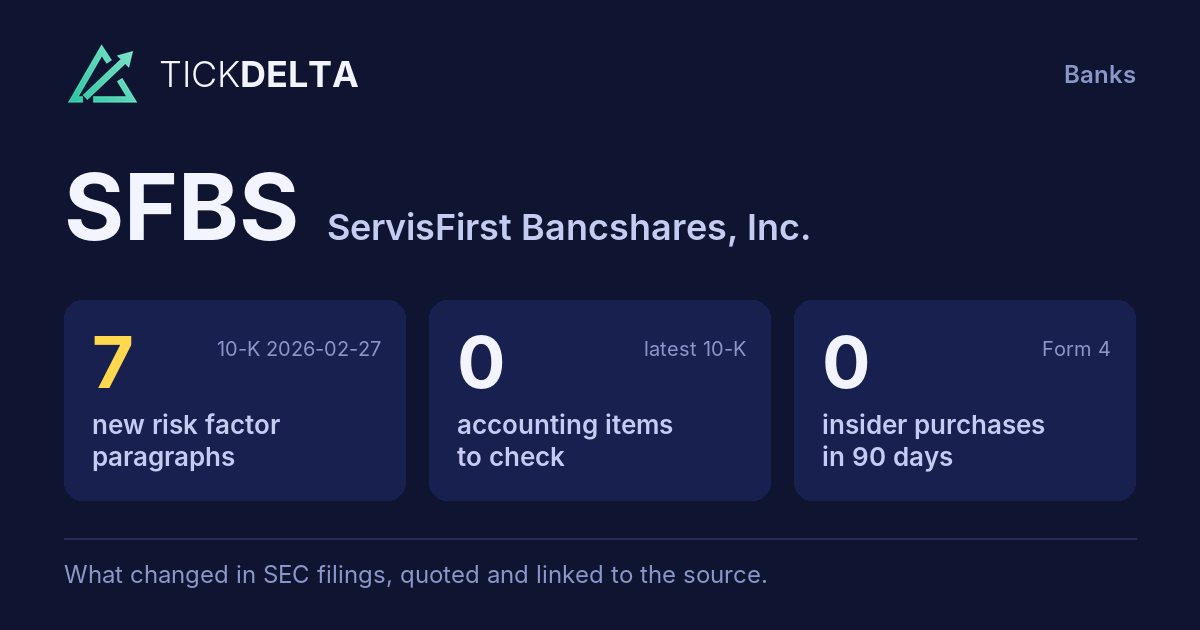
of the text changed · 7,316 words now · 7 new paragraphs, 16 gone
MD&A
5.2%
of the text changed · 8,884 words now · 1 new paragraphs, 7 gone
Legal Proceedings
1.7%
of the text changed · 508 words now
Accounting Policies
3.9%
of the text changed · 5,157 words now
10-K 0001171843-26-001150 (Feb 27, 2026) vs 10-K 0001171843-25-001208 (Mar 3, 2025)
Every paragraph, and how much of it changed
One bar per paragraph, in the order of the 10-K. Height and colour show the share of its words not in the closest paragraph a year earlier; the tallest bars are new paragraphs.
Risk Factors
99 paragraphs · 7 new · 42 reworded · 16 gone · 10-K Feb 27, 2026 against Mar 3, 2025
New paragraph
Reworded (5% of its words or more)
Same or nearly
Paragraph 38 · 45% changed
Every version of it
Substantially all of our borrowers and depositors are individuals and businesses located and doing business in our markets, which may subject us to geographic, industry, borrower and collateral concentration. We may not be able to sustain our historical rate of growth have been, and may not in the future be, negatively impacted by general business and economic conditions in our markets, including due to interest rates, housing conditions, real estate values, inflation, labor market issues, recession, tariffs, trade wars, pandemics, political issues, regulatory issues and changes local economies, that differ from the broader U.S. or global economies. Our credit risk and credit losses could increase if our loans are concentrated to borrowers engaged in the same or similar activities or to borrowers who as a group may be able to further expand our business. Various factors, such as economic conditions, regulatory and legislative considerations and competition, may impede uniquely or prohibit our ability to expand our disproportionately affected by unique geographic, industry or market presence. We lend primarily to small to medium-sized businesses within our communities, which conditions. This may expose us to greater lending risks than those faced by other banks that lend to different markets, industries, or to larger, better-capitalized and more diversified businesses with longer operating histories. We manage our credit exposure through careful monitoring of loan applicants and loan concentrations in particular industries, and through our loan approval and review procedures. Our use of historical and objective information in determining and managing credit exposure may not be accurate in assessing our risk. Our failure to sustain our historical rate of growth or adequately manage the factors that have contributed to our growth could have a material adverse effect on our business, financial condition, results of operations and prospects.
Paragraph 15 · 44% changed
Every version of it
Our corporate structure provides for decision-making authority by our regional chief executive officers and banking teams. Our business, financial condition, results of operations and prospects could be negatively affected if our employees do not follow our internal policies or are negligent in their decision-making.
Paragraph 27 · 43% changed
Every version of it
Paragraph 26 · 42% changed
Every version of it
Our operations and financial performance could be adversely affected by natural disasters, disasters and climate change can increase those risks while adding regulatory, compliance, reputational and other risks. weather.
Paragraph 31 · 41% changed
Every version of it
We use information technology in our operations and offer online banking services to our customers. Any unauthorized access to our or our customers’ confidential or proprietary information customers, which exposes us to reputational harm and litigation and could adversely affect our ability to attract and retain customers. the risk of unauthorized access.
Paragraph 9 · 40% changed
Every version of it
Our decisions regarding credit risk could be inaccurate and our allowance for credit losses may be inadequate, which could have a material adverse effect on our business, financial condition, results of operations and future prospects. inadequate.
Paragraph 20 · 39% changed
Every version of it
Paragraph 32 · 45% changed
Every version of it
10-K Mar 3, 2025Information security risks for financial institutions have increased in recent years, in part because of the proliferation of new technologies, the use of the internet and telecommunications technologies to conduct financial transactions, and the increased sophistication and activities of organized crime, hackers, terrorists, activists, and other external parties. We are under continuous threat of loss due to hacking, cyber-attacks and fraud, including fraud committed by external parties against us or our customers, fraud committed internally by or associates and fraud committed by customers. Our risk and exposure to these matters remains heightened because of the evolving nature and complexity, and the increasing frequency, of these threats from cybercriminals and hackers, our plans to continue to provide internet banking and mobile banking channels, and our plans to continue to develop additional remote connectivity solutions to serve our customers. Therefore, the secure processing, transmission, and storage of information in connection with our online banking services are critical elements of our operations. However, our network is vulnerable to unauthorized access, computer viruses and other malware, phishing schemes, human error or other security failures. In addition, our customers may use personal smartphones, tablet PCs, or other mobile devices that are beyond our control systems in order to access our products and services. Our technologies, systems and networks, and our customers’ devices, have been and will continue to be the target of cyber-attacks, electronic fraud, or information security breaches that could result in the unauthorized release, gathering, monitoring, misuse, loss, or destruction of our or our customers’ confidential, proprietary, and other information, or otherwise disrupt our or our customers’ or other third parties’ business operations. As cyber threats continue to evolve, we continue to spend significant capital and other resources to protect against these threats or to alleviate or investigate problems caused by such threats. To the extent that our activities or the activities of our customers involve the processing, storage, or transmission of confidential customer information, any breaches or unauthorized access to such information would present significant regulatory costs and expose us to litigation and other possible liabilities. Any inability to prevent these types of security threats could also cause existing customers to lose confidence in our systems and could adversely affect our reputation and ability to generate deposits. Additionally, our insurance may be inadequate to compensate us for losses due to a cyber-attack, hacking, or similar technology security breach. While we have not experienced any material losses relating to cyber-attacks or other information security breaches to date, we may suffer such losses in the future. The occurrence of any cyber-attack or information security breach could result in potential liability to clients, reputational damage, damage to our competitive position, and the disruption of our operations, all of which could adversely affect our financial condition or results of operations. Further, in addition to cyber-attacks, there has been a significant increase in check fraud in which checks are stolen in the mail and fraudulently deposited into the criminal’s account. This has resulted in losses to the Bank, and we expect this trend to continue.
10-K Feb 27, 2026
Secure processing, transmission, and storage of information in connection with our online banking services are critical elements of our operations. We plan to continue to provide internet banking and mobile banking channels, use our information systems and those of third parties, and plan to continue to develop additional remote connectivity solutions to serve our customers. We are under continuous threat of loss due to the evolving nature and complexity, and increasing frequency of, hacking, cyber-attacks and fraud, including fraud committed by external parties against us or our customers, fraud committed internally by or associates and fraud committed by customers, unauthorized access, security breaches, computer viruses and other malware, phishing schemes, human error or other security failures related to information systems. Our customer’s use of personal smartphones, tablet PCs, or other mobile devices, and our use of third-party systems that are beyond our control systems in order to access our products and services may increase these risks. As these threats continue to evolve, we continue to spend significant capital and other resources to protect against these threats or to alleviate or investigate problems caused by such threats.
Paragraph 38 · 45% changed
Every version of it
10-K Mar 3, 2025
We may not be able to sustain our historical rate of growth and may not be able to further expand our business. Various factors, such as economic conditions, regulatory and legislative considerations and competition, may impede or prohibit our ability to expand our market presence. We lend primarily to small to medium-sized businesses within our communities, which may expose us to greater lending risks than those faced by other banks that lend to larger, better-capitalized and more diversified businesses with longer operating histories. We manage our credit exposure through careful monitoring of loan applicants and loan concentrations in particular industries, and through our loan approval and review procedures. Our use of historical and objective information in determining and managing credit exposure may not be accurate in assessing our risk. Our failure to sustain our historical rate of growth or adequately manage the factors that have contributed to our growth could have a material adverse effect on our business, financial condition, results of operations and prospects.
10-K Feb 27, 2026
Substantially all of our borrowers and depositors are individuals and businesses located and doing business in our markets, which may subject us to geographic, industry, borrower and collateral concentration. We have been, and may in the future be, negatively impacted by general business and economic conditions in our markets, including due to interest rates, housing conditions, real estate values, inflation, labor market issues, recession, tariffs, trade wars, pandemics, political issues, regulatory issues and changes local economies, that differ from the broader U.S. or global economies. Our credit risk and credit losses could increase if our loans are concentrated to borrowers engaged in the same or similar activities or to borrowers who as a group may be uniquely or disproportionately affected by unique geographic, industry or market conditions. This may expose us to greater lending risks than those faced by other banks that lend to different markets, industries, or to larger, better-capitalized and more diversified businesses with longer operating histories. We manage our credit exposure through careful monitoring of loan applicants and loan concentrations in particular industries, and through our loan approval and review procedures. Our use of historical and objective information in determining and managing credit exposure may not be accurate in assessing our risk.
Paragraph 15 · 44% changed
Every version of it
10-K Mar 3, 2025
Our corporate structure provides for decision-making authority by our regional chief executive officers and banking teams. Our business, financial condition, results of operations and prospects could be negatively affected if our employees do not follow our internal policies or are negligent in their decision-making.
10-K Feb 27, 2026
Our corporate structure provides for decision-making authority by our regional chief executive officers and banking teams.
Paragraph 27 · 43% changed
Every version of it
10-K Mar 3, 2025Natural disasters could have a material adverse effect on our financial position and results of operations. Natural disasters, such as hurricanes, tornados, earthquakes and similar unpredictable weather events, could affect us directly (by interrupting our systems, damaging our offices or otherwise preventing us from operating our business in the ordinary course) or indirectly (by damaging or destroying the businesses or properties of our customers or otherwise impairing our customers’ ability to make loan payments on a timely basis or destroying property pledged as collateral for loans). Our entry into various markets in Florida and the Mobile, Alabama and Charleston, South Carolina markets increased our exposure to potential losses associated with hurricanes and similar natural disasters that are more common in coastal areas than in our other markets.
10-K Feb 27, 2026
Natural disasters, such as hurricanes, tornados, flooding, drought, fires, and earthquakes, and other similar unpredictable weather events such as heat waves, freezes, temperature changes, and changing weather patterns could affect us by interrupting our systems, damaging our offices or otherwise preventing us from operating our business in the ordinary course. Those events may also impact indirectly by damaging or destroying the businesses or properties of our customers, impairing our customers’ ability to make loan payments on a timely basis, destroying property pledged as collateral for loans or increasing costs in response to changes. Certain of our coastal markets may be even more susceptible to hurricanes, flooding and other natural disasters more common to coastal areas. We may further be impacted by any increased burdens or costs to comply with increased environmental regulations or laws, market shifts and changing investor perception in response to the weather events described above.
Paragraph 26 · 42% changed
Every version of it
10-K Mar 3, 2025
Our operations and financial performance could be adversely affected by natural disasters, and climate change can increase those risks while adding regulatory, compliance, reputational and other risks.
10-K Feb 27, 2026
Our operations and financial performance could be adversely affected by natural disasters and weather.
Paragraph 31 · 41% changed
Every version of it
10-K Mar 3, 2025
We use information technology in our operations and offer online banking services to our customers. Any unauthorized access to our or our customers’ confidential or proprietary information exposes us to reputational harm and litigation and could adversely affect our ability to attract and retain customers.
10-K Feb 27, 2026
We use information technology in our operations and offer online banking services to our customers, which exposes us to the risk of unauthorized access.
Paragraph 9 · 40% changed
Every version of it
10-K Mar 3, 2025
Our decisions regarding credit risk could be inaccurate and our allowance for credit losses may be inadequate, which could have a material adverse effect on our business, financial condition, results of operations and future prospects.
10-K Feb 27, 2026
Our decisions regarding credit risk could be inaccurate and our allowance for credit losses may be inadequate.
Paragraph 20 · 39% changed
Every version of it
10-K Mar 3, 2025Competition from financial institutions and other financial service providers may adversely affect our profitability.
10-K Feb 27, 2026
We face competition from financial institutions and other financial service providers.
MD&A
107 paragraphs · 1 new · 17 reworded · 7 gone · 10-K Feb 27, 2026 against Mar 3, 2025
New paragraph
Reworded (5% of its words or more)
Same or nearly
Paragraph 27 · 44% changed
From 2023 2024 to 2024, our volume component was favorable as asset volumes increased primarily as a result of the growth in loan balances as well as an increase in taxable debt securities, while 2025, both the volume change from our and rate components were favorable, as average asset and liability balances increased while rates on both assets and liabilities was declined, driven primarily driven by growth three reductions in money market balances. the Federal Reserve’s target rate during 2025. The rate component was favorable benefited from a greater decrease in the cost of funds, as average interest-bearing liabilities repriced downward more quickly than earning asset yields. As a result, our net interest margin expanded. Average rates paid on interest-bearing liabilities increased 39 decreased 69 basis points over this period, while yields on average earning assets increased 41 decreased 19 basis points.
Paragraph 13 · 40% changed
Paragraph 61 · 30% changed
The allowance for credit losses (“ACL”) for December 31, 2025 and 2024 and 2023 was calculated under the CECL methodology and totaled $164.5 $171.7 million and $153.3 $164.5 million, or 1.25% and 1.30% and 1.32% of loans, net of unearned income, respectively. The decrease in the ACL as a percentage of total loans from December 31, 2023, 2024, to December 31, 2024, 2025, was primarily driven by higher net credit charge-offs during 2025 and the release of a more favorable economic outlook, including lower unemployment rates special reserve that had been included in the 2024 balance, as well as updates to loss drivers and projected gross domestic product (“GDP”) growth compared to 2023. Additionally, adjustments to qualitative factors within our CECL model were made to reflect these improved economic conditions. model. Net credit charge-offs to average loans were 0.09% 0.21% for the year ended December 31, 2024, 2025, compared to 0.09% and 0.10% and 0.08% for the years ended December 31, 2023 2024 and 2022, 2023, respectively. Nonaccrual loans increased to $168.4 million, or 1.23% of total loans, at December 31, 2025 from $39.5 million, or 0.31% of total loans, at December 31, 2024 from 2024, and were $19.3 million, or 0.17% of total loans, at December 31, 2023, and were $12.5 million, or 0.11% of total loans, at 2023. The year-over-year nonaccrual increase from the year ended December 31, 2022. At 2024 to the year ended December 31, 2024, the nonaccrual increase 2025 was driven by attributable to a commercial, financial and agricultural relationship and a owner-occupied commercial large, real-estate secured relationship.
Paragraph 35 · 15% changed
Noninterest income increased $4.6 decreased $7.8 million, or 15.3%, 22.3%, to $35.1 $27.2 million for the year ended December 31, 2024 2025 compared to $30.4 $35.1 million for the same period in 2023. 2024. Service charges on deposit accounts increased $1.0 $2.5 million, or 12.0%, 26.0%, to $9.4 $11.9 million for the year ended December 31, 2024 2025 compared to $8.4 $9.4 million for the same period in 2023. 2024. Credit card income decreased $351,000, remained flat at $8.3 million during 2025 compared to 2024. Mortgage banking income increased $542,000, or 4.1%, 11.0%, to $8.3 $5.5 million for the year ended December 31, 2024 2025 compared to $8.6 $4.9 million for the same period in 2023. Mortgage banking 2024. Bank-owned life insurance income increased $2.2 $5.3 million, or 78.7%, 55.4%, to $4.9 $14.8 million for the year ended December 31, 2024 2025 compared to $2.8 $9.5 million for the same period in 2023. Closed loans 2024. The cash surrender value increased 49.9% $1.0 million and we recognized $4.3 million of income attributed to a BOLI policy during 2024 2025 compared to 2023. Bank-owned life insurance 2024. Other operating income increased $2.0 million, $218,000, or 25.9%, 7.6%, to $9.5 $3.1 million for the year ended December 31, 2024 2025 compared to $7.6 $2.9 million for the same period in 2023. The cash surrender value increased $1.6 million during 2024 compared to 2023. Other operating income decreased $150,000, or 4.9%, to $2.9 million for the year ended December 31, 2024 compared to $3.0 million for the same period in 2023. 2024. Merchant service revenue increased $63,000, $59,000, or 2.9%, 2.6%, to $2.3 million for the year ended December 31, 2024 2025 compared to $2.2 $2.3 million for the same period in 2023. 2024.
Paragraph 29 · 12% changed
Our average interest-earning assets for the year ended December 31, 2024 2025 increased $1.23 $1.30 billion, or 8.4%, 8.2%, to $15.85 $17.15 billion from $14.62 $15.85 billion for the year ended December 31, 2023. 2024. Average loans grew $548.0 $958.9 million, or 4.7%, 7.9%, average debt securities increased $76.7 decreased $47.1 million, or 4.1%, 2.4%, and average federal funds sold and sold, interest-bearing balances with banks banks, and securities purchased with agreement to resell increased $599.2 $389.3 million, or 53.5%. 22.7%.
Paragraph 23 · 9% changed
(5) Net interest margin is net interest income divided by average total interest-earning assets.
Paragraph 38 · 9% changed
Noninterest expenses increased $3.1 $3.8 million, or 1.7%, 2.1%, to $181.1 $185.0 million for the year ended December 31, 2024 2025 compared to $178.1 $181.1 million for the same period in 2023. Increased salaries and employee benefits expenses were the primary drivers of the increase in noninterest expense. 2024. Salary and employee benefits expenses increased $15.4 decreased $1.5 million, or 19.0%, 1.6%, to $96.3 $94.8 million for the year ended December 31, 2024 2025 compared to $81.0 $96.3 million for the same period in 2023. 2024, mainly due to a $3 million credit adjustment to our annual Incentive Plan expense during the second quarter of 2025. We had 630 666 full-time equivalent employees as of December 31, 2024 2025 compared to 591 630 as of December 31, 2023 2024. Equipment and occupancy expense increased $224,000, $78,000, or 1.6%, .5%, to $14.5 $14.6 million for the year ended December 31, 2024 2025 compared to $14.3 $14.5 million for the same period in 2023. 2024. Third party processing and other services increased $3.3 million, $436,000, or 11.9%, 1.4%, to $31.2 $31.6 million for the year ended December 31, 2024 2025 compared to $27.9 $31.2 million for the same period in 2023. 2024. Professional services expense increased $985,000, $274,000, or 16.6%, 4.0%, to $6.9 $7.2 million for the year ended December 31, 2024 2025 compared to $5.9 $6.9 million for the same period in 2023. 2024. FDIC assessments decreased $4.9 million, increased $303,000, or 31.6%, 2.8%, to $10.7 $11.0 million for the year ended December 31, 2024 2025 compared to $15.6 $10.7 million for the same period in 2023. 2024. The FDIC implemented a special assessment to recapitalize the Deposit Insurance Fund resulting in an expense of additional $1.8 million during 2024, and $7.2 million during 2023. 2024. Other operating expenses decreased $12.0 increased $4.3 million, or 36.0%, 20.1%, to $21.3 $25.6 million for the year ended December 31, 2024 2025 compared to $33.3 $21.3 million for the same period in 2023. 2024. The increase was mainly due to an operational loss and an increase in loan credit expenses. We adopted the proportional amortization method of accounting for investments in certain tax credit partnerships during 2024. The proportional amortization method results in the cost of the investment being amortized in proportion to the income tax credits and other income tax benefits received, with the amortization of the investment and the income tax credits being presented net in the consolidated income statement as a component of income tax expense. Previously the amortization of the investment was included in other non-interest expenses. Changes in other operating expenses from 2023 2024 to 2024 2025 are detailed in Note 15 14 - “Other Operating Income and Expenses,” to the Consolidated Financial Statements.
Paragraph 33 · 8% changed
The provision expense for credit losses for the year ended December 31, 2024 2025 increased compared to the year-ended December 31, 2023. 2024. The increase in provision expense is was primarily the result of loan growth during 2024 2025 compared to 2023. 2024. Nonperforming loans increased to $168.8 million, or 1.23% of total loans, at December 31, 2025 from $42.5 million, or 0.34% of total loans, at December 31, 2024 from $21.5 million, or 0.18% of total loans, at December 31, 2023. 2024. The year-over-year increase was attributable to a large, real-estate secured relationship. During 2024, 2025, we had net charged-off loans totaling $10.4 $28.1 million, compared to net charged-off loans of $11.7 $10.4 million for 2023. 2024. The ratio of net charged-off loans to average loans was 0.21% for 2025 compared to 0.09% for 2024 compared to 0.10% for 2023. 2024. The ACL for December 31, 2024 2025 totaled $171.7 million, or 1.25% of loans, net of unearned income. The ACL totaled $164.5 million, or 1.30% of loans, net of unearned income. The ACL totaled $153.3 million, or 1.32% of loans, net of unearned income, at December 31, 2023. 2024.
Paragraph 27 · 44% changed
10-K Mar 3, 2025
From 2023 to 2024, our volume component was favorable as asset volumes increased primarily as a result of the growth in loan balances as well as an increase in taxable debt securities, while the volume change from our liabilities was primarily driven by growth in money market balances. The rate component was favorable as average rates paid on interest-bearing liabilities increased 39 basis points while yields on average earning assets increased 41 basis points.
10-K Feb 27, 2026
From 2024 to 2025, both the volume and rate components were favorable, as average asset and liability balances increased while rates on both assets and liabilities declined, driven primarily by three reductions in the Federal Reserve’s target rate during 2025. The rate component benefited from a greater decrease in the cost of funds, as interest-bearing liabilities repriced downward more quickly than earning asset yields. As a result, our net interest margin expanded. Average rates paid on interest-bearing liabilities decreased 69 basis points over this period, while yields on average earning assets decreased 19 basis points.
Paragraph 13 · 40% changed
10-K Mar 3, 2025Our average interest-earning assets produced a taxable equivalent yield of 5.97% for the year ended December 31, 2024, compared to 5.56% for the year ended December 31, 2023. The average rate paid on interest-bearing liabilities was 4.13% for the year ended December 31, 2024, compared to 3.73% for the year ended December 31, 2023.
10-K Feb 27, 2026
Net interest income increased 19.8% for the year ended December 31, 2025 from the year ended December 31, 2024. Net interest income increased primarily due to a larger decline in the average rate paid on interest-bearing liabilities than the decline in the average yield on interest-earning assets, resulting in a wider net interest spread.
Paragraph 61 · 30% changed
10-K Mar 3, 2025
The allowance for credit losses (“ACL”) for December 31, 2024 and 2023 was calculated under the CECL methodology and totaled $164.5 million and $153.3 million, or 1.30% and 1.32% of loans, net of unearned income, respectively. The decrease in the ACL as a percentage of total loans from December 31, 2023, to December 31, 2024, was primarily driven by a more favorable economic outlook, including lower unemployment rates and projected gross domestic product (“GDP”) growth compared to 2023. Additionally, adjustments to qualitative factors within our CECL model were made to reflect these improved economic conditions. Net credit charge-offs to average loans were 0.09% for the year ended December 31, 2024, compared to 0.10% and 0.08% for the years ended December 31, 2023 and 2022, respectively. Nonaccrual loans increased to $39.5 million, or 0.31% of total loans, at December 31, 2024 from $19.3 million, or 0.17% of total loans, at December 31, 2023, and were $12.5 million, or 0.11% of total loans, at December 31, 2022. At December 31, 2024, the nonaccrual increase was driven by a commercial, financial and agricultural relationship and a owner-occupied commercial relationship.
10-K Feb 27, 2026
The allowance for credit losses (“ACL”) for December 31, 2025 and 2024 was calculated under the CECL methodology and totaled $171.7 million and $164.5 million, or 1.25% and 1.30% of loans, net of unearned income, respectively. The decrease in the ACL as a percentage of total loans from December 31, 2024, to December 31, 2025, was primarily driven by higher net credit charge-offs during 2025 and the release of a special reserve that had been included in the 2024 balance, as well as updates to loss drivers and qualitative factors within our CECL model. Net credit charge-offs to average loans were 0.21% for the year ended December 31, 2025, compared to 0.09% and 0.10% for the years ended December 31, 2024 and 2023, respectively. Nonaccrual loans increased to $168.4 million, or 1.23% of total loans, at December 31, 2025 from $39.5 million, or 0.31% of total loans, at December 31, 2024, and were $19.3 million, or 0.17% of total loans, at December 31, 2023. The year-over-year nonaccrual increase from the year ended December 31, 2024 to the year ended December 31, 2025 was attributable to a large, real-estate secured relationship.
Paragraph 35 · 15% changed
10-K Mar 3, 2025
Noninterest income increased $4.6 million, or 15.3%, to $35.1 million for the year ended December 31, 2024 compared to $30.4 million for the same period in 2023. Service charges on deposit accounts increased $1.0 million, or 12.0%, to $9.4 million for the year ended December 31, 2024 compared to $8.4 million for the same period in 2023. Credit card income decreased $351,000, or 4.1%, to $8.3 million for the year ended December 31, 2024 compared to $8.6 million for the same period in 2023. Mortgage banking income increased $2.2 million, or 78.7%, to $4.9 million for the year ended December 31, 2024 compared to $2.8 million for the same period in 2023. Closed loans increased 49.9% during 2024 compared to 2023. Bank-owned life insurance income increased $2.0 million, or 25.9%, to $9.5 million for the year ended December 31, 2024 compared to $7.6 million for the same period in 2023. The cash surrender value increased $1.6 million during 2024 compared to 2023. Other operating income decreased $150,000, or 4.9%, to $2.9 million for the year ended December 31, 2024 compared to $3.0 million for the same period in 2023. Merchant service revenue increased $63,000, or 2.9%, to $2.3 million for the year ended December 31, 2024 compared to $2.2 million for the same period in 2023.
10-K Feb 27, 2026
Noninterest income decreased $7.8 million, or 22.3%, to $27.2 million for the year ended December 31, 2025 compared to $35.1 million for the same period in 2024. Service charges on deposit accounts increased $2.5 million, or 26.0%, to $11.9 million for the year ended December 31, 2025 compared to $9.4 million for the same period in 2024. Credit card income remained flat at $8.3 million during 2025 compared to 2024. Mortgage banking income increased $542,000, or 11.0%, to $5.5 million for the year ended December 31, 2025 compared to $4.9 million for the same period in 2024. Bank-owned life insurance income increased $5.3 million, or 55.4%, to $14.8 million for the year ended December 31, 2025 compared to $9.5 million for the same period in 2024. The cash surrender value increased $1.0 million and we recognized $4.3 million of income attributed to a BOLI policy during 2025 compared to 2024. Other operating income increased $218,000, or 7.6%, to $3.1 million for the year ended December 31, 2025 compared to $2.9 million for the same period in 2024. Merchant service revenue increased $59,000, or 2.6%, to $2.3 million for the year ended December 31, 2025 compared to $2.3 million for the same period in 2024.
Paragraph 29 · 12% changed
10-K Mar 3, 2025
Our average interest-earning assets for the year ended December 31, 2024 increased $1.23 billion, or 8.4%, to $15.85 billion from $14.62 billion for the year ended December 31, 2023. Average loans grew $548.0 million, or 4.7%, average debt securities increased $76.7 million, or 4.1%, and average federal funds sold and interest-bearing balances with banks increased $599.2 million, or 53.5%.
10-K Feb 27, 2026
Our average interest-earning assets for the year ended December 31, 2025 increased $1.30 billion, or 8.2%, to $17.15 billion from $15.85 billion for the year ended December 31, 2024. Average loans grew $958.9 million, or 7.9%, average debt securities decreased $47.1 million, or 2.4%, and average federal funds sold, interest-bearing balances with banks, and securities purchased with agreement to resell increased $389.3 million, or 22.7%.
Paragraph 23 · 9% changed
10-K Mar 3, 2025
(5) Net interest margin is net interest income divided by average interest-earning assets.
10-K Feb 27, 2026
(5) Net interest margin is net interest income divided by total interest-earning assets.
Paragraph 38 · 9% changed
10-K Mar 3, 2025
Noninterest expenses increased $3.1 million, or 1.7%, to $181.1 million for the year ended December 31, 2024 compared to $178.1 million for the same period in 2023. Increased salaries and employee benefits expenses were the primary drivers of the increase in noninterest expense. Salary and employee benefits expenses increased $15.4 million, or 19.0%, to $96.3 million for the year ended December 31, 2024 compared to $81.0 million for the same period in 2023. We had 630 full-time equivalent employees as of December 31, 2024 compared to 591 as of December 31, 2023 Equipment and occupancy expense increased $224,000, or 1.6%, to $14.5 million for the year ended December 31, 2024 compared to $14.3 million for the same period in 2023. Third party processing and other services increased $3.3 million, or 11.9%, to $31.2 million for the year ended December 31, 2024 compared to $27.9 million for the same period in 2023. Professional services expense increased $985,000, or 16.6%, to $6.9 million for the year ended December 31, 2024 compared to $5.9 million for the same period in 2023. FDIC assessments decreased $4.9 million, or 31.6%, to $10.7 million for the year ended December 31, 2024 compared to $15.6 million for the same period in 2023. The FDIC implemented a special assessment to recapitalize the Deposit Insurance Fund resulting in an expense of $1.8 million during 2024, and $7.2 million during 2023. Other operating expenses decreased $12.0 million, or 36.0%, to $21.3 million for the year ended December 31, 2024 compared to $33.3 million for the same period in 2023. We adopted the proportional amortization method of accounting for investments in certain tax credit partnerships during 2024. The proportional amortization method results in the cost of the investment being amortized in proportion to the income tax credits and other income tax benefits received, with the amortization of the investment and the income tax credits being presented net in the consolidated income statement as a component of income tax expense. Previously the amortization of the investment was included in other non-interest expenses. Changes in other operating expenses from 2023 to 2024 are detailed in Note 15 - “Other Operating Income and Expenses,” to the Consolidated Financial Statements.
10-K Feb 27, 2026
Noninterest expenses increased $3.8 million, or 2.1%, to $185.0 million for the year ended December 31, 2025 compared to $181.1 million for the same period in 2024. Salary and employee benefits expenses decreased $1.5 million, or 1.6%, to $94.8 million for the year ended December 31, 2025 compared to $96.3 million for the same period in 2024, mainly due to a $3 million credit adjustment to our annual Incentive Plan expense during the second quarter of 2025. We had 666 full-time equivalent employees as of December 31, 2025 compared to 630 as of December 31, 2024. Equipment and occupancy expense increased $78,000, or .5%, to $14.6 million for the year ended December 31, 2025 compared to $14.5 million for the same period in 2024. Third party processing and other services increased $436,000, or 1.4%, to $31.6 million for the year ended December 31, 2025 compared to $31.2 million for the same period in 2024. Professional services expense increased $274,000, or 4.0%, to $7.2 million for the year ended December 31, 2025 compared to $6.9 million for the same period in 2024. FDIC assessments increased $303,000, or 2.8%, to $11.0 million for the year ended December 31, 2025 compared to $10.7 million for the same period in 2024. The FDIC implemented a special assessment to recapitalize the Deposit Insurance Fund resulting in an additional $1.8 million during 2024. Other operating expenses increased $4.3 million, or 20.1%, to $25.6 million for the year ended December 31, 2025 compared to $21.3 million for the same period in 2024. The increase was mainly due to an operational loss and an increase in loan credit expenses. We adopted the proportional amortization method of accounting for investments in certain tax credit partnerships during 2024. The proportional amortization method results in the cost of the investment being amortized in proportion to the income tax credits and other income tax benefits received, with the amortization of the investment and the income tax credits being presented net in the consolidated income statement as a component of income tax expense. Previously the amortization of the investment was included in other non-interest expenses. Changes in other operating expenses from 2024 to 2025 are detailed in Note 14 - “Other Operating Income and Expenses,” to the Consolidated Financial Statements.
Paragraph 33 · 8% changed
10-K Mar 3, 2025
The provision expense for credit losses for the year ended December 31, 2024 increased compared to the year-ended December 31, 2023. The increase in provision expense is primarily the result of loan growth during 2024 compared to 2023. Nonperforming loans increased to $42.5 million, or 0.34% of total loans, at December 31, 2024 from $21.5 million, or 0.18% of total loans, at December 31, 2023. During 2024, we had net charged-off loans totaling $10.4 million, compared to net charged-off loans of $11.7 million for 2023. The ratio of net charged-off loans to average loans was 0.09% for 2024 compared to 0.10% for 2023. The ACL for December 31, 2024 totaled $164.5 million, or 1.30% of loans, net of unearned income. The ACL totaled $153.3 million, or 1.32% of loans, net of unearned income, at December 31, 2023.
10-K Feb 27, 2026
The provision expense for credit losses for the year ended December 31, 2025 increased compared to the year-ended December 31, 2024. The increase in provision expense was primarily the result of loan growth during 2025 compared to 2024. Nonperforming loans increased to $168.8 million, or 1.23% of total loans, at December 31, 2025 from $42.5 million, or 0.34% of total loans, at December 31, 2024. The year-over-year increase was attributable to a large, real-estate secured relationship. During 2025, we had net charged-off loans totaling $28.1 million, compared to net charged-off loans of $10.4 million for 2024. The ratio of net charged-off loans to average loans was 0.21% for 2025 compared to 0.09% for 2024. The ACL for December 31, 2025 totaled $171.7 million, or 1.25% of loans, net of unearned income. The ACL totaled $164.5 million, or 1.30% of loans, net of unearned income, at December 31, 2024.
A paragraph is matched with the one last year that shares the most of its words; under half in common makes it new. The paragraphs shown are the 8 reworded the most in each section.
The paragraph that changed most in each section
The redline
Marked against last year's 10-K: cut words struck through, new words highlighted.
Risk Factors484 words changed in this paragraph; it is 30% similar to last year's version.
Source: Item 1A, 10-K 0001171843-26-001150 vs Item 1A, 10-K 0001171843-25-001208
MD&A119 words changed in this paragraph; it is 82% similar to last year's version.
2025 2024 2023 2022 Number Number Number Balance of Loans Balance of Loans Balance of Loans (Dollars in Thousands) Nonaccrual loans: Commercial, financial and agricultural $ 26,756 55 $ 25,692 54 $ 7,217 35 $ 7,108 18 Real estate - construction 35,885 8 - - 111 1 - - Real estate - mortgage: Owner-occupied commercial 13,578 17 8,744 14 7,089 14 3,312 3 1-4 family mortgage 9,440 34 3,051 24 4,426 41 1,524 16 Non-owner occupied commercial 81,977 13 1,259 2 506 2 506 2 Total real estate - mortgage 104,995 64 13,054 40 12,021 57 5,342 21 Consumer 715 2 755 1 - - - - Total nonaccrual loans $ 168,351 129 $ 39,501 95 $ 19,349 93 $ 12,450 39 90+ days past due and accruing: Commercial, financial and agricultural $ 101 10 $ 38 4 $ 170 8 $ 195 26 Real estate - construction - - 661 2 - - - - Real estate - mortgage: Owner-occupied commercial - - - - - - 1-4 family mortgage 323 2 2,240 7 1,909 9 594 5 Non-owner occupied commercial - - - - 4,512 1 Total real estate - mortgage 2,240 7 1,909 9 5,106 6 Consumer 26 21 105 16 90 44 Total 90+ days past due and accruing $ 2,965 34 $ 2,184 33 $ 5,391 76 Total nonperforming loans $ 42,466 129 $ 21,533 126 $ 17,841 115 Plus: Other real estate owned and repossessions 2,531 8 995 7 248 2 Total nonperforming assets $ 44,997 137 $ 22,528 133 $ 18,089 117 Restructured accruing loans: Commercial, financial and agricultural $ - - $ - - $ 2,480 5 Real estate - construction - - - - - - Real estate - mortgage: Owner-occupied commercial - - - - - - 1-4 family mortgage - - - - - - Non-owner occupied commercial - - - - - - Total real estate - mortgage - - - - - - 323 2 2,240 7 1,909 9 Consumer - - - - - - 54 28 26 21 105 16 Total restructured 90+ days past due and accruing $ 478 40 $ 2,965 34 $ 2,184 33 Total nonperforming loans $ - - 168,829 169 $ - - 42,466 129 $ 2,480 5 21,533 126 Plus: Other real estate owned and repossessions 2,583 9 2,531 8 995 7 Total nonperforming assets and restructured accruing loans $ 171,412 178 $ 44,997 137 $ 22,528 133 $ 20,569 122 Ratios: Nonperforming loans to total loans 1.23% 0.34% 0.18% 0.15% Nonperforming assets to total loans plus other real estate owned and repossessions 1.25% 0.36% 0.19% 0.15% Nonperforming assets and restructured accruing loans to total loans plus other real estate owned and repossessions 1.25% 0.36% 0.19% 0.18%
Source: Item 7, 10-K 0001171843-26-001150 vs Item 7, 10-K 0001171843-25-001208
Accounting Policies108 words changed in this paragraph; it is 38% similar to last year's version.
In December 2023, the FASB issued ASU No. 2023-09, 2023‑09, Income Taxes (Topic 740): Improvements to Income Tax Disclosures. ASU 2023-09 Disclosures, which requires enhanced annual income tax disclosures primarily related to disclosures, including additional disaggregation within the effective tax rate reconciliation and income taxes paid information to provide more transparency by requiring (i) consistent categories and greater disaggregation of information in the rate reconciliation table and (ii) income taxes paid, net of refunds, to be disaggregated by jurisdiction based on an established threshold. jurisdiction. The amendments in this standard will be ASU is effective for public business entities for annual periods beginning after December 15, 2024, with early adoption permitted. Entities may apply the Company on January 1, 2025. The Company is currently evaluating the impact the amendments will have the consolidated financial statements and related disclosures. guidance either prospectively or retrospectively.
Source: Item 8, Note 1 – SUMMARY OF SIGNIFICANT ACCOUNTING POLICIES, 10-K 0001171843-26-001150 vs Item 8, Note 1 – SUMMARY OF SIGNIFICANT ACCOUNTING POLICIES, 10-K 0001171843-25-001208
Legal Proceedings2 words changed in this paragraph; it is 99% similar to last year's version.
December 31, Balance Sheet Location 2025 2024 2023 (In Thousands) Investments in affordable housing projects and other qualified tax credits: Carrying amount Other assets $ 98,681 $ 75,705 $ 42,832 Amount of future funding commitments including in carrying amount Other liabilities 65,439 39,502 - Lending exposures Loans 88,207 84,652 107,764 96,224 SBIC and certain other equity method investments: Carrying amount Other assets 13,399 4,642 2,071 Amount of future funding commitments not included in carrying amount N/A 18,551 12,308 14,879
Source: Item 3, via Note 16 – COMMITMENTS AND CONTINGENCIES, 10-K 0001171843-26-001150 vs Item 3, via Note 17 – COMMITMENTS AND CONTINGENCIES, 10-K 0001171843-25-001208
Sentences and paragraphs added, removed or reworded
Every change, by type
Sentences and paragraphs of SFBS's Risk Factors and MD&A, 10-K Feb 27, 2026 against 10-K Mar 3, 2025. Each links to the text at sec.gov.
Quiet changes are sentences kept from last year with one to four words changed, at least one of them a hedge, a modal or a qualifier (may, could, will, not, significant, material…). A year or date rolling forward is not counted.
The full word list
adverse, adversely, all, although, anticipate, anticipates, any, approximately, believe, believes, can, cannot, certain, could, expect, expects, generally, however, if, intend, intends, largely, likely, many, material, materially, may, might, most, must, never, no, not, possible, primarily, probable, should, significant, significantly, some, substantial, substantially, unlikely, will, would
AddedRisk Factors
Additionally, in the event of a default with respect to any of these loans, we may foreclose on the real estate, which subjects us to additional risk of ownership and operation of real estate. The amount we receive upon ultimate sale of the collateral is dependent upon many factors outside of our control, which may result in the amount received being less than the outstanding principal and interest on the loan. We may also face difficulty managing the amount of costs or size of the risks associated with the ownership of real estate prior to sale.
Read it in 10-K Feb 27, 2026 at sec.gov
AddedRisk Factors
Furthermore, we could be liable to governmental entities or third parties related to environmental and other liabilities with respect to real estate that we foreclose upon. The costs associated with environmental investigation or remediation activities could be substantial.
Read it in 10-K Feb 27, 2026 at sec.gov
AddedRisk Factors
These threats may result in the unauthorized release, gathering, monitoring, misuse, loss, inability to compile or use, or destruction of our or our customers’ confidential, proprietary data and other information, or otherwise disrupt our or our customers’ or other third parties’ business operations. This could result in significant regulatory costs and expose us to litigation and other possible liabilities, disrupt our systems and the systems of third parties we use, damage our competitive position, cause our existing customers to lose confidence in our systems, and adversely affect our reputation and ability to generate deposits. Our insurance may be inadequate to compensate us for losses due to any such loss or event.
Read it in 10-K Feb 27, 2026 at sec.gov
AddedRisk Factors
Further, in addition to cyber-attacks, there has been a significant increase in check fraud in which checks are stolen in the mail and fraudulently deposited into the criminal’s account. This has resulted in losses to the Bank, and we expect this trend to continue.
Read it in 10-K Feb 27, 2026 at sec.gov
AddedRisk Factors
We may not be able to sustain our historical rate of growth or further expand our business. Various factors, such as economic conditions, regulatory and legislative considerations and competition, may impede or prohibit our ability to grow and expand.
Read it in 10-K Feb 27, 2026 at sec.gov
AddedRisk Factors
Our investments and/or financings in certain tax-advantaged projects may not generate returns as anticipated and may have an adverse impact on our financial results.
Read it in 10-K Feb 27, 2026 at sec.gov
AddedRisk Factors
We invest in and/or finance certain tax-advantaged projects promoting renewable energy sources and affordable housing for low- and moderate-income tenants. Our investments in these projects are designed to generate a return primarily through the realization of federal and state income tax credits, and other tax benefits, over specified time periods. We are subject to the risk that previously recorded tax credits, which remain subject to recapture by taxing authorities based on compliance features required to be met at the project level, will fail to meet certain government compliance requirements and will not be able to be fully realized. The possible inability to realize these tax credits and other tax benefits can have a negative impact on our financial results. The risk of not being able to realize the tax credits and other tax benefits depends on many factors outside of our control, including changes in the applicable provisions of the tax code and the ability of the projects to be completed and properly managed.
Read it in 10-K Feb 27, 2026 at sec.gov
RemovedRisk Factors
Show the other 44
RemovedRisk Factors
RemovedRisk Factors
RemovedRisk Factors
RemovedRisk Factors
RemovedRisk Factors
RemovedRisk Factors
RemovedRisk Factors
RemovedRisk Factors
RemovedRisk Factors
RemovedRisk Factors
RemovedRisk Factors
RewordedRisk Factors
Natural disasters, such as hurricanes, tornados, earthquakes flooding, drought, fires, and earthquakes, and other similar unpredictable weather events, events such as heat waves, freezes, temperature changes, and changing weather patterns could affect us directly (by by interrupting our systems, damaging our offices or otherwise preventing us from operating our business in the ordinary course) or indirectly (by damaging or destroying the businesses or properties of our customers or otherwise impairing our customers’ ability to make loan payments on a timely basis or destroying property pledged as collateral for loans). course.
Read it in 10-K Feb 27, 2026 at sec.gov
RewordedRisk Factors
RewordedRisk Factors
RewordedRisk Factors
A decline in real estate values, either in the regions we serve or across the country, could impair the value of our collateral and our ability to sell the collateral upon foreclosure, which would likely require us to re-value the collateral and increase our provision for credit losses.
Read it in 10-K Feb 27, 2026 at sec.gov
RewordedRisk Factors
We are under continuous threat of loss due to the evolving nature and complexity, and increasing frequency of, hacking, cyber-attacks and fraud, including fraud committed by external parties against us or our customers, fraud committed internally by or associates and fraud committed by customers. customers, unauthorized access, security breaches, computer viruses and other malware, phishing schemes, human error or other security failures related to information systems.
Read it in 10-K Feb 27, 2026 at sec.gov
RewordedRisk Factors
We do not have any control over monetary policies policies, or changes in those policies, implemented by the Federal Reserve or otherwise and any changes in these policies could have a material adverse effect on our business, financial condition, results of operations and prospects. otherwise.
Read it in 10-K Feb 27, 2026 at sec.gov
RewordedRisk Factors
The allowance for credit losses may not be adequate to cover losses associated with any of these relationships, and any loss or we may be required to increase in the allowance could have or suffer a material adverse effect on our business, financial condition, results of operations and prospects. loss in connection therewith.
Read it in 10-K Feb 27, 2026 at sec.gov
RewordedRisk Factors
Our success depends in large part on the performance of our key personnel, as well as on including our ability to attract, motivate management team, and retain highly qualified senior Board of Directors and middle management. directors of the Bank.
Read it in 10-K Feb 27, 2026 at sec.gov
RewordedRisk Factors
We are dependent on the services of our management team team, key employees and Board of Directors, and the unexpected loss of key officers or directors may adversely affect our business and operations. Directors
Read it in 10-K Feb 27, 2026 at sec.gov
RewordedRisk Factors
RewordedRisk Factors
RewordedRisk Factors
This instrument of monetary policy frequently causes volatile fluctuations in interest rates, and it can have a direct, material adverse effect on the operating results of financial institutions including our business. rates.
Read it in 10-K Feb 27, 2026 at sec.gov
AddedMD&A
2025 2024 Change Percentage Change Salaries and employee benefits $ 94,815 $ 96,318 $ (1,503) (1.6 Equipment and occupancy expense 14,597 14,519 78 0.5 Third party processing and other services 31,617 31,181 436 1.4 Professional services 7,175 6,901 274 4.0 FDIC and other regulatory assessments 10,990 10,687 303 2.8 Other real estate owned expense 155 199 (44) (22.1 Other operating expenses 25,641 21,341 4,300 20.1 Total noninterest expenses $ 184,990 $ 181,146 $ 3,844 2.1
Read it in 10-K Feb 27, 2026 at sec.gov
RemovedMD&A
RemovedMD&A
RemovedMD&A
RemovedMD&A
RemovedMD&A
RemovedMD&A
RemovedMD&A
RewordedMD&A
Year Ended December 31, 2023 2022 2025 2024 Change from the Prior Year (Dollars in Thousands) Interest income $ 813,246 990,427 $ 559,315 45.4 946,121 4.7 Interest expense 402,309 88,423 355.0 455,218 499,462 (8.9 Net interest income 410,937 470,892 (12.7 535,209 446,659 19.8 Provision for credit losses 18,715 37,607 (50.2 35,311 21,587 63.6 Net interest income after provision for credit losses 392,222 433,285 (9.5 499,898 425,072 17.6 Noninterest income 30,417 33,359 (8.8 27,222 35,056 (22.3 Noninterest expense 178,051 157,816 12.8 184,990 181,146 2.1 Income before income taxes 244,588 308,828 (20.8 342,130 278,982 22.6 Income taxes 37,735 57,324 (34.2 65,527 51,740 26.6 Net income 206,853 251,504 (17.8 276,603 227,242 21.7 Dividends on preferred stock 62 62 - Net income available to common stockholders $ 206,791 276,541 $ 251,442 (17.8 227,180 21.7
Read it in 10-K Feb 27, 2026 at sec.gov
RewordedMD&A
Salary and employee benefits expenses increased $15.4 decreased $1.5 million, or 19.0%, 1.6%, to $96.3 $94.8 million for the year ended December 31, 2024 2025 compared to $81.0 $96.3 million for the same period in 2023. 2024, mainly due to a $3 million credit adjustment to our annual Incentive Plan expense during the second quarter of 2025.
Read it in 10-K Feb 27, 2026 at sec.gov
RewordedMD&A
Nonaccrual loans increased to $168.4 million, or 1.23% of total loans, at December 31, 2025 from $39.5 million, or 0.31% of total loans, at December 31, 2024 from 2024, and were $19.3 million, or 0.17% of total loans, at December 31, 2023, and were $12.5 million, or 0.11% of total loans, at December 31, 2022. 2023.
Read it in 10-K Feb 27, 2026 at sec.gov
RewordedMD&A
The ratio of our average interest-earning assets to average interest-bearing liabilities decreased from 135.6% for the year ended December 31, 2023 to 130.9% for the year ended December 31, 2024, 2024 to 129.7% for the year ended December 31, 2025, as average noninterest-bearing deposits and stockholders’ equity decreased increased by a combined $107.8 $227.3 million, or 2.52%, 5.45%, from 2023 2024 to 2024. 2025.
Read it in 10-K Feb 27, 2026 at sec.gov
RewordedMD&A
Basic and diluted net income per common share was were both $5.06 for the year ended December 31, 2025, compared to $4.17 and $4.16, respectively, for the year ended December 31, 2024, compared to $3.80 and $3.79, respectively, for the year ended December 31, 2023. 2024.
Read it in 10-K Feb 27, 2026 at sec.gov
RewordedMD&A
Owner-occupied commercial - - - - - - 1-4 family mortgage 323 2 2,240 7 1,909 9 594 5 Non-owner occupied commercial - - - - 4,512 1 - - Total real estate - mortgage 323 2 2,240 7 1,909 9 5,106 6 Consumer 54 28 26 21 105 16 90 44 Total 90+ days past due and accruing $ 478 40 $ 2,965 34 $ 2,184 33 $ 5,391 76 Total nonperforming loans $ 168,829 169 $ 42,466 129 $ 21,533 126 $ 17,841 115 Plus:
Read it in 10-K Feb 27, 2026 at sec.gov
RewordedMD&A
Average loans grew $548.0 $958.9 million, or 4.7%, 7.9%, average debt securities increased $76.7 decreased $47.1 million, or 4.1%, 2.4%, and average federal funds sold and sold, interest-bearing balances with banks banks, and securities purchased with agreement to resell increased $599.2 $389.3 million, or 53.5%. 22.7%.
Read it in 10-K Feb 27, 2026 at sec.gov
RewordedMD&A
Our average interest-bearing liabilities increased $1.32 $1.12 billion, or 12.3%, 9.3%, to $13.22 billion for the year ended December 31, 2025 from $12.10 billion for the year ended December 31, 2024 from $10.78 billion for the year ended December 31, 2023. 2024.
Read it in 10-K Feb 27, 2026 at sec.gov
RewordedMD&A
Nonperforming loans increased to $168.8 million, or 1.23% of total loans, at December 31, 2025 from $42.5 million, or 0.34% of total loans, at December 31, 2024 from $21.5 million, or 0.18% of total loans, at December 31, 2023. 2024.
Read it in 10-K Feb 27, 2026 at sec.gov
RewordedMD&A
Owner-occupied commercial 13,578 17 8,744 14 7,089 14 3,312 3 1-4 family mortgage 9,440 34 3,051 24 4,426 41 1,524 16 Non-owner occupied commercial 81,977 13 1,259 2 506 2 506 2 Total real estate - mortgage 104,995 64 13,054 40 12,021 57 5,342 21 Consumer 715 2 755 1 - - - - Total nonaccrual loans $ 168,351 129 $ 39,501 95 $ 19,349 93 $ 12,450 39 90+ days past due and accruing:
Read it in 10-K Feb 27, 2026 at sec.gov
RewordedMD&A
Net income available to common stockholders was $276.5 million for the year ended December 31, 2025, compared to $227.2 million for the year ended December 31, 2024, compared to $206.8 million for the year ended December 31, 2023. 2024.
Read it in 10-K Feb 27, 2026 at sec.gov
RewordedMD&A
Return on average assets was 1.56% in 2025, compared to 1.39% in 2024, compared to 1.37% in 2023, and return on average common stockholders’ equity was 16.05% in 2025, compared to 14.98% in 2024, compared to 15.13% in 2023. 2024.
Read it in 10-K Feb 27, 2026 at sec.gov
Quiet changesMD&A
Commitments to extend credit beyond current fundings are agreements to lend to a customer as long as if there is no violation of any condition established in the contract.
Read it in 10-K Feb 27, 2026 at sec.gov
Sources
The two latest 10-Ks on EDGAR, section by section. Each change links to the text at sec.gov.
Also
New risk factors: paragraphs with nothing like them last year, quoted in full.
Work with it
Excel workbook · CSV. Google Sheet that stays up to date: paste =IMPORTDATA("https://tickdelta.com/company/SFBS/export.csv") into a cell.