Screener / SEC EDGAR /CIK 0001594805 /Numbers from the XBRL of the 10-Ks
Nasdaq Technology · Software

Shopify Inc. SHOP

Compare with peers Embed
SEC comment letters, last 20 years

2 reviews of SHOP's filings by SEC staff

UPLOAD and CORRESP
Reviews 2 latest letter Jul 7, 2025
Questions asked 50 each answered in the company's own letter
No closing letter 1 reviews without a letter saying the staff completed it

When the SEC's staff reviews a filing, it writes to the company with numbered questions, and the company answers each one in a letter. SEC publishes the exchange once the review is over, at least 20 business days later. A question is not an accusation; most reviews end with the company adding detail to its next filing.

How the reviews went

Every review on EDGAR, from the first staff letter to the letter that closes it

  1. 1. Staff letters 3 UPLOAD
  2. 2. Questions in them 50 numbered comments
  3. 3. Company replies 2 CORRESP
  4. 4. Reviews closed 1 of 2 closing letter

Half the closed reviews took 38 days or less from the first letter to the closing letter.

Form 10-K for the year ended December 31, 2024

2025-07-07 to 2025-08-14 · 5 questions · 1 letter from the SEC, 1 from the company
Review closed 2025-08-14
RevenueResults discussion (MD&A)Key metricsSegments
Management's Discussion and Analysis of Financial Condition and Results of Operations · Key Performance Indicators, page 48
SEC asked (1)
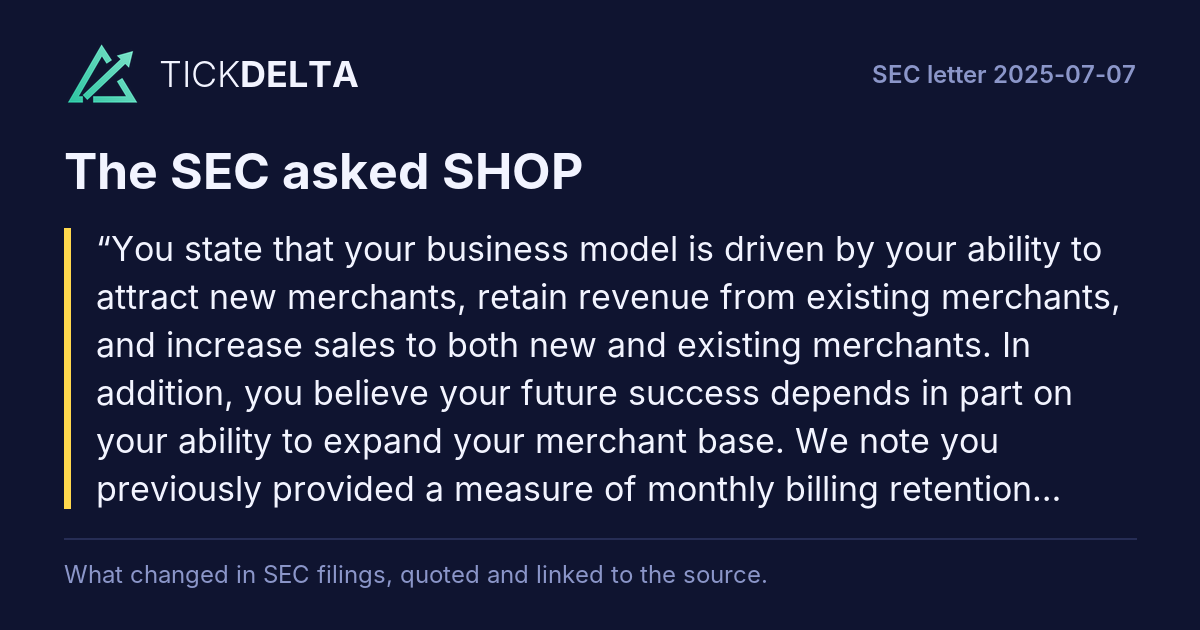
You state that your business model is driven by your ability to attract new merchants, retain revenue from existing merchants, and increase sales to both new and existing merchants. In addition, you believe your future success depends in part on your ability to expand your merchant base.
Rest of the question

We note you previously provided a measure of monthly billing retention rate that you used to evaluate your ability to maintain and expand your relationships with merchants. Please clarify whether management currently uses this measure or tell us what measures they now use to monitor your ability to retain and grow your existing merchant base, and revise to include a quantified discussion of such measures for each period presented. Refer to SEC Release 33-10751.

SHOP answered
We acknowledge the Staff’s comment. Management does not currently use Monthly Billings Retention Rate (“MBRR”) to monitor its ability to retain and grow its merchant base. MBRR was a month- over-month run-rate that illustrated merchant billing retention only in the short term. Management has not reviewed this metric since 2018.

The key performance indicator that Management relies on to monitor Shopify’s ability to retain and grow its existing merchant base is Monthly

Recurring Revenue (“MRR”), which is further discussed in our response to comment 2 below.
Rest of the answer

We use MRR to help us assess trends in subscription plan revenue. MRR is provided for the applicable periods in the management’s discussion and analysis of financial condition and results of operations (“MD&A”) included in the

Form 10-Q for the quarter ended June 30, 2025.

Read in the reply
In its next report

First report after the company's reply of Aug 6, 2025: 10-Q filed Nov 4, 2025 ↗, against the 10-Q filed May 8, 2025 ↗.

Tickdelta does not hold the text of both reports, so they are not compared here.
Management's Discussion and Analysis of Financial Condition and Results of Operations · Key Performance Indicators, page 48
SEC asked (2)
We note from your discussion of Monthly Recurring Revenue (MRR) you analyze the factors that make up MRR, specifically the number of paying merchants using your platform and changes in average revenue earned from subscription plan fees per paying merchant.
Rest of the question

Please describe for us how management uses the number of paying merchants in their analysis and tell us what consideration you gave to including the number of paying merchants as a key performance indicator to evaluate your business. In your response, provide us with the number of paying merchants for each period presented.

SHOP answered
As described in response to the Staff’s comment 1 above,

Management relies on MRR to monitor Shopify’s ability to retain and grow our existing merchant base. While the number of paying merchants is one factor that contributes to MRR, as our platform and merchant base have evolved, the number of paying merchants has become less relevant to understanding Shopify’s overall business.
Rest of the answer

The impact one merchant has on Shopify’s business performance varies based upon a number of factors, including plan type, whether their subscription is on a full-price or trial basis, and how much transaction flow, and ultimately revenue, Shopify receives from the merchant. This dynamic has become more prevalent in recent years as we have attracted more large, global merchants to our platform. Particularly in light of this variability, Management does not look to the number of paying merchants as a key performance indicator. Instead, Management looks to MRR – which provides a more comprehensive view of the subscription revenue earned from our merchant relationships – to evaluate the overall health of our merchant base and make strategic decisions.

We acknowledge the Staff’s comment and have updated our discussion of MRR. These updates de-emphasize the number of paying merchants and highlight other contributing factors to MRR. These changes do not change the value of MRR in the current period or historical periods and are reflected in our Form 10-Q for the quarter ended June 30, 2025 and detailed below (with additions marked in bold underline and deletions marked in bold and struck through).

As disclosed in our Form 10-Q for the quarter ended June 30, 2025:

We calculate MRR is the at the end of each period by multiplying the number of merchants who have subscription plans with us at the period end date by the average monthly subscription plan fee, which excludes variable platform fees, aggregate value of all subscription plans, excluding variable platform fees, in effect on the last day of the period, assuming they merchants maintain their subscription plans the following month . . . . We also analyze consider the factors that make up contribute to MRR, specifically the number of paying merchants using our platform, the number of merchants that are on full-price plans or paid trials, the mix of subscription plan types, and overall pricing of our subscription plans and changes in average revenue earned from subscription plan fees per paying merchant.

Read in the reply
In its next report

First report after the company's reply of Aug 6, 2025: 10-Q filed Nov 4, 2025 ↗, against the 10-Q filed May 8, 2025 ↗.

Tickdelta does not hold the text of both reports, so they are not compared here.

Discussion of the Results of Operations, page 54
SEC asked (3)
We note fluctuations between periods in subscription revenue were due to various factors including a higher number of merchants using the platform and increases in subscription pricing, and fluctuations in cost of revenue for both subscriptions and merchant solutions were also due to a variety of factors. In addition, we note your references to changes being due “primarily” or "mainly" to these factors.
Rest of the question

Where a material change is attributed to two or more factors, including any offsetting factors, please revise to describe the contribution of each factor in quantified terms. Also, revise to use more definitive terminology, rather than general or vague terms such as “primarily” and "mainly," to describe each contributing factor. Refer to Item 303(b) of Regulation S-K.

SHOP answered
We acknowledge the Staff’s comment. We have enhanced disclosure in our Form 10-Q for the quarter ended June 30, 2025. In future filings, where a material change is attributable to two or more factors, we will quantify such factors in reference to Item 303(b) of Regulation S-K in line with the objective outlined in Item 303(a) of Regulation S-K.
Rest of the answer

Below is an example of this enhanced disclosure within the MD&A of our Form 10-Q for the quarter ended June 30, 2025 (with additions marked in bold underline and deletions marked in bold and struck through).

Subscription Solutions

Subscription solutions revenues increased for the three months ended March 31, June 30, 2025 compared to the same period in 2024. The largest component of the period-over-period change was an increase in subscription fees of $80 million driven by an increase in MRR, which was the result of a larger percentage of subscriptions coming from higher priced plans, such as Plus, and by higher GMV resulting in an increase in subscription fees from the variable component of certain subscription contracts primarily growth in MRR, which was driven largely by a higher number of merchants using our platform.

Read in the reply
In its next report

First report after the company's reply of Aug 6, 2025: 10-Q filed Nov 4, 2025 ↗, against the 10-Q filed May 8, 2025 ↗.

Tickdelta does not hold the text of both reports, so they are not compared here.

Notes to the Consolidated Financial Statements · Note 23. Segment and Geographical Information, page 116
SEC asked (4)
Please revise to disclose how the CODM uses the segment measure of consolidated net income (loss) to manage segment performance and allocate resources. Refer to ASC 280-10-50-29(f) and the example in 280-10-55-54(c).
SHOP answered
We acknowledge the Staffʼs comment and have enhanced the disclosures in our Form 10-Q for the quarter ended June 30, 2025 to include this information, as shown below (with additions marked in bold underline).

17. Segment and Geographical Information

The Company’s chief operating decision maker

(“CODM”) CODM is its Chief Executive

Officer. The CODM has determined that the Company operates in a single operating and reportable segment and manages segment performance and resource allocation based upon consolidated net income (loss).
Rest of the answer

The CODM uses consolidated net income (loss) in deciding whether to reinvest profits into opportunities for the business, invest in business combinations or equity investments or return a portion of such profits to shareholders. The measure of segment assets is reported on the condensed consolidated balance sheet as total consolidated assets. Significant expenses reviewed by the CODM include those that are presented in the Condensed

Consolidated Statements of Operations and Comprehensive Income (Loss).

Read in the reply
In its next report

First report after the company's reply of Aug 6, 2025: 10-Q filed Nov 4, 2025 ↗, against the 10-Q filed May 8, 2025 ↗.

Tickdelta does not hold the text of both reports, so they are not compared here.

Notes to the Consolidated Financial Statements · Note 23. Segment and Geographical Information, page 116
SEC asked (5)
We note your subscription solutions include revenue from subscriptions to the Shopify platform as well as from the sale of themes, apps and domain names. We also note that merchant solutions revenue is principally generated from payment processing and currency conversion fees, but also includes revenue from third-party referral fees, sales of products such as shipping labels and POS hardware, advertising and lending
Rest of the question

services. Please tell us your consideration to provide a breakdown of revenue for each of the products and services included in subscription solutions and merchant solutions. In your response, provide us with the amount of revenue from each of the products and services included in these revenue line items. Refer to ASC 280-10-50-40.

SHOP answered
Shopify uses the guidance in ASC 280-10-50-40 to determine how to best group similar products and services, along with the relative value of the revenue from the individual products and services and the guidance provided by Rule 5-03(b)(1) under Regulation S-X. In doing so, Shopify determined that presenting the two lines “subscription solutions” and “merchant solutions” appropriately grouped similar products and services based on the underlying value driven by each of the products and services.
Rest of the answer

The products and services included in subscription solutions are grouped together as we see them as related to the core platform that our merchants use to run their businesses. Merchant solutions products and services augment the core platform provided by our subscription product. For context on materiality, subscription solutions revenue from the sale of themes, apps, and domain names represented, in aggregate, less than 2% of total Shopify revenue for the year ended

December 31, 2024. None of the merchant solutions revenue from third-party referral fees, sales of shipping labels, POS hardware and advertising and lending services individually generated more than 5% of total Shopify revenue for the year ended

December 31, 2024 and, in the aggregate, these merchant solutions products and services were below the threshold stated in Rule 5-03(b) under Regulation S-X for the year ended December 31, 2024. Therefore, we respectfully believe that these products and services have been appropriately grouped, and we have not provided a breakdown of revenues for each of the products and services included in subscription solutions and merchant solutions. We will consider further modifications to our revenue disclosures in future periodic reports if and when products or services become material.

Read in the reply
In its next report

First report after the company's reply of Aug 6, 2025: 10-Q filed Nov 4, 2025 ↗, against the 10-Q filed May 8, 2025 ↗.

Tickdelta does not hold the text of both reports, so they are not compared here.

Also in this review: request for more time, Jul 10, 2025, closing letter, 2025-08-14

Form F-1

2015-03-17 to 2015-04-14 · 45 questions · 2 letters from the SEC, 1 from the company
No closing letter
RevenueRisk factorsResults discussion (MD&A)Liquidity and cashLeasesSegmentsDebt
SEC letter of Mar 17, 2015 ↗ no reply letter on EDGAR (the company may have answered in an amended filing)
General
SEC asked (1)
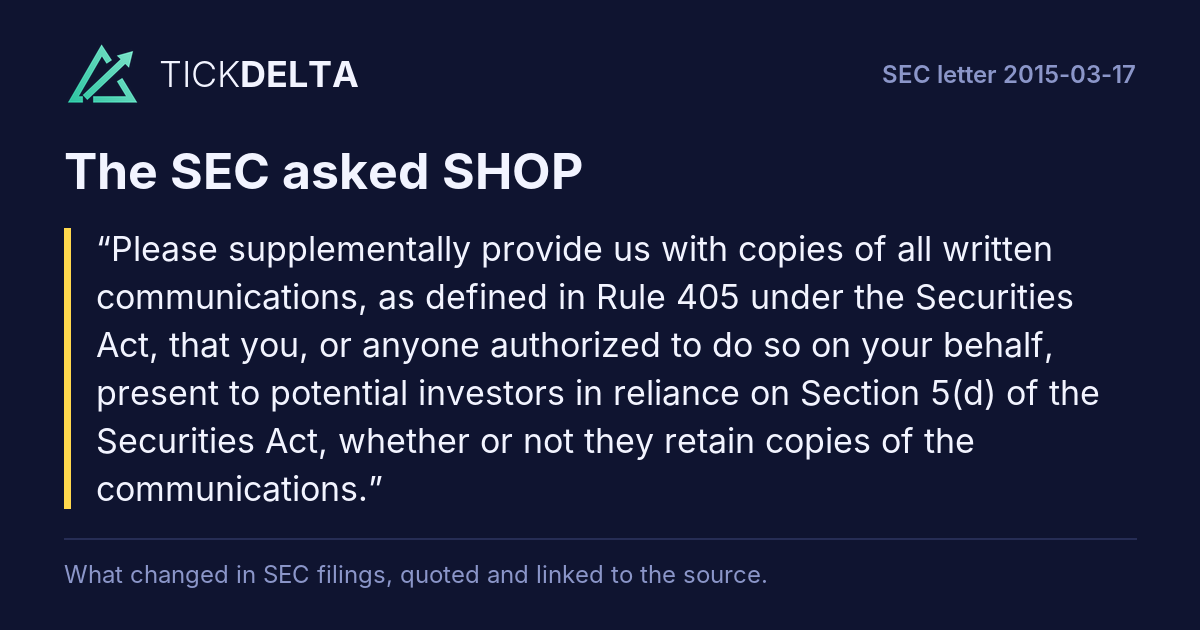
Please supplementally provide us with copies of all written communications, as defined in Rule 405 under the Securities Act, that you, or anyone authorized to do so on your behalf, present to potential investors in reliance on Section 5(d) of the Securities Act, whether or not they retain copies of the communications.
SHOP answered

No reply letter found.

General
SEC asked (2)
We will process your submission and amendments without price ranges. Since the price range you select will affect disclosure in several sections of the document, we will need sufficient time to process your amendments once a price range is included and the material information now appearing blank throughout the document has been provided.
Rest of the question

Please understand that the effect of the price range on disclosure throughout the document may cause us to raise issues on areas not previously commented on.

SHOP answered

No reply letter found.

Prospectus Cover Page
SEC asked (3)
Here and in the summary, please disclose that there will be two classes of authorized common stock outstanding after the offering - Class A subordinate voting shares and Class B multiple voting shares - and briefly describe the different rights between the two classes. Also, in the Summary, disclose the aggregate voting power of each class of common stock following the offering.
SHOP answered

No reply letter found.

Table of Contents
SEC asked (4)
Please move all the information that immediately follows the paragraph disclosing a dealer’s prospectus delivery obligation to the end of the risk factors section or another appropriate portion of the body of the prospectus. The summary should immediately follow the page with the table of contents.
SHOP answered

No reply letter found.

Industry and Market Data, page ii
SEC asked (5)
We note your statement in this section that while you believe the market position, market opportunity and market share information included in the prospectus is “generally reliable,” such information is “inherently imprecise.” As you know, the company is responsible for the entire contents of the registration statement and should not include language that can be interpreted as a disclaimer of information contained
Rest of the question

in the filing. Please revise accordingly.

SHOP answered

No reply letter found.

Prospectus Summary · Overview, page 1
SEC asked (6)
Please tell us your basis for the leadership claim in the first sentence.
SHOP answered

No reply letter found.

Prospectus Summary · Overview, page 1
SEC asked (7)
Refer to the disclosure in the last paragraph where you disclose year-over-year merchant growth. Please disclose here and on page 87 the time period for this calculation.
SHOP answered

No reply letter found.

Industry Overview and Market Opportunity, page 2
SEC asked (8)
Regarding the information from third parties cited in your prospectus, such as the data provided by AMI Partners and Forrester Research, please tell us whether any of the data was prepared for you or for the offering. Also, provide us with supplemental copies of the reports that you cite and from which the data in the prospectus is extracted.
Rest of the question

Mark the reports appropriately to designate the portions you rely upon in making the statements in the prospectus.

SHOP answered

No reply letter found.

Risk Factors · We use a limited number of data centers…, page 19
SEC asked (9)
We note your reliance on your two third-party data center facilities from the disclosure in this risk factor and in your Business section. Please file a copy of any agreement relating to your leases of these facilities or tell us why you believe that they are not required to be filed. In addition, with regard to the disclosure in the last paragraph, expand to include the termination date of the agreements.
SHOP answered

No reply letter found.

Risks Related to this Offering and Ownership of our Class A Subordinate Voting Shares, page 34
SEC asked (10)
You disclose in the first full paragraph on page 35 that Mr. Lütke may control a majority of the combined voting power of your Class A and Class B shares. Please tell us whether you expect to be a controlled company as defined by the exchange on which you will list your shares and if so, include a risk factor that discloses the corporate governance implications of being a controlled company.
Rest of the question

Also include succinct disclosure of your controlled company status on the prospectus cover page and in the Prospectus Summary.

SHOP answered

No reply letter found.

Risks Related to this Offering and Ownership of our Class A Subordinate Voting Shares, page 34
SEC asked (11)
We note your disclosure immediately below the bullet points on page 134 that you will have an unlimited number of Class A and Class B shares authorized upon completion of this offering. Please add a risk factor that highlights the risks of dilution as a result of shares issuances from the unlimited number of authorized shares, including if applicable, the ability to issue such shares without a shareholder vote.
SHOP answered

No reply letter found.

Provisions of our charter documents…, page 43
SEC asked (12)
Please expand to disclose that you are authorized to issue and unlimited number of preferred shares as well as the attendant risks.
SHOP answered

No reply letter found.

Use of Proceeds, page 48
SEC asked (13)
In the third paragraph, you disclose that you may use proceeds to fund your growth strategies and mention a number of specific uses. Please disclose the net amount of proceeds for each intended use. Refer to Item 3.C.1 of Form 20-F.
SHOP answered

No reply letter found.

Management’s Discussion and Analysis of Financial Condition and Results of Operations · Overview, page 57
SEC asked (14)
You disclose in the third full paragraph on page 57 that you expect international revenues to increase as a percentage of total revenues. According to the table at the top of page 65, revenue derived outside the United States has decreased as a percentage of total revenues for the fiscal year ended December 31, 2014.
Rest of the question

Please expand your disclosure on page 57 or elsewhere to discuss the reasons for this decrease despite your efforts to diversify internationally.

SHOP answered

No reply letter found.

Cost of Revenues · Cost of Revenue Solutions, page 61
SEC asked (15)
We note your disclosure regarding the decrease in gross margin percentage on merchant solutions; however, the gross margin percentage on subscription solutions for the fiscal year ended December 31, 2014 appears to have decreased as well. Please provide a discussion of the reason for the decrease and any steps management is taking to address this challenge.
SHOP answered

No reply letter found.

Liquidity and Capital Resources, page 74
SEC asked (16)
Regarding the credit facility you discuss beginning on page 74, please file a copy of the agreements related to the credit facility or tell us why you believe that they are not required to be filed.
SHOP answered

No reply letter found.

Stock-based Compensation · Stock Valuations, page 80
SEC asked (17)
We note your disclosure that given the absence of an active market for your shares prior to your initial public offering, the fair value of the shares underlying stock options was determined by your board of directors. Please revise to disclose that the estimates will not be necessary to determine the fair value of new awards once the underlying shares begin trading.
SHOP answered

No reply letter found.

Business · Overview, page 86
SEC asked (18)
Please explain in your disclosure how you concluded that the Shopify platform can process at least 10,000 requests per second and disclose any significant assumptions.
SHOP answered

No reply letter found.

Business · Overview, page 86
SEC asked (19)
Where appropriate, please describe the key terms of your agreement with Stripe Inc.
SHOP answered

No reply letter found.

The Opportunity, page 90
SEC asked (20)
You appear to use the number of merchants and annualized revenue per merchant, which you disclose in the first paragraph of this section and on page 3, as a business metric. Please disclose comparable information for prior interim and fiscal periods and provide a discussion of any trends. Also consider expanding your disclosure on page 58 under
SHOP answered

No reply letter found.

“Performance Indicators.” · Technology, page 95
SEC asked (21)
Please disclose the basis for your belief in the fourth bullet point on page 95 that median response times were much lower than average. Quantify if possible.
SHOP answered

No reply letter found.

Our Merchants, page 96
SEC asked (22)
With regard to the disclosure in this section, please include the method used to select the merchants that you discuss. In addition, we note that in many instances, your disclosure suggests that a positive outcome was as a result of the merchant’s use of your product.
Rest of the question

For example, you disclose:  In the first bullet point on page 96 that after implementing Shopify POS, the company’s monthly sales increased 250% and 100% the following year.  In the second bullet point on page 96 that when Black Milk Clothing launched their Shopify platform and started worldwide shipping, the brand quickly became popular.  In the last bullet point on page 97 that after DODOcase launched its business with Shopify, their sales increased to $3 million. To the extent that the positive outcomes you describe could be attributed to other factors, please revise to clarify. Otherwise, please describe with greater specificity how Shopify was solely responsible for the positive outcomes you disclose.

SHOP answered

No reply letter found.

Our Merchants, page 96
SEC asked (23)
Refer to the first bullet point on page 97. Please note that where you include a hyperlink or a URL to a website in your disclosure you assume responsibility for that information. Please file this information or revise to remove the URL. Refer to footnote 41 of SEC Release No. 34-42728 (May 4, 2000).
SHOP answered

No reply letter found.

Facilities, page 101
SEC asked (24)
Please describe the terms of the lease incentives under your agreement for the Ottawa and Toronto properties, including any material conditions attached to the incentives.
SHOP answered

No reply letter found.

Certain Relationships and Related-Party Transactions, page 130
SEC asked (25)
Please clarify what you mean in the last sentence by “except for routine indebtedness as defined under applicable securities legislation” and tell us whether such indebtedness meets the definition of a related party transaction under Item 7.B of Form 20-F.
SHOP answered

No reply letter found.

Principal Shareholders, page 131
SEC asked (26)
In the second paragraph, please include as part of your definition of “beneficial owner” the power to receive the economic benefit of ownership of the securities.
SHOP answered

No reply letter found.

Principal Shareholders, page 131
SEC asked (27)
Refer to footnote (3) on page 133. Disclose the natural persons that have voting or investment power over the shares held by Klister Credit Corp.
SHOP answered

No reply letter found.

Description of Share Capital · Registration Rights, page 140
SEC asked (28)
We note that your exhibit index only includes the Fourth Amended and Restated Investors’ Rights Agreement. Please include a discussion of the terms of this Rights Agreement or advise.
SHOP answered

No reply letter found.

Taxation, page 152
SEC asked (29)
Item 601(b)(8) of Regulation S-K requires a tax opinion to be filed “where the tax consequences are material to an investor and a representation as to tax consequences is set forth in the filing.” Please advise whether you intend to file a tax opinion. We may have additional comments.
SHOP answered

No reply letter found.

Underwriting, page 157
SEC asked (30)
Please disclose the number of shares subject to the lock up agreement and provide equivalent disclosure in the risk factor on page 37.
SHOP answered

No reply letter found.

Note 3. Significant Accounting Policies · Segment Information, page F-8
SEC asked (31)
Please tell us what consideration was given to separately disclosing revenues generated from the sales of POS hardware, themes, applications, and domains. Refer to ASC 28010-50-40.
SHOP answered

No reply letter found.

Revenue Recognition, page F-8
SEC asked (32)
We note on the company’s web-site description of the Shopify Partner Program that a theme designers can earn up to 70% of each sale they make on the Shopify Theme Store. Please tells us the following with respect to sales of themes:  Quantify the amount of revenue generated from the sales of themes for each period presented;  Describe the process and the parties involved;  Identify who is ultimately responsible
Rest of the question

for providing the service/product to the customer;  Describe the nature and level of risk borne by the company;  Describe how pricing for theme sales is established;  Describe how the payment to theme designers is established. For example, clarify if the fees are a percentage of amounts charged for the theme sold;  Quantify the typical percentage or range of percentages of fees paid to a theme designer relative to the price paid for the purchase of a theme; and  Describe your analysis of all factors in ASC 605-45-45.

SHOP answered

No reply letter found.

Revenue Recognition, page F-8
SEC asked (33)
We note your disclosure that revenues from the sale of Themes, Apps and Domains are classified within Subscription solutions because they are typically sold at the time the merchant enters into the subscription services arrangement or because they are charged on a recurring basis.
Rest of the question

Please revise to disclose your revenue recognition policies related to multiple element arrangements and to provide the disclosures required by ASC 605-2550-2.

SHOP answered

No reply letter found.

Revenue Recognition, page F-8
SEC asked (34)
Related to sales of Themes, Apps and Domains, please provide us with your analysis that these are separate units of accounting based on ASC 605-25-25-5. As these products appear to be utilized by the merchant in conjunction with the subscription, describe for us your basis for recognizing the revenues at the time of the sale. Refer to ASC 605-10-251 and SAB 13.A.1.
Rest of the question

Please provide us with a similar analysis for your sales of POS hardware.

SHOP answered

No reply letter found.

Note 16. Earnings Per Share, page F-26
SEC asked (35)
We note that you present pro forma net loss per common share calculated assuming the conversion of all series of the company’s convertible preferred shares into common shares. Please revise to also reflect the impact of the redesignation of common shares as Class B multiple voting shares, which will occur immediately prior to the consummation of this offering.
Rest of the question

Revise to describe how the ratio will be determined for the redesignation and to address consideration of the two-class method. Refer to ASC 260-10-45-59A through 45-60B.

SHOP answered

No reply letter found.

Part II · Item 7. Recent Sales of Unregistered Securities, page II-2
SEC asked (36)
Please revise to disclose the date of sale for each transaction. In addition, please ensure that you have disclosed the aggregate offering price or nature and aggregate amount of consideration received for all securities issued without registration. Finally, identify the exemption you relied upon for each transaction and disclose the facts relied upon to support the claimed exemption.
Rest of the question

Refer to Item 701 of Regulation S-K.

SHOP answered

No reply letter found.

Prospectus Cover Page
SEC asked (1)
Regarding the revisions here and on page 7 in response to prior comment 3, we note that you now qualify your statement based on the amended articles of incorporation. Please revise to disclose the voting rights of your Class A and B shares as of the date of your prospectus.
SHOP answered
The Company has revised the disclosure on the cover page and on page 6 of the Amendment.
Read in the reply
Summary Historical and Pro Forma Consolidated Financial Information, page 10
SEC asked (2)
We note your revised disclosure on page F-27 that pro forma net loss per common share is calculated assuming the conversion of all series of the company’s convertible preferred shares into common shares and the redesignation of common shares as Class B multiple voting shares.
Rest of the question

Please revise the pro forma column on page 12 to provide the pro forma balance sheet data to reflect the conversion of convertible preferred stock and the redesignation of common shares to Class B, or advise. In addition, please revise your pro forma capitalization disclosure on page 53 and pro forma tangible book value on page 55 as appropriate.

SHOP answered
The Company respectfully advises the Staff that it has not populated the pro forma information as identified in the Staff’s comment, as it is in the process of contemplating a stock split. Once a decision is made with respect to a possible stock split, the Company plans to revise its disclosures accordingly.
Read in the reply
Risk Factors · Provisions of our debt instruments…, page 32
SEC asked (3)
Please include in this or another risk factor, as appropriate, that your March 2015 credit facility is collateralized by substantially all your assets.
SHOP answered
The Company has revised the disclosure on page 28 of the Amendment.
Read in the reply
Our constating documents permit us to issue…, page 45
SEC asked (4)
We note your added risk factor in response to prior comment 11. Please expand to include Class B shares or advise. In this regard, your disclosure on page 138 continues to indicate that you will be able to issue an unlimited number of Class B shares.
SHOP answered
The Company has revised the disclosure on pages 39 and 129 of the Amendment.
Read in the reply
Use of Proceeds, page 51
SEC asked (5)
Please include the substance of your response to prior comment 13 regarding your inability to provide approximate dollar amounts for each of your offering purposes.
SHOP answered
The Company has revised the disclosure on page 44 of the Amendment.

Consolidated Financial Statements

Note 3.
Read in the reply
Note 3. Significant Accounting Policies · Segment Information, page F-8
SEC asked (6)
In your response to prior comment 31 you indicate that you considered the characteristics (or “nature”) of the different product and service offerings. Although themes, apps, and domain names are designed to support a merchant’s online subscription arrangement, the purchase of these products is optional and the nature of the “products” themselves appears different from a subscription.
Rest of the question

Similarly, POS hardware is an elective purchase and appears to differ in nature from the subscriptions and payment processing service. Please provide us with a more detailed analysis of your consideration of the nature of themes, apps, domains, and POS hardware as it relates to subscriptions and payment processing. Tell us what consideration was given to separately disclosing “product” revenues in your segment footnote, aggregating revenues generated from the sale of themes, apps, domain names, and POS hardware.

SHOP answered
The Company would like to initially clarify for the Staff that revenue from the sale of themes (3.9%), apps (0.7%), domains (0.4%) and POS hardware (1.2%) represented, in aggregate, 6.2% of total revenue for the year ended December 31, 2014. As such, the Company had considered the materiality of these amounts in its evaluation of the entity-wide disclosures relating to information by products and services.
Rest of the answer

The Company further advises the Staff that if revenue from the sale of “products” were to become material in the future, as compared to its services, the Company would provide the disclosures in accordance with ASC paragraph 280-10-50-40 by disclosing revenues for each product and service or each group of similar products and services.

In evaluating the Staff’s comment, the Company evaluated its various product and service offerings and determined that the sale of themes and POS hardware are similar products, which in aggregate represented approximately 5.1% of total revenue for the year ended December 31, 2014.

The Company considers the sale of apps and domain names to be revenue from services (not “products”) that are similar in nature to subscription revenues, and therefore would be aggregated with service revenues. The basis for management’s conclusion is as follows. Domain names are similar in nature to subscription fees as the service is provided to similar customers and provides a ‘right to use’ that domain name over a defined term, which is similar to a subscription to the Shopify platform. With respect to apps, the Company is not principal to the transaction and therefore is only recognizing a “commission” as agent, which is more akin to service revenue and not from the sale of products. Furthermore, and similar to subscription revenue, the majority of apps revenue is generated from a recurring monthly billing cycle.

In evaluating the Company’s products and services revenue, the Company considered the guidance related to the segment aggregation criteria in ASC 280-10-50-11. Specifically, the Company notes that subscription fees, apps and domain registrations each have similar classes of customers, degree of risk and opportunities for growth. Subscription fees, apps and domain registrations are all different types of subscription services that are offered on the Company’s platform.

The Company believes that its current segment disclosure is appropriate and in compliance with ASC 280-10-50. However, the Company will evaluate its segment disclosures going forward, at each reporting period, and will consider including the additional entity-wide disclosure relating to information about products and services if such amounts become quantitatively and qualitatively material.

Read in the reply
Revenue Recognition, page F-8
SEC asked (7)
We note your response to prior comment 33 that you believe revenues generated from the sale of themes, apps and domain registrations are separate units of accounting and therefore the additional disclosures required by ASC 605-25-50-2 would not be meaningful to the company’s financial statements.
Rest of the question

We believe it would be meaningful disclosure, if such arrangements are material to the company’s revenues, to address the company’s application of the multiple element arrangement guidance, including but not limited to, disclosing that the elements are all separate units of accounting, sold separately on a recurring basis, that there are no discounts attributed to bundled arrangements, that there are no rights of return for themes, apps, and domain registrations, and POS hardware has a 30-day refund period. Please revise accordingly or tell us why such revision is not necessary.

SHOP answered
The Company has revised page F-20 of the Amendment.
Read in the reply
Revenue Recognition, page F-8
SEC asked (8)
In your response to prior comment 34 you indicate that control of the theme, app, or domain name passes once access to the theme, app or domain name is provided to the merchant for use on its online store. Please tell us whether a purchased theme, app, and domain name can be used by a merchant for an online store or other purpose outside of the Shopify platform.
SHOP answered
Purchased themes can be used by a merchant for an online store or other purpose outside of the Shopify platform. The Company believes this supports its position to recognize revenue upon payment for the purchased theme.

Purchased apps cannot be used by a merchant outside of the Shopify platform. Although purchased apps lose functionality once a merchant leaves the Shopify platform, the Company believes revenue should be recognized upon the delivery and concurrent payment for the app.
Rest of the answer

Once the merchant has the ability to use the app on the Shopify platform (and payment is received) Shopify has fulfilled its performance obligation under the contract, has no ongoing performance obligations with respect to the performance or functionality of the app, and has effectively “earned” its commission in the transaction. Shopify acts as an agent in the transaction and recognizes revenue on a net basis, as stated in the Company’s accounting policy. Also, it is important to note that as the majority of the Company’s customers purchase apps on a monthly basis, the Company generally recognizes app revenue on a month-to-month basis.

Merchants that purchase the right to use a custom domain name through Shopify, will be granted that right over the agreed upon term in the contract. Domains purchased through the Company start at $9.00, are registered for one year, and can be renewed with Shopify, unless the merchant cancels their online subscription. Merchants are able to keep their domains after cancelling their online store with the Company (and can use the domain name outside of the Shopify platform), but must contract separately to renew the domain through their new separate service provider after their existing contract term with Shopify expires. Having considered the Staff’s comment and this analysis, the Company has revised its accounting policy as it relates to domain names to reflect that revenue from the sale of domain names is recognized ratably over the term of the registration contract term. As domain names represent approximately 0.4% of total revenue for the year ended December 31, 2014, this policy change has no material impact on the consolidated financial statements for all years presented. Therefore management does not believe additional disclosure related to this change is necessary.

The Company has revised page F-21 of the Amendment to reflect the revised accounting policy for domain names included within the

Company’s revenue recognition policy.

Read in the reply
Note 22. Subsequent Events, page F-31
SEC asked (9)
We note your added disclosure on page 79 that you entered into a new credit facility in March 2015. Please revise to update your subsequent event evaluation and describe the terms of the credit facility. Refer to ASC 855-10-50-1.
SHOP answered
The Company has revised pages F-41 of the Amendment.

* * *

*

Please telephone the undersigned at (617) 523-0002 if you have any questions or require any additional information.
Read in the reply

Letters without questions

Other letters

UPLOAD and CORRESP
2 other letters: notices that a filing will not be reviewed, requests to declare a registration effective, and the like

From the SEC's correspondence on EDGAR: staff letters (form UPLOAD) and company letters (form CORRESP), 9 letters filed since 2015-03-18. Questions and answers are matched by their numbers; topics come from words in each question. The reports are compared word for word (same form, before the first SEC letter against the first report after the company's reply). No AI.

Sources

The SEC's correspondence on EDGAR: staff letters (form UPLOAD) and company letters (form CORRESP), matched question by question. No AI.

Also

Filings: the letters in the filing list.

Work with it

Excel workbook · CSV. Google Sheet that stays up to date: paste =IMPORTDATA("https://tickdelta.com/company/SHOP/export.csv") into a cell.

Next in Owners and insiders:Insider trades
Esc

Type a ticker such as AAPL, a name, an investor such as Buffett, or a topic such as tariffs. ↑ ↓ to move, Enter to open.