Screener / SEC EDGAR /CIK 0000832988 /10-K filed Mar 19, 2026, compared with Mar 19, 2025 /Numbers from the XBRL of the 10-Ks
NYSE Consumer discretionary · Jewelry Stores

Signet Jewelers Ltd SIG

Compare with peers Embed
SEC comment letters, last 20 years

2 reviews of SIG's filings by SEC staff

UPLOAD and CORRESP
Reviews 2 latest letter Jan 29, 2025
Questions asked 7 each answered in the company's own letter
No closing letter 0 reviews without a letter saying the staff completed it

When the SEC's staff reviews a filing, it writes to the company with numbered questions, and the company answers each one in a letter. SEC publishes the exchange once the review is over, at least 20 business days later. A question is not an accusation; most reviews end with the company adding detail to its next filing.

How the reviews went

Every review on EDGAR, from the first staff letter to the letter that closes it

  1. 1. Staff letters 3 UPLOAD
  2. 2. Questions in them 7 numbered comments
  3. 3. Company replies 3 CORRESP
  4. 4. Reviews closed 2 of 2 closing letter

Half the closed reviews took 49 days or less from the first letter to the closing letter.

Form 10-K for the Fiscal Year Ended February 3, 2024

2025-01-29 to 2025-03-03 · 1 question · 1 letter from the SEC, 1 from the company
Review closed 2025-03-03
RevenueGoodwill and impairmentCritical estimates
Consolidated Statements of Operations, page 61
SEC asked
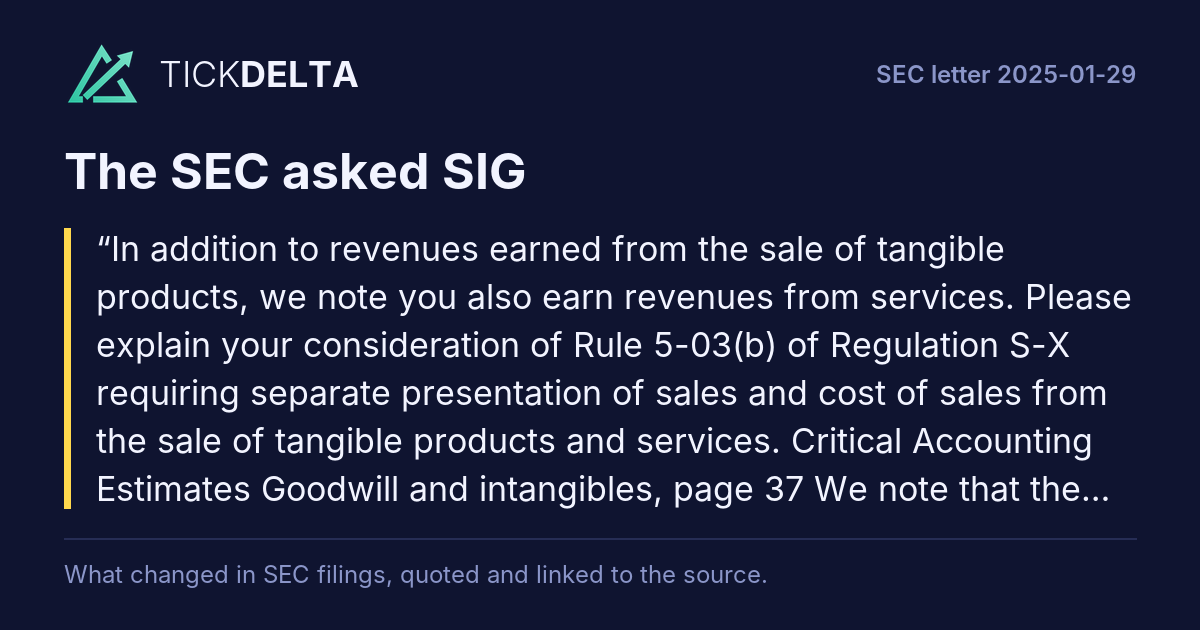
In addition to revenues earned from the sale of tangible products, we note you also earn revenues from services. Please explain your consideration of Rule 5-03(b) of Regulation S-X requiring separate presentation of sales and cost of sales from the sale of tangible products and services.
Rest of the question

Critical Accounting Estimates Goodwill and intangibles, page 37 We note that the Diamonds Direct reporting unit estimated fair value exceeded its carrying value by 11%. Please tell us your consideration of also disclosing the carrying value of Diamonds Direct goodwill in order to provide investors with 2. additional information that allows for an assessment of a future material impairment charge.

SIG answered
We respectfully acknowledge the Staff’s comment. As the Staff notes, we earn revenues from both the sale of tangible products and services. As discussed in Item 1 of the Form 10-K (page 13), the services business is highly integrated into our retail operations. The Company’s revenues earned from services are from two primary components: 1) the jewelry repair business and 2) the sale of extended service plans on merchandise sold through our retail channels.

In evaluating the Company’s presentation and disclosures in the consolidated financial statements as it relates to the services business,
Rest of the answer

we considered the guidance in Rule 5-03(b) of Regulation S-X as follows:

•We considered the thresholds noted in Section 210.5.03(b) which state “If income is derived from more than one of the sub-captions described under § 210.5-03.1, each class which is not more than 10 percent of the sum of the items may be combined with another class. If these items are combined, related costs and expenses as described under § 210.5-03.2 shall be combined in the same manner.” The Company’s services revenue for the fiscal years ended January 29, 2022, January 28, 2023, and February 3, 2024 was approximately $645 million, $707 million, and $742 million, respectively, which represented 8.2%, 9.0% and 10.3%, respectively, of the Company’s consolidated revenue for those periods. The Company’s measure for cost of sales for the services business was less than 5% of consolidated cost of sales for each of the periods presented.

•While services revenue exceeded the 10% threshold for the first time for the fiscal year ended February 3, 2024, management concluded to not present this revenue and the related costs separately on the face of the consolidated statements of operations. The services revenue for all periods presented was disclosed in Note 3, Revenue Recognition (page 73) to our Form 10-K, within the disaggregated revenue tables as required under ASC 606-10-50-5. Management planned to monitor during fiscal year 2025 and if services revenue remained above the 10% threshold it would update its presentation in future filings.

•In planning for the upcoming 10-K filing for the fiscal year ended February 1, 2025, management has continued to monitor and evaluate this historical presentation, considering the continued growth of our services business. As a result of this evaluation, the Company will present services revenue separately on the face of the consolidated statements of operations for all years presented beginning with the Form 10-K for the year ended February 1, 2025.

•As noted above, the Company’s measure for cost of sales for the services business was less than 5% of consolidated cost of sales for each of the periods presented. This measure includes direct costs for labor and materials to provide the services. Under the Company’s cost structure, the retail merchandise and services businesses share a significant amount of non-allocable, fixed operating costs such as rent, utilities and depreciation. Specifically, the sale of extended service plans (which represent approximately 70% of the services revenue) is fully integrated with the sale of jewelry, and thus, the revenues and costs from the sale of extended service plans would not occur without the related sale of jewelry. Similarly, the Company’s jewelry repair business (representing the remaining portion of the services revenue) also shares the same operating costs. As such, and in consideration of § 210.5-03.2 which permits such shared costs to be included with costs of tangible goods sold, we do not believe separate presentation of the costs of services and costs of merchandise on the face of the consolidated statements of operations would provide useful information to investors, and in fact could be distortive due to the integrated nature of the businesses. Further, based on the guidance in ASU 2023-07 (Segment Reporting (Topic 280): Improvements to Reportable Segment Disclosures), the Company will disclose its measure for cost of services, in addition to merchandise costs and other cost of sales, separately within the Segment Reporting note as significant segment expenses beginning with the Form 10-K for the year ended February 1, 2025.

Read in the reply
In its next report

First report after the company's reply of Feb 19, 2025: 10-K filed Mar 19, 2025 ↗, against the 10-K filed Mar 21, 2024 ↗.

Tickdelta does not hold the text of both reports, so they are not compared here.
Also in this review: closing letter, 2025-03-03

Form 10-K for the Fiscal Year Ended February 2, 2019

2019-09-12 to 2019-10-31 · 6 questions · 2 letters from the SEC, 2 from the company
Review closed 2019-10-31
Goodwill and impairmentLeasesNon-GAAP measuresIncome taxesRevenue
Notes to the Consolidated Financial Statements
SEC asked (2)
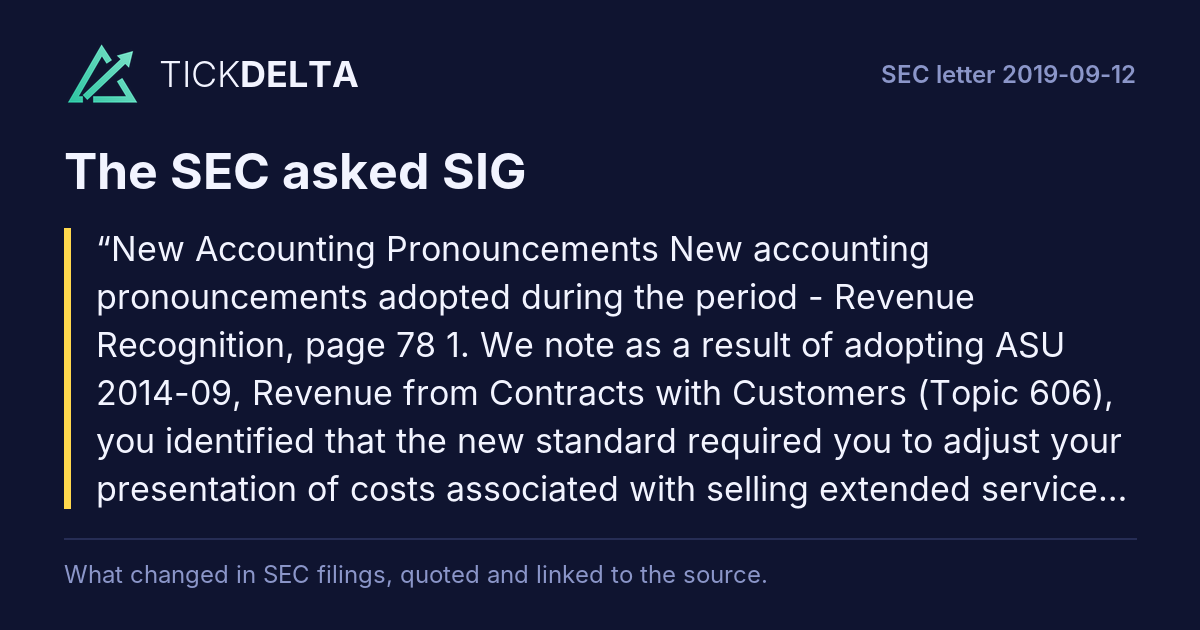
New Accounting Pronouncements New accounting pronouncements adopted during the period - Revenue Recognition, page 78 1. We note as a result of adopting ASU 2014-09, Revenue from Contracts with Customers (Topic 606), you identified that the new standard required you to adjust your presentation of costs associated with selling extended service plans and treatment of the amortization of certain bonus and profit-sharing
Rest of the question

arrangements related to third-party credit card programs. The capitalization and amortization of "certain costs" associated with selling extended service plans was discontinued and are now expensed as incurred. Please tell us the nature of these "certain costs" and why your accounting complies with ASC 606. Please also tell us the nature of the costs that are capitalized. In addition, with regards to the credit card program, please describe the change in balance classification and change in amortization treatment of certain bonus and profit-sharing arrangements. Finally, please tell us whether you received any bonus or profit-sharing payments, where such payments are recorded, how they are accounted for and the guidance you applied. 4. Credit transaction, net, page 83 2. We note you recognized net charges of $167.4 million as a result of the sale of the nonprime in-house accounts receivable. Please tell us how you computed the loss and whether the loss reflects the reversal of the related allowance of $107.6 million disclosed on page 97. In addition, please tell us what facts and circumstances lead to the loss. Notes to the Condensed Consolidated Financial Statements 13. Leases, page 19

SIG answered
Capitalized contract costs

As part of the procedures performed during the Company’s adoption of ASU 2014-09, management reviewed the composition of direct selling costs incurred related to the sale of extended service plans (“ESP”). The nature of each cost was reviewed to determine if it met the criteria defined in ASC 340-40-25 for deferral, specifically the costs being incremental costs to obtain a contract with a customer that it would not have incurred if the contract had not been obtained.
Rest of the answer

Management has identified costs eligible for capitalization under the new guidance which are directly incremental to the sale of ESP including specific store incentive compensation programs (such as commissions and related fringe benefits) and costs of tender.

During the review of the composition of direct ESP selling costs, certain store incentive compensation arrangements previously capitalized by management were identified where the sale of ESP was one of multiple factors in the calculation of incentive compensation. As a result and based on the guidance in ASC subtopic 340-40, management determined these costs should be expensed as incurred prospectively. Further, upon adoption of ASU 2014-09, the portion of the deferred ESP selling costs as of February 3, 2018 related to these store incentive compensation arrangements was reclassified to beginning retained earnings in the amount of $16.5 million.

Balance sheet classification

The change in balance classification is referencing the impact of the change in accounting for returns reserve. Prior to the adoption of ASU 2014-09, the Company recognized a sales return reserve within accrued expenses. Subsequent to the adoption of ASU 2014-09 and in accordance with ASC Topic 606, the Company revised its sales return reserve presentation such that a refund liability is recognized within current liabilities and an asset for recovery is presented within current assets.

Third-party credit card programs

The change in amortization treatment of certain signing bonus and profit-sharing arrangements related to third-party credit card programs is referencing specific elements of the Company’s strategic initiative to outsource its North America private label credit card programs as disclosed in Note 4 of Form 10-K for the fiscal year ended February 2, 2019. Prior to the adoption of ASU 2014-09, the Company recognized these items as offsets to selling, general and administrative expenses in the consolidated income statements.

As part of the procedures performed during the Company’s adoption of ASU 2014-09, management reviewed the terms of its existing private label credit card programs and identified the programs as being a normal, ordinary activity which enable incremental retail sales, as well as builds customer loyalty. Management concluded that the nature of the promise to maintain and support the private label credit card programs, (including soliciting new accounts, marketing the program, maintaining infrastructure, training personnel, access to licenses and customer lists) was a series of distinct services being fulfilled on a daily basis. For providing these services, the Company received various forms of variable consideration. As a result and in accordance with ASC Topic 606, the Company revised its policy and records these items as incremental revenue included within sales in the consolidated income statements.

Management also reviewed the manner by which the performance obligations are required to be fulfilled, noting performance was required over time. Certain performance obligations, including the signing bonus, require performance in a steady, even manner throughout the term of the agreement. For these obligations, revenue is recognized on a straight-line basis. Other performance obligations, including the profit-sharing arrangements, require periodic assessments of performance during distinct periods throughout the term of the agreement. For these obligations, revenue is recognized only when the performance obligations have been satisfied by the Company. The unamortized portion of the signing bonus is presented within other current and non-current liabilities within the consolidated balance sheets.

4. Credit transaction, net, page 83

2. We note you recognized net charges of $167.4 million as a result of the sale of the nonprime in-house accounts receivable. Please tell us how you computed the loss and whether the loss reflects the reversal of the related allowance of $107.6 million disclosed on page 97. In addition, please tell us what facts and circumstances lead to the loss.

Response:

The net charge of $167.4 million was comprised of $160.4 million of valuation losses recognized (net of the reversal of the related allowance of $107.6 million) related to the non-prime in-house accounts receivable portfolio and $7.0 million of transaction costs related to the sale of the portfolio which were expensed as incurred.

With respect to the valuation losses, including the timing of when the losses were recognized by the Company, below is a brief summary of events disclosed in the Form 10-K for the year ended February 2, 2019 and incremental information regarding the facts that lead to the loss:

–

As of February 3, 2018, the Company presented its non-prime in-house accounts receivable portfolio net of an allowance for credit losses, which represented management’s estimate of incurred losses as of the balance sheet date as required under ASC Topic 310 “Receivables”.

In March 2018, the Company entered into a definitive agreement to sell the non-prime in-house accounts receivable portfolio at a price expressed as 72% of the par value of the accounts receivable eligible at the time of the transaction closing. At the time the decision was made to sell the portfolio and in accordance with guidance in ASC 310-10-35-49, management transferred the accounts receivable into the “held for sale” classification, reversed the related allowance of $107.6 million and recognized an incremental loss to write down the accounts receivable to the lower of cost or fair value as required for held for sale accounts receivable. Although this transaction impacted the first quarter of Fiscal 2019, the terms of the agreement were considered in management’s fair value measurement disclosure related to the in-house finance receivable portfolio in Note 19 of Form 10-K for the year ended February 3, 2018.

For each fiscal period subsequent to entering into the definitive agreement to sell the portfolio in March 2018, the Company utilized a discounted cash flow model to estimate fair value, which included forecasting activity within the portfolio to determine the composition of the portfolio expected at the transaction close date. The results from this model were utilized by management to determine the incremental loss required to be recognized each period. The primary activity included within the model related to collections, write-offs and interest income (yield) which directly impact the composition of the portfolio as of the expected transaction closing date, which would then be subject to the sale price described above.

As a result, incremental losses recognized between March 2018 when the definitive agreement was signed and June 2018 when the transaction closed are directly attributable to continuing to operate the business in its normal course. This included the generation of new accounts, sales, collections, write-offs and other activity within the portfolio.

Notes to the Condensed Consolidated Financial Statements

13. Leases, page 19

Read in the reply
Notes to the Consolidated Financial Statements
SEC asked (3)
In future filings, please provide the required ASC 840 disclosures for all periods that continue to be reported in accordance with ASC 840 or explain why such disclosures are not required. Reference is made to ASC 842-10-65-1(jj). 14. Goodwill and intangibles
SIG answered
We acknowledge the Staff’s comment. In future filings, we will provide the description of lease designations and future minimum payments as required by ASC 840 for periods that continue to be reported in accordance with ASC 840.

14. Goodwill and intangibles, page 20
Read in the reply
Goodwill, page 20
SEC asked (4)
We note you recorded a non-cash out-of-period adjustment of $47.7M related to Zales and R2Net goodwill, which were related to an error in the calculation of goodwill impairments during fiscal 2019. Please provide us with your materiality assessment in accordance with ASC 250-10-S99-1 and S99-2 and explain to us why the error is considered immaterial to the prior year and the current year.
SIG answered
As disclosed in Note 14 of the Form 10-Q for quarterly period ended August 3, 2019, the Company recognized a non-cash immaterial out-of-period adjustment of $47.7 million, with $35.2 million related to Zales goodwill and $12.5 million related to R2Net goodwill, within goodwill and intangible impairments on the condensed consolidated statements of operations related to an error in the calculation of goodwill impairments during Fiscal 2019.

The out-of-period adjustment related to the Zales goodwill related to the correction of an error resulting from a calculation performed during the first
Rest of the answer

quarter of Fiscal 2019. The out-of-period adjustment related to the R2Net goodwill related to the correction of an error resulting from a calculation performed during the fourth quarter of Fiscal 2019. The goodwill from the Zales and R2Net acquisitions is reported within the North America reportable segment.

The Company considered the provisions of SAB 99 and ASC 250-10-S99-1, Accounting Changes and Error Corrections (“ASC 250”) in determining the quantitative and qualitative materiality of the error, with further commentary on each of these criteria provided below:

Quantitative analysis

The Company’s approach to assessing materiality includes a quantitative analysis of net assets under the iron curtain approach and net income under both the iron curtain and rollover approaches. The Company evaluated the quantitative impacts of this error on its consolidated financial statements for the following periods:

13 week period ended May 4, 2018 (First quarter of Fiscal 2019)

Fiscal year ended February 2, 2019 (Fiscal 2019)

(Forecasted) Fiscal year ended February 1, 2020 (Fiscal 2020)

Within our consolidated income statements or statements of operations, the error impacted amounts reported in the goodwill and intangible impairments line, as well as all subtotals which included the the goodwill and intangible impairment line. Significant subtotals reported by management include operating income, income (loss) before income taxes, net income (loss) and net income (loss) attributable to common shareholders. Additionally, the adjustment would have impacted earnings (loss) per share in each period. The quantitative impacts of the adjustments on significant line items for each period is summarized in the table below as a percentage change to the reported amount:

% change

First Quarter Fiscal 2019

Fiscal 2019

Fiscal 2020

(Forecasted)

Goodwill and intangible impairments

7.8

%

6.5

100.0

Operating income (loss)

6.1

6.2

***

Income (loss) before income taxes

6.0

5.9

Net income (loss)

7.0

7.2

Net income (loss) attributable to common shareholders

6.9

Diluted earnings (loss) per share

***With respect to Fiscal 2020, management has evaluated the impact of the adjustment on the forecasted full year results and does not expect it to have a significant impact on the Company’s profitability or trends as discussed further in the evaluation of qualitative factors below.

Within our consolidated balance sheets, the error impacted the amounts reported in the following line items: goodwill; total assets; retained earnings; total shareholders’ equity; and total liabilities, redeemable convertible preferred shares and shareholders’ equity. The quantitative impacts of the adjustments on significant line items as of each reporting date is summarized in the table below as a percentage of the reported amount:

As of

May 5,

2018

February 2,

2019

Goodwill

16.1

Total assets

0.7

1.1

Total shareholders’ equity

1.8

3.9

There was no material impact on the statement of cash flows as the error represented the correction of a non-cash impairment charge with all line items impacted being presented within operating activities.

Qualitative analysis

Management also considered the impact of the error, individually and in the aggregate, in its qualitative analysis and concluded the following:

The impact of this error on the income statement and profitability in Fiscal 2019 was mitigated by the large loss incurred by the previously recognized non-cash impairment charges during the first quarter ($448.7 million), fourth quarter ($286.7 million) and full year Fiscal 2019 ($735.4 million); also, it is considered a non-GAAP add back to the model used by analysts and as such does not factor in to how the analysts’ evaluate or forecast the financial performance of the Company;

The impact of recognizing the adjustment in the Fiscal 2020 consolidated income statement is not expected to have a significant impact on the Company’s full year profitability or trends; Further, management highlights the adjustment is non-cash and has no impact on expected operating cash flows for the Company in Fiscal 2020;

The misstatements do not have a significant impact on the profitability or trends within the North America segment, which represents approximately 90% of the Company’s sales and total assets, in any of the relevant periods for the same reasons as described above;

The misstatements individually and in the aggregate do not affect Signet’s compliance with any loan covenants or other contractual requirements within the relevant periods as the impairment charges are non-cash and added back for purposes of the Company’s leverage ratio and fixed charge coverage ratio;

The misstatements do not affect management’s compensation as it is determined by the compensation committee based on non-GAAP results, which adjust for non-recurring items such as impairment charges;

The error did not hide a failure to meet consensus expectations as goodwill and intangible impairment charges are added back for purposes of determining non-GAAP earnings and EPS measures as disclosed within the Company’s quarterly earnings releases; and

The misstatements do not appear to be a potential for market reaction as analyst and investor questions focused on the non-GAAP operating results of the business.

Additionally, from a qualitative perspective, ASC 250 also provides that a change of an item in a financial report is material if, in the light of surrounding circumstances, the magnitude of the item is such that it is probable that the judgment of a reasonable person relying upon the report would have been changed or influenced by the inclusion or correction of the item. Based on the factors noted and conclusions reached above under our SAB 99 analysis, the Company believes the correction of the error would not change a reasonable investor’s view of the reports containing the error.

Materiality conclusion

After considering both the quantitative and qualitative assessments of the error noted above, the Company believes there are no factors that would suggest the error has a material impact on the prior year or current year consolidated financial statements.

Read in the reply
Financial Guidance, page 6
SEC asked (5)
We note that you provide a non-GAAP tax rate as part of your fiscal 2020 guidance. Please revise to include the appropriate reconciliation required by Item 10(e) of Regulation S-K, or provide disclosure that you are relying on the "unreasonable efforts" exception in Regulation G.
Rest of the question

Please refer to Question 102.10 of the SEC Staff's Compliance and Disclosure Interpretations on Non-GAAP Financial Measures, updated April 4, 2018.

SIG answered
We acknowledge the Staff’s comment and the guidance set forth in Question 102.10 of the Non-GAAP Financial Measures Compliance and Disclosure Interpretations. The Company confirms that it will comply with the guidance, in future filings, when preparing its public disclosures. The information below illustrates what the incremental disclosure would have been if the changes were incorporated into the Form 8-K filed on September 5, 2019:

Fiscal 2020 Guidance Low End

Fiscal 2020 Guidance High End

GAAP effective tax rate

17.0

19.0

Charges related to transformation plan

4.0

2.5

Loss related
Rest of the answer

to goodwill and intangible impairment

(5.3

)%

(4.9

Read in the reply
In its next report

First report after the company's reply of Sep 26, 2019: 10-Q filed Dec 5, 2019 ↗, against the 10-Q filed Sep 5, 2019 ↗.

Tickdelta does not hold the text of both reports, so they are not compared here.

GAAP to Non-GAAP Reconciliations, page 10
SEC asked (6)
We note that you present adjustments net of related tax effects to arrive at non-GAAP diluted EPS for fiscal year 2020 and Q3 of fiscal year 2020. Please note that income taxes should be shown as a separate line item and clearly explained.
Rest of the question

Please revise your presentations of non-GAAP diluted EPS in future earnings releases to comply with the guidance in Question 102.11 of the SEC Staff's Compliance and Disclosure Interpretations on Non-GAAP Financial Measures, updated April 4, 2018.

SIG answered
We acknowledge the Staff’s comment and, in future earnings releases where we provide non-GAAP diluted EPS, we will provide a quantitative analysis which separately presents and clearly explains the income taxes associated with the non-GAAP measure. The information below illustrates what the incremental disclosure would have been if the changes were incorporated into the Form 8-K filed on September 5, 2019:

Diluted EPS

$

0.87

1.33

1.35

1.16

0.91

0.14

Tax impact of items above

(0.36

)

(0.31

Non-GAAP Diluted EPS

2.91

3.23

Q3

(1.48

(1.21

0.15

0.05

0.03

—

(1.16

(1.02
Read in the reply
In its next report

First report after the company's reply of Sep 26, 2019: 10-Q filed Dec 5, 2019 ↗, against the 10-Q filed Sep 5, 2019 ↗.

Tickdelta does not hold the text of both reports, so they are not compared here.

Notes to the Consolidated Financial Statements
SEC asked
Goodwill and intangibles, page 20 1. We reviewed your response to comment 4. With respect to the impact of the error on the current year we note qualitatively you do not expect it to be material to your profitability or trends in 2020. Please explain why the error is quantitatively immaterial to the current year in light of your guidance.
SIG answered
1. We reviewed your response to comment 4. With respect to the impact of the error on the current year we note qualitatively you do not expect it to be material to your profitability or trends in 2020. Please explain why the error is quantitatively immaterial to the current year in light of your guidance.

The Company’s current US GAAP guidance for Fiscal 2020 includes sales of $6.0 - $6.03 billion, operating income of $142 - $172 million, and diluted earnings per share of $0.87 - $1.33. Management assessed the impact of the error quantitatively on these metrics.
Rest of the answer

When viewed in comparison with Company’s historical performance specifically as it relates to operating income (loss) (Fiscal 2019 operating loss of $765 million, Fiscal 2018 operating income of $580 million and Fiscal 2017 operating income of $763 million), Fiscal 2020 operating income is approaching breakeven. The Fiscal 2020 operating income guidance includes the expected initial results of the Company’s multi-year transformation plan.

Given Fiscal 2020 operating income guidance is approaching breakeven especially after considering the large operating loss in Fiscal 2019, Management does not believe there is a meaningful relationship between operating income and the error in the context of a $6 billion business. Management believes that at this stage of the Company’s transformation taken as a whole, the comparison of the error to sales is the appropriate metric to measure materiality. The error, $48 million, when compared to the projected $6 billion of sales is less than 1%. At less than 1% of sales, it is not quantitatively material.

Management also restates that it considered the impact of the error in its qualitative analysis and concluded the following:

•

The impact of this error on the income statement and profitability in Fiscal 2020 is considered a non-GAAP add back to the model used by analysts and as such does not factor in to how the analysts evaluate or forecast the financial performance of the Company; further, management highlights the adjustment is non-cash and has no impact on expected operating cash flows for the Company in Fiscal 2020;

The error does not have a significant impact on the profitability or trends within the North America segment, which represents approximately 90% of the Company’s sales, in any of the relevant periods for the same reasons as described above;

The error does not affect Signet’s compliance with any loan covenants or other contractual requirements as the impairment charge is non-cash and added back for purposes of the Company’s debt covenant calculations;

The error does not affect management’s compensation as it is determined by the compensation committee based on non-GAAP results, which adjust for non-recurring items such as impairment charges;

The error did not hide a failure to meet consensus expectations as goodwill and intangible impairment charges are added back for purposes of determining non-GAAP earnings and EPS measures as disclosed within the Company’s quarterly earnings release; and,

The error does not appear to be a potential for market reaction as analyst and investor questions focus on the non-GAAP operating results of the business.

Additionally, from a qualitative perspective, ASC 250 also provides that a change of an item in a financial report is material if, in the light of surrounding circumstances, the magnitude of the item is such that it is probable that the judgment of a reasonable person relying upon the report would have been changed or influenced by the inclusion or correction of the item. Based on the factors noted and conclusions reached above under our SAB 99 analysis, the Company believes the correction of the error would not change a reasonable investor’s view of the reports containing the error. Further, Management also notes that subsequent to the second quarter earnings release which included disclosure of the error correction, the Company’s stock has experienced an upward trend which supports the conclusion that a reasonable person relying upon the report was not influenced by the inclusion or correction of the item.

Materiality Conclusion

After considering both the quantitative and qualitative assessments of the error noted above, the Company believes there are no factors that would suggest the error has a material impact on the current year consolidated financial statements. This conclusion has been reviewed by KPMG LLP’s National Office.

Read in the reply

Also in this review: closing letter, 2019-10-31

From the SEC's correspondence on EDGAR: staff letters (form UPLOAD) and company letters (form CORRESP), 8 letters filed since 2019-09-12. Questions and answers are matched by their numbers; topics come from words in each question. The reports are compared word for word (same form, before the first SEC letter against the first report after the company's reply). No AI.

Sources

The SEC's correspondence on EDGAR: staff letters (form UPLOAD) and company letters (form CORRESP), matched question by question. No AI.

Also

Filings: the letters in the filing list.

Work with it

Excel workbook · CSV. Google Sheet that stays up to date: paste =IMPORTDATA("https://tickdelta.com/company/SIG/export.csv") into a cell.

Next in Owners and insiders:Insider trades
Esc

Type a ticker such as AAPL, a name, an investor such as Buffett, or a topic such as tariffs. ↑ ↓ to move, Enter to open.