Form 10-K for the Fiscal Year Ended December 31, 2019
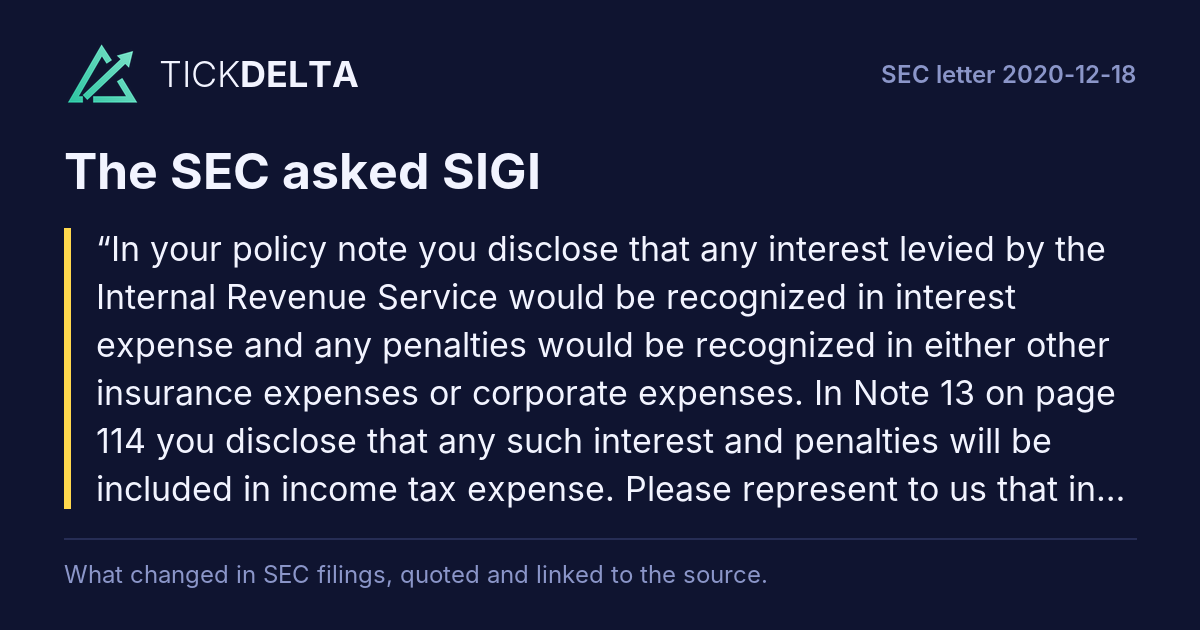
In your policy note you disclose that any interest levied by the Internal Revenue Service would be recognized in interest expense and any penalties would be recognized in either other insurance expenses or corporate expenses. In Note 13 on page 114 you disclose that any such interest and penalties will be included in income tax expense.Rest of the question
Please represent to us that in future filings you will revise your disclosure to remove this inconsistency. Notes to Unaudited Interim Consolidated Financial Statements Note 1: Basis of Presentation and Accounting Policies (b) Accounting Policies
We represent we will consistently disclose all interest and penalties levied by the Internal Revenue Service as federal income tax expense in future filings.Read in the reply
Form 10-Q for the Quarterly Period Ended September 30, 2020
Notes to Unaudited Interim Consolidated Financial Statements
Note 1: Basis of Presentation and Accounting Policies
(b) Accounting Policies
First report after the company's reply of Jan 5, 2021: 10-K filed Feb 12, 2021 ↗, against the 10-K filed Feb 12, 2020 ↗.
Tickdelta does not hold the text of both reports, so they are not compared here.
Although we note that you have adopted ASU 2016-13 and that you revised your investment policy note to reflect your current expected credit losses on investment securities, you continue to refer to other than-temporary impairments ("OTTI").Rest of the question
As both temporary impairments and OTTI were constructs of predecessor requirements and the length of time a security's fair value is below amortized cost is no longer a factor as to whether a charge to earnings for that security's impairment is warranted, please represent to us that you will revise your policy and other investment disclosures (including that on the face of your statements of income) to remove reference to OTTI for periods after January 1, 2020.
We represent we will revise our policy and other investment disclosures (including on the face of our statements of income) to remove all temporary and other-than-temporary impairment references in future filings.Read in the reply
In sub-note (f) on page 13 you disclose that you do not have exposure to any credit concentration risk of a single issuer greater than 10% of your stockholders' equity, other that certain U.S. government agencies.Rest of the question
We note that on page 54 of your September 30, 2020 Form 10-Q you provided more granular information about the credit quality of your investment portfolio compared to prior practice in your annual and quarterly reports. Please tell us whether you have exposure to any significant industry sector concentrations in your corporate securities and overall investment portfolios and your consideration for disclosing the information required by ASC 825-10-50-21 in your upcoming Form 10-K. In your response, specifically tell us your exposures to the industries you identify as being negatively impacted by the COVID-19 pandemic in the first bullet of your risk factor on page 56 of your September 30, 2020 Form 10-Q.
Expanded Disclosure:Read in the reply
We believe we do not have significant exposure to industries impacted by the COVID-19 pandemic; however, to provide our investors, creditors, and analysts with additional insight into our investment portfolio’s credit quality, we expanded our investment disclosures on page 54 of our September 30, 2020 Form 10-Q. We feel this additional disclosure was warranted in light of the economic uncertainty and market volatility created by COVID-19.Rest of the answer
We will continue to review and evaluate our investment disclosures in light of the impact of COVID-19 and other factors, including ASC 825-10-50-21, as we prepare our upcoming 2020 Form 10-K.
Sector Concentrations:
On a quarterly basis, we review our investment portfolio for concentrations of credit risk in accordance with ASC 825-10-50-21. The following three sectors represent more than 10% of our fixed income securities portfolio, each of which are discussed more fully below:
($ in millions) September 30, 2020 December 31, 2019
Major Asset Category Sector Fair Value Net Unrealized Gain Weighted Average Credit Rating % of Fixed Income Portfolio Fair Value Net Unrealized Gain Weighted Average Credit Rating % of Fixed Income Portfolio
RMBS Agency RMBS $1,090.1 $58.2 AAA 17% $1,367.8 $40.7 AAA 22%
Corporate Securities Financials 1,045.8 70.6 A16% 925.2 42.5 A15%
State and Municipal Obligations Special Revenue Bonds 970.1 60.7 AA15% 954.0 48.5 AA16%
Agency RMBS within RMBS
Our September 30, 2020 Form 10-Q provides additional details on our RMBS portfolio on page 54. As we illustrated, agency RMBS represented 92% of our RMBS allocation as of September 30, 2020 and 94% as of December 30, 2019. These securities are “AAA” rated, so we did not believe additional disclosure was warranted.
Financials within Corporate Securities
We discuss corporate securities on page 64 of our 2019 Form 10-K, including the investment grade (90%) versus non-investment grade (10%) allocation in this portfolio and our approach to mitigating the risk of an individual issuer’s default by maintaining a diverse portfolio of holdings. No individual issuer comprised more than 1% of our fixed income securities portfolio at December 31, 2019 and September 30, 2020. Within our allocation to corporate securities, financials is our most significant industry concentration at 16% of our fixed income securities portfolio at September 30, 2020. The corporate securities portfolio allocation to financials is well diversified by issuer and its weighted average credit rating of “A-” has not changed since our 2019 Form 10-K disclosure. As shown in the corporate securities table below, the next highest sector allocation within our corporate securities allocation is consumer non-cyclicals at 4% at December 31, 2019 and 5% at September 30, 2020. Considering this and any potential changes due to COVID-19, we did not believe we had a significant concentration of credit risk within our corporate securities allocation of our investment portfolio that warranted additional disclosure. We will review this concentration again as we prepare our 2020 Form 10-K.
Special Revenue Bonds within State and Municipal Obligations
The special revenue municipal obligation category is reviewed in conjunction with our disclosure on page 64 of our 2019 Form 10-K, which we plan to disclose in our 2020 Form 10-K. This portfolio is well diversified with approximately 70% of the dedicated revenue stream at December 31, 2019 from (i) essential services (55%), which is comprised of transportation, water and sewer, and electric, and (ii) education (15%), which includes school districts and higher education, including state-wide university systems. As of September 30, 2020, we did not believe there was a significant change in the state concentration or credit quality of this sector of our portfolio compared to our 2019 Form 10-K disclosure. The weighted average credit rating of our special revenue municipal bonds allocation was “AA-” at September 30, 2020. Therefore, we did not believe it was necessary to disclose further detailed information related to this sector in our quarterly report. We will review this conclusion again as we prepare our 2020 Form 10-K.
Corporate Securities:
Aside from the financials allocation within corporate securities, no other sector within our corporate securities portfolio represents more than 10% of our fixed income securities portfolio. The sector composition of this portfolio is provided in the table below:
Sector Fair Value Weighted Average Credit Rating % of Fixed Income Portfolio Fair Value Weighted Average Credit Rating % of Fixed Income Portfolio
Financials $1,045.8 A16% $925.2 A15%
Consumer Non-Cyclicals 298.2 BBB+ 5% 259.7 BBB+ 4%
Communications 148.5 BBB+ 2% 129.8 BBB+ 2%
Consumer Cyclicals* 143.7 BBB2% 136.0 BBB 2%
Technology 115.9 BBB+ 2% 81.6 BBB+ 1%
Energy 101.7 BBB 2% 104.7 BBB 2%
Utilities 74.2 BBB+ 1% 37.6 BBB+ 1%
Bank Loans 73.1 B 1% 65.6 B 1%
Basic Materials 37.3 BBB1% 26.7 BBB- <1%
Other Industrials 196.8 BBB 3% 158.5 BBB 3%
Other 79.0 BBB+ 1% 39.2 BBB+ 1%
Total Corporate Securities $2,314.2 BBB+ 36% $1,964.6 BBB+ 32%
*Included in consumer cyclicals are travel and leisure, as well as retail exposures.
In the first bullet of the risk factor on page 56 of our September 30, 2020 Form 10-Q, we identified certain industries, namely travel, leisure, retail, energy, and real estate, as being negatively impacted by COVID-19. Travel, leisure, and retail are included in consumer cyclicals in the table above. Our exposure to these sectors within our consumer cyclicals portfolio as of September 30, 2020 was as follows:
•Travel: $24.7 million fair value, $0.4 million net unrealized loss, “BBB-” weighted average credit rating;
•Leisure: $19.7 million fair value, $0.5 million net unrealized gain, “BB” weighted average credit rating; and
•Retail: $42.6 million fair value, $3.1 million net unrealized gain, “BBB” weighted average credit rating.
Overall, our allocation to these sectors that were negatively impacted by COVID-19 is not significant, and in the aggregate, these positions were in a net unrealized gain at September 30, 2020. The net unrealized gain position of the consumer cyclical and energy sectors at September 30, 2020, was marginally higher compared to the net unrealized gain position at December 31, 2019 as follows:
($ in millions) Net Unrealized Gain
Sector September 30, 2020 December 31, 2019
Consumer Cyclicals $6.1 $4.7
Energy 6.1 3.8
As these sectors were not material to our fixed income securities portfolio, we did not separately discuss or disclose them on page 54 of our September 30, 2020 Form 10-Q. As we prepare our 2020 Form 10-K, we will evaluate these sectors and include discussion about their materiality to our portfolio.
Mortgage-backed securities represent our most significant exposure to real estate, and we have provided a further breakdown of our mortgage-backed securities on page 54 of our September 30, 2020 Form 10-Q.
We also have some modest direct and indirect exposure to travel, leisure, retail, energy, and real estate within our allocations to Equity Securities and Other Investments. Our allocation to Equity Securities and Other Investments comprise only approximately 6% of the total fair value of our overall investment portfolio. Therefore, we do not believe any further disaggregation across those components of our portfolio would change the analysis discussed herein.
In preparing our 2020 Form 10-K, we will continue to analyze all of this information to determine whether any significant concentrations within our investment portfolio exist and require further disclosure.
First report after the company's reply of Jan 5, 2021: 10-K filed Feb 12, 2021 ↗, against the 10-K filed Feb 12, 2020 ↗.
Tickdelta does not hold the text of both reports, so they are not compared here.
Also in this review: closing letter, 2021-01-07