Paragraph 17 · 47% changed
Every version of it
Screener
/
SEC EDGAR
/CIK 0001650729
/10-K filed Feb 19, 2026, compared with Feb 20, 2025
/Numbers from the XBRL of the 10-Ks
NYSE
Industrials · Professional & Commercial Equipment & Supplies
SiteOne Landscape Supply, Inc. SITE
The 10-K against last year's
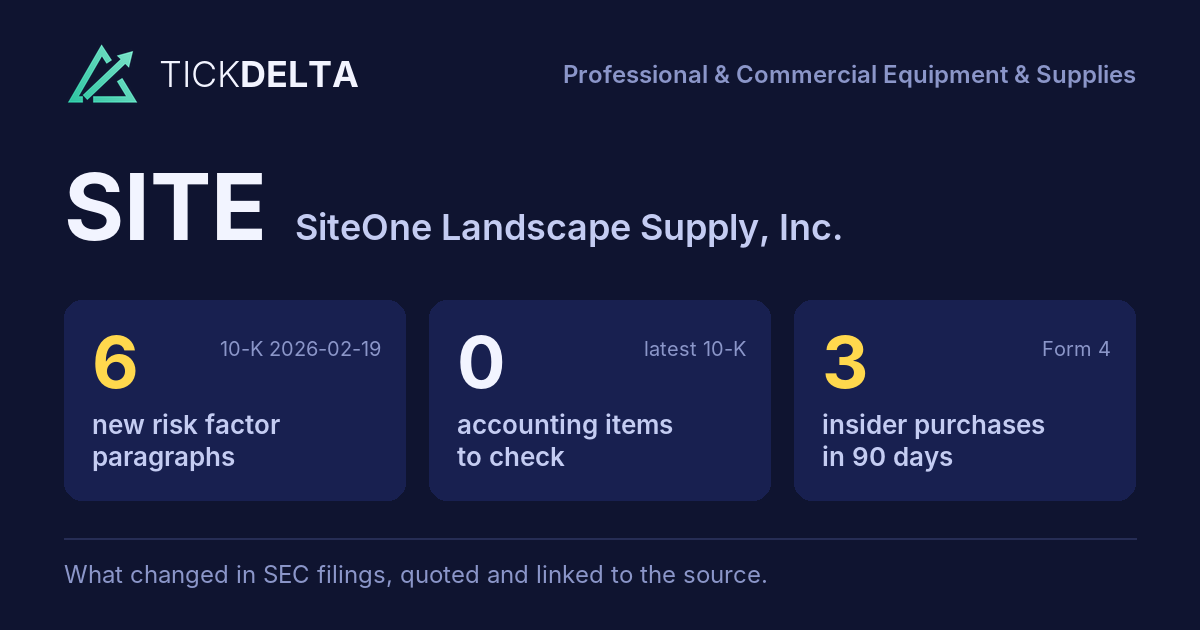
159 changes: 8 added, 56 removed, 92 reworded, 3 quiet changes
10-K Feb 19, 2026 vs Feb 20, 2025
Risk Factors
24.4%
of the text changed · 10,724 words now · 6 new paragraphs, 44 gone
MD&A
17.7%
of the text changed · 10,218 words now · 2 new paragraphs, 12 gone
Legal Proceedings
26.1%
of the text changed · 553 words now
Accounting Policies
11.1%
of the text changed · 6,447 words now
10-K 0001650729-26-000005 (Feb 19, 2026) vs 10-K 0001650729-25-000004 (Feb 20, 2025)
Every paragraph, and how much of it changed
One bar per paragraph, in the order of the 10-K. Height and colour show the share of its words not in the closest paragraph a year earlier; the tallest bars are new paragraphs.
Risk Factors
115 paragraphs · 6 new · 36 reworded · 44 gone · 10-K Feb 19, 2026 against Feb 20, 2025
New paragraph
Reworded (5% of its words or more)
Same or nearly
Paragraph 21 · 42% changed
Every version of it
Laws and government regulations applicable to governing several aspects of our business operations could increase our legal costs, restrict our operations or product offerings, expose us to liabilities, and regulatory expenses, and impact adversely affect our reputation, business, financial position, results of operations, and cash flows.
Paragraph 23 · 42% changed
Every version of it
In addition, in the United States, products containing herbicides and pesticides generally must be registered with the U.S. Environmental Protection Agency (“EPA”) and similar state agencies before they can be sold or distributed. The failure to obtain obtain, maintain, or renew these registrations, or the cancellation or withdrawal of any such registration, or the withdrawal from the marketplace of such products, could have an adverse effect on restrict our business, the ability to sell affected products. The severity of which any impact would depend in part on the products involved, whether other products could be substituted, the availability of substitutes, and whether our competitors were are similarly affected. The Many of the herbicides and pesticides we use supply are manufactured by independent third parties and are evaluated by the subject to ongoing EPA as part of its ongoing exposure risk assessment. The EPA assessments, which may decide that a herbicide result in limitations or pesticide we use will be limited or will not be re-registered for use in the United States. non‑re‑registration of certain active ingredients. We cannot predict the outcome or timing of these evaluations or their impacts on product availability, demand, or costs. Even when we comply with applicable regulations and maintain required registrations and licenses, our products may be alleged to cause harm to the severity of the effect of the EPA’s continuing evaluations. environment, people, or animals, or may be banned or restricted in certain circumstances, and we are subject to such allegations from time to time. Regulations applicable to our customers, and any failure by them to comply, could also expose us to liabilities or adversely affect demand for our products.
Paragraph 20 · 41% changed
Every version of it
Paragraph 9 · 40% changed
Every version of it
Paragraph 8 · 38% changed
Every version of it
Our business and results of operations are significantly affected by general business, economic and financial market, and economic market conditions. General business, economic and financial market, and economic market conditions that could impact the level of activity in the wholesale landscape supply industry include the level of new home sales and construction activity, interest rate fluctuations, inflation, inflation and deflation, unemployment levels, geopolitics, tax rates, capital spending, bankruptcies, volatility in both the debt and equity capital markets, liquidity of the global financial markets, volatility, any government shutdown, the availability and cost of credit, investor and consumer confidence, global economic growth, local, state and federal government regulation, and the strength of regional and local economies in which we operate. With respect to the residential construction sector in particular, spending on landscape projects is largely discretionary and lower levels of consumer spending or the decision by homeowners to perform landscape upgrades or maintenance themselves rather than outsource to contractors, or to focus less on outdoor projects may adversely affect our business. While the rate of inflation has stabilized since reaching historic levels in the 2022 and 2023 Fiscal Years, we continued to experience the adverse impact of an inflationary environment in the 2024 Fiscal Year, and we cannot predict whether adverse economic conditions such as these will continue, the impact that future economic developments will have on consumers, or the manner in which negative economic trends will impact consumer demand or preferences over the long term.
Paragraph 22 · 38% changed
Every version of it
We are subject to extensive federal, state, provincial, and local environmental, health and safety laws and regulations, including laws regulations that regulate the emission or discharge of materials into the environment, environment; govern the use, packaging, labeling, transportation, handling, treatment, storage, disposal, and management of chemicals and hazardous substances and waste, waste; and protect the health and safety of our associates and users of our products. Such These requirements also include consumer protection, wage and hour, immigration and labor relations, permitting and licensing, building codes, worker safety, employee benefits, marketing and advertising, and laws also impose governing the application and use of herbicides, pesticides, and other chemicals. Noncompliance with, or liability for investigation under, any of these laws and remediation failures, regulations can result in investigations, enforcement actions, and damages resulting from, present and past releases of hazardous substances, including releases at sites we have ever owned, leased or operated, or used as a disposal site. We could be subject to fines, penalties, significant civil or criminal sanctions, penalties, as well as third‑party claims for personal injury, property damage, or other third-party claims as a result of violations of, or liabilities under, these laws and regulations. damages. We could also incur significant investigation substantial costs to investigate and cleanup costs for remediate contamination at any currently or formerly owned owned, leased, or operated facilities, including LESCO’s manufacturing and blending facilities. In addition, changes or at disposal sites we have used. Changes in, or new interpretations of, existing laws, regulations, or enforcement policies, policies; the discovery of previously unknown contamination, contamination; or the imposition of other new environmental liabilities or obligations in the future, health‑related obligations, including obligations with respect those related to any potential health hazards of our products, may lead to could require additional compliance measures, capital investments, or other operational changes that increase costs that could have a material adverse effect on and adversely affect our business, financial position, results of operations, and cash flows. business.
Paragraph 10 · 30% changed
Every version of it
Paragraph 17 · 47% changed
Every version of it
10-K Feb 20, 2025Most of our facilities are located in leased premises. Many of our current leases are non-cancelable and typically have terms ranging from three to five years, with options to renew for specified periods of time. We believe that leases we enter into in the future will likely be long-term and non-cancelable and have similar renewal options. However, we may be unable to renew our current or future leases on favorable terms or at all, which could have an adverse effect on our operations and costs. In addition, if we close a location, we generally remain committed to perform our obligations under the applicable lease, which include, among other things, payment of the base rent for the balance of the lease term.
10-K Feb 19, 2026
We incur significant operating expenses for occupancy, fuel, vehicle maintenance, equipment, parts, wages and salaries, employee benefits, health care, self-insurance and other insurance premiums, and regulatory compliance, among other items. Persisting inflationary pressures and other external market variables have, and may continue to, result in supply chain constraints, elevated energy prices, labor shortages, and uncertain trade policies, contributing to higher operating costs. Additionally, most of our facilities are located in leased premises, many of which are long-term and non-cancelable, typically with three- to five-year terms and renewal options. We may be unable to renew leases on favorable terms or at all, and if we close a location, we generally remain obligated to perform under the applicable lease, including with respect to payment of base rent for the balance of the term, which could adversely affect our operations and costs.
Paragraph 21 · 42% changed
Every version of it
10-K Feb 20, 2025
Laws and government regulations applicable to our business could increase our legal and regulatory expenses, and impact our business, financial position, results of operations, and cash flows.
10-K Feb 19, 2026
Laws and regulations governing several aspects of our operations could increase our costs, restrict our operations or product offerings, expose us to liabilities, and adversely affect our reputation, business, financial position, results of operations, and cash flows.
Paragraph 23 · 42% changed
Every version of it
10-K Feb 20, 2025
In addition, in the United States, products containing herbicides and pesticides generally must be registered with the U.S. Environmental Protection Agency (“EPA”) and similar state agencies before they can be sold or distributed. The failure to obtain or the cancellation of any such registration, or the withdrawal from the marketplace of such products, could have an adverse effect on our business, the severity of which would depend in part on the products involved, whether other products could be substituted, and whether our competitors were similarly affected. The herbicides and pesticides we use are manufactured by independent third parties and are evaluated by the EPA as part of its ongoing exposure risk assessment. The EPA may decide that a herbicide or pesticide we use will be limited or will not be re-registered for use in the United States. We cannot predict the outcome or the severity of the effect of the EPA’s continuing evaluations.
10-K Feb 19, 2026
In the United States, products containing herbicides and pesticides generally must be registered with the U.S. Environmental Protection Agency (“EPA”) and similar state agencies before they can be sold or distributed. The failure to obtain, maintain, or renew these registrations, or the cancellation or withdrawal of any such registration, could restrict our ability to sell affected products. The severity of any impact would depend on the products involved, the availability of substitutes, and whether competitors are similarly affected. Many of the herbicides and pesticides we supply are manufactured by third parties and are subject to ongoing EPA exposure risk assessments, which may result in limitations or non‑re‑registration of certain active ingredients. We cannot predict the outcome or timing of these evaluations or their impacts on product availability, demand, or costs. Even when we comply with applicable regulations and maintain required registrations and licenses, our products may be alleged to cause harm to the environment, people, or animals, or may be banned or restricted in certain circumstances, and we are subject to such allegations from time to time. Regulations applicable to our customers, and any failure by them to comply, could also expose us to liabilities or adversely affect demand for our products.
Paragraph 20 · 41% changed
Every version of it
10-K Feb 20, 2025Market variables and other events outside of our control could cause our Cost of goods sold and operating costs to grow more rapidly than Net sales, which could result in lower Gross profit and gross margin as well as lower Net income.
10-K Feb 19, 2026
Our inability to mitigate or pass through increased product and operating costs as a result of market variables outside of our control in a timely manner, or at all, could cause our Cost of goods sold and operating costs to grow more rapidly than Net sales, resulting in lower Gross profit, gross margin, and Net income. As a result, any of these factors, individually or in combination, could adversely affect our business, financial condition, results of operations, liquidity, and cash flows.
Paragraph 9 · 40% changed
Every version of it
10-K Feb 20, 2025Our business and results of operations are significantly affected by general business, financial market, and economic conditions. General business, financial market, and economic conditions that could impact the level of activity in the wholesale landscape supply industry include the level of new home sales and construction activity, interest rate fluctuations, inflation, unemployment levels, geopolitics, tax rates, capital spending, bankruptcies, volatility in both the debt and equity capital markets, liquidity of the global financial markets, the availability and cost of credit, investor and consumer confidence, global economic growth, local, state and federal government regulation, and the strength of regional and local economies in which we operate. With respect to the residential construction sector in particular, spending on landscape projects is largely discretionary and lower levels of consumer spending or the decision by homeowners to perform landscape upgrades or maintenance themselves rather than outsource to contractors, or to focus less on outdoor projects may adversely affect our business. While the rate of inflation has stabilized since reaching historic levels in the 2022 and 2023 Fiscal Years, we continued to experience the adverse impact of an inflationary environment in the 2024 Fiscal Year, and we cannot predict whether adverse economic conditions such as these will continue, the impact that future economic developments will have on consumers, or the manner in which negative economic trends will impact consumer demand or preferences over the long term.
10-K Feb 19, 2026
With respect to the residential construction sector in particular, spending on landscape projects is largely discretionary. Therefore, lower levels of consumer spending or homeowners determining to perform landscape upgrades or maintenance themselves (rather than outsource to contractors), or to focus less on outdoor projects more generally may adversely affect our business. While the rate of inflation has moderated, we have continued to experience the adverse impact of inflationary pressures and other adverse economic conditions, and we cannot predict whether these adverse economic conditions will continue, the impact that future economic developments will have on consumers, or the manner in which negative economic trends will impact consumer demand or preferences over the long-term.
Paragraph 8 · 38% changed
Every version of it
10-K Feb 20, 2025
Our business and results of operations are significantly affected by general business, financial market, and economic conditions. General business, financial market, and economic conditions that could impact the level of activity in the wholesale landscape supply industry include the level of new home sales and construction activity, interest rate fluctuations, inflation, unemployment levels, geopolitics, tax rates, capital spending, bankruptcies, volatility in both the debt and equity capital markets, liquidity of the global financial markets, the availability and cost of credit, investor and consumer confidence, global economic growth, local, state and federal government regulation, and the strength of regional and local economies in which we operate. With respect to the residential construction sector in particular, spending on landscape projects is largely discretionary and lower levels of consumer spending or the decision by homeowners to perform landscape upgrades or maintenance themselves rather than outsource to contractors, or to focus less on outdoor projects may adversely affect our business. While the rate of inflation has stabilized since reaching historic levels in the 2022 and 2023 Fiscal Years, we continued to experience the adverse impact of an inflationary environment in the 2024 Fiscal Year, and we cannot predict whether adverse economic conditions such as these will continue, the impact that future economic developments will have on consumers, or the manner in which negative economic trends will impact consumer demand or preferences over the long term.
10-K Feb 19, 2026
Our business and results of operations are significantly affected by general business, economic and financial market conditions. General business, economic and financial market conditions that could impact the level of activity in the wholesale landscape supply industry include the level of new home sales and construction activity, interest rate fluctuations, inflation and deflation, unemployment levels, geopolitics, tax rates, capital spending, bankruptcies, volatility, any government shutdown, the availability and cost of credit, investor and consumer confidence, global economic growth, local, state and federal government regulation, and the strength of regional and local economies in which we operate.
Paragraph 22 · 38% changed
Every version of it
10-K Feb 20, 2025
We are subject to federal, state, provincial, and local environmental, health and safety laws and regulations, including laws that regulate the emission or discharge of materials into the environment, govern the use, packaging, labeling, transportation, handling, treatment, storage, disposal, and management of chemicals and hazardous substances and waste, and protect the health and safety of our associates and users of our products. Such laws also impose liability for investigation and remediation failures, and damages resulting from, present and past releases of hazardous substances, including releases at sites we have ever owned, leased or operated, or used as a disposal site. We could be subject to fines, penalties, civil or criminal sanctions, personal injury, property damage, or other third-party claims as a result of violations of, or liabilities under, these laws and regulations. We could also incur significant investigation and cleanup costs for contamination at any currently or formerly owned or operated facilities, including LESCO’s manufacturing and blending facilities. In addition, changes in, or new interpretations of, existing laws, regulations, or enforcement policies, the discovery of previously unknown contamination, or the imposition of other environmental liabilities or obligations in the future, including obligations with respect to any potential health hazards of our products, may lead to additional compliance or other costs that could have a material adverse effect on our business, financial position, results of operations, and cash flows.
10-K Feb 19, 2026
We are subject to extensive federal, state, provincial, and local laws and regulations that regulate the emission or discharge of materials into the environment; govern the use, packaging, labeling, transportation, handling, treatment, storage, disposal, and management of chemicals and hazardous substances and waste; and protect the health and safety of our associates and users of our products. These requirements also include consumer protection, wage and hour, immigration and labor relations, permitting and licensing, building codes, worker safety, employee benefits, marketing and advertising, and laws governing the application and use of herbicides, pesticides, and other chemicals. Noncompliance with, or liability under, any of these laws and regulations can result in investigations, enforcement actions, and significant civil or criminal penalties, as well as third‑party claims for personal injury, property damage, or other damages. We could incur substantial costs to investigate and remediate contamination at currently or formerly owned, leased, or operated facilities, or at disposal sites we have used. Changes in, or new interpretations of, existing laws, regulations, or enforcement policies; the discovery of previously unknown contamination; or the imposition of new environmental or health‑related obligations, including those related to potential health hazards of our products, could require additional compliance measures, capital investments, or operational changes that increase costs and adversely affect our business.
Paragraph 10 · 30% changed
Every version of it
10-K Feb 20, 2025Disruptions in credit or financial markets could, among other things, lead to impairment charges, make it more difficult for us to obtain, or increase our cost of obtaining, financing for our operations or investments or to refinance our indebtedness, cause our lenders to depart from prior credit industry practice and not give technical or other waivers under the Credit Facilities (as defined under “—Risks Related to Our Current Indebtedness” below), to the extent we may seek them in the future, thereby causing us to be in default under one or more of the Credit Facilities. These disruptions could also cause our customers to encounter liquidity issues that could lead to a reduction in the amount of our products purchased or services used, could result in an increase in the time it takes our customers to pay us, or could lead to a decrease in pricing for our products, any of which could adversely affect our accounts receivable, among other things, and, in turn, increase our working capital needs. In addition, adverse developments at federal, state, and local levels associated with budget deficits resulting from economic conditions could result in federal, state, and local governments increasing taxes or other fees on businesses, including us, to generate more tax revenues, which could negatively impact spending by customers on our products.
10-K Feb 19, 2026
Additionally, disruptions or volatility in financial markets could, among other things, lead to impairment charges, make it more difficult for us to obtain, or increase our cost of obtaining, financing for our operations or investments or to refinance our indebtedness, cause our lenders to depart from prior credit industry practice and not give technical or other waivers for potential defaults under the Credit Facilities. These disruptions could also cause our customers to encounter liquidity issues that may lead to a reduction in the amount of our products purchased or services used, result in an increase in the time it takes our customers to pay us or lead to a decrease in pricing for our products, any of which could adversely affect our financial position, results of operations, and cash flows.
MD&A
143 paragraphs · 2 new · 49 reworded · 12 gone · 10-K Feb 19, 2026 against Feb 20, 2025
New paragraph
Reworded (5% of its words or more)
Same or nearly
Paragraph 66 · 37% changed
Paragraph 27 · 33% changed
•In December 2024, November 2025, we acquired the assets and assumed the liabilities of Custom Stone. French Broad Stone Yards, LLC (“French Broad”). With six two locations across Texas, Custom Stone in Arden and Brevard, North Carolina, French Broad is a wholesale distributor of hardscape hardscapes products to landscape professionals.
Paragraph 59 · 33% changed
SG&A for the 2024 2025 Fiscal Year increased 10% 2% to $1,385.1 $1,415.6 million from $1,256.6 $1,385.1 million for the 2023 Fiscal Year. SG&A as a percentage of Net sales increased 130 basis points to 30.5% for the 2024 Fiscal Year compared to 29.2% for the 2023 Fiscal Year. The increase in SG&A, including Compensation, Facility, and Depreciation and amortization, Delivery, and Other Selling, general, and administrative expenses amortization was primarily due to the impact of acquisitions with higher operating costs. Facility expenses also increased acquisitions. SG&A as a result percentage of Net sales decreased 40 basis points to 30.1% for the consolidations 2025 Fiscal Year compared to 30.5% for the 2024 Fiscal Year, primarily driven by improved operating leverage from our productivity initiatives and closures of certain branches and other locations in the fourth quarter of 2024. better cost alignment with market demand.
Paragraph 28 · 32% changed
•In April 2024, November 2025, we acquired the assets and assumed the liabilities of Eggemeyer Land Clearing, LLC (“Eggemeyer”). CC Landscaping Warehouse Plus, Inc. (“CC Landscaping”). With one location in New Braunfels, Texas, Eggemeyer Bradenton, Florida, CC Landscaping is a wholesale distributor of nursery products, bulk materials, and landscape supplies to landscape professionals.
Paragraph 29 · 32% changed
•In December 2024, October 2025, we acquired the assets and assumed the liabilities of OakStreet Wholesale Nursery, LLC (“OakStreet”). Red’s Home and Garden, LP and Red’s Home and Garden GP, Inc. (collectively “Red’s Home and Garden”). With one location in Fairview, Texas, OakStreet Wilkesboro, North Carolina, Red’s Home and Garden is a wholesale distributor of nursery and hardscapes products to landscape professionals.
Paragraph 58 · 32% changed
Gross profit for the 2024 2025 Fiscal Year increased 5% to $1,560.1 $1,635.2 million as compared to $1,491.2 $1,560.1 million for the 2023 2024 Fiscal Year. Gross profit growth was driven by higher Net sales growth, including acquisitions. sales. Gross margin decreased 30 increased 40 basis points to 34.8% for the 2025 Fiscal Year as compared to 34.4% for the 2024 Fiscal Year as compared to 34.7% for the 2023 Fiscal Year. The decrease increase in gross margin primarily reflects lower improved price realization, benefits from our commercial initiatives, and a positive contribution from acquisitions, partially offset by contributions from acquisitions with higher gross margins. freight and logistics costs supporting our growth.
Paragraph 67 · 30% changed
Net income attributable to SiteOne for the 2024 2025 Fiscal Year decreased 29% increased 23% to $123.6 $151.8 million as compared to $173.4 $123.6 million for the 2023 2024 Fiscal Year. The decrease increase in Net income was primarily due to the negative impact of commodity product deflation Net sales growth, improved gross margin, and lower price realization. SG&A as a percentage of Net sales.
Paragraph 30 · 28% changed
•In June 2024, September 2025, we acquired the assets and assumed the liabilities of Cohen & Cohen Natural Autumn Ridge Stone and Landscape Supply, Inc. (“Cohen & Cohen”). (“Autumn Ridge”). With one location in Ottawa, Ontario, Canada, Cohen & Cohen Holland, Michigan, Autumn Ridge is a wholesale distributor of hardscapes products and landscape supplies to landscape professionals.
Paragraph 66 · 37% changed
10-K Feb 20, 2025Net income attributable to non-controlling interest was $0.8 million for the 2024 Fiscal Year as a result of the acquisition of Devil Mountain in April 2024. There was no Net income attributable to non-controlling interest for the 2023 Fiscal Year.
10-K Feb 19, 2026
Adjustment of non-controlling interest to redemption value was $3.6 million for the 2025 Fiscal Year as a result of adjustments of the carrying amount of the Redeemable non-controlling interest to what would be the redemption value assuming the security was redeemable as of December 28, 2025. There was no Adjustment of non-controlling interest to redemption value for the 2024 Fiscal Year.
Paragraph 27 · 33% changed
10-K Feb 20, 2025
•In December 2024, we acquired the assets and assumed the liabilities of Custom Stone. With six locations across Texas, Custom Stone is a wholesale distributor of hardscape products to landscape professionals.
10-K Feb 19, 2026
•In November 2025, we acquired the assets and assumed the liabilities of French Broad Stone Yards, LLC (“French Broad”). With two locations in Arden and Brevard, North Carolina, French Broad is a wholesale distributor of hardscapes products to landscape professionals.
Paragraph 59 · 33% changed
10-K Feb 20, 2025
SG&A for the 2024 Fiscal Year increased 10% to $1,385.1 million from $1,256.6 million for the 2023 Fiscal Year. SG&A as a percentage of Net sales increased 130 basis points to 30.5% for the 2024 Fiscal Year compared to 29.2% for the 2023 Fiscal Year. The increase in SG&A, including Compensation, Facility, Depreciation and amortization, Delivery, and Other Selling, general, and administrative expenses was primarily due to the impact of acquisitions with higher operating costs. Facility expenses also increased as a result of the consolidations and closures of certain branches and other locations in the fourth quarter of 2024.
10-K Feb 19, 2026
SG&A for the 2025 Fiscal Year increased 2% to $1,415.6 million from $1,385.1 million for the 2024 Fiscal Year. The increase in SG&A, including Compensation, Facility, and Depreciation and amortization was primarily due to the impact of acquisitions. SG&A as a percentage of Net sales decreased 40 basis points to 30.1% for the 2025 Fiscal Year compared to 30.5% for the 2024 Fiscal Year, primarily driven by improved operating leverage from our productivity initiatives and better cost alignment with market demand.
Paragraph 28 · 32% changed
10-K Feb 20, 2025
•In April 2024, we acquired the assets and assumed the liabilities of Eggemeyer Land Clearing, LLC (“Eggemeyer”). With one location in New Braunfels, Texas, Eggemeyer is a wholesale distributor of bulk landscape supplies to landscape professionals.
10-K Feb 19, 2026
•In November 2025, we acquired the assets and assumed the liabilities of CC Landscaping Warehouse Plus, Inc. (“CC Landscaping”). With one location in Bradenton, Florida, CC Landscaping is a wholesale distributor of nursery products, bulk materials, and landscape supplies to landscape professionals.
Paragraph 29 · 32% changed
10-K Feb 20, 2025
•In December 2024, we acquired the assets and assumed the liabilities of OakStreet Wholesale Nursery, LLC (“OakStreet”). With one location in Fairview, Texas, OakStreet is a wholesale distributor of nursery products to landscape professionals.
10-K Feb 19, 2026
•In October 2025, we acquired the assets and assumed the liabilities of Red’s Home and Garden, LP and Red’s Home and Garden GP, Inc. (collectively “Red’s Home and Garden”). With one location in Wilkesboro, North Carolina, Red’s Home and Garden is a wholesale distributor of nursery and hardscapes products to landscape professionals.
Paragraph 58 · 32% changed
10-K Feb 20, 2025
Gross profit for the 2024 Fiscal Year increased 5% to $1,560.1 million as compared to $1,491.2 million for the 2023 Fiscal Year. Gross profit growth was driven by Net sales growth, including acquisitions. Gross margin decreased 30 basis points to 34.4% for the 2024 Fiscal Year as compared to 34.7% for the 2023 Fiscal Year. The decrease in gross margin primarily reflects lower price realization, partially offset by contributions from acquisitions with higher gross margins.
10-K Feb 19, 2026
Gross profit for the 2025 Fiscal Year increased 5% to $1,635.2 million as compared to $1,560.1 million for the 2024 Fiscal Year. Gross profit growth was driven by higher Net sales. Gross margin increased 40 basis points to 34.8% for the 2025 Fiscal Year as compared to 34.4% for the 2024 Fiscal Year. The increase in gross margin reflects improved price realization, benefits from our commercial initiatives, and a positive contribution from acquisitions, partially offset by higher freight and logistics costs supporting our growth.
Paragraph 67 · 30% changed
10-K Feb 20, 2025
Net income attributable to SiteOne for the 2024 Fiscal Year decreased 29% to $123.6 million as compared to $173.4 million for the 2023 Fiscal Year. The decrease in Net income was primarily due to the negative impact of commodity product deflation and lower price realization.
10-K Feb 19, 2026
Net income attributable to SiteOne for the 2025 Fiscal Year increased 23% to $151.8 million as compared to $123.6 million for the 2024 Fiscal Year. The increase in Net income was primarily due to Net sales growth, improved gross margin, and lower SG&A as a percentage of Net sales.
Paragraph 30 · 28% changed
10-K Feb 20, 2025
•In June 2024, we acquired the assets and assumed the liabilities of Cohen & Cohen Natural Stone Inc. (“Cohen & Cohen”). With one location in Ottawa, Ontario, Canada, Cohen & Cohen is a wholesale distributor of hardscapes to landscape professionals.
10-K Feb 19, 2026
•In September 2025, we acquired the assets and assumed the liabilities of Autumn Ridge Stone and Landscape Supply, Inc. (“Autumn Ridge”). With one location in Holland, Michigan, Autumn Ridge is a wholesale distributor of hardscapes products and landscape supplies to landscape professionals.
A paragraph is matched with the one last year that shares the most of its words; under half in common makes it new. The paragraphs shown are the 8 reworded the most in each section.
The paragraph that changed most in each section
The redline
Marked against last year's 10-K: cut words struck through, new words highlighted.
Risk Factors214 words changed in this paragraph; it is 51% similar to last year's version.
We are subject to extensive federal, state, provincial, and local environmental, health and safety laws and regulations, including laws regulations that regulate the emission or discharge of materials into the environment, environment; govern the use, packaging, labeling, transportation, handling, treatment, storage, disposal, and management of chemicals and hazardous substances and waste, waste; and protect the health and safety of our associates and users of our products. Such These requirements also include consumer protection, wage and hour, immigration and labor relations, permitting and licensing, building codes, worker safety, employee benefits, marketing and advertising, and laws also impose governing the application and use of herbicides, pesticides, and other chemicals. Noncompliance with, or liability for investigation under, any of these laws and remediation failures, regulations can result in investigations, enforcement actions, and damages resulting from, present and past releases of hazardous substances, including releases at sites we have ever owned, leased or operated, or used as a disposal site. We could be subject to fines, penalties, significant civil or criminal sanctions, penalties, as well as third‑party claims for personal injury, property damage, or other third-party claims as a result of violations of, or liabilities under, these laws and regulations. damages. We could also incur significant investigation substantial costs to investigate and cleanup costs for remediate contamination at any currently or formerly owned owned, leased, or operated facilities, including LESCO’s manufacturing and blending facilities. In addition, changes or at disposal sites we have used. Changes in, or new interpretations of, existing laws, regulations, or enforcement policies, policies; the discovery of previously unknown contamination, contamination; or the imposition of other new environmental liabilities or obligations in the future, health‑related obligations, including obligations with respect those related to any potential health hazards of our products, may lead to could require additional compliance measures, capital investments, or other operational changes that increase costs that could have a material adverse effect on and adversely affect our business, financial position, results of operations, and cash flows. business.
Source: Item 1A, 10-K 0001650729-26-000005 vs Item 1A, 10-K 0001650729-25-000004
Legal Proceedings174 words changed in this paragraph; it is 38% similar to last year's version.
As part of the sale by LESCO of its manufacturing assets in 2005, the Company retained the environmental liability associated with those assets. Remediation activities can vary substantially in duration and cost, and it is difficult to develop precise estimates of future site remediation costs. The Company recorded in Other long-term liabilities the undiscounted cost estimate of future remediation efforts of $3.9 million and $3.9 million as of December 29, 2024 and December 31, 2023, respectively. As part of the acquisition of a majority stake in the Company in December 2013 by CD&R Acquisition, from Deere, Deere agreed to pay the first $2.5 million of the this liability and the Company’s exposure is was capped at $2.4 million. In September 2025, the Company and Deere entered into agreements to settle and resolve the environmental liability arising from the LESCO sale. Under these agreements, a lump-sum settlement payment was made on September 30, 2025 to the purchaser of the LESCO manufacturing assets in exchange for a release of all related claims against both the Company and Deere, as well as the termination of certain indemnification obligations under the original LESCO sale agreement. The Company has recorded an indemnification asset in Other assets against Company’s share of the liability as a result of these actions of $1.5 million and $1.5 million as of December 29, 2024 and December 31, 2023, respectively. settlement payment was $0.5 million.
Source: Item 3, via Note 10 – Commitments and Contingencies, 10-K 0001650729-26-000005 vs Item 3, via Note 10 – Commitments and Contingencies, 10-K 0001650729-25-000004
Accounting Policies160 words changed in this paragraph; it is 66% similar to last year's version.
Non-controlling interest represents the portion of profit or loss, net assets, and comprehensive income or loss that is not allocable to the Company. A non-controlling interest that contains an option requiring the Company to purchase such ownership interest for cash is considered to be a redeemable non-controlling interest as the redemption feature is not deemed to be a freestanding financial instrument and the redemption is not solely within the Company’s control. The put and call options embedded in the Redeemable non-controlling interest did not require bifurcation as they did not meet the definition of a derivative and were considered to be clearly and closely related to the Redeemable non-controlling interest. Redeemable non-controlling interest is recorded as a temporary equity mezzanine item between liabilities and stockholders’ equity in the Consolidated Balance Sheets. In connection with the purchase accounting of the Company’s ownership interest in Devil Mountain, the Company recorded the estimated fair value of the non-controlling interest as redeemable. The carrying value of the Redeemable non-controlling interest is remeasured to allocate Net income (loss) each reporting period and by adjusting the carrying amount of the redeemable security to what would be the redemption amount assuming the security was redeemable at the balance sheet date. Any increase (decrease) in the carrying amount of the Redeemable non-controlling interest as a result of adjusting to the redemption value is recorded as an offset to retained earnings. In addition, the earnings (loss) per share (“EPS”) impact of the Redeemable non-controlling interest is included in the allocation of the Net income (loss) during the period. Should an adjustment to the redemption value of the Redeemable non-controlling interest exceed the then current fair value of the Redeemable non-controlling interest, the Company will apply the two-class method and reduce the EPS numerator by the portion of the periodic adjustment that reflects a redemption in excess of fair value. Refer to “Note 3. Acquisitions” for additional information.
Source: Item 8, Note 1 – Nature of Business and Significant Accounting Policies, 10-K 0001650729-26-000005 vs Item 8, Note 1 – Nature of Business and Significant Accounting Policies, 10-K 0001650729-25-000004
MD&A135 words changed in this paragraph; it is 64% similar to last year's version.
Source: Item 7, 10-K 0001650729-26-000005 vs Item 7, 10-K 0001650729-25-000004
Sentences and paragraphs added, removed or reworded
Every change, by type
Sentences and paragraphs of SITE's Risk Factors and MD&A, 10-K Feb 19, 2026 against 10-K Feb 20, 2025. Each links to the text at sec.gov.
Quiet changes are sentences kept from last year with one to four words changed, at least one of them a hedge, a modal or a qualifier (may, could, will, not, significant, material…). A year or date rolling forward is not counted.
The full word list
adverse, adversely, all, although, anticipate, anticipates, any, approximately, believe, believes, can, cannot, certain, could, expect, expects, generally, however, if, intend, intends, largely, likely, many, material, materially, may, might, most, must, never, no, not, possible, primarily, probable, should, significant, significantly, some, substantial, substantially, unlikely, will, would
AddedRisk Factors
Prices for the products we purchase and the costs to operate our business are subject to significant volatility and external market variables beyond our control, and we may be unable to adjust our pricing or cost structure quickly enough to avoid the adverse effects on our financial performance.
Read it in 10-K Feb 19, 2026 at sec.gov
AddedRisk Factors
We purchase and sell a wide variety of products whose prices and availability can fluctuate materially due to factors we do not control, particularly during periods of inflation or deflation. Changes in the cost of products and inputs, such as commodities used by our suppliers, such as grass seed and chemicals used in fertilizer, may not be fully or timely passed through to our customers. In a rising cost environment, if we are unable to pass cost increases through to our customers, we may experience reduced Gross profit, gross margin, and Net income. In a declining price environment, including the commodity price deflation experienced in our 2024 and 2025 Fiscal Years, we may be required to lower prices, which can reduce Net sales and adversely affect results even if volumes remain stable. Significant price fluctuations also have the potential to give rise to disputes with contractual counterparties, which can be complex and difficult to resolve. These dynamics can also increase our working capital requirements and, in turn, our levels of debt and financing costs.
Read it in 10-K Feb 19, 2026 at sec.gov
AddedRisk Factors
Additionally, trade policies and related government actions, including the imposition, increase, or extension of tariffs on goods imported into the United States, can further amplify price volatility and result in supplier price increases (such as the lighting and irrigation product price increases we experienced during the 2025 Fiscal Year). There remains significant uncertainty regarding the extent, duration, and economic impact of any future tariffs or other trade measures. Price changes associated with such policies can occur rapidly, and we might not be successful in adjusting our prices to reflect increases in our costs.
Read it in 10-K Feb 19, 2026 at sec.gov
AddedRisk Factors
Legislative and regulatory activity related to climate change, chemical and nutrient use, water use, equipment efficiency standards, and other environmental matters is evolving and expanding at the federal, state, provincial, and local levels. New or more stringent requirements, including climate‑related disclosure obligations and laws addressing greenhouse gas emissions, are expected to increase our operational, compliance, and reporting burdens. Collecting, measuring, and analyzing relevant data can be costly, time‑consuming, dependent on third‑party cooperation, and subject to uncertainty, and these requirements may necessitate additional investments in systems, processes, and product design. Such developments may also increase our energy and raw material costs and heighten litigation and enforcement risk related to our disclosures. The scope, timing, and ultimate impact of these emerging requirements remain uncertain, but they could result in higher operating costs, changes in our product mix, reduced demand for certain products, and constraints on how we conduct our business.
Read it in 10-K Feb 19, 2026 at sec.gov
AddedRisk Factors
More broadly, the cumulative effect of these legal and regulatory regimes, whether through direct compliance expenditures, constraints on product availability and use, increased monitoring and reporting obligations, or exposure to enforcement actions and third‑party claims, could adversely affect our reputation, business, financial position, results of operations, and cash flows. Failure to comply with applicable laws or regulations could also result in substantial fines or damages, litigation, loss of licenses, or other penalties that may alter how we operate our business.
Read it in 10-K Feb 19, 2026 at sec.gov
AddedRisk Factors
In addition, we have made, and in the future may make, acquisitions through joint ventures. Joint ventures inherently involve a lesser degree of control over the business operations acquired. Our joint venture partners may have economic and business interests that are inconsistent with ours and disputes between us and our joint venture partners could subject us to delays, litigation and increased expenses related to acquired businesses.
Read it in 10-K Feb 19, 2026 at sec.gov
RemovedRisk Factors
RemovedRisk Factors
Show the other 51
RemovedRisk Factors
RemovedRisk Factors
RemovedRisk Factors
RemovedRisk Factors
RemovedRisk Factors
RemovedRisk Factors
RemovedRisk Factors
RemovedRisk Factors
RemovedRisk Factors
RemovedRisk Factors
RewordedRisk Factors
RewordedRisk Factors
RewordedRisk Factors
RewordedRisk Factors
RewordedRisk Factors
RewordedRisk Factors
RewordedRisk Factors
While the rate of inflation has stabilized since reaching historic levels in the 2022 and 2023 Fiscal Years, moderated, we have continued to experience the adverse impact of an inflationary environment in the 2024 Fiscal Year, pressures and other adverse economic conditions, and we cannot predict whether these adverse economic conditions such as these will continue, the impact that future economic developments will have on consumers, or the manner in which negative economic trends will impact consumer demand or preferences over the long term. long-term.
Read it in 10-K Feb 19, 2026 at sec.gov
RewordedRisk Factors
RewordedRisk Factors
General business, economic and financial market, and economic market conditions that could impact the level of activity in the wholesale landscape supply industry include the level of new home sales and construction activity, interest rate fluctuations, inflation, inflation and deflation, unemployment levels, geopolitics, tax rates, capital spending, bankruptcies, volatility in both the debt and equity capital markets, liquidity of the global financial markets, volatility, any government shutdown, the availability and cost of credit, investor and consumer confidence, global economic growth, local, state and federal government regulation, and the strength of regional and local economies in which we operate.
Read it in 10-K Feb 19, 2026 at sec.gov
RewordedRisk Factors
RewordedRisk Factors
Laws and government regulations applicable to governing several aspects of our business operations could increase our legal costs, restrict our operations or product offerings, expose us to liabilities, and regulatory expenses, and impact adversely affect our reputation, business, financial position, results of operations, and cash flows.
Read it in 10-K Feb 19, 2026 at sec.gov
RewordedRisk Factors
We could also incur significant investigation substantial costs to investigate and cleanup costs for remediate contamination at any currently or formerly owned owned, leased, or operated facilities, including LESCO’s manufacturing and blending facilities. or at disposal sites we have used.
Read it in 10-K Feb 19, 2026 at sec.gov
Quiet changesRisk Factors
Such water shortages may also make irrigation or the maintenance of turf uneconomical. no longer economical.
Read it in 10-K Feb 19, 2026 at sec.gov
Quiet changesRisk Factors
We have not entered into any hedging arrangements that protect against fuel price increases and we do not have any long-term fuel purchase contracts.
Read it in 10-K Feb 19, 2026 at sec.gov
AddedMD&A
During the 2025 Fiscal Year, we experienced a challenging end market environment with significant headwinds as a result of economic uncertainty, elevated interest rates, weakened consumer confidence, low existing home sales, inflation and affordability concerns, as well as deflationary impacts from commodity products like grass seed and PVC pipe. While we benefitted from steady growth in the maintenance end market and we believe our commercial initiatives drove market share gains during the year, this environment continued to negatively affect consumer confidence and discretionary spending which resulted in softer demand in the new residential construction and repair and upgrade end markets. Accordingly, we anticipate continued pressure on Net sales growth and Net income for the foreseeable future. Net sales grew 4% in the 2025 Fiscal Year, primarily driven by the execution of our sales initiatives as well as contributions from acquisitions. Organic Daily Sales increased by 1% in the 2025 Fiscal Year with pricing having a negligible impact. The negative pricing trend has significantly improved from the 3% decline we experienced in 2024 and was flat in 2025. We expect the impact of pricing to contribute approximately 1% to 3% to Organic Sales growth in the 2026 Fiscal Year. Gross margin increased 40 basis points for the 2025 Fiscal Year, primarily due to improved price realization, benefits from our commercial initiatives, and a positive contribution from acquisitions, partially offset by higher freight and logistics costs supporting our growth. Selling, general and administrative expenses (“SG&A”) increased 2% for the 2025 Fiscal Year. SG&A as a percentage of Net sales decreased 40 basis points to 30.1% for the 2025 Fiscal Year compared to 30.5% for the 2024 Fiscal Year, primarily driven by improved operating leverage from productivity initiatives and better cost alignment with market demand. Net income attributable to SiteOne increased 23% for the 2025 Fiscal Year, primarily due to Net sales growth, improved gross margin, and lower SG&A as a percentage of Net sales. Net cash provided by operating activities increased to $300.5 million for the 2025 Fiscal Year compared to $283.4 million for the 2024 Fiscal Year, primarily driven by higher Net income.
Read it in 10-K Feb 19, 2026 at sec.gov
AddedMD&A
Year Qtr 4 Qtr 3 Qtr 2 Qtr 1 Year Qtr 4 Qtr 3 Qtr 2 Qtr 1 2025 Fiscal Year 2024 Fiscal Year Adjusted EBITDA attributable to non-controlling interest $ 4.2 $1.1 $1.0 $1.8 $0.3 $ 2.5 $0.8 $0.8 $0.9 $
Read it in 10-K Feb 19, 2026 at sec.gov
RemovedMD&A
RemovedMD&A
RemovedMD&A
RemovedMD&A
RemovedMD&A
RemovedMD&A
RemovedMD&A
RemovedMD&A
RemovedMD&A
RemovedMD&A
RemovedMD&A
RemovedMD&A
RewordedMD&A
The total amount of projected interest payments on long-term debt increased $18.8 decreased $36.2 million since December 31, 2023 29, 2024 to $131.2 $95.0 million, primarily due to a decrease in the extension of the remaining period to maturity date of the term loan facility loans as well as a decline in the increase in borrowings under the term loans. weighted average interest rate on long-term debt.
Read it in 10-K Feb 19, 2026 at sec.gov
RewordedMD&A
We also continue to enhance our website and B2B e-Commerce platform as well as implement new inventory planning, stocking, and transportation management system functionalities in an effort to reduce costs as well as improve our reliability and level of service. service as well as help our customers be more efficient.
Read it in 10-K Feb 19, 2026 at sec.gov
RewordedMD&A
Organic Daily Sales for landscaping products (irrigation (hardscapes, irrigation supplies, hardscapes, landscape accessories, nursery goods, and outdoor lighting) decreased 3% reflecting price deflation and weaker 1% due to softer demand in the new residential construction and repair and remodel upgrade end market. markets, partially offset by benefits from our sales initiatives.
Read it in 10-K Feb 19, 2026 at sec.gov
RewordedMD&A
December 30, 2024 to December 28, 2025 January 1, 2024 to December 29, 2024 January 2, 2023 to December 31, 2023 Compensation expenses $ 818.3 $ 776.1 $ 703.8 Facility expenses 249.5 245.1 213.9 Depreciation and amortization expenses 134.2 131.9 124.7 Delivery expenses 72.6 77.0 58.4 Other Selling, general and administrative expenses 141.0 155.0 155.8 Selling, general and administrative expenses $ 1,415.6 $ 1,385.1 $ 1,256.6
Read it in 10-K Feb 19, 2026 at sec.gov
RewordedMD&A
Landscape Holding and Landscape, as borrowers (collectively, the “Borrowers”), entered into the Fifth Amendment to the Amended and Restated Credit Agreement, the (“Fifth Amendment”), dated as of March 23, 2021, with JPMorgan Chase Bank, N.A. N.A., as administrative agent and collateral agent, the several banks and other financial institutions party thereto and certain other parties party thereto from time to time.
Read it in 10-K Feb 19, 2026 at sec.gov
RewordedMD&A
December 30, 2024 to December 28, 2025 January 1, 2024 to December 29, 2024 January 2, 2023 to December 31, 2023 Inventory costs, net of supplier incentives and discounts $ 2,800.1 $ 2,750.6 $ 2,617.7 Freight, handling, and distribution expenses 181.2 151.3 136.1 Other Cost of goods sold 88.3 78.6 56.3 Cost of goods sold $ 3,069.6 $ 2,980.5 $ 2,810.0
Read it in 10-K Feb 19, 2026 at sec.gov
RewordedMD&A
December 30, 2024 to December 28, 2025 January 1, 2024 to December 29, 2024 January 2, 2023 to December 31, 2023 Operating activities $ 300.5 $ 283.4 $ 297.5 Investing activities $ (83.4) $ (177.1) $ (226.0) Financing activities $ (134.6) $ (80.9) $ (18.3)
Read it in 10-K Feb 19, 2026 at sec.gov
RewordedMD&A
Gross margin decreased 30 increased 40 basis points to 34.8% for the 2025 Fiscal Year as compared to 34.4% for the 2024 Fiscal Year as compared to 34.7% for the 2023 Fiscal Year.
Read it in 10-K Feb 19, 2026 at sec.gov
RewordedMD&A
RewordedMD&A
Income tax expense was $45.7 million for the 2025 Fiscal Year as compared to $36.0 million for the 2024 Fiscal Year as compared to $49.8 million for the 2023 Fiscal Year.
Read it in 10-K Feb 19, 2026 at sec.gov
RewordedMD&A
RewordedMD&A
Interest and other non-operating expense, net increased 18% 10% to $35.0 million for the 2025 Fiscal Year from $31.9 million for the 2024 Fiscal Year from $27.1 million for the 2023 Fiscal Year.
Read it in 10-K Feb 19, 2026 at sec.gov
Quiet changesMD&A
As we continue to navigate through the current uncertainty presented by market and economic conditions, we believe that we are prepared to meet the challenges ahead due to our well-balanced business, strong financial condition, dedicated and experienced teams, and focused business strategy.
Read it in 10-K Feb 19, 2026 at sec.gov
Sources
The two latest 10-Ks on EDGAR, section by section. Each change links to the text at sec.gov.
Also
New risk factors: paragraphs with nothing like them last year, quoted in full.
Work with it
Excel workbook · CSV. Google Sheet that stays up to date: paste =IMPORTDATA("https://tickdelta.com/company/SITE/export.csv") into a cell.