SITIME Corp SITM
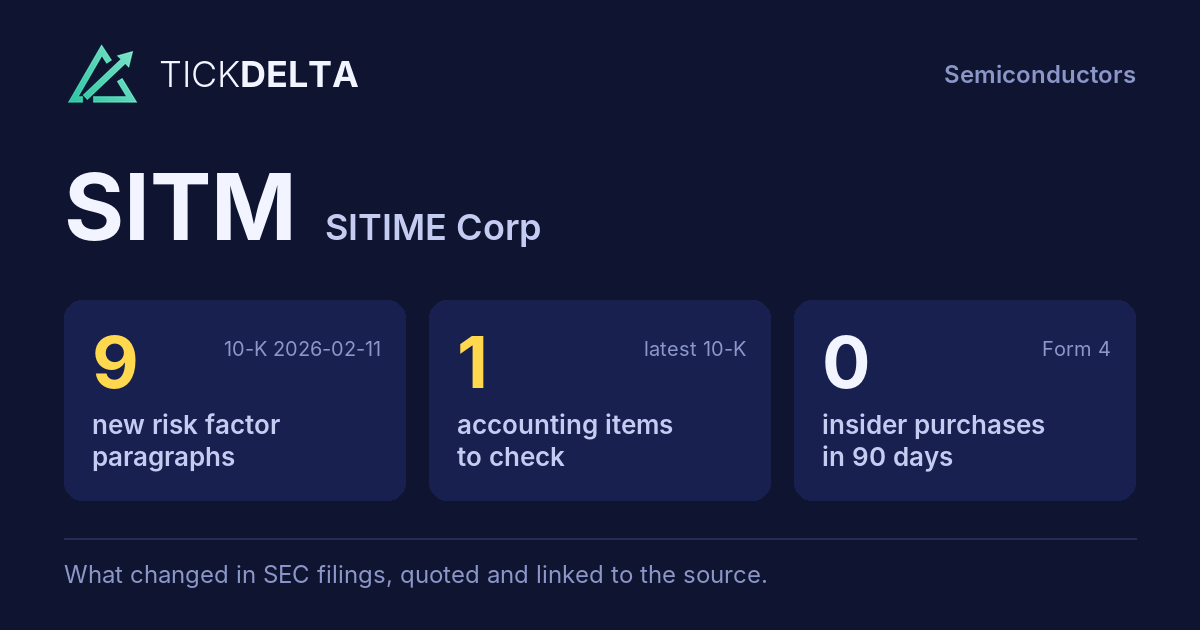
What the 10-K filed Feb 11, 2026 says off the balance sheet
10-K notesRisks that are not on the face of the balance sheet. Tickdelta picks sentences with specifics and quotes them as filed. New marks a sentence with nothing like it in the 10-K filed Feb 14, 2025.
Big customers
Customers the company names as a large share of revenue or receivables (it must name any worth 10% of revenue).
“Our top three distributors by revenue together accounted for approximately 59%, 56%, and 51% of our revenue for the years ended December 31, 2025, 2024, and 2023, respectively.”
59% in the 10-K filed 2026-02-11, 56% in the one filed 2025-02-14
Read it in the 10-K
“Based on our shipment information, we believe that revenue attributable to our ten largest end customers accounted for 65%, 59%, and 49% of our revenue for the years ended December 31, 2025, 2024, and 2023, respectively.”
65% in the 10-K filed 2026-02-11, 59% in the one filed 2025-02-14
Read it in the 10-K
“Sales attributable to Apple, our largest end customer accounted for approximately 17%, 22%, and 21% of our revenue for the years ended December 31, 2025, 2024, and 2023, respectively.”
17% in the 10-K filed 2026-02-11, 22% in the one filed 2025-02-14
Read it in the 10-K
“Our top ten direct customers, including distributors, accounted for approximately 85%, 84% and 82% of net revenues in 2025, 2024, and 2023, respectively.”
85% in the 10-K filed 2026-02-11, 84% in the one filed 2025-02-14
Read it in the 10-K
Key suppliers
Parts or manufacturing that depend on one or a few suppliers.
“Many major components, product equipment items, engineered materials, and raw materials, which are procured or subcontracted by our third-party suppliers for manufacturing of our products are procured or subcontracted on a single or sole-source basis.”
Read it in the 10-K
“Many major components, product equipment items, engineered materials, and raw materials, are procured or subcontracted on a single or sole-source basis.”
Read it in the 10-K
Lawsuits and legal claims
Pending cases, settlements and what the company has set aside for them.
“Accrual estimates are recorded when and if it is determined that such a liability for litigation and contingencies are both probable and reasonably estimable.”
Read it in the 10-K
Guarantees and indemnities
Promises to pay someone else's debts or losses if they cannot.
No specific sentence about this in the 10-K.
Debt covenants
Conditions in loan agreements that, if broken, can make debt due early.
“Typically, these obligations arise in the context of contracts that the Company has entered into, under which the Company customarily agrees to hold the other party harmless against losses arising from a breach of representations and covenants or terms and conditions related to such matters as the sale and/or delivery of its products, title to assets sold, certain intellectual property claims, defective products, specified environmental matters, and certain income taxes.”
Read it in the 10-K
Commitments off the balance sheet
Contracts the company must pay for later: purchase obligations, take-or-pay deals.
No specific sentence about this in the 10-K.
Companies it names
Tracked companies that its latest 10-K or its 8-Ks of the last year call a customer or a supplier.
No other tracked company is named as a customer or a supplier in the latest filings.
Companies that name it
Tracked companies whose latest 10-K or 8-Ks call it a customer or a supplier.
No other tracked company names it as a customer or a supplier in the latest filings.
Sentences are chosen by their words, not read by AI, so some can be off topic. Always check the filing. Open the 10-K
Sources
The notes to the financial statements, Legal Proceedings and the MD&A of the latest 10-K (and, for customers and suppliers, Business and Risk Factors), quoted as filed.
Also
Debt: the debt note in numbers.
Work with it
Excel workbook · CSV. Google Sheet that stays up to date: paste =IMPORTDATA("https://tickdelta.com/company/SITM/export.csv") into a cell.