Paragraph 139 · 46% changed
Every version of it
Screener
/
SEC EDGAR
/CIK 0001519449
/10-K filed Mar 2, 2026, compared with Mar 3, 2025
/Numbers from the XBRL of the 10-Ks
Nasdaq
Financials · Property & Casualty Insurance
Skyward Specialty Insurance Group, Inc. SKWD
The 10-K against last year's
96 changes: 42 added, 19 removed, 35 reworded
10-K Mar 2, 2026 vs Mar 3, 2025
Risk Factors
13.5%
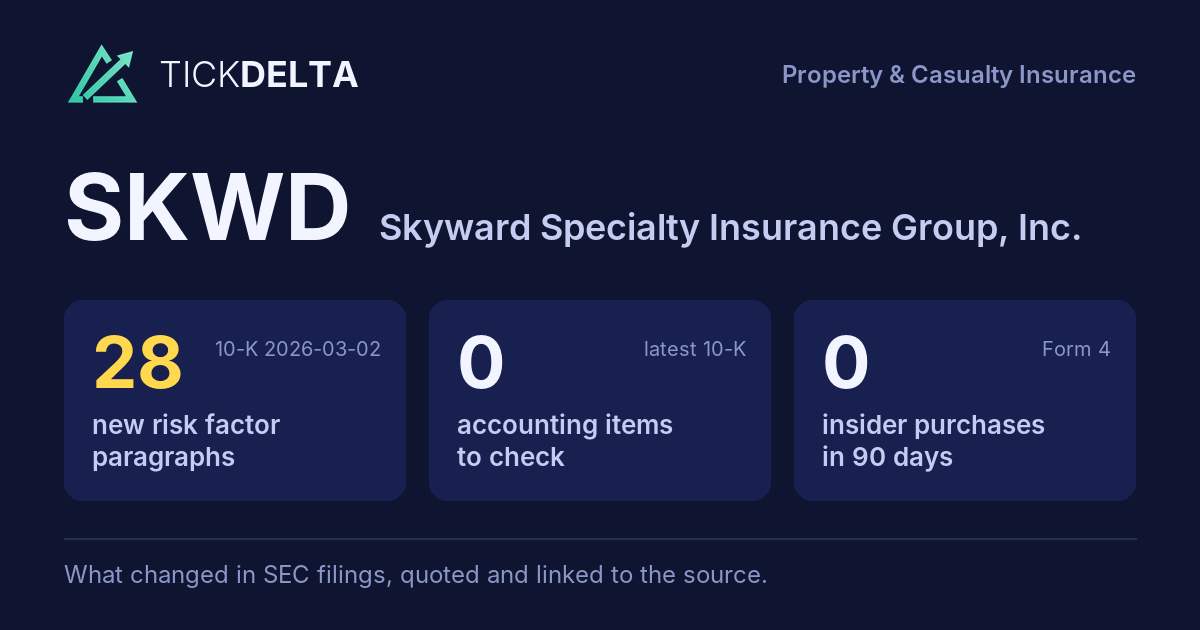
of the text changed · 14,516 words now · 28 new paragraphs, 6 gone
MD&A
26.3%
of the text changed · 7,347 words now · 14 new paragraphs, 13 gone
Legal Proceedings
0.4%
of the text changed · 229 words now
Accounting Policies
17.0%
of the text changed · 5,291 words now
10-K 0001519449-26-000015 (Mar 2, 2026) vs 10-K 0001519449-25-000011 (Mar 3, 2025)
Every paragraph, and how much of it changed
One bar per paragraph, in the order of the 10-K. Height and colour show the share of its words not in the closest paragraph a year earlier; the tallest bars are new paragraphs.
Risk Factors
202 paragraphs · 28 new · 29 reworded · 6 gone · 10-K Mar 2, 2026 against Mar 3, 2025
New paragraph
Reworded (5% of its words or more)
Same or nearly
Paragraph 187 · 46% changed
Every version of it
Provisions of our certificate of incorporation and bylaws by-laws, as well as applicable Delaware law, federal and state regulations and insurance company regulations may discourage, delay or prevent a merger, tender offer or other change of control that holders of our securities may consider favorable. Some of these provisions impose various procedural and other requirements that could make it more difficult for a third party shareholders to acquire control of us even if such a change in control would increase the value of our common stock and prevent attempts by our stockholders to replace or remove our current Board of Directors or management. affect certain corporate actions. Therefore, these provisions could adversely affect the price of our common stock. Among other things, our charter documents:
Paragraph 68 · 38% changed
Every version of it
Paragraph 156 · 38% changed
Every version of it
Our success and ability to compete depend in part on our intellectual property, which includes our rights in our brand and our proprietary technology used in certain of our product lines. We primarily rely on copyright and trade secret laws, and confidentiality agreements with our employees, customers, service providers, partners and others to protect our intellectual property rights. However, the steps we take to protect our intellectual property may be inadequate. Our efforts to enforce our intellectual property rights may be met with defenses, counterclaims and countersuits attacking the validity and enforceability and scope of our intellectual property rights. Our failure to secure, protect and enforce our intellectual property rights could adversely affect our brand and adversely impact our business.
Paragraph 98 · 34% changed
Every version of it
Paragraph 87 · 33% changed
Every version of it
Although an individual insurance company’s financial performance depends on its own specific business characteristics, the profitability of most P&C insurance companies tends to follow this cyclical market pattern with higher gross written premium growth and improved profitability during hard market cycles. Further, this cyclical market pattern can be more pronounced in the E&S market than in the standard insurance market. When the standard insurance market hardens, the E&S market typically hardens, and growth in the E&S market can be significantly more rapid than growth in the standard insurance market. Similarly, when conditions begin to soften, many customers that were previously driven into the E&S market may return to the admitted market, exacerbating the effects of rate decreases on our financial results. Finally, the market may experience “micro cycles” where certain areas of the market harden or soften independently of the market as a whole, and perhaps at a more drastic rate. As a result, our operating results are subject to fluctuation and have historically varied from quarter to quarter. We expect our quarterly results will continue to fluctuate in the future due to a number of factors, including the general economic conditions in the markets where we operate, the frequency of occurrence or severity of catastrophe or other insured events, fluctuating interest rates, claims exceeding our loss reserves, competition in our industry, deviations from expected premium retention rates of our existing policies and contracts, adverse investment performance, and the cost of reinsurance coverage.
Paragraph 22 · 32% changed
Every version of it
Paragraph 15 · 30% changed
Every version of it
Paragraph 139 · 46% changed
Every version of it
10-K Mar 3, 2025Our reinsurers may not reimburse us for claims on a timely basis, or at all, which may materially adversely affect our business, financial condition and results of operations.
10-K Mar 2, 2026
The acquisition and integration of Apollo may adversely affect our business, financial condition and results of operations.
Paragraph 187 · 46% changed
Every version of it
10-K Mar 3, 2025
Provisions of our certificate of incorporation and bylaws could make it more difficult for a third party to acquire control of us even if such a change in control would increase the value of our common stock and prevent attempts by our stockholders to replace or remove our current Board of Directors or management. Therefore, these provisions could adversely affect the price of our common stock. Among other things, our charter documents:
10-K Mar 2, 2026
Provisions of our certificate of incorporation and by-laws, as well as applicable Delaware law, federal and state regulations and insurance company regulations may discourage, delay or prevent a merger, tender offer or other change of control that holders of our securities may consider favorable. Some of these provisions impose various procedural and other requirements that could make it more difficult for shareholders to affect certain corporate actions. Therefore, these provisions could adversely affect the price of our common stock. Among other things, our charter documents:
Paragraph 68 · 38% changed
Every version of it
10-K Mar 3, 2025Our business is exposed to the risk of severe weather conditions, earthquakes and man-made catastrophes. Catastrophes can be caused by various events, including natural events such as severe winter weather, severe convective storms/tornadoes, windstorms, earthquakes, hailstorms, severe thunderstorms and fires, or man-made events such as explosions, war, terrorist attacks and riots. Over the past several years, changing weather patterns and climatic conditions, such as global warming, have added to the unpredictability and frequency of natural disasters in certain parts of the world, including in areas that have not historically been exposed to natural disasters and in the markets in which we operate. Climate change may increase the frequency and severity of extreme weather events. This effect has led to conditions in the ocean and atmosphere, including warmer-than-average sea-surface temperatures and low wind shear that increase hurricane activity, as well as drought conditions that increase wildfire risks. The occurrence of a natural disaster or other catastrophe loss could materially adversely affect our business, financial condition, and results of operations. This may include catastrophes even where we do not insure against the loss, such as the 2025 California wildfires, as homes and businesses lost or damaged due to catastrophe may otherwise cancel our policies following such event. Additionally, any increased frequency and severity of such weather events, including hurricanes or convective storms (which are difficult to model with current tools), could have a material adverse effect on our ability to predict, quantify, reinsure and manage catastrophe risk and may materially increase our losses resulting from such catastrophe events.
10-K Mar 2, 2026
catastrophes even where we do not insure against the loss, such as the 2025 California wildfires, as homes and businesses lost or damaged due to catastrophe may otherwise cancel our policies following such event. Additionally, any increased frequency and severity of such weather events, including hurricanes or convective storms (which are difficult to model with current tools), could have a material adverse effect on our ability to predict, quantify, reinsure and manage catastrophe risk and may materially increase our losses resulting from such catastrophe events.
Paragraph 156 · 38% changed
Every version of it
10-K Mar 3, 2025
Our success and ability to compete depend in part on our intellectual property, which includes our rights in our brand and our proprietary technology used in certain of our product lines. We primarily rely on copyright and trade secret laws, and confidentiality agreements with our employees, customers, service providers, partners and others to protect our intellectual property rights. However, the steps we take to protect our intellectual property may be inadequate. Our efforts to enforce our intellectual property rights may be met with defenses, counterclaims and countersuits attacking the validity and enforceability and scope of our intellectual property rights. Our failure to secure, protect and enforce our intellectual property rights could adversely affect our brand and adversely impact our business.
10-K Mar 2, 2026
Our success and ability to compete depend in part on our intellectual property, which includes our rights in our brand and our proprietary technology used in certain of our product lines. We primarily rely on copyright and trade secret laws,
Paragraph 98 · 34% changed
Every version of it
10-K Mar 3, 2025We invest the premiums we receive from our insureds until they are needed to pay policyholder claims. Consequently, we seek to manage the duration of our investment portfolio based on the duration of our losses and LAE reserves to provide sufficient liquidity and avoid having to liquidate investments to fund claims. Risks such as inadequate losses and LAE reserves or unfavorable trends in litigation could potentially result in the need to sell investments to fund these liabilities. We may not be able to sell our investments at favorable prices or at all. Sales could result in significant realized losses depending on the conditions of the general market, interest rates and credit issues with individual securities.
10-K Mar 2, 2026
liabilities. We may not be able to sell our investments at favorable prices or at all. Sales could result in significant realized losses depending on the conditions of the general market, interest rates and credit issues with individual securities.
Paragraph 87 · 33% changed
Every version of it
10-K Mar 3, 2025
Although an individual insurance company’s financial performance depends on its own specific business characteristics, the profitability of most P&C insurance companies tends to follow this cyclical market pattern with higher gross written premium growth and improved profitability during hard market cycles. Further, this cyclical market pattern can be more pronounced in the E&S market than in the standard insurance market. When the standard insurance market hardens, the E&S market typically hardens, and growth in the E&S market can be significantly more rapid than growth in the standard insurance market. Similarly, when conditions begin to soften, many customers that were previously driven into the E&S market may return to the admitted market, exacerbating the effects of rate decreases on our financial results. Finally, the market may experience “micro cycles” where certain areas of the market harden or soften independently of the market as a whole, and perhaps at a more drastic rate. As a result, our operating results are subject to fluctuation and have historically varied from quarter to quarter. We expect our quarterly results will continue to fluctuate in the future due to a number of factors, including the general economic conditions in the markets where we operate, the frequency of occurrence or severity of catastrophe or other insured events, fluctuating interest rates, claims exceeding our loss reserves, competition in our industry, deviations from expected premium retention rates of our existing policies and contracts, adverse investment performance, and the cost of reinsurance coverage.
10-K Mar 2, 2026
Although an individual insurance company’s financial performance depends on its own specific business characteristics, the profitability of most P&C insurance companies tends to follow this cyclical market pattern with higher gross written premium growth and improved profitability during hard market cycles. Further, this cyclical market pattern can be more pronounced in the E&S market than in the standard insurance market. When the standard insurance market hardens, the E&S market typically hardens, and growth in the E&S market can be significantly more rapid than growth in the standard insurance market. Similarly, when conditions begin to soften, many customers that were previously driven into the E&S market may return to the admitted market, exacerbating the effects of rate decreases on our financial results.
Paragraph 22 · 32% changed
Every version of it
10-K Mar 3, 2025We face competition from other specialty insurance companies, standard insurance companies and underwriting agencies. In particular, competition in the insurance industry is based on many factors, including price of coverage, the general reputation and perceived financial strength of the company, relationships with distribution partners, terms and conditions of products offered, ratings assigned by independent rating agencies, speed of claims payment and reputation, and the experience and reputation of the members of our underwriting team in the particular lines of insurance and reinsurance we seek to underwrite. In recent years, the insurance industry has undergone increasing consolidation, which may further increase competition. In addition, a number of new, proposed or potential industry or legislative developments could further increase competition in our industry.
10-K Mar 2, 2026
and the experience and reputation of the members of our underwriting team in the particular lines of insurance and reinsurance we seek to underwrite. In recent years, the insurance industry has undergone increasing consolidation, which may further increase competition. In addition, a number of new, proposed or potential industry or legislative developments could further increase competition in our industry.
Paragraph 15 · 30% changed
Every version of it
10-K Mar 3, 2025We are required by Section 404 of the Sarbanes‑Oxley Act to evaluate the effectiveness of our internal control over financial reporting. If we are unable to achieve and maintain effective internal controls, our operating results and financial condition could be harmed and the market price of our common stock may be negatively affected.
10-K Mar 2, 2026
•if we fail to achieve and maintain effective internal controls, our operating results and financial condition could be impacted and the market price of our common stock may be negatively affected;
MD&A
105 paragraphs · 14 new · 35 reworded · 13 gone · 10-K Mar 2, 2026 against Mar 3, 2025
New paragraph
Reworded (5% of its words or more)
Same or nearly
Paragraph 78 · 50% changed
Paragraph 13 · 47% changed
Paragraph 32 · 46% changed
Paragraph 100 · 41% changed
The actuarial review considers multiple actuarial methods are used to estimate the reserve for losses and LAE. These methods include paid and incurred loss development methods, paid and incurred Bornhuetter-Ferguson methods, paid and incurred loss ratio cape cod methods and frequency and severity methods. In circumstances where one actuarial method is considered more credible than the others, that method is used to set the point estimate. For example, the paid loss and incurred loss development methods rely on historical paid and incurred loss data. For new lines of business, where there is insufficient history of paid and incurred claims data, or in circumstances where there have been significant changes in claim practices, the paid and incurred loss development methods would be less credible than other actuarial methods. The actuarial point estimate may also be based on a judgmental weighting of estimates produced from each of the methods considered. These methods utilize, to varying degrees, the initial expected loss ratio, detailed statistical analysis of past claims reporting and payment patterns, claims frequency and severity, paid loss experience, industry loss experience, and changes in market conditions, policy forms, exclusions, and exposures. The actuarial methods used to estimate losses and LAE reserves are:
Paragraph 80 · 40% changed
Paragraph 58 · 33% changed
Equity price risk represents the potential economic losses due to adverse changes in equity security prices. At December 31, 2024, 2025, approximately 6.7% 0.1% of the fair value of our investment portfolio (excluding cash and cash equivalents and short-term investments) was invested in equity securities. We manage equity price risk through portfolio diversification and maintain a tail-risk management strategy that is designed to provide some protection for During the equity portfolio if there is a significant decline in the S&P 500 within a 30 day period. third quarter of 2025, we sold almost all of our equities portfolio, retaining only our preferred stocks.
Paragraph 86 · 30% changed
In May 2019, we issued entered into an agreement to issue unsecured subordinated notes (the “Notes”) with an aggregate principal amount of $20.0 million. Interest on the subordinated notes Notes is fixed at 7.25% fixed for the first eight 8 years and fixed at 8.25% fixed thereafter. Early retirement of the debt ahead of the eight-year 8-year commitment requires all interest payments to be paid in full, full as well as the return of all capital. outstanding principal. Principal payment is due at maturity on May 24, 2039 and interest is payable quarterly. The Notes have junior priority to all previously issued debt. We report debt related to the Notes in our December 31, 2025 and 2024 Consolidated Balance Sheets, net of debt issuance costs of approximately $0.4 million and $0.5 million, respectively. These deferred financing costs are presented as a direct deduction from the carrying amount of the subordinated debt.
Paragraph 85 · 30% changed
Paragraph 78 · 50% changed
10-K Mar 3, 2025We are subject to covenants on the Revolving Credit Facility based on minimum net worth, maximum debt to capital ratio, minimum A.M. Best Rating and minimum liquidity. As of December 31, 2024, we are in compliance with all covenants.
10-K Mar 2, 2026
The Term Loan Facility includes customary covenants, including certain limitations on the incurrence by us of additional indebtedness exceeding $10.0 million and on our ability to make distributions to our stockholders, or redeem, repurchase or retire shares of stock, upon the occurrence of certain events and certain financial covenants, including financial covenants relating to our minimum consolidated net worth, maximum total debt to capitalization, minimum A.M. Best rating and minimum liquidity, as well as customary events of default. As of December 31, 2025, we were in compliance with all covenants.
Paragraph 13 · 47% changed
10-K Mar 3, 2025Twelve months ended December 31, 2024 2023 ($ in thousands) Losses % of Losses % of and LAE Net Earned and LAE Net Earned Premiums Premiums Losses and LAE: Non-cat loss and LAE $ 640,257 60.6% $ 504,664 60.9% Cat loss and LAE(1) 17,954 1.7% 12,000 1.4% Prior accident year development - LPT 11,598 1.1% (1,427) (0.2)% Total losses and LAE $ 669,809 63.4% $ 515,237 62.1% Adjusted losses and LAE(2): Non-cat loss and LAE $ 640,257 60.6% $ 504,664 60.9% Cat loss and LAE(1) 17,954 1.7% 12,000 1.4% Total adjusted losses and LAE(2) $ 658,211 62.3% $ 516,664 62.3% (1) Current accident year (2) See "Reconciliation of Non-GAAP Financial Measures" included in this Item 2
10-K Mar 2, 2026
($ in thousands) 2024 Net earned premiums $ 1,056,722 Losses and LAE 669,809 Pre-tax net impact of loss portfolio transfer (11,598) Adjusted losses and LAE $ 658,211 Loss ratio 63.4 % Less: Net impact of LPT 1.1% Adjusted loss ratio 62.3 % Combined ratio 92.3 % Less: Net impact of LPT 1.1% Adjusted combined ratio 91.2 %
Paragraph 32 · 46% changed
10-K Mar 3, 2025During the year ended December 31, 2023, the Company recognized adverse development related to prior years’ loss and loss expense reserves of $10.8 million. Adverse development of $11.7 million in multi-line solutions was driven by
10-K Mar 2, 2026
For the year ended December 31, 2025, we recognized favorable development related to prior years’ loss and loss expense reserves of $7.5 million due to favorable development of $24.6 million and $5.3 million in short-tail/monoline specialty lines and multi-line solutions, respectively, partially offset by $22.4 million of adverse development in exited lines. The adverse development is primarily attributable to commercial auto and excess over auto in divisions that we have non-renewed or significantly reduced our exposure over the past three years. This was offset by favorable development in surety and property.
Paragraph 100 · 41% changed
10-K Mar 3, 2025
The actuarial review considers multiple actuarial methods are used to estimate the reserve for losses and LAE. These methods utilize, to varying degrees, the initial expected loss ratio, detailed statistical analysis of past claims reporting and payment patterns, claims frequency and severity, paid loss experience, industry loss experience, and changes in market conditions, policy forms, exclusions, and exposures. The actuarial methods used to estimate losses and LAE reserves are:
10-K Mar 2, 2026
The actuarial review considers multiple actuarial methods to estimate the reserve for losses and LAE. These methods include paid and incurred loss development methods, paid and incurred Bornhuetter-Ferguson methods, paid and incurred loss ratio cape cod methods and frequency and severity methods. In circumstances where one actuarial method is considered more credible than the others, that method is used to set the point estimate. For example, the paid loss and incurred loss development methods rely on historical paid and incurred loss data. For new lines of business, where there is insufficient history of paid and incurred claims data, or in circumstances where there have been significant changes in claim practices, the paid and incurred loss development methods would be less credible than other actuarial methods. The actuarial point estimate may also be based on a judgmental weighting of estimates produced from each of the methods considered. These methods utilize, to varying degrees, the initial expected loss ratio, detailed statistical analysis of past claims reporting and payment patterns, claims frequency and severity, paid loss experience, industry loss experience, and changes in market conditions, policy forms, exclusions, and exposures.
Paragraph 80 · 40% changed
10-K Mar 3, 2025On March 29, 2023, we entered into an unsecured revolving credit facility (the “Revolving Credit Facility”) with a syndicate of participating banks. The Revolving Credit Facility provides us with up to a $150.0 million revolving credit facility and a letter of credit sub-facility of up to $30.0 million.
10-K Mar 2, 2026
During the fourth quarter of 2025, we entered into a Credit Agreement (the “Revolving Credit Facility”) with a syndicate of participating banks. The Revolving Credit Facility is unsecured and provided us with up to an initial maximum principal amount of $150.0 million which was increased to $250.0 million on the closing date of our acquisition of Apollo. Also, during the fourth quarter of 2025, we amended the Revolving Credit Facility to permit the funding of certain revolving loans in connection with the acquisition of Apollo, among other things.
Paragraph 58 · 33% changed
10-K Mar 3, 2025
Equity price risk represents the potential economic losses due to adverse changes in equity security prices. At December 31, 2024, approximately 6.7% of the fair value of our investment portfolio (excluding cash and cash equivalents and short-term investments) was invested in equity securities. We manage equity price risk through portfolio diversification and maintain a tail-risk management strategy that is designed to provide some protection for the equity portfolio if there is a significant decline in the S&P 500 within a 30 day period.
10-K Mar 2, 2026
Equity price risk represents the potential economic losses due to adverse changes in equity security prices. At December 31, 2025, approximately 0.1% of the fair value of our investment portfolio (excluding cash and cash equivalents and short-term investments) was invested in equity securities. During the third quarter of 2025, we sold almost all of our equities portfolio, retaining only our preferred stocks.
Paragraph 86 · 30% changed
10-K Mar 3, 2025
In May 2019, we issued unsecured subordinated notes (the “Notes”) with an aggregate principal amount of $20.0 million. Interest on the subordinated notes is 7.25% fixed for the first eight years and 8.25% fixed thereafter. Early retirement of the debt ahead of the eight-year commitment requires all interest payments to be paid in full, as well as the return of all capital. Principal payment is due at maturity on May 24, 2039 and interest is payable quarterly.
10-K Mar 2, 2026
In May 2019, we entered into an agreement to issue unsecured subordinated notes (the “Notes”) with an aggregate principal amount of $20.0 million. Interest on the Notes is fixed at 7.25% for the first 8 years and fixed at 8.25% thereafter. Early retirement of the debt ahead of the 8-year commitment requires all interest payments to be paid in full as well as the return of outstanding principal. Principal is due at maturity on May 24, 2039 and interest is payable quarterly. The Notes have junior priority to all previously issued debt. We report debt related to the Notes in our December 31, 2025 and 2024 Consolidated Balance Sheets, net of debt issuance costs of approximately $0.4 million and $0.5 million, respectively. These deferred financing costs are presented as a direct deduction from the carrying amount of the subordinated debt.
Paragraph 85 · 30% changed
10-K Mar 3, 2025On March 29, 2023, we entered into an unsecured revolving credit facility (the “Revolving Credit Facility”) with a syndicate of participating banks. The Revolving Credit Facility provides us with up to a $150.0 million revolving credit facility and a letter of credit sub-facility of up to $30.0 million.
10-K Mar 2, 2026
During the first quarter of 2023, we entered into an agreement to obtain a unsecured revolving credit facility (the “2023 Revolving Credit Facility”) with a syndicate of participating banks. The 2023 Revolving Credit Facility provided us with up to a $150.0 million revolving credit facility and a letter of credit sub-facility of up to $30.0 million. On November 13, 2025, we redeemed the 2023 Revolving Credit Facility, paid $0.3 million of accrued interest and recognized $0.6 million of expense for the remaining unamortized deferred financing costs.
A paragraph is matched with the one last year that shares the most of its words; under half in common makes it new. The paragraphs shown are the 8 reworded the most in each section.
The paragraph that changed most in each section
The redline
Marked against last year's 10-K: cut words struck through, new words highlighted.
MD&A144 words changed in this paragraph; it is 44% similar to last year's version.
The actuarial review considers multiple actuarial methods are used to estimate the reserve for losses and LAE. These methods include paid and incurred loss development methods, paid and incurred Bornhuetter-Ferguson methods, paid and incurred loss ratio cape cod methods and frequency and severity methods. In circumstances where one actuarial method is considered more credible than the others, that method is used to set the point estimate. For example, the paid loss and incurred loss development methods rely on historical paid and incurred loss data. For new lines of business, where there is insufficient history of paid and incurred claims data, or in circumstances where there have been significant changes in claim practices, the paid and incurred loss development methods would be less credible than other actuarial methods. The actuarial point estimate may also be based on a judgmental weighting of estimates produced from each of the methods considered. These methods utilize, to varying degrees, the initial expected loss ratio, detailed statistical analysis of past claims reporting and payment patterns, claims frequency and severity, paid loss experience, industry loss experience, and changes in market conditions, policy forms, exclusions, and exposures. The actuarial methods used to estimate losses and LAE reserves are:
Source: Item 7, 10-K 0001519449-26-000015 vs Item 7, 10-K 0001519449-25-000011
Risk Factors140 words changed in this paragraph; it is 35% similar to last year's version.
Source: Item 1A, 10-K 0001519449-26-000015 vs Item 1A, 10-K 0001519449-25-000011
Accounting Policies104 words changed in this paragraph; it is 74% similar to last year's version.
Investments in fixed maturities that are classified as available-for-sale are carried at fair value. For available-for-sale fixed maturities in an unrealized loss position, the Company first determines whether there is an intent to sell the security or if it is more likely than not that the Company will be required to sell the security before maturity or recovery of its cost basis. If either of these criteria are met, the amortized cost of the security is written down to fair value with the losses recognized in net investment gains on the consolidated statements Consolidated Statements of operations. Operations. If neither of the these criteria are met, the Company determines whether unrealized losses are due to credit-related factors. If the unrealized losses are due to credit-related factors, an allowance for credit losses is determined using a present value of cash flows compared to the amortized cost of the security. Prior to 2025, changes in the allowance for credit losses were recognized in net investment income on the Consolidated Statements of Operations. As of 2025, changes in the allowance for credit losses are recognized in net investment gains. Prior periods have been updated to conform to the current period presentation. Credit losses that are limited by the fair value of the security are recognized in stockholders’ equity, net of taxes, as a component of accumulated other comprehensive income (loss). Unrealized losses that are not credit-related continue to be recognized in stockholders’ equity, net of taxes, as a component of accumulated other comprehensive income (loss).
Source: Item 8, Note 1 – Summary of Significant Accounting Policies, 10-K 0001519449-26-000015 vs Item 8, Note 1 – Summary of Significant Accounting Policies, 10-K 0001519449-25-000011
Legal Proceedings2 words changed in this paragraph; it is 99% similar to last year's version.
The Company is named as a defendant party in various legal actions arising from claims made under insurance policies and contracts. Those actions are considered by the Company in estimating the losses and loss adjustment expense reserves. Also, from time to time, the Company is a defendant in various legal actions that relate to bad faith claims, disputes with third parties or that involve alleged errors and omissions. The Company records accruals for these items to the extent the losses are probable and reasonably estimable. Although the ultimate outcome of these matters cannot be determined at this time, based on present information, the availability of insurance coverage and advice received from outside legal counsel, the Company believes the resolution of any such matters will not, individually or in the aggregate, have a material adverse effect on the Company’s consolidated financial position, results of operations or cash flows.
Source: Item 3, via Note 22 – Commitments and Contingencies, 10-K 0001519449-26-000015 vs Item 3, via Note 22 – Commitments and Contingencies, 10-K 0001519449-25-000011
Sentences and paragraphs added, removed or reworded
Every change, by type
Sentences and paragraphs of SKWD's Risk Factors and MD&A, 10-K Mar 2, 2026 against 10-K Mar 3, 2025. Each links to the text at sec.gov.
Quiet changes are sentences kept from last year with one to four words changed, at least one of them a hedge, a modal or a qualifier (may, could, will, not, significant, material…). A year or date rolling forward is not counted.
The full word list
adverse, adversely, all, although, anticipate, anticipates, any, approximately, believe, believes, can, cannot, certain, could, expect, expects, generally, however, if, intend, intends, largely, likely, many, material, materially, may, might, most, must, never, no, not, possible, primarily, probable, should, significant, significantly, some, substantial, substantially, unlikely, will, would
AddedRisk Factors
•our use of derivatives to mitigate exposure to market price volatility may subject us to risks such as hedge ineffectiveness, basis risk, collateral and margin call liquidity pressures, and valuation uncertainty inherent in futures and options markets, any of which could adversely affect our financial condition; and
Read it in 10-K Mar 2, 2026 at sec.gov
AddedRisk Factors
•the integration of Apollo may present unforeseen challenges, including potential difficulties in integrating technology systems, business processes, and risk management frameworks, which could result in operational disruptions, increased costs, or delays in realizing anticipated strategic benefits from the acquisition.
Read it in 10-K Mar 2, 2026 at sec.gov
AddedRisk Factors
•pricing for our products, including the impact of hedging activities to protect against commodity price volatility;
Read it in 10-K Mar 2, 2026 at sec.gov
AddedRisk Factors
Additionally, changes in domestic and international programs and initiatives with respect to climate policy as well as federal, state, and local legislation and regulation based on concerns about climate change cannot be predicted but could have a material adverse effect on our business, operational results and financial results.
Read it in 10-K Mar 2, 2026 at sec.gov
AddedRisk Factors
Our use of derivatives to mitigate exposure to market price volatility may subject us to risks such as hedge ineffectiveness, basis risk, collateral and margin call liquidity pressures, and valuation uncertainty inherent in futures and options markets, any of which could adversely affect our financial condition.
Read it in 10-K Mar 2, 2026 at sec.gov
AddedRisk Factors
Our use of derivatives to mitigate exposure to market price volatility subjects us to risks that could adversely affect our financial condition and results of operations. These risks include hedge ineffectiveness due to imperfect correlation between derivatives and the underlying exposures, a recognized limitation in commodity market hedge theory; basis risk, where futures prices do not move in line with cash market prices relevant to our business; and liquidity pressures arising from margin call or collateral requirements associated with futures positions during adverse market movements. Additionally, reliance on market based models introduces valuation uncertainty that may cause hedges to perform differently than expected. Together, these factors may prevent our hedging strategies from effectively reducing volatility and could materially adversely impact our financial results.
Read it in 10-K Mar 2, 2026 at sec.gov
AddedRisk Factors
For example, on July 4, 2025, H.R. 1, the “One Big Beautiful Bill Act” (the “OBBBA”) was signed into law in the United States. Among other changes, the OBBBA modifies key business tax provisions, including the restoration of 100% bonus depreciation under Section 168(k) of the United States Internal Revenue Code of 1986, as amended (the “IRC”), the restoration of the immediate deduction of U.S. domestic research and experimental expenditures under Section 174A of the IRC, the restoration of the EBITDA-based business interest expense limitation under Section 163(j) of the IRC, and changes to the computation of taxes related to international operations. Based on our current analysis of these provisions, we do not believe these provisions will have a material impact on our business and our results of operations. However, regulations and other U.S. Internal Revenue Service guidance implementing the OBBBA may give rise to new issues that we did not foresee, and further changes to tax laws may be implemented. Therefore, there can be no assurance that our business will not be adversely affected by the OBBBA or any other tax law changes.
Read it in 10-K Mar 2, 2026 at sec.gov
AddedRisk Factors
The availability of credit under the Revolving Credit Facility is subject to conditions that may limit our access.
Read it in 10-K Mar 2, 2026 at sec.gov
Show the other 55
AddedRisk Factors
Our access to credit under the Revolving Credit Facility is subject to the satisfaction of certain conditions. If we are unable to satisfy these conditions, we would be unable to borrow under the Revolving Credit Facility. The inability to borrow under the Revolving Credit Facility may adversely affect our liquidity, financial position and results of operations.
Read it in 10-K Mar 2, 2026 at sec.gov
AddedRisk Factors
The failure to meet certain financial covenants required by our credit agreements may materially and adversely affect our assets, financial position, and cash flows.
Read it in 10-K Mar 2, 2026 at sec.gov
AddedRisk Factors
A breach of any of the covenants under the Term Loan Facility and Revolving Credit Facility could result in an event of default under the credit agreements. Upon the occurrence of an event of default under the credit agreements, all amounts outstanding, together with accrued interest, could be declared immediately due and payable by our lenders. If this happens, our assets may not be sufficient to repay in full the payments due under the credit agreements. The current credit market environment and other macro-economic challenges affecting the global economy may adversely impact our ability to borrow sufficient funds or sell assets or equity in order to pay existing debt.
Read it in 10-K Mar 2, 2026 at sec.gov
AddedRisk Factors
Artificial intelligence is an evolving and rapidly growing technology which may impact our business and operations.
Read it in 10-K Mar 2, 2026 at sec.gov
RemovedRisk Factors
RemovedRisk Factors
RemovedRisk Factors
RemovedRisk Factors
RemovedRisk Factors
RemovedRisk Factors
RewordedRisk Factors
In particular, competition in the insurance industry is based on many factors, including price of coverage, the general reputation and perceived financial strength of the company, relationships with distribution partners, terms and conditions of products offered, ratings assigned by independent rating agencies, speed of claims payment and reputation, and the experience and reputation of the members of our underwriting team in the particular lines of insurance and reinsurance we seek to underwrite.
Read it in 10-K Mar 2, 2026 at sec.gov
RewordedRisk Factors
We primarily rely on copyright and trade secret laws, and confidentiality agreements with our employees, customers, service providers, partners and others to protect our intellectual property rights.
Read it in 10-K Mar 2, 2026 at sec.gov
RewordedRisk Factors
If we fail to remediate the material weakness, or if we fail to establish and maintain an effective system of internal control over ITGCs, controls, the market price of our common stock could be adversely affected.
Read it in 10-K Mar 2, 2026 at sec.gov
RewordedRisk Factors
We have had identified a material weakness in our internal control over information technology general controls (“ITGCs”). (“ITGCs”) as of December 31, 2024, which was remediated as of December 31, 2025.
Read it in 10-K Mar 2, 2026 at sec.gov
RewordedRisk Factors
As a public company, and particularly since we are no longer an emerging growth company, as a large accelerated filer, we incur significant legal, accounting and other expenses that we would not incur as a private company.
Read it in 10-K Mar 2, 2026 at sec.gov
RewordedRisk Factors
Anti-takeover provisions in our organizational documents could prevent or delay a change in management of control that is beneficial to shareholders and limit our share price.
Read it in 10-K Mar 2, 2026 at sec.gov
RewordedRisk Factors
Demand for insurance depends on numerous factors, including the frequency and severity of catastrophic events, levels of capacity, the introduction of new capital providers and general economic conditions.
Read it in 10-K Mar 2, 2026 at sec.gov
RewordedRisk Factors
To the extent that cash flows generated by our operations are insufficient to fund future operating requirements and cover claim losses, or that our capital position is adversely impacted by a decline in the fair value of our investment portfolio, losses from catastrophe events events, adverse reserve development or otherwise, we may need to raise additional funds through financings or curtail our growth.
Read it in 10-K Mar 2, 2026 at sec.gov
RewordedRisk Factors
Any such event future cybersecurity events may result in operational disruptions as well as unauthorized access to, the disclosure of, or loss of our proprietary information or our customers’ data and information, which in turn may result in legal claims, regulatory scrutiny and liability, reputational damage, the incurrence of costs to eliminate or mitigate further exposure, the loss of customers or affiliated advisors, or other damage to our business.
Read it in 10-K Mar 2, 2026 at sec.gov
AddedMD&A
During the first quarter of 2025, we updated our underwriting divisions to align with how management currently oversees the business, allocates resources and evaluates operating performance. We added a ninth division, Agriculture and Credit (Re)insurance, which includes the Global Agriculture unit, previously reported with Global Property, and the Mortgage and Credit units, and focuses on specialty classes for which reinsurance provides a more attractive market entry. The Industry Solutions division is now the Construction & Energy Solutions division and the Inland Marine unit is now included in the Transactional E&S division. Programs is now Specialty Programs. Prior reporting periods have been conformed to reflect the new presentation.
Read it in 10-K Mar 2, 2026 at sec.gov
AddedMD&A
On September 2, 2025, we entered into two share purchase agreements (the "Apollo Majority SPAs") with institutional and management shareholders, respectively, of Apollo Group Holdings Limited ("Apollo") (the "Majority Sellers"). Pursuant to the Apollo Majority SPAs and in accordance with the terms and subject to the conditions therein, we agreed to acquire all of the issued shares of Apollo held by the Majority Sellers, representing approximately 87% of the issued share capital of Apollo. In addition, closing of the transaction ("Closing") was conditioned upon our acquiring 100% of the issued share capital of Apollo (the “Acquisition”) at Closing pursuant to additional short-form share purchase agreements (the "Apollo Minority SPAs" and together with the Apollo Majority SPAs, the "Apollo SPAs") with the remaining minority shareholders of Apollo (the "Minority Sellers" and together with the Majority Sellers, the "Sellers"). The consideration for the entire issued share capital of Apollo under the Apollo SPAs was $555.0 million, which included (i) $371.0 million in cash (the “Cash Consideration”) and (ii) the issuance of 3,679,332 shares of the Company’s common stock. In connection with the Apollo SPAs, on December 30, 2025, we entered into a Term Loan Credit Agreement (the “Facility”) we the lenders from time to time parties thereto (each a “Lender” and collectively, the “Lenders”), Barclays Bank PLC, as Administrative Agent (the “Agent”), and the Agent, Truist Securities, Inc., Citizens Bank, N.A. and Texas Capital Bank as joint lead arrangers, joint book runners and co-syndication agents for the Tranche B Term Facility. The facility includes (a) an unsecured senior delayed draw term loan facility in the aggregate principal amount of $150.0 million (the “Tranche A Term Facility”) and (b) an additional unsecured senior delayed draw term loan facility in the aggregate principal of $150.0 million. The acquisition closed on January 1, 2026. The consideration for the transaction was satisfied by the issuance of common stock of the Company to certain sellers and the remainder in cash. As of December 31, 2025, we recognized $14.0 million in transaction expenses associated with the transaction.
Read it in 10-K Mar 2, 2026 at sec.gov
AddedMD&A
($ in thousands) 2025 2024 Income before income taxes $ 216,424 $ 152,739 Add: Interest expense 7,919 9,496 Amortization expense 1,636 2,007 Transaction costs 14,019 — Other expenses 4,162 4,392 Less (add): Net investment income 83,619 80,600 Net investment gains 22,149 6,342 Other loss (587) (167) Underwriting income $ 138,979 $ 81,859
Read it in 10-K Mar 2, 2026 at sec.gov
AddedMD&A
The year-over-year increase of $423.1 million in gross written premiums, when compared to 2024, was primarily driven by growth from the agriculture and credit (re)insurance division due to (i) new opportunities in dairy and livestock and crop, and (ii) growth in our credit portfolio which we started writing in the fourth quarter of 2024. Specialty programs, accident & health, surety and captives also contributed meaningfully to the growth in 2025. The growth in specialty programs was primarily due to the addition of two new programs in 2025. The growth in accident and health was primarily driven by the acquisition of more high deductible accident and health captives when compared to 2024. The increase in
Read it in 10-K Mar 2, 2026 at sec.gov
AddedMD&A
surety was primarily due to market expansion in both commercial and contract bonds. The growth in the captives division was primarily due to rate increases and new business.
Read it in 10-K Mar 2, 2026 at sec.gov
AddedMD&A
Partially offsetting the growth in gross written premiums were decreases in our global property, construction and energy solutions and professional lines divisions due to (i) continued downward pricing pressure in the global property market, although retention remained steady, and (ii) the exit of unprofitable lines in construction and energy solutions and professional lines during 2025.
Read it in 10-K Mar 2, 2026 at sec.gov
AddedMD&A
During the fourth quarter of 2025, we entered into a Term Loan Credit Agreement (the “Term Loan Facility”) with a syndicate of participating banks The Term Loan Facility includes (a) an unsecured senior delayed draw term loan facility (“DDTL”) in the aggregate principal amount of $150.0 million (the “Tranche A DDTL”) and (b) an additional unsecured senior DDTL in the aggregate principal amount of $150.0 million (the “Tranche B DDTL”) and together with the Tranche A DDTL, the “Term Loan Facility”).
Read it in 10-K Mar 2, 2026 at sec.gov
AddedMD&A
We used the Term Loan Facility to fund a portion of the consideration of the acquisition of Apollo Group Holdings Limited (“Apollo”) and related transaction fees and expenses. Amounts drawn under the Term Loan Facility will bear interest at either term SOFR plus a margin, which will range from 150 basis points to 190 basis points, or the base rate plus a margin, which will range from 50 basis points to 90 basis points, each depending on our debt to capitalization ratio. SOFR will be calculated using a SOFR floor of 0.00% and a credit spread adjustment of 0.10%. The base rate will be the highest of (i) the Agent’s then-current prime lending rate, (ii) the Federal Funds Rate plus 0.50%, (iii) SOFR plus 1.00% and (iv) zero percent (0%). In addition, we will also pay a fee ranging from 0.20% to 0.35% on average daily undrawn amounts under the Facility, depending on our debt to capitalization ratio. The Tranche A DDTL matures on January 1, 2028 and the Tranche B DDTL matures on July 2, 2029. On December 30, 2025, we drew $150 million of the Tranche A DDTL and $150 million of the Tranche B DDTL for the acquisition of Apollo on January 1, 2026.
Read it in 10-K Mar 2, 2026 at sec.gov
AddedMD&A
The Term Loan Facility is unsecured. In connection with the Credit Agreement, during the fourth quarter of 2025, we and the subsidiary guarantors party thereto, entered into a guaranty agreement, pursuant to which our obligations under the Term Loan Facility are guaranteed by us and our existing wholly-owned subsidiaries and subsequently acquired or organized subsidiaries, excluding insurance company subsidiaries and subject to certain other exceptions.
Read it in 10-K Mar 2, 2026 at sec.gov
AddedMD&A
We initially drew $43.0 million, which was used to redeem our prior revolving credit facility (described below). On December 30, 2025, we drew an additional $71.5 million which was used for the consideration paid for the acquisition. The proceeds from the draws on the Term Loan Facility and the draw of the Revolving Credit Facility are presented net with the liabilities on the Consolidated Balance Sheets for the year ended December 31, 2025. The proceeds were used for the acquisition of Apollo on January 1, 2026.
Read it in 10-K Mar 2, 2026 at sec.gov
AddedMD&A
Interest on the Revolving Credit Facility is payable quarterly. Amounts drawn under the Facility bear interest at either term SOFR plus a margin, which range from 150 and 190 basis points, or the base rate plus a margin, which range from 50 basis points to 90 basis points, each depending on our debt to capitalization ratio. SOFR will be calculated using a SOFR floor of 0.00% and a credit spread adjustment of 0.10%. The base rate will be the highest of (i) the Agent’s then current prime lending rate, (ii) the Federal Funds Rate plus 0.50%, (iii) SOFR plus 1.00% and (iv) zero percent (0%). In addition,
Read it in 10-K Mar 2, 2026 at sec.gov
AddedMD&A
we will also pay a fee ranging from 0.20% to 0.35% on average daily undrawn amounts under the Facility, depending on our debt to capitalization ratio. The availability period under the Facility will terminate on November 12, 2030.
Read it in 10-K Mar 2, 2026 at sec.gov
RemovedMD&A
RemovedMD&A
RemovedMD&A
RemovedMD&A
RemovedMD&A
RemovedMD&A
RemovedMD&A
RemovedMD&A
RemovedMD&A
RemovedMD&A
RemovedMD&A
RemovedMD&A
RewordedMD&A
Years Ended December 31, ($ in thousands) 2025 2024 2023 Gross written premiums $ 2,166,236 $ 1,743,232 $ 1,459,829 Ceded written premiums (760,004) (619,654) (549,138) Net written premiums $ 1,406,232 $ 1,123,578 $ 910,691 Net earned premiums $ 1,304,505 $ 1,056,722 $ 829,143 Commission and fee income 6,855 6,703 6,064 Losses and LAE 795,022 669,809 515,237 Underwriting, acquisition and insurance expenses 377,359 311,757 243,444 Underwriting income(1) $ 138,979 $ 81,859 $ 76,526 Net investment income $ 80,686 83,619 $ 40,322 80,600 Net investment gains (losses) $ 6,256 22,149 $ 11,072 6,342 Income before income taxes $ 216,424 $ 152,739 $ 110,102 Net income $ 170,028 $ 118,828 $ 85,984 Adjusted operating income(1) $ 126,650 167,372 $ 80,847 126,582 Loss and LAE ratio 60.9 % 63.4 % 62.1 % Expense ratio 28.4 % 28.9 % 28.6 % Combined ratio 89.3 % 92.3 % 90.7 % Adjusted loss and LAE ratio(1) 62.3 % NM(2) 62.3 % Expense ratio NM(2) 28.9 % 28.6 % Adjusted combined ratio(1) NM(2) 91.2 % 90.9 % Return on equity 18.9 % 16.3 % 15.9 % Return on tangible equity(1) 20.9 % 18.6 % 19.0 % Adjusted return on equity(1) 18.6 % 17.4 % 14.9 % Adjusted return on tangible equity(1) 20.6 % 19.8 % 17.9 % (1) See “Reconciliation of Non-GAAP Financial Measures” in this Item 2 7 (2) Not meaningful
Read it in 10-K Mar 2, 2026 at sec.gov
RewordedMD&A
The expense ratio for 2024 increased 0.3 2025 improved 0.5 points when compared 2023, to 2024, primarily driven due to earnings leverage, partially offset by higher acquisition costs due to the business mix shift partially offset by earnings leverage. shift.
Read it in 10-K Mar 2, 2026 at sec.gov
RewordedMD&A
We used the proceeds to fund the redemption redemptions of the March 15, 2024 draw draws on the Revolving Credit Facility and redeemed $7.0 million of the March 29, 2023 draw on the Revolving Credit Facility (see “Revolving Credit Facility” below for additional information regarding the redemption).
Read it in 10-K Mar 2, 2026 at sec.gov
RewordedMD&A
The increase in income from our fixed income portfolio for 2024, 2025, when compared to 2023, 2024, was due to (i) a larger asset base as we continued to increase our allocation to this part of our investment portfolio and (ii) a higher book yield of 5.4% at December 31, 2025 compared to 5.2% at December 31, 2024 compared to 4.5% at December 31, 2023. 2024.
Read it in 10-K Mar 2, 2026 at sec.gov
RewordedMD&A
The weighted average credit rating of our available-for-sale fixed income portfolio was “AA-” by Standard & Poor’s Financial Services, LLC (“Standard & Poor’s”) “A+” at December 31, 2024 2025 and 2023. “AA-” at December 31, 2024.
Read it in 10-K Mar 2, 2026 at sec.gov
RewordedMD&A
The increase decrease in income from short-term investments & cash and cash equivalents for 2024 2025 when compared to 2023 2024 was due to higher investment yields and a larger asset base. an overall decrease in yields.
Read it in 10-K Mar 2, 2026 at sec.gov
RewordedMD&A
The 2024 2025 cat loss and LAE ratio increased 0.3 improved 0.5 points when compared to 2023, primarily due to catastrophe losses from 2024, which was impacted by Hurricanes Helene and Beryl in the third quarter of 2024 and Hurricane Milton in the fourth quarter of 2024.
Read it in 10-K Mar 2, 2026 at sec.gov
RewordedMD&A
The fair value of decrease in income from our alternative and strategic investments portfolio for 2024 increased in 2025 when compared to 2023 2024 due to an increase a decline in the fair value of limited partnership investments.
Read it in 10-K Mar 2, 2026 at sec.gov
RewordedMD&A
The decrease increase in cash provided by operating activities in 2024 2025 when compared to 2023 2024 was primarily due to an increase in cash outflows inflows from our net reinsurance recoverables and net premiums receivables. insurance operations.
Read it in 10-K Mar 2, 2026 at sec.gov
RewordedMD&A
RewordedMD&A
RewordedMD&A
The following table sets forth the credit quality of our available-for-sale fixed income portfolio at December 31, 2024 2025 and 2023, as rated by Standard & Poor’s or equivalent designation: 2024:
Read it in 10-K Mar 2, 2026 at sec.gov
Sources
The two latest 10-Ks on EDGAR, section by section. Each change links to the text at sec.gov.
Also
New risk factors: paragraphs with nothing like them last year, quoted in full.
Work with it
Excel workbook · CSV. Google Sheet that stays up to date: paste =IMPORTDATA("https://tickdelta.com/company/SKWD/export.csv") into a cell.