Screener / SEC EDGAR /CIK 0001038074 /10-K filed Feb 10, 2026, compared with Feb 4, 2025 /Numbers from the XBRL of the 10-Ks
Nasdaq Technology · Semiconductors

Silicon Laboratories Inc. SLAB

Compare with peers Embed
New in the 10-K 35 paragraphs with nothing like them in the 10-K filed Feb 4, 2025 New in the 10-Q 1 paragraphs not in the 10-Q filed Aug 11, 2026 10-Q against the 10-K 26 risk factor paragraphs and sentences added or reworded

New risk paragraphs, branching off last year

Each branch is a paragraph in Risk Factors with nothing like it in the 10-K filed Feb 4, 2025. A box jumps to the paragraph as filed, below.

35 new

Paragraphs with nothing like them in last year's 10-K

Quoted exactly

35 paragraphs in Risk Factors of the 10-K filed Feb 10, 2026 with nothing like them in the 10-K filed Feb 4, 2025. Quoted exactly. Paragraphs that were only edited are under 10-K change.

•We may not complete the proposed Merger within the time frame we anticipate, or at all, which could have an adverse effect on our business, financial condition, results of operations, cash flows and stock price

Read in the 10-K

•The Merger Agreement contains provisions that limit our ability to pursue alternatives to the Merger and that could deter or discourage a competing acquirer from making a favorable alternative transaction proposal

•While the Merger Agreement is in effect, we are subject to restrictions on our business activities

Read in the 10-K

•Our business, financial condition, and results of operations could be materially and adversely affected by global or industry-specific shortages of memory components or other key components necessary for our customers’ products

Read in the 10-K

•Our business, financial condition, and results of operations could be materially and adversely affected by tariffs, trade restrictions, and other barriers to international trade

Read in the 10-K

We may not complete the proposed Merger within the time frame we anticipate, or at all, which could have an adverse effect on our business, financial condition, results of operations, cash flows and stock price

On February 4, 2026, we entered into the Merger Agreement with Parent and Merger Subsidiary, pursuant to which Merger Subsidiary will be merged with and into us, with us continuing as the surviving company and a wholly owned subsidiary of Parent. If the Merger is completed, we will become a privately held company, meaning that our common stock will be delisted from the NASDAQ National Market and deregistered under the Securities Exchange Act of 1934. Completion of the Merger is subject to a number of closing conditions, including obtaining approval of our stockholders at a special meeting of stockholders and the receipt of required regulatory approvals. The failure to satisfy these closing conditions could jeopardize or delay the consummation of the Merger.

Each party’s obligation to consummate the Merger is also subject to the accuracy of the representations and warranties of the other party (subject to certain materiality qualifications) and the performance in all material respects of the other party’s covenants under the Merger Agreement, including, with respect to us, covenants regarding operation of our business prior to closing. In addition, the Merger Agreement may be terminated under certain specified circumstances. Certain conditions to the completion of the pending Merger are not within our control, and we cannot predict when or if these conditions will be satisfied (or waived, as applicable). As a result, we cannot assure you that the Merger will be completed.

If the Merger is not completed within the expected time frame, or at all, we may be subject to a number of material risks. To the extent that the current market price of our common stock reflects an assumption that the Merger will be completed, the price of our common stock could decrease if the Merger is not completed and stockholders may not recover their investment or receive a price for their shares of our common stock similar to what has been offered under the Merger Agreement. Further, investor confidence in us could decline, and stockholder litigation could be brought against us. Additionally, we may be required to pay a termination fee under certain circumstances that give rise to a termination of the Merger Agreement.

In addition, we have incurred, and will continue to incur, significant costs, expenses and fees for professional services and other transaction costs in connection with the Merger, including for activities that we would have not undertaken other than to complete the Merger. As a result, to the extent the Merger is not completed, we will receive little or no benefit from incurring these costs.

Even if successfully completed, there are certain risks to our stockholders from the Merger, including: the amount of cash per outstanding share of our common stock to be paid under the Merger Agreement is fixed and will not be adjusted for changes in our business, assets, liabilities, prospects, outlook, financial condition or operating results or in the event of any change in the market price of, analyst estimates of, or projections relating to, our common stock; receipt of the all-cash per share Merger consideration under the Merger Agreement is taxable to stockholders that are treated as U.S. holders for U.S. federal income tax purposes; and if the Merger is completed, our stockholders will forego the opportunity to realize the potential long-term value of the successful execution of our current business strategy as an independent company.

Read in the 10-K
Show the other 8

The announcement and pendency of the Merger, as well as any delays in the expected timeframe, could cause disruption in our business and create uncertainties, which could have an adverse effect on our business, results of operations, cash flows and financial condition, regardless of whether the Merger is completed. These risks and uncertainties include, but are not limited to:

•the possibility that our relationship with suppliers, customers and employees could be adversely affected, including if our suppliers, customers or others attempt to negotiate changes in existing business relationships, consider entering into business relationships with parties other than us, delay or defer decisions concerning their business with us, or terminate their existing business relationships with us during the pendency of the Merger;

•uncertainties caused by any negative sentiment in the marketplace with respect to the Merger, which could adversely impact investor confidence in the Company;

•a diversion of a significant amount of management time and resources toward the completion of the Merger;

•a distraction of our current employees as a result of the Merger, which could result in a decline in their productivity or cause distractions in the workplace;

•possibly foregoing certain business opportunities that we might otherwise pursue absent the pending Merger;

•difficulties in attracting and retaining key employees due to uncertainties related to the Merger;

•other developments beyond our control, including, but not limited to, changes in domestic or global economic conditions that may affect the timing or success of the Merger.

The adverse effects of the pendency of the Merger could be exacerbated by any delays in completion of the Merger or termination of the Merger Agreement. As a result, there can be no assurance that our business, results of operations, cash flows and financial condition will not be adversely affected, as compared to prior to the announcement of the Merger Agreement.

The Merger Agreement contains provisions that limit our ability to pursue alternatives to the Merger and that could deter or discourage a competing acquirer from making a favorable alternative transaction proposal

Under the Merger Agreement, we are subject to “no-shop” restrictions and are not permitted, subject to certain exceptions set forth in the Merger Agreement, to initiate, solicit or knowingly encourage or facilitate any inquiries or the making of any proposal or offer by or with a third party with respect to an acquisition proposal and to furnish nonpublic information to, or engage in discussions or negotiations with, a third party interested in pursuing an alternative transaction. Further, our board of directors is required to recommend that our stockholders vote in favor of the Merger, subject to exceptions for superior proposals and other situations where failure to effect a recommendation change would be inconsistent with the board of directors’ fiduciary duties. Upon the termination of the Merger Agreement under specified circumstances, including, among others, the termination by the Parent in the event of a Change of Recommendation (as defined in the Merger Agreement) by our board of directors, we would be required to pay Parent a termination fee of $259 million. Such provisions of the Merger Agreement could discourage or deter a third party that may be willing to pay more than Parent for our outstanding common stock from considering or proposing such an acquisition of the Company.

While the Merger Agreement is in effect, we are subject to restrictions on our business activities

Under the terms of the Merger Agreement, we are subject to restrictions on our business activities, including, among other things, restrictions on our ability to pay dividends; acquire other businesses and assets; dispose of our assets; enter into or materially modify certain contracts; repurchase, adjust the terms of or issue securities; make certain capital expenditures; settle certain legal actions; take certain actions relating to intellectual property; take certain action related to employee benefit plans; amend our organizational documents; and incur certain indebtedness. Because of these restrictions, we may be prevented from taking certain actions with respect to the conduct of our business that we might otherwise have taken if not for the Merger Agreement, including responding effectively and/or timely to competitive pressures and industry developments, which could have a material adverse effect on our business, results of operations, cash flows and financial condition.

Read in the 10-K

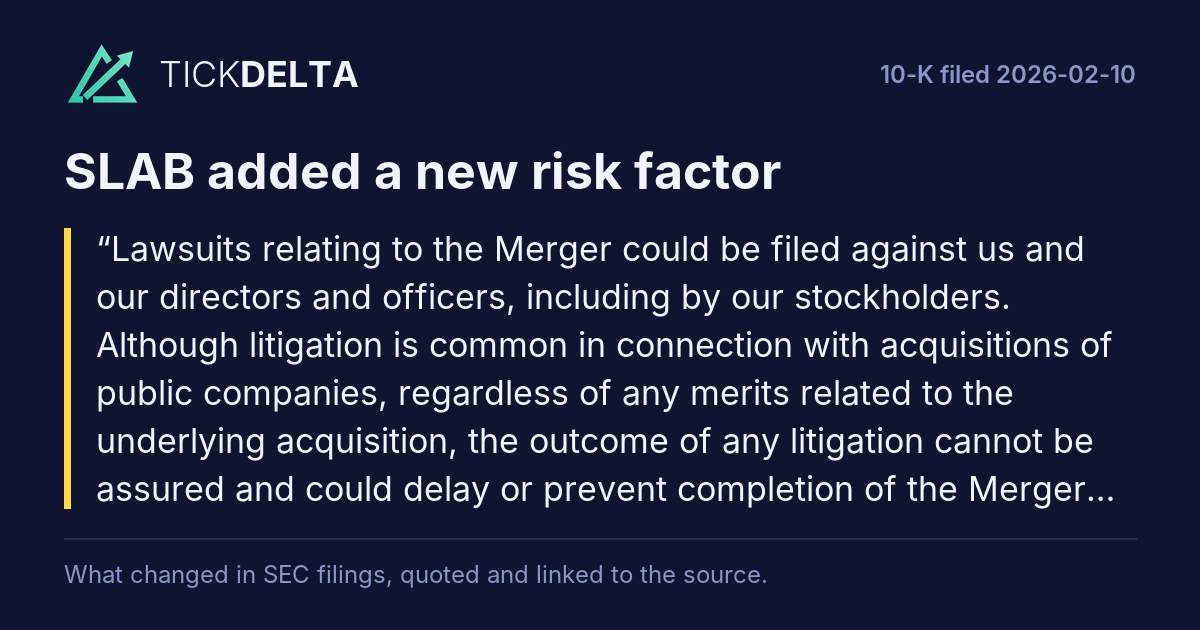
Lawsuits relating to the Merger could be filed against us and our directors and officers, including by our stockholders. Although litigation is common in connection with acquisitions of public companies, regardless of any merits related to the underlying acquisition, the outcome of any litigation cannot be assured and could delay or prevent completion of the Merger. Additionally, the amount of fees and costs of defense, including costs associated with the indemnification of directors and officers, and other liabilities that may be incurred in connection with lawsuits and other negative effects, such as diversion of resources from the Merger and ongoing business activities, negative publicity or damage to our relationships with business partners, suppliers and customers, could have a material adverse effect on our business, results of operations, cash flows and financial condition.

Read in the 10-K

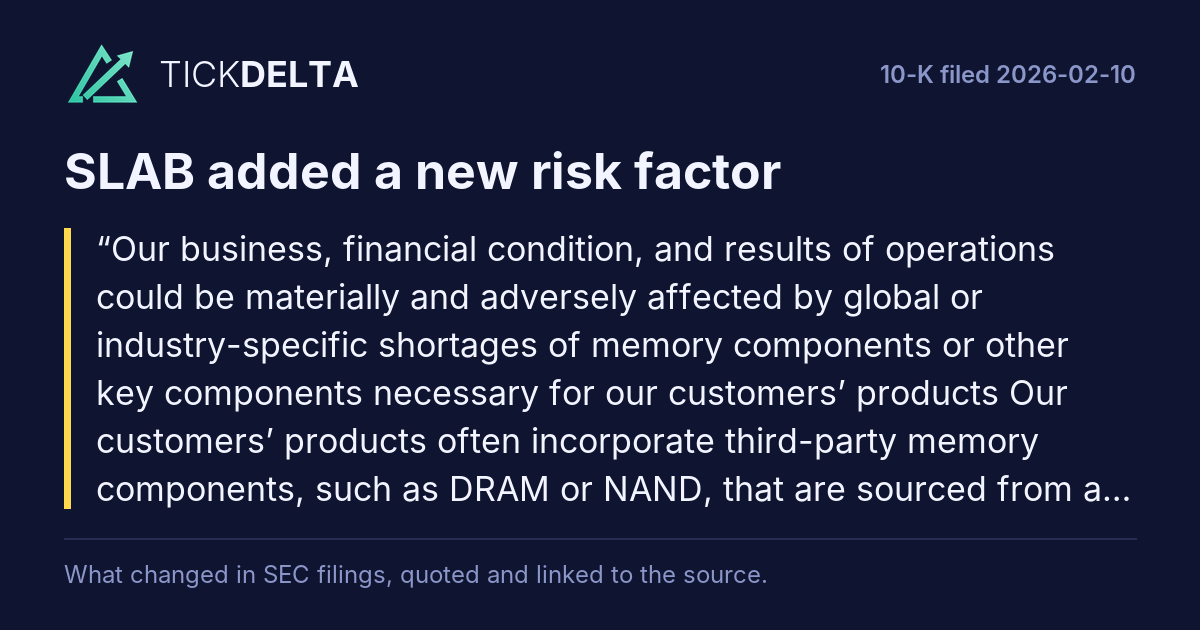
Our business, financial condition, and results of operations could be materially and adversely affected by global or industry-specific shortages of memory components or other key components necessary for our customers’ products

Our customers’ products often incorporate third-party memory components, such as DRAM or NAND, that are sourced from a limited number of suppliers. The memory market has in the past experienced supply imbalances, capacity constraints, and pricing volatility, and the industry is currently experiencing a global shortage of certain memory components as a result of AI-driven demand. These conditions are likely to impact our customers and may limit their ability to manufacture their end products or may cause them to adjust production schedules, delay product launches, or revise demand forecasts, which in turn could lead them to reduce, delay, or cancel orders for our products, even when demand for their end products remains strong. The current shortage and resulting price increase for memory components also may lead our customers to increase prices of their end products, which could lead to decreased demand those products, negatively impacting orders for our products in the longer term. In addition, uncertainty regarding the availability or pricing of memory components or other key components may impair our ability to accurately forecast demand, manage inventory levels, or plan production. Any of these factors could adversely affect our business, financial condition, and results of operations.

Read in the 10-K

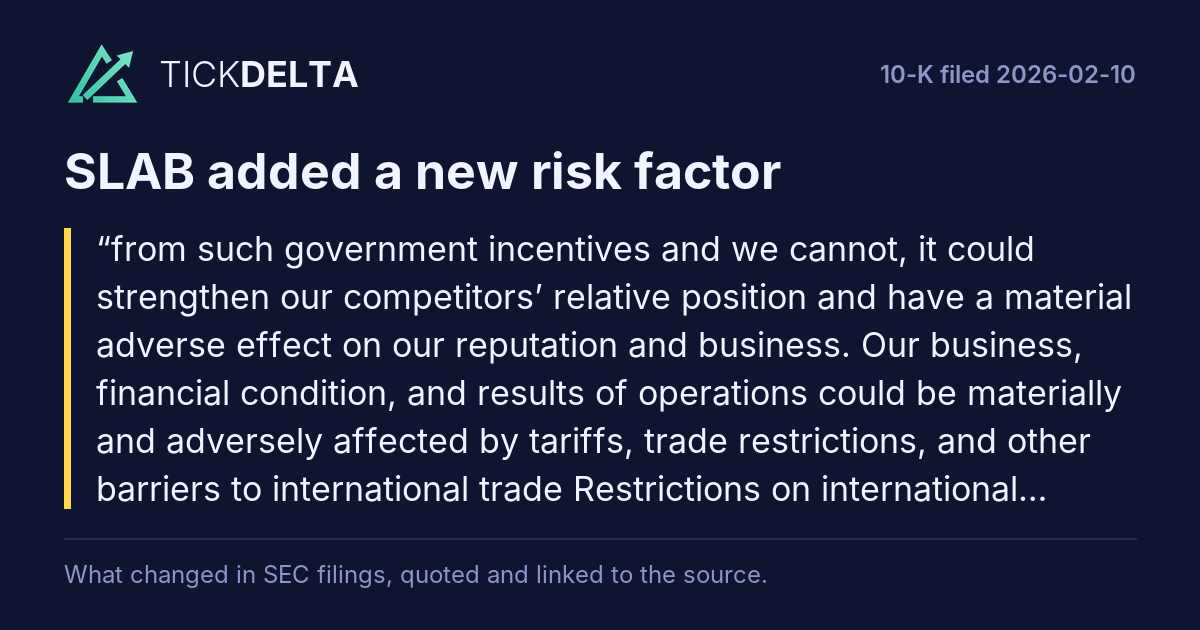
from such government incentives and we cannot, it could strengthen our competitors’ relative position and have a material adverse effect on our reputation and business.

Our business, financial condition, and results of operations could be materially and adversely affected by tariffs, trade restrictions, and other barriers to international trade

Restrictions on international trade, such as tariffs and other controls on imports or exports of goods and technology can adversely affect our business and supply chain. These trade restrictions may impact the cost and availability of raw materials, components, and finished goods, which could lead to supply chain disruptions, increased costs, and lower margins. There is currently significant uncertainty about the future relationship between the U.S. and various other countries with respect to trade policies and tariffs. Export restrictions imposed by the U.S. government, including the addition of licensing requirements by the United States Department of Commerce’s Bureau of Industry and Security (“BIS”) through the addition of companies to the BIS Entity List, could require us to suspend our business with certain entities if we conclude or are notified by the U.S. government that such business presents a risk of noncompliance with U.S. regulations. The global trade situation has been highly dynamic, and we cannot predict what actions may be taken with respect to tariffs or trade relations, what products may be subject to such actions, or what actions may be taken by other countries in response. In addition to the possibility of new or modified tariffs, sector-based trade measures may be implemented. For example, the U.S. Department of Commerce initiated an investigation into imports of semiconductors, semiconductor manufacturing equipment, and related products. The rapid and fluctuating changes in global trade policies have contributed to greater market volatility and general economic uncertainties, including the risk of inflation and recession, and could adversely affect customer demand, delay purchasing decisions, or limit our ability to operate efficiently in key markets. If we are unable to mitigate any negative impacts of tariffs, trade restrictions, or related market volatility through pricing adjustments, operational efficiencies, or alternative sourcing strategies, our business, financial condition, and results of operations could be materially and adversely affected.

Read in the 10-K

•Volatility in foreign currency exchange rates and any requirements for buying and/or selling in currencies other than the U.S. dollar;

Read in the 10-K

Any acquisition we pursue as part of our growth and product‑diversification strategy could disrupt our business and negatively affect our financial condition. Integrating acquired operations, technologies, or products may prove difficult and could divert management’s attention, require greater financial resources than planned, and strain relationships with suppliers and customers. Entering unfamiliar markets, transferring intellectual property licenses, absorbing additional overhead, addressing tax complexities, resolving acquisition‑related disputes, retaining key employees, and managing potential impairment of goodwill or other intangible assets all pose additional risks. Future acquisitions may also result in debt, contingent liabilities, or the issuance of equity that could dilute existing shareholders.

Read in the 10-K

Any past or future disposition of a business or product line could expose us to risks that may materially and adversely affect our business and operating results. These risks include diverting management’s attention from core operations, facing difficulties in separating the divested business, and potentially harming relationships with customers tied to the discontinued product line. Dispositions may also reduce our purchasing leverage with suppliers, create challenges with employee relations, and face delays or failures in completion. Additional risks arise from transferring or licensing intellectual property, not realizing anticipated benefits, encountering third‑party claims, managing security and other

liabilities associated with transition services, addressing tax complexities, and resolving disputes related to earn‑outs and escrows.

Read in the 10-K

standards. We may need to adjust our portfolio to meet the needs of this evolving market through acquisitions or significant new investments in research and development.
Read in the 10-K

Paragraphs in the 10-Q filed Nov 10, 2026 that were not in the one before

New in the latest 10-Q

1 paragraph in the 10-Q filed Nov 10, 2026 with nothing like it in the 10-Q filed Aug 11, 2026 (at least half the words must differ; new numbers alone do not count). Quoted exactly, grouped by the item heading above them. This is text that changed, not a judgement of how serious it is.

Financial statements and notes

The increase in the provision for income taxes for the three and nine months ended October 3, 2026 in comparison with the three and nine months ended October 4, 2025 is primarily due to the release of $1.7 million of unrecognized tax benefits in the three months ended October 4, 2025 with no comparable release in the current year-to-date.

Read in the 10-Q

The 10-Q's risk factors against the 10-K

Item 1A of the 10-Q filed Nov 10, 2026 against Item 1A of the 10-K filed Feb 10, 2026. A 10-Q repeats only the risks that changed, so a 10-K paragraph that is missing from it is not counted as removed. Added is a paragraph with nothing like it in the 10-K, Reworded a sentence that is in both with several words changed, Quiet changes a sentence in both where one to four words changed and one is a hedge or a modal (cut words struck through, new words highlighted). Text on the page, not a score; each links to the filing at sec.gov.

Added10-Q Nov 10, 2026 vs 10-K Feb 10, 2026
greater market volatility, rising inflation and general economic uncertainty, including the possibility of slower growth or recession. These developments have increased, and could further increase, our costs and could adversely affect customer demand, delay purchasing decisions, disrupt our supply chain, or limit our ability to operate efficiently in key markets. If we are unable to mitigate any negative impacts of tariffs, trade restrictions, or related market volatility through pricing adjustments, operational efficiencies, or alternative sourcing strategies, our business, financial condition, and results of operations could be materially and adversely affected.

Read it in the 10-Q at sec.gov

Added10-Q Nov 10, 2026 vs 10-K Feb 10, 2026
We believe our future success will depend in large part upon our ability to attract and retain highly skilled managerial, engineering, sales and marketing personnel. We believe that our future success will be dependent on retaining the services of our key personnel, developing their successors and certain internal processes to reduce our reliance on specific individuals, and on properly managing the transition of key roles when they occur. Competition for qualified personnel

Read it in the 10-Q at sec.gov

Added10-Q Nov 10, 2026 vs 10-K Feb 10, 2026
fail to comply with SEC rules and regulations, which could result in investigations and sanctions by regulatory authorities. Any of these results could adversely affect our business and the value of our common stock.

Read it in the 10-Q at sec.gov

Show the other 13
Reworded10-Q Nov 10, 2026 vs 10-K Feb 10, 2026
Additionally, the The amount of fees and costs of defense, including costs associated with the indemnification of directors and officers, and other liabilities that may be incurred in connection with lawsuits and other negative effects, such as diversion of resources from the Merger and ongoing business activities, negative publicity or damage to our relationships with business partners, suppliers and customers, could have a material adverse effect on our business, results of operations, cash flows and financial condition.

Read it in the 10-Q at sec.govThe 10-K sentence

Reworded10-Q Nov 10, 2026 vs 10-K Feb 10, 2026
See the risk factor entitled “Our business, financial condition, and results of operations could be materially and adversely affected by tariffs, trade restrictions, and other barriers to international trade. ” Furthermore, our current or potential competitors may be acquired by third parties with greater available resources and the ability to initiate or withstand substantial price competition, which may include price concessions, delayed payment terms, financing terms, or other terms and conditions that are more enticing to potential customers.

Read it in the 10-Q at sec.govThe 10-K sentence

Reworded10-Q Nov 10, 2026 vs 10-K Feb 10, 2026
Any failure or perceived failure by us to comply with our privacy or security policies policies, laws and regulations, or privacy-related legal obligations, any of our contractual commitments regarding these matters, or any compromise of security that results in the unauthorized release or transfer of personal data, security, may result in governmental enforcement actions, litigation or negative publicity, and could have an adverse effect on our operating results and financial condition.

Read it in the 10-Q at sec.govThe 10-K sentence

Reworded10-Q Nov 10, 2026 vs 10-K Feb 10, 2026
Lawsuits may arise arising in connection with the Merger, which Merger could be costly, delay or prevent completion of the Merger Merger, divert management’s attention and otherwise adversely affect our business, results of operations, cash flows and financial condition business

Read it in the 10-Q at sec.govThe 10-K sentence

Reworded10-Q Nov 10, 2026 vs 10-K Feb 10, 2026
Lawsuits relating to the Merger could be filed against us and and/or our directors and officers, including by our stockholders. stockholders, may be time-consuming and expensive and may distract our management from running the day-to-day operations of our business.

Read it in the 10-Q at sec.govThe 10-K sentence

Reworded10-Q Nov 10, 2026 vs 10-K Feb 10, 2026
Such There are numerous U.S. federal, state, and local laws and regulations and foreign laws and regulations regarding these matters, which often vary in scope, may be subject to differing interpretations, and may be inconsistent among different jurisdictions.

Read it in the 10-Q at sec.govThe 10-K sentence

Reworded10-Q Nov 10, 2026 vs 10-K Feb 10, 2026
If we fail to remediate any future material weaknesses or maintain proper and effective internal control over financial reporting in the future, we may be required to restate our financial statements, experience delays in satisfying our reporting obligations or fail to comply with SEC rules and regulations, which could result in investigations and sanctions by regulatory authorities.

Read it in the 10-Q at sec.govThe 10-K sentence

Reworded10-Q Nov 10, 2026 vs 10-K Feb 10, 2026
Similarly, a decrease in the value of the U.S. dollar, such as the decline that occurred in 2025, has occurred since in the beginning of 2025, past and may in the future reduce our buying power with respect to international suppliers.

Read it in the 10-Q at sec.govThe 10-K sentence

Reworded10-Q Nov 10, 2026 vs 10-K Feb 10, 2026
As a result, an increase in the value of the U.S. dollar relative to foreign currencies could currencies, such as the rebound from 2025 that has occurred since early 2026, can make our products more expensive for our international customers to purchase, thus rendering our products less competitive.

Read it in the 10-Q at sec.govThe 10-K sentence

Reworded10-Q Nov 10, 2026 vs 10-K Feb 10, 2026
Additional risks arise from transferring or licensing intellectual property, not realizing anticipated benefits, encountering third‑party claims, managing security and other liabilities associated with transition services, addressing tax complexities, and resolving disputes related to earn‑outs and escrows.

Read it in the 10-Q at sec.govThe 10-K sentence

The first 18 of 26 are shown (at most 12 of each type).

Phrases used for the first time

Two-word phrases in Risk Factors of the 10-K filed Feb 10, 2026 that are in none of the 1 earlier 10-Ks stored, back to Feb 4, 2025

merger agreement ×20memory components ×6tariffs trade ×4international trade ×4third party ×4time frame ×3alternative transaction ×3prevent completion ×3key components ×3proposed merger ×2uncertainties associated ×2agreement contains ×2contains provisions ×2pursue alternatives ×2discourage competing ×2competing acquirer ×2
Where each one is used
  • merger agreement: •The Merger Agreement contains provisions that limit our ability to pursue alternatives to the Merger and that could deter or discourage a competing acquirer from making a favorable alternative transaction proposal
  • memory components: •Our business, financial condition, and results of operations could be materially and adversely affected by global or industry-specific shortages of memory components or other key components necessary for our customers’ products
  • tariffs trade: •Our business, financial condition, and results of operations could be materially and adversely affected by tariffs, trade restrictions, and other barriers to international trade
  • international trade: •Our business, financial condition, and results of operations could be materially and adversely affected by tariffs, trade restrictions, and other barriers to international trade
  • third party: Under the Merger Agreement, we are subject to “no-shop” restrictions and are not permitted, subject to certain exceptions set forth in the Merger Agreement, to initiate, solicit or knowingly encourage or facilitate any inquiries or the making of any proposal or offer by or with a third party with respect to an...
  • time frame: •We may not complete the proposed Merger within the time frame we anticipate, or at all, which could have an adverse effect on our business, financial condition, results of operations, cash flows and stock price
  • alternative transaction: •The Merger Agreement contains provisions that limit our ability to pursue alternatives to the Merger and that could deter or discourage a competing acquirer from making a favorable alternative transaction proposal
  • prevent completion: •Lawsuits may arise in connection with the Merger, which could delay or prevent completion of the Merger and adversely affect our business, results of operations, cash flows and financial condition

The 10-K at sec.gov

Used at least twice, small words left out. Counted, not picked: a phrase can be new because the company renamed something.

What was taken out

30 paragraphs of last year's Risk Factors with nothing like them now. The longest are quoted.

Across all companies
There can be no assurance that any decrease in sales resulting from any public health crisis will be offset by increased sales in subsequent periods. Even after any public health crisis has subsided, we may continue to experience materially adverse impacts to our business as a result of its global economic impact, including any recession, economic downturn or increased unemployment that has occurred or may occur in the future. An extended period of global supply chain and economic disruption could materially affect our business, results of operations, access to sources of liquidity and...
In the 10-K filed Feb 4, 2025
•Disruptions to our business and supply chain (and the business and supply chains of our customers) in connection with the sourcing of materials, equipment and engineering support, and services from geographic areas impacted by the public health crisis, including disruptions caused by illnesses, quarantines and restrictions on people’s ability to work, office and factory closures, disruptions to ports and other shipping infrastructure, border closures, and other travel or health-related restrictions;
In the 10-K filed Feb 4, 2025
in interest rates have led to a decline in the market value of debt securities issued with interest rates below current market interest rates. Sales of such securities prior to their maturity would result in the recognition of losses previously unrealized.
In the 10-K filed Feb 4, 2025
Provisions of our certificate of incorporation and bylaws could have the effect of discouraging, delaying or preventing a merger or acquisition that a stockholder may consider favorable. For example, our certificate of incorporation and bylaws provide for:
In the 10-K filed Feb 4, 2025

Sources

Item 1A of each 10-K and 10-Q on EDGAR, quoted exactly. Each paragraph links to the filing at sec.gov.

Also

10-K change: what was reworded or cut, section by section.

Work with it

Excel workbook · CSV. Google Sheet that stays up to date: paste =IMPORTDATA("https://tickdelta.com/company/SLAB/export.csv") into a cell.

Next:10-K change
Esc

Type a ticker such as AAPL, a name, an investor such as Buffett, or a topic such as tariffs. ↑ ↓ to move, Enter to open.