Screener / SEC EDGAR /CIK 0001330568 /Numbers from the XBRL of the 10-Ks
NYSE Financials · Commodity Contracts Brokers & Dealers

iShares Silver Trust SLV

Compare with peers Embed
SEC comment letters, last 20 years

3 reviews of SLV's filings by SEC staff

UPLOAD and CORRESP
Reviews 3 latest letter Sep 16, 2014
Questions asked 9 each answered in the company's own letter
No closing letter 1 reviews without a letter saying the staff completed it

When the SEC's staff reviews a filing, it writes to the company with numbered questions, and the company answers each one in a letter. SEC publishes the exchange once the review is over, at least 20 business days later. A question is not an accusation; most reviews end with the company adding detail to its next filing.

How the reviews went

Every review on EDGAR, from the first staff letter to the letter that closes it

  1. 1. Staff letters 5 UPLOAD
  2. 2. Questions in them 9 numbered comments
  3. 3. Company replies 5 CORRESP
  4. 4. Reviews closed 2 of 3 closing letter

Half the closed reviews took 63 days or less from the first letter to the closing letter.

Form 10-K

2014-09-16 to 2014-10-16 · 2 questions · 1 letter from the SEC, 1 from the company
Review closed 2014-10-16
Item 1. Business, page 1
SEC asked (1)
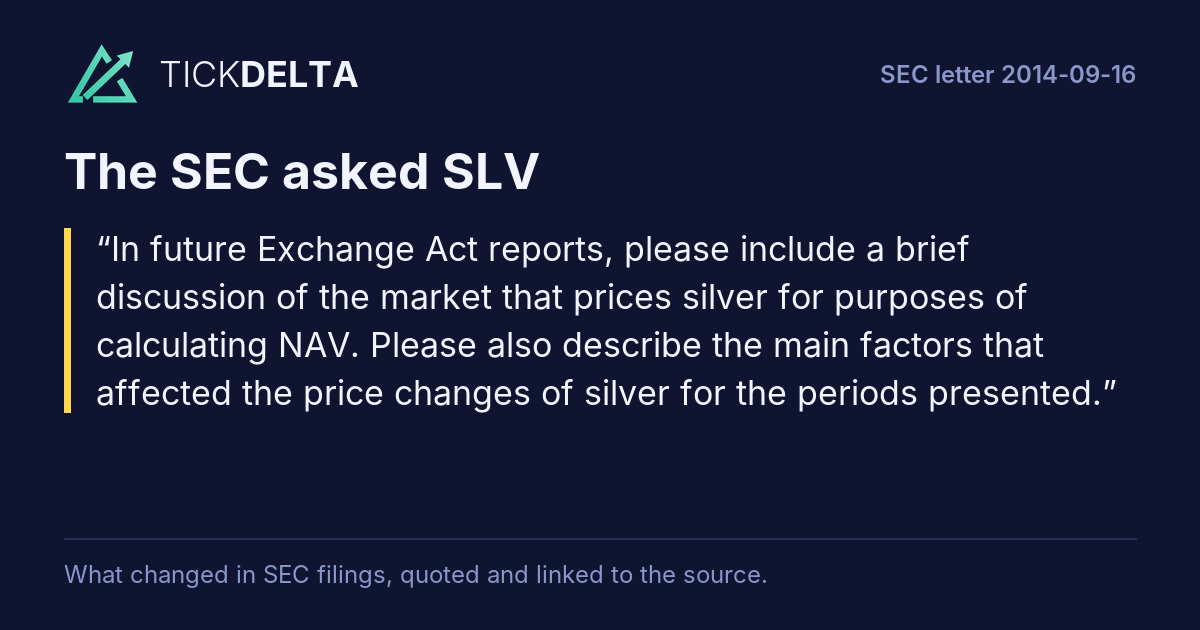
In future Exchange Act reports, please include a brief discussion of the market that prices silver for purposes of calculating NAV. Please also describe the main factors that affected the price changes of silver for the periods presented.
SLV answered
As requested by the staff, the registrant's future Annual Reports on Form 10-K will include in the response to Item 1 (Business) a description of the operation of the market in which the price used by the Trustee for the daily determination of the Trust's net asset value is discovered.

The registrant’s Annual Reports on Form 10-K under Item 1A, Risk Factors, include a description of various factors that may affect movements in the price of silver generally.
Rest of the answer

Unfortunately, neither the registrant nor the sponsor of the registrant is in possession of information that would give them insight as to why the prices of silver have moved in one or another direction in a given period. Neither the registrant nor the sponsor of the registrant is an active participant in the silver markets. The sole objective of the registrant is to passively reflect the general performance of the price of silver. The registrant (a New York common law trust without any employees or active management) does not engage in any activities designed to obtain a profit from, or to ameliorate losses caused by, changes in the price of silver. Consequently, the registrant has no proprietary trading data and no access to the trading and other information necessary to form a view as to what factors may have affected the price of silver at any time.

Read in the reply
In its next report

First report after the company's reply of Sep 29, 2014: 10-Q filed Nov 7, 2014 ↗, against the 10-Q filed Aug 8, 2014 ↗.

Tickdelta does not hold the text of both reports, so they are not compared here.

Signatures
SEC asked (2)
In future Exchange Act reports, please identify Mr. Gee as your principal accounting officer, as applicable, or alternatively, include the signature of your principal accounting officer or controller.
SLV answered
The registrant's future Annual Reports on Form 10-K will expressly identify the signatory who is the registrant's principal accounting officer.

* * *

As requested, the Trust hereby acknowledges as follows:

●

The Trust is responsible for the adequacy and accuracy of the disclosure in the filing;

Staff comments or changes to disclosure in response to staff comments do not foreclose the Commission from taking any action with respect to the filing; and

The Trust may not assert staff comments as a defense in any proceeding initiated by the Commission or any person under the federal
Rest of the answer

securities laws of the United States.
Read in the reply

Also in this review: closing letter, 2014-10-16
Form 10-K

2011-12-22 to 2012-02-23 · 3 questions · 2 letters from the SEC, 2 from the company
Review closed 2012-02-23
Reserves and insurance
Form 10-K · General
SEC asked (1)
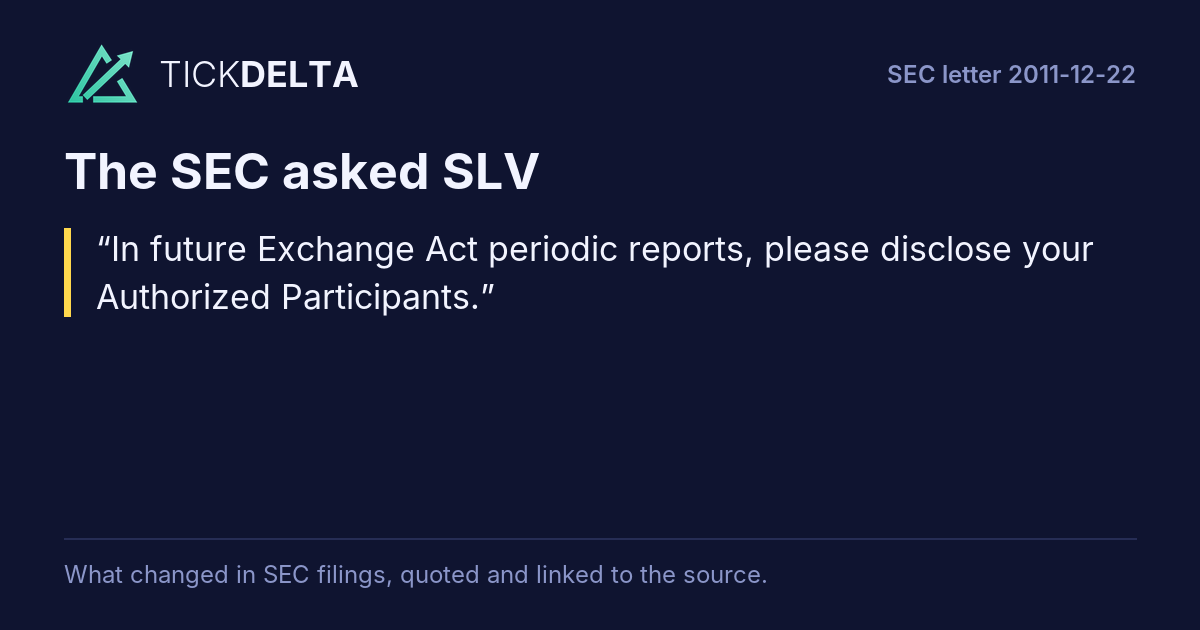
In future Exchange Act periodic reports, please disclose your Authorized Participants.
SLV answered
The Trust will include in Item 1 (Business) of future Annual Reports on Form 10-K a list of the entities having the status of Authorized Participants as of the date of the filing.
Read in the reply
Financial Statements · Income Statements, page F-4
SEC asked (2)
Please tell us and disclose your accounting policy for recording market value reserves and their subsequent recovery. Within your response, please ensure that you tell us how your policy complies with ASC 330.
SLV answered
As indicated in MD&A section of the filing, and reiterated in note 2B to the financial statements of the Trust, the accounting policy of the registrant is (i) to record a “market value reserve” whenever the market value of the silver owned by the Trust (as measured by the London Fix) is lower than its cost, and (ii) to reverse the “market value reserve” and record a “market value recovery” whenever the London Fix rises again above the average cost of the silver owned by the Trust.
Rest of the answer

For income statement purposes, market value reserves are treated as expenses, and market value recoveries are included in income. The registrant believes this treatment is consistent with ASC 330 which requires the recognition of a loss whenever there is evidence that “the utility of goods, in their disposal in the ordinary course of business, will be less than cost, whether due to physical deterioration, obsolescence, changes in price levels, or other causes” (emphasis added).

***

As requested, the Trust hereby acknowledges as follows:

•

The Trust is responsible for the adequacy and accuracy of the disclosure in the filing;

Staff comments or changes to disclosure in response to staff comments do not foreclose the Commission from taking any action with respect to the filing; and

The Trust may not assert staff comments as a defense in any proceeding initiated by the Commission or any person under the federal securities laws of the United States.

Read in the reply
In its next report

First report after the company's reply of Jan 5, 2012: 10-K filed Feb 29, 2012 ↗, against the 10-K filed Feb 25, 2011 ↗.

Tickdelta does not hold the text of both reports, so they are not compared here.

Financial Statements · Income Statements, page F-4
SEC asked
We note your response to our prior comment two. Your response did not address our comment in its entirety. Please tell us how your policy for recording subsequent recovery of market value reserves complies with ASC 330. Within your response, specifically address paragraph 14 of ASC 330-10-35.
SLV answered
As stated in Note 2B to the registrant’s financial statements included in the Form 10-K Report, it has been the policy of the registrant to record a “market value recovery” whenever the

London Fix rises again above average cost of the silver owned by the Trust. Based on your comment, and consistent with ASC 330-10-35-14, the registrant will in the future apply this policy only when the recovery occurs in the same fiscal year during which a market value reserve has been recorded.

Because the misapplication of the registrant’s policy referred to above resulted in the erroneous recognition of
Rest of the answer

a loss in the amount of the market value reserve for fiscal year 2008 and of a gain in the amount of the market value recovery in fiscal year 2009, the board of directors of

BlackRock Asset Management International Inc., the sponsor of the registrant, in consultation with PricewaterhouseCoopers LLP (the registrant’s independent registered public accounting firm), has determined that the audited financial statements of the registrant included in the Form 10-K Report should no longer be relied upon. An amendment to the Form 10-K Report which includes audited restated financial statements that give effect to the reversal of the 2008 loss and the 2009 gain referred to above has been filed on the date hereof. The amendment also includes management’s re-assessment, in light of the circumstances discussed in this response, of the effectiveness of the registrant’s internal control over financial reporting and discloses the ongoing process of evaluation of appropriate remedial action to be undertaken by the registrant. Such process is expected to be completed prior to the filing of, and its outcome described in, the registrant’s Annual Report on Form 10-K for the year ended December 31, 2011 (due on February 29, 2012).

* * *

As requested, the Trust hereby acknowledges as follows:

•

The Trust is responsible for the adequacy and accuracy of the disclosure in the filing;

Staff comments or changes to disclosure in response to staff comments do not foreclose the Commission from taking any action with respect to the filing; and

The Trust may not assert staff comments as a defense in any proceeding initiated by the Commission or any person under the federal securities laws of the United States.

Read in the reply
In its next report

First report after the company's reply of Feb 17, 2012: 10-K filed Feb 29, 2012 ↗, against the 10-K filed Feb 25, 2011 ↗.

Tickdelta does not hold the text of both reports, so they are not compared here.

Also in this review: closing letter, 2012-02-23

Form 10-K

2008-05-30 to 2008-08-08 · 4 questions · 2 letters from the SEC, 2 from the company
No closing letter
Liquidity and cashRevenueReserves and insurance
Financial Statements · Income Statements, page F-5
SEC asked (1)
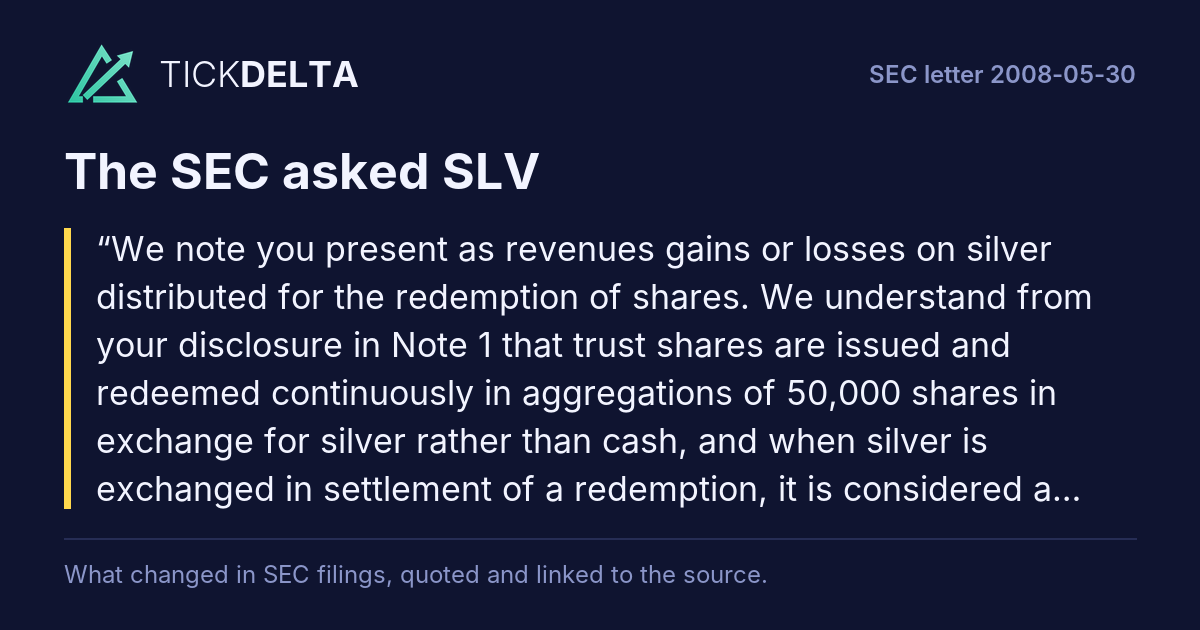
We note you present as revenues gains or losses on silver distributed for the redemption of shares. We understand from your disclosure in Note 1 that trust shares are issued and redeemed continuously in aggregations of 50,000 shares in exchange for silver rather than cash, and when silver is exchanged in settlement of a redemption, it is considered a sale of silver for financial statement purposes.
Rest of the question

Please identify the authoritative literature that you have relied upon with this presentation, and explain why you believe the guidance in paragraph 28 of APB 9 does not apply, if that is your view.

SLV answered
The financial statements of the Trust are prepared on the basis agreed between the Sponsor and the staff of the Division at the time of the registration of the initial public offering of shares of the iShares COMEX Gold Trust (the “Gold Trust”), another investment vehicle sponsored by the Sponsor that operates in a similar fashion as the Trust, with the exception that it takes and delivers gold

(rather than silver) in exchange for its shares.
Rest of the answer

At that time, the Gold Trust was one of the first commodity-backed exchange-traded funds to come to registration under the Securities Act of 1933, as amended (the “Securities Act”), and there were significant issues of first impression that needed to be addressed in light of the fact that the disclosure regime (including in respect of financial statements) contemplated by the Securities Act and the rules and regulations thereunder, was designed more with a view towards the needs of investors in operating companies than in passive investment vehicles of the type of the Trust or the Gold Trust.

With respect to the presentation of financial statements, the initial conversations between the Sponsor and the staff centered around which of the prescriptive regimes in Articles 5 and 6 of Regulation S-X would be used for the financial statements of the Gold Trust. The main argument for the application of Article 6 was the similarity between the activities of the Gold Trust and those of an investment company registered under the Investment Company Act of 1940, as amended (the “Investment Company Act”). Of course, the obvious response to that argument was that the Gold Trust was not (as the Trust is not) a registered investment company. This irrefutable conclusion led to the application, by default, of the provisions of Article 5 (applicable to all types of reporting companies that do not have a different regime authorized under Regulation S-X).

Even within the realm of application of Article 5, it is clear that there are many respects in which the Gold Trust and the Trust operate as a registered investment company and, more particularly, as an exchange-traded fund. One of these respects is the use of “in-kind” redemptions. Contrary to what typically occurs in an operating company that redeems its shares, the Gold Trust and the Trust redeem shares only in exchange for their only asset (respectively, gold and silver); not in exchange for cash. This situation is identical to what occurs when an Investment Company Act-registered index-based exchange-traded fund redeems its shares—shareholders receive the shares that comprise the index (not the cash value of those shares). In both instances, it becomes necessary to account for the difference in the dollar amounts at which the assets distributed were carried on the books of the issuer and such assets’ value at the moment of distribution to the shareholder. Consistent with the accepted practice in respect of Investment Company-registered exchange-traded funds, the Trust and the Gold Trust recognize on the income statement the nominal gain or loss realized upon the delivery of the underlying metal in exchange for its shares.

Accordingly, it is respectfully submitted that paragraph 28 of APB 9 should not apply to the Trust because the Trust operates as an exchange-traded fund and the accounting and financial reporting presentation of realized gains on distribution of silver for the redemption of shares follows the accepted conventions for exchange-traded funds and is consistent with the presentation agreed with the Division staff at the time of the registration of the Gold Trust.

Read in the reply
In its next report

First report after the company's reply of Jun 19, 2008: 10-Q filed Aug 7, 2008 ↗, against the 10-Q filed May 9, 2008 ↗.

Tickdelta does not hold the text of both reports, so they are not compared here.

Statements of Cash Flows, page F-7
SEC asked (2)
We note that you are adding or subtracting amounts from net income in your reconciliation to net cash provided by operating activities that appear to be cash amounts already included in your net income or loss, such as ‘proceeds from the sale of silver to pay expenses’ and a portion of expenses incurred on the line item ‘gain (loss) on sales of silver to pay expenses.’ Please submit the reconciliation that you would
Rest of the question

need to present to comply with the guidance in paragraphs 28 and 29 of SFAS 95.

SLV answered
The Trust uses the direct method to report cash flows from operating activities in accordance with paragraph 27 of SFAS 95. It consists of one gross cash receipt, the ‘proceeds from sales of silver,’ and one gross cash payment, the ‘Sponsor’s fees paid.’

The Trust performs the reconciliation of net income to net cash provided by operating activities in accordance with paragraph 29 of SFAS 95.

For the year ended December 31, 2007, the reconciliation separately shows the major reconciling items to net income:

•

Removal of the $61,937 thousand in non-cash ‘gain on silver distributed for the
Rest of the answer

redemption of shares’;

Removal of the ‘gain on sales of silver to pay expenses’ of $1,105 thousand, as this amount is captured in the ‘proceeds from sales of silver to pay expenses’ of $8,879 thousand; and

The change during the period in ‘Sponsor’s fee payable’ of $249 thousand.

This reconciliation allows for the presentation of the major reconciling items to net income, while also showing more explicitly how the gross cash receipt

(‘proceeds from sales of silver’) and the gross cash payment (‘Sponsor’s fees paid’) reconciles to net income.

In future filings, for additional clarity in presentation, the Trust will adjust the reconciliation of net income to net cash provided by operating activities, by reordering the line items to show the gains being removed from net income before showing the proceeds from sales of silver. Please refer to Exhibit A.

Read in the reply
In its next report

First report after the company's reply of Jun 19, 2008: 10-Q filed Aug 7, 2008 ↗, against the 10-Q filed May 9, 2008 ↗.

Tickdelta does not hold the text of both reports, so they are not compared here.

Note 1 – Organization and Significant Accounting Policies, page F-8
SEC asked (3)
We note your disclosure stating, “The accompanying unaudited financial statements were prepared in accordance with accounting principles generally accepted in the United States of America.” Please tell us why you are referring to your financial statements as “unaudited,” given that you include an audit report on pages F-2 and F-3.
Rest of the question

Closing Comments Please respond to these comments within 10 business days or tell us when you will provide us with a response. Please furnish a letter that keys your responses to our comments and provides any requested information. Detailed letters greatly facilitate our review. Please understand that we may have additional comments after reviewing your responses to our comments.

SLV answered
The financial statements as of the December 31, 2007 were audited, as evidenced by the audit report included on pages F-2 and F-3. The inclusion of the term

“unaudited” is a typographical error. The statement should read as follows: “The accompanying audited financial statements were prepared in accordance with accounting principles generally accepted in the United States of
Read in the reply
In its next report

First report after the company's reply of Jun 19, 2008: 10-Q filed Aug 7, 2008 ↗, against the 10-Q filed May 9, 2008 ↗.

Tickdelta does not hold the text of both reports, so they are not compared here.

Financial Statements · Statements of Cash Flows, page F-7
SEC asked
We have read your response to prior comment two in which you indicate that in reconciling your net income to net cash provided by operating activities, you have made an adjustment to remove the gain on sale of silver to pay expenses in the amount of $1,105 thousand, since this amount is captured in the ‘proceeds from sales of silver to pay expenses’ of $8,879 thousand, which is also shown as an adjustment to net
Rest of the question

income. Under the indirect method, items included in net income that affect operating cash receipts and disbursements should not be removed in the reconciliation; rather, the effort generally involves adjusting net income to eliminate the non-cash elements. Although we do not object to your end result, we recommend the following refinements to your presentation. We understand the reconciling item “proceeds from sales of silver to pay expenses” is a cash generating event that is reflected in your measure of net income. Therefore, it should not appear as a reconciling item. However, since the cost of silver sold to pay expenses is a non-cash item that is reflected in your measure of net income, you should have a reconciling item to add back this non-cash charge. You should also delete the adjustment for gain on sales of silver to pay expenses, as this is simply the net of the two items mentioned above. If you must write-down the carrying value of silver, as you appear to have done in 2006 with your market value reserve, this would be an add-back because it is a non-cash charge. To further illustrate, it appears that your reconciliation for 2007 would begin with net income of $53,914; less gain on silver distributed of $61,937; add non-cash cost of silver sold to pay expenses of $7,774; and add increase in sponsor fee payable of $249. Similarly, your reconciliation for 2006 would begin with net loss of $191,169; add loss on silver distributed of $4,568; add non-cash cost of silver sold to pay expenses of $2,866; add market value reserve of $183,090; add increase in sponsor fee payable of $645. Please let us know if you require further clarification. Closing Comments Please respond to these comments within 10 business days or tell us when you will provide us with a response. Please furnish a letter that keys your responses to our comments and provides any requested information. Detailed letters greatly facilitate our review. Please understand that we may have additional comments after reviewing your responses to our comments.

SLV answered
We agree with your recommendations. On the Statements of Cash Flows, the ‘Proceeds from sales of silver to pay expenses’ and ‘Gain on sales of silver to pay expenses’ line items have been deleted. A new line titled ‘Cost of silver sold to pay expenses’ has been included, to add back the non-cash charge to net income. We have implemented these refinements to the Trust’s

Statement of Cash Flows beginning with the Quarterly Report on Form 10-Q for the quarter ended June 30, 2008. Please refer to Exhibit A for the revised presentation.
Read in the reply
In its next report

First report after the company's reply of Aug 8, 2008: 10-Q filed Nov 7, 2008 ↗, against the 10-Q filed May 9, 2008 ↗.

Tickdelta does not hold the text of both reports, so they are not compared here.

Letters without questions

Other letters

UPLOAD and CORRESP
3 other letters: notices that a filing will not be reviewed, requests to declare a registration effective, and the like

From the SEC's correspondence on EDGAR: staff letters (form UPLOAD) and company letters (form CORRESP), 15 letters filed since 2008-06-03. Questions and answers are matched by their numbers; topics come from words in each question. The reports are compared word for word (same form, before the first SEC letter against the first report after the company's reply). No AI.

Sources

The SEC's correspondence on EDGAR: staff letters (form UPLOAD) and company letters (form CORRESP), matched question by question. No AI.

Also

Filings: the letters in the filing list.

Work with it

Excel workbook · CSV. Google Sheet that stays up to date: paste =IMPORTDATA("https://tickdelta.com/company/SLV/export.csv") into a cell.

Next in Owners and insiders:Insider trades
Esc

Type a ticker such as AAPL, a name, an investor such as Buffett, or a topic such as tariffs. ↑ ↓ to move, Enter to open.