Screener / SEC EDGAR /CIK 0001856485 /10-K filed Feb 20, 2026, compared with Feb 20, 2025 /Numbers from the XBRL of the 10-Ks
NYSE Materials · Paper

Sylvamo Corp SLVM

Compare with peers Embed
New in the 10-K 44 paragraphs with nothing like them in the 10-K filed Feb 20, 2025 New in the 10-Q 22 paragraphs not in the 10-Q filed Aug 7, 2026 10-Q against the 10-K 5 risk factor paragraphs and sentences added or reworded

New risk paragraphs, branching off last year

Each branch is a paragraph in Risk Factors with nothing like it in the 10-K filed Feb 20, 2025. A box jumps to the paragraph as filed, below.

44 new

Paragraphs with nothing like them in last year's 10-K

Quoted exactly

44 paragraphs in Risk Factors of the 10-K filed Feb 20, 2026 with nothing like them in the 10-K filed Feb 20, 2025. Quoted exactly. Paragraphs that were only edited are under 10-K change.

Our business can be adversely affected by global or regional economic, civil, political or trade developments.

Read in the 10-K

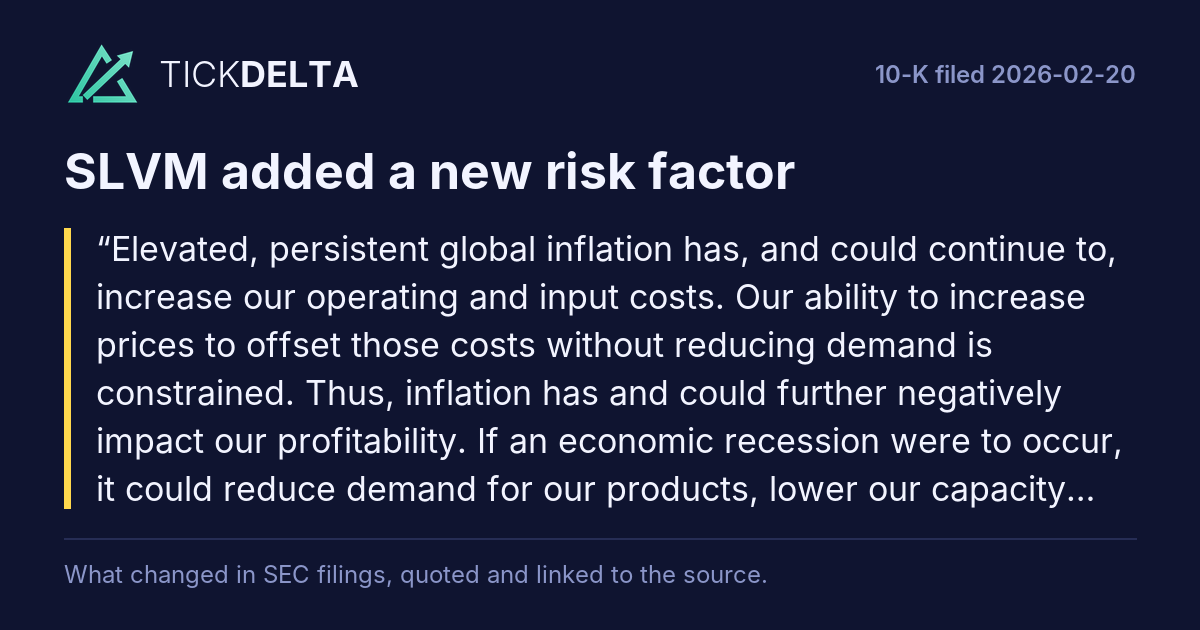
Elevated, persistent global inflation has, and could continue to, increase our operating and input costs. Our ability to increase prices to offset those costs without reducing demand is constrained. Thus, inflation has and could further negatively impact our profitability. If an economic recession were to occur, it could reduce demand for our products, lower our capacity utilization and compress margins. Furthermore, significant inflation or a recession could negatively affect industrial non-durable goods production, consumer spending, commercial printing and advertising activity, white collar employment levels, and overall consumer confidence, which also could reduce demand for our products.

Read in the 10-K

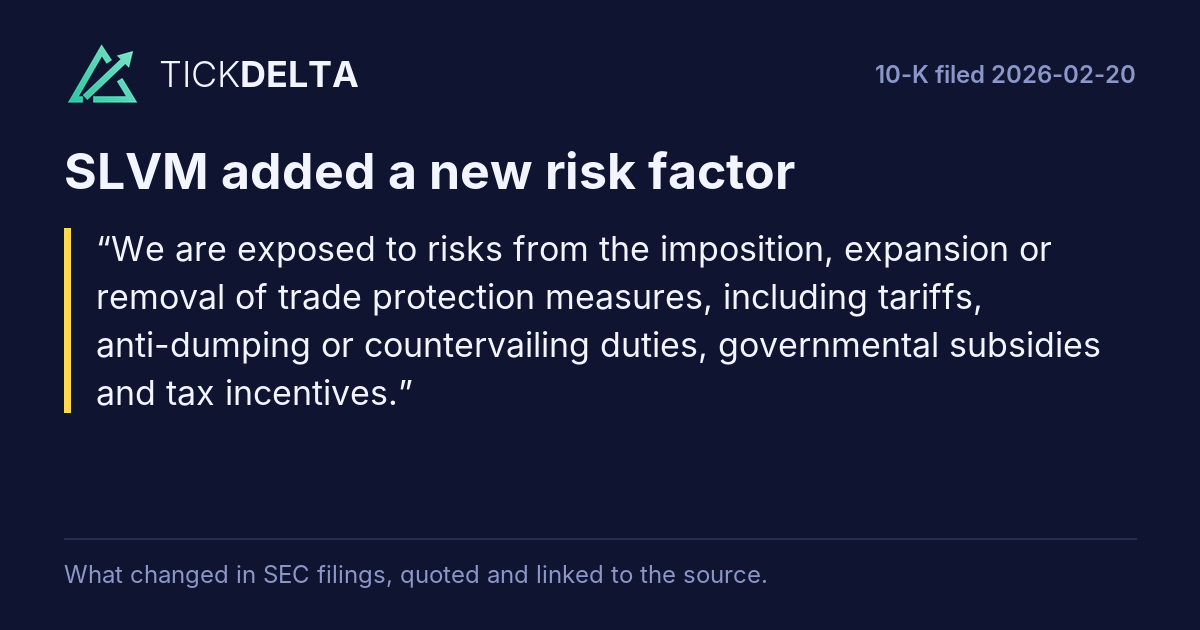
We are exposed to risks from the imposition, expansion or removal of trade protection measures, including tariffs, anti-dumping or countervailing duties, governmental subsidies and tax incentives.

Read in the 10-K

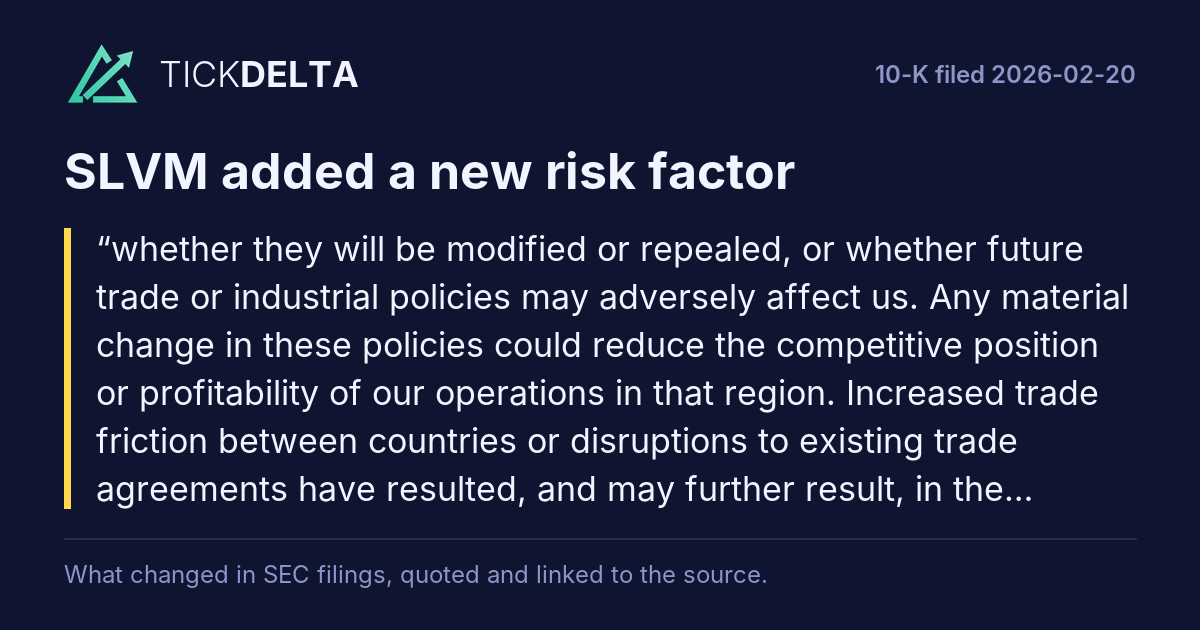
whether they will be modified or repealed, or whether future trade or industrial policies may adversely affect us. Any material change in these policies could reduce the competitive position or profitability of our operations in that region.

Increased trade friction between countries or disruptions to existing trade agreements have resulted, and may further result, in the imposition of protective trade measures such as tariffs. Tariffs also could disrupt the cross border flow and availability of raw materials, energy or finished goods, negatively affecting our supply chain and distribution capabilities. As of December 31, 2025, the United States has imposed tariffs on imported goods from various countries. Resulting changes in trade flows have introduced additional competing products into some countries where we sell, putting downward pressure on the pricing of our products. Also, the tariffs have increased, directly or indirectly, the costs of certain equipment and other goods that we purchase for our operations, constrained our ability to import and sell in the United States various products that we produce outside the United States, and caused, and could cause future, volatility in ocean shipping prices as demand for ocean transport increases or decreases in response to the tariffs’ impact on the volume of goods to be transported to and from affected areas. We cannot predict how long these impacts will continue or if new tariffs or other protective trade measures will be introduced in the future. Any new or increased tariffs or other protective trade measures could add to these impacts.

To offset increased costs resulting from tariffs or other protective trade measures, we may implement price increases, cost reductions and operational efficiencies, but we are limited in our ability to mitigate higher costs through price increases without decreasing demand for our products. The ultimate impact of continuing or new tariffs or other protective trade measures on our business is uncertain and depends on a number of factors, including which jurisdictions are affected by the tariffs or other measures, the scope and duration of the measures, the volume and nature of the goods affected, the extent to which we can pass any increased costs on to customers, changes in competitive dynamics resulting from the measures, and whether we obtain any competitive advantage from the measures and such advantage is sufficient to offset any higher costs we incur as a result of the measures.

We are exposed to risks associated with adverse climate and weather conditions and evolving climate-related regulations, obligations and stakeholder expectations.

Climate related physical conditions, including those typically associated with climate change, could disrupt our operations and supply chain and result in financial losses. If average temperatures increase, it may contribute to changes in weather patterns, including precipitation variability and more frequent or severe extreme weather events and natural disasters. Events such as hurricanes, tornadoes, hailstorms, wildfires, floods, droughts, heatwaves, snow, ice storms and lightening strikes could damage or destroy our facilities and other assets, interrupt operations, increase operating and repair costs and adversely affect demand for our products. If any such event were to damage infrastructure at our mills or disrupt water and energy availability, it could cause us reduced throughput, temporary shutdowns or costly repairs. For example, periodic drought conditions in Mogi Guaçu, Brazil have at times in the past reduced water flow needed for our mill operations there. In addition, our mills located near rivers are exposed to the risk of flooding that could significantly damage facilities. If severe enough, any of these types of events could result in a suspension of operations at a mill for an extended period or mill closure.

Our business relies on a steady and reliable supply of timber and other forest-based inputs. Reduced timber availability and quality and poor timber harvesting conditions can be caused by climate-related problems, such as the spread of pests or disease, increased drought, wildfires, altered growing seasons, flooding and other extreme weather. Any reduction in the availability, density or quality of virgin timber fiber could increase manufacturing costs or disrupt operations. For example, in Brazil, our owned and managed forestlands have been producing sub-optimal yields, partly due to weather events, of mature virgin fiber for our operations, and if there were additional adverse weather-related events affecting virgin timber availability in Brazil, it could further increase the costs we have been incurring to replenish trees on such forestlands (and, in the meantime, our costs to source virgin fiber from third parties). Drought conditions in Brazil in 2024 caused weather- and fire- related decreases in the supply of virgin fiber and thus inflated its cost, which inflation continued into 2025. While these events did not have a material impact in 2025, if we become unable to procure wood supplies in Brazil, or third party wood costs significantly elevate, or droughts increase in frequency or severity, then our wood fiber costs in Brazil would further increase. If adequate fiber supply could not be obtained, production at our Brazil mills could be reduced or interrupted.

Energy and fuel are critical to our manufacturing processes, our suppliers’ transportation of materials to us and our transportation of finished products to customers. Climate related disruptions of or constraints on energy and fuel sources could increase their costs, cause shortages or cause delivery disruptions. Such events could increase our manufacturing and logistics costs or require us to curtail or suspend operations.

Severe or unpredictable weather may disrupt our suppliers’ and customers’ operations, impair logistics networks, or reduce end market demand, which could increase our input costs, delay production or reduce sales volumes.

While we maintain disaster preparedness, response and business continuity plans, these measures may not fully mitigate the adverse effects of all climate-related events. Also, we may not be able to offset increased costs resulting from climate-related events through pricing or other measures. Attempts to pass such costs on to customers could reduce demand for our products and adversely affect our competitive position.

We are exposed to risks associated with climate-related regulatory developments. The introduction of carbon taxes or new or more stringent environmental regulations, such as those addressing GHG emissions, energy use or permitting requirements, could increase our compliance, monitoring, reporting or capital expenditure costs (references to “regulations” in these Risk Factors include all governmental and quasi-governmental requirements, including, without limitation, laws, rules, regulations, ordinances, governmental agency requirements and court orders). The scope, timing, and impact of future regulatory developments is uncertain and may vary by jurisdiction. See Item 1. Business – Environmental and Other Regulations for additional information. Compliance with evolving regulations could increase our administrative and compliance costs.

Read in the 10-K

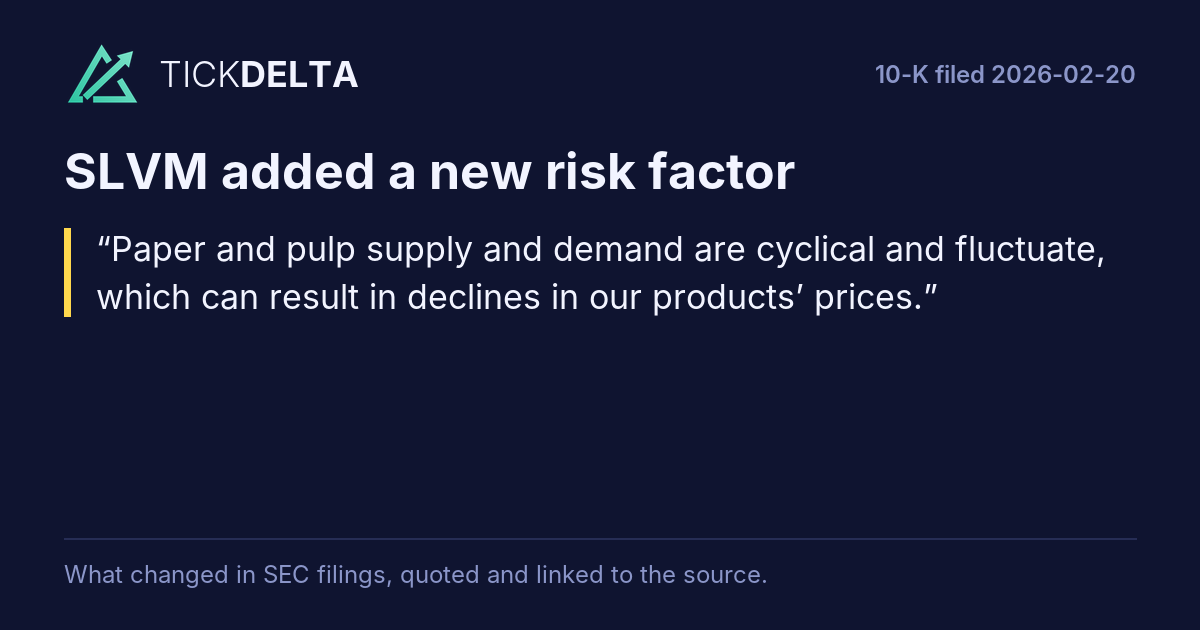
Paper and pulp supply and demand are cyclical and fluctuate, which can result in declines in our products’ prices.

Read in the 10-K
Show the other 19

Our products face strong competition as commodities and from industry consolidation.

Read in the 10-K

Disruptions at our facilities or in transportation and logistics could increase our costs and impair our ability to operate and serve customers.

Our business depends on the continuous and efficient operation of our manufacturing facilities, the reliable performance of the equipment within those facilities, and the ability to process and fill customer orders. A material disruption at our corporate headquarters or at any of our mills -- whether affecting an entire facility, operations at multiple facilities, or one or more key machines -- could interrupt production, delay product deliveries, limit our ability to meet customer demand, and reduce sales.

Our facilities or equipment could experience unexpected downtime or cease operations as a result of a variety of events. Examples are natural disasters or severe weather; disruptions to water, energy or other utility supplies; shortages of raw materials, such as wood fiber, and other critical inputs; interruptions in transportation infrastructure (including roads, bridges, railways or ports); unscheduled maintenance outages; equipment failures or damage to paper‑making or other important equipment; prolonged power outages; or information technology or operational technology system failures, including those resulting from cybersecurity incidents affecting us or third parties with whom we do business. In addition, spills or releases of chemicals or other hazardous substances, explosions or damage involving boilers or other equipment, or damage caused by third parties operating on or near our facilities could result in shutdowns, repairs or corrective or punitive regulator actions.

Disruptions may also result from other third-party events that impact us, such as failures or delays by our third‑party service providers or a business partner’s labor disputes or workforce availability issues, or regulations or governmental action applicable to our or our business partners’ businesses. The frequency, severity or duration of any such disruptions could affect our production volumes, increase operating or repair costs, cause missed deliveries or require capital expenditures to restore operations. While we maintain maintenance programs, contingency plans and insurance coverage for certain risks, these measures may not prevent all disruptions or fully offset their financial impact.

Read in the 10-K

the prices charged by our transportation providers, increasing our costs to produce and deliver our product to customers. In 2025, transportation markets remained relatively stable and we did not experience any material increased transportation costs or disruptions, but we cannot predict whether this stability will continue. Any of the circumstances described in this paragraph could cause us increased supply chain costs, increased costs to supply customers and loss of customers.

Failures or security breaches of our information technology systems could disrupt our operations, harm our business and result in regulatory non-compliance.

Our business operations rely upon secure information technology systems for data capture, processing, storage and

Read in the 10-K

Labor disputes could disrupt our operations and increase our labor and operating costs.

Read in the 10-K

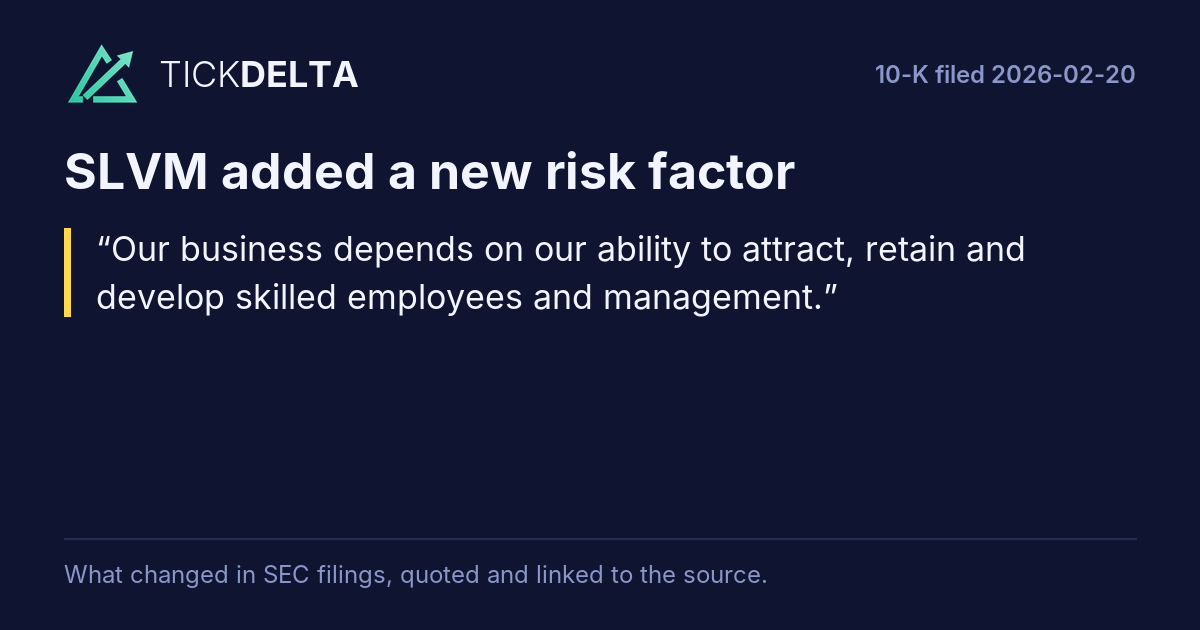
Our business depends on our ability to attract, retain and develop skilled employees and management.

Read in the 10-K

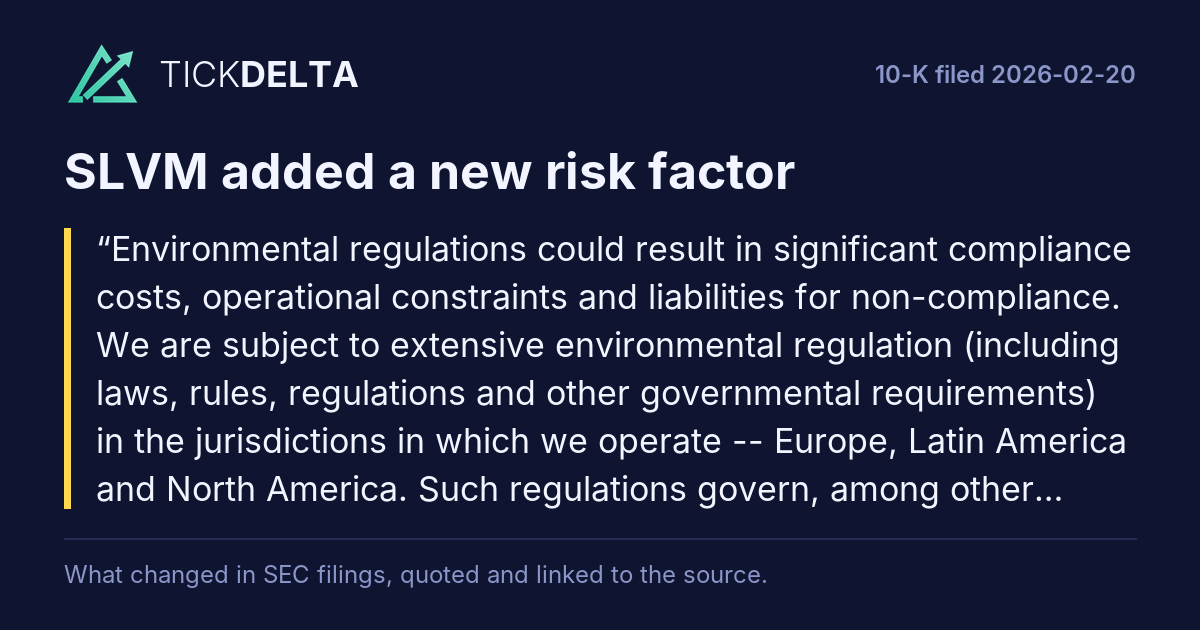
Environmental regulations could result in significant compliance costs, operational constraints and liabilities for non-compliance.

We are subject to extensive environmental regulation (including laws, rules, regulations and other governmental requirements) in the jurisdictions in which we operate -- Europe, Latin America and North America. Such regulations govern, among other things, air emissions, water discharges, waste management, land use and remediation obligations. Environmental regulations continue to evolve, and regulatory authorities may adopt or more actively enforce environmental regulations, including those affecting air quality, water use and quality, emissions, permitting, reporting or facility operations. Compliance with existing environmental requirements, or with new or more stringent standards that may be adopted, could increase our operating and capital costs or restrict certain aspects of our manufacturing operations.

Read in the 10-K

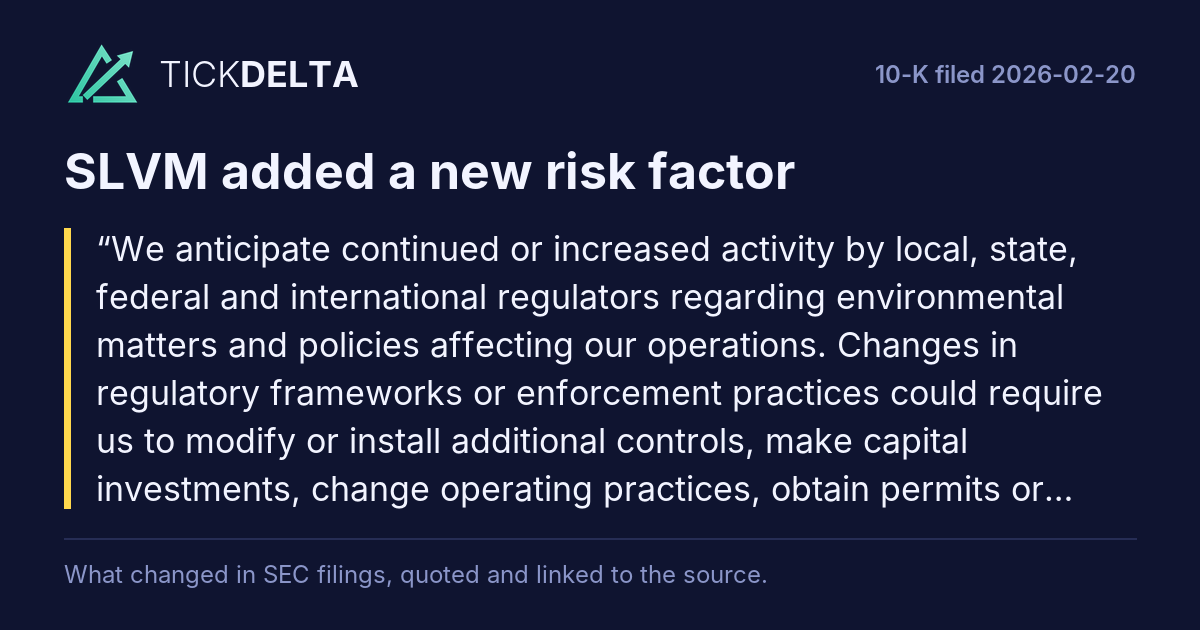
We anticipate continued or increased activity by local, state, federal and international regulators regarding environmental matters and policies affecting our operations. Changes in regulatory frameworks or enforcement practices could require us to modify or install additional controls, make capital investments, change operating practices, obtain permits or take other required actions. In certain circumstances, compliance obligations could result in production constraints, temporary shutdowns or the curtailment of operations at facilities.

Read in the 10-K

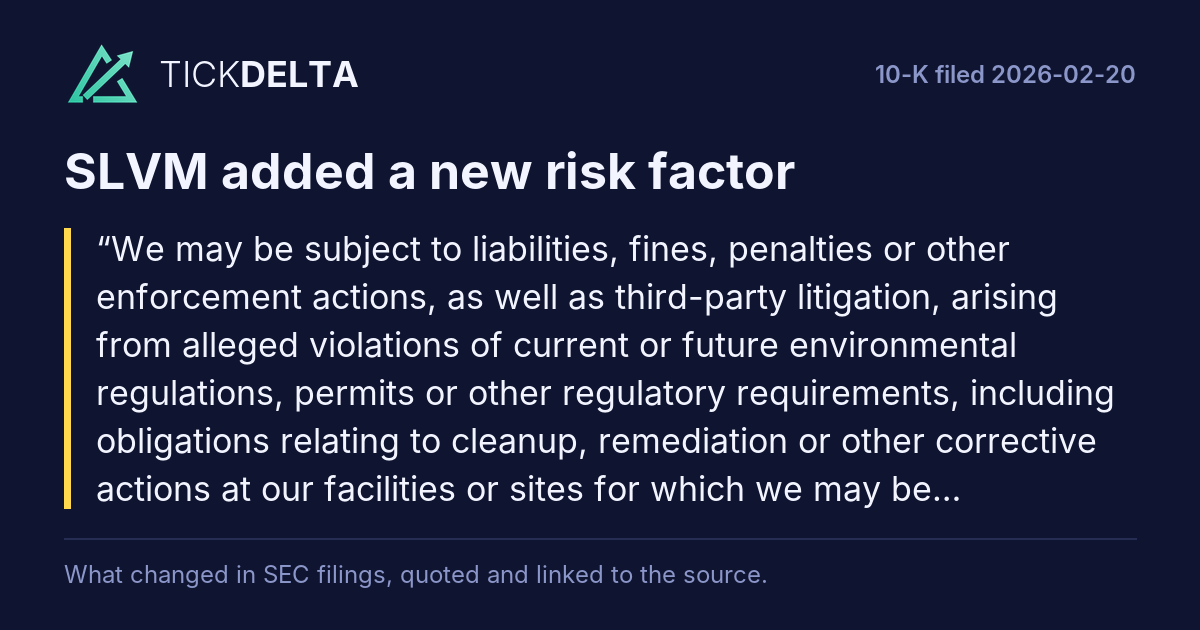
We may be subject to liabilities, fines, penalties or other enforcement actions, as well as third-party litigation, arising from alleged violations of current or future environmental regulations, permits or other regulatory requirements, including obligations relating to cleanup, remediation or other corrective actions at our facilities or sites for which we may be responsible. The cost of compliance, remediation or other corrective action, litigation or penalties associated with environmental matters could be material. The amount and timing of environmental expenditures is difficult to predict. In some cases, liability may be imposed without regard to contribution or whether we knew of or caused the environmental issue. Liability could exceed forecasted amounts or the value of the property itself. There can be no assurance that our existing reserves for specific matters will be adequate to cover our future costs.

Read in the 10-K

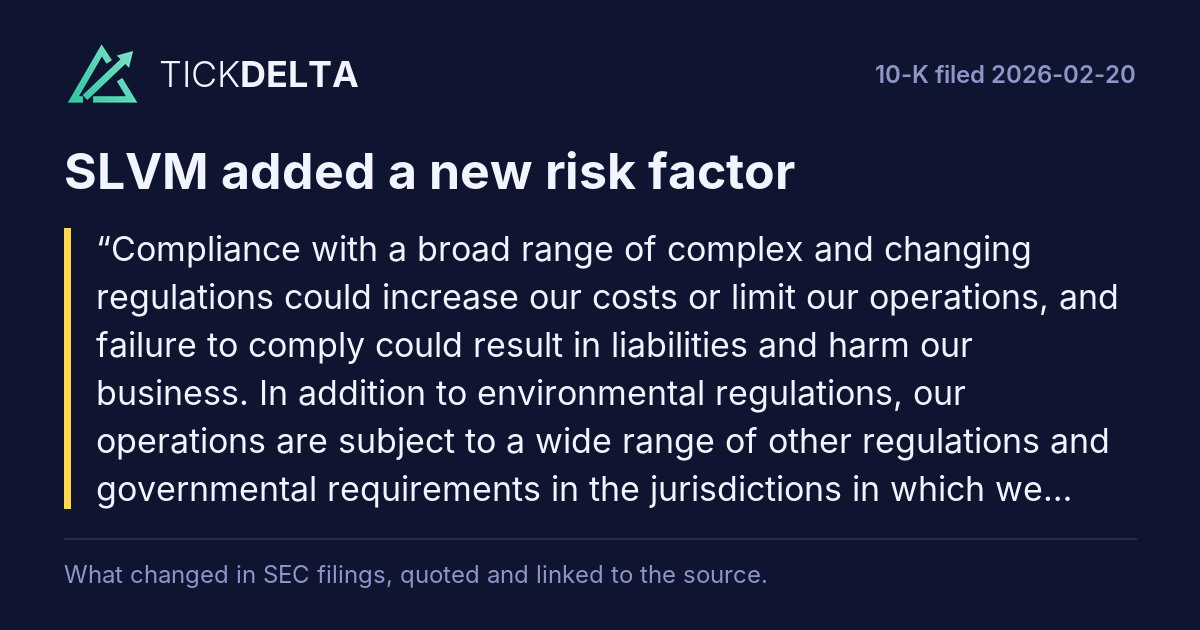
Compliance with a broad range of complex and changing regulations could increase our costs or limit our operations, and failure to comply could result in liabilities and harm our business.

In addition to environmental regulations, our operations are subject to a wide range of other regulations and governmental requirements in the jurisdictions in which we operate, including Europe, Latin America and North America. These requirements relate to, among other areas, health and safety, labor and employment, data privacy and cybersecurity, taxation, antitrust and competition, trade and customs and other regulatory matters. Changes in these regulations, or in their interpretation or enforcement, could require us to modify certain operations and incur additional costs to maintain compliance, including costs to modify policies, processes, systems and controls, and to enhance monitoring and reporting capabilities. Regulatory authorities may also interpret applicable regulations in ways that differ from our interpretations or expectations. If our efforts to comply with existing or future regulations are deemed inadequate, we could be subject to investigations, enforcement actions, remediation obligations, fines or penalties, criminal prosecution, private litigation and restrictions on our operations.

Read in the 10-K

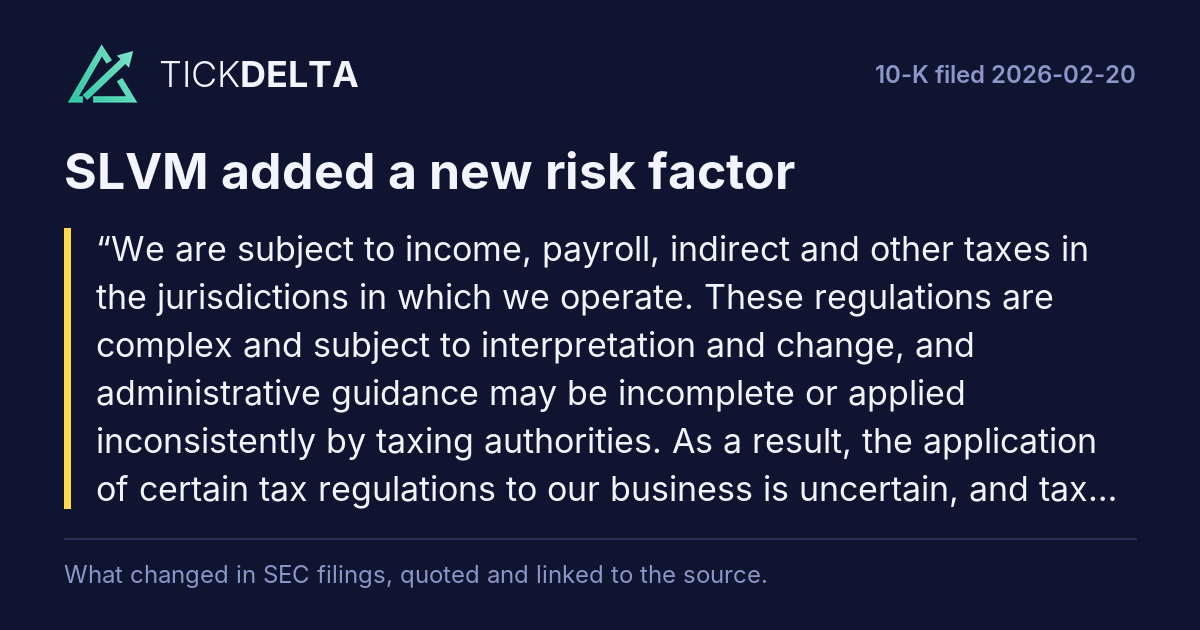
We are subject to income, payroll, indirect and other taxes in the jurisdictions in which we operate. These regulations are complex and subject to interpretation and change, and administrative guidance may be incomplete or applied inconsistently by taxing authorities. As a result, the application of certain tax regulations to our business is uncertain, and tax authorities may challenge our interpretations, positions or methodologies.

We are regularly subject to audits, examinations, and inquiries by tax authorities in multiple jurisdictions, particularly Brazil. Although we believe our tax positions are appropriate and are reported in accordance with applicable regulations, tax authorities could reach different conclusions. Adverse outcomes from tax audits, litigation or changes in regulation or interpretation could result in additional tax liabilities, higher effective tax rates, interest, penalties or other charges, some of which could be material. We are currently involved in ongoing tax controversy matters, including a dispute in Brazil relating to the deductibility of goodwill amortization arising from a 2007 acquisition by our Brazilian subsidiary, Sylvamo do Brasil Ltda. Assessments for the tax years 2007 through 2015 total approximately $106 million in tax and $289 million in interest, penalties and fees, which increased in 2025 due to currency fluctuations. We would share liability in this matter with our former parent, International Paper, pursuant to a tax matters agreement entered into in connection with our spin-off from International Paper in 2021 (the “Tax Matters Agreement”). Although Sylvamo do Brasil Ltda. prevailed in October 2024 in Brazilian federal court proceedings covering approximately two‑thirds of the disputed amounts, the Brazilian tax authorities have appealed the favorable ruling. The remaining one-third of the assessments is also under active challenge. A ruling at the Brazilian administrative court level in November 2025 upheld this one-third of the assessments, and Sylvamo do Brasil Ltda. filed a defense against the upheld assessments in the Brazilian federal court system in January 2026. A description of this matter is set forth in Note 10 Income Taxes to the Consolidated Financial Statements included in Item 8 of this Annual Report on Form 10‑K. The outcome and timing of the Brazil Tax Dispute and other tax matters are uncertain and could extend for many years.

Read in the 10-K

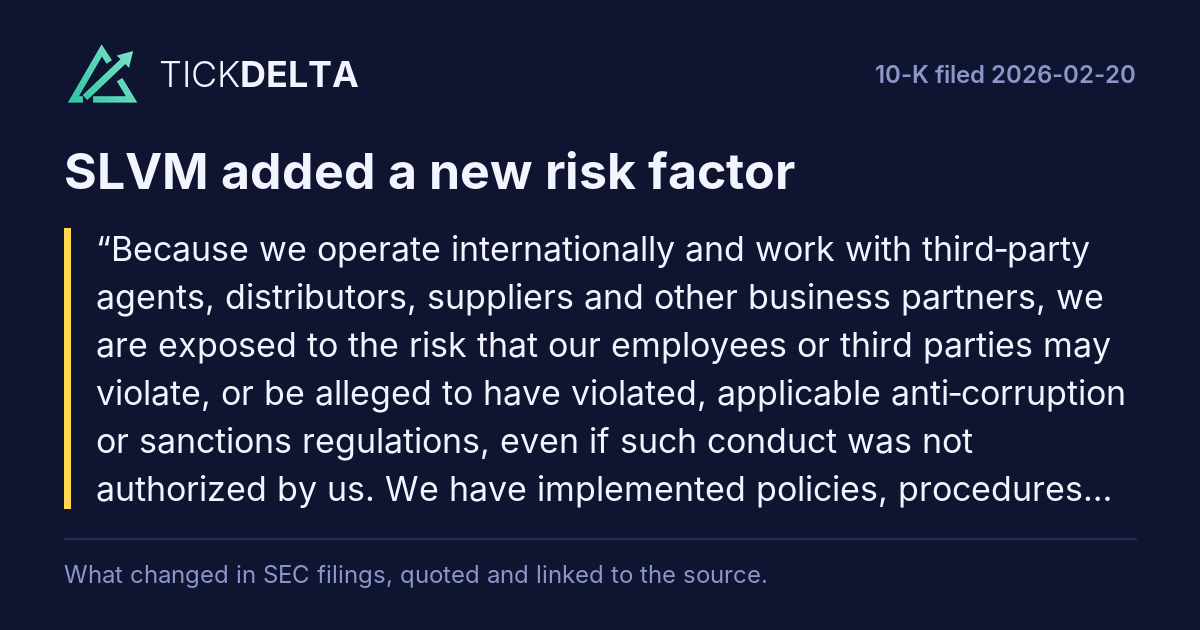
Because we operate internationally and work with third‑party agents, distributors, suppliers and other business partners, we are exposed to the risk that our employees or third parties may violate, or be alleged to have violated, applicable anti‑corruption or sanctions regulations, even if such conduct was not authorized by us. We have implemented policies, procedures, training and internal controls designed to promote compliance with applicable

anti‑corruption and sanctions regulations. However, these measures may not prevent all violations, and we may not be able to detect improper conduct or third‑party non‑compliance in a timely manner. Violations or alleged violations could result in expensive and disruptive investigations or enforcement actions by authorities in the U.S. or other jurisdictions, require significant management time and resources, and lead to criminal or civil fines or penalties, disgorgement, sanctions, injunctions, exclusions from government contracts or other remedial measures.

Failure to protect our intellectual property or defend against infringement claims could harm our business.

Read in the 10-K

If the transaction separating us from International Paper in 2021 fails to qualify for non-recognition treatment for U.S. tax purposes, it could result in significant tax liabilities.

Read in the 10-K

We have ongoing potential liabilities in connection with our 2021 separation from International Paper.

Read in the 10-K

We may be required to recognize impairments of goodwill or other intangible assets.

Read in the 10-K

Our indebtedness could constrain our business and use of cash, and a default under our debt agreements could adversely impact our business.

Read in the 10-K

Dividends and share repurchases are subject to board discretion and may be reduced or discontinued.

Read in the 10-K

We may be the subject of activity by activist shareholders. Responding to shareholder activism can be costly and time-consuming, disrupt our operations and divert the attention of management and our employees from executing our

Read in the 10-K

Our certificate of incorporation and bylaws contain certain provisions that may discourage, delay or prevent a change in our management or change of control, including that they, collectively: authorize the issuance of “blank check” preferred stock that could be issued by our board of directors to thwart a takeover attempt; provide that vacancies on our board of directors, including vacancies resulting from an enlargement of our board of directors, may be filled only by a majority vote of directors then in office; prohibit shareholder action by written consent, thereby requiring all actions to be taken at a meeting of the shareholders; and establish advance notice requirements for nominations of candidates for election as directors or to bring other business before an annual meeting of our shareholders.

Additionally, in November 2025, we adopted a shareholder rights plan, pursuant to which we issued a dividend of one preferred share purchase right (a “Right”) for each share of our common stock then outstanding. In the event of certain takeover events not authorized by our board of directors, the holders of Rights may purchase additional shares of preferred stock at a discount, diluting the ownership stake of any potential acquirer and making a takeover more expensive and difficult.

Read in the 10-K

An exclusive forum provision in our Certificate of Incorporation may limit shareholders’ ability to bring claims in some forums.
Read in the 10-K

Paragraphs in the 10-Q filed Nov 6, 2026 that were not in the one before

New in the latest 10-Q

22 paragraphs in the 10-Q filed Nov 6, 2026 with nothing like them in the 10-Q filed Aug 7, 2026 (at least half the words must differ; new numbers alone do not count). Quoted exactly, grouped by the item heading above them. This is text that changed, not a judgement of how serious it is.

Financial statements and notes

During the third quarter of 2026, management committed to a plan to sell the Company’s Europe business segment. As a result, all current and historical operating results of the Europe business segment are presented as “Discontinued operations, net of taxes” in the condensed consolidated statement of operations and the notes to the condensed consolidated financial statements. All historical assets and liabilities of the Europe business segment are classified as current and long-term assets and liabilities held for sale in the accompanying condensed consolidated balance sheet. We recorded a pre-tax charge of $ 342 million ($ 342 million after taxes) for the impairment of the Europe business segment and a pre-tax gain of $ 67 million ($ 67 million after taxes) which includes an expected cumulative foreign currency translation gain and other accumulated other comprehensive loss related to our Europe business segment, which will be recognized upon the sale of the business. See Note 7 Divestiture and Impairment of Business for further details.

Read in the 10-Q

Our operations in Europe include two integrated paper mills in the region, one in Saillat, France and one in Nymölla, Sweden. Operations related to these mills represented approximately 23 % of our net sales for the nine months ended September 30, 2026 and 17 % of our long-lived assets as of September 30, 2026.

Read in the 10-Q

A discontinued operation may include a component or a group of components of the Company's operations. A disposal of a component or a group of components is reported in discontinued operations if the disposal represents a strategic shift that has or will have a major effect on the Company's operations and financial results when the following occurs: (1) a component (or group of components) meets the criteria to be classified as held for sale; (2) the component or group of components is disposed of by sale; or (3) the component or group of components is disposed of other than by sale (for example, by abandonment or in a distribution to owners in a spin-off). For any component classified as held for sale or disposed of by sale or other than by sale, qualifying for presentation as a discontinued operation, the Company reports the results of operations of the discontinued operations (including any gain or loss recognized on the disposal or loss recognized on classification as held for sale of a discontinued operation), less applicable income taxes (benefit), as a separate component in the consolidated statements of operations for current and all prior periods presented. The Company also reports assets and liabilities associated with discontinued operations as separate line items on the consolidated balance sheets for prior periods. See Note 7 Divestiture and Impairment of Business for further details.

Read in the 10-Q

Basic and diluted earnings from continuing operations per share are calculated as follows:

Read in the 10-Q

During the third quarter of 2026, management committed to a plan to sell the Company’s Europe business segment. The divestiture of the business under this plan is expected to occur by the end of the first quarter of 2027. As a result, all current and historical operating results of the Europe business segment are presented as “Discontinued operations, net of taxes” in the condensed consolidated statement of operations and the notes to the condensed consolidated financial statements. All historical assets and liabilities of the Europe business segment are classified as current and long-term assets and liabilities held for sale in the accompanying condensed consolidated balance sheet.

Read in the 10-Q
Show the other 17

The following summarizes the major classes of line items comprising Income (Loss) Before Income Taxes reconciled to “Discontinued Operations, net of taxes”, related to the Europe business segment for all periods presented in the condensed consolidated of operations.

Read in the 10-Q

The following summarizes the major classes of assets and liabilities of the Europe business segment operations reconciled to the accompanying condensed consolidated balance sheets, with all amounts as of September 30, 2026 being presented as current assets or liabilities held for sale.

Read in the 10-Q

The following summarizes the total cash used for operating activities from discontinued operations, net and total cash used for investing activities from discontinued operations, net and included in the consolidated statement of cash flows:

Read in the 10-Q

During the third quarter of 2026, as a result of management’s commitment to a plan to sell the Company’s Europe business segment, a determination was made that the carrying value of the Europe business segment exceeded its estimated fair value. The fair value of the Europe business segment was estimated based on a probability-weighted average approach of potential cash flows from various alternatives with respect to the business. This estimated fair value was calculated using information available as of the impairment evaluation date of September 30, 2026 and could change materially in future periods. As a result, in the third quarter of 2026, we recorded a pre-tax charge of $ 342 million ($ 342 million after taxes) for the impairment of the Europe business segment and a pre-tax gain of $ 67 million ($ 67 million after taxes) which includes an expected cumulative foreign currency translation gain and other accumulated other comprehensive loss related to our Europe business segment, which will be recognized upon the sale of the business. These amounts are included in “Impairment of business” within the summarized income statement for our Europe business segment included in this footnote and is included in “Discontinued operations, net of taxes” in the condensed consolidated statement of operations and are reflected in the valuation allowance to adjust net assets to estimated fair value, less costs to dispose in current liabilities held for sale.

Read in the 10-Q

On November 6, 2026, the Company announced that it is entering into a put option agreement (“Option Agreement”) with Midas Atlantic Partners, in partnership with The Najafi Companies, for a binding offer to acquire the Company’s Europe business (the “Offer”). The Offer is for the business to be transferred to Midas Atlantic Partners with an agreed level of working capital and cash in exchange for the right to receive 20% of future distributions of the business. The Offer binds the buyer, but not the Company.

Read in the 10-Q

The Company maintains supplier finance agreements with third-party financial institutions. These agreements allow the Company’s participating suppliers to sell their receivables to such third-party financial institutions to receive payment earlier

Read in the 10-Q

On October 14, 2026, the tribunal overseeing the arbitration granted the Company interim relief preventing Suzano from invoicing VAT under the Supply Agreement until it issues a further decision on such relief, overriding a previous court decision that would have allowed Suzano to invoice VAT while the arbitration is ongoing. If Suzano were to prevail in the arbitration, the VAT potentially invoiced could total $ 15 to $ 20 million annually, although Suzano’s ability to invoice VAT would expire in 2032 due to a change in Brazil’s VAT law.

Read in the 10-Q

On November 6, 2026, we announced we have entered into exclusive negotiations with a buyer after signing a put option agreement that creates a binding offer to acquire our Europe business. We believe this potential transaction represents an important strategic step for our Europe business and Sylvamo. In Europe, it would create the opportunity to move forward with an owner experienced in corporate carveouts and positioning businesses for long-term success. After the proposed transaction, Sylvamo will be a more focused company, with greater ability to invest in our business, strengthen our performance and pursue world-class excellence.

Read in the 10-Q

During the third quarter of 2026, management committed to a plan to sell the Company’s European business segment. As a result, all current and historical operating results of the European business segment are presented as “Discontinued operations, net of taxes” in the condensed consolidated statement of operations and the notes to the condensed consolidated financial statements. All historical assets and liabilities of the European business segment are classified as current and long-term assets and liabilities held for sale in the accompanying condensed consolidated balance sheet. We recorded a pre-tax charge of $342 million ($342 million after taxes) for the impairment of the Europe business segment and a pre-tax gain of $67 million ($67 million after taxes) which includes an expected cumulative foreign currency translation gain and other accumulated other comprehensive loss related to our Europe business segment, which will be recognized upon the sale of the business. See Note 7 Divestiture and Impairment of Business for further details.

Read in the 10-Q

Our operations in Europe include two integrated mills in the region, one in Saillat, France and one in Nymölla, Sweden. Operations from these mills represented approximately 23% of our net sales for the nine months ended September 30, 2026 and 17% of our long-lived assets as of September 30, 2026.

Read in the 10-Q

Income (loss) from discontinued operations for the three months ended September 30, 2026 includes a net pre-tax charge of $342 million ($342 million after taxes) for the impairment of the Europe business segment and a pre-tax gain of $67 million ($67 million after taxes) which includes an expected cumulative foreign currency translation gain and other accumulated other comprehensive loss related to our Europe business segment, which will be recognized upon the sale of the business. See Note 7 Divestiture and Impairment of Business to our unaudited condensed consolidated financial statements included elsewhere in this Form 10-Q.

Read in the 10-Q

Income (loss) from discontinued operations for the nine months ended September 30, 2026 includes a net pre-tax charge of $342 million ($342 million after taxes) for the impairment of the Europe business segment and a pre-tax gain of $67 million ($67 million after taxes) which includes an expected cumulative foreign currency translation gain and other accumulated other comprehensive loss related to our Europe business segment, which will be recognized upon the sale of the business. See Note 7 Divestiture and Impairment of Business to our unaudited condensed consolidated financial statements included elsewhere in this Form 10-Q.

Read in the 10-Q

Reconciliation of Net Income from Continuing Operations to Business Segment Operating Profit

Read in the 10-Q

Reconciliation of Cash Provided by Operating Activities from Continuing Operations to Free Cash Flow

Read in the 10-Q

Risk Factors

On November 6, 2026, the Company announced that it had entered into a put option agreement with Midas Atlantic Partners, in partnership with The Najafi Companies, for a binding offer to acquire the Company’s Europe business. The Offer is for the business to be transferred to Midas Atlantic Partners with an agreed level of working capital and cash in exchange for the right to receive 20% of future distributions of the business. The Offer binds the buyer, but not the Company.

Read in the 10-Q

There is no assurance that the Offer will result in a sale of the Company’s Europe business. The Company’s ability to conduct the proposed sale depends on various factors, some beyond our control. The Company’s entry into a share purchase agreement (“SPA”), as proposed by the Option Agreement, is subject to the Company’s election to exercise the put option after certain conditions have been met, including our completion of required consultation processes with works councils and employee representatives in accordance with applicable law. We will complete these consultation processes before making any final decision on exercising the put option and entering into an SPA. Definitive SPA terms and completion of the transaction on a timely basis, if at all, would be subject to various factors and conditions, both known and unknown, including the satisfaction of conditions related to work councils’ approvals, the parties’ obtaining required regulatory approvals, and the satisfaction or waiver of other closing conditions.

Read in the 10-Q

Even if the Company were to complete the proposed sale, it might not have a positive effect on shareowner value and the Company might not realize the anticipated benefits of the transaction. The sale process and any resulting sale could have known and unknown adverse effects on the Company, including diverting management’s attention, disrupting our business, and exposing us to litigation. The Company has incurred, and will continue to incur, significant costs and expenses in connection with the proposed sale. Speculation and perceived uncertainties about developments related to the proposed sale could also cause volatility in the market price of the Company’s common stock.

Read in the 10-Q

The 10-Q's risk factors against the 10-K

Item 1A of the 10-Q filed Nov 6, 2026 against Item 1A of the 10-K filed Feb 20, 2026. A 10-Q repeats only the risks that changed, so a 10-K paragraph that is missing from it is not counted as removed. Added is a paragraph with nothing like it in the 10-K, Reworded a sentence that is in both with several words changed, Quiet changes a sentence in both where one to four words changed and one is a hedge or a modal (cut words struck through, new words highlighted). Text on the page, not a score; each links to the filing at sec.gov.

What the 10-Q itself says about its risk factors:The risk factors that affect our business and financial results are set forth under Part I, Item 1A, “Risk Factors,” in our 2025 Form 10-K. There have been no material changes to the risk factors described in the 2025 Form 10-K, except for the risk noted below. The risk factors in Item 1A. Risk Factors in the 2025 Form 10-K and the risks described in this Form 10-Q or our other SEC filings could cause our actual results to differ materially from those stated in any forward-looking statements.

Read in the 10-Q
Added10-Q Nov 6, 2026 vs 10-K Feb 20, 2026
On November 6, 2026, the Company announced that it had entered into a put option agreement with Midas Atlantic Partners, in partnership with The Najafi Companies, for a binding offer to acquire the Company’s Europe business. The Offer is for the business to be transferred to Midas Atlantic Partners with an agreed level of working capital and cash in exchange for the right to receive 20% of future distributions of the business. The Offer binds the buyer, but not the Company.

Read it in the 10-Q at sec.gov

Added10-Q Nov 6, 2026 vs 10-K Feb 20, 2026
There is no assurance that the Offer will result in a sale of the Company’s Europe business. The Company’s ability to conduct the proposed sale depends on various factors, some beyond our control. The Company’s entry into a share purchase agreement (“SPA”), as proposed by the Option Agreement, is subject to the Company’s election to exercise the put option after certain conditions have been met, including our completion of required consultation processes with works councils and employee representatives in accordance with applicable law. We will complete these consultation processes before making any final decision on exercising the put option and entering into an SPA. Definitive SPA terms and completion of the transaction on a timely basis, if at all, would be subject to various factors and conditions, both known and unknown, including the satisfaction of conditions related to work councils’ approvals, the parties’ obtaining required regulatory approvals, and the satisfaction or waiver of other closing conditions.

Read it in the 10-Q at sec.gov

Added10-Q Nov 6, 2026 vs 10-K Feb 20, 2026
Even if the Company were to complete the proposed sale, it might not have a positive effect on shareowner value and the Company might not realize the anticipated benefits of the transaction. The sale process and any resulting sale could have known and unknown adverse effects on the Company, including diverting management’s attention, disrupting our business, and exposing us to litigation. The Company has incurred, and will continue to incur, significant costs and expenses in connection with the proposed sale. Speculation and perceived uncertainties about developments related to the proposed sale could also cause volatility in the market price of the Company’s common stock.

Read it in the 10-Q at sec.gov

Added10-Q Nov 6, 2026 vs 10-K Feb 20, 2026
(a) 4,800 shares were acquired from employees from share withholdings under the Company’s long term incentive compensation program.

Read it in the 10-Q at sec.gov

Added10-Q Nov 6, 2026 vs 10-K Feb 20, 2026
On May 18, 2022, the Board approved a share repurchase program under which the Company may purchase up to an aggregate amount of $150 million of shares of its common stock (the “Repurchase Program”). In 2023 and again in the third quarter of 2025, the Board authorized an additional $150 million for the Repurchase Program, bringing the total program capacity to $450 million. As of September 30, 2026, $150 million remains available for repurchases. Pursuant to the Repurchase Program, the Company may repurchase in amounts, at prices and at such times as it deems appropriate, subject to market conditions and other considerations, including all applicable legal requirements. Repurchases may include purchases on the open market or privately negotiated transfers, under Rule 10b5-1 trading plans, under accelerated share repurchase programs, in tender offers and otherwise. The Repurchase Program does not obligate the Company to acquire any particular amount of shares of its common stock and may be modified or suspended at any time at the Company’s discretion. The Company did not repurchase any shares during the nine months ended September 30, 2026.

Read it in the 10-Q at sec.gov

Phrases used for the first time

Two-word phrases in Risk Factors of the 10-K filed Feb 20, 2026 that are in none of the 1 earlier 10-Ks stored, back to Feb 20, 2025

environmental regulations ×9separation transaction ×5million outstanding ×5compliance obligations ×4privacy regulations ×3anti corruption ×3outstanding term ×3input costs ×2materials energy ×2competing products ×2downward pressure ×2new tariffs ×2offset increased ×2extreme weather ×2repair costs ×2temporary shutdowns ×2
Where each one is used
  • environmental regulations: We are exposed to risks associated with climate-related regulatory developments. The introduction of carbon taxes or new or more stringent environmental regulations, such as those addressing GHG emissions, energy use or permitting requirements, could increase our compliance, monitoring, reporting or capital...
  • separation transaction: Our separation spin-off from International Paper (the “Separation Transaction”) was generally deemed tax-free. However, until the fifth anniversary of the Separation Transaction on October 1, 2026, or later until any audit of International Paper’s 2021 tax year is closed, the U.S. Internal Revenue Service (the...
  • million outstanding: We have outstanding indebtedness that includes the following amounts as of December 31, 2025: a revolving credit facility with $67 million outstanding; a Term Loan A maturing in 2029 with $208 million outstanding; a Term Loan F maturing in 2027 with $257 million outstanding; a Term Loan F‑2 maturing in 2031 with...
  • compliance obligations: We anticipate continued or increased activity by local, state, federal and international regulators regarding environmental matters and policies affecting our operations. Changes in regulatory frameworks or enforcement practices could require us to modify or install additional controls, make capital investments,...
  • privacy regulations: Compliance obligations in certain regulatory areas are complex and actively evolving. For example, we are subject to data‑protection and privacy regulations in multiple jurisdictions, including the European Union’s General Data Protection Regulation (“GDPR”), Brazil’s Lei Geral de Proteção de Dados Pessoais...
  • anti corruption: We are subject to anti‑corruption and anti‑bribery regulations in the jurisdictions in which we operate, including the U.S. Foreign Corrupt Practices Act (“FCPA”), the U.K. Bribery Act, France’s Sapin II Act, and similar regulations in other countries. These regulations generally prohibit us and our directors,...
  • outstanding term: We have outstanding indebtedness that includes the following amounts as of December 31, 2025: a revolving credit facility with $67 million outstanding; a Term Loan A maturing in 2029 with $208 million outstanding; a Term Loan F maturing in 2027 with $257 million outstanding; a Term Loan F‑2 maturing in 2031 with...
  • input costs: Elevated, persistent global inflation has, and could continue to, increase our operating and input costs. Our ability to increase prices to offset those costs without reducing demand is constrained. Thus, inflation has and could further negatively impact our profitability. If an economic recession were to occur, it...

The 10-K at sec.gov

Used at least twice, small words left out. Counted, not picked: a phrase can be new because the company renamed something.

What was taken out

92 paragraphs of last year's Risk Factors with nothing like them now. The longest are quoted.

Across all companies
For example, the Brazilian Federal Revenue Service has challenged the deductibility of goodwill amortization generated in a 2007 acquisition by International Paper do Brasil Ltda., now named Sylvamo do Brasil Ltda. (“Sylvamo Brasil”), a wholly-owned subsidiary of Sylvamo (the “Brazil Tax Dispute”). Sylvamo Brasil’s assessments for the tax years 2007-2015 total approximately $95 million in tax and $235 million in interest, penalties and fees (adjusted for variation in currency exchange rates). After a previous favorable ruling challenging the basis for these assessments, Sylvamo Brasil...
In the 10-K filed Feb 20, 2025
Disruption in existing trade agreements, or increased trade friction between countries, could result in protective measures such as tariffs and anti-dumping and countervailing duties. Protective trade measures could skew markets and disrupt the cross-border flow of globally traded materials needed to make our products and the distribution of our products. For example, tariffs imposed or proposed by the United States on items that we import into the United States could increase our costs for such items. If we were to increase our products’ prices to mitigate the increase in our costs, it...
In the 10-K filed Feb 20, 2025
•Decreased productivity of forests, increased frequency and severity of wildfires, heavy rain or drought, inadequate distribution and abundance of tree species, and the spread of disease or insect epidemics in forestlands, could adversely affect timber production and harvesting, thereby reducing the availability to us of, or reducing the density and quality of, the virgin fiber upon which we rely to manufacture our products. Thus, any one or more of these events could significantly increase the costs to manufacture our products and potentially delay or interrupt our manufacturing...
In the 10-K filed Feb 20, 2025
We are subject to extensive environmental laws and regulations in Europe, Latin America and North America. Environmental laws and regulations continue to evolve, and we could become subject to increasingly stringent environmental standards in the future, particularly under air quality and water quality laws and standards, including those intended to address climate change discussed at “— We are subject to physical, financial and reputational risks associated with climate change, including the impact of global, regional and local weather conditions, the availability of wood fiber, water and...
In the 10-K filed Feb 20, 2025

Sources

Item 1A of each 10-K and 10-Q on EDGAR, quoted exactly. Each paragraph links to the filing at sec.gov.

Also

10-K change: what was reworded or cut, section by section.

Work with it

Excel workbook · CSV. Google Sheet that stays up to date: paste =IMPORTDATA("https://tickdelta.com/company/SLVM/export.csv") into a cell.

Next:10-K change
Esc

Type a ticker such as AAPL, a name, an investor such as Buffett, or a topic such as tariffs. ↑ ↓ to move, Enter to open.