Screener / SEC EDGAR /CIK 0001856485 /10-K filed Feb 20, 2026, compared with Feb 20, 2025 /Numbers from the XBRL of the 10-Ks
NYSE Materials · Paper

Sylvamo Corp SLVM

Compare with peers Embed
The 10-K against last year's

282 changes: 49 added, 96 removed, 133 reworded, 4 quiet changes

10-K Feb 20, 2026 vs Feb 20, 2025

10-K 0001856485-26-000008 (Feb 20, 2026) vs 10-K 0001856485-25-000008 (Feb 20, 2025)

Every paragraph, and how much of it changed

One bar per paragraph, in the order of the 10-K. Height and colour show the share of its words not in the closest paragraph a year earlier; the tallest bars are new paragraphs.

Risk Factors

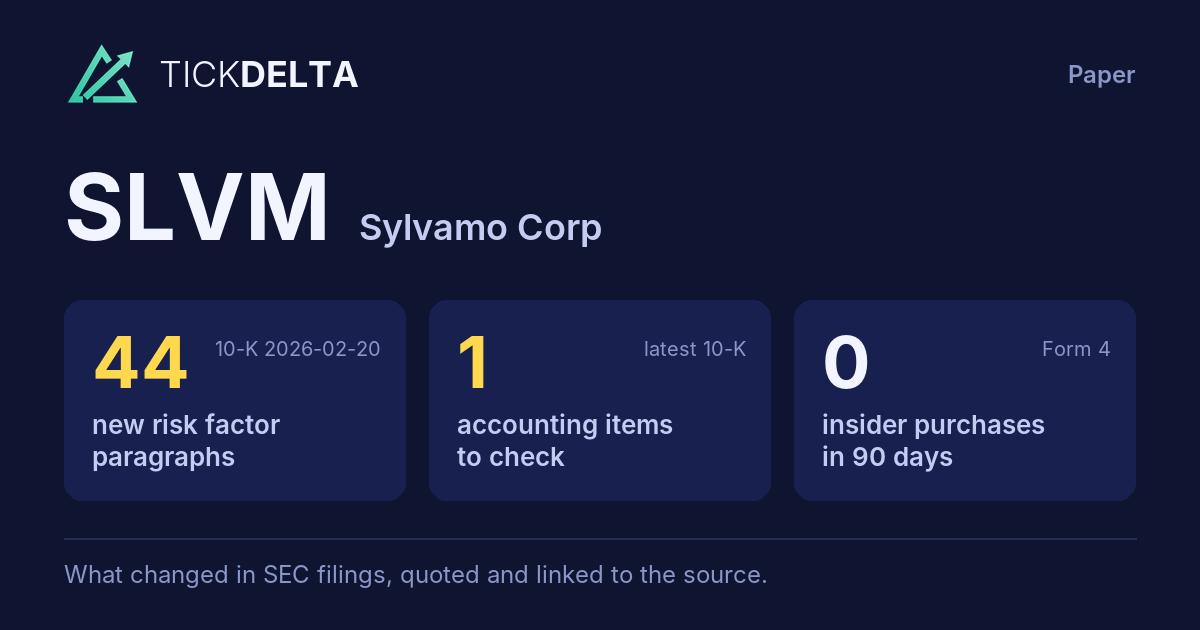
122 paragraphs · 44 new · 67 reworded · 92 gone · 10-K Feb 20, 2026 against Feb 20, 2025
New paragraph Reworded (5% of its words or more) Same or nearly
Paragraph 95 · 50% changed Every version of it
We have outstanding indebtedness that includes the following amounts as of December 31, 2025: a revolving credit facility with $67 million outstanding; a Term Loan A maturing in 2029, 2029 with $208 million outstanding; a $257 million Term Loan F maturing in 2027, 2027 with $257 million outstanding; a $232 million Term Loan F-2 F‑2 maturing in 2031, 2031 with $220 million outstanding; and a $110 million an accounts receivable finance facility maturing in 2027. As of December 31, 2024, the aggregate principal amount of all of our outstanding debt was approximately $796 million. Our strategy has included a reduction of our outstanding debt obligations, by nearly 48% since 2021, but nonetheless our debt is a risk that could have important consequences to our shareholders, including: 2027 with $90 million outstanding.
Paragraph 92 · 49% changed Every version of it
We sponsor various defined benefit pension plans. plans in the U.S. and U.K. The assets of the pension plans are diversified in an attempt to mitigate the risk of a large loss. Required funding for our domestic U.S. defined benefit pension plan is determined in accordance with guidelines set forth in the federal Employee Retirement Income Security Act of 1974, as amended (“ERISA”) and foreign defined benefit the U.K. pension plans are plan is funded in accordance with local statutes or practice. Additional contributions to enhance the funded status of the pension plans can be made at our discretion. As of December 31, 2024, the Sylvamo U.K. pension plan was fully funded, and the Sylvamo United States pension plan was 96% funded. We may need to make future contributions to reduce any underfunding and, with respect to the U.K. pension plan, we have agreed with U.K. regulators to contribute to the plan approximately $4 million per year through 2029 to enhance the plan’s self-sufficiency. There can be no assurance that the value of the pension plan assets, or the investment returns on those plan assets, will be sufficient to meet the future benefit obligations of such plans. In addition, during periods of adverse market conditions and declining interest rates, we may be required to make additional cash contributions to the pension plans that could reduce our financial flexibility. Changes in plan demographics, including an increase in the number of retirements or increases in life expectancy assumptions, may also increase the costs and funding requirements of the obligations related to the company’s pension plans. Additionally, interpretations of or changes in laws applicable to our United States or U.K. pension plan could cause us to have to increase funding of the plan; for example, see the disclosure concerning our U.K. pension plan in “— Our business is subject to a wide variety of other laws, regulations and other government requirements that may change in significant ways, and the cost of compliance with such requirements could have a material adverse effect on our business, financial condition, results of operations and cash flows.” An increase in costs or funding requirements could adversely impact our business, financial condition, results of operations and cash flows.
Paragraph 9 · 48% changed Every version of it
The imposition of trade protection measures, such as governmental subsidies and tax benefits, favoring Trade policies that favor locally produced products that compete with ours, but which do not also protect competing products, without providing comparable protection to our products, could have place us at a material adverse effect on our results of operations and business prospects. Conversely, competitive disadvantage, as could the removal elimination or reduction of trade protection measures that protect currently benefit our products could have a material adverse effect on our results of operations and business prospects. products. For example, our mills in Brazil have historically benefited from Brazil’s policies favoring that favor Brazilian domestic producers. We cannot guarantee that any predict whether such policies will continue or that we will continue to benefit from existing or future policies, nor can we guarantee that we will not be harmed by future policies. remain in effect,
Paragraph 33 · 48% changed Every version of it
•changes in the cost Increased costs or decreased availability of raw materials and energy needed to manufacture could adversely affect our products; business.
Paragraph 73 · 48% changed Every version of it
The We maintain defined benefit pension plans that we maintain for some current and former employees in the United States and former employees United Kingdom, along with immaterial plans in certain other jurisdictions. These plans are subject to extensive and evolving regulations and regulatory interpretations. Changes in applicable pension requirements, or in how existing requirements are interpreted or enforced, could increase our compliance obligations, funding requirements or administrative costs. Developments in the United Kingdom (“U.K.”) are heavily regulated, and changes in the applicable laws and regulations, or interpretations that impact us, could increase have introduced uncertainty regarding our costs of compliance or negatively impact funding. For example, in a 2024 historical pension plan case in the amendments. A 2024 U.K. court decision (Virgin Media Ltd v. NTL Pension Trustees II), the presiding court invalidated II) held that certain pension plan amendments, amendments dating back to the earliest being in 1999, on grounds that the U.K.’s late 1990s were invalid because statutory process required that any amendments materially changing plan benefits must undergo certain regulatory notifications notification and actuarial confirmation. confirmation requirements were not properly followed. As a result of this ruling, all decision, U.K. pension plans (including generally, including our U.K. pension plan) are subject to plan, may face the risk that any plan amendment made since the late 1990s may historical amendments could be deemed void if required statutory processes were not properly completed or adequately documented. If one or more amendments were determined to be invalid, we could be required to reassess past benefit calculations and make backdated benefit payments to plan members. Any such statutory process was not followed. The Company is reviewing its archival U.K. pension files to verify that such process was followed and documented for its U.K. pension plan amendments. If for any amendment to outcome could result in a material increase in our U.K. pension plan the process was not followed, liabilities and require increased contributions or if we cannot document that it was followed, additional funding. The timing, scope and if the amendment is void as a result, we may have to revisit benefits paid out under the Company’s U.K. pension plan and make backdated payments to plan members. In such event, there could be a material increase in the Company’s U.K. pension plan liabilities that requires financial impact on us of any required remedial actions or increased Company contributions to make up the difference. funding obligations are uncertain.
Paragraph 91 · 48% changed Every version of it
Failure to achieve expected Pension plan investment returns on pension plan assets, as well as performance and actuarial changes in interest rates or plan demographics, could adversely impact affect our business, financial condition, results of operations and cash flows.
Paragraph 69 · 48% changed Every version of it
Compliance obligations in certain regulatory areas are complex and actively evolving. For example, we are subject to complex data‑protection and evolving U.S. and international privacy laws and regulations, regulations in multiple jurisdictions, including those pertaining to the handling of personal data, such as the EU European Union’s General Data Protection Regulation (“GDPR”), Brazil’s Lei General Geral de Proteção de Dados Pessoais (“LGPD”), and state‑level privacy regulations in the United States, such as the California Consumer Privacy Act of 2018 (“CCPA”), Act, as amended and expanded by the California Privacy Rights Act (“CPRA”). The GDPR, which applies with respect (“CCPA/CPRA”). These regulations impose requirements related to all member states of the European Union, and Brazil’s LGPD both establish rules for the collection, use, processing, storage storage, security and transfer of personal data data, and provide regulators with enforcement authority that includes the ability to impose significant penalties fines and other remedies for noncompliance. The GDPR gives European Union citizens and residents, and the LGPD gives Brazilian data subjects, expanded rights to control their personal data and access to it, and includes requirements with respect to maintaining the There is no assurance that our security of personal data, limiting the processing of personal data, reporting data breaches and cross-border data transfers. The CCPA, as amended by the CPRA, affords California residents and households expanded privacy protections. Additionally, governmental authorities in these and other jurisdictions may implement new data protection laws and regulations that apply to us. controls over
Paragraph 62 · 46% changed Every version of it
Further, we We are required to comply with environmental laws and the terms and conditions of multiple environmental permits. In permits in the countries jurisdictions where we manufacture paper, our industry is subject to various including permits imposing performance-based rules associated with requirements for effluent and air emissions. For example, in the United States, federal, state and local laws and regulations require us to routinely obtain authorizations from and comply with the evolving standards of the appropriate permit terms over which governmental authorities, which authorities have considerable discretion over the terms of permits. Failure to comply with environmental laws and permit requirements imposed by a governmental authority having jurisdiction over our operations could result in civil discretion. If we cannot maintain or criminal fines or penalties or enforcement actions, including regulatory or judicial orders enjoining or curtailing our operations or requiring us to take corrective measures, install pollution control equipment, or take other remedial actions, such as product recalls or labeling changes. There can be no assurance that future environmental permits will be granted or that we will be able to maintain and renew existing permits, and the failure to do so it could have a material adverse effect on materially adversely affect our business, financial condition, results of operations and cash flows. business.

MD&A

74 paragraphs · 5 new · 40 reworded · 4 gone · 10-K Feb 20, 2026 against Feb 20, 2025
New paragraph Reworded (5% of its words or more) Same or nearly
Paragraph 46 · 42% changed
The following table shows capital spending by our business segment, which represents the most significant portion of our recurring investment activities. segments and corporate:
Paragraph 45 · 36% changed
The total cash outflow from investing activities from continuing operations for the year ended December 31, 2024 decreased 2025 increased from the year ended December 31, 2023, primarily 2024, due to the purchase of the Nymölla mill which occurred in the prior year. increased capital spending.
Paragraph 52 · 35% changed
At December 31, 2024, 2025, contractual obligations for future payments of long-term debt maturities (including finance lease liabilities disclosed in Note 10 Leases) by calendar year were as follows: 2025 - $22 million; 2026 - $25 $20 million; 2027 - $370 million; 2028 - $25 $23 million; 2029 - $191 $189 million; 2030 - $12 million; thereafter - $180 $161 million. In addition, at December 31, 2025 there is an outstanding balance of $67 million related to a cash flow-based revolving credit facility which matures in 2029.
Paragraph 62 · 33% changed
The Company also performed its annual testing of goodwill impairment by applying the quantitative goodwill impairment test to its Brazil France reporting unit due to the length of time lapsed since the previous quantitative goodwill impairment test. continued challenging market conditions in Europe. The Company calculated the estimated fair value of the Brazil France reporting unit using a probability-weighted weighted approach based on discounted future cash flows, market multiples and transaction multiples. As a result, the Company concluded multiples, and determined that the fair value all of the Brazil reporting unit was substantially goodwill in excess of carrying value and no goodwill impairment charge was recorded. the business, totaling $11 million, should be written off.
Paragraph 6 · 32% changed
Comparing our performance in 2024 2025 to 2023, higher 2024, challenging industry conditions contributed to lower volumes were driven by stronger demand for of uncoated freesheet across all three of our regions. Unabsorbed Price and mix were unfavorable in Europe and Latin America but improved in North America. Planned maintenance outages were significantly higher due to two outages in Europe compared with one in the previous year. Europe and North America benefited from lower unabsorbed fixed costs due to reduced economic manufacturing downtime in Europe and North America declined significantly in 2024. These factors, in addition to more favorable input 2025. Input costs and lower planned maintenance outages, operations were partially offset by lower price and mix and less favorable operations. unfavorable in all of our regions compared to 2024. We generated solid free cash flow again this year. We generated $248 $44 million in free cash flow, repaid $154 million in debt, flow this year and returned $130 $155 million in cash to shareholders. Additionally, we shareowners. We also reinvested $221 $224 million across our manufacturing network and our Brazil forestlands to strengthen our low-cost position. We also accelerated the development of high-return capital project investments.
Paragraph 55 · 31% changed
For the year ended December 31, 2024, we have invested approximately $221 million, or 5.9% of net sales in total capital expenditures. Of that amount, we spent approximately $195 million, or 5.2% of net sales, on maintenance, regulatory and reforestation capital expenditures, and approximately $27 million, or 0.7% of net sales, on high-return capital projects. Our annual maintenance, regulatory and reforestation capital expenditures are expected to be in the range of approximately $175 to $190 million per year (before inflation) for the next several years, which we believe will be sufficient to maintain our operations and productivity. In addition, we expect to invest approximately $50 to $70 $95 million in high-return projects in 2025. 2026.
Paragraph 43 · 27% changed
Cash provided by operating activities from continuing operations totaled $268 million for the year ended December 31, 2025, compared with cash provided by operating activities of $469 million for the year ended December 31, 2024, compared with cash provided by operating activities from continuing operations of $504 million for the year ended December 31, 2023. 2024. The decrease in cash provided by operating activities from continuing operations in 2024 2025 relates primarily to changes in lower net income and timing of cash flows related to working capital which was partially offset by higher net income. capital.
Paragraph 34 · 24% changed
(a) Net special items represent income or expenses that are incurred periodically, rather than on a regular basis. Net special items in the periods presented primarily include the impairment of goodwill in our France reporting unit, charges related to the termination of the Georgetown mill offtake agreement, environmental reserves in Brazil, legal fees related to the Brazil Tax Dispute, foreign VAT refunds, transaction and integration costs related to the Nymölla acquisition, professional and legal fees related to negotiations resulting in a shareholder cooperation agreement, the impact of the step-up of acquired Nymölla inventory sold during the first quarter of 2023 acquisition and certain severance costs related to our salaried workforce.

A paragraph is matched with the one last year that shares the most of its words; under half in common makes it new. The paragraphs shown are the 8 reworded the most in each section.

The paragraph that changed most in each section

The redline

Marked against last year's 10-K: cut words struck through, new words highlighted.

Risk Factors296 words changed in this paragraph; it is 46% similar to last year's version.
Our certificate of incorporation provides that, unless we consent in writing to the selection of an alternative forum, the Court of Chancery of the State of Delaware will be the sole and exclusive forum for any (1) derivative action or proceeding brought on our behalf, (2) action asserting a claim of actions, claims for breach of a fiduciary duty owed to us or our shareholders by any of our directors, officers, employees or agents, (3) action asserting a claim duty, claims arising out of or pursuant to under the Delaware General Corporation Law (the “DGCL”) or (“DGCL”), our certificate of incorporation or bylaws, or as to which the DGCL confers jurisdiction on the Court of Chancery of the State of Delaware or (4) action asserting a claim other claims governed by the internal affairs doctrine. Unless we consent in writing In addition, to the selection of an alternative forum, fullest extent permitted by law, the federal district courts of the United States of America will, to the fullest extent permitted by law, will be the sole and exclusive forum for the resolution of any complaint asserting a cause of action claims arising under the Securities Act of 1933, as amended (the “Securities Act”), the Securities Exchange Act, Act of 1934, and the rules and regulations thereunder. Neither this provision nor the exclusive These forum provision will mean that shareholders have waived our compliance with federal securities laws and the rules and regulations thereunder, but it does mean that our shareholders are deemed to have notice of and have consented to these selection provisions concerning choice of forum. The choice of forum provision in our certificate of incorporation may limit our shareholders’ a stockholder’s ability to bring a claim in a judicial forum that they find favorable for disputes with us certain claims against the Company, or any of our against current or former directors, officers or other shareholders, which in a judicial forum that the shareholder perceives to be favorable and may discourage lawsuits litigation with respect to such claims. Additionally, a court could determine that the exclusive forum provision is unenforceable. If a court were to find the choice any portion of forum provision contained in our certificate of incorporation to be these provisions inapplicable or unenforceable to an action in which we assert the choice of forum, unenforceable, we could incur additional costs associated with resolving the action such matters in other jurisdictions, which could have a material adverse effect on our business, financial condition and results of operations. jurisdictions.

Source: Item 1A, 10-K 0001856485-26-000008 vs Item 1A, 10-K 0001856485-25-000008

MD&A128 words changed in this paragraph; it is 48% similar to last year's version.
Comparing our performance in 2024 2025 to 2023, higher 2024, challenging industry conditions contributed to lower volumes were driven by stronger demand for of uncoated freesheet across all three of our regions. Unabsorbed Price and mix were unfavorable in Europe and Latin America but improved in North America. Planned maintenance outages were significantly higher due to two outages in Europe compared with one in the previous year. Europe and North America benefited from lower unabsorbed fixed costs due to reduced economic manufacturing downtime in Europe and North America declined significantly in 2024. These factors, in addition to more favorable input 2025. Input costs and lower planned maintenance outages, operations were partially offset by lower price and mix and less favorable operations. unfavorable in all of our regions compared to 2024. We generated solid free cash flow again this year. We generated $248 $44 million in free cash flow, repaid $154 million in debt, flow this year and returned $130 $155 million in cash to shareholders. Additionally, we shareowners. We also reinvested $221 $224 million across our manufacturing network and our Brazil forestlands to strengthen our low-cost position. We also accelerated the development of high-return capital project investments.

Source: Item 7, 10-K 0001856485-26-000008 vs Item 7, 10-K 0001856485-25-000008

Legal Proceedings123 words changed in this paragraph; it is 71% similar to last year's version.
The Brazilian Federal Revenue Service has challenged the deductibility of goodwill amortization generated in a 2007 acquisition by International Paper do Brasil Ltda., a wholly-owned subsidiary of the Company now named Sylvamo do Brasil Ltda. (“Sylvamo Brasil”). Sylvamo Brasil received assessments for the tax years 2007-2015 totaling approximately $106 million in tax, and $289 million in interest, penalties and fees (adjusted for variation in currency exchange rates). International Paper challenged and is managing the litigation of this matter pursuant to the Tax Matters Agreement between us and International Paper. After a previous favorable ruling challenging the basis for these assessments, Sylvamo Brasil received other subsequent unfavorable decisions from the Brazilian Administrative Council of Tax Appeals. These decisions are being appealed. The appeal involves several separate cases. In October 2024, at the first level of appeal in the Brazilian federal court system, the court ruled in favor of Sylvamo Brasil in cases covering approximately two thirds of the disputed amounts. The remaining one Brazilian tax authorities have appealed the favorable ruling. One third of the disputed amounts is still was under challenge at the Brazilian administrative court level and was not part of the ruling. The In November 2025, the administrative court upheld the assessments for the remaining one third of the disputed amounts. In January 2026, Sylvamo Brasil’s challenge of the administrative ruling was filed in the Brazilian tax authorities have appealed the October 2024 ruling. federal court system. This tax litigation matter may take many years to resolve. The Company believes that the transaction underlying these assessments was appropriately evaluated, and that the Company’s tax position would be sustained, based on Brazilian tax law.

Source: Item 3, via Note 10 – INCOME TAXES, 10-K 0001856485-26-000008 vs Item 3, via Note 12 – INCOME TAXES, 10-K 0001856485-25-000008

Accounting Policies71 words changed in this paragraph; it is 86% similar to last year's version.
The Company has the option to evaluate goodwill for impairment by first performing a qualitative assessment of events and circumstances to determine whether it is more likely than not that the fair value of a reporting unit is less than its carrying amount. If, after assessing the totality of events or circumstances, the Company determines that it is not more likely than not that the fair value of a reporting unit is less than its carrying amount, then the quantitative goodwill impairment test is not required to be performed. If the Company determines that it is more likely than not that the fair value of a reporting unit is less than its carrying amount, or if the Company does not elect the option to perform an initial qualitative assessment, then the Company is required to perform the quantitative goodwill impairment test. In performing this evaluation, the Company estimates the fair value of its reporting unit using a weighted approach based on discounted future cash flows, market multiples and transaction multiples. The determination of fair value using the discounted cash flow approach requires management to make significant estimates and assumptions related to forecasts of future revenues, operating profit margins and discount rates. The determination of fair value using market multiples and transaction multiples requires management to make significant assumptions related to revenue multiples and adjusted earnings before interest, taxes, depreciation and amortization (“EBITDA”) multiples. For reporting units whose carrying amount is in excess of their estimated fair value, the reporting unit will record an impairment charge by the amount that the carrying amount exceeds the reporting unit’s fair value, not to exceed the total amount of goodwill allocated to the reporting unit. See Note 11 Goodwill for further discussion.

Source: Item 8, Note 2 – BASIS OF CONSOLIDATION AND SIGNIFICANT ACCOUNTING POLICIES, 10-K 0001856485-26-000008 vs Item 8, Note 2 – BASIS OF CONSOLIDATION AND SIGNIFICANT ACCOUNTING POLICIES, 10-K 0001856485-25-000008

Sentences and paragraphs added, removed or reworded

Every change, by type

Sentences and paragraphs of SLVM's Risk Factors and MD&A, 10-K Feb 20, 2026 against 10-K Feb 20, 2025. Each links to the text at sec.gov.

Quiet changes are sentences kept from last year with one to four words changed, at least one of them a hedge, a modal or a qualifier (may, could, will, not, significant, material…). A year or date rolling forward is not counted.

The full word list

adverse, adversely, all, although, anticipate, anticipates, any, approximately, believe, believes, can, cannot, certain, could, expect, expects, generally, however, if, intend, intends, largely, likely, many, material, materially, may, might, most, must, never, no, not, possible, primarily, probable, should, significant, significantly, some, substantial, substantially, unlikely, will, would

AddedRisk Factors
Elevated, persistent global inflation has, and could continue to, increase our operating and input costs. Our ability to increase prices to offset those costs without reducing demand is constrained. Thus, inflation has and could further negatively impact our profitability. If an economic recession were to occur, it could reduce demand for our products, lower our capacity utilization and compress margins. Furthermore, significant inflation or a recession could negatively affect industrial non-durable goods production, consumer spending, commercial printing and advertising activity, white collar employment levels, and overall consumer confidence, which also could reduce demand for our products.
Read it in 10-K Feb 20, 2026 at sec.gov
AddedRisk Factors
We are exposed to risks from the imposition, expansion or removal of trade protection measures, including tariffs, anti-dumping or countervailing duties, governmental subsidies and tax incentives.
Read it in 10-K Feb 20, 2026 at sec.gov
AddedRisk Factors
whether they will be modified or repealed, or whether future trade or industrial policies may adversely affect us. Any material change in these policies could reduce the competitive position or profitability of our operations in that region.
Read it in 10-K Feb 20, 2026 at sec.gov
AddedRisk Factors
Increased trade friction between countries or disruptions to existing trade agreements have resulted, and may further result, in the imposition of protective trade measures such as tariffs. Tariffs also could disrupt the cross border flow and availability of raw materials, energy or finished goods, negatively affecting our supply chain and distribution capabilities. As of December 31, 2025, the United States has imposed tariffs on imported goods from various countries. Resulting changes in trade flows have introduced additional competing products into some countries where we sell, putting downward pressure on the pricing of our products. Also, the tariffs have increased, directly or indirectly, the costs of certain equipment and other goods that we purchase for our operations, constrained our ability to import and sell in the United States various products that we produce outside the United States, and caused, and could cause future, volatility in ocean shipping prices as demand for ocean transport increases or decreases in response to the tariffs’ impact on the volume of goods to be transported to and from affected areas. We cannot predict how long these impacts will continue or if new tariffs or other protective trade measures will be introduced in the future. Any new or increased tariffs or other protective trade measures could add to these impacts.
Read it in 10-K Feb 20, 2026 at sec.gov
AddedRisk Factors
To offset increased costs resulting from tariffs or other protective trade measures, we may implement price increases, cost reductions and operational efficiencies, but we are limited in our ability to mitigate higher costs through price increases without decreasing demand for our products. The ultimate impact of continuing or new tariffs or other protective trade measures on our business is uncertain and depends on a number of factors, including which jurisdictions are affected by the tariffs or other measures, the scope and duration of the measures, the volume and nature of the goods affected, the extent to which we can pass any increased costs on to customers, changes in competitive dynamics resulting from the measures, and whether we obtain any competitive advantage from the measures and such advantage is sufficient to offset any higher costs we incur as a result of the measures.
Read it in 10-K Feb 20, 2026 at sec.gov
AddedRisk Factors
Climate related physical conditions, including those typically associated with climate change, could disrupt our operations and supply chain and result in financial losses. If average temperatures increase, it may contribute to changes in weather patterns, including precipitation variability and more frequent or severe extreme weather events and natural disasters. Events such as hurricanes, tornadoes, hailstorms, wildfires, floods, droughts, heatwaves, snow, ice storms and lightening strikes could damage or destroy our facilities and other assets, interrupt operations, increase operating and repair costs and adversely affect demand for our products. If any such event were to damage infrastructure at our mills or disrupt water and energy availability, it could cause us reduced throughput, temporary shutdowns or costly repairs. For example, periodic drought conditions in Mogi Guaçu, Brazil have at times in the past reduced water flow needed for our mill operations there. In addition, our mills located near rivers are exposed to the risk of flooding that could significantly damage facilities. If severe enough, any of these types of events could result in a suspension of operations at a mill for an extended period or mill closure.
Read it in 10-K Feb 20, 2026 at sec.gov
Show the other 53
AddedRisk Factors
Our business relies on a steady and reliable supply of timber and other forest-based inputs. Reduced timber availability and quality and poor timber harvesting conditions can be caused by climate-related problems, such as the spread of pests or disease, increased drought, wildfires, altered growing seasons, flooding and other extreme weather. Any reduction in the availability, density or quality of virgin timber fiber could increase manufacturing costs or disrupt operations. For example, in Brazil, our owned and managed forestlands have been producing sub-optimal yields, partly due to weather events, of mature virgin fiber for our operations, and if there were additional adverse weather-related events affecting virgin timber availability in Brazil, it could further increase the costs we have been incurring to replenish trees on such forestlands (and, in the meantime, our costs to source virgin fiber from third parties). Drought conditions in Brazil in 2024 caused weather- and fire- related decreases in the supply of virgin fiber and thus inflated its cost, which inflation continued into 2025. While these events did not have a material impact in 2025, if we become unable to procure wood supplies in Brazil, or third party wood costs significantly elevate, or droughts increase in frequency or severity, then our wood fiber costs in Brazil would further increase. If adequate fiber supply could not be obtained, production at our Brazil mills could be reduced or interrupted.
Read it in 10-K Feb 20, 2026 at sec.gov
AddedRisk Factors
Energy and fuel are critical to our manufacturing processes, our suppliers’ transportation of materials to us and our transportation of finished products to customers. Climate related disruptions of or constraints on energy and fuel sources could increase their costs, cause shortages or cause delivery disruptions. Such events could increase our manufacturing and logistics costs or require us to curtail or suspend operations.
Read it in 10-K Feb 20, 2026 at sec.gov
AddedRisk Factors
Severe or unpredictable weather may disrupt our suppliers’ and customers’ operations, impair logistics networks, or reduce end market demand, which could increase our input costs, delay production or reduce sales volumes.
Read it in 10-K Feb 20, 2026 at sec.gov
AddedRisk Factors
While we maintain disaster preparedness, response and business continuity plans, these measures may not fully mitigate the adverse effects of all climate-related events. Also, we may not be able to offset increased costs resulting from climate-related events through pricing or other measures. Attempts to pass such costs on to customers could reduce demand for our products and adversely affect our competitive position.
Read it in 10-K Feb 20, 2026 at sec.gov
RemovedRisk Factors
Our business is subject to numerous risks and uncertainties, including those described in “Risk Factors” below. The principal risks and uncertainties affecting our business include the following:
Read it in 10-K Feb 20, 2025 at sec.gov
RemovedRisk Factors
•extensive laws, regulations and government requirements, including those related to the environment and climate change, including costs of compliance and any liabilities under such laws;
Read it in 10-K Feb 20, 2025 at sec.gov
RemovedRisk Factors
•if we do not continue to declare dividends, repurchase shares of our common stock or otherwise return capital to shareholders, shareholders must rely on appreciation in our stock’s value for investment returns;
Read it in 10-K Feb 20, 2025 at sec.gov
RemovedRisk Factors
•provisions in our certificate of incorporation and bylaws that could hinder a change in control of our company, cause a reduction in the price of our stock and limit the forum for actions against, and the liability of, our directors and officers.
Read it in 10-K Feb 20, 2025 at sec.gov
RewordedRisk Factors
Our certificate of incorporation provides that, unless we consent in writing to the selection of an alternative forum, the Court of Chancery of the State of Delaware will be the sole and exclusive forum for any (1) derivative action or proceeding brought on our behalf, (2) action asserting a claim of actions, claims for breach of a fiduciary duty owed to us or our shareholders by any of our directors, officers, employees or agents, (3) action asserting a claim duty, claims arising out of or pursuant to under the Delaware General Corporation Law (the “DGCL”) or (“DGCL”), our certificate of incorporation or bylaws, or as to which the DGCL confers jurisdiction on the Court of Chancery of the State of Delaware or (4) action asserting a claim other claims governed by the internal affairs doctrine.
Read it in 10-K Feb 20, 2026 at sec.gov
RewordedRisk Factors
Corporate transactions of this nature which In addition, if we may were to pursue involve a corporate transaction, we would face a number of other special risks, including our inability to realize our business goals with respect to such transactions as noted above, the focus diversion of our management’s attention on these transactions and to the integration of transaction, failure to integrate an acquired businesses business into our operations, the significant demands on our financial, operational and information technology systems resulting from an acquired businesses, business, and the possibility that we may become responsible for substantial contingent or unanticipated legal liabilities as the result of acquisitions or other corporate transactions.
Read it in 10-K Feb 20, 2026 at sec.gov
RewordedRisk Factors
We have outstanding indebtedness that includes the following amounts as of December 31, 2025: a revolving credit facility with $67 million outstanding; a Term Loan A maturing in 2029, 2029 with $208 million outstanding; a $257 million Term Loan F maturing in 2027, 2027 with $257 million outstanding; a $232 million Term Loan F-2 F‑2 maturing in 2031, 2031 with $220 million outstanding; and a $110 million an accounts receivable finance facility maturing in 2027. 2027 with $90 million outstanding.
Read it in 10-K Feb 20, 2026 at sec.gov
RewordedRisk Factors
Unless we consent in writing In addition, to the selection of an alternative forum, fullest extent permitted by law, the federal district courts of the United States of America will, to the fullest extent permitted by law, will be the sole and exclusive forum for the resolution of any complaint asserting a cause of action claims arising under the Securities Act of 1933, as amended (the “Securities Act”), the Securities Exchange Act, Act of 1934, and the rules and regulations thereunder.
Read it in 10-K Feb 20, 2026 at sec.gov
RewordedRisk Factors
For example, we are subject to complex data‑protection and evolving U.S. and international privacy laws and regulations, regulations in multiple jurisdictions, including those pertaining to the handling of personal data, such as the EU European Union’s General Data Protection Regulation (“GDPR”), Brazil’s Lei General Geral de Proteção de Dados Pessoais (“LGPD”), and state‑level privacy regulations in the United States, such as the California Consumer Privacy Act of 2018 (“CCPA”), Act, as amended and expanded by the California Privacy Rights Act (“CPRA”). (“CCPA/CPRA”).
Read it in 10-K Feb 20, 2026 at sec.gov
RewordedRisk Factors
Environmental We are subject to sustainability regulations, such as the EUDR in the European Union, which will become effective on December 30, 2026, and Other Regulations, EPR regulations in various European countries, Canadian provinces and states in the United States that increase our costs of operating and, if we fail to be fully compliant, could result in fines, penalties and reputational harm.
Read it in 10-K Feb 20, 2026 at sec.gov
RewordedRisk Factors
As a result of this ruling, all decision, U.K. pension plans (including generally, including our U.K. pension plan) are subject to plan, may face the risk that any plan amendment made since the late 1990s may historical amendments could be deemed void if such required statutory process was processes were not followed. properly completed or adequately documented.
Read it in 10-K Feb 20, 2026 at sec.gov
RewordedRisk Factors
These laws regulations generally prohibit us and our directors, officers, directors, employees, agents and agents business partners acting on our behalf from corruptly offering, promising, authorizing, authorizing or providing anything improper payments or things of value to foreign government officials or others for the purposes purpose of influencing official decisions or actions, obtaining or retaining business or otherwise obtaining favorable treatment. securing other improper advantages.
Read it in 10-K Feb 20, 2026 at sec.gov
RewordedRisk Factors
Among the The benefits we would expect from potential acquisitions of strategic investments and joint ventures are synergies, transactions potentially include cost savings, growth opportunities business growth, synergies and access to new markets (or a combination thereof), and in the case of divestitures, the realization of proceeds from the sale of assets to purchasers who place higher high strategic value on such assets than we do. assets.
Read it in 10-K Feb 20, 2026 at sec.gov
RewordedRisk Factors
Sylvamo may be required to indemnify International Paper for such tax liability in certain circumstances, pursuant to the tax matters agreement; however, there can be no assurance that Sylvamo would have the resources or liquidity needed to satisfy any claim under the indemnity. Tax Matters Agreement with International Paper.
Read it in 10-K Feb 20, 2026 at sec.gov
RewordedRisk Factors
In addition, if we make changes in our business strategy or if external conditions adversely affect affecting our business operations, we may be required to record operations could require an impairment charge for goodwill or intangibles, which would lead to decreased assets and reduced net operating results. intangibles.
Read it in 10-K Feb 20, 2026 at sec.gov
RewordedRisk Factors
Product innovations, manufacturing and operating efficiencies, and marketing, distribution and pricing strategies pursued Adverse economic, civil or achieved by competitors political developments, whether globally or in any of these regions, could have a material adverse effect on our business, financial condition, results of operations and cash flows.
Read it in 10-K Feb 20, 2026 at sec.gov
Quiet changesRisk Factors
All of these These factors drive up our cost of labor and, further, there is no guarantee that we will be able to attract and retain the skilled employees needed to successfully operate our business in the future.
Read it in 10-K Feb 20, 2026 at sec.gov
Quiet changesRisk Factors
Moreover, even if we ultimately succeed in recovering from International Paper any amounts for which we are indemnified by it, we may be temporarily required to bear these losses ourselves, requiring us to divert cash that would otherwise have been used in furtherance of our operating business.
Read it in 10-K Feb 20, 2026 at sec.gov
AddedMD&A
Looking ahead, 2026 will be a transition year for North America as we work through short-term capacity constraints with the Riverdale supply agreement exit and the execution of investments at our Eastover mill. We are prioritizing strategic projects with the fastest payback so that 2027 and beyond reflects lower costs, higher efficiency, and stronger cash conversion potential. We strive to create long-term shareowner value by executing our strategy and delivering on our investment thesis. Keeping a strong financial position is the cornerstone of our capital allocation framework. This allows us to reinvest in our business to strengthen our competitive advantages through the cycle and to increase future earnings and cash flow.
Read it in 10-K Feb 20, 2026 at sec.gov
AddedMD&A
The OECD Pillar Two global minimum tax rules have been enacted in numerous jurisdictions in which the Group operates, with effective dates beginning January 1, 2024 and continuing through 2025. Management has assessed the potential impact of the rules on the Group’s 2025 tax obligations. Based on currently available information, no material top‑up tax liabilities are expected for the year ended December 31, 2025. However, the Group continues to monitor evolving administrative guidance and data requirements, which may affect future reporting periods.
Read it in 10-K Feb 20, 2026 at sec.gov
RemovedMD&A
Looking ahead to 2025, we remain committed to generating strong adjusted EBITDA and free cash flow while returning cash to shareowners. Our financial results for the three full years since spin-off have established a solid track record and are indicative of our ability to navigate industry conditions, geopolitical events and other uncertainty that we may face. We are confident in our ability to continue to create value for our customers and shareowners.
Read it in 10-K Feb 20, 2025 at sec.gov
RemovedMD&A
On January 2, 2023, the Company completed the previously announced acquisition of Stora Enso’s uncoated freesheet paper mill in Nymölla, Sweden. Sylvamo accounted for the acquisition under ASC 805, “Business Combinations” and the Nymölla mill’s results of operations are included in Sylvamo’s consolidated financial statements from the date of acquisition. See Note 7 Acquisitions to our consolidated financial statements included elsewhere in this Annual Report on Form 10-K for further details.
Read it in 10-K Feb 20, 2025 at sec.gov
RemovedMD&A
During the second quarter of 2022, management committed to a plan to sell the Company’s Russian operations (which were sold on October 2, 2022). As a result, all historical operating results of the Company’s Russian operations have been classified as “Discontinued operations, net of taxes” in the consolidated statements of operations and the notes to the consolidated financial statements. In October 2022, the Company completed the sale of its Russian operations to Pulp Invest Limited Liability Company, a company incorporated in the Russian Federation. See Note 8 Divestiture and Impairment of Business to our financial statements included elsewhere in this Annual Report on Form 10-K for further details.
Read it in 10-K Feb 20, 2025 at sec.gov
RemovedMD&A
The Organization for Economic Co-Operation and Development (“OECD”) has been working on a project to act to prevent what it refers to as base erosion and profit shifting (“BEPS”). Most recently, the OECD, through an association of almost 140 countries known as the “inclusive framework,” has announced a consensus to address, among other things, perceived challenges presented by global digital commerce (“Pillar 1”) and the perceived need for a minimum global effective tax rate of 15% (“Pillar 2”). On December 15, 2022, the European Union formally adopted the Pillar Two Directive, and a majority of EU member states have enacted the directive into domestic law as of December 31, 2023. Other countries are taking similar actions. We have evaluated the developments and do not anticipate any material impact on our financial position, results of operations, or cash flows.
Read it in 10-K Feb 20, 2025 at sec.gov
RewordedMD&A
Europe operating profit for the year ended December 31, 2024 2025 was $35 $122 million higher lower than the same period in 2023 2024 as lower sales price and mix ($73 million), higher planned maintenance outages ($26 ($39 million), higher operating costs ($16 million) and higher input costs ($8 million), primarily for wood, more than offset lower unabsorbed costs due to economic downtime ($27 million), lower operating costs ($11 million), lower input costs ($16 million), primarily for chemicals, ($10 million) and higher volumes ($13 million) more than offset the impact of lower sales price and mix ($58 ($4 million).
Read it in 10-K Feb 20, 2026 at sec.gov
RewordedMD&A
Net special items in the periods presented primarily include the impairment of goodwill in our France reporting unit, charges related to the termination of the Georgetown mill offtake agreement, environmental reserves in Brazil, legal fees related to the Brazil Tax Dispute, a loss related to forest fires in Brazil, foreign VAT refunds, transaction and integration costs related to the Nymölla acquisition, professional and legal fees related to negotiations resulting in a shareholder cooperation agreement, the impact of the step-up of acquired Nymölla inventory sold during the first quarter of 2023 acquisition and certain severance costs related to our salaried workforce.
Read it in 10-K Feb 20, 2026 at sec.gov
RewordedMD&A
Net special items in the periods presented primarily include the impairment of goodwill in our France reporting unit, charges related to the termination of the Georgetown mill offtake agreement, environmental reserves in Brazil, legal fees related to the Brazil Tax Dispute, foreign VAT refunds, transaction and integration costs related to the Nymölla acquisition, professional and legal fees related to negotiations resulting in a shareholder cooperation agreement, the impact of the step-up of acquired Nymölla inventory sold during the first quarter of 2023 acquisition and certain severance costs related to our salaried workforce.
Read it in 10-K Feb 20, 2026 at sec.gov
RewordedMD&A
In millions for the years ended December 31 2025 2024 2023 Income From Continuing Operations Before Income Taxes $ 199 $ 405 $ 369 Interest expense (income), net 39 34 39 Foreign exchange on intercompany note (1) — Corporate special items, net (b) 1 — Other special items, net (b) 13 9 38 Business Segment Operating Profit (a) $ 251 $ 453 $ 441 Europe $ (112) $ 10 $ (25) Latin America 100 150 197 North America 263 293 269 Business Segment Operating Profit (Loss) (a) $ 251 $ 453 $ 441
Read it in 10-K Feb 20, 2026 at sec.gov
RewordedMD&A
Cash used for working capital components (accounts and notes receivable, inventories, accounts payable and accrued liabilities, and other) was $79 million for the year ended December 31, 2025, compared with cash used for working capital components of $8 million for the year ended December 31, 2024, compared with cash provided by working capital components of $85 million for the year ended December 31, 2023. 2024.
Read it in 10-K Feb 20, 2026 at sec.gov
RewordedMD&A
In millions for the years ended December 31, 31 2025 2024 2023 Net Income $ 132 $ 302 $ 253 Income tax provision 67 103 116 Interest expense (income), net 39 34 39 Depreciation, amortization and cost of timber harvested 179 159 143 Stock-based compensation 18 23 23 Foreign exchange on intercompany note (1) — Net special items expense (income) (a) 14 6 38 Adjusted EBITDA (b) $ 448 $ 632 $ 607 Net Sales $ 3,351 $ 3,773 $ 3,721 Adjusted EBITDA Margin 16.8 13 % 16.3 17 %
Read it in 10-K Feb 20, 2026 at sec.gov
RewordedMD&A
For the year ended December 31, 2024, 2025, our Latin America Europe segment sales decreased $32 $60 million compared to the same period in 2023, 2024, primarily driven by due to lower sales price and mix ($35 ($74 million) and significant unfavorable foreign exchange impacts which were lower volumes ($28 million), partially offset by higher volumes ($39 million). significant favorable foreign exchange impacts.
Read it in 10-K Feb 20, 2026 at sec.gov
RewordedMD&A
Operating profit for Latin America for the year ended December 31, 2024 2025 was $47 $50 million lower than the same period in 2023, 2024, primarily driven by the impact of lower sales price and mix ($34 ($26 million), higher operating costs ($18 million) and ($24 million), higher planned maintenance outages ($3 million) and lower volumes ($9 million) which more than offset higher volumes ($9 million) and lower input costs, costs ($12 million), primarily for chemicals energy, pulp and pulp ($5 million). distribution costs.
Read it in 10-K Feb 20, 2026 at sec.gov
RewordedMD&A
For the year ended December 31, 2024, 2025, our North America segment sales increased $78 decreased $275 million, compared to the same period in 2023, primarily 2024, driven by higher lower volumes ($145 ($292 million) primarily due to the termination of the Georgetown mill offtake agreement which more than offset lower higher sales price and mix ($68 ($19 million).
Read it in 10-K Feb 20, 2026 at sec.gov
RewordedMD&A
At December 31, 2024, 2025, contractual obligations for future payments of long-term debt maturities (including finance lease liabilities disclosed in Note 10 Leases) by calendar year were as follows: 2025 - $22 million; 2026 - $25 $20 million; 2027 - $370 million; 2028 - $25 $23 million; 2029 - $191 $189 million; 2030 - $12 million; thereafter - $180 $161 million.
Read it in 10-K Feb 20, 2026 at sec.gov
RewordedMD&A
The decrease in cash provided by operating activities from continuing operations in 2024 2025 relates primarily to changes in lower net income and timing of cash flows related to working capital which was partially offset by higher net income. capital.
Read it in 10-K Feb 20, 2026 at sec.gov
RewordedMD&A
This activity was offset by $25 $14 million, $52 million and $46 million of cash provided by inventories and $42 million of cash provided by used for inventories, accounts payable and accrued liabilities. liabilities, and other operating activities, respectively.
Read it in 10-K Feb 20, 2026 at sec.gov

Sources

The two latest 10-Ks on EDGAR, section by section. Each change links to the text at sec.gov.

Also

New risk factors: paragraphs with nothing like them last year, quoted in full.

Work with it

Excel workbook · CSV. Google Sheet that stays up to date: paste =IMPORTDATA("https://tickdelta.com/company/SLVM/export.csv") into a cell.

Next:Related parties
Esc

Type a ticker such as AAPL, a name, an investor such as Buffett, or a topic such as tariffs. ↑ ↓ to move, Enter to open.