SM Energy Co SM
New risk paragraphs, branching off last year
Each branch is a paragraph in Risk Factors with nothing like it in the 10-K filed Feb 20, 2025. A box jumps to the paragraph as filed, below.
Paragraphs with nothing like them in last year's 10-K
35 paragraphs in Risk Factors of the 10-K filed Feb 26, 2026 with nothing like them in the 10-K filed Feb 20, 2025. Quoted exactly. Paragraphs that were only edited are under 10-K change.
•The market price for our common stock may be affected by factors different from those that historically have affected SM Energy common stock or Civitas common stock.
•Our ability to utilize certain tax attributes may be limited as a result of the Civitas Merger.
•The historical business relationships of SM Energy and Civitas may be subject to disruption due to uncertainty associated with the Merger, which could have a material adverse effect on our results of operations, cash flows and financial position.
•The synergies and other benefits attributable to the Merger may vary from expectations.
•The proposed divestiture of certain of our South Texas assets may not be completed on the anticipated terms or at all, which could adversely affect our ability to execute our publicly stated deleveraging objectives.
•The development of our proved undeveloped reserves may take longer and may require higher levels of capital expenditures than we currently anticipate. Therefore, our undeveloped reserves may not be ultimately developed or produced.
•In the future, we may be subject to claims, litigation, administrative proceedings and regulatory actions that may not be resolved in our favor.
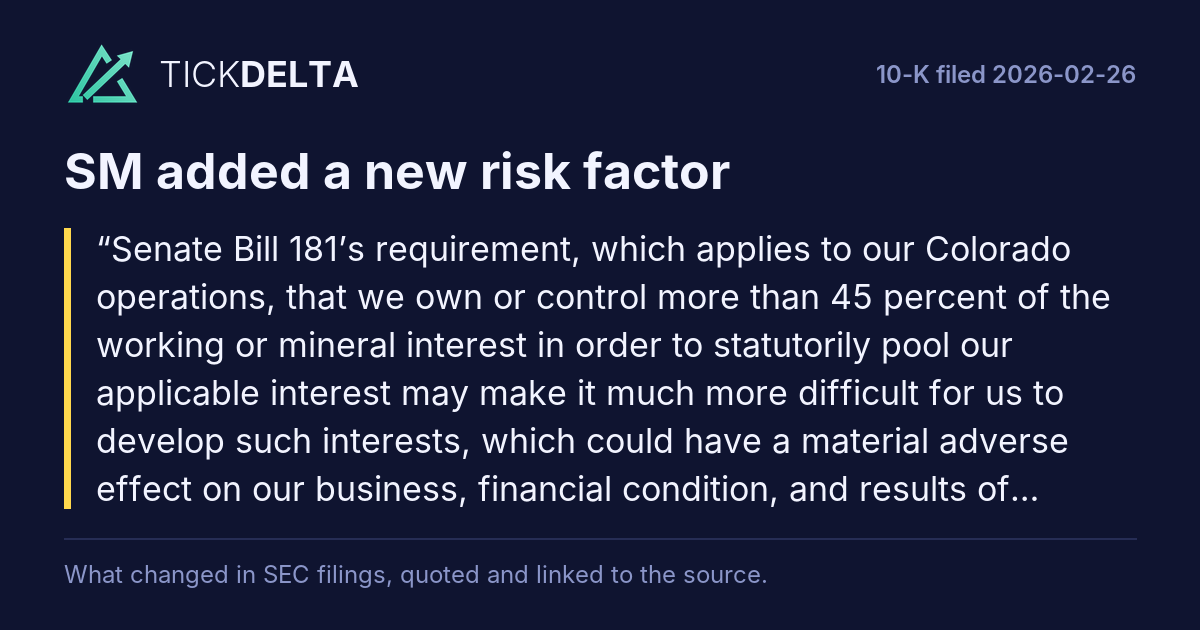
•Senate Bill 181’s requirement, which applies to our Colorado operations, that we own or control more than 45 percent of the working or mineral interest in order to statutorily pool our applicable interest may make it much more difficult for us to develop such interests, which could have a material adverse effect on our business, financial condition, and results of operations.
•Commodity price declines could result in a decrease in the amount available to us under our Credit Agreement.
Show the other 12
The market price for our common stock may be affected by factors different from those that historically have affected SM Energy common stock or Civitas common stock.
Our financial position will differ from our financial position prior to the closing of the Merger, and our post-Merger results of operations may be affected by factors that are different from those that have historically affected the results of operations of SM Energy and of Civitas. Accordingly, the market price and performance of our common stock is likely to be different from the performance of the SM Energy and of Civitas common stock absent of the Merger. In addition, general fluctuations in trading activity and prices on the NYSE could have a material adverse effect on the market for, or liquidity of, our common stock, regardless of our actual operating performance.
Our ability to utilize certain tax attributes may be limited as a result of the Civitas Merger.
Our ability to utilize the former SM Energy’s carryover research and development credits and the former Civitas’ net operating losses (“NOL” or “NOLs”) and other tax attributes may be limited. The former Civitas had a material amount of federal tax NOLs that remained unutilized as of the Closing Date of the Merger.
Our ability to utilize these tax attributes to reduce future taxable income and reduce future tax liability depends on many factors, including our future income, which cannot be assured. Sections 382 and 383 of the Code (“Sections 382 and 383”) generally impose an annual limitation on the amount of attributes that can be used when a corporation has undergone an “ownership change” (as determined under Sections 382 and 383). An ownership change generally occurs if one or more stockholders (or groups of stockholders) who are each deemed to own at least five percent of such corporation’s stock has increased their ownership by more than 50 percentage points over their lowest ownership percentage within a rolling three-year period. In the event that an ownership change occurs, utilization of the relevant corporation’s tax attributes would be subject to an annual limitation under Sections 382 and 383.
The historical business relationships of SM Energy and Civitas may be subject to disruption due to uncertainty associated with the Merger, which could have a material adverse effect on our results of operations, cash flows and financial position.
Parties with which the former SM Energy or the former Civitas do business may experience uncertainty associated with the Merger, including with respect to current or future business relationships with the Company. Our business relationships may be subject to disruption as customers, distributors, suppliers, vendors, landlords, joint venture partners and other business partners may attempt to delay or defer entering into new business relationships, negotiate changes in existing business relationships or consider entering into business relationships with parties other than us. These disruptions could have a material adverse effect on our results of operations, cash flows and our financial position, as well as a material adverse effect on the our ability to realize the expected cost savings and other benefits of the Merger.
The synergies and other benefits attributable to the Merger may vary from expectations.
•market conditions, lack of buyer interest, regulatory delays or unforeseen economic issues could impede achieving our divestiture target of at least $1.0 billion and delay our ability to reach long term strategic goals;
The proposed divestiture of certain of our South Texas assets may not be completed on the anticipated terms or at all, which could adversely affect our ability to execute our publicly stated deleveraging objectives.
We have entered into the PSA with Caturus for the sale of certain of our South Texas assets as part of our previously announced plan to reduce debt and strengthen our capital structure. The completion of this Transaction, as defined in Note 17 – Mergers, Acquisitions, and Divestitures in Part II, Item 8 of this report, is subject to customary closing conditions including regulatory approvals and certain required consents, as well as the satisfaction of other contractual conditions. There can be no assurance that these conditions will be satisfied on the anticipated timeline or at all.
If the Transaction is delayed or not completed, we may not receive the anticipated proceeds within the expected timeframe, or at all, which could delay or prevent us from achieving our targeted leverage metrics or other strategic priorities. We may also incur Transaction-related costs, including advisory, legal and other expenses, regardless of whether the Transaction is completed, and management’s attention may be diverted during the pendency of the Transaction.
liability. As these cyber risks continue to evolve and our dependence on digital technologies grows, we may be required to expend significant additional resources to continue to modify or enhance our protective measures and remediate cyber vulnerabilities.
Our Uinta Basin operations include the use of rail systems operated by third-parties to transport our crude oil to market which involves inherent risk, including the potential for accidents and derailments. In the event of a rail system accident or derailment, there
•compliance with and changes in federal, state, and local environmental and other governmental regulatory requirements;
The development of our proved undeveloped reserves may take longer and may require higher levels of capital expenditures than we currently anticipate. Therefore, our undeveloped reserves may not be ultimately developed or produced.
The development of our proved undeveloped reserves may take longer and require higher levels of capital expenditures than we currently anticipate or that may be available to us. Delays in the development of our reserves or increases in costs to drill and develop such reserves will reduce the value of our estimated proved undeveloped reserves and future net revenues estimated for such reserves and may result in some projects becoming uneconomic. In addition, delays in the development of reserves could require us to reclassify our proved reserves as unproved reserves.
Our management has identified and scheduled drilling locations as an estimation of our future multi-year drilling activities on our existing acreage. Our ability to drill and develop these locations is subject to a number of uncertainties, including uncertainty in the level of reserves; the availability of capital to us and other participants; seasonal conditions; regulatory approvals; activist intervention; crude oil, natural gas, and NGL prices; availability of permits; costs; and well performance. Because of these uncertainties, we do not know if the numerous potential drilling locations we have identified will ever be drilled or if we will be able to produce crude oil or natural gas from these or any other potential drilling locations. Pursuant to existing SEC rules and guidance, subject to limited exceptions, proved undeveloped reserves may only be booked if they relate to wells scheduled to be drilled within five years of the date of booking, and we may therefore be required to downgrade to probable or possible categories any proved undeveloped reserves that are not developed within this five-year time frame. These limitations may limit our potential to book additional proved undeveloped reserves as we pursue our drilling program.
parties to perpetuate leases we intend to develop in the future. The magnitude of such retained liabilities or of the indemnification obligations may be difficult to quantify at the time of the transaction and ultimately could be material.
There is an inherent risk of incurring significant environmental costs and liabilities in our operations due to our current and past generation, handling, and disposal of materials, including produced water, solid and hazardous wastes, and petroleum hydrocarbons. We may incur joint and several, and/or strict liability under applicable United States federal and state environmental laws in connection
In the future, we may be subject to claims, litigation, administrative proceedings and regulatory actions that may not be resolved in our favor.
In the future, we may be subject to claims, litigation, administrative proceedings and regulatory actions. The outcome of these matters may be difficult to assess or quantify, and there cannot be any assurance that such matters will be resolved in our favor. If we are unable to resolve such matters favorably, we or our directors, officers or employees may become involved in legal proceedings that could result in an onerous or unfavorable decision, including fines, sanctions, monetary damages or the inability to engage in certain operations or transactions. The defense of such matters may also be costly, time consuming and could divert the attention of management and key personnel away from our operations. We may also be subject to adverse publicity associated with such matters, regardless of whether such allegations are valid or whether we are ultimately found liable. As a result, such matters could have a material adverse effect on our business, reputation, financial condition, results of operations or liquidity.
A slowdown in federal regulation of hydraulic fracturing could encourage states, tribes, or localities to implement more or stricter regulations. Certain states have adopted or may adopt, regulations that could impose more stringent permitting, public disclosure, waste disposal, and well construction requirements on hydraulic fracturing operations or otherwise seek to ban fracturing activities altogether. The regulatory burden of each state’s respective laws varies. For example, some counties in Colorado have amended their land use regulations to impose new siting and other requirements on oil and gas development, while other local governments have entered memoranda of agreement with oil and gas producers to accomplish the same or similar objectives. Under current Colorado law, local governments can regulate both facility siting and the surface impacts associated with oil and gas development, and local government regulations may be more protective or stricter than state requirements. Texas, Utah, and Colorado require disclosure of chemical ingredients used in hydraulic fracturing fluids. State initiatives relevant to fracturing are often changing and priorities across states differ. On May 14, 2025, the New Mexico Water Quality Control Commission adopted a rule that prohibits the discharge of produced water to New Mexico’s ground and surface waters. Also in 2025, New Mexico lawmakers proposed a bill that would ban PFAS in fracking operations. In 2015, Texas Governor Greg Abbott signed a law which preempts municipal and county bans or limits on oil and gas operations, including drilling and hydraulic fracturing, and confirms that regulation of those activities is under the state of Texas’ exclusive jurisdiction, while still allowing limited, commercially reasonable, surface-level regulation by local governments.
Senate Bill 181’s requirement, which applies to our Colorado operations, that we own or control more than 45 percent of the working or mineral interest in order to statutorily pool our applicable interest may make it much more difficult for us to develop such interests, which could have a material adverse effect on our business, financial condition, and results of operations.
With respect to our operations in the DJ Basin in Colorado, in some cases, we do not own more than 45 percent working interest or mineral interest in a prospective area of development, which is now required to statutorily pool our applicable working or mineral interests. In such cases, unless we can obtain the consent of more than 45 percent of all applicable working or mineral interest owners (who can be located through reasonable diligence) to pursue statutory pooling, or achieve a voluntary pooling agreement with 100 percent of the applicable interest owners, we may be prohibited from developing the resources in that area or having them be developed by other operators.
Commodity price declines could result in a decrease in the amount available to us under our Credit Agreement.
Paragraphs in the 10-Q filed Nov 4, 2026 that were not in the one before
New in the latest 10-Q
10 paragraphs in the 10-Q filed Nov 4, 2026 with nothing like them in the 10-Q filed Aug 6, 2026 (at least half the words must differ; new numbers alone do not count). Quoted exactly, grouped by the item heading above them. This is text that changed, not a judgement of how serious it is.
Financial statements and notes
CONDENSED CONSOLIDATED STATEMENTS OF STOCKHOLDERS’ EQUITY (UNAUDITED) (Continued)
Read in the 10-Q
(1) As the South Texas Divestiture closed on April 30, 2026, the earnings amount presented reflects four months of activity during the nine months ended September 30, 2026.
Read in the 10-Q
On July 4, 2025, the One Big Beautiful Bill Act was enacted, introducing certain favorable changes to corporate tax provisions. As required, we recorded the full-year impact to current income tax expense during the third quarter of 2025.
Read in the 10-Q
During the nine months ended September 30, 2026, we strengthened our debt maturity profile and reduced higher-coupon debt through the following transactions:
Read in the 10-Q
During the nine months ended September 30, 2026, benchmark oil prices were substantially higher than the prior year period, primarily due to global supply disruptions and heightened risk associated with War and Geopolitical Instability. Despite sustained higher near-term prices, we have maintained our disciplined approach to capital allocation and have not materially altered our 2026 development program. We continue to monitor commodity market developments, including potential inflationary pressures on oilfield services, materials, and other key inputs associated with the elevated commodity price environment and the ongoing conflict in the Middle East.
Read in the 10-Q
Show the other 5
as well as lower demand during the spring shoulder season. Differentials narrowed through the late second and third quarters as regional demand strengthened.
Read in the 10-Q
These developments, together with evolving U.S. and international trade policies, including tariffs and other trade restrictions, may also contribute to inflationary pressures, supply chain disruptions, and increased costs for oilfield services, equipment, materials and other key inputs. We continue to monitor these conditions and their potential effects on our operating costs, capital expenditures, and development economics.
Read in the 10-Q
The duration and magnitude of these factors remain uncertain. Changes in commodity prices, regional pricing differentials, operating costs and broader economic conditions could materially affect our business, financial condition, and results of operations. In addition, sustained declines in oil, gas, and NGL prices could result in impairments of certain oil and gas properties.
Read in the 10-Q
• We substantially completed the integration of the Merger across all key operational and organizational workstreams and have captured targeted synergies from our combined operations, with remaining integration activities expected to continue in the normal course.
Read in the 10-Q
Commodity prices remain subject to uncertainty arising from global supply and demand fundamentals, geopolitical developments and broader economic conditions. While these factors influence benchmark prices, our realized prices are also affected by regional supply and demand, basis differentials, and transportation and infrastructure constraints, including capacity limitations and outages in or affecting our operating areas. We continue to monitor these conditions and their potential impacts on our realized prices and financial results. Refer to Market Trends and Uncertainties above for additional discussion of factors impacting pricing.
Read in the 10-Q
The 10-Q's risk factors against the 10-K
Item 1A of the 10-Q filed Nov 4, 2026 against Item 1A of the 10-K filed Feb 26, 2026.
A 10-Q repeats only the risks that changed, so a 10-K paragraph that is missing from it is not counted as removed.
Added is a paragraph with nothing like it in the 10-K, Reworded a sentence that is in both with several words changed,
Quiet changes a sentence in both where one to four words changed and one is a hedge or a modal
(cut words struck through, new words highlighted).
Text on the page, not a score; each links to the filing at sec.gov.
What the 10-Q itself says about its risk factors:There have been no material changes to the risk factors as previously disclosed in our 2025 Form 10-K.
Read in the 10-Q
1 paragraph in the 10-Q's Item 1A, and none of them adds, rewords or quietly edits a paragraph of the 10-K's.
Phrases used for the first time
Two-word phrases in Risk Factors of the 10-K filed Feb 26, 2026 that are in none of the 1 earlier 10-Ks stored, back to Feb 20, 2025
Where each one is used
- civitas merger: In addition to the other information included in this report, the risk factors discussed below should be carefully considered when evaluating an investment in SM Energy. For the purposes of this section, “we,” “our,” “us,” “Company” and “SM Energy” refer to the post-Merger company following the Civitas Merger. Our...
- tax attributes: •Our ability to utilize certain tax attributes may be limited as a result of the Civitas Merger.
- mineral interest: •Senate Bill 181’s requirement, which applies to our Colorado operations, that we own or control more than 45 percent of the working or mineral interest in order to statutorily pool our applicable interest may make it much more difficult for us to develop such interests, which could have a material adverse effect...
- civitas common: •The market price for our common stock may be affected by factors different from those that historically have affected SM Energy common stock or Civitas common stock.
- texas assets: •The proposed divestiture of certain of our South Texas assets may not be completed on the anticipated terms or at all, which could adversely affect our ability to execute our publicly stated deleveraging objectives.
- require higher: •The development of our proved undeveloped reserves may take longer and may require higher levels of capital expenditures than we currently anticipate. Therefore, our undeveloped reserves may not be ultimately developed or produced.
- currently anticipate: •The development of our proved undeveloped reserves may take longer and may require higher levels of capital expenditures than we currently anticipate. Therefore, our undeveloped reserves may not be ultimately developed or produced.
- claims litigation: •In the future, we may be subject to claims, litigation, administrative proceedings and regulatory actions that may not be resolved in our favor.
Used at least twice, small words left out. Counted, not picked: a phrase can be new because the company renamed something.
What was taken out
5 paragraphs of last year's Risk Factors with nothing like them now. The longest are quoted.
Sources
Item 1A of each 10-K and 10-Q on EDGAR, quoted exactly. Each paragraph links to the filing at sec.gov.
Also
10-K change: what was reworded or cut, section by section.
Work with it
Excel workbook · CSV. Google Sheet that stays up to date: paste =IMPORTDATA("https://tickdelta.com/company/SM/export.csv") into a cell.