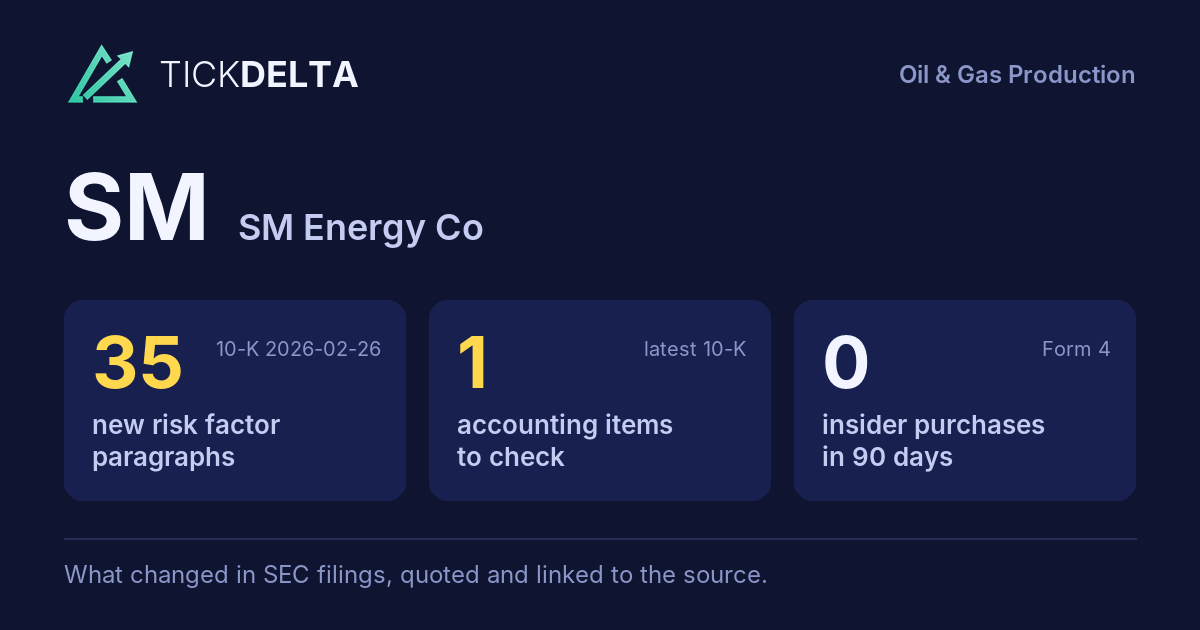
Screener / SEC EDGAR /CIK 0000893538 /10-K filed Feb 26, 2026, compared with Feb 20, 2025 /Numbers from the XBRL of the 10-Ks
NYSE Energy · Oil & Gas Production

SM Energy Co SM

Compare with peers Embed
The 10-K against last year's

205 changes: 53 added, 11 removed, 140 reworded, 1 quiet changes

10-K Feb 26, 2026 vs Feb 20, 2025

10-K 0000893538-26-000032 (Feb 26, 2026) vs 10-K 0000893538-25-000008 (Feb 20, 2025)

Every paragraph, and how much of it changed

One bar per paragraph, in the order of the 10-K. Height and colour show the share of its words not in the closest paragraph a year earlier; the tallest bars are new paragraphs.

Risk Factors

253 paragraphs · 35 new · 106 reworded · 5 gone · 10-K Feb 26, 2026 against Feb 20, 2025
New paragraph Reworded (5% of its words or more) Same or nearly
Paragraph 192 · 46% changed Every version of it
In the recent past, several federal governmental agencies were actively involved in studies or reviews that focus on environmental aspects and impacts of hydraulic fracturing practices. Increased regulation and attention given to the hydraulic fracturing process could lead to greater opposition, including litigation, to oil and gas production activities using hydraulic fracturing techniques. Disclosure of chemicals used in the hydraulic fracturing process could make it easier for third parties opposing such activities to pursue legal proceedings against producers and service providers based on allegations that specific chemicals used in the fracturing process could adversely affect human health or the environment, including groundwater. In 2013, a court in California, and in 2020, the United States District Court for the District of Montana, each held that the BLM did not comply with the National Environmental Policy Act (“NEPA”) because it did not adequately consider the impact of hydraulic fracturing and horizontal drilling before issuing leases. In 2022, the federal Ninth Circuit Court of Appeals held that two federal agencies violated NEPA, in part, by failing to evaluate the environmental impacts of well stimulation treatments such as hydraulic fracturing before authorizing unconventional oil drilling offshore. Similar cases continue to be filed. In addition, courts in New York and Colorado reduced the level of evidence required before a court will agree to consider alleged damage claims from hydraulic fracturing by property owners. Litigation resulting in financial compensation for damages linked to hydraulic fracturing, including damages from induced seismicity, could spur future litigation and bring increased attention to the practice of hydraulic fracturing. Judicial decisions could also lead to increased regulation, permitting requirements, enforcement actions, and penalties. Additional legislation or regulation could also lead to operational delays or restrictions or increased costs in the exploration for, and production of, oil, gas, and NGLs, including from the development of shale plays, or could make it more difficult to perform hydraulic fracturing. The adoption of additional state or local laws, or the implementation of new regulations regarding hydraulic fracturing could potentially cause a decrease in the completion of new oil and gas wells, or an increase in compliance costs and delays, which could adversely affect our financial position, results of operations, and cash flows.
Paragraph 58 · 44% changed Every version of it
During 2024, the fiscal year ended December 31, 2025, we incurred non-recurring costs associated with the Uinta Basin Acquisition, integrating the Uinta Basin assets into our business, and realizing the expected benefits of the Uinta Basin Acquisition, Merger, and we expect to continue to incur such costs during a portion of 2025. 2026. A substantial majority of non-recurring expenses consist of change in control payments and transaction costs and which include, among others, fees paid to financial, legal, accounting, and other advisors. Although we expect that the elimination of any duplicative costs, as well as the realization of expected benefits related to the integration of the Uinta Basin assets, should allow us to offset these transaction costs over time, this net benefit may not be achieved in the near term or at all.
Paragraph 2 · 42% changed Every version of it
Integration of assets acquired in the recent Uinta Basin Acquisition with our existing business will •We may be a complex and time-consuming process. A failure unable to successfully integrate Civitas’ business into our business or achieve the acquired assets with our existing business in a timely manner anticipated benefits of the Merger, which may have a material adverse effect on our business, financial condition, condition or results of operations.
Paragraph 50 · 42% changed Every version of it
Integration of assets acquired in the recent Uinta Basin Acquisition with our existing business will We may be a complex and time-consuming process. A failure unable to successfully integrate Civitas’ business into our business or achieve the acquired assets with our existing business in a timely manner anticipated benefits of the Merger, which may have a material adverse effect on our business, financial condition, condition or results of operations.
Paragraph 18 · 42% changed Every version of it
Our ability to sell oil, gas, and NGLs, and/or receive market prices for our production, may be adversely affected by constraints on gathering systems, processing facilities, pipelines, rail systems, and other transportation systems owned or operated by third-parties parties or by other interruptions beyond our control, which could obstruct, limit, or eliminate our access to oil, gas, and NGL markets.
Paragraph 193 · 40% changed Every version of it
In the recent past, several federal governmental agencies were actively involved in studies or reviews that focus on environmental aspects and impacts of hydraulic fracturing practices. Increased regulation and attention given to the hydraulic fracturing process could lead to greater opposition, including litigation, to oil and gas production activities using hydraulic fracturing techniques. Disclosure of chemicals used in the hydraulic fracturing process could make it easier for third parties opposing such activities to pursue legal proceedings against producers and service providers based on allegations that specific chemicals used in the fracturing process could adversely affect human health or the environment, including groundwater. In 2013, a court in California, and in 2020, the United States District Court for the District of Montana, each held that the BLM did not comply with the National Environmental Policy Act (“NEPA”) because it did not adequately consider the impact of hydraulic fracturing and horizontal drilling before issuing leases. In 2022, the federal Ninth Circuit Court of Appeals held that two federal agencies violated NEPA, in part, by failing to evaluate the environmental impacts of well stimulation treatments such as hydraulic fracturing before authorizing unconventional oil drilling offshore. Similar cases continue to be filed. In addition, courts in New York and Colorado reduced the level of evidence required before a court will agree to consider alleged damage claims from hydraulic fracturing by property owners. Litigation resulting in financial compensation for damages linked to hydraulic fracturing, including damages from induced seismicity, could spur future litigation and bring increased attention to the practice of hydraulic fracturing. Judicial decisions could also lead to increased regulation, permitting requirements, enforcement actions, and penalties. Additional legislation or regulation could also lead to operational delays or restrictions or increased costs in the exploration for, and production of, oil, gas, and NGLs, including from the development of shale plays, or could make it more difficult to perform hydraulic fracturing. The adoption of additional state or local laws, or the implementation of new regulations regarding hydraulic fracturing could potentially cause a decrease in the completion of new oil and gas wells, or an increase in compliance costs and delays, which could adversely affect our financial position, results of operations, and cash flows.
Paragraph 204 · 38% changed Every version of it
In the areas where we have significant operations, there have been, and could be, in the future, constraints in gas takeaway capacity which has historically led to increased gas flaring. We are subject to laws established by state and other regulatory agencies that restrict the duration and amount of natural gas that can be legally flared. These laws and regulations, including potential future regulations that may impose further restrictions on flaring, could limit the amount of oil and gas we can produce from our wells or may limit the number of wells or the locations that we can drill. Any future laws or commitments may increase our operational costs, or restrict our production, which could have a material adverse effect on our financial condition, results of operations and cash flows.
Paragraph 229 · 37% changed Every version of it
As of December 31, 2024, In connection with the Civitas Merger on January 30, 2026, we had $2.7 assumed approximately $4.9 billion of in aggregate principal amount outstanding of Senior Notes additional senior notes with maturities through 2032, as further discussed 2033. Additionally, in connection with the closing of the Civitas Merger, the Company and defined in its lenders entered into the Fourth Amendment to the Credit Agreement, which increased the aggregate revolving lender commitments available under our Credit Agreement to $2.5 billion and increased the borrowing base to $5.0 billion. As of February 2, 2026, we had no outstanding balance on our revolving credit facility and we had $2.5 billion of available borrowing capacity under our Credit Agreement. Refer to Note 5 – Long-Term Debt in Part II, Item 8 of this report. We had $68.5 million outstanding balance on our revolving credit facility and had $1.9 billion of available borrowing capacity under our Credit Agreement as of December 31, 2024. Our long-term debt represented 40 percent of our total book capitalization as of December 31, 2024. report for additional detail.

MD&A

150 paragraphs · 18 new · 78 reworded · 6 gone · 10-K Feb 26, 2026 against Feb 20, 2025
New paragraph Reworded (5% of its words or more) Same or nearly
Paragraph 143 · 47% changed
The adoption of legislation or regulatory programs to reduce emissions of GHGs could require us to incur increased operating costs, such as costs to purchase and operate emissions control systems, to acquire emissions allowances, or comply with new regulatory or reporting requirements. Any such legislation or regulatory programs could also increase the cost of consuming, and thereby reduce demand for, the oil and gas we produce. Consequently, legislation and regulatory programs to reduce emissions of GHGs could have an adverse effect on our business, financial condition, and results of operations. Judicial challenges to new regulatory measures are likely and we cannot predict the outcome of such challenges. New regulatory suspensions, revisions, or rescissions and conflicting state and federal regulatory mandates may inhibit our ability to accurately forecast the costs associated with future regulatory compliance. Finally, scientists have concluded that increasing concentrations of GHGs in the earth’s atmosphere produce climate changes that likely have significant physical effects, such as increased frequency and severity of storms, droughts, floods, and other climatic events. Such effects could have an adverse effect on our financial condition and results of operations.
Paragraph 10 · 47% changed
Our purpose is to make people’s lives better by responsibly producing energy supplies, contributing to domestic energy security and prosperity, and having a positive impact in the communities where we live and work. Our long-term vision and strategy is to are focused on sustainably grow growing value for all of our stakeholders as a premier operator of top-tier assets by maintaining deploying our technical excellence and optimizing exceptional execution to improve and optimize our high-quality asset portfolio, generating generate cash flows, and maintaining maintain a disciplined, strong balance sheet. Our team executes this our strategy by prioritizing safety, technological innovation, and stewardship of natural resources, all of which are integral foundational to our corporate culture. Our near-term goals include focusing strategic focus is the successful integration of Civitas following the closing of the Merger on January 30, 2026. Integration is centered on maintaining safe operations, delivering consistent operational execution execution, and successfully integrating the Uinta Basin assets; generating continuing to generate cash flows that enable us to continue returning return value to stockholders through fixed dividend payments, debt repayments, reduction, and share repurchases. Refer to Outlook for discussion of our Stock Repurchase Program; and expanding our portfolio of top-tier economic drilling inventory through acquisition and exploration. 2026 capital program.
Paragraph 112 · 44% changed
For the Years Ended December 31, Amount Change Between Periods 2025 2024 2023 2022 (in millions) Interest income Net cash provided by (used in) financing activities $ 31.9 $19.9 $5.8 (175) $1,008 $(1,183)
Paragraph 76 · 40% changed
For the Years Ended December 31, 2025 2024 2023 2022 (in millions) Interest income millions, except tax rate) Income tax expense $ 31.9 $19.9 $5.8 (182) $ (196) Effective tax rate 22.0 % 20.3 %
Paragraph 110 · 39% changed
For the Years Ended December 31, Amount Change Between Periods 2025 2024 2023 2022 (in millions) Interest income Net cash used in investing activities $ 31.9 $19.9 $5.8 (1,468) $ (3,407) $1,939
Paragraph 117 · 39% changed
The prices we receive for our oil, gas, and NGL production directly affect our revenue, profitability, access to capital, ability to return capital to our stockholders, and future rate of growth. Oil, gas, and NGL prices are subject to unpredictable fluctuations resulting from a variety of factors that are typically beyond our control, including changes in supply and demand associated with the broader macroeconomic environment, constraints on gathering systems, processing facilities, pipelines, rail systems, and other transportation systems, and weather-related events. The markets for oil, gas, and NGLs have been volatile, especially over the last decade, and remain subject to high levels of uncertainty and volatility related to production output from OPEC+, fluctuations in oil and gas demand from China, global shipping channel constraints and disruptions, War and Geopolitical Instability, tariffs or trade restrictions, and the potential impacts of these issues on global commodity and financial markets. These circumstances have contributed to inflation, instances of supply chain disruptions, and fluctuations in interest rates, and could have further industry-specific impacts that may require us to adjust our business plan. The realized prices we receive for our production also depend on numerous factors that are typically beyond our control. Refer to Risk Factors - Risks Related to Commodity Prices and Global Macroeconomics in Part I, Item 1A of this report. Based on our 2024 production, a 10 percent decrease in our average realized prices for oil, gas, and NGLs would have reduced our oil, gas, and NGL production revenues by approximately $218.7 million, $24.9 million, and $23.5 million, respectively. If commodity prices had been 10 percent lower, our net derivative settlements for the year ended December 31, 2024, would have offset the declines in oil, gas, and NGL production revenue by approximately $50.3 million.
Paragraph 106 · 38% changed
For the Years Ended December 31, Amount Change Between Periods 2025 2024 2023 2022 (in millions) Interest income Net cash provided by operating activities $ 31.9 $19.9 $5.8 2,011 $1,783 $228
Paragraph 12 · 37% changed
We are affected by As global commodity commodities, the prices of oil, gas, and NGLs, as well as broader financial markets that markets, remain subject to heightened levels of uncertainty and volatility. Key Market conditions are influenced by factors contributing to market fluctuations include ongoing oil production curtailment agreements among OPEC+, fluctuations in oil and gas demand from China, including real or perceived geopolitical risks, War and Geopolitical Instability, United States OPEC+ production decisions, fluctuations in global supply and demand (including demand from China), U.S. Federal Reserve monetary policy, movements in the strength of the U.S. dollar, shipping channel constraints and disruptions, tariffs or trade restrictions, and changes in global oil inventory in storage. These factors have driven resulted in commodity price volatility, contributed to instances of supply chain disruptions disruptions, inflation, and fluctuations in interest rates, rate fluctuations, and could have further industry-specific impacts that may require us to adjust our business plan. Future impacts The timing and magnitude of these and other events on commodity and financial markets future effects are inherently unpredictable. Despite continuing uncertainty, we expect to maximize the value of our high-quality asset base and sustain strong operational performance and financial stability. We remain focused on generating cash flows to enable us to return capital to stockholders and reduce our debt.

A paragraph is matched with the one last year that shares the most of its words; under half in common makes it new. The paragraphs shown are the 8 reworded the most in each section.

The paragraph that changed most in each section

The redline

Marked against last year's 10-K: cut words struck through, new words highlighted.

Risk Factors259 words changed in this paragraph; it is 46% similar to last year's version.
In the recent past, several federal governmental agencies were actively involved in studies or reviews that focus on environmental aspects and impacts of hydraulic fracturing practices. Increased regulation and attention given to the hydraulic fracturing process could lead to greater opposition, including litigation, to oil and gas production activities using hydraulic fracturing techniques. Disclosure of chemicals used in the hydraulic fracturing process could make it easier for third parties opposing such activities to pursue legal proceedings against producers and service providers based on allegations that specific chemicals used in the fracturing process could adversely affect human health or the environment, including groundwater. In 2013, a court in California, and in 2020, the United States District Court for the District of Montana, each held that the BLM did not comply with the National Environmental Policy Act (“NEPA”) because it did not adequately consider the impact of hydraulic fracturing and horizontal drilling before issuing leases. In 2022, the federal Ninth Circuit Court of Appeals held that two federal agencies violated NEPA, in part, by failing to evaluate the environmental impacts of well stimulation treatments such as hydraulic fracturing before authorizing unconventional oil drilling offshore. Similar cases continue to be filed. In addition, courts in New York and Colorado reduced the level of evidence required before a court will agree to consider alleged damage claims from hydraulic fracturing by property owners. Litigation resulting in financial compensation for damages linked to hydraulic fracturing, including damages from induced seismicity, could spur future litigation and bring increased attention to the practice of hydraulic fracturing. Judicial decisions could also lead to increased regulation, permitting requirements, enforcement actions, and penalties. Additional legislation or regulation could also lead to operational delays or restrictions or increased costs in the exploration for, and production of, oil, gas, and NGLs, including from the development of shale plays, or could make it more difficult to perform hydraulic fracturing. The adoption of additional state or local laws, or the implementation of new regulations regarding hydraulic fracturing could potentially cause a decrease in the completion of new oil and gas wells, or an increase in compliance costs and delays, which could adversely affect our financial position, results of operations, and cash flows.

Source: Item 1A, 10-K 0000893538-26-000032 vs Item 1A, 10-K 0000893538-25-000008

MD&A195 words changed in this paragraph; it is 50% similar to last year's version.
The prices we receive for our oil, gas, and NGL production directly affect our revenue, profitability, access to capital, ability to return capital to our stockholders, and future rate of growth. Oil, gas, and NGL prices are subject to unpredictable fluctuations resulting from a variety of factors that are typically beyond our control, including changes in supply and demand associated with the broader macroeconomic environment, constraints on gathering systems, processing facilities, pipelines, rail systems, and other transportation systems, and weather-related events. The markets for oil, gas, and NGLs have been volatile, especially over the last decade, and remain subject to high levels of uncertainty and volatility related to production output from OPEC+, fluctuations in oil and gas demand from China, global shipping channel constraints and disruptions, War and Geopolitical Instability, tariffs or trade restrictions, and the potential impacts of these issues on global commodity and financial markets. These circumstances have contributed to inflation, instances of supply chain disruptions, and fluctuations in interest rates, and could have further industry-specific impacts that may require us to adjust our business plan. The realized prices we receive for our production also depend on numerous factors that are typically beyond our control. Refer to Risk Factors - Risks Related to Commodity Prices and Global Macroeconomics in Part I, Item 1A of this report. Based on our 2024 production, a 10 percent decrease in our average realized prices for oil, gas, and NGLs would have reduced our oil, gas, and NGL production revenues by approximately $218.7 million, $24.9 million, and $23.5 million, respectively. If commodity prices had been 10 percent lower, our net derivative settlements for the year ended December 31, 2024, would have offset the declines in oil, gas, and NGL production revenue by approximately $50.3 million.

Source: Item 7, 10-K 0000893538-26-000032 vs Item 7, 10-K 0000893538-25-000008

Accounting Policies153 words changed in this paragraph; it is 42% similar to last year's version.
The Company derives revenue predominately from the sale of produced oil, gas, and NGLs. Revenue reflects the Company’s net revenue interest production, including both its working interests and royalty interests. Revenue is recognized at the point in time when custody and title (“control”) of the product transfers to the purchaser, which may differ depending on the applicable contractual terms. Revenue accruals Transfer of control determines the presentation of transportation, gathering, processing, and other post-production expenses (“costs and other deductions”) within the accompanying statements of operations. Costs and other deductions incurred by the Company prior to transfer of control are recorded monthly within the oil, gas, and NGL production expense line item on the accompanying statements of operations. When control is transferred, sales are based on estimated production delivered to a purchaser and the expected market price to that may be received. The Company uses knowledge of its properties, contractual arrangements, historical performance, NYMEX, local spot market, and OPIS prices, affected by fees and other factors as deductions incurred by the basis purchaser subsequent to the transfer of these estimates. Variances between estimates and the actual amounts received are recorded in the month payment is received. Refer to Note 2 – Revenue from Contracts with Customers for additional discussion. control.

Source: Item 8, Note 1 – Summary of Significant Accounting Policies, 10-K 0000893538-26-000032 vs Item 8, Note 1 – Summary of Significant Accounting Policies, 10-K 0000893538-25-000008

Legal Proceedings51 words changed in this paragraph; it is 76% similar to last year's version.
(1) The Company has transportation throughput, terminal services, transloading, and delivery commitments with various third-parties that require delivery of a minimum amount of oil and produced water. oil. As of December 31, 2024, 2025, the Company had commitments to deliver a minimum of 46 49 MMBbl of oil through December of 2028, and 3 MMBbl of produced water through June of 2027. 2032. Certain of these oil delivery commitments may be fulfilled with the same single barrel of oil. The Company would be required to make periodic deficiency payments for any shortfalls in delivering the minimum volume commitments under certain agreements. Additionally, one of the contracts does not have a minimum volume commitment associated with it, however, as of December 31, 2024, the Company would owe a cancellation fee of $3.4 million if the agreement was terminated.

Source: Item 3, via Note 6 – Commitments and Contingencies, 10-K 0000893538-26-000032 vs Item 3, via Note 6 – Commitments and Contingencies, 10-K 0000893538-25-000008

Sentences and paragraphs added, removed or reworded

Every change, by type

Sentences and paragraphs of SM's Risk Factors and MD&A, 10-K Feb 26, 2026 against 10-K Feb 20, 2025. Each links to the text at sec.gov.

Quiet changes are sentences kept from last year with one to four words changed, at least one of them a hedge, a modal or a qualifier (may, could, will, not, significant, material…). A year or date rolling forward is not counted.

The full word list

adverse, adversely, all, although, anticipate, anticipates, any, approximately, believe, believes, can, cannot, certain, could, expect, expects, generally, however, if, intend, intends, largely, likely, many, material, materially, may, might, most, must, never, no, not, possible, primarily, probable, should, significant, significantly, some, substantial, substantially, unlikely, will, would

AddedRisk Factors
•The historical business relationships of SM Energy and Civitas may be subject to disruption due to uncertainty associated with the Merger, which could have a material adverse effect on our results of operations, cash flows and financial position.
Read it in 10-K Feb 26, 2026 at sec.gov
AddedRisk Factors
•The proposed divestiture of certain of our South Texas assets may not be completed on the anticipated terms or at all, which could adversely affect our ability to execute our publicly stated deleveraging objectives.
Read it in 10-K Feb 26, 2026 at sec.gov
AddedRisk Factors
•The development of our proved undeveloped reserves may take longer and may require higher levels of capital expenditures than we currently anticipate. Therefore, our undeveloped reserves may not be ultimately developed or produced.
Read it in 10-K Feb 26, 2026 at sec.gov
AddedRisk Factors
•Senate Bill 181’s requirement, which applies to our Colorado operations, that we own or control more than 45 percent of the working or mineral interest in order to statutorily pool our applicable interest may make it much more difficult for us to develop such interests, which could have a material adverse effect on our business, financial condition, and results of operations.
Read it in 10-K Feb 26, 2026 at sec.gov
Show the other 52
AddedRisk Factors
Our financial position will differ from our financial position prior to the closing of the Merger, and our post-Merger results of operations may be affected by factors that are different from those that have historically affected the results of operations of SM Energy and of Civitas. Accordingly, the market price and performance of our common stock is likely to be different from the performance of the SM Energy and of Civitas common stock absent of the Merger. In addition, general fluctuations in trading activity and prices on the NYSE could have a material adverse effect on the market for, or liquidity of, our common stock, regardless of our actual operating performance.
Read it in 10-K Feb 26, 2026 at sec.gov
RemovedRisk Factors
•operating in less familiar geological formations, with different legal and regulatory environments, different completion techniques, different transportation methods and operators, and unfamiliar operating conditions; and
Read it in 10-K Feb 20, 2025 at sec.gov
RemovedRisk Factors
The IRA imposes fees on emissions of GHGs, including methane, that exceed applicable thresholds. Our GHG emissions in 2024 did not exceed the thresholds set forth by the IRA; however, there is no assurance that we will be able to meet our goals or that we will not exceed the thresholds set forth by the IRA in the future. This and any court rulings, laws, or regulations that restrict or require reduced emissions of GHGs or introduce new climate-related regulations such as a carbon pricing system, could have an adverse effect on demand for the oil and gas that we produce, and could lead to increased operating and compliance costs, and litigation costs, which could have a material adverse impact on our business.
Read it in 10-K Feb 20, 2025 at sec.gov
RewordedRisk Factors
Our ability to achieve the anticipated benefits The success of the Uinta Basin Acquisition Merger depends in part on whether we can complete the integration of the Uinta Basin Civitas assets that we have not previously operated into our existing business in an efficient and effective manner. manner, and there can be no assurance that we will be able to successfully integrate or otherwise realize the anticipated benefits of the Merger.
Read it in 10-K Feb 26, 2026 at sec.gov
RewordedRisk Factors
Non-compliance with statutes and regulations and more vigorous enforcement of such statutes and regulations by regulatory agencies These may lead to increased operational and compliance costs, substantial administrative, civil, and criminal penalties, including include the assessment of natural resource damages, damages and the imposition of significant investigatory and remedial obligations and may also result obligations, potentially resulting in the suspension or termination of our operations.
Read it in 10-K Feb 26, 2026 at sec.gov
RewordedRisk Factors
The Notwithstanding any reversal of this trend federally by the Trump administration, the adoption of additional state or local laws, or the implementation of new regulations could potentially cause a decrease in the completion of new oil and gas wells, or an increase in compliance costs and delays, which laws could adversely affect our financial position, results of operations, and cash flows.
Read it in 10-K Feb 26, 2026 at sec.gov
RewordedRisk Factors
In 2024, the EPA announced a final rule that facilitates the implementation of Congress’s directive in the Inflation Reduction Act of 2022 (“IRA”) to collect a waste emissions charge, and adds new reporting requirements for facilities and wells completed after May 7, 2024. but on March 14, 2025, President Trump signed a joint resolution of disapproval under the Congressional Review Act, voiding the EPA’s final rule on methane waste emission.
Read it in 10-K Feb 26, 2026 at sec.gov
RewordedRisk Factors
Risks we face while drilling include, but are not limited to, landing our well bore outside the desired drilling zone, deviating from the desired drilling zone while drilling horizontally through the formation, the inability to run our casing the entire length of the well bore, and the inability to run tools and recover equipment consistently through the horizontal well bore.
Read it in 10-K Feb 26, 2026 at sec.gov
RewordedRisk Factors
During 2024, the fiscal year ended December 31, 2025, we incurred non-recurring costs associated with the Uinta Basin Acquisition, integrating the Uinta Basin assets into our business, and realizing the expected benefits of the Uinta Basin Acquisition, Merger, and we expect to continue to incur such costs during a portion of 2025. 2026.
Read it in 10-K Feb 26, 2026 at sec.gov
RewordedRisk Factors
Non-compliance with statutes and regulations and more vigorous enforcement of such statutes and regulations by regulatory agencies may lead to increased operational and compliance costs, substantial administrative, civil, administrative penalties, civil penalties, and criminal penalties, including the assessment of natural resource damages, the imposition of significant investigatory and remedial obligations and may also result in the suspension or termination of our operations. prosecution.
Read it in 10-K Feb 26, 2026 at sec.gov
RewordedRisk Factors
A failure We may be unable to successfully integrate Civitas’ business into our business or achieve the acquired assets with our existing business in a timely manner anticipated benefits of the Merger, which may have a material adverse effect on our business, financial condition, condition or results of operations.
Read it in 10-K Feb 26, 2026 at sec.gov
RewordedRisk Factors
We do not believe the loss of any single purchaser would materially impact our operating results, as we have numerous options for purchasers in each of our operating areas for our oil, gas, and NGL production. production; however, if adverse market conditions or other economic decline affected a substantial number of our customers or joint interest owners, our operations and financial results could be impacted.
Read it in 10-K Feb 26, 2026 at sec.gov
RewordedRisk Factors
Such developments, including increased focus on environmental, social and governance matters and initiatives aimed at limiting climate change and reducing air pollution, and changes in federal income tax laws developments could result in downward pressure on the stock prices of oil and gas companies, including ours.
Read it in 10-K Feb 26, 2026 at sec.gov
RewordedRisk Factors
Compliance with environmental regulations, oil and gas leases, surface use agreements, and permit requirements governing the withdrawal, storage, and use of surface water and disposal or recycling of produced water or groundwater necessary for hydraulic fracturing of wells may increase our operating costs and cause delays, interruptions, or termination of our operations, the extent of which cannot be predicted, all of which could have an adverse effect on our operations and financial condition. operations.
Read it in 10-K Feb 26, 2026 at sec.gov
RewordedRisk Factors
War and Geopolitical Instability could lead to significant market and other disruptions, including, but not limited to: significant volatility in commodity prices and supply of energy resources, instability in financial markets, supply chain interruptions, shipping channel constraints and disruptions, political and social instability, political and economic sanctions, geopolitical shifts, embargoes, changes in consumer or purchaser preferences, the potential destruction of critical oil-related infrastructure, as well as increases in cyberattacks and espionage.
Read it in 10-K Feb 26, 2026 at sec.gov
Quiet changesRisk Factors
Public interest in environmental protection has increased over time, and environmental and other public interest organizations have opposed, with some success, certain projects.
Read it in 10-K Feb 26, 2026 at sec.gov
AddedMD&A
On November 2, 2025, we entered into the Merger Agreement with Civitas. On January 27, 2026, our stockholders voted in favor of both proposals necessary to complete the Civitas Merger, which included approval of (i) the issuance of shares of SM Energy common stock to Civitas stockholders as contemplated by the Merger Agreement, and (ii) an amendment of our Restated Certificate of Incorporation to increase the number of authorized shares of our common stock from 200 million shares to 400 million shares.
Read it in 10-K Feb 26, 2026 at sec.gov
AddedMD&A
On January 30, 2026, we completed the Civitas Merger in accordance with the terms of the Merger Agreement. Civitas was an independent exploration and production company focused on the acquisition, development, and production of crude oil and associated liquids-rich natural gas in the DJ Basin in Colorado and the Permian Basin in Texas and New Mexico. We believe that the Merger will create a premier portfolio across the highest-return U.S. shale basins, driving significant free cash flow, enhancing stockholder value, and enabling the realization of significant operational and cost efficiencies.
Read it in 10-K Feb 26, 2026 at sec.gov
AddedMD&A
Under the terms of the Merger Agreement, subject to certain exceptions, each share of Civitas common stock was converted into the right to receive 1.45 shares of SM Energy common stock, with cash paid in lieu of fractional shares. On January 30, 2026, we issued approximately 124 million shares to holders of Civitas common stock, representing 52 percent of the outstanding shares of SM Energy’s common stock upon the closing of the Merger. Based on the closing price of SM Energy common stock on January 30, 2026, the total stock consideration was valued at $2.4 billion.
Read it in 10-K Feb 26, 2026 at sec.gov
AddedMD&A
On February 17, 2026, we entered into the PSA with Caturus to sell certain of our South Texas assets for a Purchase Price of $950 million, subject to certain customary purchase price adjustments set forth in the PSA. This Transaction is expected to advance our deleveraging goals and position us to substantially achieve our commitment to complete at least $1.0 billion of divestitures within one year following the closing of the Civitas Merger. Refer to Note 17 – Mergers, Acquisitions, and Divestitures in Part II, Item 8 for additional discussion and the definitions of Purchase Price and Transaction.
Read it in 10-K Feb 26, 2026 at sec.gov
AddedMD&A
Our purpose is to make people’s lives better by responsibly producing energy supplies, contributing to domestic energy security and prosperity, and having a positive impact in the communities where we live and work. We are a premier operator of top-tier assets in the Midland Basin, South Texas, and the Uinta Basin, utilizing state-of-the-art digital technology, data analytics, and AI in our operations, and continually seeking innovative ideas to help us optimize capital efficiency and well performance, while reducing our impact on shared natural resources and operating in an efficient, safe, and responsible manner.
Read it in 10-K Feb 26, 2026 at sec.gov
AddedMD&A
Historically, tariffs have led to increased costs for products exchanged in international trade, and have heightened global political tensions. Recent U.S. government policies, including new and higher tariffs on imported goods, have increased economic uncertainty. These tariffs, along with retaliatory tariffs from other countries, could lead to reduced trade resulting from increased costs for imported goods and decreased demand for U.S. exports, as well as reduced investment and technological exchange between major economies. These outcomes could negatively impact global economic conditions, financial market stability, and commodity prices. Volatility in political, trade, regulatory, and economic conditions could have a material adverse effect on our financial condition or results of operations. We are unable to reasonably estimate the period of time that these market conditions will exist or the extent to which they will impact our business, results of operations, and financial condition.
Read it in 10-K Feb 26, 2026 at sec.gov
AddedMD&A
Continuing volatility in political, trade, regulatory and economic conditions could impact supply and demand fundamentals, and any related declines in oil, gas, and NGL prices could lead to proved and unproved property impairments in the future. Future impairments of proved and unproved properties are difficult to predict, especially in a volatile price environment.
Read it in 10-K Feb 26, 2026 at sec.gov
AddedMD&A
•Strong operating cash flow enabled us to reduce debt through $69 million in net repayments on our revolving credit facility, increase cash on hand to $368 million, and return capital to stockholders. We repurchased and subsequently retired 444,705 shares of our common stock at a cost of $12 million, excluding excise taxes, commissions, and fees, and paid $92 million in dividends.
Read it in 10-K Feb 26, 2026 at sec.gov
AddedMD&A
The Civitas Merger, which closed on January 30, 2026, is expected to materially affect our future operating and financial results. The addition of Civitas’ assets and operations is expected to increase production volumes and revenues and to impact oil, gas, and NGL production expense, general and administrative expense, and other expense categories. The magnitude and timing of these impacts will depend, in part, on integration activities, operating performance, commodity prices, and other factors and may not be directly comparable to the Company’s historical results. Unless otherwise noted, the discussion below reflects the results of our legacy operations and historical trends prior to the Merger.
Read it in 10-K Feb 26, 2026 at sec.gov
RemovedMD&A
Midland Basin South Texas (1) Uinta Basin Total Gross Net Gross Net Gross Net Gross Net Wells drilled but not completed at December 31, 2023 39 29 37 37 — — 76 66 Drilled but not completed wells acquired (2) — — — — 40 31 40 31 Wells drilled 89 73 52 52 19 15 160 140 Wells completed (88) (73) (54) (54) (11) (8) (153) (135) Wells drilled but not completed at December 31, 2024 40 29 35 35 48 38 123 102
Read it in 10-K Feb 20, 2025 at sec.gov
RemovedMD&A
Our effective tax rate in 2023 benefited from credits claimed as the result of the completion of a multi-year research and development (“R&D”) credit study. Excess tax deficiencies from stock-based compensation awards offset limits on expensing of certain
Read it in 10-K Feb 20, 2025 at sec.gov
RemovedMD&A
covered individual’s compensation, net apportionment changes and other permanent expense items reduced the rate for each period presented. We benefited from the release of a valuation allowance on certain deferred tax assets in 2022.
Read it in 10-K Feb 20, 2025 at sec.gov
RemovedMD&A
Enactment of changes to federal income tax laws, including changes in the corporate tax rate, could have a material effect on our current tax expense, tax receivable, and deferred tax liabilities. Effective for tax years beginning after December 31, 2022, the IRA provides for a 15 percent corporate alternative minimum tax (“CAMT”) on corporations with average adjusted financial statement income over $1.0 billion for any three-year period preceding the tax year. While the final proposed regulations regarding the CAMT may impact our calculation, as of the filing of this report we do not anticipate that we will become subject to the CAMT in 2025. Refer to Overview of Liquidity and Capital Resources below and to the Risk Factors section in Part 1, Item 1A of this report.
Read it in 10-K Feb 20, 2025 at sec.gov
RemovedMD&A
Our credit ratings affect the availability of, and cost for us to borrow, additional funds. One major credit rating agency upgraded our credit ratings following the close of the Uinta Basin Acquisition on October 1, 2024, citing our increased size and scale, increased inventory, increased oil percentage of expected production, strong operational performance, our priority of improving our leverage metrics, our ability to consistently generate cash flows, and our use of financial derivative instruments as part of our financial risk management program. Refer to Note 17 – Acquisitions in Part II, Item 8 of this report for the definition of the Uinta Basin Acquisition.
Read it in 10-K Feb 20, 2025 at sec.gov
RemovedMD&A
(1) For the year ended December 31, 2023, performance revisions consisted of positive revisions of 65.3 MMBOE resulting from changes to decline curve estimates based on reservoir engineering analysis and negative revisions of 28.0 MMBOE related to well performance.
Read it in 10-K Feb 20, 2025 at sec.gov
RewordedMD&A
For the Three Months Ended December 31, September 30, June 30, March 31, 2024 2024 2024 2024 2025 2025 2025 2025 Average net daily equivalent production (MBOE per day) 208.0 170.0 158.5 145.1 206.9 213.8 209.1 197.3 Lease operating expense (per BOE) $ 5.35 $4.73 $4.82 $5.54 $5.55 $5.67 $5.52 $6.13 Transportation costs (per BOE) $ 4.10 $2.13 $1.94 $2.07 $3.67 $3.77 $4.13 $3.92 Production taxes as a percent of oil, gas, and NGL production revenue 3.8 % 4.1 % 4.6 3.9 % 4.3 % 4.5% 4.4% Ad valorem tax expense (per BOE) $ (0.03) $0.76 $0.82 $0.89 $0.23 $0.51 $0.54 $0.55 Depletion, depreciation, and amortization (per BOE) $ 13.61 $12.98 $12.46 $12.59 $16.73 $16.54 $15.40 $15.20 General and administrative (per BOE) $ 2.19 $2.25 $2.16 $2.29 $2.10 $2.00 $2.21 $2.22
Read it in 10-K Feb 26, 2026 at sec.gov
RewordedMD&A
Interest expense increased 54 23 percent for the year ended December 31, 2024, 2025, compared with 2023, 2024, as a result of the issuance of our 2029 Senior Notes and 2032 Senior Notes during 2024, the third quarter of 2024 and an increase in interest expense associated with borrowings under our revolving credit facility, and a $9.0 million fee that was paid to secure firm commitments for up to $1.2 billion of senior unsecured 364-day bridge term loans (“Bridge Facility”) in connection with the Uinta Basin Acquisition. facility.
Read it in 10-K Feb 26, 2026 at sec.gov
RewordedMD&A
General and administrative (“G&A”) expense on a per BOE basis increased two decreased four percent for the year ended December 31, 2024, 2025, compared with 2023, 2024, primarily as driven by a result higher rate of production growth relative to increases in certain G&A expenses resulting from the Uinta Basin Acquisition and increased compensation expense, partially offset by a 12 percent increase in average net equivalent production. expense on an absolute basis.
Read it in 10-K Feb 26, 2026 at sec.gov
RewordedMD&A
Our weighted-average interest rate includes paid and accrued interest, fees on the unused portion of the aggregate revolving lender commitment amount under the Credit Agreement, letter of credit fees, and the non-cash amortization of deferred financing costs, and for the portion of 2022 during which they were outstanding, the non-cash amortization of the discount related to the 2025 Senior Secured Notes, as defined in Note 5 – Long-Term Debt in Part II, Item 8 of this report. costs.
Read it in 10-K Feb 26, 2026 at sec.gov
RewordedMD&A
Net cash used in financing activities during the year ended December 31, 2023, 2025, primarily consisted of $228.1 related to $92 million of cash paid, dividends paid to our stockholders, net repayments under our revolving credit facility of $69 million, and $13 million, including commission and fees, paid to repurchase and subsequently retire 6.9 million 444,705 shares of our common stock under the Stock Repurchase Program, and $71.6 million of dividends paid to our stockholders. Program.
Read it in 10-K Feb 26, 2026 at sec.gov
RewordedMD&A
Oil production as a percentage of total production increased to 53 percent in 2025 from 47 percent in 2024 2024, resulting from 43 percent in 2023, as a result full year of increased oil production from both our Midland Basin and South Texas assets, in addition to oil production from our Uinta Basin assets. assets, which averaged 87 percent oil production in 2025.
Read it in 10-K Feb 26, 2026 at sec.gov
RewordedMD&A
DD&A expense for the year ended December 31, 2024, 2025, increased 17 49 percent compared with 2023, 2024, primarily as a result of a combination of resulting from increased average net daily equivalent production, including the addition of production from our Uinta Basin assets during the fourth quarter of 2024, and a shift in production mix to our Uinta Basin assets. 2025.
Read it in 10-K Feb 26, 2026 at sec.gov
RewordedMD&A
Production tax expense on a per BOE basis for the year ended December 31, 2024, 2025, decreased two nine percent compared with 2023, 2024, primarily as a result of resulting from a decrease in the realized price of gas. oil, and full year operations for our Uinta Basin assets which incur a lower production tax rate compared to our Midland Basin and South Texas assets.
Read it in 10-K Feb 26, 2026 at sec.gov
RewordedMD&A
Ad valorem tax expense on a per BOE basis decreased 16 18 percent for the year ended December 31, 2024, 2025, compared with 2023, as a result of 2024, primarily due to increased net equivalent production and changes to the assessed values of our producing properties due to decreased commodity price assumptions used in the current year valuation, and increased net equivalent production. properties.
Read it in 10-K Feb 26, 2026 at sec.gov
RewordedMD&A
Key factors contributing to market fluctuations include ongoing oil production curtailment agreements among OPEC+, fluctuations in oil and gas demand from China, War and Geopolitical Instability, United States Federal Reserve monetary policy, movements in the strength of the U.S. dollar, shipping channel constraints and disruptions, tariffs or trade restrictions, and changes in global oil inventory in storage.
Read it in 10-K Feb 26, 2026 at sec.gov
RewordedMD&A
Our weighted-average interest rate and weighted-average borrowing rate each increased for the year ended December 31, 2024, 2025, compared with 2023, 2024, primarily as a result of the issuance of our 2029 Senior Notes and 2032 Senior Notes during 2024, which have greater outstanding aggregate principal balances and higher interest rates compared with our other outstanding Senior Notes and our 2025 5.625% Senior Notes due June 1, 2025 (“2025 Senior Notes”) that we redeemed during the third quarter of 2024, and as a result of borrowings under our revolving credit facility during the fourth quarter of 2024.
Read it in 10-K Feb 26, 2026 at sec.gov
RewordedMD&A
Average net daily equivalent production for the year ended December 31, 2024, 2025, increased 12 21 percent compared with 2023, as 2024, resulting from a result full year of an increased number of completions, strong well performance, and production from our Uinta Basin assets during the fourth quarter of 2024. assets, and continued strong well performance.
Read it in 10-K Feb 26, 2026 at sec.gov

Sources

The two latest 10-Ks on EDGAR, section by section. Each change links to the text at sec.gov.

Also

New risk factors: paragraphs with nothing like them last year, quoted in full.

Work with it

Excel workbook · CSV. Google Sheet that stays up to date: paste =IMPORTDATA("https://tickdelta.com/company/SM/export.csv") into a cell.

Next:Related parties
Esc

Type a ticker such as AAPL, a name, an investor such as Buffett, or a topic such as tariffs. ↑ ↓ to move, Enter to open.