tickdelta
Sign in

Tickdelta is free for now. Sign up and get Pro free

← Screener

SNPSSynopsys

Technology · Software · Nasdaq

Synopsys, Inc. (Synopsys, we, our or us) is the leader in engineering solutions from silicon to systems, enabling customers to rapidly innovate AI-powered products. 10-K, Item 1

Employees
28,000
Headquarters
Sunnyvale, CA
CEO
Sassine Ghazi
Next results
around Dec 9, 2026
Compare with peers → Embed

When the SEC's staff reviews a filing, it writes to the company with numbered questions, and the company answers each one in a letter. SEC publishes the exchange once the review is over, at least 20 business days later. Below: what the staff asked SNPS, and the company's answer to each question, quoted from the letters. A question is not an accusation; most reviews end with the company adding detail to its next filing.

Form 10-K for the Fiscal Year Ended October 31, 2018

2019-05-09 to 2019-06-05 · 2 questions · 1 letter from the SEC, 1 from the company
Review closed 2019-06-05
Income taxes
Notes to Consolidated Financial Statements · Note 11. Income Taxes, page 78
SEC asked (1)
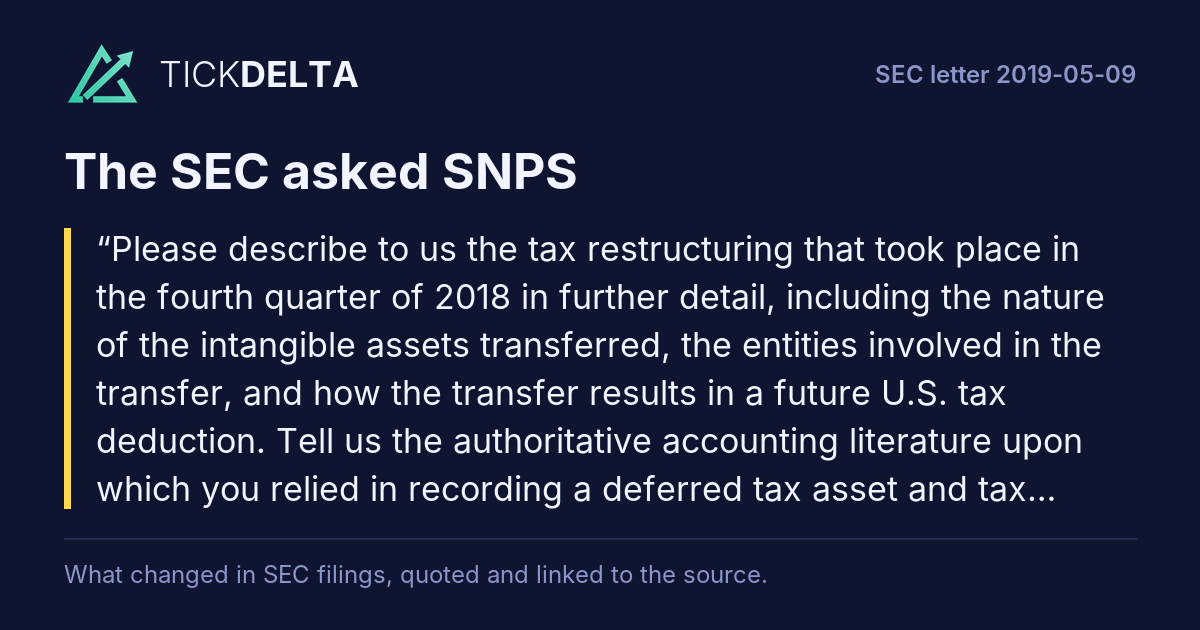
Please describe to us the tax restructuring that took place in the fourth quarter of 2018 in further detail, including the nature of the intangible assets transferred, the entities involved in the transfer, and how the transfer results in a future U.S. tax deduction.
Rest of the question

Tell us the authoritative accounting literature upon which you relied in recording a deferred tax asset and tax benefit and how you took into consideration the provisions of ASC 740-10-253(e).

SNPS answered
In the fourth quarter of 2018, the Company and its subsidiaries Synopsys Ireland Unlimited Corporation

(“SIR”) and Synopsys USIE Holdings, LLC (“SUSIE”) undertook a restructuring (the “Tax Restructuring”) to centralize the rights to the Company’s intellectual property ownership in the United States. For US Federal tax purposes, the Tax Restructuring was treated as an “inbound” tax-free reorganization under Internal Revenue Code Section 368(a)(1)(F) (“SIR F Reorg”).
Rest of the answer

The SIR F Reorg effectively resulted in bringing the tax basis of the assets and liabilities of SIR and its subsidiaries into the U.S. tax jurisdiction. This included the tax basis SIR held in the intangible assets immediately prior to the reorganization (i.e., SUSIE takes a

“carryover basis” in the intangible assets).

As a result of the SIR F Reorg, while SIR does not in and of itself change status for non-U.S. tax purposes (i.e. it is still a corporation for non-U.S. tax purposes), the tax status of SIR was changed from a controlled foreign corporation to a disregarded branch of a U.S. corporation. Under ASC 740-10-25-32, this change in tax status resulted in SIR’s existing temporary differences being treated as temporary differences of SUSIE and required the Company to recognize U.S. deferred taxes on those temporary differences.

Further, US GAAP ASC

740-10-45-19 states “When deferred tax accounts are recognized or derecognized as required by paragraphs 740-10-25-32 and

740-10-40-6 due to a change in tax status, the effect of recognizing or derecognizing the deferred tax liability or asset shall be included in income from continuing operations.”

As the deferred tax assets resulted from a change in tax status as part of a tax-free reorganization, the resulting deferred tax asset of $172 million was included in income from continuing operations.

The deferred tax assets did not result from an intra-entity difference between the tax basis in the “buyer’s” tax jurisdiction and the cost as reported in the consolidated financial statements. Accordingly, we believe ASC 740-10-25-3(e) does not apply.

Read in the reply ↗
In its next report

First report after the company's reply of 2019-05-16: 10-Q filed 2019-05-24 ↗, against the 10-Q filed 2019-02-25 ↗.

Tickdelta does not hold the text of both reports, so they are not compared here.
Notes to Consolidated Financial Statements · Note 11. Income Taxes, page 78
SEC asked (2)
We note your disclosure that a portion of foreign taxes paid as a result of the changes to your international tax structure in 2018 may result in a U.S. foreign tax credit, but the amount realized cannot be determined at this time. Please explain to us in more detail this disclosure and the basis in U.S. GAAP for not recognizing a deferred tax asset for foreign tax credits.
SNPS answered
In fiscal 2018, we recorded a deferred tax asset for the foreign tax credit and a corresponding full valuation allowance resulting from the changes to our international tax structure.

The Tax Cuts and Jobs Act of 2017

(“TCJA”) added a limitation on foreign tax credits allocable to “foreign branches”. The Company determined that these limitations could potentially apply to the foreign taxes incurred as a result of the Tax Restructuring.
Rest of the answer

As of the end of our fiscal 2018, no guidance had been issued on the application of these new rules, and significant uncertainty existed with respect to the application of the foreign tax credit associated with transactions that occurred after the enactment of the TCJA.

As disclosed in Note 11 of the Consolidated Financial Statements, on November 28, 2018, the U.S. Treasury

Department (“Treasury”) and the Internal Revenue Service (“IRS”) issued proposed regulations on changes made to the application of the foreign tax credit under the TCJA. However, because these regulations were issued in proposed form following the end of the reporting period and were subject to revision by Treasury, they are not considered enacted tax law under ASC

740-10-25-47.

In evaluating the need for a valuation allowance on the foreign tax credit, the Company considered the potential application of the new foreign branch limitation, and assuming such limitation applied, whether it had sufficient ability to realize the benefit through a carryback to a prior tax year or through future taxable income. The Company concluded there was no definitive authority which would have allowed for the carryback of the credit to a prior taxable year, and that it did not expect to realize sufficient future foreign branch income to use the credit in the foreseeable future. Accordingly, the Company recorded a full valuation allowance for the foreign tax credit.

As disclosed in Note 11, if the proposed regulations were to be finalized in their current form, the Company could release all or a portion of the valuation allowance on these foreign tax credits. The Company intends to evaluate the ability to use the credit when final guidance is issued by the IRS.

Read in the reply ↗
In its next report

First report after the company's reply of 2019-05-16: 10-Q filed 2019-05-24 ↗, against the 10-Q filed 2019-02-25 ↗.

Tickdelta does not hold the text of both reports, so they are not compared here.

Also in this review: closing letter, 2019-06-05
Form 10-K for the Fiscal Year Ended October 31, 2015

2016-03-09 to 2016-04-06 · 1 question · 1 letter from the SEC, 1 from the company
Review closed 2016-04-06
Income taxes
Notes to Consolidated Financial Statements · Note 11. Income Taxes, page 75
SEC asked
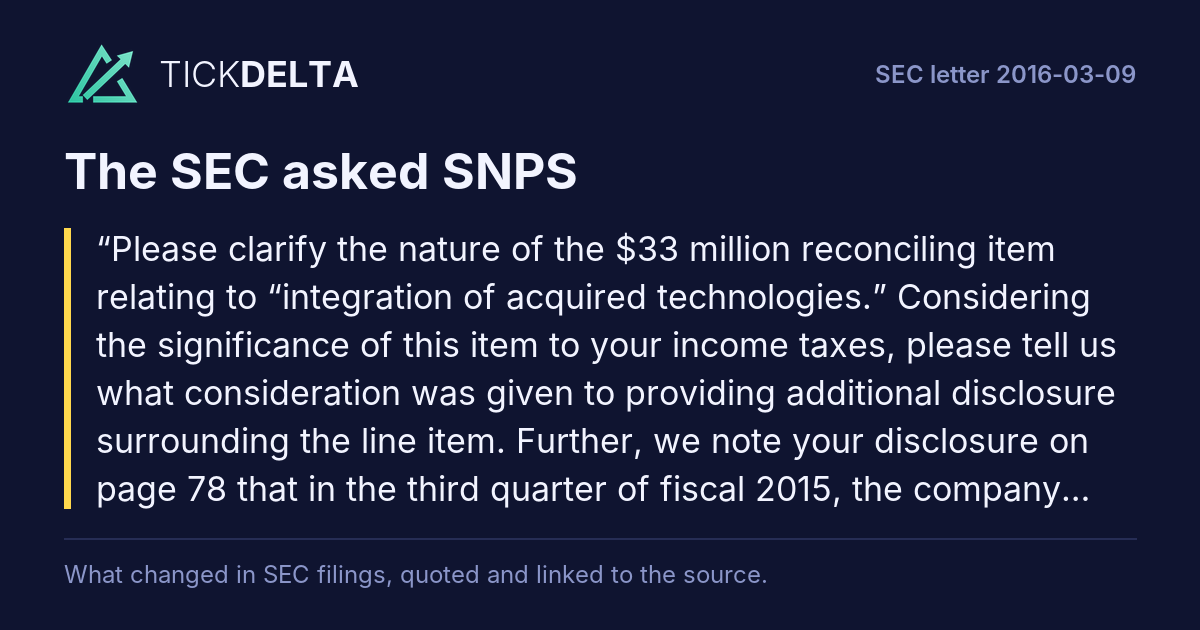
Please clarify the nature of the $33 million reconciling item relating to “integration of acquired technologies.” Considering the significance of this item to your income taxes, please tell us what consideration was given to providing additional disclosure surrounding the line item.
Rest of the question

Further, we note your disclosure on page 78 that in the third quarter of fiscal 2015, the company reached final settlement with the Examination Division of the IRS on the integration of acquired technologies for fiscal 2015. Please tell us if this exposure was considered in your unrecognized tax benefits and indicate the factors you considered in making this determination. Tell us how you expect the integration of acquired technologies to impact your effective tax rate in the future and what consideration you gave to disclosing these factors, including any uncertainties with respect to the positions you have taken.

SNPS answered
As part of our tax planning and transfer pricing practices, the Company regularly transfers intangible assets among various Company-controlled entities in different countries. Generally, these intangible assets result from the acquisition of technology by a Company-controlled entity as part of a business or asset acquisition.
Rest of the answer

The tax effect of these intangible asset transfers varies from year to year depending upon the jurisdiction of the Company-controlled entity acquiring the technology, the amount of intangible assets acquired, and the timing of integrating such acquired technology into the

Company’s general transfer pricing policies.

We account for the tax effect of these transfers under ASC 740-10-25-3. Typically, the tax effect of these transfers has not been material in any particular year. In November 2014, the Company transferred a large amount of intangible assets resulting primarily from integrating the acquired technology from several recent and older U.S. acquisitions to controlled entities outside the U.S. While the transfers were routine, the resulting tax impact in fiscal 2015 was greater than 5% of the tax on income before taxes computed at the U.S. statutory tax rate. Therefore, we disclosed this integration of technologies event separately as an item in the rate reconciliation table in the Income Taxes footnote of our consolidated financial statements.

After considering the materiality of the tax effect of integrating these acquired technologies, we provided additional disclosure in two distinct sections of the Management’s Discussion and Analysis of Financial Condition and Results of Operations.

First, in the “Fiscal 2015 Financial Performance Summary” (on page 27), we indicated that the higher provision for income taxes resulted primarily from the integration of acquired technologies. Second, in the “Income Taxes” section (on page 37), we indicated that the effective tax rate for fiscal 2015 included, among other things, the $33 million tax expense resulting from the integration of acquired technologies. We also discussed the impact of intercompany transfer pricing more generally on our effective tax rate in the Risk Factors section of our Annual Report on Form 10-K (page 15). Consequently, we determined that our tax disclosures were adequate.

As we account for the transfer of assets over five years, pursuant to ASC 740-10-25-3(e), it is likely that these intercompany intangible asset transfers will again, in the future, be material to the Company’s overall tax provision. While we consider our disclosures adequate, we will add the disclosure below to the Income Taxes footnote in our Annual Report on Form 10-K for the fiscal year ending

October 29, 2016:

“The integration of acquired technologies represents the income tax effect resulting from the transfer of certain intangible assets among company-controlled entities. The income tax effect is generally recognized over five years. These intangible assets generally result from the acquisition of technology by a company-controlled entity as part of a business or asset acquisition. The tax impact of the integration of acquired technologies in fiscal 2016 was $XX million compared to $33 million in fiscal 2015 and $4.7 million in fiscal 2014. The tax impact in fiscal 2016 and fiscal 2015 was higher compared to fiscal 2014 due to the higher value of the intangible assets that were transferred to certain wholly owned foreign subsidiaries in November 2014.”

We participate in the Compliance Assurance Process program with the Internal Revenue Service (“IRS”) where we work collaboratively with the IRS to identify and resolve potential tax issues before the tax return is filed each year. As a result, in our third quarter of fiscal 2015, we reached final settlement with the Examination Division of the IRS with regard to the tax effect of the fiscal 2015 integration of acquired technologies. Accordingly, there were no unrecognized U.S. tax benefits as of the end of fiscal 2015 with respect to the fiscal 2015 integration of acquired technologies. We disclosed these facts in the Income Taxes footnote on page 78 of our Annual Report on Form 10-K.

***

As requested in the Staff’s letter, the Company acknowledges:

• the Company is responsible for the adequacy and accuracy of the disclosure in its filings;

Staff comments or changes to disclosure in response to Staff comments do not foreclose the Commission from taking any action with respect to the filing; and the Company may not assert Staff comments as a defense in any proceeding initiated by the Commission or any person under the federal securities laws of the United States.

Read in the reply ↗
In its next report

First report after the company's reply of 2016-03-23: 10-Q filed 2016-05-24 ↗, against the 10-Q filed 2016-02-22 ↗.

Tickdelta does not hold the text of both reports, so they are not compared here.

Also in this review: closing letter, 2016-04-06

2 other letters: notices that a filing will not be reviewed, requests to declare a registration effective, and the like

From the SEC's correspondence on EDGAR: staff letters (form UPLOAD) and company letters (form CORRESP), 8 letters filed since 2016-03-09. Questions and answers are matched by their numbers; topics come from words in each question. The reports are compared word for word (same form, before the first SEC letter against the first report after the company's reply). No AI.

Work on SNPS in a spreadsheet: Excel workbook (a sheet per section, ten years by column, charts, links to the filings) · CSV. For a Google Sheet that stays up to date, paste =IMPORTDATA("https://tickdelta.com/company/SNPS/export.csv") into a cell.