Added10-Q Nov 9, 2026 vs 10-K Mar 2, 2026
We may not realize the anticipated benefits of the LivePerson Acquisition, and integrating LivePerson’s business may be more difficult, costly or time-consuming than we expect.
Each branch is a paragraph in Risk Factors with nothing like it in the 10-K filed Mar 11, 2025. A box jumps to the paragraph as filed, below.
11 paragraphs in Risk Factors of the 10-K filed Mar 2, 2026 with nothing like them in the 10-K filed Mar 11, 2025. Quoted exactly. Paragraphs that were only edited are under 10-K change.
We expect other jurisdictions around the world will adopt similar laws. In the United States, several states and localities have enacted measures related to the use of AI and machine learning in products and services. We may have to change our business practices to comply with such obligations. For example, our employees and personnel use generative AI technologies to perform their work. Our use of this technology could result in additional compliance costs, regulatory investigations and actions, and lawsuits. If we are unable to use generative AI, it could make our business less efficient and result in competitive disadvantages. Further, under privacy and data security laws as well as other obligations, we may be required to obtain certain consents to process personal data and our inability or failure to do so could result in adverse consequences. For example, the FTC has required companies to turn over valuable insights or trainings generated through the use of AI and machine learning where they allege the company has violated privacy and consumer protection laws. If we cannot use generative AI technologies or that use is restricted, our business may be less efficient, or we may be at a competitive disadvantage.
SoundHound’s business depends on, and is directly affected by, the global Voice AI market, as well as the global economy more generally, including global economic trends affecting the automotive, internet of things (“IoT”), mobile application, call center, semiconductor device maker and restaurant and hospitality industries. For example, SoundHound’s largest customers are currently in the automotive industry, and automotive production and sales are highly cyclical and
from winning a contract to implementation is long and SoundHound is subject to the risks of cancellation or postponement of the contract or unsuccessful implementation.
For the year ended December 31, 2025, there was no customer that accounted for more than 10% of the Company's total revenues. For the year ended December 31, 2024, one customer accounted for 14% of the Company's total revenues. For the year ended December 31, 2023, two customers accounted for 62% of the Company's total revenues.
could adversely impact our business and results of operations in a number of ways, including longer sales cycles, lower demand or prices for our platform, fewer subscriptions and lower or no growth.
or strategic transaction, may entail numerous operational and financial risks, including the risks outlined above and additionally:
financial reporting, which resulted in the Company not designing and maintaining effective controls related to substantially all accounts and disclosures. These material weaknesses contributed to the following additional material weaknesses that continue to exist as of December 31, 2025:
Although SoundHound is not directly impacted by the tariffs as a software-as-a-service ("SaaS") provider, SoundHound’s business or stock price may be adversely affected by the imposition of duties and tariffs and other trade barriers and retaliatory countermeasures on our customers implemented by the U.S. and other governments.
In 2025, there have been significant changes to U.S. trade policies, sanctions, legislation, treaties and tariffs, including, but not limited to, trade policies and tariffs affecting products from outside of the U.S. For example, in early April, 2025, the current U.S. presidential administration announced significant new tariffs on foreign imports into the U.S. from about 90 nations. Although SoundHound is not directly impacted by the tariffs as a SaaS provider, the extent and duration of increased tariffs and the resulting impact on general economic conditions and on our business partners are uncertain and depend on various factors, such as negotiations between the U.S. and affected countries, the responses of other countries or regions, and exemptions or exclusions that may be granted. Any new or additional tariffs on goods imported to the U.S. could eventually impact the demand of our products and services from our business partners or our pricing strategy. Additionally, U.S. policy changes and uncertainty about such changes could increase market volatility and currency exchange rate fluctuations, which may ultimately increase the unpredictability of our business or stock price.
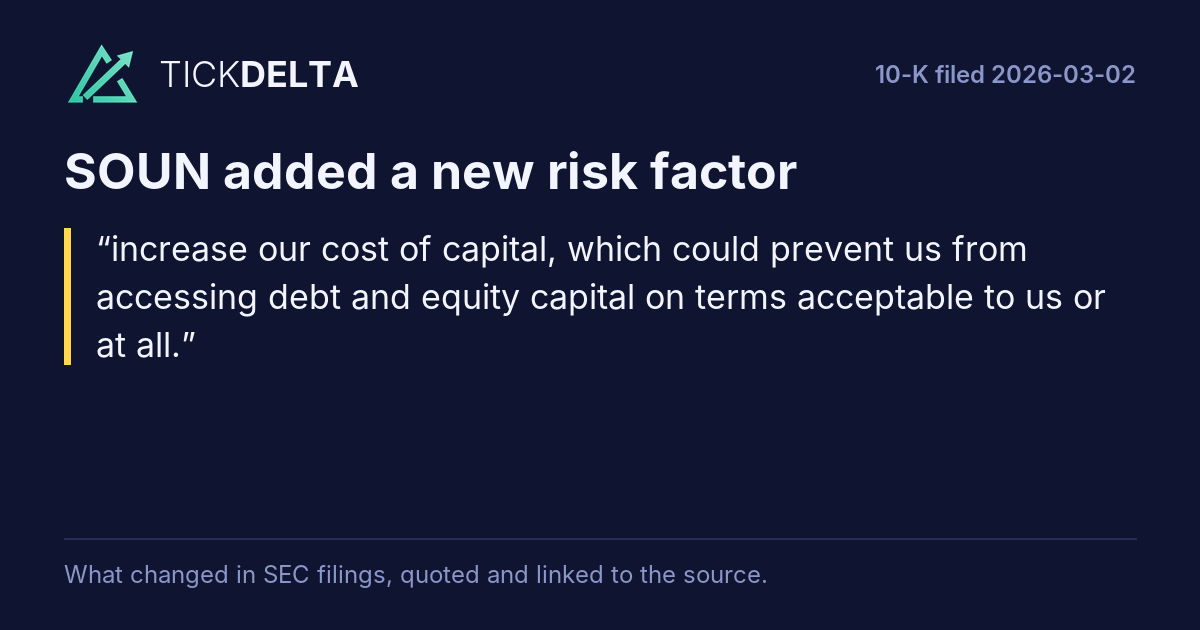
increase our cost of capital, which could prevent us from accessing debt and equity capital on terms acceptable to us or at all.
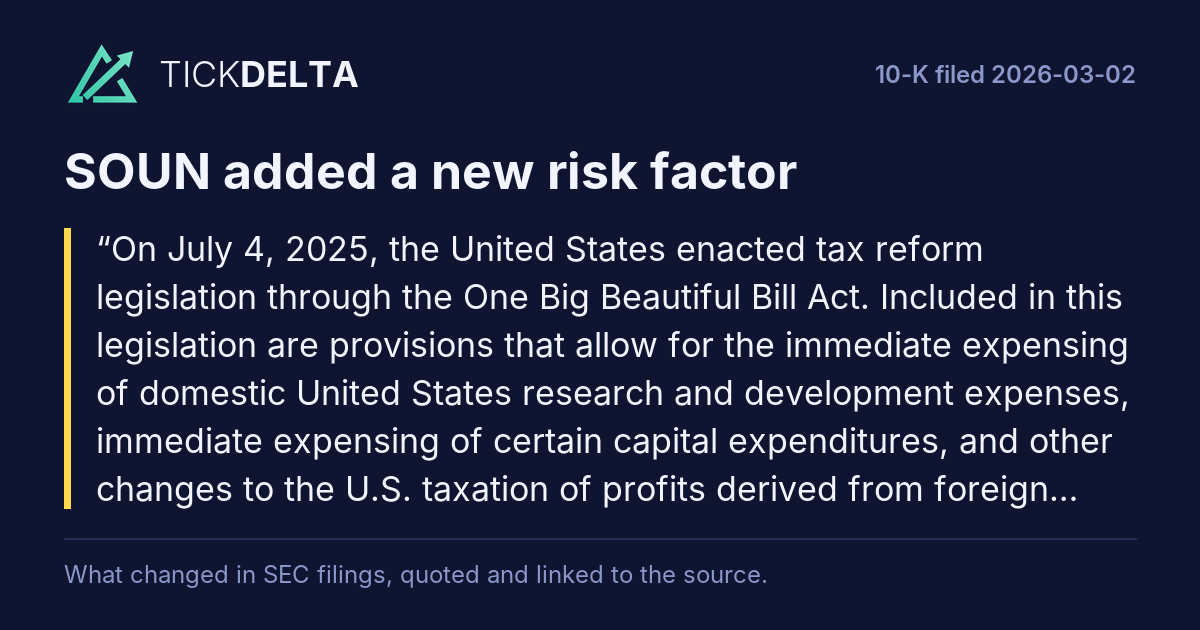
On July 4, 2025, the United States enacted tax reform legislation through the One Big Beautiful Bill Act. Included in this legislation are provisions that allow for the immediate expensing of domestic United States research and development expenses, immediate expensing of certain capital expenditures, and other changes to the U.S. taxation of profits derived from foreign operations. We do not expect that the enactment of the legislation will lead to a significant change of our tax expense during 2025, primarily due to our taxable loss position and the full valuation allowance on deferred tax assets in the US jurisdiction. The Company continues to evaluate the impact the new legislation will have on our annual or interim consolidated financial statements.
New in the latest 10-Q
111 paragraphs in the 10-Q filed Nov 9, 2026 with nothing like them in the 10-Q filed Aug 10, 2026 (at least half the words must differ; new numbers alone do not count). Quoted exactly, grouped by the item heading above them. This is text that changed, not a judgement of how serious it is.
• unexpected costs, charges or expenses resulting from the acquisition of LivePerson;
Read in the 10-Q
(1) Includes related party revenue from an investee company of $0.1 million and $7.6 million for the three and nine months ended September 30, 2026. Refer to Note 18, Related Party Transactions.
Read in the 10-Q
Proceeds from sales of Class A common stock under the Second Equity Distribution Agreement 48,481 201,519
Read in the 10-Q
Proceeds from exercise of stock options and employee stock purchase plan 4,015 7,233
Read in the 10-Q
Payment of financing costs associated with the Second Equity Distribution Agreement (970) (4,030)
Read in the 10-Q
Net change in cash, cash equivalents, and restricted cash equivalents (40,577) 70,956
Read in the 10-Q
Cash, cash equivalents, and restricted cash equivalents, beginning of period 249,166 198,916
Read in the 10-Q
Cash, cash equivalents, and restricted cash equivalents, end of period $ 208,589 $ 269,872
Read in the 10-Q
Equity investments that are neither consolidated nor accounted for under the equity method are accounted for in accordance with ASC Topic 321, Investments - Equity Securities (“ASC 321”). For equity investments that do not have a readily determinable fair value and do not qualify for the net asset value practical expedient, the Company has elected the measurement alternative, under which the investment is measured at cost, less impairment, if any, plus or minus changes resulting from observable price changes in orderly transactions for the identical or a similar investment of the same issuer. The election is made on an investment-by-investment basis.
Read in the 10-Q
The Company performs a qualitative assessment each reporting period to evaluate whether an investment measured under the measurement alternative is impaired. Impairment indicators considered include a significant deterioration in the earnings performance or business prospects of the investee, a significant adverse change in the regulatory, economic or technological environment in which the investee operates, a significant adverse change in the general market condition of the geographical area or industry in which the investee operates, a bona fide offer to purchase or sell the same or a similar investment for an amount less than the carrying amount of the investment, and factors that raise significant concerns about the investee's ability to continue as a going concern. If the qualitative assessment indicates that the investment is impaired, the Company estimates the fair value of the investment and recognizes an impairment in net income equal to the amount by which the carrying amount exceeds fair value. The Company also monitors for observable price changes in orderly transactions for the identical or a similar investment of the same issuer.
Read in the 10-Q
Dividends received on equity investments are recognized in other (expense) income, net, when the Company’s right to receive payment is established.
Read in the 10-Q
Impairments and adjustments resulting from observable price changes are recognized in other (expense) income, net.
Read in the 10-Q
In connection with the acquisition of LivePerson, the Company assumed the remaining principal of 0 % Convertible Senior Notes due 2026 (the "2026 Notes"), which were recognized at their acquisition-date fair value in accordance with ASC 805, Business Combinations. Acquisition accounting establishes a new basis of accounting for the instrument, and any unamortized debt discount, premium or issuance costs recognized by the acquiree prior to the acquisition date are not carried forward.
Read in the 10-Q
The Company evaluates convertible notes at the acquisition date, and upon any subsequent modification, to determine whether any embedded features are required to be separated from the host contract and accounted for as derivatives under ASC 815, Derivatives and Hedging. In performing this evaluation, the Company assesses whether each embedded feature is clearly and closely related to the debt host and, for embedded conversion features, whether the feature would meet the scope exception in ASC 815-40 for contracts that are both indexed to the Company's own equity and would be classified in
Read in the 10-Q
stockholders' equity if freestanding. Convertible notes for which no embedded feature requires separate accounting are accounted for as a single liability instrument.
Read in the 10-Q
Convertible notes are subsequently measured at amortized cost. Where the acquisition-date fair value differs from the principal amount payable at maturity, the difference is accreted to interest expense over the remaining term of the instrument using the effective interest method. Where the acquisition-date fair value equals the principal amount, no discount or premium arises and no amount is accreted. Convertible notes are classified as current liabilities when the scheduled maturity date is within twelve months of the balance sheet date or when holders have a currently exercisable right to require the Company to repurchase the notes. Gains and losses on the extinguishment of convertible notes are measured as the difference between the reacquisition price and the net carrying amount of the notes extinguished and are recognized in other (expense) income, net.
Read in the 10-Q
The Company's reporting currency is the U.S. dollar. The functional currency of each of the Company's subsidiaries is the currency of the primary economic environment in which that subsidiary operates, determined by reference to the economic indicators in ASC 830, Foreign Currency Matters.
Read in the 10-Q
In connection with the LivePerson Acquisition, the Company reassessed the functional currency of LivePerson's foreign subsidiaries in light of the changes in their operations resulting from the acquisition and the Company's integration of those operations, including the centralization of cash management and funding with the Company and the determination of pricing by reference to worldwide competitive conditions. As a result of that reassessment, the functional currency of substantially all of LivePerson's foreign subsidiaries is the U.S. dollar. The functional currency of one subsidiary located in Australia remains the Australian dollar, as it sells locally developed products into a local market, incurs its operating costs in Australian dollars and is funded through locally generated cash flows.
Read in the 10-Q
For subsidiaries whose functional currency is the U.S. dollar but whose books and records are maintained in a local currency, financial statements are remeasured into U.S. dollars. Monetary assets and liabilities are remeasured at exchange rates in effect at the balance sheet date. Non-monetary assets and liabilities, primarily property and equipment, operating lease right-of-use assets, intangible assets and deferred revenue, are remeasured at historical exchange rates. Revenues and expenses are remeasured at average exchange rates for the period, except for amounts related to non-monetary assets and liabilities, which are remeasured at historical exchange rates. Remeasurement gains and losses are recognized in other (expense) income, net, in the condensed consolidated statements of operations and comprehensive loss.
Read in the 10-Q
For subsidiaries whose functional currency is not the U.S. dollar, assets and liabilities are translated into U.S. dollars at exchange rates in effect at the balance sheet date, and revenues and expenses are translated at average exchange rates for the period. The resulting translation adjustments are recorded in accumulated other comprehensive income (loss), a component of stockholders' equity.
Read in the 10-Q
Company has adopted this standard for its interim financial statements as of and for the three months ended March 31, 2026 and thereafter. The Company has assessed no material impact from the updated standard on the financial statement disclosures.
Read in the 10-Q
Stock subject to time and performance-based vesting conditions. The fair value of the purchase consideration was $ 15.8 million.
Read in the 10-Q
The LivePerson Acquisition was effected pursuant to the Agreement and Plan of Merger entered into on April 21, 2026 (the "Original Merger Agreement"), which was amended and restated on July 2, 2026 by the Amended and Restated Merger Agreement (the "Amended Merger Agreement"). Under the Amended Merger Agreement, the acquisition was structured as two successive mergers: a wholly owned merger subsidiary of the Company merged with and into LivePerson, with LivePerson surviving (the "First Merger"), and immediately following the First Merger, LivePerson merged with and into a second wholly owned merger subsidiary of the Company, which survived as an indirect wholly owned subsidiary of the Company (the "Second Merger"). The two-step structure was adopted so that holders of LivePerson common stock held through the Tel Aviv Stock Exchange Clearing House (the "TASE Shares") could receive cash rather than shares of the Company's Class A Common Stock.
Read in the 10-Q
On September 4, 2026, the LivePerson Acquisition Date, at the effective time of the First Merger, each share of LivePerson common stock outstanding immediately prior to that time, other than TASE Shares, was converted into the right to receive 0.4673 shares of the Company's Class A Common Stock. At the effective time of the Second Merger, each TASE Share was converted into the right to receive $ 3.31 in cash. The Company issued 4,974,627 shares of its Class A Common Stock with a fair value of $ 33.5 million based on the closing market price of $ 6.74 per share on the LivePerson Acquisition Date, and paid $ 5.8 million in cash to former holders of LivePerson common stock. The fair value of equity issued as part of the
Read in the 10-Q
consideration paid was determined on the basis of the closing market price of the Company's shares on the LivePerson Acquisition Date.
Read in the 10-Q
The LivePerson Acquisition did not include any holdback, escrow or contingent earnout consideration.
Read in the 10-Q
The Company concluded that the settlement of the Secured Notes pursuant to the Notes Restructuring Agreement was contingent upon and effected contemporaneously with the closing, extinguished pre-existing obligations of LivePerson, and was an integral part of the exchange for control of LivePerson. Accordingly, the fair value of the consideration issued and paid by the Company to the Secured Holders has been included in the purchase consideration for the LivePerson Acquisition.
Read in the 10-Q
In connection with the closing, the Company also entered into a Registration Rights Agreement, dated September 4, 2026, with the Secured Holders, pursuant to which the Company agreed to register the resale of the shares of Class A Common Stock issued to the Secured Holders. The Company satisfied this obligation on the LivePerson Acquisition Date.
Read in the 10-Q
In connection with the LivePerson Acquisition, the Company assumed the remaining $ 5.0 million aggregate principal amount of LivePerson's 2026 Notes, which were recognized at their acquisition-date fair value of $ 5.0 million. The consummation of the LivePerson Acquisition constituted a Fundamental Change under the Indenture governing the 2026 Notes, entitling holders to require repurchase at 100 % of principal. See Note 8 to our unaudited condensed consolidated financial statements for more information on the 2026 Notes.
Read in the 10-Q
At the effective time of the First Merger, each outstanding option to purchase shares of LivePerson common stock was cancelled for no consideration, and each outstanding LivePerson warrant was cancelled for no consideration. Each outstanding LivePerson restricted stock unit held by a non-employee director of LivePerson, and each LivePerson restricted stock unit that was vested but unsettled, was converted into the right to receive the merger consideration. Each other outstanding LivePerson restricted stock unit was assumed by the Company and converted into a restricted stock unit denominated in shares of the Company's Class A Common Stock, with the number of shares subject to each such award adjusted by the exchange ratio and otherwise subject to substantially the same terms and vesting conditions (the "Replacement Awards").
Read in the 10-Q
The Company allocated the fair value of the Replacement Awards as of the LivePerson Acquisition Date between pre-combination and post-combination service in accordance with ASC 805. The portion attributable to pre-combination service of $ 1.3 million was included in purchase consideration, and the portion attributable to post-combination service will be recognized as stock-based compensation expense over the remaining requisite service period. See Note 12 to our
Read in the 10-Q
unaudited condensed consolidated financial statements for more information on stock-based awards assumed in connection with the LivePerson Acquisition.
Read in the 10-Q
The purchase accounting is not yet complete as of September 30, 2026 and as such, the final allocation among purchase consideration, intangible assets, net assets acquired and goodwill may be subject to change. Any adjustments to the preliminary purchase price allocation will be made in the periods in which the adjustments are determined, and the cumulative effect of such adjustments will be calculated as if the adjustments had been completed as of the acquisition date. The Company expects to finalize the purchase price allocation within 12 months from the acquisition date.
Read in the 10-Q
The financial results of Interactions and LivePerson are included in these unaudited condensed consolidated financial statements from the date of the acquisition. Interactions contributed revenue of $ 5.5 million and net income of $ 0.3 million to the Company for the three and nine months ended September 30, 2025. LivePerson contributed revenue of $ 13.6 million and net loss of $ 1.6 million to the Company for the three and nine months ended September 30, 2026.
Read in the 10-Q
The following table includes unaudited pro forma financial information that presents combined results of the Company as if the Interactions acquisition was completed on January 1, 2024 and the LivePerson acquisition was completed on January 1, 2025, the beginning of the comparable prior annual reporting period.
Read in the 10-Q
Unaudited Three Months Ended Nine Months Ended September 30, 2025 September 30, 2025 Revenue $ 112,626 $ 341,096 Net loss attributable to SoundHound AI, Inc. $ (115,800) $ (104,870)
Read in the 10-Q
The following table includes unaudited pro forma financial information that presents combined results of the Company as if the LivePerson acquisition was completed on January 1, 2025, the beginning of the comparable prior annual reporting period.
Read in the 10-Q
Unaudited Three Months Ended Nine Months Ended September 30, 2026 September 30, 2026 Revenue $ 95,157 $ 310,701 Net loss attributable to SoundHound AI, Inc. $ (27,828) $ (103,332)
Read in the 10-Q
The unaudited pro forma financial information includes the combined historical operating results of the Company, Interactions, and LivePerson prior to the acquisition, with adjustments to give effect for the acquisitions and related events. Pro forma adjustments have been made to reflect the incremental intangible asset amortization to be incurred based on the fair values and useful lives of each identifiable intangible asset; the elimination of Interactions' historical amortization of deferred project costs, internally developed software and deferred commissions, and LivePerson's historical amortization of contract acquisition costs and internal-use software development cost; the elimination of the historical interest expense of Interactions and LivePerson on debt that was settled in connection with the acquisitions; the elimination of LivePerson’s historical gain due on the change in fair value of warrants, gain on troubled debt restructuring, and impairment of goodwill; and incremental transaction costs related to the acquisitions. These unaudited pro forma results are presented for informational purposes only and are not necessarily indicative of what the actual results of operations of the combined company would have been if the acquisition had occurred at the beginning of the period presented, nor are they indicative of future results of operations. The unaudited pro forma results are based on the preliminary purchase price allocation and will be updated to reflect the final amounts as the allocation is finalized during the measurement period.
Read in the 10-Q
The Company did not have any material nonrecurring pro forma adjustments directly attributable to the business combination included in the reported pro forma revenue and earnings.
Read in the 10-Q
Contingent MIPA Earnout Consideration shall be recorded as an adjustment to the cost basis of the acquired intangible asset.
Read in the 10-Q
In addition, as of September 30, 2026, the Company had an indefinite-lived intangible asset of $3.2 million related to in-process research and development acquired in the LivePerson Acquisition, which is not subject to amortization.
Read in the 10-Q
On June 15, 2026, the Company entered into an Investment and Shareholders Agreement to subscribe for Class A Preferred shares of a privately held company, a provider of contact-center and business process outsourcing services, for $ 5.0 million in cash. Completion of the subscription was subject to the satisfaction of conditions precedent, including corporate and regulatory approvals and registration of the investee's amended bylaws, and the parties agreed to use best efforts to close within 60 calendar days following signing. No amounts were funded at signing, and the Company recognized no investment as of June 30, 2026.
Read in the 10-Q
On July 29, 2026, the conditions precedent were satisfied and the Company funded the $ 5.0 million subscription price in cash, acquiring 166,658 Class A Preferred shares representing approximately 11.8 % of the investee on a fully diluted basis.
Read in the 10-Q
The Class A Preferred shares do not have a readily determinable fair value and the net asset value practical expedient is not available. The investment does not qualify for the equity method of accounting because the Class A Preferred shares are not in-substance common stock. Accordingly, the Company has elected the measurement alternative in ASC 321 and carries the investment at cost, less impairment, if any, plus or minus changes resulting from observable price changes in orderly transactions for the identical or a similar investment of the same issuer.
Read in the 10-Q
The Company evaluates the investment for impairment each reporting period by considering qualitative indicators, including the investee's earnings and cash flow performance relative to plan, adverse changes in the regulatory, economic or technological environment, adverse changes in the general market condition of the investee's geography or industry, and the terms of any subsequent financing transactions by the investee. The Company also monitors for observable price changes in orderly transactions for identical or similar investments of the same issuer.
Read in the 10-Q
The Company did not identify any impairment or any observable price changes during the three and nine months ended September 30, 2026. The carrying amount of the investment was $ 5.0 million as of September 30, 2026, and there were no upward adjustments and no impairments or downward adjustments, either during the periods presented or cumulatively since acquisition.
Read in the 10-Q
Because the investment is not measured at fair value in the Company's condensed consolidated balance sheets, it is not categorized within the fair value hierarchy.
Read in the 10-Q
In connection with the LivePerson Acquisition on September 4, 2026, the Company assumed obligations related to LivePerson’s 0 % Convertible Senior Notes due 2026 (the “2026 Notes”), which were originally issued by LivePerson in December 2020 pursuant to an indenture between LivePerson and the trustee named therein (the “Indenture”). In accordance with the acquisition method of accounting, these obligations were recognized at their acquisition-date fair value of $ 5.0 million.
Read in the 10-Q
In September 2026, subsequent to the LivePerson Acquisition, the Company settled $ 1.2 million of the aggregate $ 5.0 million in obligations assumed. As of September 30, 2026, $ 3.8 million aggregate principal amount of the 2026 Notes remained outstanding.
Read in the 10-Q
The 2026 Notes do not bear regular cash interest and the principal amount does not accrete. The 2026 Notes may bear special interest under specified circumstances relating to the Company's failure to comply with its reporting obligations under the Indenture or if the 2026 Notes are not freely tradable as required by the Indenture. The 2026 Notes mature on December 15, 2026, unless earlier converted or repurchased, and are senior unsecured obligations of the Company. Because the 2026 Notes mature within twelve months of the balance sheet date, and because holders have a currently exercisable right to require the Company to repurchase the 2026 Notes as described below, the entire carrying value is classified within convertible notes, current in the Company's condensed consolidated balance sheets.
Read in the 10-Q
The 2026 Notes are convertible at any time prior to the close of business on the second scheduled trading day immediately preceding the maturity date. As a result of the LivePerson Acquisition, each $1,000 principal amount of 2026 Notes is convertible into approximately 0.4141 shares of the Company’s Class A Common Stock, and the Company may settle conversions in cash, shares of its Class A Common Stock, or a combination thereof, at its election. No 2026 Notes were converted during the period from September 4, 2026 through September 30, 2026.
Read in the 10-Q
The consummation of the LivePerson Acquisition constituted a Fundamental Change under the Indenture. As a result, holders of the 2026 Notes have the right to require the Company to repurchase their 2026 Notes for cash at a repurchase price equal to 100 % of the principal amount to be repurchased, plus accrued and unpaid special interest, if any, to, but excluding, the fundamental change repurchase date. During the period from September 4, 2026 through September 30, 2026, no 2026 Notes were repurchased due to the fundamental change repurchase rights.
Read in the 10-Q
The Company determined the features embedded in the 2026 Notes are not material and, accordingly, the 2026 Notes are accounted for as a single liability instrument. Because the 2026 Notes were originally measured at fair value equal to principal amount, and the 2026 Notes are not interest-bearing, there was no material interest expense associated with the 2026 Notes.
Read in the 10-Q
In connection with the LivePerson Acquisition, the Company assumed a contract for information technology infrastructure services, originally entered into in September 2025, with aggregate purchase commitments of $ 76.4 million over a two-year term. As of September 30, 2026, approximately $ 55.4 million remained committed under this contract.
Read in the 10-Q
On July 30, 2026, a putative class action captioned Thompson v. SoundHound AI, Inc., Case No. 26-CV-202181, was filed against the Company in the Superior Court of California for the County of Alameda. The complaint alleges that the Company’s AI-powered phone-ordering technology, which certain restaurant customers use to answer telephone calls and take orders, intercepted, recorded, and transcribed callers’ conversations without their consent and without disclosing the Company’s role, in violation of the California Invasion of Privacy Act, Cal. Penal Code §§ 631(a), 632, and 632.7. The complaint also asserts claims for intrusion upon seclusion and violation of California’s Unfair Competition Law. The plaintiff seeks to represent a class of California citizens who, during the four years preceding the filing of the complaint, called a California restaurant using the Company’s phone-ordering technology and whose calls were allegedly intercepted, recorded, or transcribed by the Company. The complaint seeks statutory damages, actual damages, restitution and disgorgement, injunctive relief, compensatory and punitive damages, and attorneys’ fees and costs. The complaint also names unidentified “Doe” defendants, which it describes as including restaurant brands, franchisors, and franchisees that use the Company’s technology. On October 16, 2026, the Company filed a demurrer and a motion to strike portions of the complaint. A hearing on both motions is scheduled for November 24, 2026. The Company believes the claims are without merit and intends to defend the action vigorously. The action is at an early stage, and the Company is unable to estimate the reasonably possible loss or range of loss, if any. In accordance with ASC 450, Contingencies, no reasonably possible loss or range of loss can be estimated and accrued as of September 30, 2026.
Read in the 10-Q
In December 2023, a putative stockholder class action entitled Damri v. LivePerson, Inc. was filed under the federal securities laws against LivePerson, its former Chief Executive Officer, and its Chief Financial Officer in the United States District Court for the Southern District of New York. The complaint alleges that LivePerson’s Form 10-Q filings and
Read in the 10-Q
forecasts for the first, second, and third quarters of fiscal year 2022 were false and misleading in violation of Section 10(b) of the Securities Exchange Act of 1934, based on LivePerson’s later disclosures and report on Form 10-K on March 16, 2023. In May 2024, the plaintiff filed an amended complaint. LivePerson moved to dismiss the amended complaint in August 2024, and in March 2025, the court granted the company’s motion and dismissed the action with prejudice. In April 2025, the plaintiff appealed the decision to the United States Court of Appeals for the Second Circuit and in March 2026, the dismissal was affirmed but the case was remanded to the district court with leave for the plaintiff to try to replead his complaint. A second amended complaint was filed, and LivePerson renewed its motion to dismiss, which remains pending. A parallel litigation on behalf of stockholders who purchased their shares on the Tel Aviv Stock Exchange, entitled Weissbrod v. LivePerson, Inc., was filed in the Tel Aviv District Court in Israel, and the court later closed the matter with permission for the parties to apply for reopening pending further developments in the Damri case. In accordance with ASC 450, Contingencies, no reasonably possible loss or range of loss can be estimated and accrued as of September 30, 2026.
Read in the 10-Q
In January 2024, a purported derivative action entitled Marti v. LoCascio was filed in the United States District Court for the Southern District of New York by a purported stockholder of LivePerson against LivePerson’s former Chief Executive Officer, its Chief Financial Officer, members of then-current board of directors and several former directors. The Marti litigation claims that LivePerson itself was harmed by the same acts and omissions underlying the Damri federal securities lawsuit and seeks to recover unspecified losses on behalf of the company. Between June and September 2024, four other purported derivative actions were filed by purported stockholders of LivePerson against the company’s former Chief Executive Officer, its Chief Financial Officer, members of the then-current board of directors and several former directors. These four purported derivative actions, similar to the Marti litigation, claim that LivePerson itself was harmed by the same acts and omissions underlying the Damri federal securities lawsuit, and seek to recover unspecified losses on behalf of the company. The four actions are entitled Steffens v. Block and Morales v. LoCascio, both filed in the United States District Court for the Southern District of New York, and Ravi v. LoCascio and Perkins v. LoCascio, both filed in the Supreme Court of the State of New York, New York County. The Marti, Steffens, Morales, Ravi and Perkins cases are stayed pending further developments in the Damri case. In accordance with ASC 450, Contingencies, no reasonably possible loss or range of loss can be estimated and accrued as of September 30, 2026.
Read in the 10-Q
In April 2026, Vector Capital VI, L.P. filed a lawsuit in the Court of Chancery of the State of Delaware against the members of LivePerson’s board of directors who voted in favor of LivePerson’s September 2025 debt exchange transaction. The action, entitled Vector Capital VI, L.P. v. Miller, alleges that the September 2025 debt exchange constituted a breach of fiduciary duty by LivePerson’s board, was unfairly coercive, frustrated stockholder voting rights and improperly diluted the value of LivePerson’s common stock. The complaint seeks unspecified damages. LivePerson, on behalf of the directors, has moved to dismiss the complaint and briefing was completed in August 2026. Oral argument on the motion to dismiss is currently scheduled for November 2026. In accordance with ASC 450, Contingencies, management considers the probability of loss to be remote as of September 30, 2026.
Read in the 10-Q
In July 2026, two lawsuits were filed in the Supreme Court of the State of New York against LivePerson and its board of directors challenging as alleged negligence and negligent misrepresentation supposedly inadequate disclosures in the proxy statement for the then-proposed merger with SoundHound. Among other things, the complaints allege that additional disclosure is needed about the work performed by LivePerson’s financial advisors, about potential conflicts of interest by those advisors, and about any potential conflicts of interest that LivePerson insiders may have with respect to the proposed merger. Both lawsuits seek an injunction directing LivePerson to make additional disclosures. The LivePerson defendants are not yet due to respond to the complaints. Several similar demand letters were sent by other purported LivePerson stockholders prior to the merger but did not result in any litigation being filed. In accordance with ASC 450, Contingencies, no reasonably possible loss or range of loss for these two lawsuits can be estimated and accrued as of September 30, 2026.
Read in the 10-Q
Certain prior period Stock-based compensation classified in expense accounts presented in the table above have been reclassified to conform to the current period presentation of capitalized software development costs.
Read in the 10-Q
Effect of potentially dilutive equivalent shares to net loss — (1,860) (18,037) (2,709)
Read in the 10-Q
Effect of potentially dilutive equivalent shares — 1,918,970 5,638,707 1,927,275
Read in the 10-Q
As of September 30, 2026, $ 3.8 million aggregate principal amount of the 2026 Notes assumed in the LivePerson Acquisition remained outstanding. The carrying amount of the 2026 Notes approximated fair value as of September 30, 2026. Fair value was estimated using the price agreed in the repurchase of 2026 Notes at 99.5 % of principal amount completed shortly after the balance sheet date, as disclosed in Note 19. Because the 2026 Notes are not traded in an active market, the fair value measurement is categorized within Level 2 of the fair value hierarchy.
Read in the 10-Q
The Company has not recognized a liability for the Contingent MIPA Earnout Consideration described in Note 3, as the amounts payable are not probable and reasonably estimable. It is not practicable to estimate the fair value of the Contingent MIPA Earnout Consideration as of September 30, 2026 without incurring excessive cost. The amounts payable depend on the revenue and gross profit of the acquired customer contracts in two separate measurement periods ending on the first and second anniversaries of the MIPA Closing Date. Estimating them would require forecasts of contract-level revenue, customer pricing and the timing of cost savings from transition arrangements that the Company does not prepare. The maximum amount payable is $ 33.5 million. Any amounts earned are payable in cash shortly after the earnout calculation for each measurement period is finalized, with the first measurement period ending in May 2027.
Read in the 10-Q
In the third quarter of 2026, the Company invested $ 5.0 million in the Class A Preferred Shares of a private company, representing approximately 11.8 % equity interest in the investee company. Refer to Note 6 to the unaudited condensed consolidated financial statements for more information. The Company and the investee are also parties to a separately negotiated license agreement, entered into in June 2026, under which the Company licenses its technology to the investee. During the three and nine months ended September 30, 2026, the Company recognized net revenue of $ 0.1 million and $ 7.6 million, respectively, associated with the licenses provided to its investee. As of September 30, 2026, there was $ 0.2 million of net accounts receivable from this investee associated with such revenue. The Company also purchases services from this party in the ordinary course of business. Amounts purchased and outstanding in accounts payable were not material for the periods presented.
Read in the 10-Q
In October 2026, the Company repurchased $ 3.3 million principal amount of the 2026 Notes at 99.5 % of par for $ 3.3 million in cash, and expects to recognize an immaterial gain on extinguishment in other (expense) income, net, in the fourth quarter of 2026. Following this repurchase, approximately $ 0.5 million principal amount of the 2026 Notes remains outstanding and matures on December 15, 2026.
Read in the 10-Q
In November 2026, the Company implemented a restructuring plan (the “Plan”) intended to align our teams and resources with our strategic priorities to drive long-term profitability. The Plan includes a reduction of our current global workforce by approximately 27 %. In connection with the Plan, we currently estimate costs of $ 18 million to $ 22 million, substantially all of which are related to one-time severance payments, equity vesting, and post-employment benefits, and of these, the Company expects that approximately $ 16 million to $ 19 million will be in cash expenditures. The majority of these charges will be recognized and distributed during the fourth quarter of 2026. The actions associated with the employee restructuring under the Plan are expected to be substantially complete by the end of 2026. The Company expects that expense savings resulting from the Plan will be used to further the Company's strategic initiatives. The estimates are subject to a number of assumptions, including local law requirements in various jurisdictions. The Company may also incur other charges or cash expenditures not currently contemplated due to unanticipated events that may occur in connection with the implementation of the Plan. Accordingly, actual amounts may differ materially from these estimates.
Read in the 10-Q
On September 4, 2026, the Company completed its acquisition of LivePerson, Inc., a provider of digital customer engagement and conversational AI software serving enterprise customers across retail, financial services, telecommunications, healthcare and consumer industries. The LivePerson Acquisition unifies the Company’s voice and agentic AI platform with LivePerson’s digital engagement capabilities and is expected to expand the Company’s omnichannel product offering and extend its enterprise customer base. Refer to Note 3 for further information on the LivePerson Acquisition.
Read in the 10-Q
amortized over 2 to 12 years from the LivePerson Acquisition Date for intangible assets with definite useful lives. Refer to Note 3 for further information on the LivePerson Acquisition.
Read in the 10-Q
On September 4, 2026, we completed the LivePerson Acquisition. The consideration consisted substantially of shares of our common stock, and the cash and cash equivalents acquired exceeded the cash consideration paid, so the transaction did not reduce our cash and cash equivalents at closing. During the three months ended September 30, 2026, we incurred $7.0 million of transaction costs in connection with the acquisition, and we expect to incur additional integration costs over the next twelve months. We also assumed LivePerson’s convertible notes due 2026, substantially all of which have since been repaid, and LivePerson’s contractual obligations, including operating lease and purchase commitments. We expect to fund these requirements through existing cash and cash equivalents, cash flows from operating activities and, if required, proceeds from our ATM program.
Read in the 10-Q
portfolio across various industries, including global consumer icons, large technology device brands, insurers, automakers, and other preeminent Fortune 100 companies across industries.
Read in the 10-Q
On September 4, 2026, we acquired all of the issued and outstanding equity of LivePerson, a provider of digital customer engagement and conversational AI software serving enterprise customers across retail, financial services,
Read in the 10-Q
telecommunications, healthcare and consumer industries. The fair value of the preliminary purchase consideration was $289.8 million.
Read in the 10-Q
The LivePerson Acquisition was effected pursuant to the Agreement and Plan of Merger entered into on April 21, 2026, which was amended and restated on July 2, 2026 by the Amended and Restated Merger Agreement. Under the Amended Merger Agreement, the acquisition was structured as two successive mergers, so that holders of LivePerson common stock held through the Tel Aviv Stock Exchange Clearing House could receive cash rather than shares of the our Class A Common Stock.
Read in the 10-Q
At the effective time of the First Merger, each share of LivePerson common stock outstanding immediately prior to that time, other than TASE Shares, was converted into the right to receive 0.4673 shares of our Class A Common Stock. At the effective time of the Second Merger, each TASE Share was converted into the right to receive $3.31 in cash. We issued 4,974,627 shares of our Class A Common Stock with a fair value of $33.5 million based on the closing market price of $6.74 per share on the LivePerson Acquisition Date, and paid $5.8 million in cash to former holders of LivePerson common stock.
Read in the 10-Q
The LivePerson Acquisition did not include any holdback, escrow or contingent earnout consideration.
Read in the 10-Q
We concluded that the settlement of the Secured Notes pursuant to the Notes Restructuring Agreement was contingent upon and effected contemporaneously with the closing, extinguished pre-existing obligations of LivePerson, and was an integral part of the exchange for control of LivePerson. Accordingly, the fair value of the consideration issued and paid by us to the Secured Holders has been included in the purchase consideration for the LivePerson Acquisition.
Read in the 10-Q
In connection with the closing, we also entered into a Registration Rights Agreement, dated September 4, 2026, with the Secured Holders, pursuant to which we agreed to register the resale of the shares of Class A Common Stock issued to the Secured Holders. We satisfied this obligation on the LivePerson Acquisition Date.
Read in the 10-Q
In connection with the LivePerson Acquisition on September 4, 2026, we assumed obligations related to LivePerson’s 0% Convertible Senior Notes due 2026 (the “2026 Notes”), which were originally issued by LivePerson in December 2020 pursuant to an indenture between LivePerson and the trustee named therein (the “Indenture”). In accordance with the acquisition method of accounting, these obligations were recognized at their acquisition-date fair value of $5.0 million. See Note 3 to our unaudited condensed consolidated financial statements for more information on the LivePerson Acquisition.
Read in the 10-Q
In September 2026, subsequent to the LivePerson Acquisition, we settled $1.2 million of the aggregate $5.0 million in obligations assumed. As of September 30, 2026, $3.8 million aggregate principal amount of the 2026 Notes remained outstanding.
Read in the 10-Q
In October 2026, we repurchased $3.3 million principal amount of the 2026 Notes at 99.5% of par for $3.3 million in cash. We expect to recognize an immaterial gain on extinguishment in other (expense) income, net, in the fourth quarter of 2026. Following this repurchase, approximately $0.5 million principal amount of the 2026 Notes remains outstanding and matures on December 15, 2026.
Read in the 10-Q
Certain outstanding LivePerson restricted stock unit were assumed by us and converted into restricted stock units denominated in shares of our Class A Common Stock.
Read in the 10-Q
The Company's reporting currency is the U.S. dollar. As described in Note 2 to the condensed consolidated financial statements, the functional currency of substantially all of the Company's foreign subsidiaries, including those acquired in the LivePerson Acquisition, is the U.S. dollar. The functional currency of one subsidiary located in Australia is the Australian dollar.
Read in the 10-Q
Management continues to execute on the previously disclosed remediation plan. Specifically, we have commenced the testing of the operating effectiveness of the newly designed and enhanced control activities in certain business processes, including Fixed Assets, Leases, Income Taxes, Procure to Pay and Payroll.
Read in the 10-Q
We may not realize the anticipated benefits of the LivePerson Acquisition, and integrating LivePerson’s business may be more difficult, costly or time-consuming than we expect.
Read in the 10-Q
On September 4, 2026, we completed our acquisition of LivePerson. The success of the transaction depends in substantial part on our ability to integrate LivePerson’s operations, technology, products, personnel and systems with our own and to realize the revenue opportunities, cost savings and other benefits we anticipate. Integration is a complex, costly and time-consuming process, and we are undertaking it while continuing to operate and grow our existing business.
Read in the 10-Q
The integration requires us to combine two companies that have operated independently, including consolidating sales and go-to-market organizations, migrating customers onto a combined product roadmap, centralizing treasury, cash management and pricing functions across LivePerson’s foreign operations, conforming accounting policies and financial reporting systems, and harmonizing compensation and benefit arrangements. We may encounter difficulties we have not anticipated, including the loss of customers, partners or key employees, disruption to our ongoing business, diversion of management attention from other priorities, unanticipated integration costs, difficulties combining information technology and financial systems, and the need to comply with the laws of jurisdictions in which LivePerson operates but in which we previously did not.
Read in the 10-Q
Even if we integrate the businesses successfully, we may not realize the benefits we expect, or may not realize them within the period we expect. Those benefits are based on assumptions about future revenue, cost savings and operating efficiencies that may prove incorrect, and the costs of integration may exceed our estimates. Any failure to realize the anticipated benefits of the LivePerson Acquisition, or to realize them on the expected timetable, could adversely affect our business, financial condition and results of operations and could cause the trading price of our common stock to decline.
Read in the 10-Q
LivePerson’s revenue declined in periods preceding the acquisition, and we may be unable to reverse that trend.
Read in the 10-Q
LivePerson’s revenue declined in recent periods prior to the LivePerson Acquisition, reflecting customer attrition, competitive pressure in the conversational artificial intelligence market and the migration of enterprise customers toward alternative platforms. We completed the acquisition on the expectation that we can stabilize and ultimately grow that revenue base by combining LivePerson’s enterprise customer relationships with our technology and go-to-market capabilities. That expectation may prove incorrect.
Read in the 10-Q
Our ability to retain LivePerson’s customers may be affected by uncertainty regarding the combined company’s product direction, by contractual provisions permitting customers to terminate or renegotiate upon a change of control, by competitors seeking to displace us during the integration period, and by any reduction in service levels during the transition. A significant portion of LivePerson’s revenue is concentrated among a limited number of large enterprise customers, and the loss of any of them, or renewal on materially less favorable terms, could have a disproportionate effect on our results. If LivePerson’s revenue continues to decline, we may not realize the benefits of the acquisition and may be required to recognize impairment charges with respect to the goodwill and intangible assets we recorded.
Read in the 10-Q
A substantial portion of our total assets consists of goodwill and intangible assets, which are subject to impairment.
Read in the 10-Q
In connection with the LivePerson Acquisition, we recorded goodwill of approximately $139.5 million and identifiable intangible assets of approximately $146.2 million, including in-process research and development that is not amortized until the related projects are completed or abandoned. Together with the goodwill and intangible assets recognized in our prior acquisitions, these balances represent a substantial portion of our total assets.
Read in the 10-Q
We test goodwill and indefinite-lived intangible assets for impairment at least annually, and we test goodwill, indefinite-lived intangible assets and long-lived assets whenever events or changes in circumstances indicate that the carrying amount may not be recoverable. Indicators that could require interim testing include a sustained decline in the trading price of our common stock or in our market capitalization, adverse changes in the business climate or in the markets we serve, the loss of significant customers, declines in actual or forecast revenue or profitability of an acquired business, and changes in the manner in which acquired assets are used. The trading price of our common stock has been volatile, and our forecasts, including forecasts for acquired businesses, are inherently uncertain and have been revised in the past. In-process research and development is particularly sensitive to changes in the expected timing, cost and commercial outcome of the underlying projects. Any impairment charge could be material to our results of operations in the period in which it is recognized.
Read in the 10-Q
Our accounting for the LivePerson Acquisition is preliminary and may change materially.
Read in the 10-Q
The amounts we have recorded for the assets acquired and the liabilities assumed in the LivePerson Acquisition are provisional and are based on preliminary valuations and on information available to us as of the date of this report. Under applicable accounting guidance, we have up to one year from the acquisition date to complete the measurement period, during which we may adjust those provisional amounts if we obtain new information about facts and circumstances that existed as of the acquisition date. Areas subject to adjustment include the valuation of acquired intangible assets, acquired income tax positions and related deferred taxes, assumed contingencies and acquired contract balances.
Read in the 10-Q
Adjustments to provisional amounts will change the amount of goodwill we have recognized and may change the amortization and other expense we recognize in subsequent periods. The final amounts may differ materially from the provisional amounts presented in this report, and any such difference could adversely affect our reported results of operations and financial condition.
Read in the 10-Q
The shares we issued as consideration in the LivePerson Acquisition diluted our existing stockholders
Read in the 10-Q
We issued approximately 41.9 million shares of our common stock as consideration in the LivePerson Acquisition, which diluted the ownership interests of our existing stockholders. In addition, we assumed LivePerson’s outstanding convertible senior notes. Those notes are convertible into shares of our common stock in accordance with their terms, and any conversion would further dilute our existing stockholders and could depress the trading price of our common stock. A portion of the assumed notes was repurchased following the acquisition, and we may repurchase, redeem, exchange or refinance the remaining notes, any of which would use cash or result in the issuance of additional shares.
Read in the 10-Q
LivePerson’s internal control over financial reporting is excluded from management’s assessment for 2026, and integrating LivePerson’s control environment presents risk.
Read in the 10-Q
As permitted by guidance of the staff of the Securities and Exchange Commission, management’s assessment of the effectiveness of our internal control over financial reporting as of December 31, 2026 will exclude the internal control over financial reporting of LivePerson. Accordingly, neither management nor our independent registered public accounting firm will evaluate or report on the effectiveness of LivePerson’s internal control over financial reporting for 2026.
Read in the 10-Q
LivePerson maintains accounting systems, processes and controls that differ from ours and conducts operations through numerous foreign subsidiaries. Integrating LivePerson into our financial reporting process and extending our internal control framework over its operations will require significant time, cost and management attention, and during the transition we expect to rely in part on LivePerson’s legacy processes and on manual procedures. If we are unable to maintain effective internal control over financial reporting as we integrate LivePerson, or if we identify a material weakness, we may be unable to report our financial results accurately or on a timely basis. Any of these outcomes could cause investors to lose confidence in our reported financial information, expose us to regulatory scrutiny or sanctions or to litigation, and cause the trading price of our common stock to decline.
Read in the 10-Q
The LivePerson Acquisition was a taxable transaction that did not result in a step-up in the tax basis of the acquired assets, and our ability to use acquired tax attributes may be limited.
Read in the 10-Q
The LivePerson Acquisition is treated as a taxable business combination for U.S. federal income tax purposes; however, it did not result in a step-up in the tax basis of the acquired assets. As a result, the goodwill we recognized is not deductible for tax purposes, and we will not receive tax deductions corresponding to the amortization of the acquired intangible assets that we recognize for financial reporting purposes. This increases our effective tax rate relative to a transaction that produced a step-up in tax basis and reduces the cash tax benefit we derive from the acquisition.
Read in the 10-Q
In addition, our ability to use LivePerson’s historical net operating loss carryforwards and other tax attributes may be limited under Section 382 of the Internal Revenue Code and comparable provisions of state and foreign law as a result of the ownership change arising from the acquisition. We have not completed our analysis of these limitations. Any limitation could reduce the value of the tax attributes we acquired and increase our future cash taxes.
Read in the 10-Q
A portion of our revenue is derived from a customer in which we hold an equity investment, which may subject our reported results to additional scrutiny.
Read in the 10-Q
We hold a minority equity investment in a business process outsourcing provider that is also a customer and commercial partner of ours. During 2026 we entered into a license arrangement with this customer that includes minimum committed amounts, and we have recognized revenue under that arrangement. We may enter into additional arrangements with this customer, and we may make additional investments in or extend additional commitments to it.
Read in the 10-Q
Because the same counterparty is both an investee and a customer, these arrangements may not be representative of the terms we would obtain from an unrelated customer, and investors, regulators and other stakeholders may question the pricing and economic substance of the arrangements, the timing and amount of revenue we recognize from them, and whether that revenue is indicative of demand from unrelated customers. Our accounting for these arrangements involves significant judgment, including with respect to the standalone selling price of the licensed technology, the enforceability of the minimum commitments and the collectibility of the related consideration. If our judgments are challenged or ultimately prove incorrect, we may be required to revise the amount or timing of revenue we have recognized.
Read in the 10-Q
Collectibility of amounts due under these arrangements depends on the financial condition of a counterparty whose operations may be funded in part by our own investment. If the counterparty does not perform as we expect, we may be unable to collect amounts due to us, may be required to reverse or defer revenue we have previously recognized, and may be required to recognize an impairment of our equity investment. Any of these outcomes, or heightened scrutiny of these arrangements, could adversely affect our reported results of operations and the trading price of our common stock.
Read in the 10-Q
Item 1A of the 10-Q filed Nov 9, 2026 against Item 1A of the 10-K filed Mar 2, 2026.
A 10-Q repeats only the risks that changed, so a 10-K paragraph that is missing from it is not counted as removed.
Added is a paragraph with nothing like it in the 10-K, Reworded a sentence that is in both with several words changed,
Quiet changes a sentence in both where one to four words changed and one is a hedge or a modal
(cut words struck through, new words highlighted).
Text on the page, not a score; each links to the filing at sec.gov.
What the 10-Q itself says about its risk factors:Our operations and financial results are subject to various risks and uncertainties, including those described in Part I, Item 1A, “Risk Factors” in our Annual Report on Form 10-K for the year ended December 31, 2025, which could adversely affect our business, financial condition, results of operations, cash flows, and the trading price of our stock. Other than as set forth below, there have been no material changes during the quarter ended September 30, 2026 from the risk factors previously disclosed in our Annual Report on Form 10-K for the year ended December 31, 2025.
Read in the 10-Q
The first 12 of 26 are shown (at most 12 of each type).
Two-word phrases in Risk Factors of the 10-K filed Mar 2, 2026 that are in none of the 1 earlier 10-Ks stored, back to Mar 11, 2025
Used at least twice, small words left out. Counted, not picked: a phrase can be new because the company renamed something.
7 paragraphs of last year's Risk Factors with nothing like them now. The longest are quoted.
Item 1A of each 10-K and 10-Q on EDGAR, quoted exactly. Each paragraph links to the filing at sec.gov.
10-K change: what was reworded or cut, section by section.
Excel workbook · CSV. Google Sheet that stays up to date: paste =IMPORTDATA("https://tickdelta.com/company/SOUN/export.csv") into a cell.