Spectrum Brands Holdings, Inc. SPB
New risk paragraphs, branching off last year
Each branch is a paragraph in Risk Factors with nothing like it in the 10-K filed Nov 15, 2024. A box jumps to the paragraph as filed, below.
Paragraphs with nothing like them in last year's 10-K
2 paragraphs in Risk Factors of the 10-K filed Nov 18, 2025 with nothing like them in the 10-K filed Nov 15, 2024. Quoted exactly. Paragraphs that were only edited are under 10-K change.
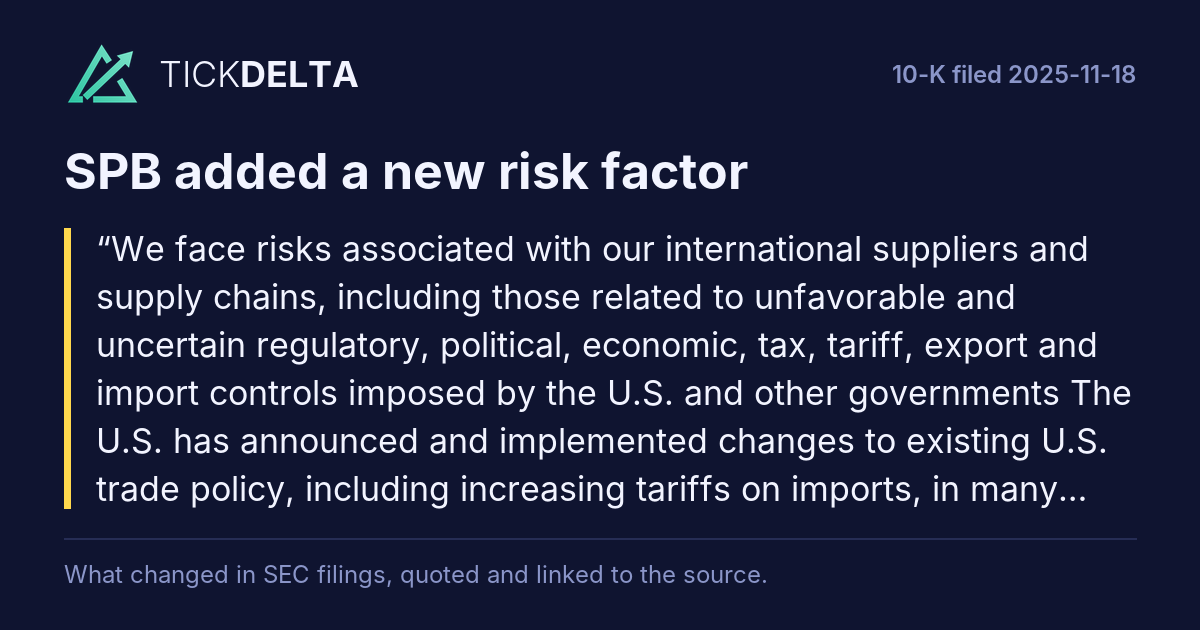
We face risks associated with our international suppliers and supply chains, including those related to unfavorable and uncertain regulatory, political, economic, tax, tariff, export and import controls imposed by the U.S. and other governments
The U.S. has announced and implemented changes to existing U.S. trade policy, including increasing tariffs on imports, in many cases significantly, and potentially renegotiating or terminating existing trade agreements. The exact scope of any such tariffs or changes to existing trade agreements, that will ultimately be implemented is not known at this time, and the impacts on our business and costs of our products is uncertain. In response, a number of countries, including several in Europe as well as China, have imposed retaliatory tariffs on a wide range of American products. Additional tariffs could be imposed by the U.S. or on the U.S.’ response to actions taken by the U.S. government.
Paragraphs in the 10-Q filed Aug 7, 2026 that were not in the one before
New in the latest 10-Q
32 paragraphs in the 10-Q filed Aug 7, 2026 with nothing like them in the 10-Q filed May 7, 2026 (at least half the words must differ; new numbers alone do not count). Quoted exactly, grouped by the item heading above them. This is text that changed, not a judgement of how serious it is.
Financial statements and notes
On May 1, 2026, the Company entered into a definitive agreement, through its indirect subsidiaries, for a strategic investment from funds affiliated with Oaktree Capital Management LP ("Oaktree") in its HPC business for $ 127.0 million in cash proceeds, before transaction costs and other fees, which effectively closed on May 11, 2026 (the "HPC Transaction"). The HPC Transaction consists of $ 67.0 million in proceeds from the issuance of convertible preferred equity ("HPC Preferred Equity") and $ 60.0 million in proceeds, less a $ 2.4 million original issuance discount, in the form of a first lien term loan on the HPC business ("HPC Term Loan"). Of the $ 67.0 million of HPC Preferred Equity, approximately $ 5.8 million was deferred until the completion of certain international regulatory approvals ("Deferred Purchase"), resulting in $ 61.2 million of HPC Preferred Equity having been issued as of the transaction close on May 11, 2026. Subsequently, all regulatory approvals were achieved and the Company closed on the Deferred Purchase on July 8, 2026. As of June 28, 2026, Oaktree held a 24.9 % equity ownership in the HPC business which has subsequently increased to approximately 27.3 % upon consummation of the Deferred Purchase. The noncontrolling equity holder holds a minority of board seats. The Company continues to consolidate the HPC business and report it as a reportable segment. The HPC Preferred Equity is recognized as Redeemable Noncontrolling Interest on the Condensed Consolidated Statement of Financial Position and is classified as mezzanine equity due to contingent redemption being outside the control of the Company. See Note 8 - Redeemable Noncontrolling Interest for further discussion. See Note 7 - Debt for further discussion on the HPC Term Loan.
Read in the 10-Q
As part of the HPC Transaction, on May 11, 2026, the Company, through its indirect subsidiaries consisting of the HPC business, entered into the Amended and Restated Credit Agreement ("HPC Credit Agreement") with Oaktree which provides for a new term loan facility with aggregate principal amount of $ 60.0 million and a maturity date of May 11, 2029, including a one-year extension option exercisable by the Company, subject to lender approval. The HPC Term Loan is subject to a rate per annum equal to SOFR (as defined in the HPC Credit Agreement), plus a margin of 5.50 % or the base rate plus a margin of 4.50 %. Upon entering into the HPC Term Loan, the net assets of the HPC business were segregated and serve as collateral for the HPC Term Loan, and have been excluded from the collateral package for the remainder of the Company's debt. The proceeds were used to pay fees and expenses in connection with the transaction and for general corporate purposes. The HPC Term Loan was issued net of a $ 2.4 million original issue discount and the Company incurred $ 4.2 million of debt issuance costs, which are being amortized with a corresponding charge to interest expense over the remaining term of the loan.
Read in the 10-Q
As part of the HPC Transaction, on May 11, 2026, the Company, through a consolidated subsidiary, issued $ 61.2 million of HPC Preferred Equity in the HPC business to a noncontrolling equity holder for cash proceeds of $ 61.2 million resulting in a 24.9 % ownership on an as-converted basis. Subsequently, on July 8, 2026, the Company issued an additional $ 5.8 million of HPC Preferred Equity following the completion of certain international regulatory approvals and increasing the noncontrolling ownership interest to 27.3 %. The noncontrolling equity holder holds a minority of board seats. The Company continues to consolidate the HPC business and report it as a reportable segment. Oaktree has certain contingent put and conversion rights associated with the HPC Preferred Equity, certain of which are outside the control of the Company. The Company considers the HPC Preferred Equity probable of becoming redeemable.
Read in the 10-Q
The Company recognized $ 56.5 million as redeemable noncontrolling interest, net related transaction costs of $ 4.6 million, upon close of the initial issuance of HPC Preferred Equity. Cumulative dividends on the HPC Preferred Equity accrete at 8.0 % per annum, compounded quarterly. Income and losses are allocated to Redeemable Noncontrolling Interest in accordance with the terms of the liquidation waterfall which represents the higher of (i) the 8.0 % dividend accretion and (ii) the allocation of comprehensive income reflective on an as-converted basis. After this allocation, if the book value of Redeemable Noncontrolling Interest is less than the redemption value, the Company will further accrete the book value of the Redeemable Noncontrolling Interest in accordance with the subsequent measurement guidance for mezzanine equity. The following is a rollforward of Redeemable Noncontrolling Interest for the three and nine month periods ended June 28, 2026.
Read in the 10-Q
(millions) Balance HPC Preferred Equity issuance, net related transaction costs of $4.6 million $56.5 Liquidation preference adjustment 5.3 Balance as of June 28, 2026 $61.8
Read in the 10-Q
Show the other 27
Due to the completion of the HPC Transaction, employees of the HPC business participating in the Company's LTIP program were rolled into a new HPC-specific long term incentive plan, resulting in both: (i) the conversion of previously issued and unvested restricted stock units into a cash-based award indexed to a fair value of equity of the HPC business; and (ii) the issuance of new, HPC specific long term incentive plan awards under similar terms and conditions as of the Company's LTIP program (collectively, the "HPC equity units").
Read in the 10-Q
HPC equity units are recognized as share based compensation and include a combination of: (i) time-based grants and (ii) performance-based grants. Compensation cost is based on the expected cash-payment based upon the assessed fair value of the HPC equity, which is periodically reassessed, and recognized on a straight-line basis over the requisite service period of the awards. Time-based units provide for either a three year cliff vesting or graded vesting depending upon vesting conditions. Performance-based units are dependent upon achieving cumulative financial metrics specific to the HPC business (Adjusted EBITDA and Business Unit Cash Flow) by the end of the three year vesting period. The Company assessed the probability of achievement of the performance conditions and recognized expense for the awards based on the probable achievement of such metrics. As the awards are cash based, they are recognized as a liability and included within Other Current Liabilities and Other Long-Term Liabilities for their current and long-term components, respectively, based upon respective vesting periods.
Read in the 10-Q
Each converted HPC equity award was based upon a defined conversion rate of the current market price of the Company stock relative to the assessed fair value of a common unit of the HPC business at the time of close for the HPC Transaction. Converted HPC equity units retain the original vesting terms of the converted LTIP award, as applicable. The conversion resulted in a modification of the previous LTIP grants, reversing previously recognized compensation previously included in the Company's consolidated APIC, converting to a liability based award and recognizing incremental share based compensation expense for HPC equity units for the three and nine month period ended June 28, 2026 based upon the relative fair value of the Company's share price. As of June 28, 2026, there are 0.5 million HPC equity units outstanding and a liability of $ 1.0 million.
Read in the 10-Q
(in millions) Foreign Currency Translation Derivative Instruments Defined Benefit Pension Total
Read in the 10-Q
Net reclassification for loss to income from continuing operations — 2.3 0.3 2.6
Read in the 10-Q
Other comprehensive income attributable to controlling interest 11.5 0.4 0.2 12.1
Read in the 10-Q
Net reclassification for loss to income from continuing operations — 3.3 0.3 3.6
Read in the 10-Q
Other comprehensive (loss) income attributable to controlling interest (12.4) 3.6 0.5 (8.3)
Read in the 10-Q
Net reclassification for loss to income from continuing operations — 2.3 0.2 2.5
Read in the 10-Q
During the three and nine month periods ended June 28, 2026, the Company recorded a net tax benefit of $ 10.4 million related to adjustments discovered as part of the ongoing IRS audit. The adjustments consist of $ 12.0 million estimated increase to the Company’s mandatory repatriation tax from the tax year ended September 30, 2018 plus applicable interest, net of $ 22.4 million of tax benefits in subsequent open tax years from additional use of foreign tax credits, against which the Company had recorded a full valuation allowance.
Read in the 10-Q
As part of the HPC Transaction, the Company was required to restructure the corporate entity organization to facilitate the transaction, and, as a result, recorded $ 19.2 million income tax expense related to gain on the movement of non-HPC assets within the group, net of applicable deductions and credits. The execution of the HPC Transaction and transfer of the Company’s partial ownership interest resulted in an estimated $ 216.2 million of capital loss, which is expected to be carried back to the fiscal year ended September 30, 2023 to offset prior capital gains. As a result, the Company recorded $ 47.1 million of tax benefits related to the loss during the three and nine month periods ended June 28, 2026. The Company also recorded $ 58.1 million income tax expense for the three and nine month periods ended June 28, 2026 to establish a deferred tax liability for the excess of the Company’s book basis in the HPC business over its tax basis due to the change in form of the HPC business that resulted from the HPC Transaction.
Read in the 10-Q
During the three and nine month periods ended June 28, 2026, the Company recorded $ 15.0 million of tax expense related to U.S. return to provision differences for the tax year ended September 30, 2025, primarily from changes in tax return elections made as a result of the anticipated income tax consequences of the HPC Transaction.
Read in the 10-Q
Tariff Matters. On February 20, 2026, the U.S. Supreme Court ruled that tariffs imposed under the International Emergency Economic Powers Act ("IEEPA") were unlawful. Following the ruling, the U.S. Court of International Trade ("CIT") issued an order directing the U.S. Customs and Border Protection ("CBP") to process refunds of the IEEPA tariffs, although the CIT immediately suspended the order while CBP developed and implemented the refund process. On April 20, 2026, the CBP launched the Consolidated Administration and Processing of Entries ("CAPE") process to permit importers to seek refunds for most unliquidated and certain recently liquidated IEEPA tariffs ("Phase 1") and deferred implementation for other submissions types including reconciliation entries, drawback entries and unresolved protests through the deployment of subsequent phases. Further, on June 2, 2026, the U.S. Department of Justice subsequently filed an appeal on the CIT's IEEPA tariff refund order contesting the CIT's authority to issue universal injunctions requiring duty refunds, whereas the CBP continues to process and fund submitted tariff refunds through the CAPE refund program. On June 29, 2026, the CBP launched further capabilities on CAPE to permit reconciliation entries where the entry is unliquidated ("Phase 2"), with subsequent phases expected in late July to cover liquidated entries which the CBP has indicated will be limited to filers with an active lawsuit.
Read in the 10-Q
The Company has paid IEEPA tariffs on certain imported products and materials of approximately $ 66.4 million since the prior year through the date in which the IEEPA tariffs were considered unlawful. During the three month period ended June 28, 2026, the Company has recognized $ 60.6 million in tariff refunds associated with Phase 1 and Phase 2 as probable of recovery based upon current status and anticipated collection in the near term, and has recognized it as a reduction in Cost of Goods Sold on the Condensed Consolidated Statements of Income during the three and nine month periods ended June 28, 2026. The Company has realized cash from such refund submissions of $ 2.7 million during the three month period ended June 28, 2026, excluding interest, with the remaining refunds of $ 57.9 million included as Other Receivables on the Condensed Consolidated Statements of Financial Position. The remaining IEEPA tariffs, excluding Phase 1 and Phase 2, were not considered probable given the current inability to submit refunds available, limitations expressed by the CBP for subsequent phases, and the uncertainty surrounding the challenges and appeals placed by the U.S. Department of Justice with the CIT. During the subsequent period, the Company has collected the substantial majority of all outstanding Phase 1 refund submissions.
Read in the 10-Q
Interest on tariff refunds are recognized when realized or realizable as they are not considered loss recovery, and reported as Other Non-Operating Income on the Condensed Consolidated Statements of Income. Interest on tariff refunds realized were $ 0.2 million during the three and nine month periods ended June 28, 2026.
Read in the 10-Q
On February 20, 2026, the U.S. Supreme Court ruled the IEEPA tariffs were unlawful. Following the ruling, the U.S. Court of International Trade ("CIT") issued an order directing the U.S. Customs and Border Protection ("CBP") to process refunds of the IEEPA tariffs, although the CIT immediately suspended the order while CBP developed and implemented the refund process. On April 20, 2026, the CBP launched the Consolidated Administration and Processing of Entries ("CAPE") process to permit importers to seek refunds for most unliquidated and certain recently liquidated IEEPA tariffs ("Phase 1") and deferred implementation for other submission types including reconciliation entries, drawback entries and unresolved protests through the deployment of subsequent phases. Further, on June 2, 2026, the U.S. Department of Justice subsequently filed an appeal on the CIT's IEEPA tariff refund order contesting the CIT's authority to issue universal injunctions requiring duty refunds, whereas the CBP continues to process and fund submitted tariff refunds through the CAPE refund program. On June 29, 2026, the CBP launched further capabilities on CAPE to permit reconciliation entries where the entry is unliquidated ("Phase 2"), with subsequent phases expected in late July to cover liquidated entries which the CBP has indicated will be limited to filers with an active lawsuit. The Company has paid IEEPA tariffs on certain imported products and materials of approximately $66.4 million since the prior year through the date in which the IEEPA tariffs were considered unlawful. During the three and nine month periods ended June 28, 2026, the Company has recognized $60.6 million in tariff refunds as a reduction in Cost of Goods Sold on the Company's Condensed Consolidated Statements of Income. See Note 15 - Commitments and Contingencies in Notes to the Condensed Consolidated Financial Statements for additional discussion. Additionally, we are evaluating other implications attributable to such actions including effects on our customers and the potential risk of price concessions which may give rise to future obligations and affect future operating results. As of June 28, 2026, the consolidated financial statements do not reflect any impacts attributable to any prospective changes or refunds.
Read in the 10-Q
The ongoing geopolitical conflicts, including the Russia-Ukraine war, the Israel-Hamas war, and the U.S.-Iran war, have contributed to meaningful macroeconomic headwinds that have affected, and may continue to affect, our business, operations, and financial results. The effects of these conflicts are multi-dimensional including, but not limited to, cost inflation, operational risk and domestic and international demand.
Read in the 10-Q
International conflicts have meaningfully elevated input cost pressures across our global operations. The continuation of conflict in Eastern Europe and the Middle East has contributed to volatility and elevated pricing in energy and commodity markets, impacting input costs for products dependent upon plastics and certain metals; along with disruptions impacting freight and logistics costs associated with rerouting of shipping lanes impacting both transit times and transportation expenses for international sourcing and distribution channels. Our supply chain mitigation efforts and pricing have partially offset these inflationary pressures, though there can be no assurance that such measures will be sufficient to address future cost escalation. The breadth of active international conflicts creates elevated risks of supply chain interruption, foreign regulatory changes, and geopolitical sanctions that could affect our ability to source materials, manufacture products, or service key markets. Although our direct exposure to conflict zones is limited, secondary and tertiary effects, including disruptions to global shipping networks, sanctions on financial counterparties, and instability in emerging market currencies, have the potential to adversely affect our operations.
Read in the 10-Q
Elevated macroeconomic uncertainty driven by geopolitical conflict has had a dampening effect on consumer confidence and discretionary spending in several key domestic and international markets, particularly in EMEA. Our HPC and GPC segments, which derive a significant portion of their revenues from international markets, have experienced periods of volume softness attributable in part to weakened household spending power and retailer inventory levels. Our GPC segment has seen more resilience given the non-discretionary nature of pet care spending, although foreign currency volatility arising from geopolitical tensions has presented headwinds to the translation of international revenues.
Read in the 10-Q
We continue to closely monitor the evolving geopolitical environment and assess our exposure and managing the relevant risks, including through active engagement with our supply chain partners, hedging arrangements, and ongoing evaluation of our geographic footprint and sourcing diversification strategies. However, given the inherently unpredictable nature of international conflict and its downstream macroeconomic consequences, there can be no assurance that future developments will not result in material adverse effects on our net sales, operating costs, profitability, or liquidity.
Read in the 10-Q
On May 1, 2026, the Company entered into a definitive agreement, through its indirect subsidiaries, for a strategic investment from funds affiliated with Oaktree Capital Management LP ("Oaktree") in its HPC business for $127.0 million in cash proceeds, before transaction costs and other fees, which effectively closed on May 11, 2026 (the "HPC Transaction"). The HPC Transaction consists of $67.0 million in proceeds from the issuance of convertible preferred equity ("HPC Preferred Equity") and $60.0 million in proceeds, less a $2.4 million original issuance discount, in the form of a first lien term loan on the HPC business ("HPC Term Loan"). Of the $67.0 million of HPC Preferred Equity, approximately $5.8 million was deferred until the completion of certain international regulatory approvals ("Deferred Purchase"), resulting in $61.2 million of HPC Preferred Equity having been issued as of the transaction close on May 11, 2026. Subsequently, all regulatory approvals were achieved and the Company closed on the Deferred Purchase on July 8, 2026. As of June 28, 2026, Oaktree held a 24.9% equity ownership in the HPC business which has subsequently increased to approximately 27.3% upon consummation of the Deferred Purchase. The noncontrolling equityholder holds a minority of seats on the board of the HPC business. The Company continues to consolidate the HPC business and report it as a reportable segment.
Read in the 10-Q
The HPC Preferred Equity is recognized as Redeemable Noncontrolling Interest on the Condensed Consolidated Statement of Financial Position and is classified as mezzanine equity. Cumulative dividends on the HPC Preferred Equity accrete at 8.0% per annum and compound quarterly. The Company recognizes an adjustment to Redeemable Noncontrolling Interest for the liquidation preference on the HPC preferred ownership consisting of the higher of (i) the 8.0% dividend accretion and (ii) the allocation of comprehensive income reflective on an as-converted basis; which is recognized as Net Income Attributable to Redeemable Noncontrolling Interest on the Condensed Consolidated Statements of Income. See Note 8 - Redeemable Noncontrolling Interest in the Notes to the Condensed Consolidated Financial Statements for further detail.
Read in the 10-Q
The HPC Term Loan has an aggregate principal amount of $60.0 million and a maturity date of May 11, 2029, including a one-year extension option exercisable by the Company, subject to lender approval, and is subject to a rate per annum equal to SOFR (as defined in the HPC Credit Agreement), plus a margin of 5.50% or the base rate plus a margin of 4.50%. See Note 7 - Debt in the Notes to the Condensed Consolidated Financial Statements for further detail.
Read in the 10-Q
Additionally, during the three month period ended June 28, 2026, the Company and its HPC segment realized a triggering event in relation to the implied enterprise value of the HPC business associated with the noncontrolling interest recognized as part of the HPC Transaction, impacting market related inputs and assumptions used in assessing the value for certain indefinite lived intangible assets held by the HPC business unit. As a result, the Company recognized an impairment charge of $104.0 million for the three and nine month periods ended June 28, 2026. See Note 6 - Goodwill and Intangible Assets in the Notes to the Condensed Consolidated Financial Statements for further detail.
Read in the 10-Q
Due to the completion of the HPC Transaction, employees of the HPC business participating in the Company's LTIP program were transferred into a new HPC-specific long term incentive plan that are cash-based liability awards indexed to the fair value of equity of the HPC business which may impact the level of share based compensation expense realized by the Company. See Note 12- Share-Based Compensation in the Notes to the Condensed Consolidated Financial Statements for further detail.
Read in the 10-Q
Net Income Attributable to Redeemable Noncontrolling Interest. Net income attributable to redeemable noncontrolling interest reflects the accretion of earnings and liquidation preference attributable to the noncontrolling interest in the HPC business that was realized during the three month period ended June 28, 2026. See Note 8 - Redeemable Noncontrolling Interest in the Notes to the Condensed Consolidated Financial Statements for further detail.
Read in the 10-Q
Controls and procedures
Changes in Internal Control Over Financial Reporting. The Company is undergoing a multi-year implementation of a new global enterprise resource planning (“ERP”) system. During the three month period ended June 28, 2026 the Company implemented the new ERP system within its GPC international businesses. As a result of this implementation, certain existing internal controls were modified to align with the processes and functionality of the new ERP system.
Read in the 10-Q
The 10-Q's risk factors against the 10-K
Item 1A of the 10-Q filed Aug 7, 2026 against Item 1A of the 10-K filed Nov 18, 2025.
A 10-Q repeats only the risks that changed, so a 10-K paragraph that is missing from it is not counted as removed.
Added is a paragraph with nothing like it in the 10-K, Reworded a sentence that is in both with several words changed,
Quiet changes a sentence in both where one to four words changed and one is a hedge or a modal
(cut words struck through, new words highlighted).
Text on the page, not a score; each links to the filing at sec.gov.
What the 10-Q itself says about its risk factors:Information about our risk factors is contained in Item 1A of our 2025 Annual Report. There have been no material changes from the risk factors discussed in our 2025 Annual Report.
Read in the 10-Q
1 paragraph in the 10-Q's Item 1A, and none of them adds, rewords or quietly edits a paragraph of the 10-K's.
Phrases used for the first time
Two-word phrases in Risk Factors of the 10-K filed Nov 18, 2025 that are in none of the 1 earlier 10-Ks stored, back to Nov 15, 2024
Where each one is used
- existing trade: The U.S. has announced and implemented changes to existing U.S. trade policy, including increasing tariffs on imports, in many cases significantly, and potentially renegotiating or terminating existing trade agreements. The exact scope of any such tariffs or changes to existing trade agreements, that will...
Used at least twice, small words left out. Counted, not picked: a phrase can be new because the company renamed something.
What was taken out
8 paragraphs of last year's Risk Factors with nothing like them now. The longest are quoted.
Sources
Item 1A of each 10-K and 10-Q on EDGAR, quoted exactly. Each paragraph links to the filing at sec.gov.
Also
10-K change: what was reworded or cut, section by section.
Work with it
Excel workbook · CSV. Google Sheet that stays up to date: paste =IMPORTDATA("https://tickdelta.com/company/SPB/export.csv") into a cell.