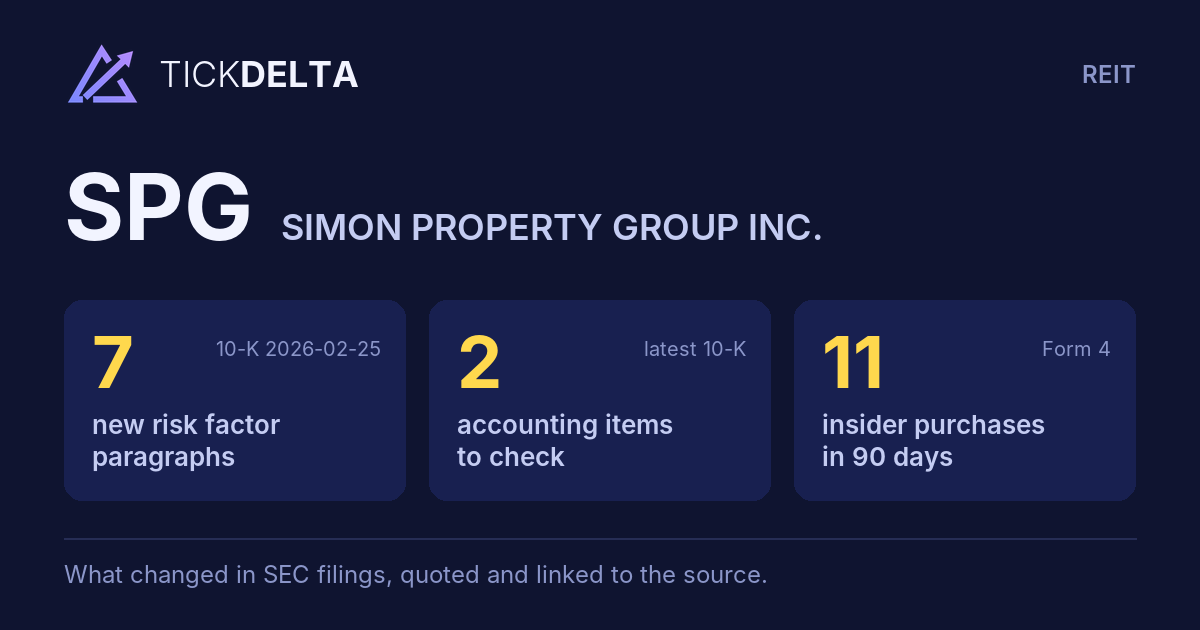
Marked against last year's 10-K:
cut words struck through, new words highlighted and underlined.
MD&A 242 words changed in this paragraph; it is 44% similar to last year's version.
We review investment properties for impairment on a property-by-property basis to identify and evaluate events or changes in circumstances which indicate that the carrying value of investment properties may not be recoverable. These circumstances include, but are not limited to, changes in a property’s operational performance such as declining cash flows, occupancy or total reported sales per square foot, the Company’s intent and ability to hold the related asset, and, if applicable, the remaining time to maturity of underlying financing arrangements. We measure any impairment of investment property when the estimated undiscounted operating income before depreciation and amortization during the anticipated holding period plus its residual value is less than the carrying value of the property. To the extent impairment has occurred, we charge to income the excess of carrying value of the property over our estimate of its fair value. We also review our investments, including investments in unconsolidated entities, to identify and evaluate whether events or changes in circumstances indicate that the carrying amount of our investments may not be recoverable. We will record an impairment charge if we determine the fair value of the investments are less than their carrying value and such impairment is other-than-temporary. Our evaluation of changes in economic or operating conditions and whether an impairment is other-than-temporary may include developing estimates of fair value, forecasted cash flows or operating income before depreciation and amortization. We estimate undiscounted cash flows and fair value, if applicable, using observable and unobservable data such as operating income, hold periods, estimated capitalization rates, or relevant market multiples, leasing prospects and local market information and whether certain impairments are other-than-temporary. Changes in economic and operating conditions, including changes in the financial condition of our tenants, and changes to our intent and ability to hold the related asset, that occur subsequent to our review of recoverability of investment property and other investments could impact the assumptions used in that assessment and could result in future charges to earnings if assumptions regarding those investments differ from actual results.
Source: Item 7, 10-K 0001104659-26-019419 vs Item 7, 10-K 0001558370-25-001271
Risk Factors 227 words changed in this paragraph; it is 59% similar to last year's version.
There are risks associated with artificial intelligence (“AI"), any or all of which could adversely affect our business. Issues in the development and use of AI, combined with an uncertain regulatory environment, may result in reputational harm, liability, or other adverse consequences to our business operations. We have adopted certain generative AI tools into our systems for specific use cases reviewed by legal and information security. Where a generative AI or machine learning model ingests our proprietary information and makes connections using such data, those technologies may reveal other sensitive, proprietary, or confidential information generated by the model. Additionally, our vendors may incorporate generative AI tools into their services and deliverables without disclosing this use to us, and the providers of these generative AI tools may not meet existing or rapidly evolving regulatory or industry standards with respect to privacy and data protection and may inhibit our or our vendors’ ability to maintain an adequate level of service and experience or confidentiality. Sensitive, proprietary, or confidential information of the Company, our tenants and employees, could be used in a generative AI or machine learning application and we may be unable to control, safeguard, or prevent the use or misuse of such information Moreover, generative AI or machine learning models may create incomplete, inaccurate, or otherwise flawed outputs, some of which may be difficult to detect. Because of these issues, these models could lead us to make flawed decisions that could result in adverse consequences to us, including exposure to reputational and competitive harm, customer loss, and legal liability. Further, bad actors around the world use increasingly sophisticated methods, including the use of AI, to engage in illegal activities involving the theft and misuse of personal information, confidential information, and intellectual property. In addition, uncertainty in the legal regulatory regime relating to AI, including as a result of inconsistent interpretation or application, may require significant resources to modify and maintain business practices to comply with applicable law, the nature of which cannot be determined at this time. Laws or regulations may prevent or limit our ability to use AI in our business, lead to regulatory fines or penalties, or require us to change our business practices. If we cannot use AI, or if our use is restricted, our business may be less efficient, or we may be at a
Source: Item 1A, 10-K 0001104659-26-019419 vs Item 1A, 10-K 0001558370-25-001271
Accounting Policies 126 words changed in this paragraph; it is 67% similar to last year's version.
We structure our leases to allow us to recover a significant portion of our property operating, real estate taxes, repairs and maintenance, and advertising and promotion expenses from our tenants. A substantial portion of our leases, other than those for anchor stores, require the tenant to reimburse us for a substantial portion of our operating expenses, including common area maintenance, or CAM, real estate taxes and insurance. Such property operating expenses typically include utility, insurance, security, janitorial, landscaping, food court and other administrative expenses. This significantly reduces our exposure to increases in costs and operating expenses resulting from inflation or otherwise. For substantially all of our leases in the U.S. mall portfolio, we receive a fixed payment from the tenant for the CAM component which is recognized as lease income on a straight-line basis over the term of the lease beginning with the adoption of ASC 842. When not reimbursed by the fixed CAM component, CAM expense reimbursements are based on the tenant’s proportionate share of the allocable operating expenses and CAM capital expenditures for the property. We accrue all variable reimbursements from tenants for recoverable portions of all of these expenses as variable lease consideration in the period the applicable expenditures are incurred. We recognize differences between estimated recoveries and the final billed amounts in the subsequent year. These differences were not material in any period presented. Our advertising and promotional costs are expensed as incurred. Provisions for credit losses that are not probable of collection are recognized as a reduction of lease income.
Source: Item 8, Note 3 – Summary of Significant Accounting Policies, 10-K 0001104659-26-019419 vs Item 8, Note 3 – Summary of Significant Accounting Policies, 10-K 0001558370-25-001271
Legal Proceedings 77 words changed in this paragraph; it is 69% similar to last year's version.
We maintain insurance coverage with third-party carriers who provide a portion of the coverage for specific layers of potential losses, including commercial general liability, fire, flood, extended coverage cyber liability, property all risk and rental loss business interruption insurance on all of our wholly-owned properties and non-wholly owned properties which we are contractually required to insure in the United States as well as cyber coverage. The initial portion States. Some portions of coverage coverage, including property insurance and certain windstorm risks, not provided by third-party carriers may be insured through our wholly-owned captive insurance company, or other financial arrangements controlled by us. If required, a third-party carrier has, in turn, agreed to provide evidence of coverage for this layer of losses under the terms and conditions of the carrier’s insurance policy with us. A similar insurance policy written either through our captive insurance company or other financial arrangements controlled by us also provides initial coverage for property insurance and certain windstorm risks.
Source: Item 3, via Note 10 – Commitments and Contingencies, 10-K 0001104659-26-019419 vs Item 3, via Note 10 – Commitments and Contingencies, 10-K 0001558370-25-001271