tickdelta
Sign in

Tickdelta is free for now. Sign up and get Pro free

← Screener

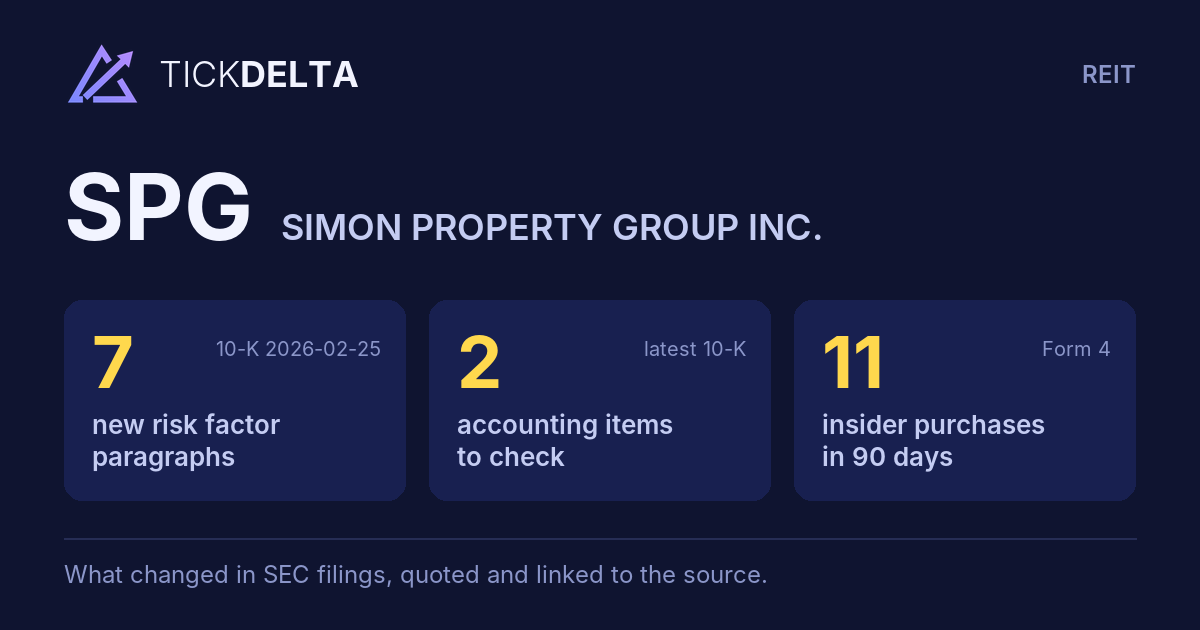
SPGSimon Property Group

Real estate · REIT · NYSE

Simon Property Group, Inc. is an Indiana corporation that operates as a self-administered and self-managed real estate investment trust, or REIT, under the Internal Revenue Code of 1986, as amended, or the Internal Revenue Code. 10-K, Item 1

Headquarters
Indianapolis, IN
CEO
David Simon
Next results
around Feb 1, 2027
Compare with peers → Embed

When the SEC's staff reviews a filing, it writes to the company with numbered questions, and the company answers each one in a letter. SEC publishes the exchange once the review is over, at least 20 business days later. Below: what the staff asked SPG, and the company's answer to each question, quoted from the letters. A question is not an accusation; most reviews end with the company adding detail to its next filing.

Form 10-K

2024-05-31 to 2024-07-19 · 1 question · 1 letter from the SEC, 1 from the company
Review closed 2024-07-19
Results discussion (MD&A)Goodwill and impairment
Management's Discussion and Analysis of Financial Condition and Results of Operations, page
SEC asked
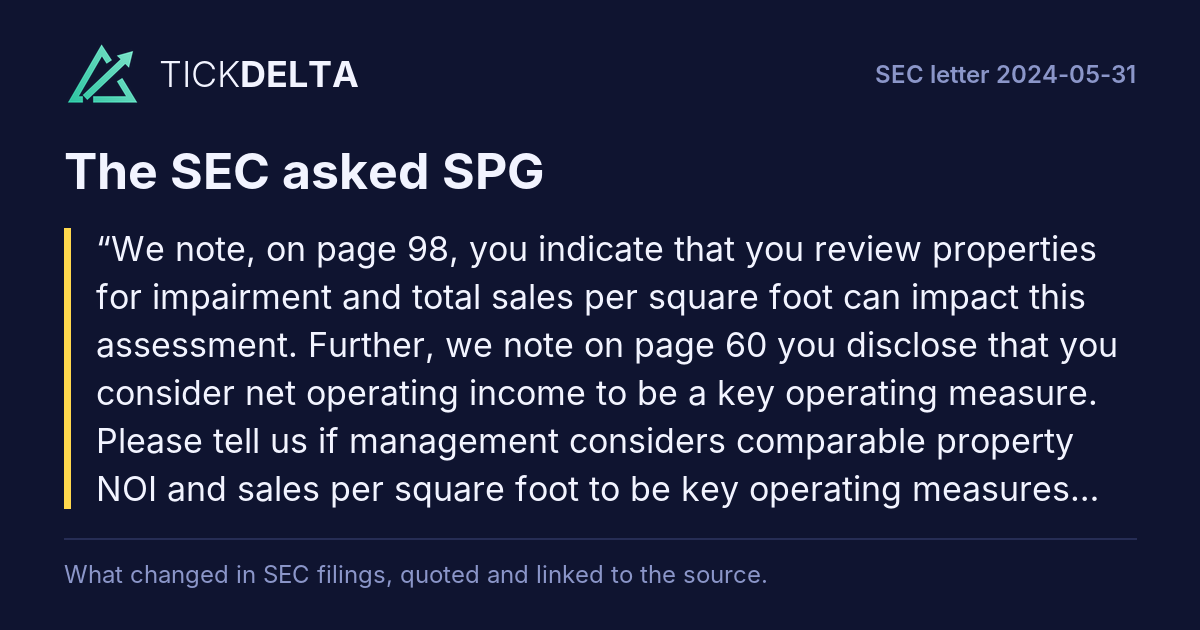
We note, on page 98, you indicate that you review properties for impairment and total sales per square foot can impact this assessment. Further, we note on page 60 you disclose that you consider net operating income to be a key operating measure. Please tell us if management considers comparable property NOI and sales per square foot to be key operating measures.
Rest of the question

If so, please include this disclosure in future Exchange Act periodic reports and tell us how you intend to present it. With respect to sales per square foot please address, as appropriate, the impact inflation has had on this metric. We remind you that the company and its management are responsible for the accuracy and adequacy of their disclosures, notwithstanding any review, comments, action or absence of action by the staff.

SPG answered
The Company respectfully acknowledges the Staff’s comment and advises the Staff that we do not consider comparable property NOI and sales per square foot to be key operating measures.

Our reference on page 98 to reported sales per square foot specifically relates to our consideration of certain factors which could constitute an impairment indicator where further evaluation may be required to determine whether the carrying value of investment property is recoverable.
Rest of the answer

Our evaluation of impairment considers assumptions including, but not limited to, forecasted cash flows, estimated capitalization rates, leasing prospects, local market information and expectations about future market and economic conditions, including sales per square foot as reported to the Company by our lessees, demand, and competition.

Although these items are assumptions in the estimation of fair value of individual properties and may give rise to potential indicators of impairment, they do not represent key operating measures for our Company.

Specifically, we have reviewed SEC Release No. 33-10751 related to the disclosure of Key Performance Indicators and Metrics in Management’s Discussion and Analysis, and determined these measures are not part of the set of key variables used by the Company to manage the Company’s business or to make strategic decisions. Further, we do not believe these measures constitute material information necessary for an understanding or evaluation of the Company’s financial condition, changes in financial condition and results of operations that would be required under Item 303(a) of Regulation

S-K.

With respect to comparable property NOI, management does not utilize or calculate this measure. The Company discontinued the calculation and reporting of this measure beginning with our Form 10-K for the year ended December 31, 2020 as further discussed on the February 8, 2021 Earnings Call. Instead, management utilizes Net

Operating Income as disclosed on page 60 as a key operating measure.

Read in the reply ↗
In its next report

First report after the company's reply of 2024-06-05: 10-Q filed 2024-08-07 ↗, against the 10-Q filed 2024-05-07 ↗.

Tickdelta does not hold the text of both reports, so they are not compared here.
Also in this review: closing letter, 2024-07-19
Form 10-K

2022-05-31 to 2022-06-21 · 3 questions · 1 letter from the SEC, 1 from the company
Review closed 2022-06-21
Non-GAAP measuresResults discussion (MD&A)Liquidity and cash
Item 7. Management's Discussion and Analysis of Financial Condition and Results of Operations · Non-GAAP Financial Measures, page 74
SEC asked (1)
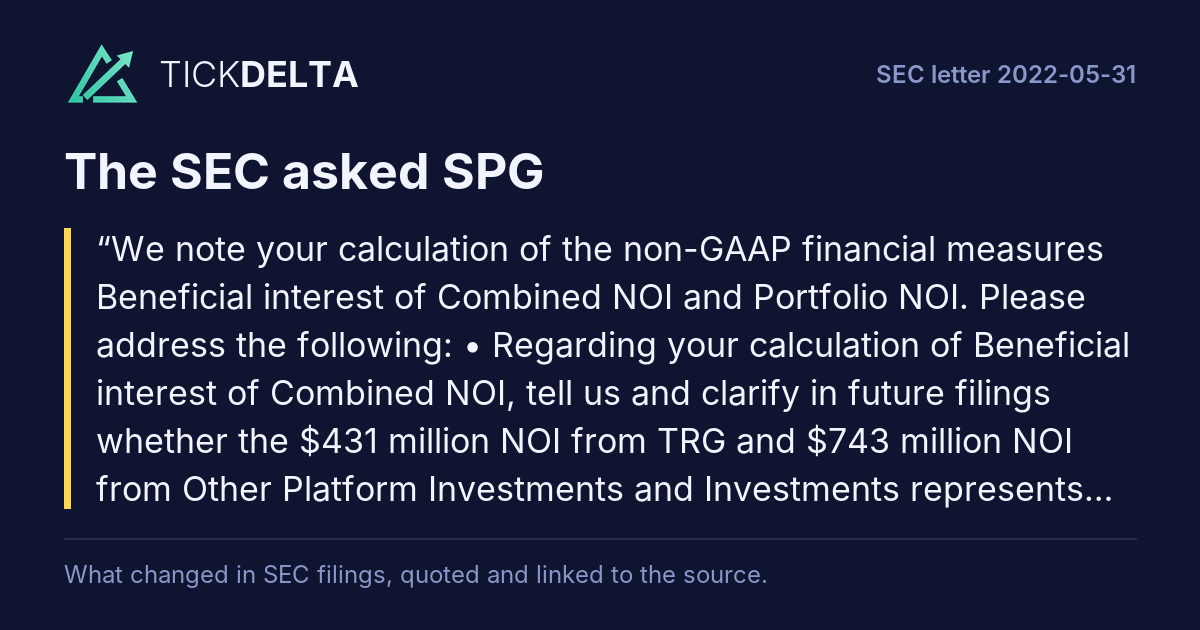
We note your calculation of the non-GAAP financial measures Beneficial interest of Combined NOI and Portfolio NOI. Please address the following: • Regarding your calculation of Beneficial interest of Combined NOI, tell us and clarify in future filings whether the $431 million NOI from TRG and $743 million NOI from Other Platform Investments and Investments represents is the entirety of such entities' NOI, or if such
Rest of the question

amounts represent your share of NOI based on your non-controlling interests in such entities, and the basis for including such amounts. Additionally clarify the unconsolidated entities included in "Other Platform Investments and Investments" line item; • Regarding Portfolio NOI, expand on the usefulness of such measure, given your indication it is used to measure the operating performance of your portfolio yet does not appear to adequately address the additions and deductions used to calculate such measure; and • Additionally, tell us why you believe the presentation of the subtotal Beneficial interest of Combined NOI provides useful information to investors given that such measure includes NOI from certain sources that almost in their entirety, appear to be subsequently deducted to calculate your measure of Portfolio NOI. In your response, tell us why you have deducted your share of NOI of Klepierre, and not that of third-party investors, in calculating Portfolio NOI.

SPG answered
The Company acknowledges the Staff’s comment and respectfully notes that within the calculation of Beneficial interest of Combined

NOI, the $431 million of NOI from TRG and the $743 million of NOI from Other Platform Investments and Investments each represent our share of NOI based upon our non-controlling interests in such entities. Further, all lines including and below “Beneficial NOI of unconsolidated entities” are presented at our share, including all amounts related to our investment in Klépierre.
Rest of the answer

We will modify the titles of these lines in future filings in order to further clarify that these amounts are presented at the Company’s share.

Beneficial interest of Combined NOI represents the Company’s share of the total NOI generated by all sources.

● The reconciliation on page 76 to net income of this Non-GAAP measure begins with beneficial NOI of consolidated entities and then

● adds our share of the beneficial NOI of unconsolidated entities that are included within the Combined Statements of Operations of our unconsolidated entities within footnote 6 on page 118 and finally

● adds the Company’s share of NOI from sources not presented within the Combined Statements of Operations of our unconsolidated entities, such as our beneficial NOI from TRG and our beneficial NOI from Other Platform Investments and Investments.

Portfolio NOI is a component of Beneficial interest of Combined NOI, and more specifically, relates to the operational performance of our global real estate portfolio. The differences between the two measures, specifically the three line items that are deducted from Beneficial interest of Combined NOI, are defined in footnotes 2 and

3 to this table on page 77 or in the case of Other Platform Investments on pages 22 and 98 (within Note 2 of the Notes to Consolidated

Financial Statements). In future filings, we will include a footnote to the table on page 76 to define unconsolidated entities included in Other Platform Investments.

We believe that a common REIT industry practice is to evaluate real estate properties, in part, based on certain performance measures, including NOI. We believe this measure is helpful to investors because it is a widely recognized measure of the performance of REITs and provides a relevant basis for comparison among REITs. We have provided different components of NOI, such as Portfolio NOI, to provide investors with disaggregated information to further differentiate our global real estate portfolio performance from corporate and other platform investments. We also use Portfolio NOI internally as a measure to evaluate the operating performance of our properties. In future filings, we will include reference to Beneficial interest of Combined NOI within the description of our non-GAAP financial measures and will expand on the usefulness of these measures to provide the additional discussion noted above.

Read in the reply ↗
In its next report

First report after the company's reply of 2022-06-10: 10-Q filed 2022-08-04 ↗, against the 10-Q filed 2022-05-09 ↗.

Tickdelta does not hold the text of both reports, so they are not compared here.

Item 8. Financial Statements · Consolidated Statements of Cash Flows, page 89
SEC asked (2)
Please tell us and disclose in future periodic filings non-cash investing and financing activities conducted during the periods presented. Refer to ASC 230-10-50-3.
SPG answered
The Company acknowledges the Staff’s comment and has reviewed ASC 230-10-50-3 with respect to non-cash investing and financing activities.

We have disclosed and will continue to disclose in future filings, as allowed under this guidance, in narrative form within the footnotes to the consolidated financial statements, material non-cash investing and financing activities.
Rest of the answer

For the periods presented, these non-cash activities have primarily included the effects of properties returned to lenders in foreclosure transactions, debt assumed and equity issued in acquisitions, exchanges of noncontrolling interests between our other platform investments, and the consolidation of a property upon the expiration of certain participating rights held by a venture partner. The substance of these transactions was disclosed in footnotes

4 and 6 to our consolidated financial statements. We will continue to provide such disclosure for all material non-cash investing and financing activities going forward, but in accordance with ASC 230-10-50-6, our narrative disclosures will more clearly refer to the statement of cash flows when quantifying the non-cash nature of the activities.

Read in the reply ↗
In its next report

First report after the company's reply of 2022-06-10: 10-Q filed 2022-08-04 ↗, against the 10-Q filed 2022-05-09 ↗.

Tickdelta does not hold the text of both reports, so they are not compared here.

Note 6. Investments in Unconsolidated Entities and International Investments · Summary Financial Information, page 115
SEC asked (3)
We note that the summary financial information of your equity method investments on pages 116-118 excludes your investments in Klepierre, TRG and other platform investments. Please tell us why you believe it is more beneficial to investors to provide a narrative description of the financial information of Klepierre and TRG when the financial information of other equity method investments has been presented in a
Rest of the question

tabular format. Also tell us why you believe the exclusion of your other platform investments from the summary financial information is compliant with Rule 4-08(g) of Regulation S-X. In closing, we remind you that the company and its management are responsible for the accuracy and adequacy of their disclosures, notwithstanding any review, comments, action or absence of action by the staff.

SPG answered
The Company acknowledges the Staff’s comment and has reviewed Rule 4-08(g) of Regulation S-X regarding the disclosure of summary financial information of investees. With respect to our investments in Klépierre and TRG, we have historically provided such required disclosures in the narrative form of each of the investments rather than in a tabular format as we felt it provided an opportunity for a more transparent illustration of the results of each of these investments.
Rest of the answer

In future filings, the Company will revise its disclosure to present such information in a tabular format, in addition to contextual information on results in the narrative form, for each of our investments in Klépierre and TRG.

In future filings, we will include aggregate summarized financial information for our other platform investments for all periods presented as required under Rule 4-08(g).

Read in the reply ↗
In its next report

First report after the company's reply of 2022-06-10: 10-Q filed 2022-08-04 ↗, against the 10-Q filed 2022-05-09 ↗.

Tickdelta does not hold the text of both reports, so they are not compared here.

Also in this review: closing letter, 2022-06-21

Form 10-K for the year ended December 31, 2020

2021-09-28 to 2021-10-25 · 2 questions · 1 letter from the SEC, 1 from the company
Review closed 2021-10-25
Non-GAAP measuresResults discussion (MD&A)AcquisitionsChina
Management's Discussion and Analysis of Financial Condition and Results of Operations · Non-GAAP Financial Measures, page 75
SEC asked (1)
We note the reconciliation of Combined NOI on page 77. Please tell us how you determined it was appropriate to present a measure that includes 100% of NOI related to your unconsolidated joint ventures. We refer you to Question 100.04 of the Division's Compliance and Disclosure Interpretations for Non-GAAP Financial Measures.
Rest of the question

This comment is also applicable to page 18 of the quarterly financial supplement filed February 8, 2021 on Form 8-K. 6. Investments in Unconsolidated Entities and International Investments

SPG answered
The Company acknowledges the Staff’s comment and has reviewed Question 100.04 of the Division’s Compliance and Disclosure

Interpretations for Non-GAAP Financial Measures. In future filings, the Company will revise its disclosure of NOI to exclude the combination of 100% of NOI related to its unconsolidated joint ventures with its consolidated properties. Read in the reply ↗
In its next report

First report after the company's reply of 2021-10-12: 10-Q filed 2021-11-03 ↗, against the 10-Q filed 2021-08-04 ↗.

Tickdelta does not hold the text of both reports, so they are not compared here.

Unconsolidated Entity Transactions, page 113
SEC asked (2)
We note that on December 29, 2020 you completed the acquisition of an 80% noncontrolling ownership interest in TRG and that you are accounting for such acquisition using the equity method of accounting. In order to better understand the Company's accounting for this transaction please further tell us the following: • How the Company considered the variable interest guidance in ASC 810-10-15-14 and whether the
Rest of the question

acquisition resulted in an acquired VIE; and • If the acquisition did not result in the acquisition of a VIE, how the Company considered the guidance under ASC 810-10-15-8, ASC 810-10-15-8A and ASC 81010-15-10a such that it resulted in the Company owning 80% of the TRG group but not consolidating the TRG group

SPG answered
The Company respectfully advises the Staff that it evaluated the acquisition of an 80% noncontrolling ownership interest in Taubman Realty

Group, LLC (“TRG”), which it completed on December 29, 2020, under the referenced guidance in ASC 810, Consolidation

(“ASC 810”) (both the variable interest model (“VIE”) and the voting interest (“VOE”) model) and

ASC 323, Equity Method and Joint Ventures (“ASC 323”) and determined the equity method of accounting was appropriate for our investment.

The analysis below presents a summary of the relevant facts including the governance structure of TRG and
Rest of the answer

our evaluation of the VIE and VOE models.

1. Background and Summary of Conclusions

TRG is governed by a Board of Directors (the “Board”) comprised of six members: three nominated by SPG and three nominated by the Taubman Family Group (“Titanium”), which holds the remaining 20% interest in TRG. In accordance with the terms of the Joint Venture Operating Agreement of The Taubman Realty Group LLC (the “Operating Agreement”), each Board member is entitled to one vote and major decisions of the Board require unanimous approval.

The Company evaluated the criteria in ASC 810 to determine whether the investee, TRG, is a VIE and concluded that TRG is not a VIE; the Company then evaluated TRG under the VOE model and concluded that the Company does not consolidate TRG.

In connection with its analyses, the Company identified and evaluated the activities that most significantly impact the economic performance of TRG, each of which constitutes a major decision requiring unanimous approval of all Board members under the Operating Agreement. These activities that most significantly impact the economic performance of TRG are as follows:

· approval of the annual budget;

· approval of capital expenditures that exceed corresponding amounts set forth in the annual budget by $10 million or more;

· sale, acquisition and purchase of any assets, land or property that exceed $10 million in aggregate;

· entering into any financing activities that exceed $10 million in aggregate; and

· entering into any material lease contract (as defined in the Operating Agreement).

As the activities that most significantly impact the economic performance of TRG require unanimous approval of all Board members, the Company concluded that power is shared by SPG and Titanium and that SPG does not control, and therefore does not consolidate, TRG.

2. Variable Interest Entity Model Considerations

The Company determined that TRG is within the scope of the

VIE model set forth in ASC 810 and that the Company’s equity investment therein represents a variable interest. The Company then analyzed the accounting for its investment considering the variable interest guidance in ASC 810-10-15-14 and, specifically, whether TRG represents a VIE.

Under this guidance, an entity is a VIE if:

a) The total equity investment at risk is not sufficient to permit the legal entity to finance its activities without additional subordinated financial support provided by any parties, including equity holders. (Remaining criteria in 14a excluded for brevity.)

The

Company’s $3.1 billion contribution in exchange for 80% equity interest in TRG is considered equity at risk as the 80% equity interest participates in both profits and losses of TRG. TRG has approximately $4.0 billion of equity at risk in total (including that of Titanium).

As of the assessment date, TRG was generating positive cash flow and had been profitable for the past several years. In addition,

TRG is financed with third-party debt and Series A Preferred Units that are consistent with the capital structures of similar entities and which provide no additional governance rights. These instruments carry market terms and TRG does not require additional subordinated financial support from its equity holders or a third party. Accordingly, the Company concluded that TRG is well capitalized and its current equity at risk of $4.0 billion is sufficient to finance its activities; therefore, TRG is not a VIE under this criterion.

b) As a group the holders of the equity investment at risk lack any one of the following three characteristics of a controlling financial interest:

1. The power, through voting rights or similar rights, to direct the activities of a legal entity that most significantly impact the entity’s economic performance.

2. The obligation to absorb the expected losses of the legal entity.

Read in the reply ↗
In its next report

First report after the company's reply of 2021-10-12: 10-Q filed 2021-11-03 ↗, against the 10-Q filed 2021-08-04 ↗.

Tickdelta does not hold the text of both reports, so they are not compared here.

Also in this review: closing letter, 2021-10-25

Form 10-K for the year ended December 31, 2015

2016-03-10 to 2016-03-24 · 1 question · 1 letter from the SEC, 1 from the company
Review closed 2016-03-24
RevenueNon-GAAP measures
Exhibit 99.1 · Pro Rata Statement of Operations, page 18
SEC asked
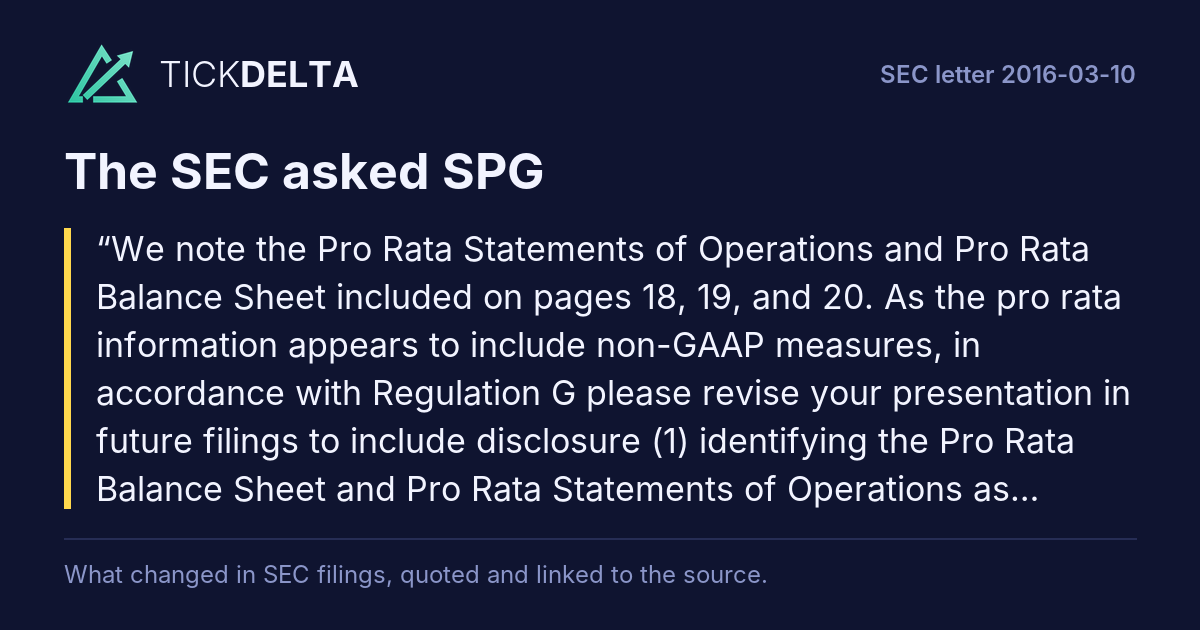
We note the Pro Rata Statements of Operations and Pro Rata Balance Sheet included on pages 18, 19, and 20. As the pro rata information appears to include non-GAAP measures, in accordance with Regulation G please revise your presentation in future filings to include disclosure (1) identifying the Pro Rata Balance Sheet and Pro Rata Statements of Operations as non-GAAP (2) an explanation of why the measure is useful
Rest of the question

to investors (and its limitations), (3) an explanation regarding the process to derive the amounts reported, (4) explicit disclosure that the company does not control the joint venture or have legal claim to the assets, liabilities, revenues or expenses of the joint venture and (5) an explanation as to the economics of the joint venture entity to which the company is entitled under the joint venture arrangements. Provide us with a draft of the disclosure you intend to include in future filings.

SPG answered
We will revise our presentation in future filings to clearly identify the Pro Rata Statements of Operations and Pro Rata Balance Sheet as non-GAAP within the headings and columns of each statement. We will also provide an introduction that will provide explanatory and cautionary language similar to the example below:

“Non-GAAP Pro-Rata Statements of Operations and Balance Sheet

The following pro-rata information is not, and is not intended to be, a presentation in accordance with GAAP.
Rest of the answer

The Pro-Rata Statements of Operations and Balance Sheet reflect our proportionate economic ownership of each asset in our portfolio that we do not wholly own. The amounts shown in the column labeled “Consolidated” reflect the amounts contained in the Company’s consolidated financial statements as filed with the SEC on the most recent Form 10-Q or 10-K, as applicable. The amounts in the column labeled “Our Share of Joint Ventures” were derived on a property-by-property basis by applying to each financial statement line item the ownership percentage interest used to arrive at our share of net income or loss during the period when applying the equity method of accounting to each of our unconsolidated joint ventures. A similar calculation was performed for the amounts in the column labeled “Noncontrolling Interests”, which represents the share of consolidated assets attributable to noncontrolling interests.

We do not control the unconsolidated joint ventures and the presentations of the assets and liabilities and revenues and expenses do not represent our legal claim to such items. The operating agreements of the unconsolidated joint ventures generally provide that partners may receive cash distributions (1) to the extent there is available cash from operations, (2) upon a capital event, such as a refinancing or sale or (3) upon liquidation of the venture. The amount of cash each partner receives is based upon specific provisions of each operating agreement and varies depending on factors including the amount of capital contributed by each partner and whether any contributions are entitled to priority distributions. Upon liquidation of the joint venture and after all liabilities, priority distributions and initial equity contributions have been repaid, the partners generally would be entitled to any residual cash remaining based on their respective legal ownership percentages.

We provide pro rata statement of operations and balance sheet information because we believe it assists investors and analysts in estimating our economic interest in our unconsolidated joint ventures when read in conjunction with the Company’s reported results under GAAP. The presentation of pro rata financial statements has limitations as an analytical tool. Some of these limitations include:

· The amounts shown on the individual line items were derived by applying our overall economic ownership interest percentage determined when applying the equity method of accounting and do not necessarily represent our legal claim to the assets and liabilities, or the revenues and expenses; and

· Other companies in our industry may calculate their pro rata interest differently than we do, limiting the usefulness as a comparative measure.

Because of these limitations, the pro rata statements of operations and balance sheet should not be considered in isolation or as a substitute for our financial statements as reported under GAAP. We compensate for these limitations by relying primarily on our GAAP results and using the pro rata statements of operations and balance sheet only supplementally.”

As you requested in your letter, the undersigned, on behalf of Simon Property Group, Inc., acknowledges that:

· the company is responsible for the adequacy and accuracy of the disclosure in the filing;

· Staff comments or changes to disclosure in response to Staff comments do not foreclose the Commission from taking any action with respect to the filing; and

· the company may not assert Staff comments as a defense in any proceeding initiated by the Commission or any person under the federal securities laws of the United States.

If I can be of assistance in answering any additional questions in connection with this response, please call me at (317) 263-7902 or, in my absence, James M. Barkley at (317) 263-7083.

Read in the reply ↗
In its next report

First report after the company's reply of 2016-03-18: 10-Q filed 2016-05-05 ↗, against the 10-Q filed 2015-11-04 ↗.

Tickdelta does not hold the text of both reports, so they are not compared here.

Also in this review: closing letter, 2016-03-24

From the SEC's correspondence on EDGAR: staff letters (form UPLOAD) and company letters (form CORRESP), 12 letters filed since 2016-03-10. Questions and answers are matched by their numbers; topics come from words in each question. The reports are compared word for word (same form, before the first SEC letter against the first report after the company's reply). No AI.

Work on SPG in a spreadsheet: Excel workbook (a sheet per section, ten years by column, charts, links to the filings) · CSV. For a Google Sheet that stays up to date, paste =IMPORTDATA("https://tickdelta.com/company/SPG/export.csv") into a cell.